
Opening
Ce Zang
Good evening, friends. I'm Ce Zang, tonight's host. Welcome to the Huxi Commune "Cloud Dinner." This is the forty-sixth session of our interdisciplinary series "Paths and Possibilities of Contemporary Imaging," and tonight's topic is "Beyond Documentary" and "Above the Document." We are honored to have three guests. First, a longtime friend whom many of you know and tonight's main speaker: photography critic, photographer, and curator Rong Jiang.
We have also invited Guosen Chen, a doctoral student in the Department of Art Philosophy at the School of Philosophy, Fudan University. He is young, but he has already joined several of our discussions, including the one on Stephen Shore, so many of you will know him. Our third guest, also familiar to many of you, is the image artist Dan Luo.
Tonight's discussion revolves around two books. One is Beyond Documentary, written by Rong Jiang and recently published by Zhejiang Photographic Press. The other is Above the Document, published in 2019, six years ago, which had a great deal of influence at the time. The two books point to two concepts: "beyond documentary" and "above the document." When Rong Jiang and I talked about this in Lishui, we both felt it made an excellent theme.
Rong Jiang traces the many ways Western photography moved beyond documentary after social documentary photography, including conceptual approaches, postmodern approaches such as staging and collage, and approaches that still work through the document. "Above the document" is also a way of moving beyond documentary, but how is it different? It uses the document to transcend the document's own nature; in other words, it uses documentary to transcend documentary. The two concepts overlap but are not the same, and where they differ touches on some very important questions in photography.
The Chinese photography world has been discussing the concept of documentary photography for many years, but not many people are especially clear about it. Reading only textbook definitions and histories tends to leave the picture fragmented. It needs to be placed within art history, photographic history, and all kinds of practice, both international and domestic, before people can see it clearly. Our understanding of documentary photography should also be freer and more open, rather than clinging to judgments like "this is how it has to be done" or "candid shots are documentary and staged shots are not." As far as I know, these issues have confused many people for a long time.
Tonight Rong Jiang brings us his new book, and we will also revisit Above the Document from 2019. Dan Luo is one of the key artists featured in Above the Document, and he remained an important artist in another book I later edited, A Room with a View. Tonight he will speak from his own practice about his ideas, work, and thinking. Guosen Chen will share the development of documentary photography in Britain, with its distinctive path and characteristics.
I will also talk about some problems the Chinese photography world faces today. For example, many people say, "I want to switch to the contemporary," so they learn the New Topographics approach, or the deadpan approach of the Düsseldorf School, and make very cool-looking pictures. But after shooting for a while they become confused and ask me: "When I used to shoot traditional documentary, everything ended up looking the same, all black-and-white, all heavy with suffering, all decisive moments. Now things are converging again, and I'm stuck in a new formula. What should I do?" Many friends have asked me this; it is a question people who want to turn toward the contemporary care about a great deal.
I will offer my views based on my own theoretical thinking and years of working alongside image artists. Dan Luo, a practitioner, is here tonight, and I think this problem can be solved, although it is difficult and not as easy as people imagine. You don't become contemporary just by shooting something that looks contemporary. Putting a contemporary vest on traditional ideas won't make them contemporary either. Tonight's discussion may be fairly deep and wide-ranging, but it is mainly aimed at concrete problems the Chinese photography world faces in its development.
As usual, we will divide the discussion into several parts, followed by open discussion. First, I'd like to invite Rong Jiang to share the first part.
From Documentary Photography to Contemporary Photography
Rong Jiang
Hello, everyone, and thank you, Ce Zang, for the introduction. To talk about modern and contemporary photography, we have to begin with art history and see how art entered the contemporary. Looking back at the origins of contemporary art worldwide, we must go back to the emergence of Conceptual Art in the 1960s. Before that, Abstract Expressionism could be called the peak of modernism.
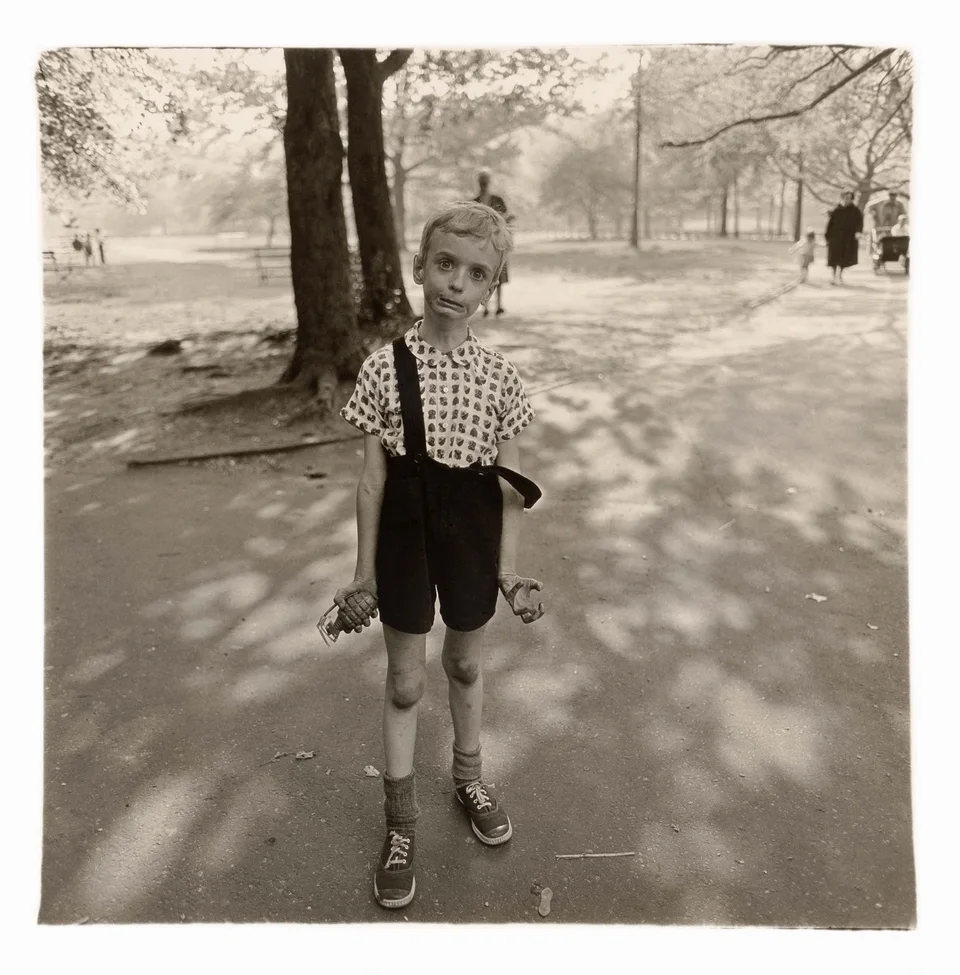
Photographic art also took off in the 1960s. A landmark exhibition was "New Documents," held at the Museum of Modern Art (MoMA) in New York in 1967. It showed the work of three American photographers: Diane Arbus, Garry Winogrand, and Lee Friedlander. Why "New Documents"? What was new? According to the curator John Szarkowski, they used photography as a tool for understanding the external world, presenting their feelings about the world around them through a personal, that is, subjective, photographic language.
Most importantly, traditional social documentary photography mainly addressed a particular social problem. Lewis Hine, for instance, made documentary projects specifically about child labor, hoping to change and solve social problems. For Arbus, Winogrand, and Friedlander, the purpose of photography was to know life, not to reform it; not to persuade, but to understand. Through photography they wanted to understand society and also themselves.
Everyone knows this Arbus picture. With a Rolleiflex medium-format camera, she photographed a little boy holding a hand grenade in Central Park in New York. To us, this figure may appear to be in an abnormal state, but in Arbus's view, that is really our prejudice about such people. She largely photographed people on the margins of society.
Winogrand mainly took America and Americans as his subject, and you can see that he placed his own shadow in the image. This photograph invites many interpretations, for example about America's long-standing race relations. What is the relationship between the Black man and the white woman? We can speculate in different ways. In fact, both were zookeepers moving two animals to another place.
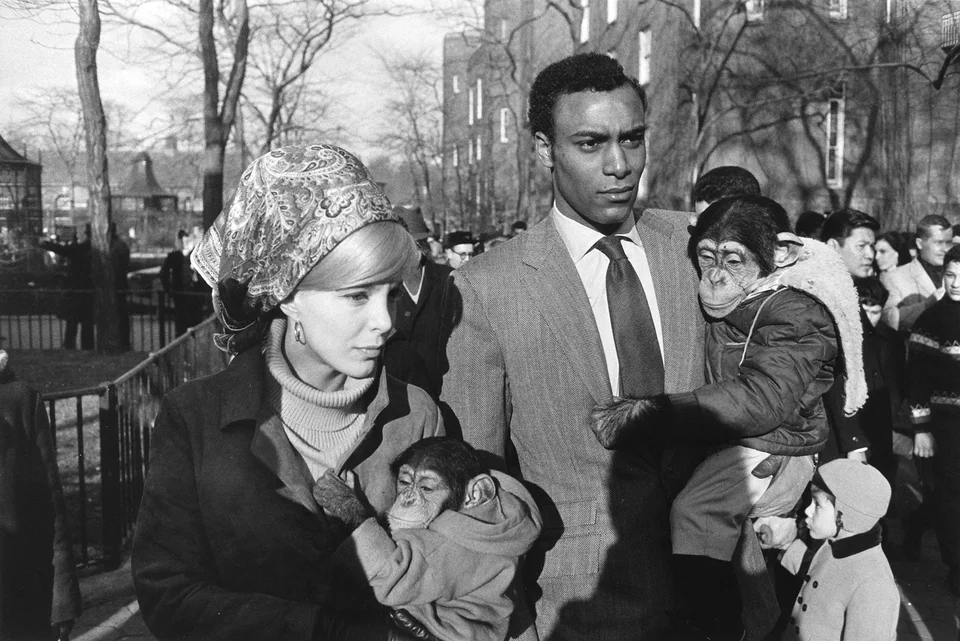
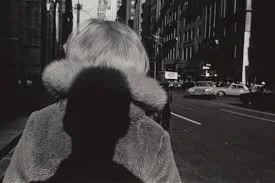
Without knowing the background, it's hard to know what the image is really saying. This photograph really can't be understood at a glance; you need to know the story behind it. Likewise, Friedlander projected his own shadow onto his subjects, showing that the photographer was not only shooting social problems but also putting his own subjectivity into the image.
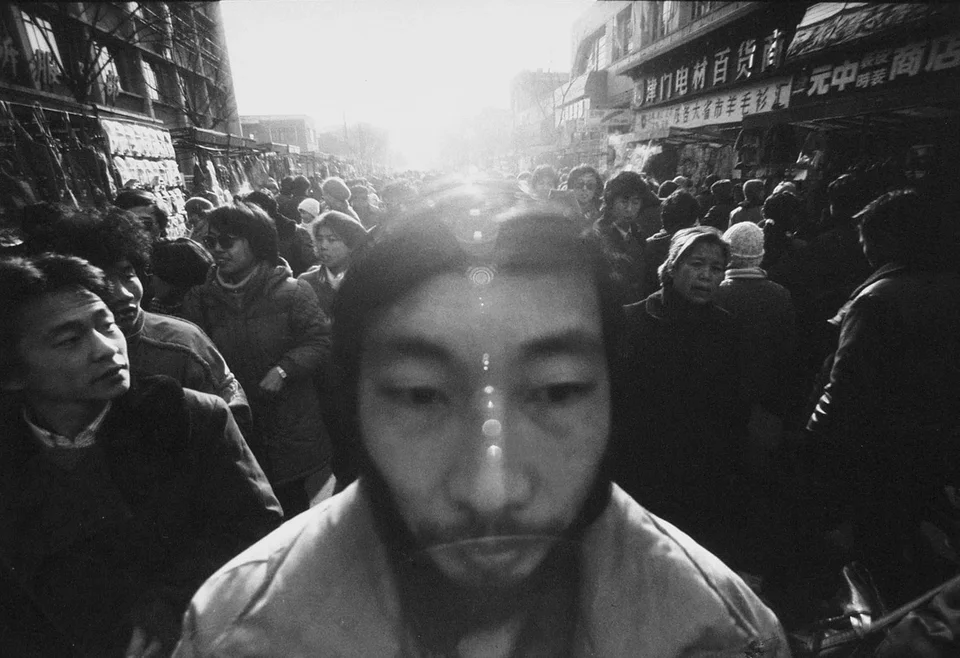
These were the experiments of American photographers in the 1960s. After the Reform and Opening Up, in the 1980s, Chinese photographers were making similar explorations. Yi Mo made a series called Expressions of the Street, in which the photographer himself stands at the center of the frame. He placed himself inside the picture while we can also see the expressions of the people around him, which differs from traditional documentary photography. He brought subjectivity into view, and this was one point of entry for Chinese photographers trying to move beyond traditional documentary.
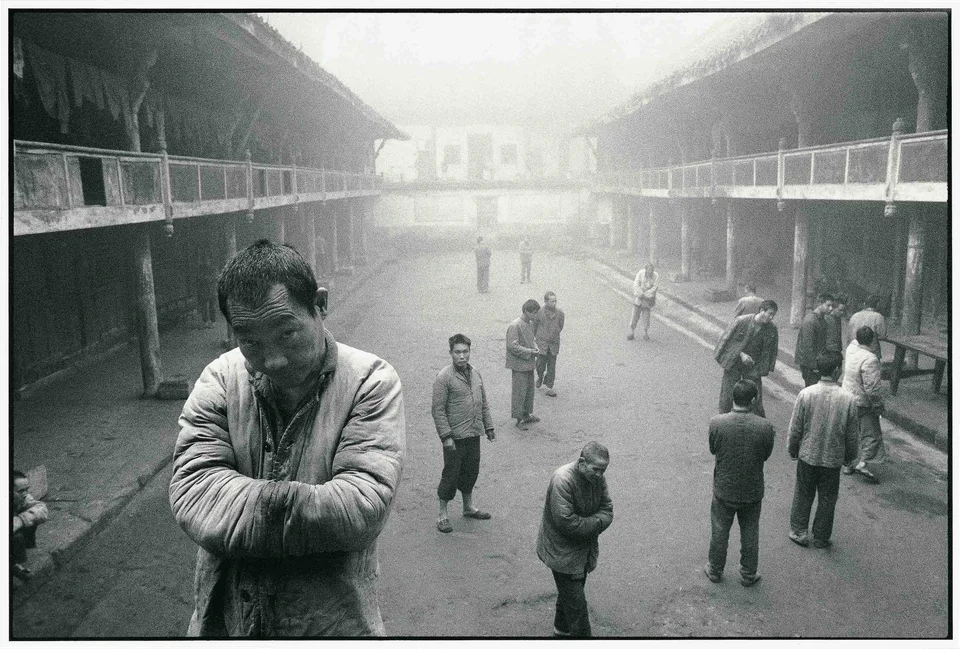
At almost the same time, in 1989, Lü Nan began photographing patients in psychiatric hospitals across China. But notice his title: The Forgotten People, not "the forgotten patients." Lü Nan said that when he made this work, he treated and photographed them as people. As a result, the work focuses more on this question: as human beings, how should we regard everyone in society, including those considered patients? The height and angle from which he stands are therefore different from documentary photography that simply shoots a social problem.
Moving on to the 1970s, there was a very important exhibition called "New Topographics: Photographs of a Man-Altered Landscape," held at the George Eastman House International Museum of Photography in upstate New York. Ten photographers turned their cameras on man-made structures within the natural environment of the American West, adopting a detached, relatively objective method, almost like a geological surveyor mapping terrain, and thereby forming a "style without style." This was completely different from how Ansel Adams photographed the beauty of nature. They neither condemned nor beautified.
What was the objective reality at the time? In the 1970s, many man-made structures were going up in American suburbs, and these buildings were encroaching on nature. The photographers considered how to represent these buildings objectively without putting their personal judgment directly into the work, letting viewers form their own judgments and ideas through looking. Critics later called this type "New Topographics photography."
One of the main figures was Robert Adams, who photographed The New West. At first glance, this picture is very plain; it seems undramatic and not particularly beautiful. But look closely and it has a sense of form, including the relationship between the building and its reflection, the relationship between the building and the distant mountains, the direction of the mountain range, and the square composition of the 6×6 format, which itself has a formal quality.
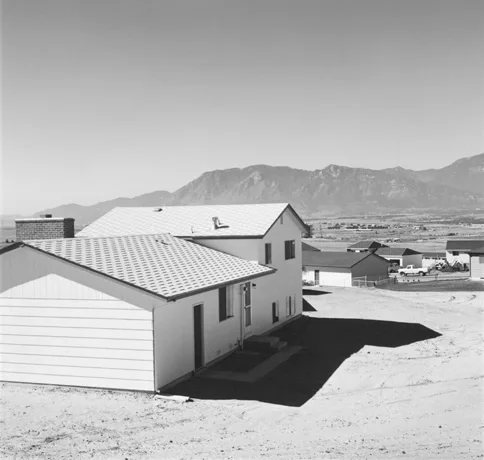
Robert Adams also preserved the highlights in his photographs, the light of the blazing noon sun. It implies redemption and hope. So in his work there is always a tension between beauty and ugliness, disappointment and hope.
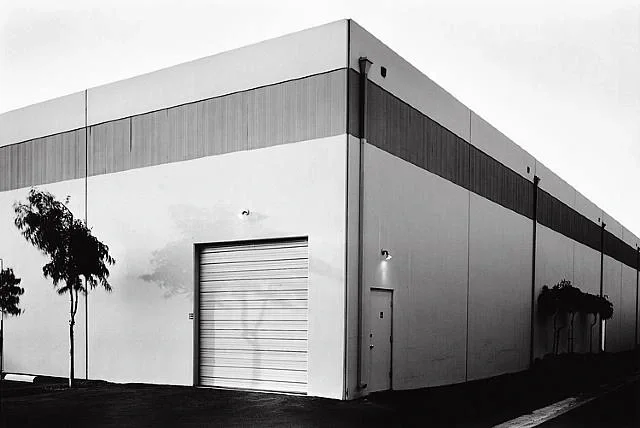
Another New Topographics photographer, Lewis Baltz, mainly photographed new industrial parks in California. At first glance, isn't this just an ordinary factory building? In fact, it isn't that simple. The angle he stood at and the camera position are crucial; that position determines the form of the building and how two-dimensional space produces the illusion of three dimensions. A seemingly very simple work already contains such an image structure inside it, and we have to learn to read it.
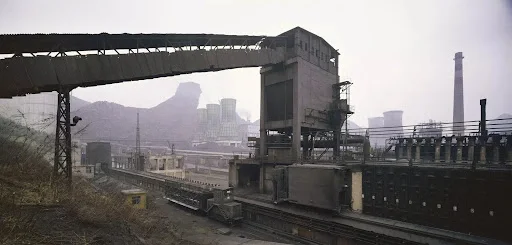
Chinese photographers have also made such attempts. Li Zeng originally worked in stage design, often collaborating with Yimou Zhang and others. In the 1980s he also began systematically documenting Chinese architecture, including abandoned state-owned factory buildings. His systematic photographing of factories reminds us of Bernd and Hilla Becher, associated with New Topographics. They photographed water towers and the industrial architecture of the Western post-industrial era, rendering buildings like sculptures and presenting them typologically. Because Li Zeng photographed abandoned factories systematically, his work became not only an image archive but also contemporary in its own right.
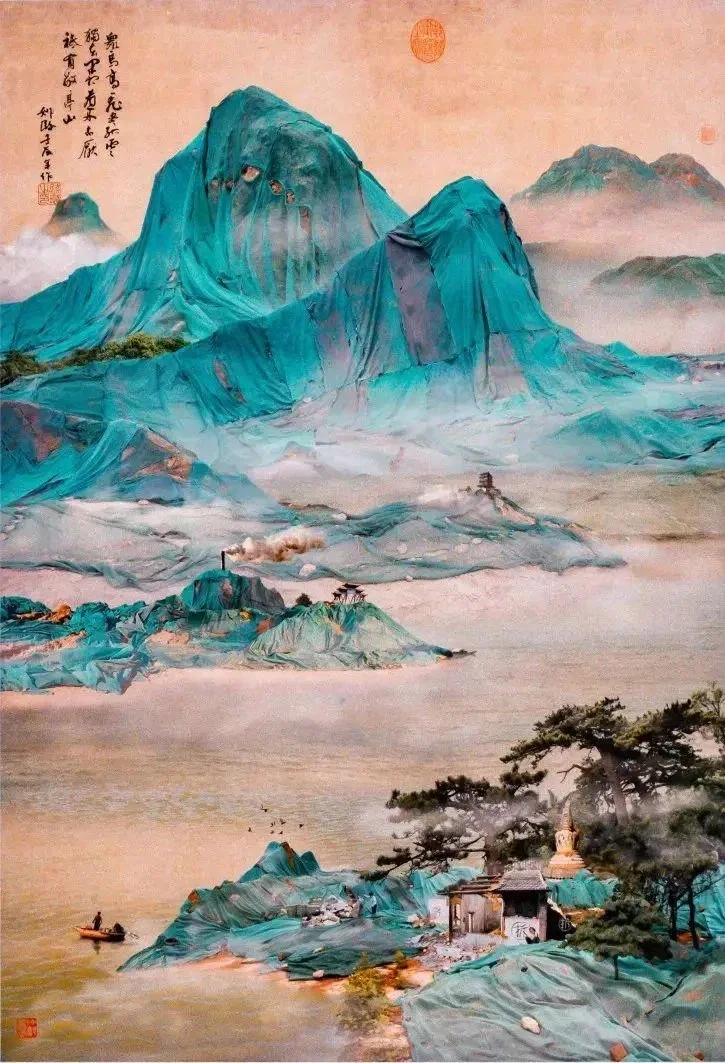
In the 1990s and 2000s, Lu Yao noticed the mounds of earth at construction sites across China, covered with green nets to keep dust down. He photographed them with a digital camera, then used Photoshop to collage them into the style of traditional Chinese blue-and-green landscape painting. At first glance it looks like a landscape painting; look again and you find many man-made traces, including power plants, so the work opens the possibility of a second look. In 2008, Lu Yao's New Landscapes won the BMW Prize at Paris Photo.
Early this year, Zheng Liu released three photobooks under the collective title Yanyun: Lost Mountains and Rivers. Over roughly the past ten years, he photographed ancient buildings and city walls in Beijing, Tianjin, northern Hebei, northern Shanxi, and elsewhere. The work shown here is also recorded from a particularly calm, objective vantage: a large-format camera on a tripod, no people in the frame. Yet precisely the absence of people reminds us that wars may have been fought here, that many people once walked here.
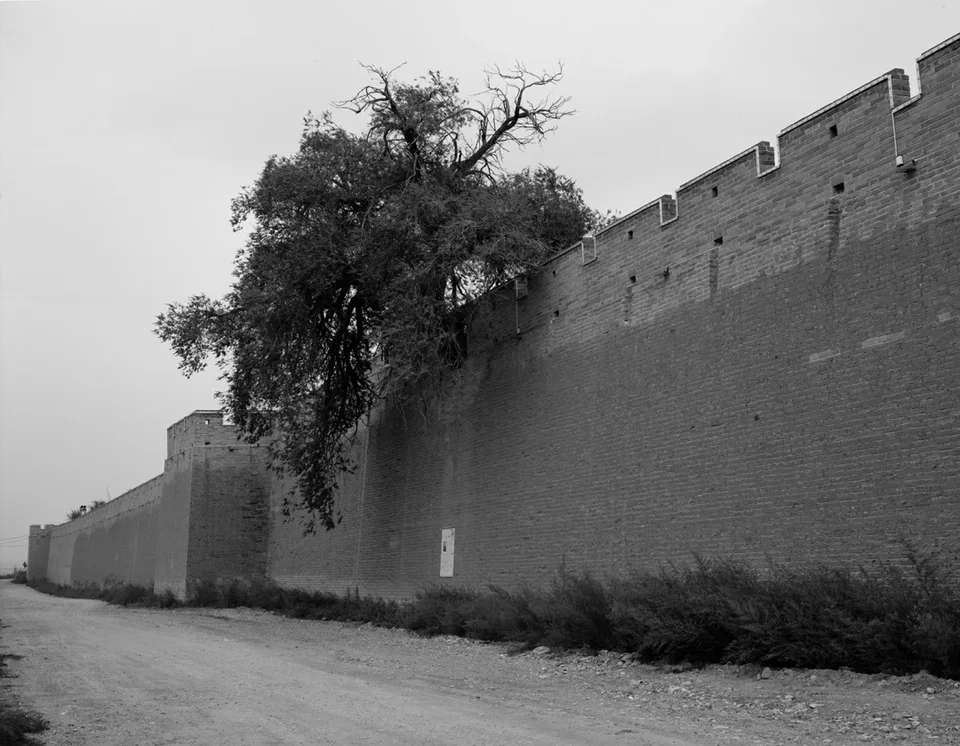
Zheng Liu calls this "new documentary photography." In a moment Ce Zang will share what "above the document" means: something that looks like a document but has already gone beyond the document. Zheng Liu's work makes us think about the relationship between history and the present.
Next, New Color Photography. In the 1970s, several American photographers independently began making work in color film. There were photographers working in color before them, but they mostly used color to reflect the beauty of nature. What was new about New Color? It did not treat color as a separate problem to solve; instead, color joined with other elements in the image, such as point, line, and plane, to form an organic whole.
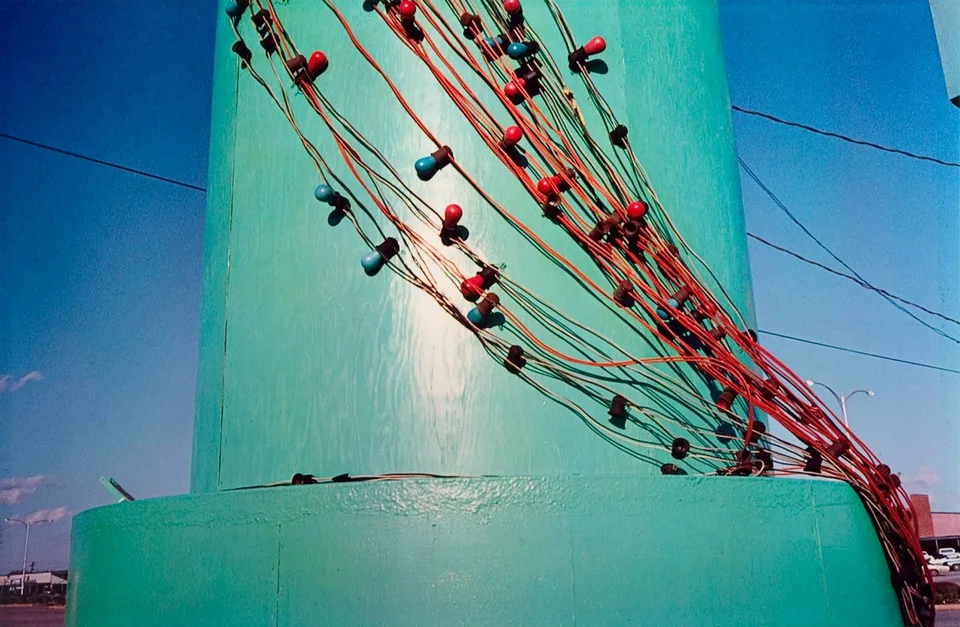
For these photographers, a blue sky is not just a blue sky; it is also a block of color. Here the blue sky, together with the green of the pole in front and the red wire, forms the three primary colors in the picture. This is a work William Eggleston shot with a 35mm Leica, and it rewards long looking. Besides color, there are the relationships among the wires behind; look closely at the corners and you can see distant buildings and vehicles. He compressed perspective into a flat plane and even used flash; you can see the flash's trace on the pole. Our attention centers on the color, but we also notice the relationship between the lines and the surroundings, and these things organically make up the picture.
In 2023, Shore came to Lishui and held a touring exhibition in China, so we were able to see Uncommon Places, which he made with a large-format camera after careful observation. At first glance, isn't this just a gas station? What's worth photographing? Why did it become an iconic work, so much so that thinking of Shore basically means thinking of this picture?
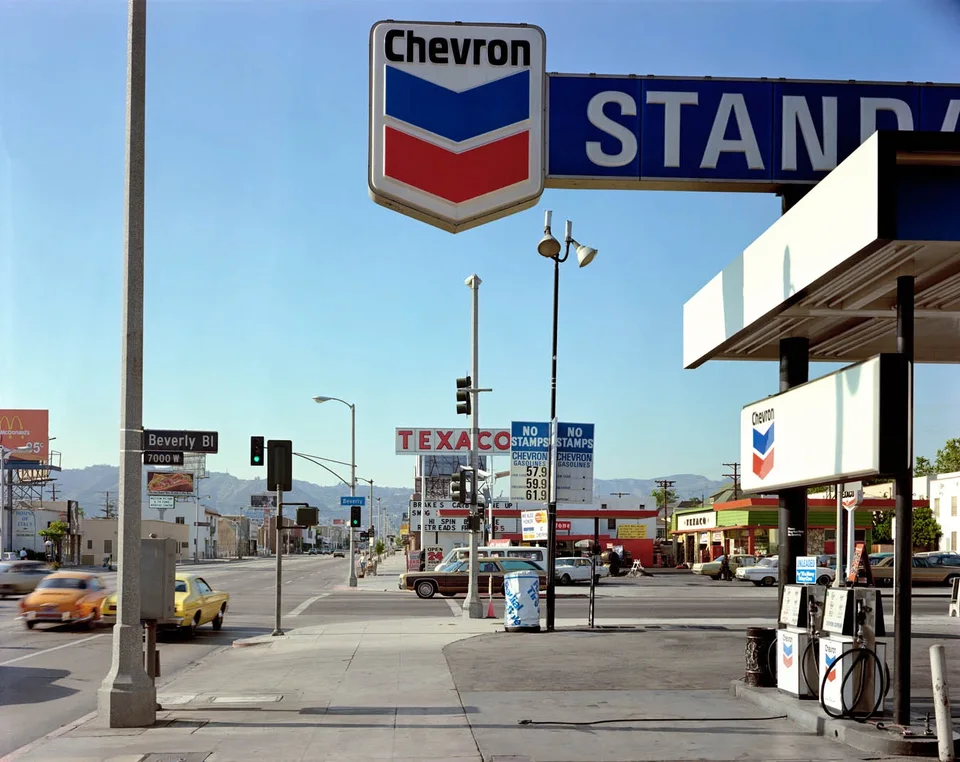
Because Shore had observed the internal structure of the image and placed each element in its own gap. He worked out the relationship between the poles and the signs above them, keeping them separate so they don't overlap. The pole on the left and the structure above the gas station on the right create perspective, together with the depth of the street, which extends all the way back. But after taking it, Shore felt this kind of image structure had already been solved in seventeenth-century French painting, so the next day he photographed the same spot again, producing a picture he considered more modern. He was always searching, exploring the possibilities of the image.
Here too the blue sky acts as color, forming the image's structure together with other elements. At the same time it has transparency; it looks just like what our eyes see. This is the so-called transparency of straight photography.
Chinese photographers have made similar attempts. Ronghui Chen used a large-format camera in Northeast China to photograph the lives of young people after the transformation of state-owned enterprises. The color saturation of this photograph is very strong; he didn't do what some Chinese photographers do, toning colors down to a middle gray to look subdued and elegant. I don't think that's necessary. If colors are that intense in real life, why not keep them? They can become a highlight of the work.
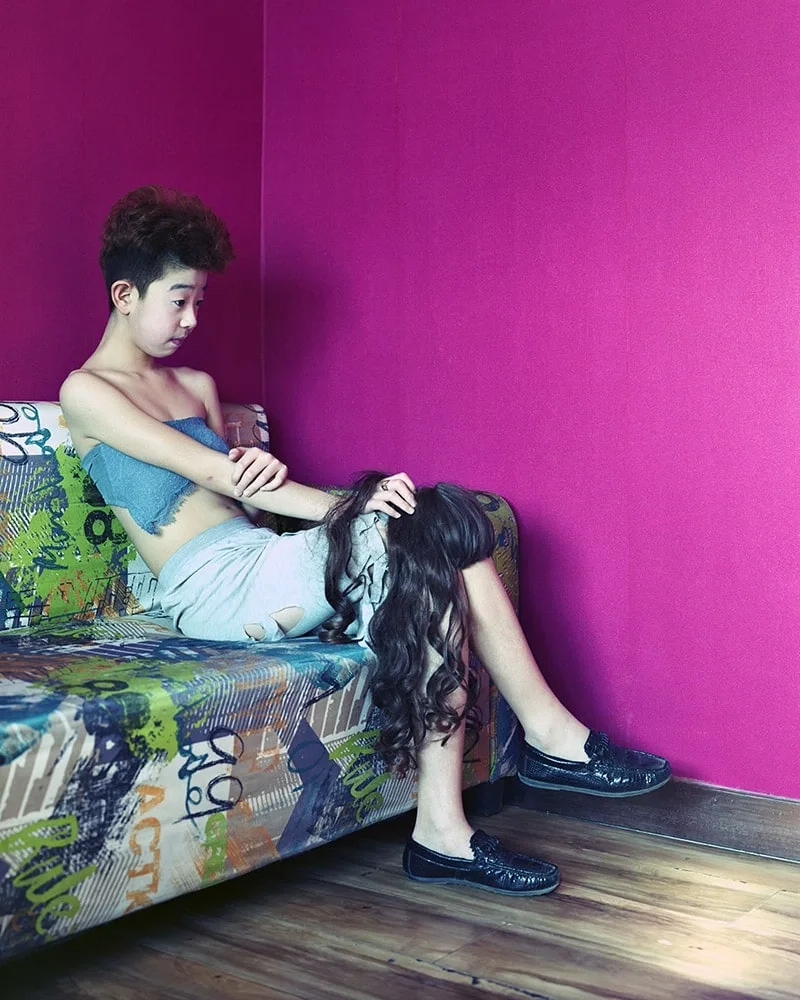
Besides the figures' expressions and positions, the key thing is that Ronghui included the cracks and dividing lines in the wall, which immediately gives the two-dimensional photograph an illusion of three-dimensional space. He graduated from Yale's photography program a few years ago and did receive this kind of training, with the aesthetic sensibility of contemporary imaging. This too can be seen as a Chinese photographer's attempt at New Color Photography.
Li Feng's White Night also pays great attention to color. He shot black-and-white early on, later switched to color, seeking phenomena in everyday life that seem incredible. Here, through the viewfinder, he excluded the person's head and upper body from the frame, highlighting a bright red parrot. The blue sky becomes a color block, forming the picture together with the red, the gray of the clothes, and the light gray of the rocks behind. There's also the posture of the legs, and especially the green characters "争春" ("vying for spring") that he included. This photograph really rewards looking.
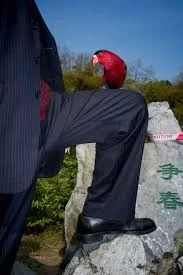
So I think White Night not only has absurdity but also belongs to the experiments of New Color Photography. That's all for the first part, which mainly introduced American photographers of the 1960s and 70s and how Chinese photographers since the 1980s and 90s have tried to move beyond documentary photography. I'll hand the microphone back to Ce Zang.
"Above the Document": Document and Concept
Ce Zang
Thank you, Rong Jiang. I'll now share the first part of "Above the Document," starting with where the concept came from. Why is it a document, and how did it become "above the document"? This involves the relationship among concept, documentary, and the image. It looks simple but is actually very deep, and I want to lay out the lineage. In the second part, I'll talk about imaging principles: why it can be done, how we look, and how we create.
The concept first came from André Rouillé. You should be familiar with his book La photographie. Entre document et art contemporain (Photography: Between Document and Contemporary Art), which was very influential in China a few years ago. By a lucky coincidence, about half a year after the book was published on the mainland, we got to know each other and began discussing these issues.
Once I invited him to an event in Tianjin. In Binhai, Yan Gao, some friends, and I held a closed-door meeting that lasted from the afternoon through dinner and on into the evening, five or six hours altogether, mainly discussing documentary photography and how to move from the document toward contemporary art. Tonight I want to share the core of that discussion with you.
Rouillé said something then: "go beyond the archive itself." He meant transcending the document through the document, through straight photography, rather than taking other routes such as the staging and appropriation of Cindy Sherman. He was speaking French, and Yan Gao immediately added that if you rendered it into Chinese not literally but by its sense, it would be "above the document." The phrase "above the document" came to us right away, and from that day we began discussing around it.
Later, the 2019 Lanzhou International Image Biennale took "Above the Document" as its theme, which led to this book I'm holding now. It offered an overall survey of this path in China: using the document to transcend the document's nature and moving from the document toward contemporary art. Dan Luo is one of the most important artists in the book.
The theoretical inspiration came from Mr. Rouillé. I should mention that he passed away on May 7 this year, and I was deeply saddened. He was a friend I could talk with wonderfully, a true kindred spirit across borders. His health had always seemed so good; I never expected he would die this year. At the recent opening of the Lanzhou International Image Biennale in Zhangye, I mentioned him and expressed my mourning. Over these two years, two very good friends of mine have died, Rui Zhu last year and Rouillé this year, and that has made me very sad.
This leads to an important question. Not long ago Thomas Ruff came to Lishui, and Brother Rong Jiang and I took part in a symposium on Ruff, where Professor Lili Yang of Shenzhen University was also present. She introduced the Düsseldorf School to China very early, at the beginning of the twenty-first century, and at the time translated "deadpan" as "expressionless appearance." She sharply raised a question: why is it that when Chinese photographers learn this visual schema, the result is "the image turns cold while the meaning turns hot"?
The image is cold, close to the deadpan style, but what does "the meaning turns hot" mean? Simply put, it means you understand it at a glance. With the Düsseldorf School, not to mention Ruff, but also Thomas Struth and the Bechers, if you don't enter their logical thread and conceptual system, you don't know what the photographs are about. But no matter how much the schemas Chinese photographers use resemble Düsseldorf, you still grasp the intended meaning at a glance.
Lili Yang raised this question and also analyzed it. It inspired me greatly; over all these years I haven't forgotten it and have kept looking for a theoretical answer. By now I think I've figured it out fairly clearly, and I've discussed it with her. When I analyze images and schemas later I'll talk about the principle; for now, let's start with the concept.
"Above the document" means using the document to transcend the nature of the document; more simply, using documentary to transcend documentary, rather than taking Cindy Sherman's path. The first thing that comes to mind is a line from Gerry Badger in The Genius of Photography, which I find especially good: photographers ask practical questions, while artists ask philosophical ones. Simply put, a practical question deals with the matter at hand, so you know at a glance what it's saying.
But I must stress what a philosophical question means here. It is by no means using images to illustrate a philosophical concept or view. In literature this is called "theme first"; in visual art it means using images to explain language, which I think should very much be avoided. Many people misunderstand conceptual art, thinking it's just using various images to explain ideas. That's not it at all. It isn't that I shoot a series to explain a philosophical concept or some philosophical reflection of mine.
It must always start from your looking, your embodied perception, from a problem you personally discover; it's just that your way of thinking is closer to philosophical method. So-called conceptual documentary means discovering problems in reality through your own looking and perception. The problem isn't necessarily a public topic everyone is discussing; it's one you discover. And your perception of the problem, your image, your vision are intertwined.
Further, conceptual documentary cannot illustrate concepts apart from visual looking; it must discover second-order problems in reality through looking. When preparing my slides, I proposed this: artists working in contemporary documentary see not only the surface-level, matter-at-hand problems of reality but also a kind of "second-order reality," a reality that enters philosophical thinking. Dan Luo mentioned it earlier too: what lies behind the image, behind reality.
That may not be clear yet, so let me give one example from literature and one from images. First literature: Flannery O'Connor has a very famous short story, "A Good Man Is Hard to Find," which I especially love. The story is simple, like something from a crime show today: a family goes on a road trip, runs into a gang of escaped convicts, and the convicts kill the family.
That is a first-order narrative. Following the logic of an ordinary crime story, the convicts are bad people, and the grandmother who is killed is a devout Christian, a good person. Yet for so many years people have been puzzled about what such a simple story is really about. An American professor even wrote to the author saying he couldn't understand it. Why?
Because within the first-order narrative she cut off the key clues that would let you understand it through a ready-made story template, preventing you from projecting the templates already in your head. With those clues removed, you can't understand it, and you're forced to think about what lies behind the text, what isn't said, what has been cut, and so you enter the second-order question: "What is a good person?"
Dealing with the matter at hand is first-order; going up a level within this story, thinking about the concept of "good person," thinking about our habitual cognition itself, is second-order. It's somewhat like what philosophy calls metacognition. I once proposed the concept of the "meta-image," and in our recent discussions of Ruff many people also mentioned meta-photography and meta-images. All of these enter this kind of second-order thinking: how is a concept formed, and why do you think this way? This way of thinking is a core part of conceptual documentary, of transcending the document's nature through the document.
But why must the second-order reflection "what is a good person" unfold through a first-order narrative? Why not just directly discuss whether the grandmother is good or bad? Once you think this through, you can understand why one transcends the document's nature through the document, rather than expressing it directly in a non-documentary, purely conceptual way.
The grandmother is hypocritical. She talks about faith every day, says good people are fewer and harder to find, yet she herself is not a good person. She thinks she is, but the habitual vices of her daily life negate her judgment of herself. She has serious moral flaws; perhaps the hypocrisy of people like her is precisely what causes the tragic lives of people like the convicts. So who harmed whom? In the story these are all questions to be thought through; the author doesn't hand you a ready-made "this one is good, that one is bad."
If she hadn't written a first-order story and had instead directly described the grandmother's flaws on a second-order level, writing it as the grandmother's life story, it would have become a moralizing tale, not such a brilliant text. Once we understand this, we can grasp "why transcend the document's nature through the document."
Now let's see how photography does it. This is a series by Yan Gao called A-Grade Knockoffs. As photographs, they are straight photography, documents, but what they discuss is not the buildings themselves; it's the relationship between image and reality: once reality enters the image, is it still the original thing, or is it a "knockoff"?
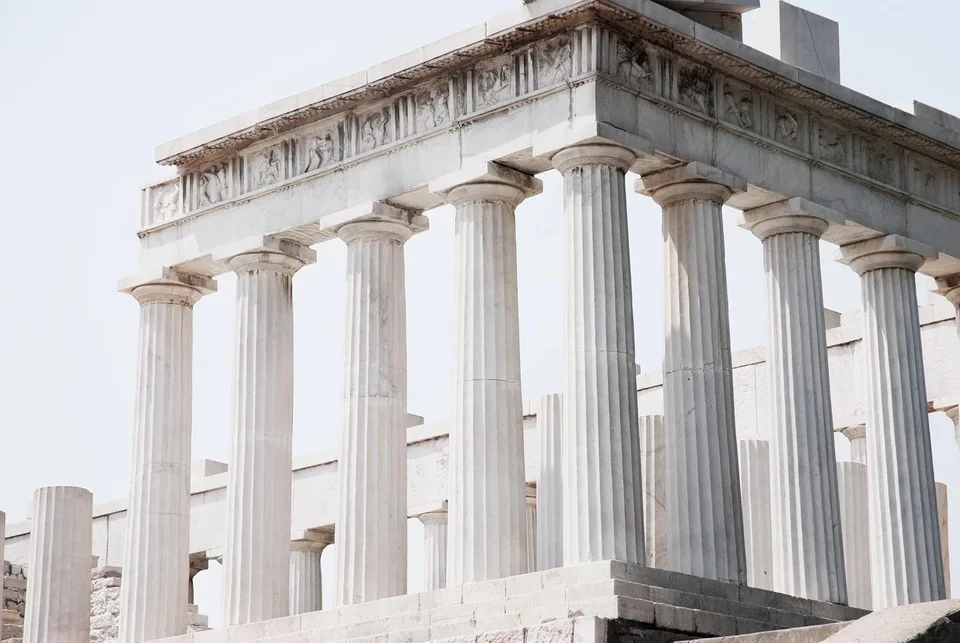
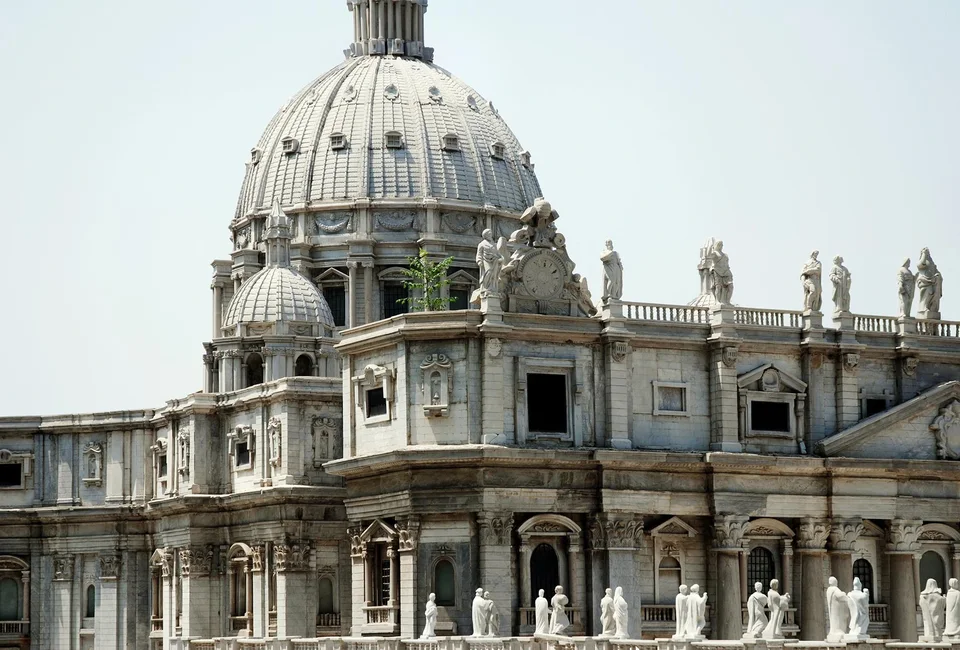
He photographed the "second-hand reality" of replica landmarks in world parks and tourist sites. They are also reality, but within reality they are knockoffs. Afterward, he exhibited the work, of all places, in the international flights area of a Shanghai airport. Many travelers had just returned from sites in Greece and elsewhere, had seen the real originals, yet couldn't tell whether the photographs showed the genuine article or a knockoff, and some eagerly posed for photos beneath the work.
It is a document, but it doesn't point to the document itself. It doesn't tell you what a Roman column or a famous building looks like; it makes you think about how to understand photography, how to understand the image: where does it differ from reality, and where does it not? When a knockoff in reality enters a photograph, is it still a knockoff? Is the image real? Is photography truthful?
This is a problem he discovered through looking. It isn't a problem of the objects themselves, nor a public topic people usually discuss; it's a problem about photography itself. This is the concept he discovered, and the document is connected with such a concept.
Now look at this series. If you use iconography, semiotics, or similar methods, you'll never understand it. On the left is a can of egg rolls, on the right a chocolate wafer. Is this still-life photography? Of course it's also a document, but it isn't about the document itself. These are Palestinian products subject to embargo by Western countries, yet they were photographed in France. It explores a social problem, not merely a documentary representation of cans and cookies.
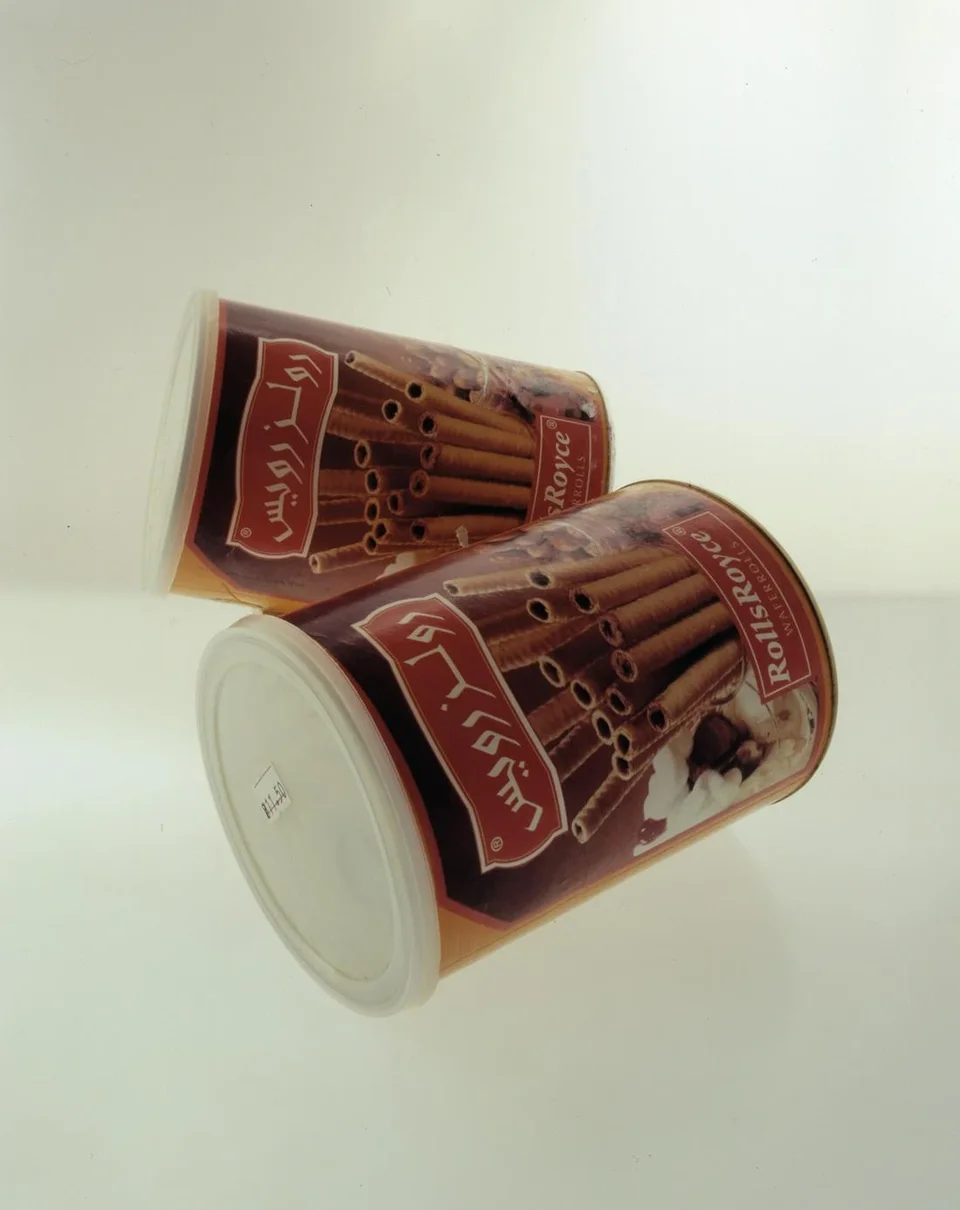
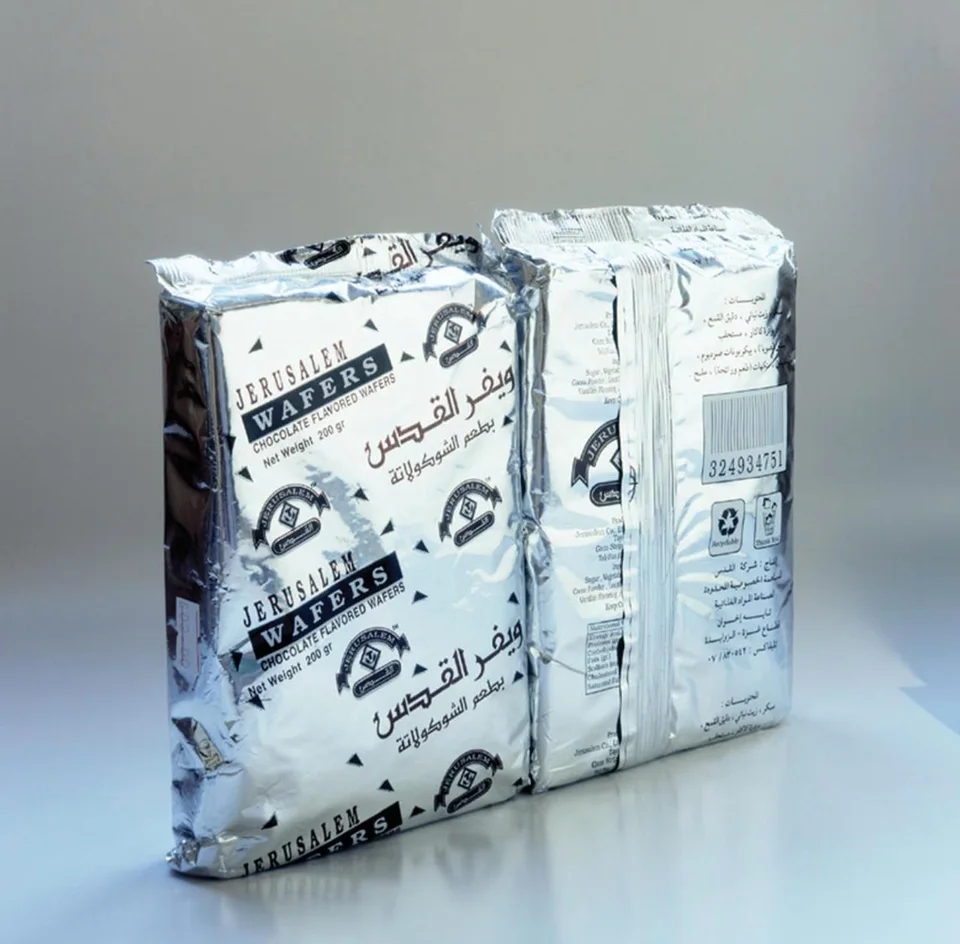
In the next part I'll share the visual mechanisms of looking and the image, analyzing images and looking from deeper principles. Over the years I've spent a great deal of effort thinking about these issues and have more or less formed my own views, without entirely adopting existing ones. This will also be my first time sharing these thoughts on a livestream. That's all for now.
The First Look and the Second Look
Rong Jiang
Host, may I respond first before Dan Luo and Guosen speak?
Ce Zang
Of course.
Rong Jiang
What you said just now about transcending the document through the form of the document, and about first-order and second-order, I found especially brilliant. In my view, transcending documentary through the document or through documentary is what Walker Evans back then called documentary photography of a certain kind.
Ce Zang
Documentary style.
Rong Jiang
Right, documentary-style photography, which looks like a document but is actually no longer merely traditional documentary photography. The so-called first-order and second-order, in my view, are the first look and the second look. Of course I'm putting it simply, while you're speaking theoretically. Let me give a few examples I didn't mention earlier, including Dan Luo's work, and then invite him to speak in detail.
Another American photographer, Joel Sternfeld, was influenced by Shore. He used a 35mm camera early on, but after seeing Shore shoot large-format color film, he drove across America with a large-format camera and made American Prospects. He photographed the failures that arose as Americans tried to realize the American Dream, especially the various alienations in American society after the Vietnam War.
In this photograph, an elephant that escaped from a circus has collapsed on the road in the summer heat, and police and rescuers are pouring water on it. A news photographer would certainly move in close to report the event. But Sternfeld is an image artist, and the whole work keeps this style: standing fairly far away, somewhat like the perspective of sixteenth-century Dutch painters, standing at a high vantage point and keeping a distance from the subject.
This gives viewers the possibility of a first look and a second look. At first glance we see an elephant collapsed on the road; at second glance we might consider the philosophical question Ce Zang mentioned: is American society, like this elephant, in a state of exhaustion? That's one reading, of course; there can be others. Making documentary-style images through the document or documentary photography yields two different possibilities of looking.
In his early work, Dan Luo was, if not the first, then among the very first Chinese photographers to adopt the "on the road" approach. Starting from Shanghai, he traveled along National Route 318 with a 6×7 camera and color film all the way to Tibet. This work carries the possibility of a second look.
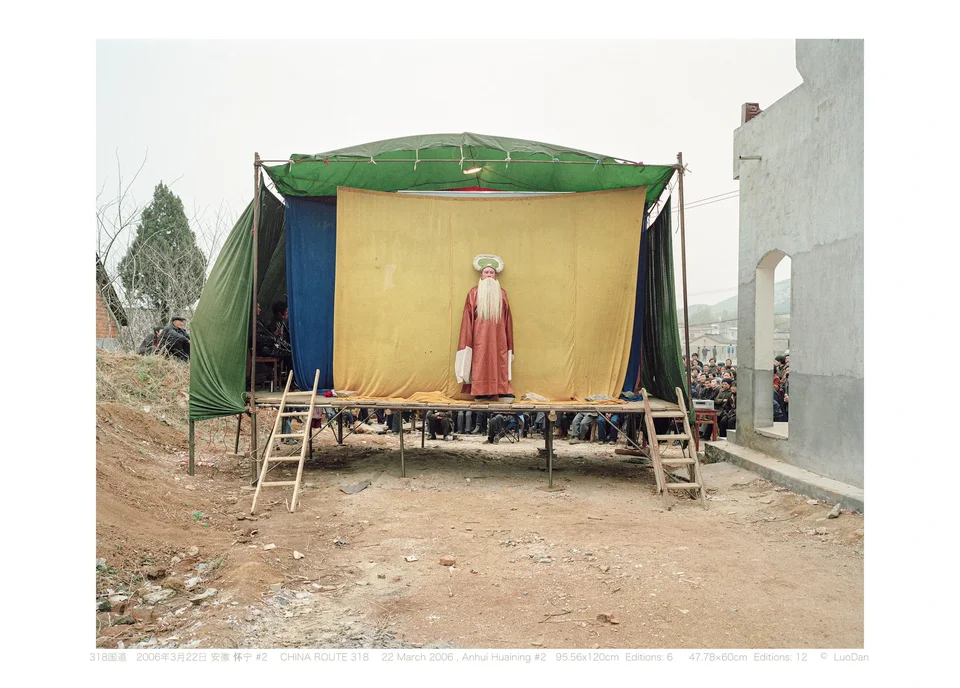
At first glance, isn't it just an actor standing on a stage? But I became absorbed looking at it. It made me think not only of the actor but of people's state of mind during the process of Reform and Opening Up. Dan Luo didn't take a close-up portrait; he placed the figure within the scenery. Like Sternfeld, it's "people in the landscape." In the past, street photographers with 35mm cameras stood among the crowd snapping candid shots; these photographers photograph the landscape from within the landscape.
The wall on the right, the two ladders, all suggest many possible readings to me. How to interpret them, each viewer can think through for themselves, and in a moment Dan Luo will talk about his process and thinking.
In 2008 he traveled again, from north to south, making another series along a diagonal line, this time with a 6×6 camera. This photograph also can be looked at twice. At first glance it seems to be a person standing there holding a "Welcome" sign; look again and it seems to be a panda, and it's hard to tell whether it's real or fake. That is where the image's uncertainty lies.
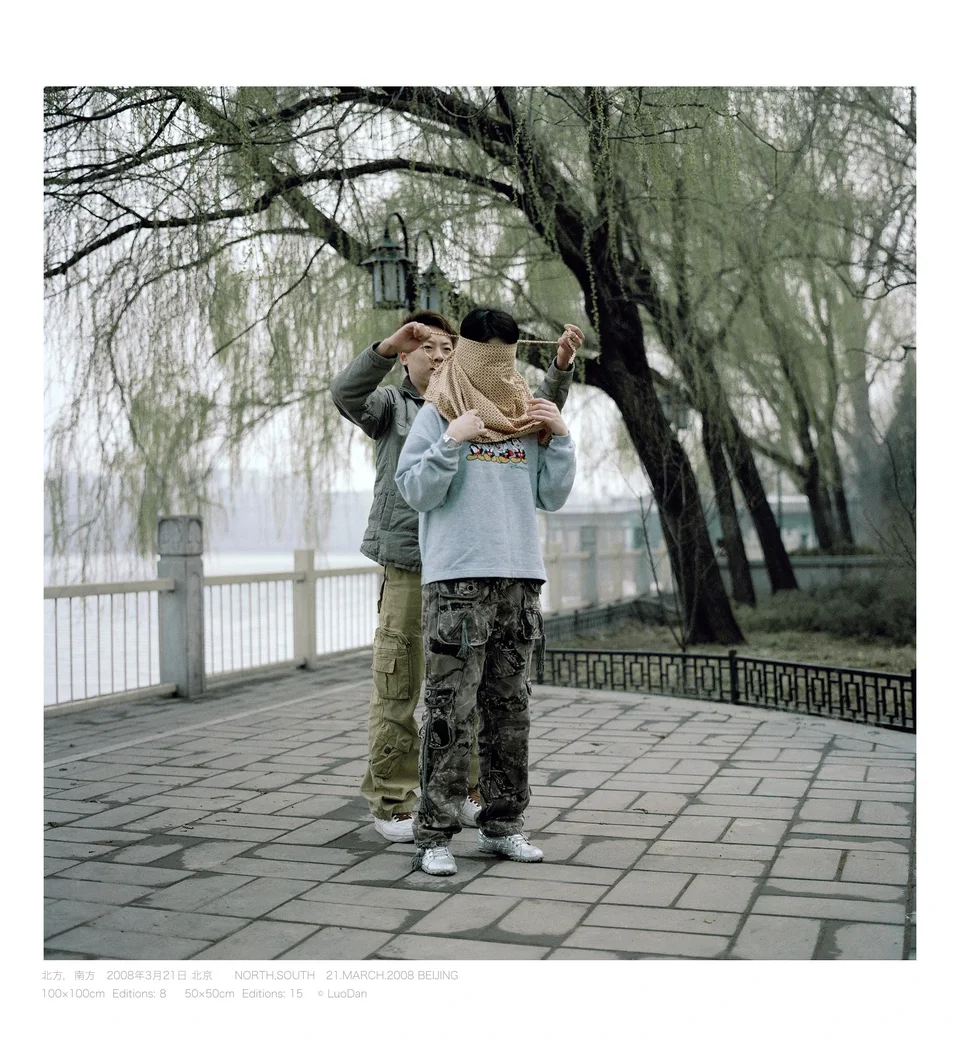
So in these two early works, Dan Luo was already trying to make images with contemporaneity, with the spirit of the times, rather than following the traditional black-and-white approach of photographing social problems. In this sense he had already moved beyond traditional documentary photography.
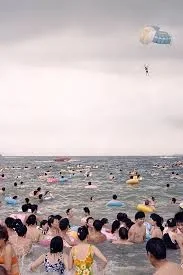
Xiao Zhang's Coastline was made at around the same time. Born in Yantai, he had a personal feeling for the coast and the sea, so he photographed along China's long coastline, from the Northeast all the way to Guangxi. This series brings out the absurdity of everyday life. At a seaside resort like Beidaihe, in summer, many people swim together, and suddenly someone descends from the sky, making us feel something is about to happen: a sense of absurdity. The series won many awards, and for good reason: the images aren't so direct; they have a second-order quality, the possibility of a second look.
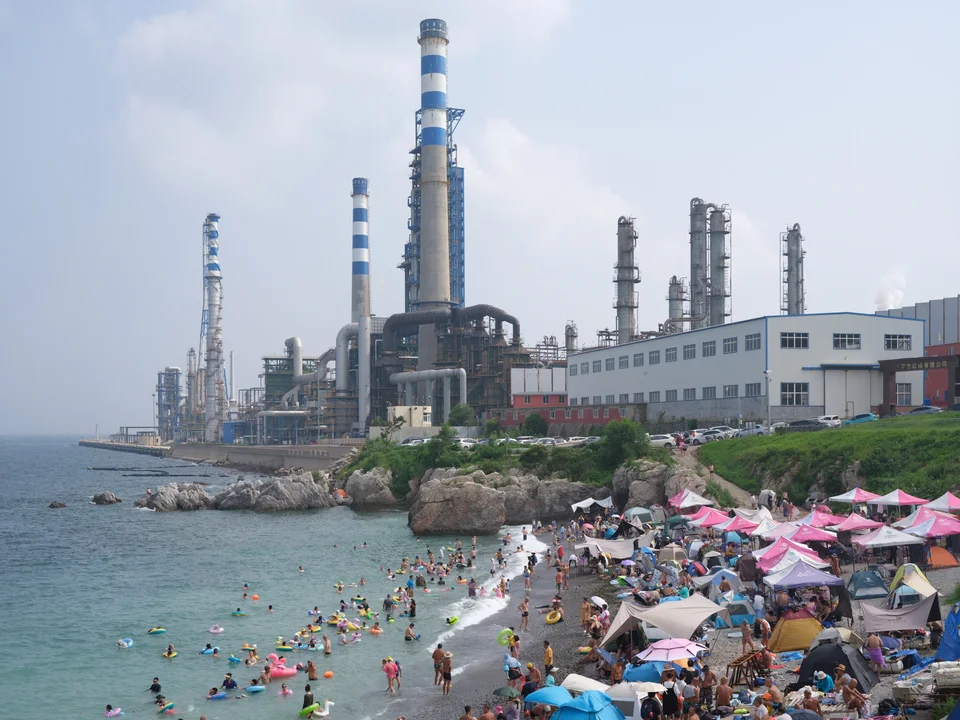
This year Lishui showed Liangong Sun's Coast Today, a series shot along the coastline more than ten years after Xiao Zhang. Liangong Sun is from Dalian and also has deep feelings for the coast and the sea. This series also has absurdity: so many people swimming near a power plant, where the water may already be polluted, and they are completely unaware. This contrast makes us think about the environment and other issues. I'll stop here and invite Dan Luo to speak.
Ce Zang
Dan Luo's work is certainly second-order and goes beyond the document, which is why it's featured prominently in our book. Now let's invite Dan Luo, as an artist, to share on tonight's topic.
Dan Luo: Making Work on the Road
Dan Luo
Thank you. Rong Jiang and Ce Zang have just discussed, from a theoretical angle, second-order thinking and the second look. I'll talk from the angle of creation about some of what I was thinking when I made these works.
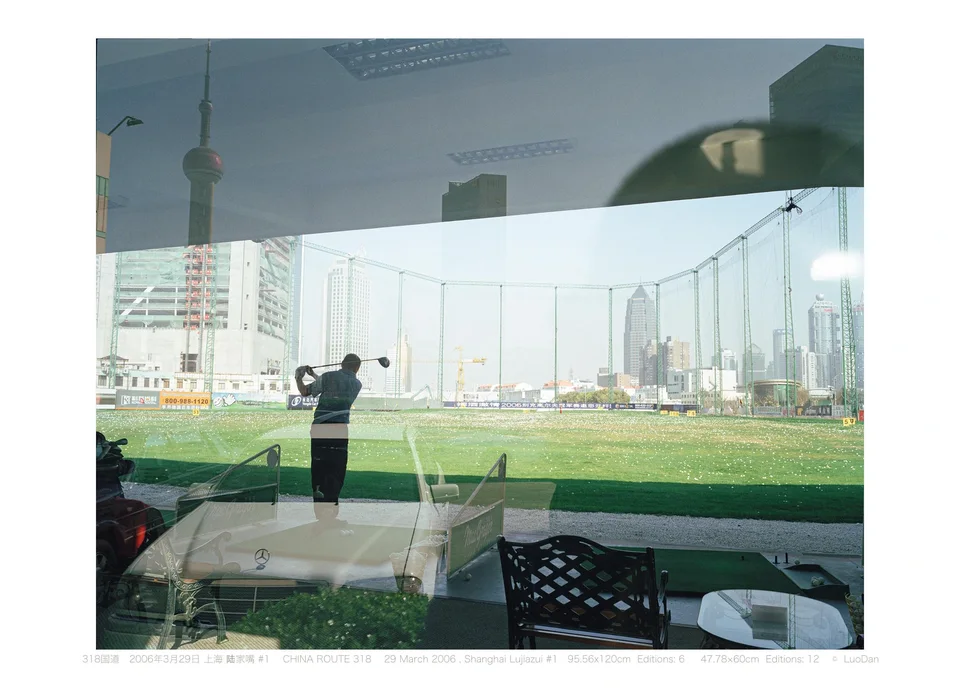
Let me start with my first work, China Route 318, shot in 2006. Why this national highway? As Rong Jiang mentioned, it runs from Shanghai to Tibet, all the way to the border between China and Nepal, forming a very clear transverse line from east to west on the map. It starts from the developed eastern coast, from a city like Shanghai, passes through Anhui, Hubei, Sichuan, and elsewhere, and reaches Tibet in the relatively remote west. I felt this line would surely hold many rich details, things visible in the present and things I wanted.
Before setting out, I had worked as a journalist for nine years, and that experience greatly shaped my vision. Every day I was immersed in different events. For ordinary people, those things are news and seem far from their own lives, but for a journalist they become daily life, and I was constantly observing within all kinds of events. After nine years I felt there were things I wanted to express, questions and thoughts about the present that needed to be expressed through a work, so I chose the representative Route 318.
I was also strongly influenced by film. My initial idea was to make a road movie through photography. Later, many of the images were handled like film stills. Film presents continuous time, a process unfolding continuously from start to finish; photography is a slice of time. I wanted to use this slice to create a kind of space within the picture, which is the second-order issue the two teachers just talked about.
Facing an image captured through straight photography, we seem to be seeing a real scene, but I wanted it not to be so certain. On the concept of documentary we were just discussing, I sometimes feel photography can't necessarily document, because after all it is a slice and not continuous. Making it tell a story clearly and give especially complete information is really not its strong suit.
So I sometimes joke with friends that what I shoot is "documenting the unreal" rather than "documenting the real." Where is the "unreal"? It's in the space for thought the image can open up. Different people looking at the same picture will have different insights, feelings, and thoughts. I use very concrete, "real" pictures hoping to open up this kind of space.
These pictures thus become very complex, and I emphasize more the relationships among the visual elements. Take this one, which I placed at the beginning of Route 318. It was shot at a golf driving range in Lujiazui, Shanghai. There are many things in the picture that people then, and even now, strive for and aspire to. In 2006 the apartments here seemed to already cost 130,000 yuan per square meter. You can see a Mercedes-Benz, people playing golf. I put it at the beginning as a place we want to go.
The picture Rong Jiang just introduced, I think his reading was very apt. It was shot in Huaining, Anhui, the hometown of Huangmei opera, where people from a village were watching a Huangmei opera performance. Chatting with locals, I learned that their ancestors originally lived in a village in the north and migrated south to escape the wars during Mang Wang's rebellion, eventually growing into a large village here. With that background I had many feelings: there is such a long history behind it, and that span of time makes one think of many things from the past.
The actor in the picture was originally smoking backstage. I called him over and had him strike this pose, and took the picture. So this is a staged photograph. Behind him you can see many audience members, but most show only their feet. This picture is fairly typical: we can see in it certain connections between the past and the present.
This one is also a very dramatic scene: beneath the ancient city wall of Jingzhou, Hubei, a naked man walks past other people, and those beside him treat him as if he were invisible. The whole of Route 318 has many scenes like this, with very complex relationships, including between people, between people and their environment, between people and the present, and between people and history. It felt like shooting stills from one drama or film after another, with a strong sense of absurdity in the plot.
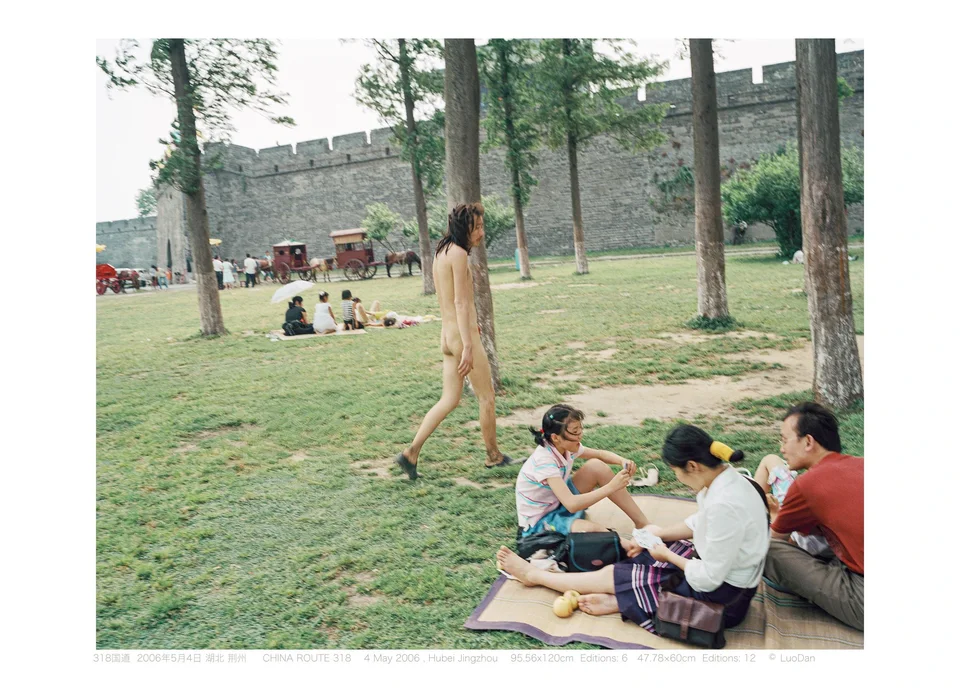
When your gaze meets these pictures, they bring a direct experience, but that experience gradually connects with our own experiences and vantage points, leading to all sorts of conclusions. How to put it, it's like a riddle. I want my work to have that effect: posing a riddle whose answer lies behind the picture, which you can think about and search for. Such scenes have a slightly surreal flavor, and the whole shooting process was full of drama and tension. Facing them, I was also thinking, about my own questions and about the questions we share.
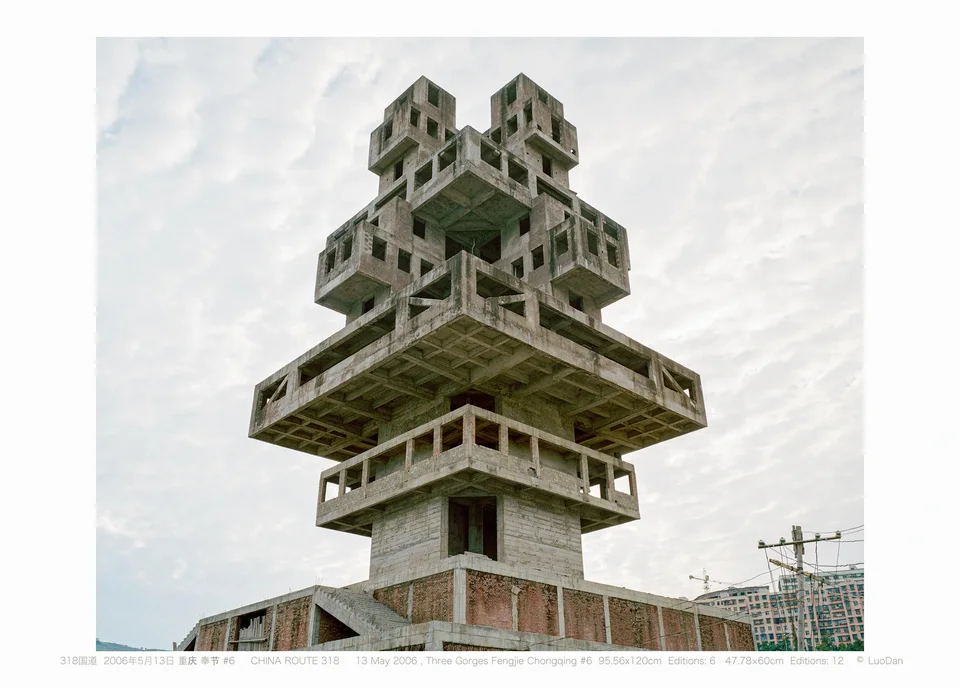
This structure is in the Three Gorges reservoir area; it's a monument to the migrants. The people who contributed to the dam's construction left their hometowns and native soil and made enormous sacrifices, and this monument was originally meant for them. Jia Zhangke's film Still Life also captured it, and in the film it was launched into space like a rocket. Those who have seen the film probably remember that shot.
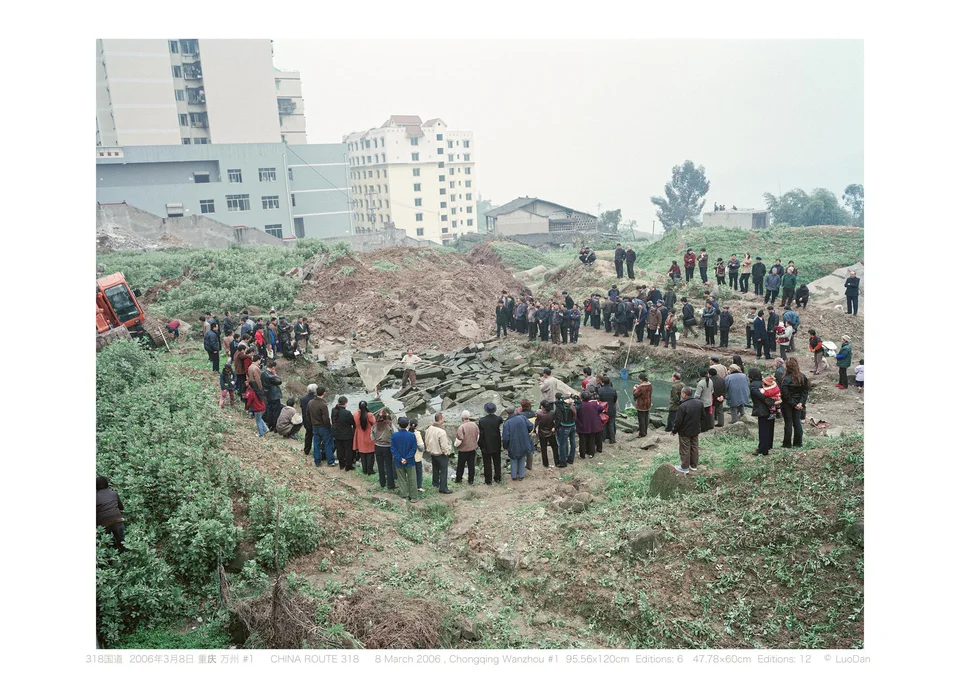
At the time, people were keen on discussing things on internet forums; I think WeChat didn't exist yet. I remember a saying, "onlooking is power." This picture also shows a crowd of onlookers, watching a man fishing in some unknown pond. The location is Wanzhou, Chongqing, in the Three Gorges reservoir area. There were lots of idle people there, not working, who would always turn up wherever there was a commotion. I found it a very interesting scene.
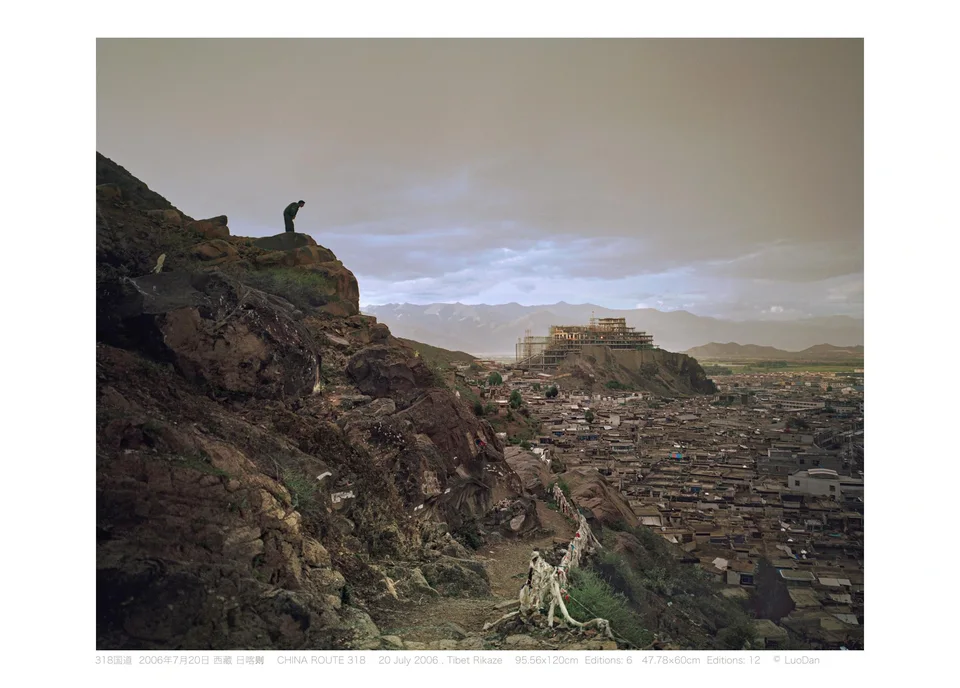
The whole work contains many things like this, like metaphors, bringing out stories, imagination, even a kind of fable, through actual photographic scenes. At the beginning I used the small figure, seen from behind, of the man swinging a golf club in Shanghai; at the end, a man on a mountain in Shigatse, bending over and looking at the city below. This is the last picture in the series.
The complete Route 318 has eighty-eight photographs, and I've always felt that these eighty-eight pictures together are the whole work; it is one entity. Because of time, tonight we can only look at a selection of representative images, but the entire work has this tone and style.
Why did I put this man at the end? I felt he was like me, a projection of myself within the scene, a mirror image. He keeps a certain distance from the city below, yet his gaze is fixed on this city, this world. His posture was connected with what I was doing at the time.
Before shooting Route 318, I already had a plan: the first part from east to west, the second from north to south. North, South, shot in 2008, was the second part of this "on the road" work. This time I switched to a Bronica camera, structurally very similar to a Hasselblad, but a Hasselblad was too expensive for me then, so I bought a relatively cheap substitute.
This camera uses 120 film in the 6×6 format with a waist-level ground-glass viewfinder, so you can see the scene you want to shoot on the ground glass. North, South follows directly from Route 318, continuing its methods and ideas. But with the 6×6 format, my shooting became a bit steadier.
Before Route 318, I used a Holga for a while. Many photographers will know it's a plastic camera, even the lens is plastic. You don't need to do anything; you just hold it and press the shutter. It makes photography extremely, extremely simple. The composition and lighting from my earlier photographic training seemed to have sunk into my bones, lodged in my body and mind, impossible to shake off; whenever I picked up a camera, those were what came out.
But the time with the Holga changed me a lot. It required none of those technical considerations; I could step outside photography's rules and simply observe with my eyes, then shoot. I discarded many old things, so later I used my Mamiya 7, a 6×7 camera, as a Holga with higher resolution and better image quality, shooting quickly, snapping fast.
North, South also used the candid method of earlier documentary photography. The method was the same, but the looking, experiencing, and expression were different. It includes many people; their states, and the feelings these pictures give us, are very complex. I wanted the visual elements in the frame to form multiple possibilities rather than become something especially definite. In other words, as I said, setting aside some of the documentary aspect to present more possibilities for thought.
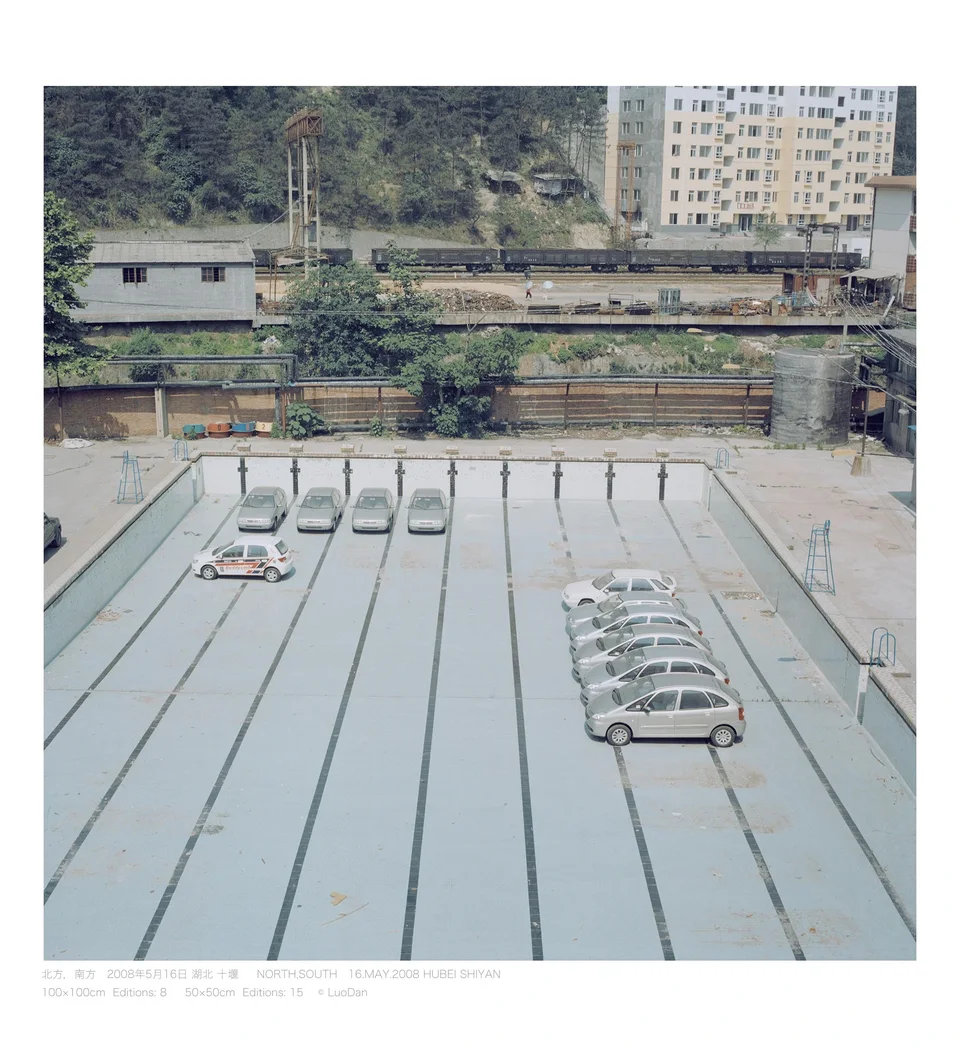
Each photograph's title gives only the time and place, with no further explanation. Why? Because once I clearly state what kind of person this is and what they're doing, the space I want may disappear. For example, a car sitting in a swimming pool: the picture itself is quite strange.
This man is also very interesting. I photographed him on the road in Nanping, Fujian, in June 2008. More than ten years later, in June 2021, in Guazhou, Gansu, thousands of kilometers away, where the "Son of the Earth" sculpture is, I saw a vehicle with the words "天才与桶才" ("genius and bucket-talent") written on it. I often look at my own work, and the elements in the pictures are all in my head, so when I saw those words I wondered: could it be him?
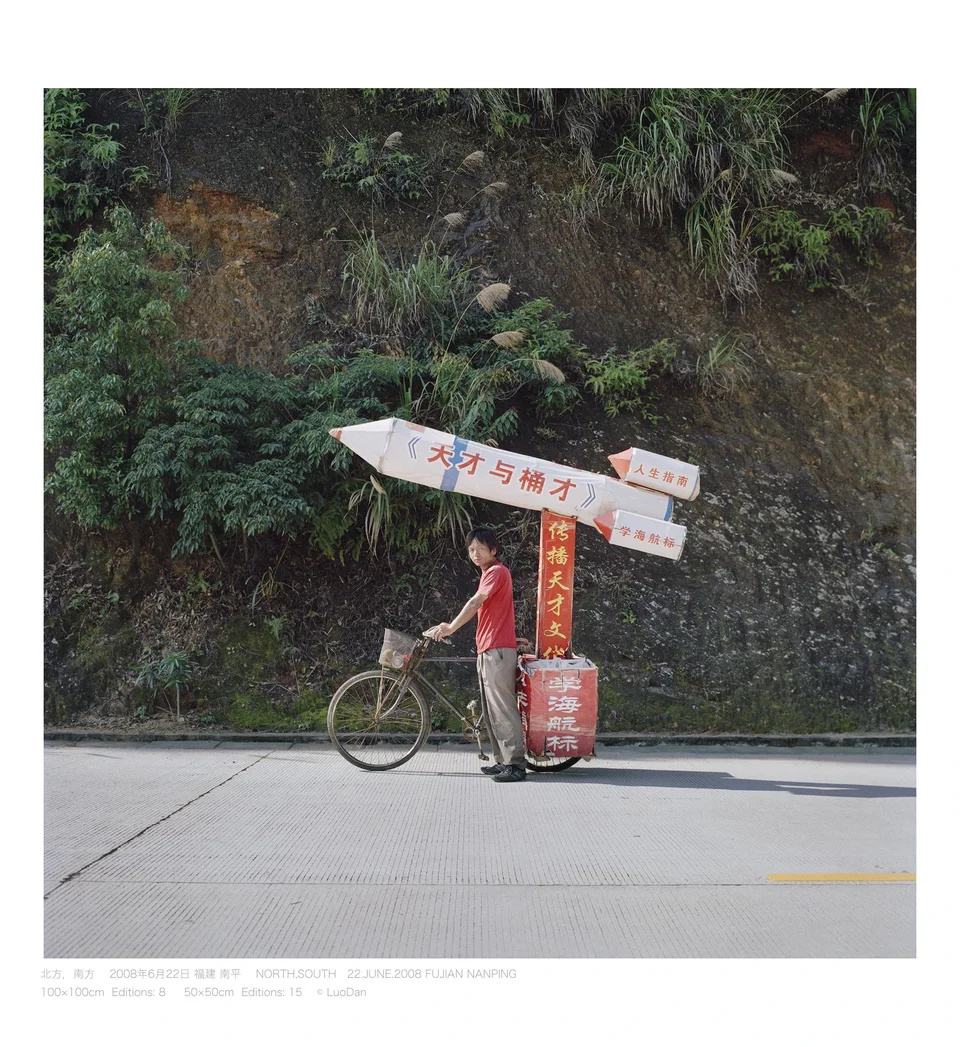
Then he came out from behind the vehicle, and it really was him! More than ten years had passed, and both of us had changed a lot in appearance. When I photographed him he was a young man; when we met again he looked like an old man, his hair completely white. But I later thought: he's still doing what he did back then, and I'm still doing what I did back then. Quite interesting.
Shooting on the road like this, you always encounter all kinds of people and events. They change me too, hit me, bring me thoughts, shape who I am. Looking back now, nearly twenty years, the roads I've traveled and these works, these pictures, seem imprinted on these twenty years of my life, merged with me.
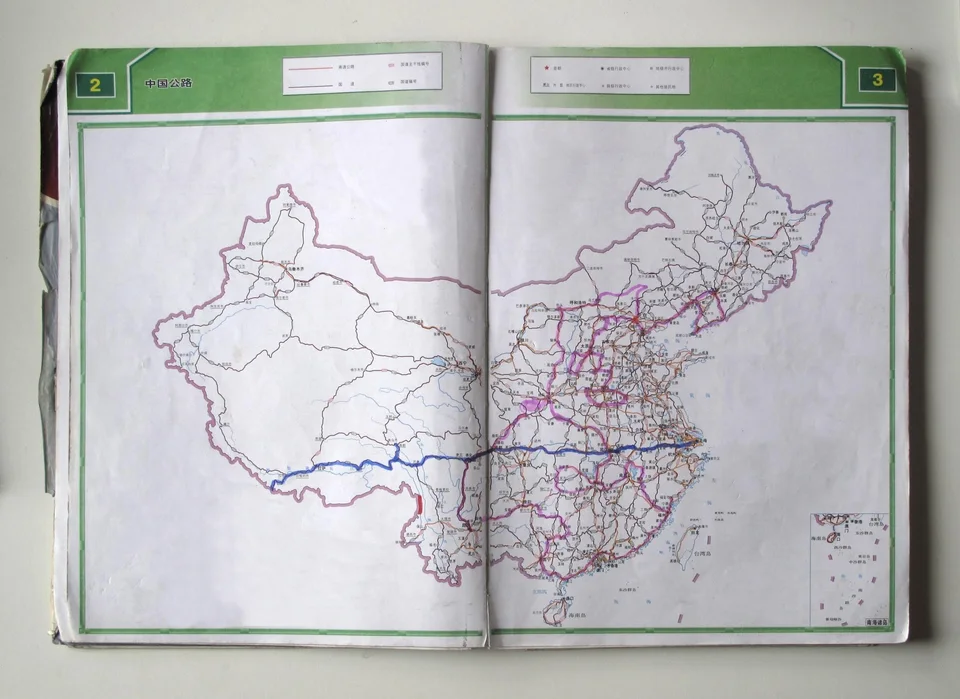
This is another fairly representative picture from North, South, quite symbolic and connected with my later work. This is a map I used at the time; of course I had many maps then. The horizontal blue line is Route 318, and the crooked purplish-red line is the route I traveled for North, South.
The inspiration for Route 318 actually came from Easy Rider. I love film, and back then I saw its thirty-fifth anniversary edition. Film lovers know there is a genre called the road movie, and this is the founding work of the genre. Through two men's journey across the American continent from east to west, and the people and events they meet on the road, it dissects American society of that time. The director used this approach to express the state of society, with his views hidden in the details throughout the film.
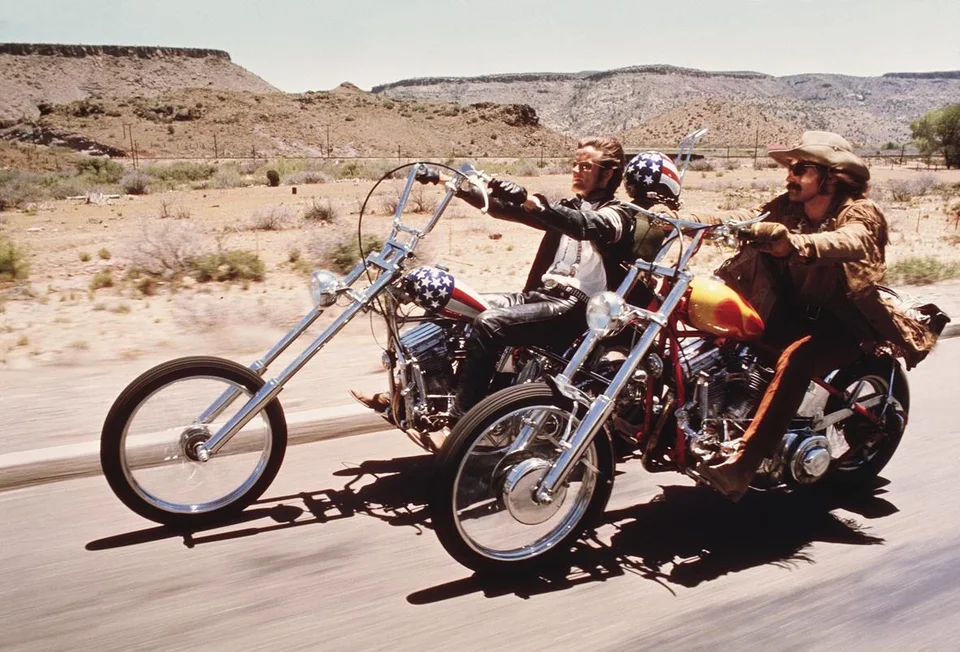
In making Route 318 and North, South, I wanted to use this approach to make photographic road movies. I think this picture represents my attitude toward shooting at that time quite well. I'll stop here for now; maybe later I'll talk about my later works.
Ce Zang
Thank you, Brother Dan Luo. That was a delightful talk, time flies, and we need to move faster. Guosen, please give a brief response first, and then we'll go into the second round.
Guosen Chen
Thank you, teachers. Listening to Ce Zang and Rong Jiang just now, I realized that the last part of my presentation happens to be about Paul Graham, which in a sense confirms what you said about first-order and second-order reality, and Rong Jiang's point about the possibility of a second look. I have a lot of material too, and I'll only give one full presentation tonight, so I'll fold my response into it.
This is also my first time meeting and talking with Dan Luo online. It's a great honor; I saw your work long ago. Listening to you describe your creative journey, I felt that very often, when artists create, they're thinking about very interesting, very intuitive questions. You mentioned the photographic road movie, and that film and popular culture influenced you, yet your pictures are relatively un-kitschy, not a noisy visual language. Looking at the photographs alone, it's sometimes hard to detect their sources in popular culture and the various arts and tastes.
So I found tonight's talk very interesting and rewarding. It also reminds those of us who do research that, facing artworks, facing these vivid things, we should try not to make them especially boring and dry. Sometimes over-interpretation can overwhelm our experience of the work. That's my brief response to Dan Luo.
The Transformation of British Social Documentary Photography
Tonight I want to share the turn in British documentary photography. Rong Jiang was originally going to cover this part too, but when he learned I would talk about Martin Parr and Paul Graham, he generously gave it to me, for which I'm very grateful. The content is newly prepared; I haven't presented it anywhere before, and tonight is the first time.
We need to deal with a rather paradoxical phenomenon: in the 1970s and 80s, why and how did British social documentary photography internalize, within its own documentary tradition, the visual grammar produced by American practices such as New Topographics, New Color, and the earlier New Documents, practices that moved toward a high degree of formalization?
Comparing Britain and America, we find that this formal "newness" in Britain did not follow the American path of aesthetic autonomy; instead, photographers independently came to care about the welfare state, industrial decline, class structure, and so on. This is my starting point: why was British social documentary of the 1970s and 80s, in absorbing American formal language, steered toward a more politicized, critical path of practice?
Before getting to specific photographers, some basic background. After the 1970s, photography faced a fairly pronounced predicament. Here I can borrow a concept from an essay by David Campany: "late photography." Rong Jiang, Ce Zang, and I recently had a conversation with Campany, which some of you may have seen. This essay of his is very representative and is still frequently cited today.
What does "late photography" mean? It doesn't mean photography was supposed to appear but arrived late. In the late 1960s and early 70s, with the spread of television and other moving-image media, the whole media environment changed. Faced with a disaster scene, people's main source of information became television. The main role once played by news and reportage photography gradually gave way to TV. Photography was no longer just shooting something as it happened and sending it out for people to see; it became the photographer arriving belatedly, after the fact, to record the aftermath of an event.
The essay's example is 9/11. The whole world saw the event through television news, while Joel Meyerowitz entered the ruins with a large-format camera after it had happened, photographing scenes in which no new disaster or movement was occurring. This stance made photography's visual grammar increasingly calm and its narrative quality increasingly weak. There might be many details but not much visible conflict; this is the "form turning cold" Ce Zang mentioned earlier. Campany compared photography at this point to an undertaker, a summarizer, or an accountant.
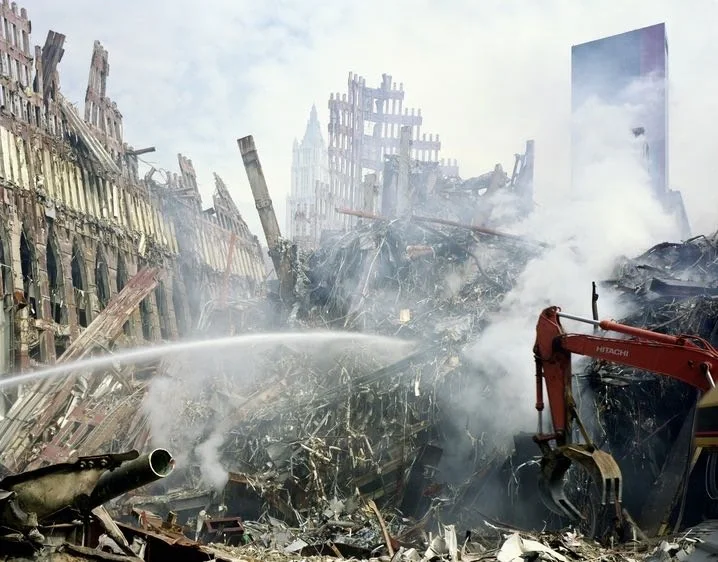
In writing the essay, he mainly wanted to warn us that excessive attention to traces can easily lead viewers into aesthetic evasion, and that overly open meaning may cause people to lose awareness of an event's politics and of the responsibility to take political responsibility. This was his warning about photography's visual turn.
Around the 1970s and 80s, American documentary photography gradually became highly institutionalized and museumified. If you're interested, look up the essay "Fitting Photography into the Modernist Mold, circa 1970," which systematically describes how New Documents, New Color, and New Topographics were absorbed into the art institution by curators and museum staff such as Szarkowski, further establishing their canonical status. Tonight's focus is Britain, so I won't expand on the comparison.
To understand why Britain turned and why the results differed so much from America, we need to look at Britain's own historical conditions. I'll briefly touch on a few factors and focus on the last one.
A 1976 essay specifically discussed the state of British photography at the time, pointing out a fact: although Britain was one of the birthplaces of photography, for a long time it did not recognize photography as art. MoMA in America began collecting photographs in the 1930s, and several generations of curators built, through exhibitions, publications, and education, a discursive system that established photography as art. But Britain was much later. London's Victoria and Albert Museum, the V&A, didn't create a dedicated assistant-level post for a keeper of photographs until 1976, and even then it wasn't a dedicated photography curator.
British documentary photography lacked institutional support at the time, and worse, mainstream taste rejected the straight photography we now take for granted. According to Gerry Badger, straight photography uses the camera's raw, basic mechanical recording function, but with expressive rather than functional aims. The most typical example is Alfred Stieglitz's Equivalents: he used directly photographed clouds to express a mental state, whether oppression or transcendence; in any case with an expressive aim, not for use as news or commercial photographs.
That is the aesthetic of American straight photography, but the British academic system prized pictorialist taste, a rather retro sensibility. Gerry Badger also said that the British documentary tradition was largely confined to mass-circulation periodicals, a product of a ruthless system, the domain of hacks and professionals. Newspaper photographs were tools, and photographers and their products were used for propaganda, commerce, and other practical purposes. That was the mainstream identity of British photographers, and it was hard for creative space and authorial self-awareness to emerge.
Another interesting factor is that British literature and photography were deeply entangled from the very beginning, even from photography's invention, including the pictorialist theory I just mentioned. I won't go into detail; those interested can consult the relevant books.
From the late 1960s to the early 70s, British documentary photography began to change. For example, Creative Camera was founded, and The Photographers' Gallery opened in 1971. The magazine systematically introduced American photographic theory to Britain, especially Szarkowski's The Photographer's Eye and the content of the "New Documents" exhibition, through reprints and features.
In 1972, The Photographers' Gallery in London held an exhibition of new American photography. You can see on the nameplates in this image Friedlander, Meyerowitz, Winogrand, Arbus, and others, whose work was introduced through the exhibition. Later there were exhibitions of Evans, Eggleston, and others. These exhibitions and publications let British photographers see directly that photographs could be taken this way, that documentary photography didn't necessarily have to serve publishing but could have its own purposes.
This change carried forward American influence and is key to understanding British photography in the 1980s. As various British arts councils began investing in photography and mounting exhibitions, a body of social documentary work gradually emerged. But the "social documentary" here was already fundamentally different from traditional documentary photography, because its intention had changed fundamentally.
A line Szarkowski wrote in 1967 for the "New Documents" exhibition shows this clearly: the use of documentary photography shifted from promoting social reform and pressuring bureaucracies to change, as in the Farm Security Administration (FSA) project in America, to personal expression. He said then that these photographers' aim was not to reform life but to know it. This attitude also influenced British documentary photography.
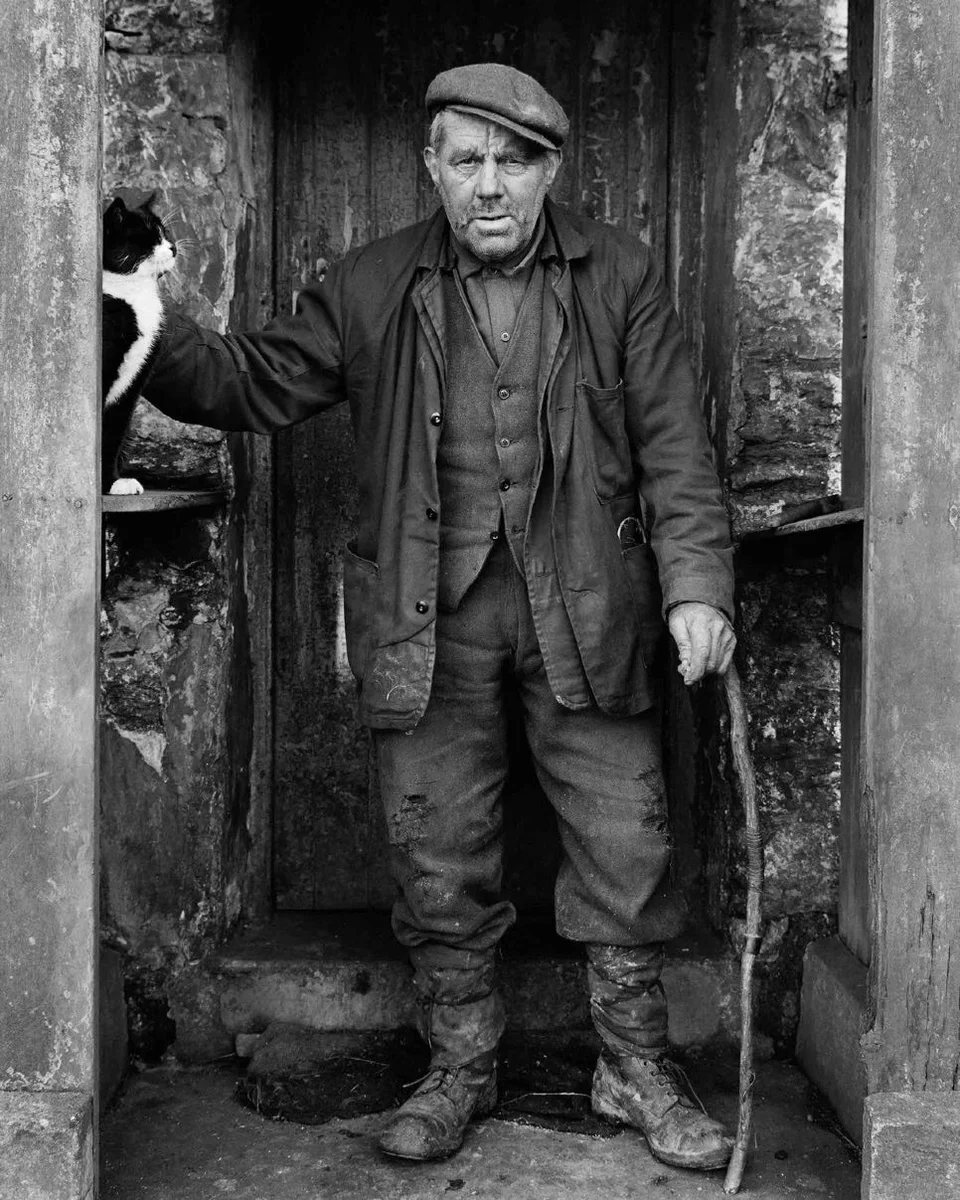
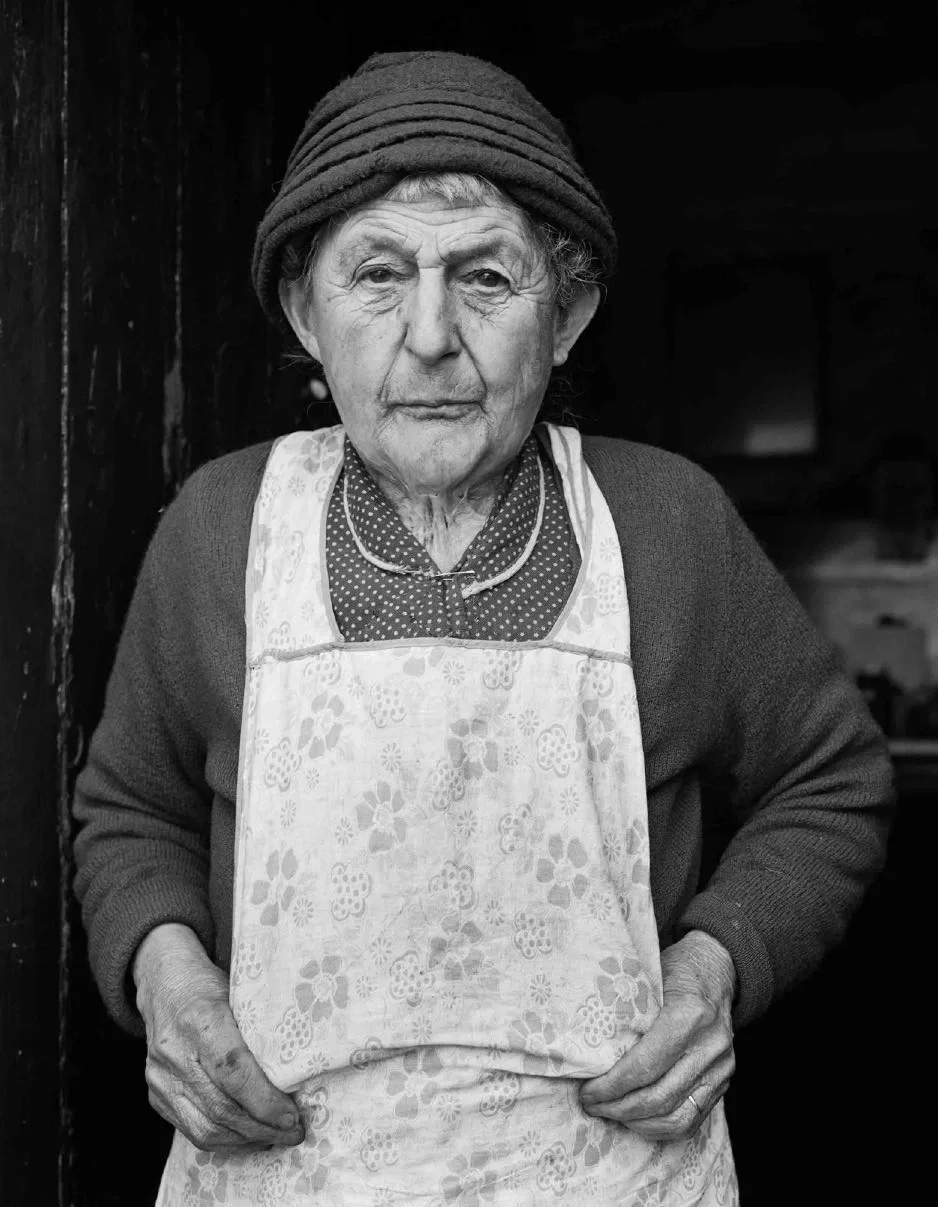
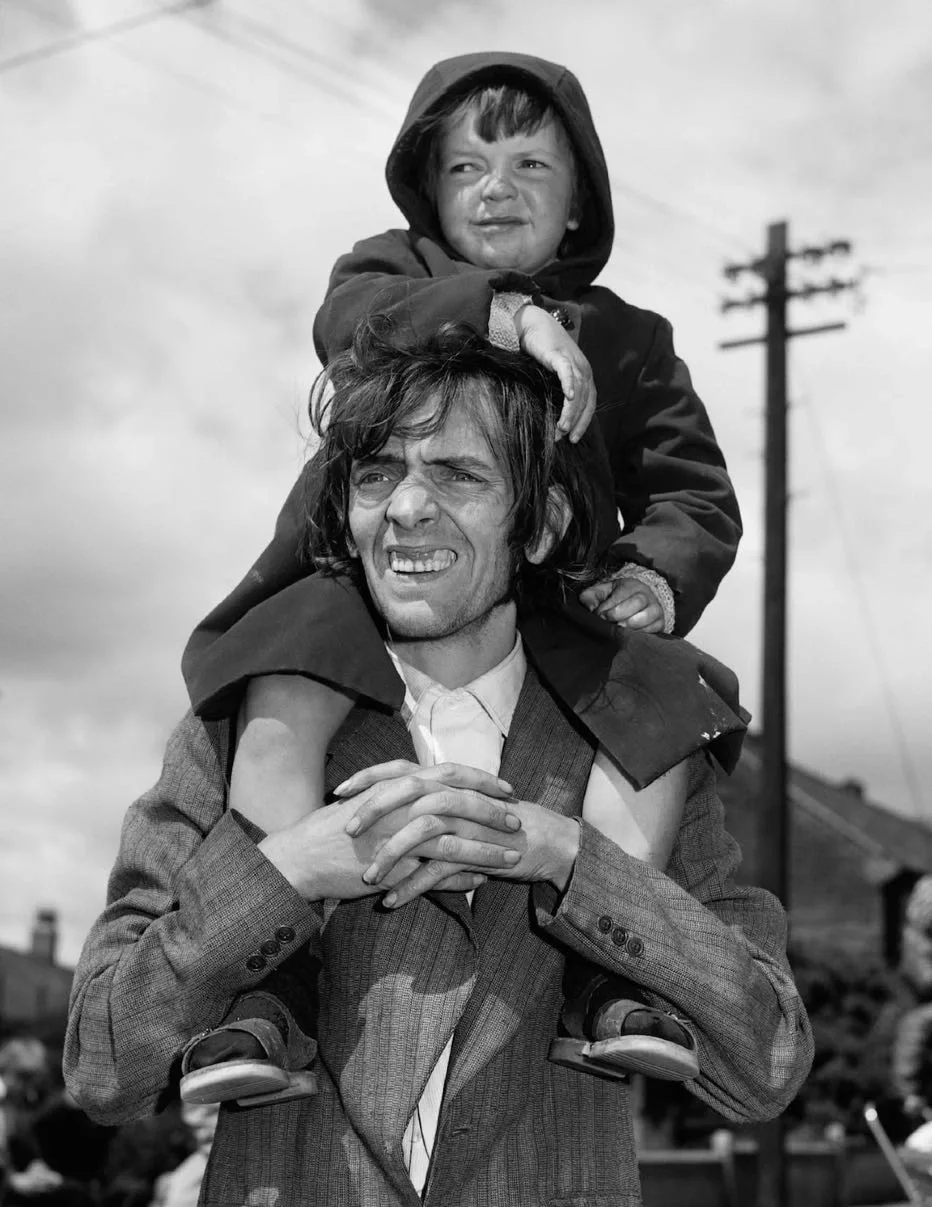
How exactly? Let's look at a very representative British photographer, Chris Killip. On the left is his first photobook, Isle of Man, published in 1980; on the right, In Flagrante, from 1988. They're eight years apart. What's the difference? The covers alone may give you some sense, but looking at the photographs makes it clear.
Killip grew up on the Isle of Man and began this project around 1970, when he was very young, only twenty-four. The visual language of Isle of Man is on the whole fairly traditional: landscapes, people, very calm, the familiar tradition that renders subjects with great dignity but relatively lacks lively vitality.
By In Flagrante in 1988, the visual grammar had changed enormously. It contains many frenzied, even violent and oppressive pictures. Look at the people's expressions: the calm of Isle of Man is almost nowhere to be seen. He shifted from calm representation to a stance of anger. Something must have happened in those eight years to bring about such a change in visual style.
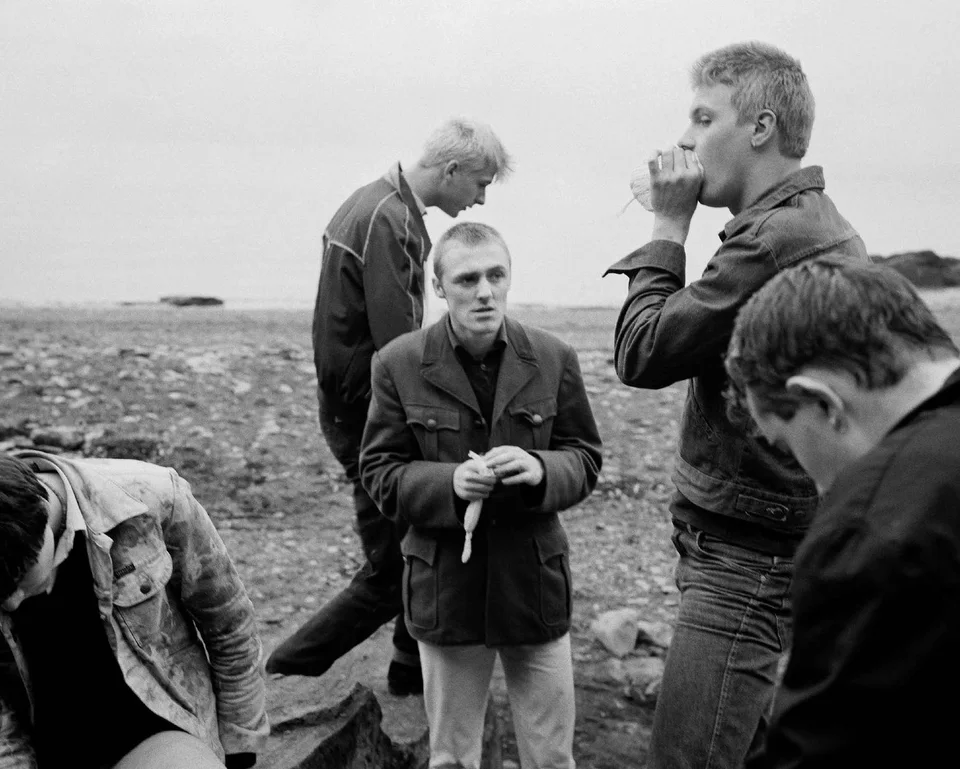
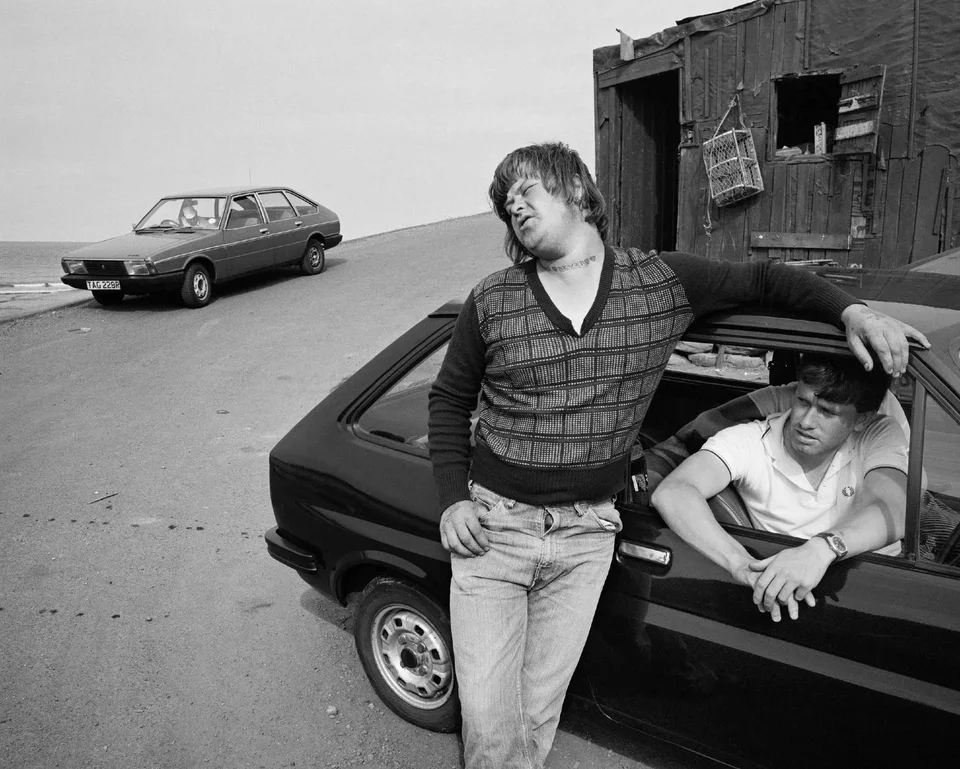
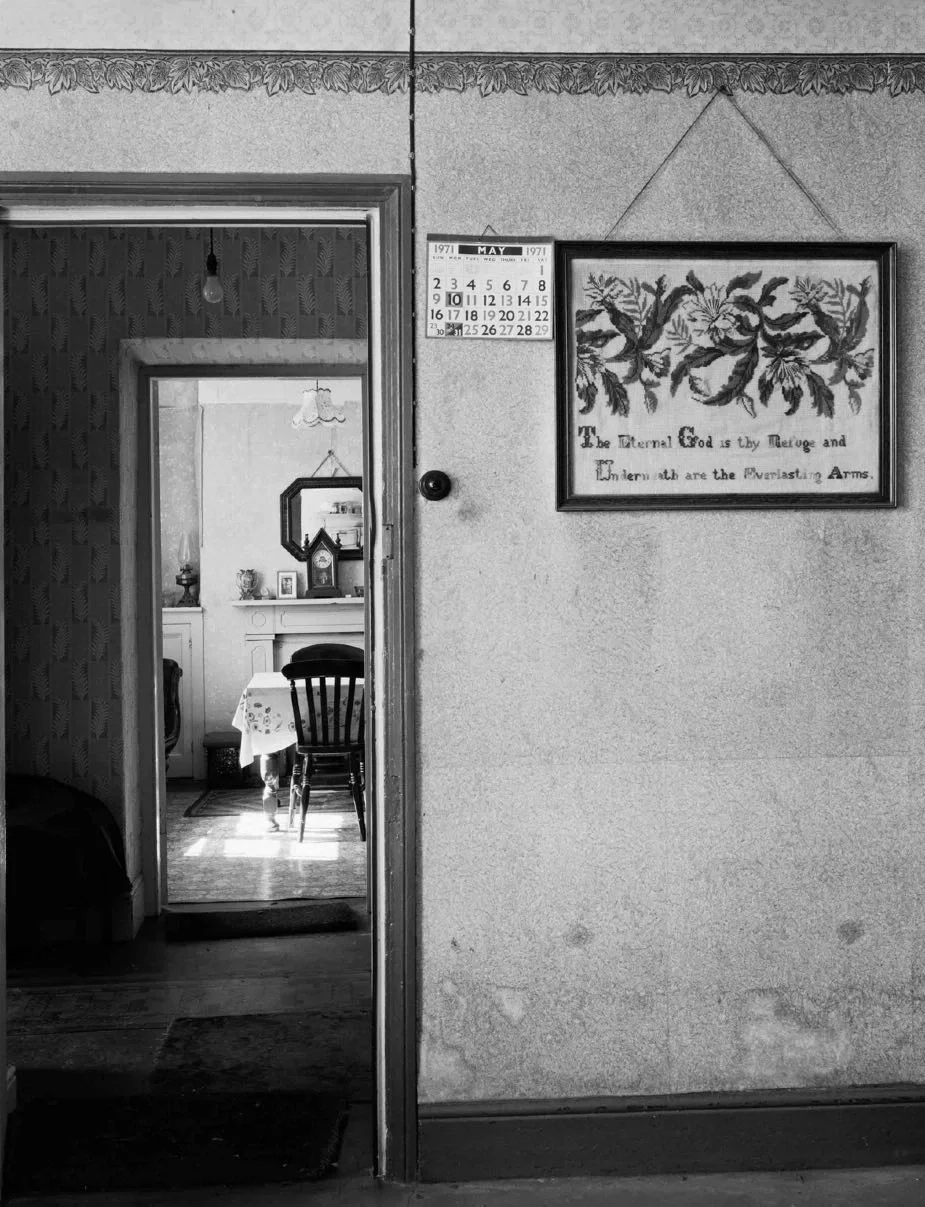
And the change didn't happen to Killip alone. The miners' strike of 1984–85 very likely heightened his political consciousness. The entire British photography world was strongly affected by changes in the political and living environment. The question is: what happened in Britain that ultimately led its documentary photography down a path completely different from America's?
In 1970s Britain, such a social crisis couldn't bring about only economic change. Just as we live in our own era now, I think everyone can relate: what goes deeper seems to be an all-pervasive psychological state, or, as I just said, in Raymond Williams's words, "social experience in solution." And if we confine this "social experience in solution" to the realm of the subject, we find another way to describe it: at this point there appeared a particular form of subjectivity that occurred only in 1970s Britain, which we can call a cognitive split. This split is of course not a psychotic split. What it means is that a person, or a social subject, facing reality, is in a complex state: on the one hand, all the earlier images and propaganda, including the bombardment of ideology, told them what the world should look like, what our tomorrow should look like; but on the other hand, they saw so many things collapsing in real life. It was these things that kept pushing such social subjects to ask: what is our world really like? Why has it become like this? That is the kind of split it is.
So when it comes to photography, you find the consequence was that the British of that time gradually found the most direct realist photography, the most direct kind like the FSA, less appealing. Here I'm talking about ordinary British people of the time: one thing was very, very obvious, namely that traditional "what you see is what you get" photography couldn't provide the explanation people needed. Because what a photograph looks like doesn't mean it automatically gives you an explanation of "why it's like this," right? It can only give you an appearance; that doesn't mean you can directly obtain knowledge about the event from the photograph. It couldn't satisfy what I just called the "will to know."
In short, people at the time didn't really want to obtain an objective reality through photography, nor did they completely stop caring what reality was like. What mattered most was that "will to know": I want to regain my right to interpret reality. We want to know the truth; we don't want you to tell us directly that "actually there is no truth." One contribution of the poststructuralist theorists of the time to photographic theory was to tell everyone that so-called truth is always determined within a system, that there is always something determining what counts as truth, which means there is no single, eternal truth. People started believing all that then, but human curiosity doesn't accept such an answer. You can't simply tell me, "Truth doesn't exist, so you don't need to look for it." That can't explain their anxiety about reality.
And why was there a problem when this arrived in Britain? Because in Britain, to shoot this way, you had to deal with the relationship between photographer and subject. As I just said, for Szarkowski, the ideal modernist photographer was the flâneur figure described by Benjamin and Baudelaire: someone without the burden of economic production or social survival, like a person who could stroll outside all day, gathering into his lens all the myriad things he saw in urban life. He and the people he photographed were basically strangers. Because the photographer was an outsider relative to what he photographed, he could, with a clear conscience, treat the other person as a visual object to be manipulated. This detached ethical stance was ultimately transformed in America into a source of aesthetic value, a basis guaranteeing that a photograph was self-contained and could grow on its own like an organism. Because according to that logic, once a photograph was taken it no longer had to answer to reality; it answered only to itself, that is, to the medium of photography. This could work in America's fast-moving urban society, but in Britain, especially in traditional industrial cities like Newcastle and Liverpool, it was completely different.
Szarkowski believed a good photograph should be decontextualized: only by severing its connection to a specific time and place could it transcend context and reach a more universal artistic realm. But in Britain, wanting to transcend context in this way felt, even intuitively, immoral. In America, because people wanted to make photography an autonomous medium like painting, curators and galleries tended to ignore the specific circumstances in which photographs were taken and produced, and this was often regarded as a triumph of art. But in Britain it meant you were being irresponsible toward our history. Because in Britain, the specific historical context of a photograph was the source and foundation of all its meaning; without it, there was no point talking about your photography at all.
Because British photographers were insiders relative to their social reality, they couldn't truly become flâneurs. Their bodies, their emotions, the whole social atmosphere didn't allow them to be so autonomous; history surrounded them on all sides.
Because people like Martin Parr and Paul Graham weren't only learning American color photography, weren't only learning from Stephen Shore and William Eggleston. As I just said, in America color leaned toward form, toward photography's own value, but for the British it had to be socialized and politicized.
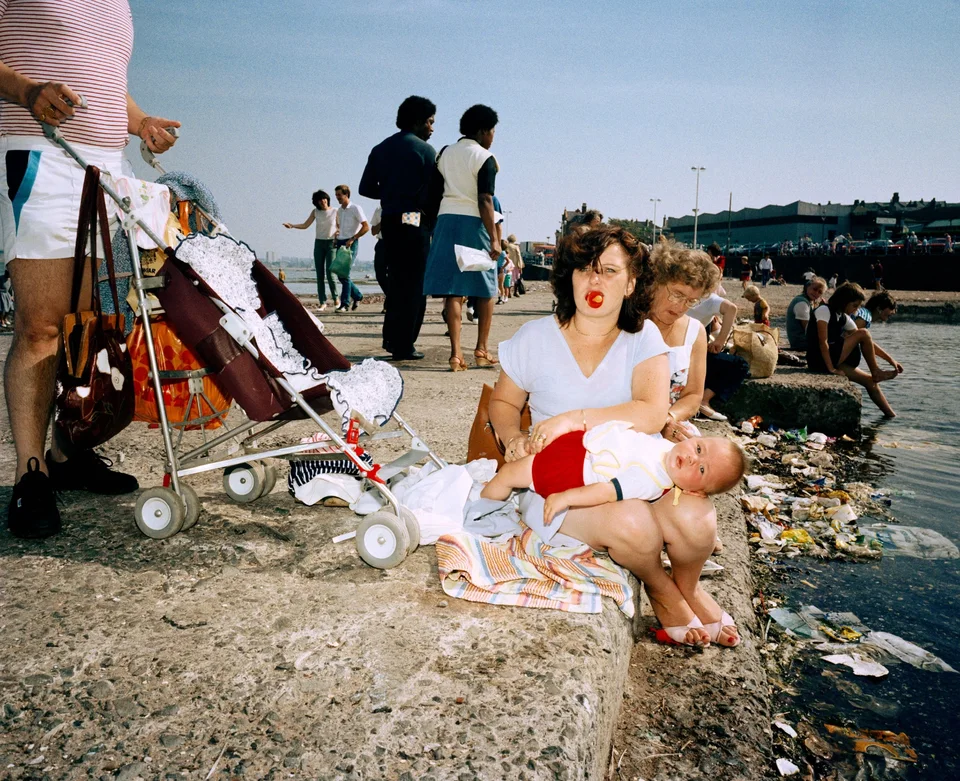
Look at this photograph: the water is full of food wrappers and plastic trash, very murky, nothing like the blue ocean we imagine. A tiny baby and its mother are only a few centimeters from the filthy water. The key is that no one in the picture shows any reaction to the dirty water; they're used to it.
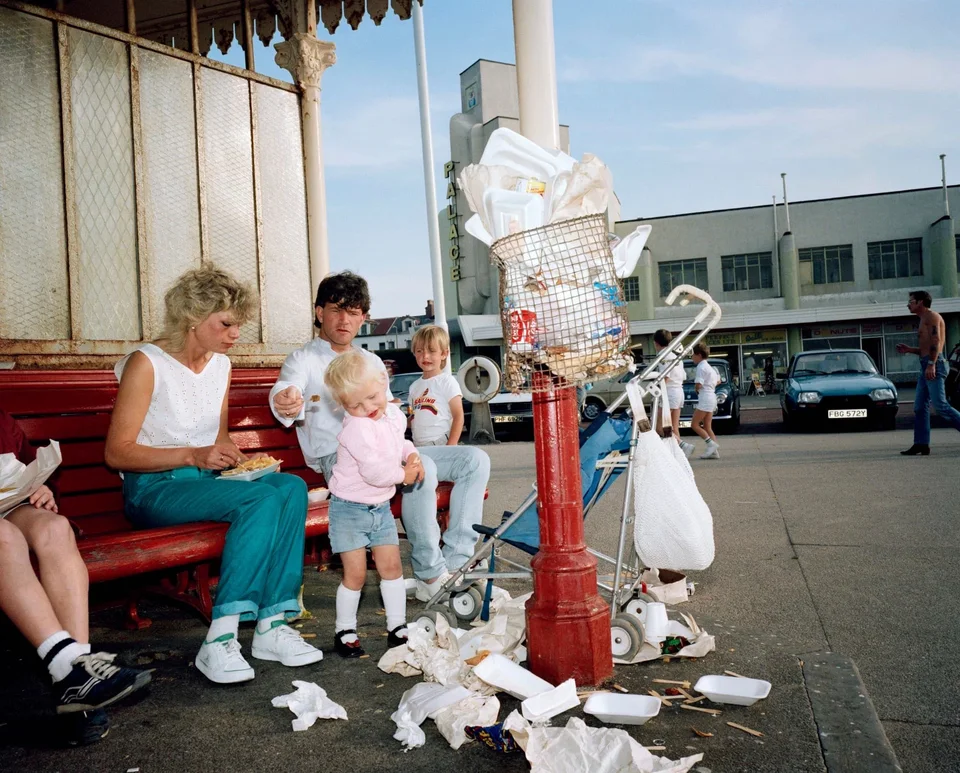
The pram is hung with many things, a brown handbag, a plastic bag printed with a brand logo; the mother wears a typical 1980s synthetic dress, her hair messy. In this series and in work from the same period, Parr kept focusing on consumer signs, trying to depict what the texture of life had become for Britain's lower working class amid the tide of consumerism promised by the Thatcher government.
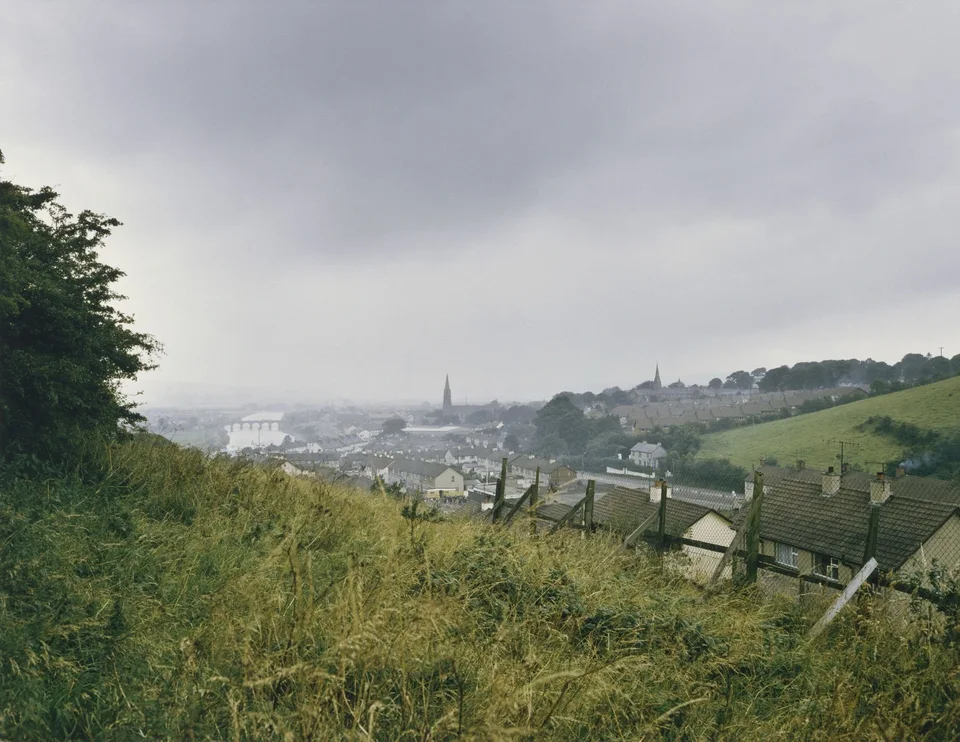
Why do I say my presentation echoes the two teachers' talks? Because Paul Graham photographed Troubled Land in Northern Ireland. If you understand the social context there, you can see why the photographs have an oppressive, gloomy atmosphere. In 1981 there was the hunger strike; Northern Irish society was split between loyalists and republicans, two irreconcilable camps with deep hatred, and it seemed very hard to resolve through political or peaceful channels.
At first glance this photograph looks like a typical British rural landscape, but zoom in a bit and there are IRA propaganda posters on the telephone pole, often printed with portraits of hunger strikers. And over here it says "IRA," the abbreviation for the Irish Republican Army, along with republican battle slogans.
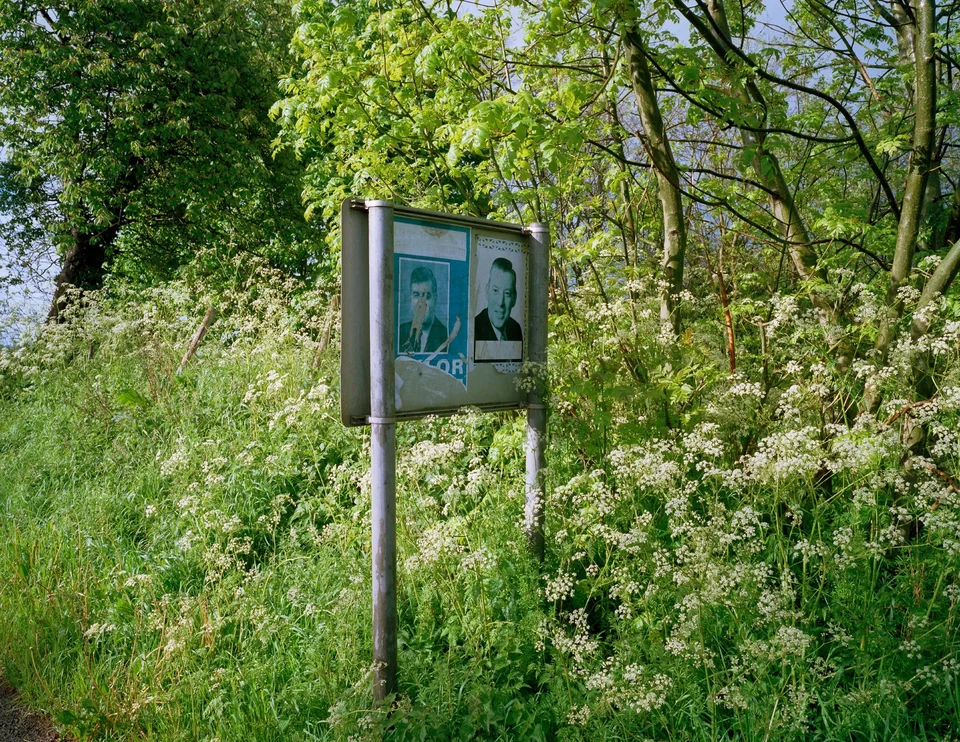
Graham is very restrained, treating these as part of the landscape. You don't see the burning cars or people with exaggerated expressions of traditional conflict imagery; you don't see events, only landscape. But tension and danger have already seeped like air into every aspect of daily life, even becoming background noise.
In this one, the most prominent word in front is "Beware." Beware of what, and why? No answer; what's presented is a pervasive anxiety. Beyond the concrete barriers is a typical Northern Irish working-class housing estate, the houses uniform. Look more closely, and there's a tiny British flag on the lamppost.
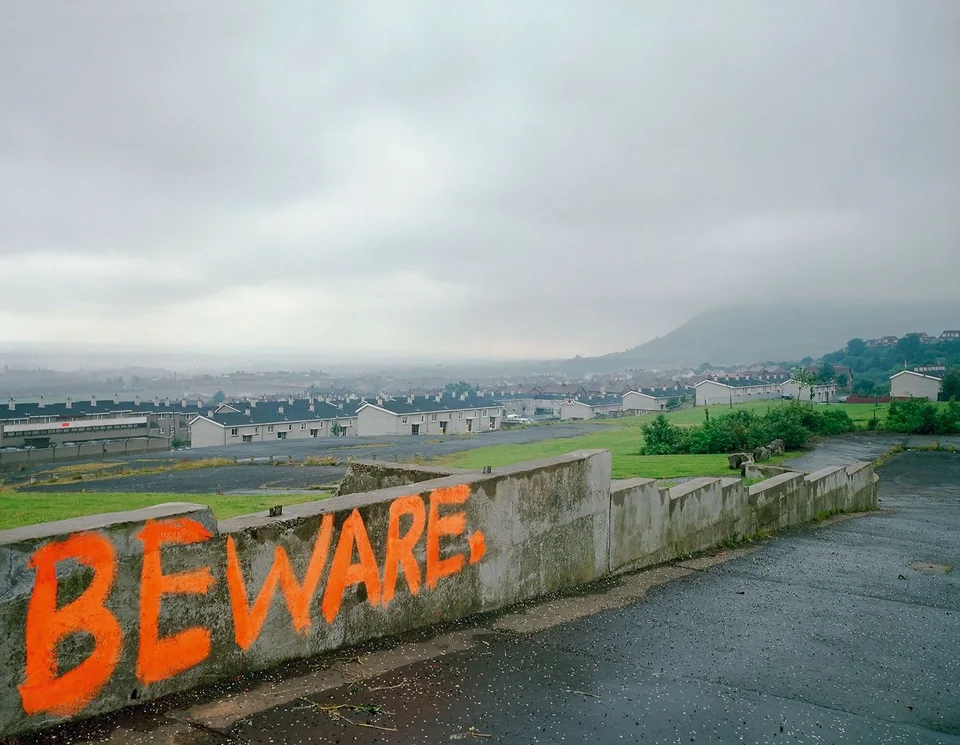
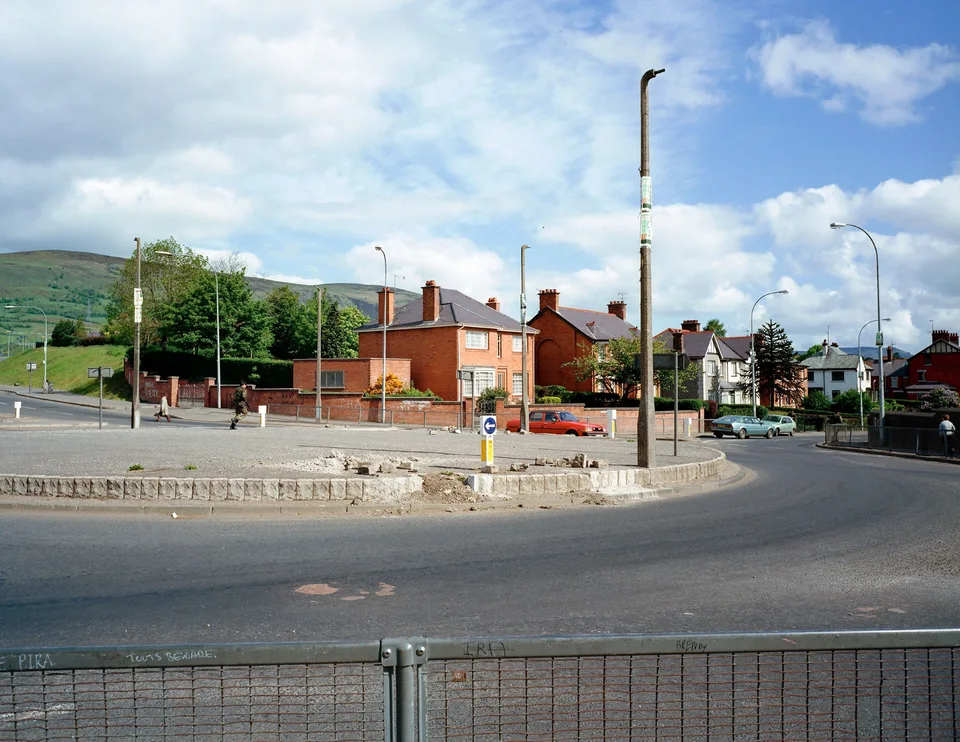
British flags and Irish flags here are territorial claims, marking the respective turf of loyalists and republicans; neither may enter the other's territory. But Graham handles it with great restraint.
This one is also a fairly peaceful scene; only on close inspection do you notice a British soldier in camouflage on duty. He almost blends into the vegetation behind him, yet he's fully armed, rifle slung. This series shows that the war machine doesn't disrupt life from outside; like the other people and things one sees every day, it has become an inseparable part of the landscape, and violence has gradually been internalized as the normal state of local life. Here the railings I pointed out earlier appear again; this is how Graham represents it.
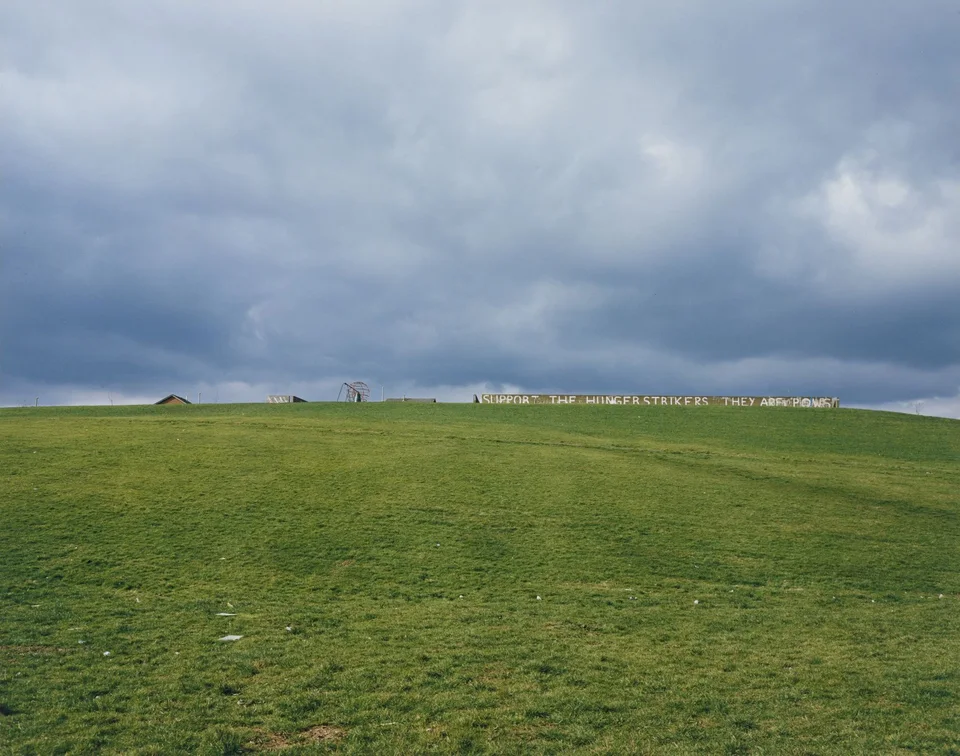
Now the slogan in this open scene points to the 1981 hunger strike, defending the protesters and demanding that the British government recognize them as prisoners of war with political status rather than ordinary criminals. For the Thatcher government they were terrorists; for republicans this was a legitimate war against colonial occupation, and captives should receive POW treatment under the Geneva Conventions.
Graham didn't rush up to the slogan wall for a close-up. He placed the slogan within a larger landscape, letting a large green slope occupy half the frame, with heavy dark clouds above. A political declaration of life and death becomes a thin line. It was originally just an ordinary hillside, but because of the protest writing, the nature of the landscape has changed.
In this last one you may not see anything special. I'll just point out one thing: notice the tiny Irish tricolors, which point to a republican parade, and there's a group of small figures moving about. This is still a representation of the normalization of violence.
But if you don't understand what the situation in Northern Ireland really was, and you look at Paul Graham's Troubled Land, basically all that's left is a game of details, and you completely fail to grasp the intent of the whole work.
Finally, let me conclude with a passage from Susan Kismaric:
"The radical changes now taking place in British life have given these photographers an artistic mission: to look at themselves and the landscape they inhabit. If earlier British documentary photographers mostly photographed 'the other,' people outside their own social class and often worse off than themselves, these photographers have instead embraced what is closest to them. Their work, while unflinchingly presenting the country's most extreme ills and the complex manifestations of the economic changes reshaping its social fabric, also reflects their deep feeling for their country and their compatriots."
I went through it rather hastily and spoke fast. That's all for my presentation; I'll hand the time back to the teachers.
Ce Zang
Guosen was concise, but the amount of information was huge. We have only twenty minutes left, so the remaining presentations will have to be as concise as possible, covering the most crucial points first. There's so much content tonight that if need be we'll do another session; good material deserves continued discussion. Rong Jiang, let's move quickly.
Multiple Paths Beyond Documentary
Rong Jiang
Dan Luo, as an artist, spoke about his creative insights, and Guosen, as a scholar, analyzed the transformation of British documentary photography. Both were very persuasive, showing us how one moves from traditional documentary into new documentary. Time really is short, so I'll quickly share the other experiments of the 1980s and 90s and since the start of the twenty-first century. Earlier we mainly discussed using straight photography to move beyond documentary; in fact there are many other methods. I'll try to finish in ten minutes.
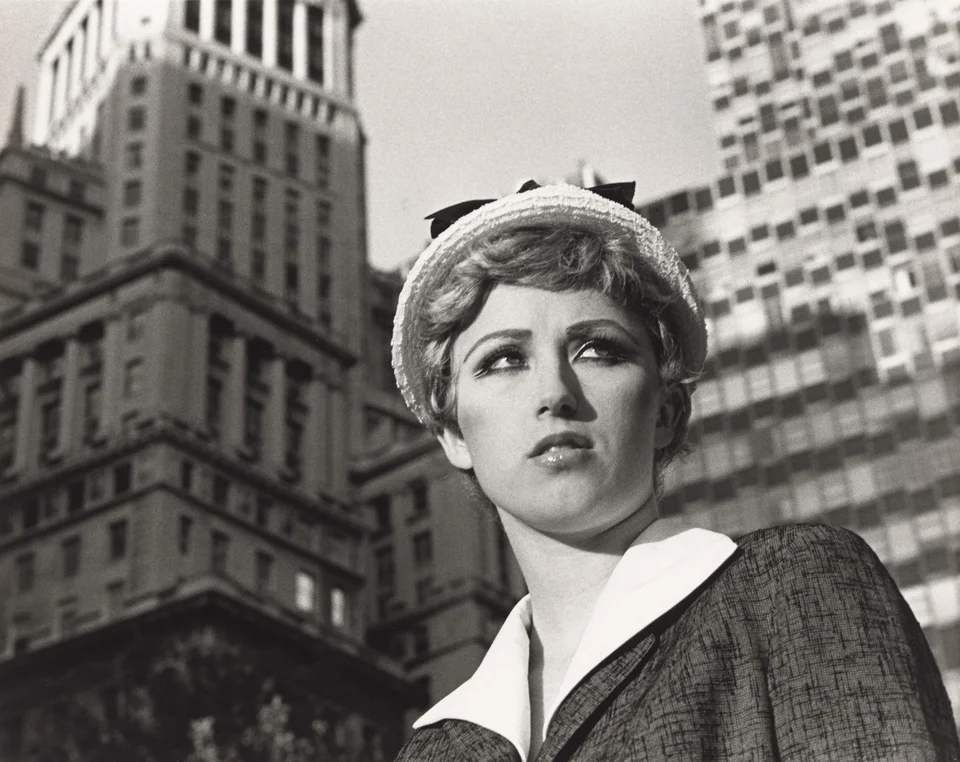
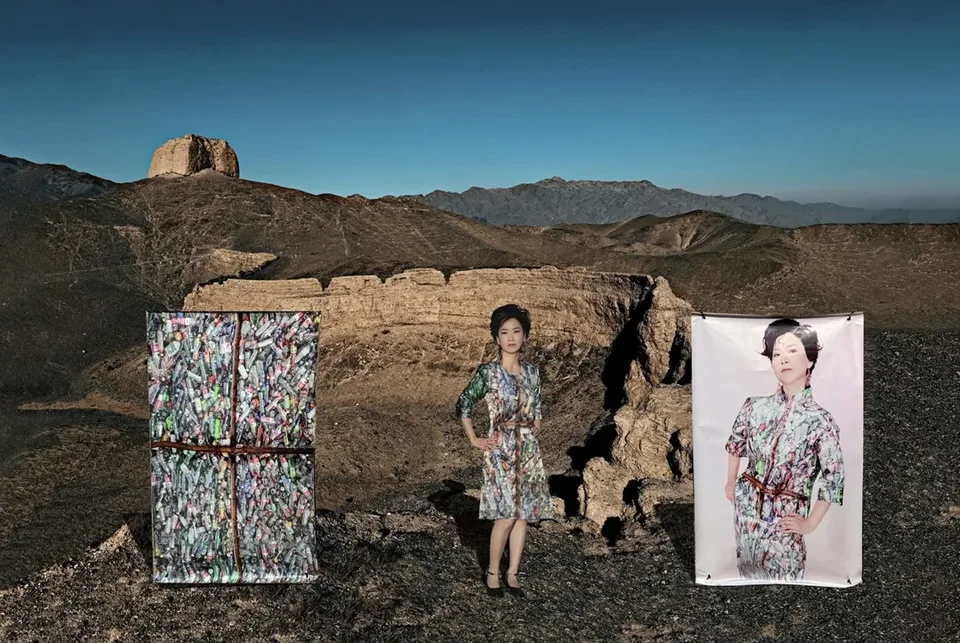
Everyone knows this photograph, so I won't say much. Cindy Sherman is a leading figure of the Pictures Generation; by playing various roles herself, she reflected the stereotypes of women in television and film. Recently I found similar attempts in China. Lijuan Zheng compressed recycled cans, photographed them, turned the images into fabric she wore, and took self-portraits beside scenes displaying recycled samples. This too expresses ideas through role-playing, different from traditional documentary.
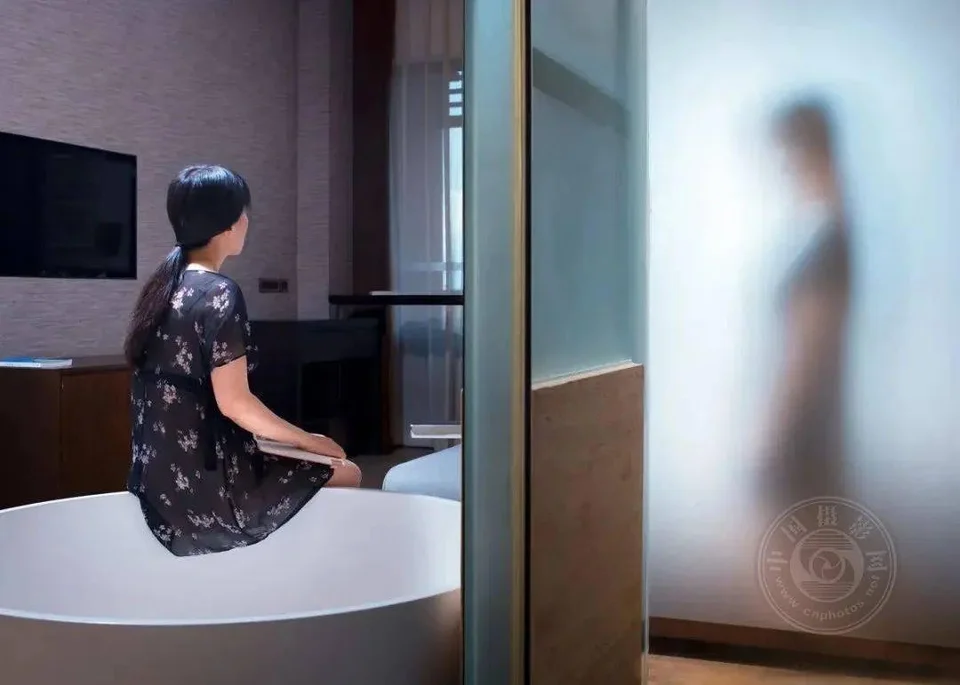
During the pandemic, Xueya Wang played different roles at home, perhaps exploring her own identity. The series is very good and was recently shown at the Jimei × Arles photo festival; do go see it.
Another Pictures Generation photographer, perhaps less familiar to you, is James Welling. He took precisely the opposite road from the transparency of straight photography; his images are like modern poetry, not immediately understandable. This work invites different readings: it looks like rushing water, or like mountainous terrain seen from above, but it's actually just a sheet of aluminum foil used to wrap food.
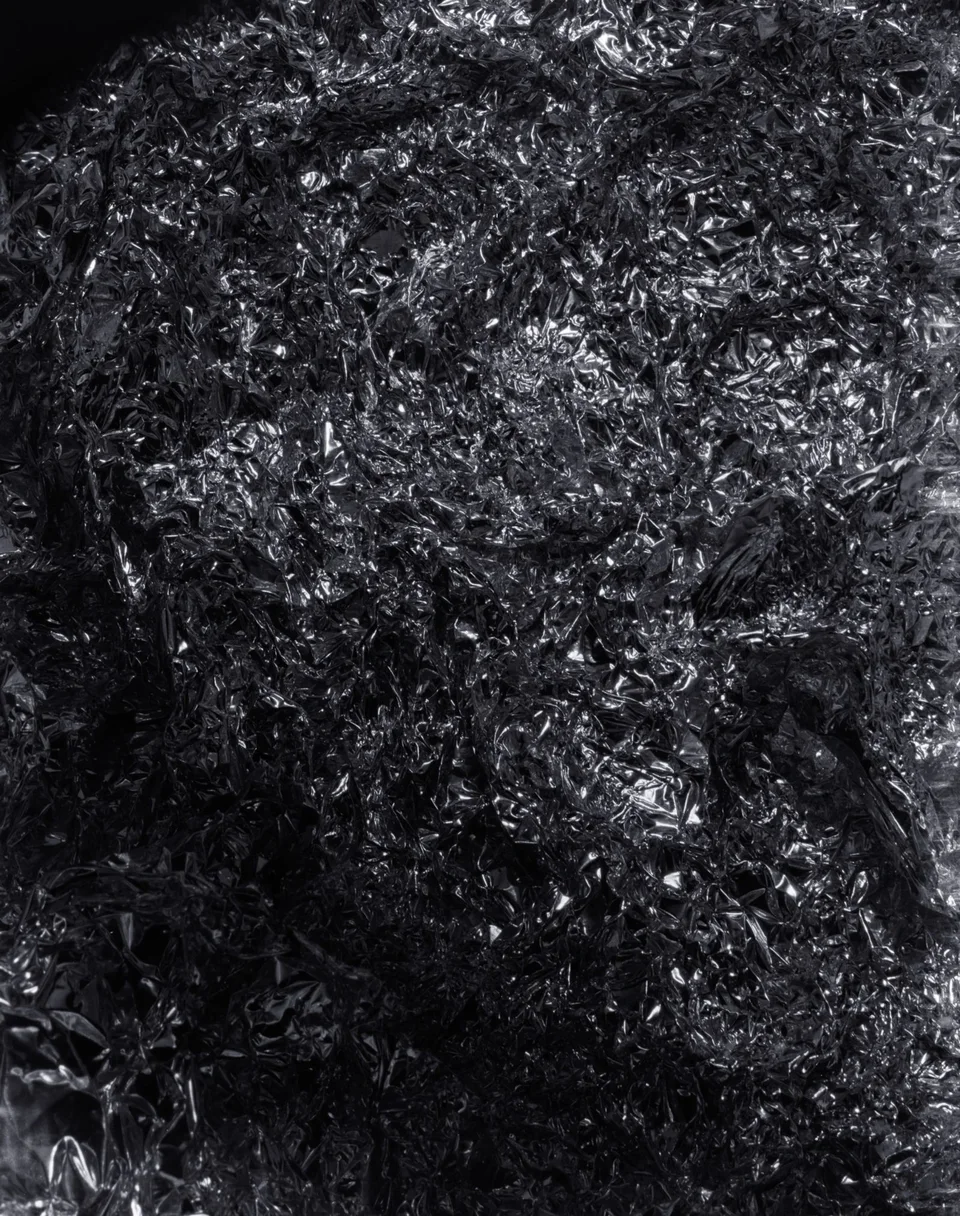
This approach between abstraction and figuration makes us question how far pictures and images can produce truthfulness. Ruff made similar attempts. He enlarged portraits enormously, roughly 2.1 by 1.6 meters; those who went to the Lishui exhibition will have seen them.
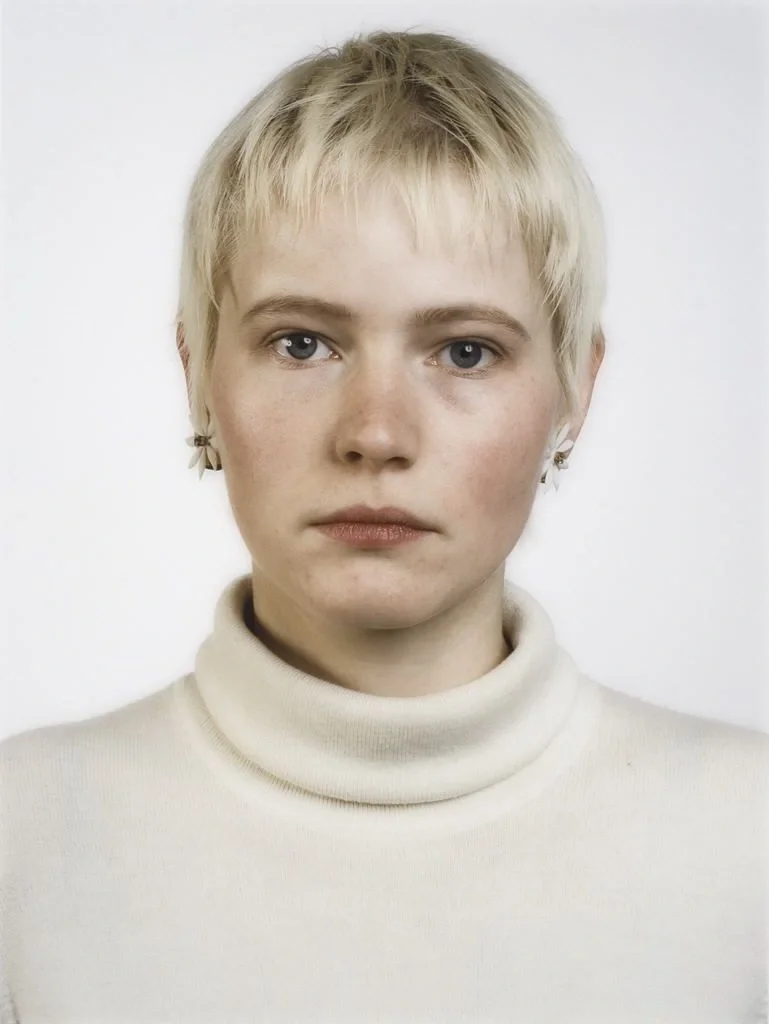
When we gaze at such a huge portrait, our attention is no longer just on who the person is; we also think about what effect an image produces when enlarged this much. This is the embodied experience Ce Zang often mentions. Traditional portraiture also has the potential for innovation; French critics call this the effect of the tableau.
In the twenty-first century, with the development of digital technology, Ruff also found that even when pixels aren't sharp, if you enlarge the photo, the human eye can fill in the blurred parts and see concrete forms; the so-called "unreal" can become "real." Chuan Wang made a similar attempt: in Eight Views of Yanjing, his picture of the Lugou Bridge enlarges the pixels hugely, and the eye can still compensate. This explores what possibilities remain when an image has no negative, only digital pixels. It even recalls Impressionist painting.
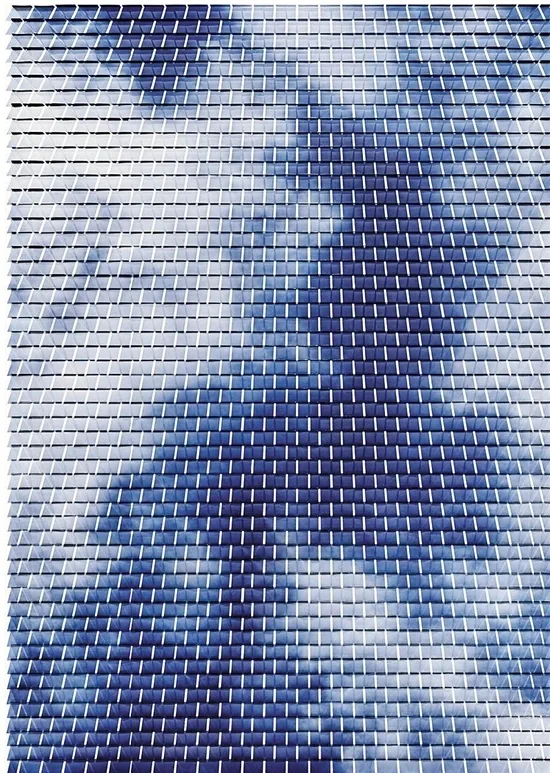
Ningde Wang's Form of Light no longer uses a camera to shoot directly; instead he combines pieces of film, which under light produce a relationship between figuration and abstraction.
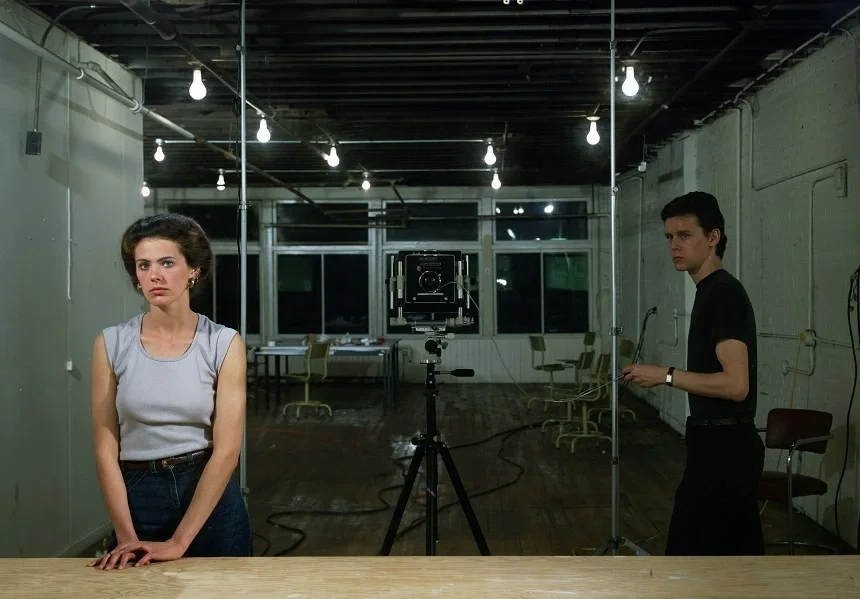
Jeff Wall never goes out shooting with a camera; he first observes scenes from real life, then restages them. For example, Picture for Women explores the power relations among camera, photographer, and subject, with very rich readability, and it is a re-creation based on a painting by Édouard Manet. He makes the works very large and presents them as lightboxes, so on the wall they can stand as equals with painting.
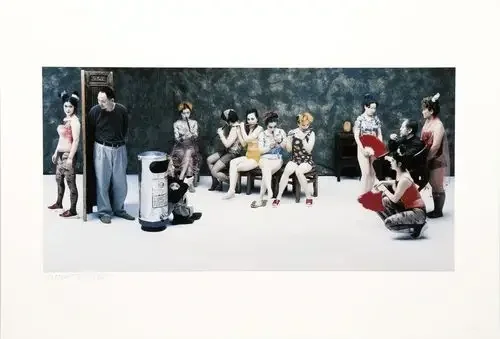
Qingsong Wang's Night Revels of Lao Li reflects the ecology of the Chinese art world after the Reform and Opening Up and the subtle relationships between critics and artists, drawing on the traditional Chinese masterpiece The Night Revels of Xizai Han. Only a detail is shown here.
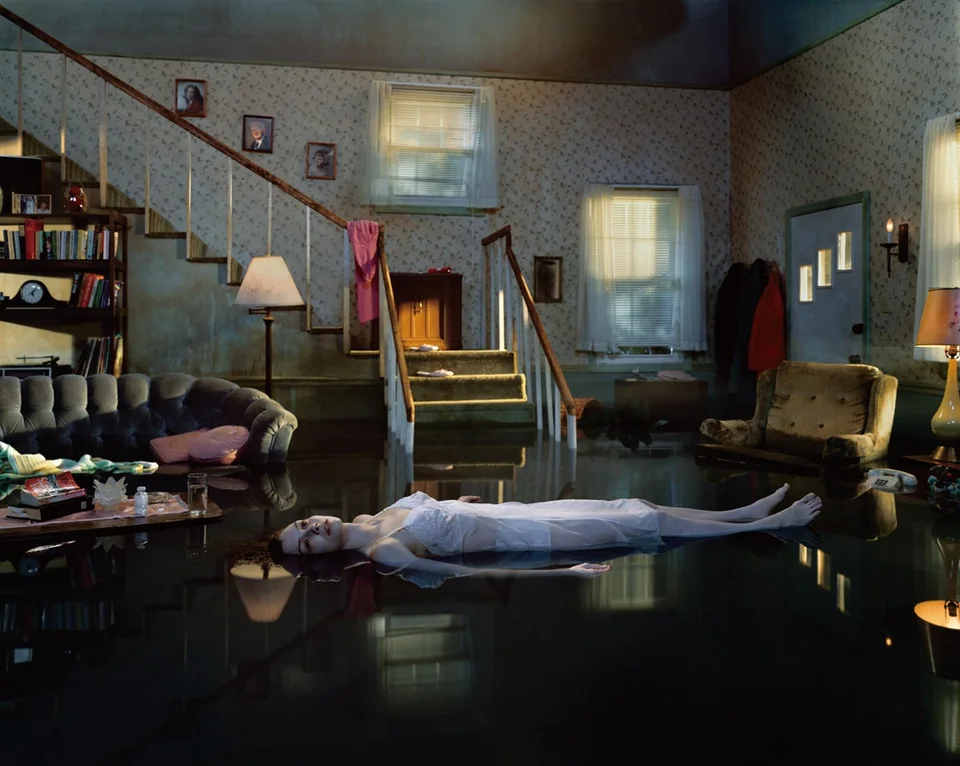
Next, the Yale School. I've been introducing Gregory Crewdson for a while, so you may know him. He also stages his pictures; the furniture and staircases are sets, with actors performing. He uses film production methods but presents the result as a still image, so it's also called cinematic photography, a combination of the real and the fictional, which is why I call it the Yale School.
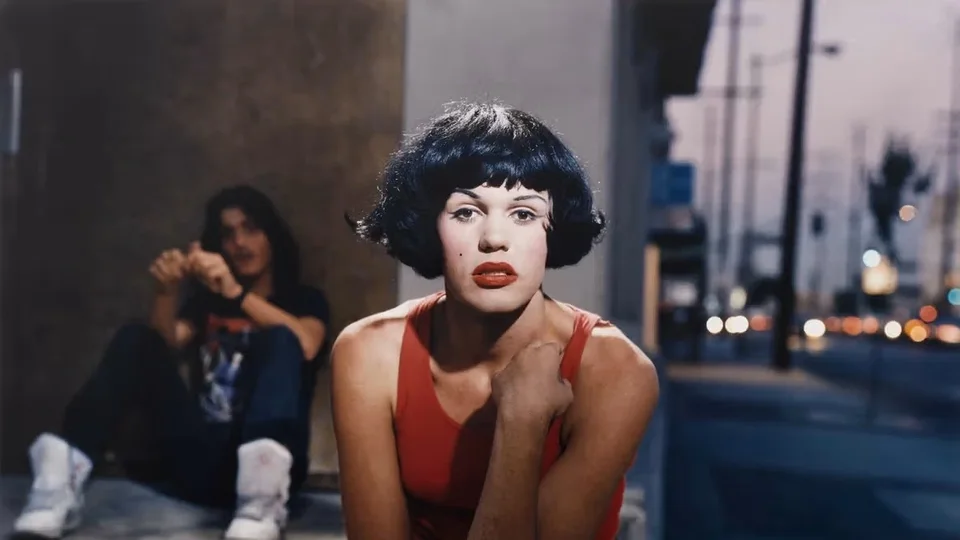
Philip-Lorca diCorcia, also a graduate of Yale's photography program, uses lighting to photograph lost figures on the street, like this Marilyn Monroe–like figure, very dramatic, again combining the real and the fictional. Liang Ma made Mobile Photo Studio in various parts of China, photographing subjects with the effect of stage drama, also such a combination.
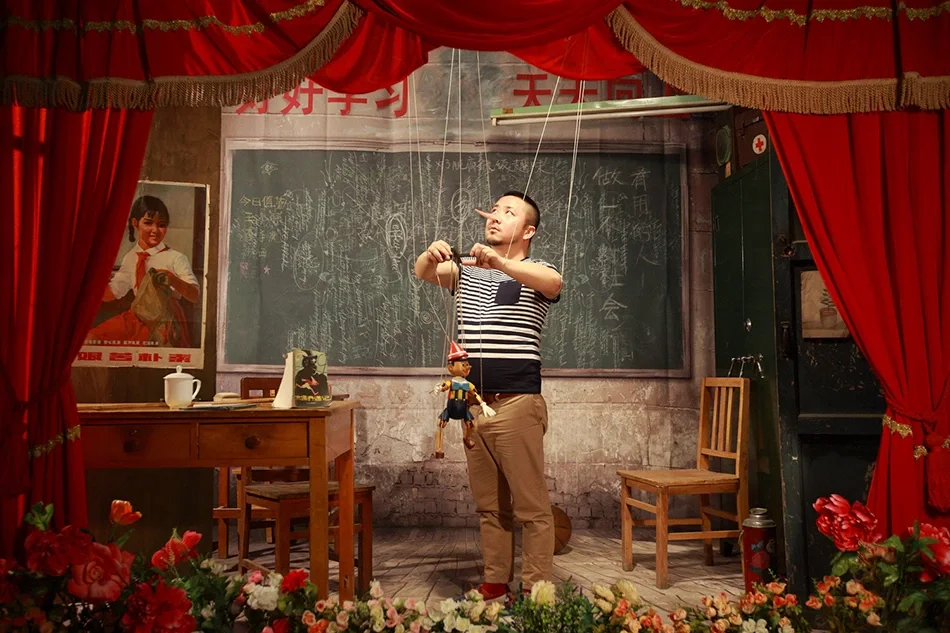
Changjiang Yan and Xiao Xuan'an's Return to the Mountains at first glance looks like animals returning to the forest after a great catastrophe, but it actually uses taxidermied animals. This opens the possibility of a second look.
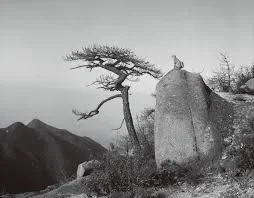
Sally Mann works with wet plate. Besides her family, she also photographed historical sites of the Civil War in the American South, using a large-format camera and wet plate. In a moment we might ask Dan Luo to talk about his wet-plate work Simple Song.
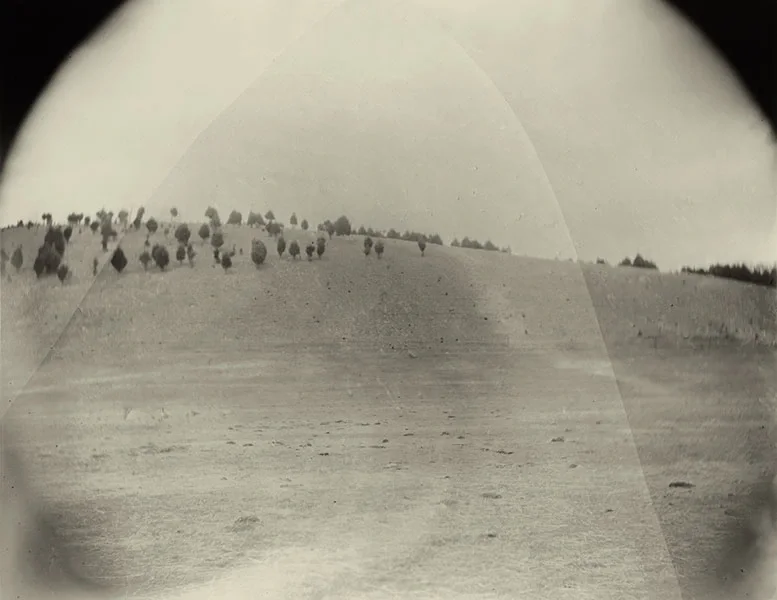
I also think of Lü Nan's Four Seasons: Everyday Life of Tibetan Peasants. Before 2004, before railways, highways, and throngs of tourists reached these places, he photographed daily life in villages at altitudes of four to five thousand meters. In these people's eyes you can see a kind of composure.
The young photographer Yangkun Shi also deserves special mention. He photographed the Forty Views of the Yuanmingyuan rebuilt at the Hengdian film studios in Zhejiang, using wet plate, then scanned and printed them digitally as postcards sent to a museum in the United States for exhibition. Images copied again and again, many times over, lead us to explore the relationship between image and reality, present and history.
In Mitch Epstein's American tragedy trilogy, for example in American Power, the foreground shows very tranquil everyday life, while the background is a power plant. The conflict between foreground and background, presented at a very large scale, gave me, when I first saw it, a feeling of walking into the picture.
You all know Alec Soth. Sleeping by the Mississippi is poetic throughout. For example, why are a discarded mattress and bed frame on the banks of the Mississippi, and why are there two flowers in front? It prompts much thought. I call this "lyrical documentary-style photography," a term derived from Walker Evans; it's an American tradition that continues all the way to Soth.
The Dutch photographer Rineke Dijkstra photographed beach portraits, reflecting differences in bodily and mental states between young people in developed Western countries and those in post–Cold War Eastern Europe. I call such portraits "liminal portraits," at the threshold between two states.
Jian Jiang's Archives of Orphans systematically photographed more than thirty orphans in Henan, enlarging the portraits to life size, then photographing their files and juxtaposing the two. This is also a concept-first attempt; it looks like documentary photography but is no longer traditional documentary.
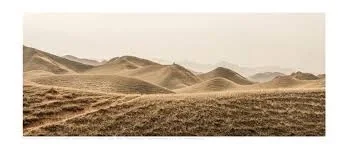
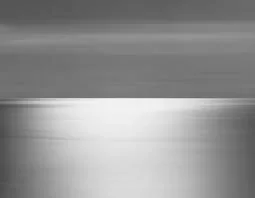
Dan Luo's later No Man's Land is yet another kind of attempt. After wet plate, he used a digital camera to shoot panoramic scenes with no one in them, yet we can fully feel the presence of people, the presence of history, the sense that history once took place here. Hiroshi Sugimoto's Seascapes is similar: it's about seascapes in memory, and of course it also has a Zen quality.
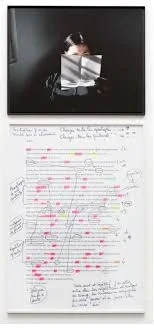
The French artist Sophie Calle also works concept-first. Her boyfriend sent her a breakup letter; she gave its last line to more than a hundred women to comment on, photographed their portraits, and juxtaposed them with their comments. This was the work that represented France at the 2007 Venice Biennale.
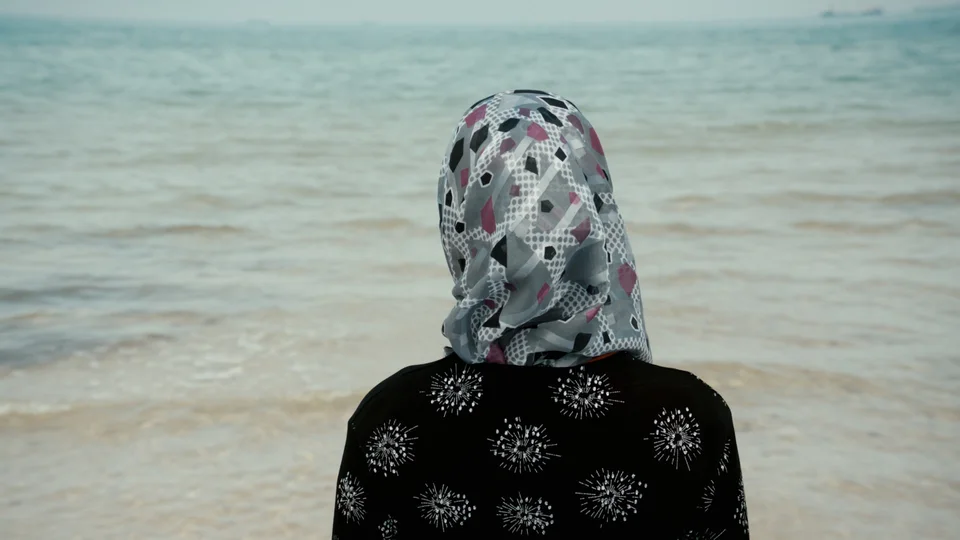
She also invited people who had never seen the sea to see it for the first time, first photographing them from behind, then, after they had looked at the sea and turned around, photographing the expressions on their faces, making Voir la mer. These photographs look like documents, like documentary, but they are already above the document, belonging to documentary-style contemporary photography.
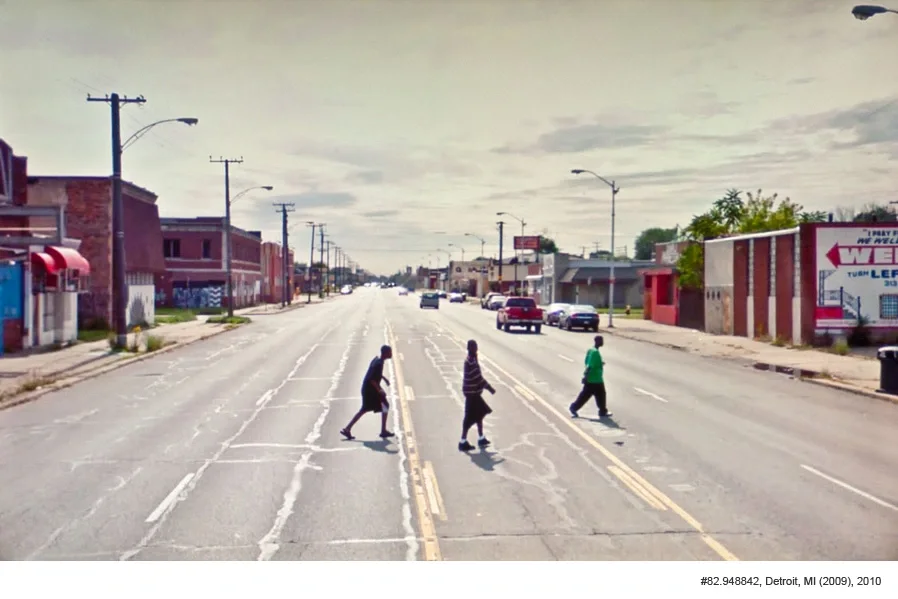
My last example is Doug Rickard. He opened Google Street View on a screen and rephotographed it with a digital camera. The places include the American South once visited by Evans, Shore, and Robert Frank, as well as other urban landscapes. Black Americans still live amid stark inequality; he rephotographed images from online street views to make A New American Picture.
All these examples of Chinese and international photographers show that we have countless ways to create documentary-style photographic works that are above the document. That's all from me.
The Visual Mechanisms of Looking and the Image
Ce Zang
Thank you, Brother Rong Jiang. I'll try to cover the most crucial points in under five minutes.
This is a page from Rong Jiang's book that I found especially interesting when reading it. He describes another lineage of documentary photography, which arose in France, with Eugène Atget. Some photography leaves its meaning within the image; some tries too hard, insisting on stating its theme especially clearly. Atget, perhaps intentionally, perhaps not, we don't know, sold visual documents to painters and artists, and representation and expression were those artists' business. He simply sold you images, visual material, and precisely because of that he opened up photography's greater latent possibilities.
What is the principle? This also relates to why I've always held that images are not signs. We say Atget's photography is documentary in character, so why was it once classed with Surrealism rather than realism? This contains a very important secret of photography, and it's also an important reason why "above the document" can hold and why images can have a second look: the "crossing of gazes."
When a photographer takes a picture, it is actually a "registration" of his gaze in a field of time and space. I call it the "registration of the gaze"; Rong Jiang knows it well and even helped me translate it into English. What the photographer directs his gaze at is a field. So where is the crossing?
The philosopher Nelson Goodman offered an idea that inspired me greatly, and I borrowed it in my essay "Let the Signified Wander," which I still haven't finished revising this year. He was talking about all pictures, not specifically photography: a picture exemplifies, or demonstrates, a concept. A photograph of an apple, for example, amounts to illustrating the concept "apple." But I think this issue needs deeper discussion in photography.
What the photographer directs his gaze at is a field, but the concept is something the viewer searches out within that field. What if I don't look at the apple but at the plate beneath it? What if not the plate but the table? Except for a very few reproductions, any straight photograph presents not just one object but a field. The photographer's and the viewer's gazes cross here; they don't correspond one-to-one. This is an important factor that allows the "signified" to "wander."
This is Yan Gao's work. Rong Jiang just mentioned New Color Photography, and I think the picture on the left is an important example. Yan Gao directs his gaze at this field. Following habitual viewing conventions, we always want to know what story is happening here. But this photograph suspends precisely "what the two people are doing." When I discussed this with Shore, I called it the "predicate": the predicate of the figures' action is indeterminate.
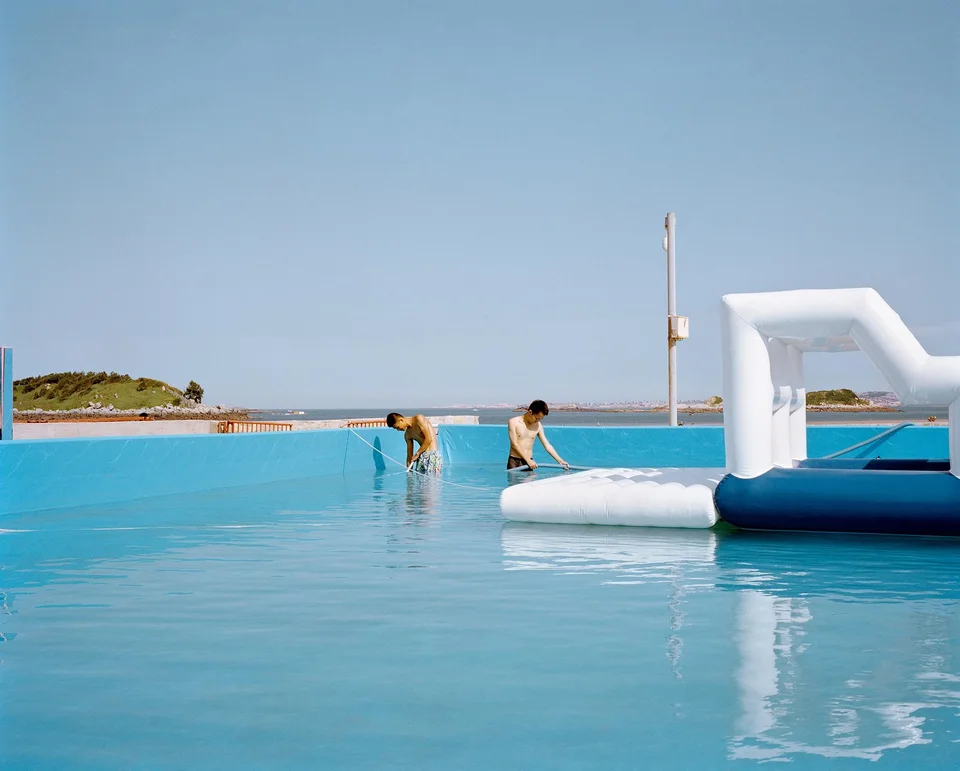
Precisely because of this, what we actually look at is color. There are five blues in the photograph: dark blue, light blue, a very intense blue, and a dull grayish blue. In the foreground is a swimming pool, in the distance the real ocean, and above, a grayish-white sky. You'll notice that the man-made pool looks more like the sea than the real sea, bluer, right? It structures the photograph with five blues; the key isn't what the figures are doing, not narrative, but structure.
A quick word on the picture on the right too: it's a youth hostel. The promotional banner that used to hang there was blown away by the wind, exposing the flagpole, and its cross shape forms a visual metaphor.
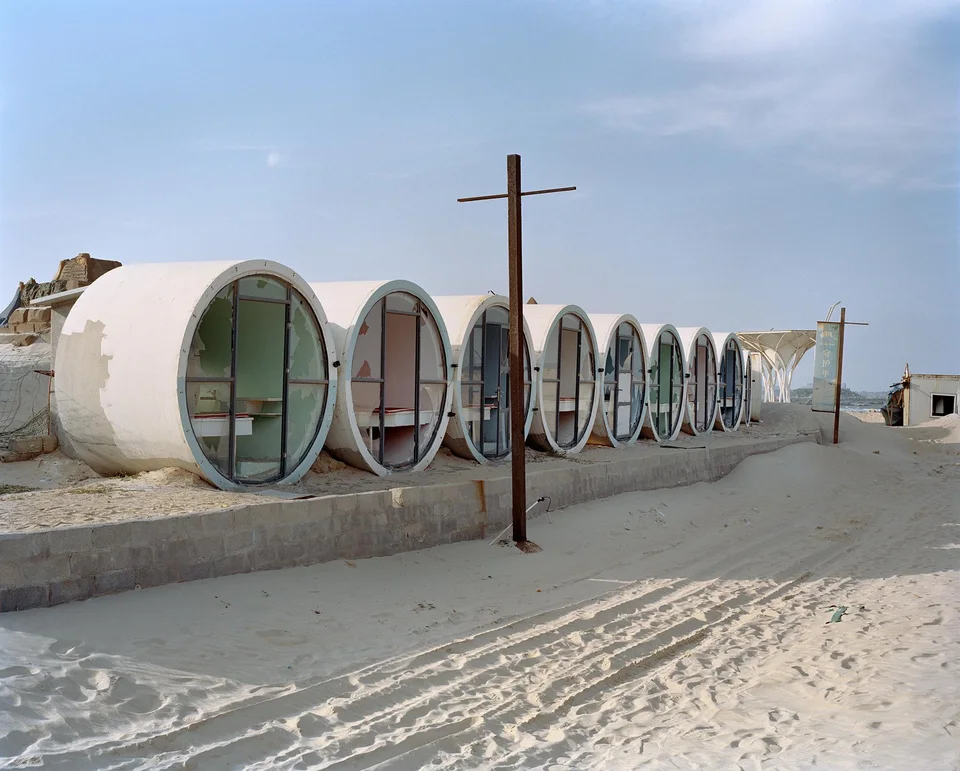
When people look, there are several levels. First is the perceptual level: the colors and shapes we see connect with the body's embodied perception. Then there's the semantic, conceptual level, what meaning we assign. These don't travel through the same pathway in the brain; perception as a whole is complex, the product of multiple pathways combining and interweaving.
Based on memory and experience, we decide that this photograph is about this and that one is about that, drawing on stored concepts to assign meaning. But the photograph itself can be given different meanings, depending on different people's models of the world, life experiences, and linguistic and semantic systems. Herein lies the possibility, in the mechanism of the image, of "above the document" going beyond a specific object.
So works you can't understand at first glance, that require careful looking, are actually very good. According to predictive processing theory, before we look, the brain already predicts what it will see. If you understand at a glance, especially with pictures that fear you won't get it and keep giving close-ups, it immediately evokes familiar concepts in the brain, and the process of connecting with bodily perception gets cut short.
Over time, making predictions every day and finding the results just as expected, perception becomes dull. Just like today's short videos and Douyin, which make the whole perceptual system and cognitive capacity regress, degenerate, and grow dull. Works that really make you use your brain, that make you reorganize bodily perception and experience, even if in the end you don't figure out the meaning, as long as you perceived, are far more meaningful than simply being handed a standard answer telling you what it's about. This is precisely an important function of art.
There's much more, but there's no time tonight. Dan Luo probably can't share all his remaining slides either, so let's pick the highlights and talk briefly for a few minutes; good topics can have another session later.
Rong Jiang
Host, I suggest this: Dan Luo already did a livestream devoted to Simple Song, and tonight there really isn't time to discuss his work in detail. Why not let Dan Luo and Guosen respond to the previous two parts, and then you give a summary at the end.
Ce Zang
Good, let's do that. Dan Luo, please.
Discussion: Perception, Reality, and Creation
Dan Luo
The examples of British documentary photography Guosen gave were all changes in photography within a particular political environment, artists responding to that environment from an artistic standpoint. I think the principle of our creative work today is the same: forming individual experience of the present, then forming personal expression through that experience. This is something I value greatly in the creative process, even its point of origin.
Ce Zang just mentioned suspension, which I think is very important in creation. From my own experience, I give up on things that are especially definite and don't shoot them. It's rather the uncertain, unclear things that leave more linguistic space for visual expression. Paying attention to such content is something that happens often in my work. That's my brief response.
Ce Zang
Thank you, Dan Luo. Guosen, please respond briefly too, and then we'll be about done for tonight.
Guosen Chen
Thank you. Ce Zang just cited Goodman, and I also remember a line of his that impressed me deeply. Roughly, when discussing what realism really is, he said realism is a matter of habit. How "correct" a picture is doesn't depend on how accurately it represents its object, but on what standards the system interpreting it adopts, what it considers reality and what it doesn't. That system's standards determine whether a picture is realist. I think this echoes Ce Zang's view.
On neuroscience at the end: I've been reading about this recently too. Since Maurice Merleau-Ponty, people have kept grappling with this problem: looking, or understanding, can never be purely intellectual; there is no consciousness in a void. All understanding and looking are synesthetic, always involving touch, hearing, and the other senses together in seeing and understanding; they are connected as one.
The brain, as an organ of relations, a relay station, coordinates these things; without the brain, people can't achieve this coordination. But conversely, with only a brain and no experience brought by the body, one couldn't understand the same visual content either. That's my small response. Thank you.
Ce Zang
Yes, exactly right. Guosen also brought up synesthesia, what we now call visual materiality. In photography, though we see something visually, we can experience touch and even associate it with taste. This is what I call the first level of looking, the perceptual level. Visual art first conveys a perception; semantics is only one dimension.
We can't understand "getting it or not getting it" the way a middle-school classroom does, with only one standard answer, one central idea, so that knowing the answer means you've understood. Even if you know an artwork's central idea, you may not have understood it at all, because your body hasn't entered into a relationship with it. What matters more is this bodily relationship. In neuroscientific terms, it's a complex interplay of top-down and bottom-up: prediction and judgment are top-down; bodily perception and synesthesia are bottom-up. No time to expand on it tonight. Rong Jiang, any response?
Rong Jiang
I've said my piece; I think you can give the summary now.
Ce Zang
Tonight's discussion centered on these two books, and there was still too much content. I thought two and a half hours would be enough, but it seems we've shared only about half. Still, this question is highly meaningful, because "documentary" is inherently complicated.
For example, many photo competitions divide entries into documentary and art categories, yet documentary photography, having developed into the contemporary context, is itself art photography. What's usually called the documentary category often refers to news and reportage. Concepts are fluid and shouldn't be understood rigidly. If we understood documentary photography entirely by the old rules, like marking the boat to find a sword lost in the river, it would become utterly ossified.
How to understand documentary, how to understand "above the document" and "beyond," all require continually broadening our thinking and exploring the unknown with a more open mind. Tonight's matter isn't finished, but we've made an important start. Although much couldn't be shared, I believe those listening and watching still gained a good deal of inspiration. You're welcome to keep the exchange going, and we'll continue discussing this topic. Thank you to our guests for your hard work, and thank you to our online friends for watching. Good night, everyone.