
Opening
Host (Butread Bookstore):
This is our last event of the year, and tonight's session is part of our "Evening Living Room" series. Has anyone been to one before? The series takes the form of a fairly relaxed conversation. The guests who come to the living room have different professional backgrounds, and the topics they care about are wide-ranging. Guosen happens to be in Chengdu this week, so we invited him to give a talk. He is currently pursuing a PhD in philosophy of art at Fudan University, has long been interested in photography studies, and also practices photography himself. His group runs a research community called "Photography Theory Shelter," where they publish their work, so please follow it if you're interested. Usually, for the Evening Living Room, we prepare some questions and ask the guest to talk about why they started doing what they do and why they care about the topic. Today Guosen also has some slides to share, so we'll first ask him to introduce himself and talk for a while, and then we'll ask some questions.
Guosen Chen:
Thank you for the introduction. Hello everyone, I'm Guosen Chen. I'm currently doing research related to photography in the Department of Philosophy of Art at the School of Philosophy, Fudan University. This is basically my first time giving a fairly improvised talk in a setting like this. Right up until I walked in, I hadn't planned to show any slides, because when we discussed it beforehand we called it a "living room," and I assumed it would just be a table with everyone sitting around it chatting. Then I walked in today and was stunned: wow, this is no different from a lecture. So, for appearances' sake, I put some slides together at the last minute, but I definitely won't just read from them. Professor Xiaolin Qiu is here today, which makes me very nervous. Professor Qiu teaches at the College of Literature and Journalism at Sichuan University, and he was my teacher. From my undergraduate years until now, both on my overall academic path and in how I understand literature, art and philosophical thought, I have been under his guidance and influence. So I'm very grateful, and also quite scared—scared of being stumped by questions later, or embarrassing myself. But never mind.
How Photography Mediates Lived Experience
The title announced in advance was "The Phenomenology of Everyday Photography." First of all, I am certainly no expert in phenomenology, and today I won't simply look at photography from the perspective of any single phenomenologist, whether Edmund Husserl, Martin Heidegger or Maurice Merleau-Ponty. When we speak of "the phenomenology of X," we don't necessarily have to start from a particular thinker. Strictly speaking, phenomenology is better described as an intellectual movement whose participants share a certain attitude initiated by Husserl. I won't say much more about phenomenology here; we'll mainly talk about photography. Starting from a phenomenological attitude means that, when we consider photography—especially photography in everyday life, or, to use the jargon, photography in the "lifeworld"—we first ask: how exactly is it constituted in your lived experience, and how does it appear through that constitution? That is today's starting point. When we were settling on the title, I half-jokingly said we might as well call it "The Phenomenology of Everyday Photography," and that's basically what the title is meant to convey. So, on that basis, how do we begin to talk about photography?
When photography comes up, people tend to think of cameras, the things they want to shoot, and post-processing afterward; if you want to become a professional photographer, you might also think of photographers' associations. But my question is this: if photography in the general sense simply means an image-making activity whose ultimate goal is producing photographs, does that understanding really capture the photographic experience we go through every day? Whether you use a phone, a DSLR or a mirrorless camera, medium format or full frame, buying equipment, upgrading your phone, looking for better ways to edit—all of these activities ultimately point toward a photograph. Is that all photography is?
If we understand photography this way, how do we explain the picture-taking that every one of us engages in every day? Should we, as some people think, separate "taking pictures" from "photography," so that only once you've mastered professional skills are you a photographer and only that process counts as photography, while everything else is merely taking pictures? Many people see it that way, but I don't think that view holds up. It appears to be defining art photography and granting photography an artistic status, but in fact it pulls out the very foundation on which photography becomes photography—especially on which it becomes photography today—and even on which it has artistic legitimacy.
Why do I say this? A few years ago, when I had just been admitted to Fudan, I told Professor Qiu that I wanted to do research on photography. He talked with me at length and mentioned what Ge Zhaoguang calls "general intellectual history": examining photography's place in lived experience and in its era. One thing he said made a deep impression on me. He said, look at life today—there's basically no life left that isn't put on display. Before you personally meet someone or personally visit some tourist spot, your experience has already been mediated by an activity called photography. The photography here comes from other people's photographs.
Whether it's check-in travel photos on Xiaohongshu, pictures by photographers on online image libraries, or more structured, more ideologically charged, complex artworks, all of them take part in this process. Some works don't necessarily point to any real-world tourist spot—works engaged in ideological critique, for example—but they prompt you to think about the social relations you are embedded in. Our lives today are basically fully subject to photography's mediation.
The keyword here is "mediation." Photography plays a mediating role in our lived experience; it provides a structure of experience that could not have existed before photography became fully widespread. This is what makes photography photography, and what ultimately allows it to become art.
This process began with the invention of photography in 1839. Although there wasn't yet a network for distributing and circulating images as extensive as today's, don't forget that one of the earliest official identities photography had was commercial portraiture. Previously, to have a painter do your portrait you had to be at least middle class; the children of ordinary families didn't get to have portraits painted. After photography was invented, you only needed to spend relatively little money and hire a photographer, and you could have a portrait photograph of yourself. In his Salon of 1859 (Salon de 1859), Charles Baudelaire expressed his disgust with photography. He thought photography could only be the servant of the artist, because it was too faithful to the world, reproducing the forms it saw too faithfully, and thus lacked creativity. Many people who discussed photography at the time, including Lady Eastlake, held broadly similar views.
Yet before photography became art, even before there was any debate over whether it could become art, it was first of all a clear-cut commercial activity. Commerce means that whether you're middle class or poor, if you pay the same money you get the same service. This seems to suggest that photography, having been tied to commerce from its invention, had the potential to equalize and democratize image-making. I think this is indeed an aspect that needs to be considered. I myself am not that optimistic about this egalitarian potential and don't wholeheartedly affirm it. I raise it here because, when we talk about photography, this aspect has been basically suppressed and needs to be brought up again. As an image-making function and a technology of mechanical reproduction, photography had from the very start a potential for equality, democracy and popularization.
The invention of photography looks like something a group of technically minded people pulled off in 1839, no matter whom you trace the origin to. But photography back then was, after all, different from photography today. Where exactly is the difference? Let me briefly introduce a scholar, Ariella Aïsha Azoulay. She teaches at Brown University in the US, and one of her major works is The Civil Contract of Photography. She identifies with Palestine and could be called an exile; she was ostracized by universities for her positions and later came to teach at Brown. She is one of the most famous scholars in global photography studies since 2000. How famous? If you do photography research abroad, you've almost certainly read her work. But I suspect her books will be hard to publish in China for the next ten or twenty years. Besides her identification bound up with Israeli–Palestinian politics, she also holds a very pronounced feminist position. For example, chapter five of The Civil Contract of Photography is titled "Has Anyone Ever Seen a Photograph of a Rape?" What she wants to ask is what the absence of such images actually signifies.
When Azoulay discusses the origins of photography, she argues that photography as we have it today didn't originate only with the invention of that technology in 1839, but also with another moment: the moment when everyone picked up a camera, began producing photographs, and shared the photos they had taken with others. She defines as "the invention of photography" the moment when photography truly became an image-making technology for everyone—promoted, carried through and established. On her account, the invention of photography began at the moment a plural space was opened up: large numbers of people, not confined to some circle of acquaintances, nor limited to amateur or professional photographers, picked up cameras and began using them as a means of producing images.
When we used to think about photography, we tended to think of a chain: the starting point is the photographer, the middle is the camera, the endpoint is the person photographed, and the three combine to produce a photograph. Thinking this way means attributing the authority of the photograph, or of photography, to the photographer. We say who took a certain photo, but we often don't ask who exactly is pictured in a news photograph.
Take this very famous social documentary photograph from the American Great Depression, Migrant Mother, taken by Dorothea Lange. You see, the title doesn't include the name of the person photographed. The photograph has basically been seen as a visualization of a certain American national spirit, an anthem to human courage and indomitability in the face of suffering. But who is the person in the photo, and where does she come from? For a long time, nobody knew. Her name was Florence Thompson. Later she began to protest, saying that when Lange took the photo, she had promised to give her some prints afterward, but no prints were given, no money either, and nothing else related was ever sent. She felt awful about having inexplicably become a symbol of the American people's suffering. On the other hand, she also said the photograph did improve her life somewhat. This is complicated. I've never liked summing it up directly as "the photographer oppresses the person photographed," because that can't explain this situation. The photographed subject may be instrumentalized, and you can call that violence; at the same time, the chain of events set off after the photograph was produced genuinely improved the subject's circumstances. These two things can coexist without contradiction.
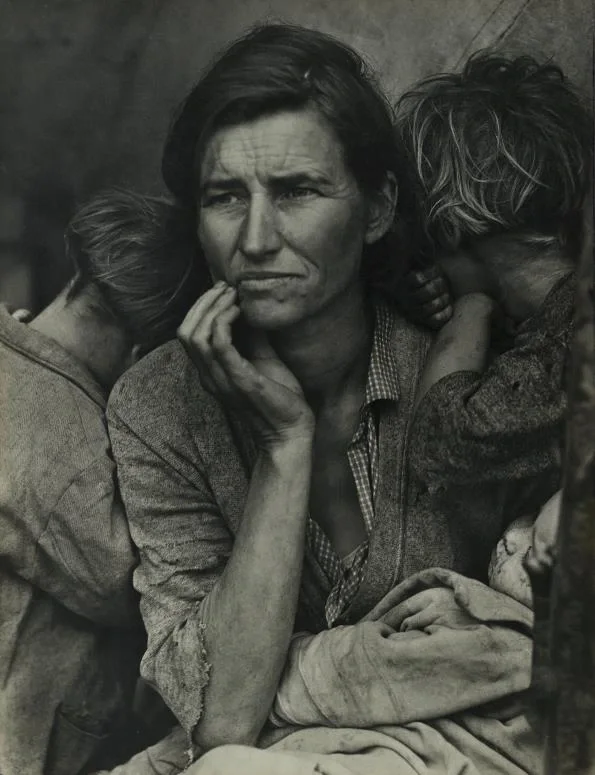
We used to discuss photography's place around a single authoritative subject, but ethically speaking, the person behind the lens and the person in front of it are equal. We can't assume that, just because someone stands in front of the lens, they are naturally in the position of an object, a position from which they cannot resist. A photograph comes into being because the photographer and the photographed subject had an encounter in a specific time and place; the encounter allows the photograph to be generated.
Once a photograph has been produced, how should its meaning be read? The Vulture and the Little Girl (known in Chinese as "Starving Sudan") is another very famous photograph. At the time, people demanded of the photographer: why did you watch the child being pecked by the vulture and not save her? I can't remember the child's sex clearly; it was probably a little girl. The photographer was subjected to this harsh condemnation—today we'd probably call it cyberbullying—and in the end, unable to bear it, he killed himself, as I recall. But in fact, throughout the shoot he stayed near the child, making sure the vulture wouldn't threaten her life, and as soon as he finished he chased the vulture away.
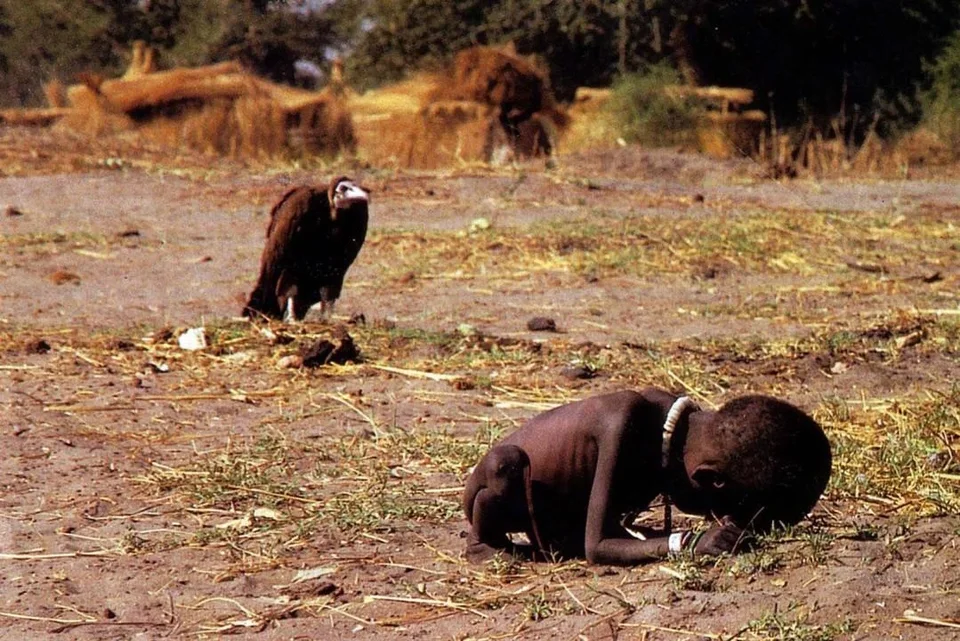
Very often, we can't judge what a photograph actually means from its form alone. The causal chain at the moment a photograph is produced can be called mechanical: a physical encounter took place, and so a photograph appeared. But the production of meaning when we understand a photograph is very different from the process by which it was produced.
The understanding of a photograph's meaning likewise occurs at the moment the viewer encounters the photograph. From production to reception, to being rediscovered decades later, every stage is part of an ongoing process of encounters among multiple parties, and no single encounter can fix its meaning.
For instance, imagine an execution photo from the Nanjing Massacre or a Nazi concentration camp. The killer took it to prove he had carried out the execution, leaving evidence to hand to his superior. In the first encounter, it serves the killer's position; a hundred years later, the same photograph may become evidence indicting him for his crimes, its meaning completely reversed. So it is always awaiting supplementation; you never know when a new encounter will give rise to new meaning.
Another example: one day you end up at the police station, and the police say you committed some offense. You say you didn't. They tell you: "We have photos of you at the crime scene. We caught you on camera." How would you feel at that moment? Whether or not they show you the photo, and even whether that photo exists at all, may make no difference to its effect. When they say it, it's as if they're telling you the photo really exists, and you have no choice but to believe it.
You'll find that photography doesn't even need an actually existing photograph to take effect and to create something we could call a "photographic event." Today, this hardly needs spelling out.
Therefore, understanding photography requires shedding the superstition of the photographer as the sole creating subject, and seeing that every act of photography and every photograph exists within a process in which plural subjects jointly participate, with no single subject able to determine its meaning once and for all. Not even a government, not even a dictator, can fix the meaning of a photograph forever. To use an analogy, a photograph is a lot like cash. A hundred-yuan note is in your hand right now; after you deposit it in the bank, someone else might withdraw it, and it keeps circulating through different hands. As long as that photograph can still be found somewhere in the world, it remains within a space constituted by plural subjects. Here we can also see the relationship between photography and life, and something with a phenomenological flavor.
Azoulay also analyzes three kinds of gaze, a line of thinking connected to Hannah Arendt. The first is the identifying gaze. From the beginning, in order to survive and avoid being eaten by wild animals, human beings first had to recognize what threatened their lives. That is discernment: what is the thing in front of me? The second is the professional gaze. For example, when a doctor looks at a patient, the gaze differs from ordinary identification; it is necessary for maintaining one's livelihood, not just for survival. Azoulay says that after the invention of photography, and especially after it became a widespread, universal image-making skill, a third kind of gaze emerged.
"The invention of photography" here is still invention in the sense discussed earlier. It added a new way of looking on at the visible, a way of seeing that did not exist before, or at least existed in a different form. This gaze is based on a new attitude toward vision and constitutes an attitude toward objects, situations, customs, images and places—things that, before photography appeared, were not in themselves considered worth thinking about. This sentence is crucial, and it's why I say photography becomes a mediator. Think about it: when you take a picture, you pick up a device with a lens, whether a phone or a camera, and that means first of all that an object is connected to your arm and you have to point it at some area. Even if you're holding a panoramic camera, the pointing is simply transferred to the position of your whole body.
Before pressing the shutter, the first thing you do is "point"—point toward some place. For example, if I shoot in this direction from here, the photo might make you notice the logo on that box, which can't be seen from other positions. Once it's photographed, it may become a prominent area in the frame and thus draw your attention. Before images are aestheticized and formalized, before they elaborately produce some aesthetic feeling, photography already has this significance in life. Photos posted to WeChat Moments, Xiaohongshu or other social platforms, however skillfully shot, are first of all a pointing, an attitude of reminding others "there's something over there."
Many people looking at art photography don't understand what the photos are of. We easily understand photos by Henri Cartier-Bresson or Fan Ho, because they conform well to compositional rules; but there are also masters in the history of photography whose photos look messy, making people think "I could take that." Setting aside the aesthetic angle and looking purely at the function of pointing, you'll find that discovering certain aspects of everyday life—such as the colors of the objects that make up the everyday—is itself photography's contribution, and these photographers' contribution. Before that, nobody paid attention to these things, and nobody thought they were worth thinking about on this level.
What happens when this pointing is connected with some extraordinary states—for example, photographing things you will never encounter in your whole life? This photograph was taken by Gilles Peress at a mass grave in Srebrenica. It shows a person who was buried alive; after the flesh decayed, only the skeleton remains. He went there with two forensic anthropologists to investigate the mass grave and took this picture.
What aesthetic value or meaning does such a photo have? It's hard to talk about it in purely formal terms. Of course, the photographer has formal training; an ordinary person shooting it might not even get the shoes fully in frame, lacking command of the frame's edges. But before any of that, the photograph first, through its pointing, breaks through a certain mode of feeling in the world you originally inhabited. In Heidegger's terms, the human world is constituted through various relations of reference. Although what he means by reference isn't exactly the same as what I mean here, let me give an example: a cup refers to holding liquid, holding liquid refers to drinking, drinking refers to other activities. Your world is constituted in this totality of involvements, appearing to you as a world you already find yourself in. Looking at photographs, especially photographs like this, in a certain sense temporarily interrupts the relations of reference in your original world, allowing you to grasp another world, to realize what someone else's world is like. The mere act of "pointing" signifies the presence of a person entirely different from you.
For instance, if each of us took a photo in this room, even though we're in exactly the same physical space, the results would differ, because each person's attention is different. Through photographs and through the referential act of shooting, a person may break out of their own particular world and enter a world in which the gaze of others can be seen. How does reference lead toward a shared world? Phenomenologists have indeed discussed this. Klaus Held wrote a Phenomenology of the World, explaining intersubjectivity from a phenomenological perspective, and how politics is possible. He was a professor who passed away last year or the year before—I don't remember exactly. Following this line of thought, photography can constitute, in an existential sense, a breakthrough of the existing world.
This is precisely why we are willing to look at photographs. Whether or not the person taking the picture is a photographer, when they post a photo on WeChat Moments, why do you click on it? I think it's often not just because it's pretty, but because that way of seeing is something you can't do yourself, or can't achieve on your own. We may not realize that it is through the mediation of photography that it becomes possible to break through our habitual gaze, our inertia of seeing, and our ways of touching the world.
That's the part I wanted to share first. I mainly want to chat with everyone; it's just that since I've put up slides, I'll roughly lay out what I mean by "phenomenology" and why photography should be considered as a mediator. The words "photography" and "photograph" are different to begin with: photography is a process, the photograph is its product, and the two cannot be equated. From here on we can just chat; what came before was sharing my basic ideas. Thank you.
Host:
Does anyone have questions?
Q&A: Homogenization and the Meaning of Taking Pictures
Host:
Let me ask one first. The event announcement listed some questions we might discuss, and I'll ask a fairly everyday one: what do you make of the fact that photos on Xiaohongshu increasingly tend toward a homogeneous style? Why does everyone want to take that kind of photo, using very similar forms?
Guosen Chen:
This question is actually quite tricky, because there are many kinds of similar photos—check-in photos, for example, or, after learning photography, imitating Xiaohongshu influencers or masters from the history of photography. All of these might be called homogenization, but the line of thinking I just proposed is precisely opposed to inferring the meaning of photography backward from the photograph: you can't use a photograph's formal value to cancel out the meaning of the photographic act. These are two different things.
Two people may produce photographs that are formally identical, yet their acts may have entirely different starting points and purposes. These two photographic acts may also mean different things to the people performing them. Very often, taking a picture isn't about producing a particular photograph. Of course, having seen so many, you might subconsciously adopt a similar angle. But in quite a few cases, you shoot just to confirm that you were in that place.
When Roland Barthes talks about photographs, he uses "that-has-been": something was once there, and then a photograph came about. A fairly common definition now understands the photograph as a kind of action or performance. Especially from a semiotic perspective, it has performativity. In linguistics, a performative means that in uttering a word you simultaneously perform an act. For example, when I say "sorry," that means I'm apologizing.
Understood this way, you'll find that beyond its form and aesthetic significance, a photograph also has a series of photography-related acts before and after it. The meaning of these acts cannot be fully interpreted within a single photograph, nor can it be determined by that photograph. So it's essential to know that photography is a process, one that changes through continually occurring encounters; even once the photograph has appeared, the process doesn't stop.
The Value of Photographs, Images, and Computational Photography
Questioner A:
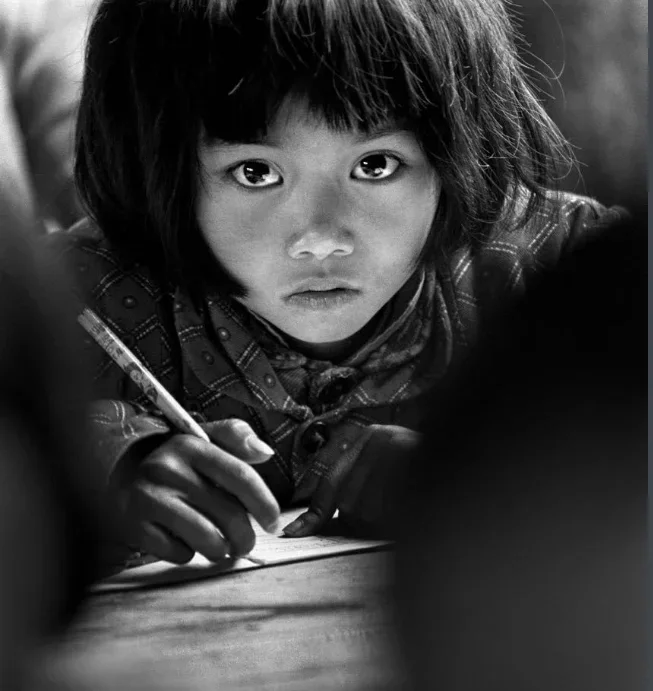
I have a few questions. You just said the production of photographs is reproducible, so why do some galleries specialize in photographic works, and why can some photographs sell for so much? Although they're signed and editioned, like 1/12, a photo like Big Eyes once sold for 210,000 yuan. Where does its value lie—is it financial value, artistic value, or social value?
My second question is about the difference between image and photograph. We use "影像" (image), but things in some image libraries are all called "照片" (photo). If you make a collage out of existing photographs, like the collage photography mentioned in the link earlier, is it an image or a photograph?
The third is a technical question. Phones now use computational photography. Does that process still count as photography? Does it have originality? Color grading, noise reduction and so on are all done by the processor.
Host:
Let's have him answer these three first, and then we'll continue with other questions.
Guosen Chen:
The first question is why some photos sell for so much. You mean photos sold by galleries—the photographs themselves, right?
Questioner A:
Right, not paintings.
Guosen Chen:
This one is tricky too. People generally feel that what gets collected on the art market must have at least some uniqueness, as when you buy a painting. But photographs are different. I've rarely thought about this before and am not very interested in the art market, so what follows is just my understanding.
Let's first think about why the photographer is considered the owner of the photograph. Big Eyes, just mentioned, was taken by Hailong Xie, and there are Andreas Gursky's photos, which sell for even more. Why does the law determine that the photographer owns the photograph and that originality belongs to the photographer? The value judgment behind it is that it doesn't regard what's in front of the lens—the girl in Big Eyes, for example—as a source of originality contributing to authorship. Only by affirming the photographer as the sole owner and absolute creator of the photograph can this legislation be carried through.
At the time, people also argued: the world already looks like this; you point a camera and cut out a fragment—why should that count as a creative act? To give photography legal copyright protection, the photographer's originality first had to be affirmed. But I myself don't endorse simply emphasizing this point.
Why is this related to market value? I think it's first of all a recognition of the photographer's labor and so-called originality. Once the law established copyright, the photographer gained a right to legitimately pick up a camera, reproduce the world, and treat it as a mark of their own originality. That may be what's being sold. But simply emphasizing the photographer's originality doesn't hold up, in my view.
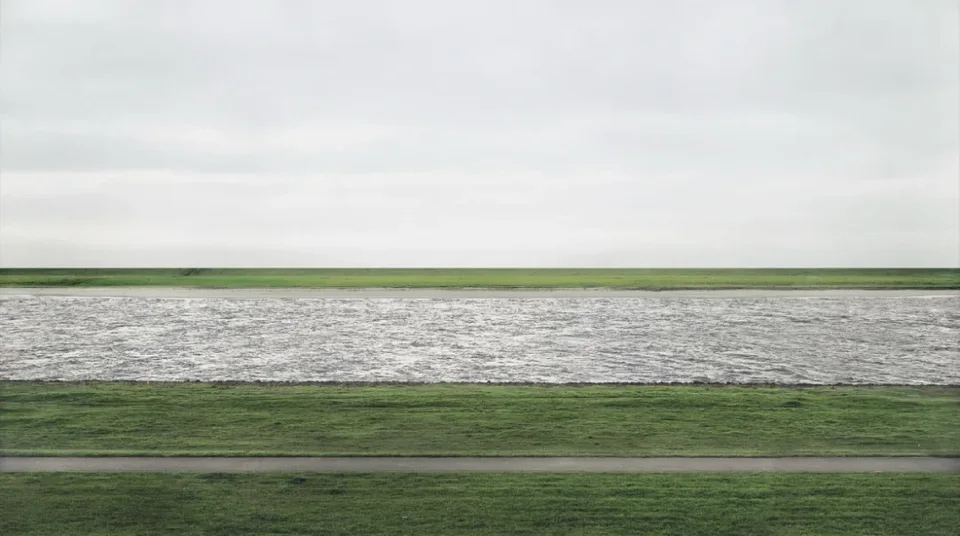
I really don't understand the art market; I can only guess that what's being bought may be the photographer's labor and so-called creative ability—I'm not sure if that's right. In many cases, it's probably not just because of the photograph's form. Take Gursky's Rhein II, which sold for about US$4.3385 million, setting the record at the time for a photograph at auction. It's all green horizontal bands. What's so beautiful about it formally? Nothing much.
One of my teachers has been to the home of Rosalind Krauss, the very famous art historian of the October school, and showed me what hangs in her house. To an ordinary person they look like rags with no artistic value, or clean white cloth, yet they cost tens of millions. In a sense, what's being bought really is value; it can't be explained by form alone.
The key is still not to equate the photograph with photography; their values are different. Many factors determine a photograph's value, even more than for painting. Of course, I don't know much about commerce or the art market; if Professor Qiu is willing, I'd love to hear his view.
Your second question is about the difference between photograph and image. I think it's better to translate "image" as "影像"; otherwise, when you run into "picture" and "photo," it becomes hard to handle the relationships among them. Images can include paintings, photographs, and moving things too. There's a photography exhibition in Shanghai right now that even shows Peili Zhang's 30×30 and Richard Serra's sculptural films.
I don't get too caught up in whether something is a photograph or an image. If you follow that question, the next step is defining the two concepts, which actually has little to do with the specific works under discussion. Collage, or photomontage, can have very different purposes. For example, in Theory of the Avant-Garde, Peter Bürger discusses John Heartfield's collages, which were anti-Nazi works trying to use collage to eliminate the ambiguity and polysemy of photographic reference and fix the meaning.
From this angle, whether we call it a photograph or an image is, at least for me, not that important. What matters more is what the collage is for, what effect it seeks, and whether that effect works. Your third question was about computational photography, right?
Questioner A:
Yes, computational photography.
Guosen Chen:
These days, when you snap a photo with an iPhone, technologies like Deep Fusion may already be at work behind it, merging seven or eight shots into one. The phone exposes the scene by zones and then stitches together the most detailed parts of each frame, but we can't see this process. The materials used to compose the final photo are unreadable and invisible to humans; they are only machine-readable. This is actually very complex. Machine readability means that many processes that change our lives can no longer be referred to visual experience we ourselves can understand. Still, why does it count as photography? The key is how the photograph is felt, used, and how it produces meaning.
As long as the whole structure through which we use photographs, feel them and let them take on meaning remains unchanged, the way a photograph is generated cannot cancel these functions. Now there are AI-generated photos too, which seem even more direct than computational photography, as though made from nothing. Computational photography at least still faces a subject being photographed; AI generation seems not to. But behind generative models are training datasets, such as ImageNet, containing huge numbers of photographs, which also require human labeling, telling the machine that this photo shows a prostitute and that one a drunk. This involves very complex political questions: why does this person get assigned such a label?
Setting that aside for now and looking only at the chain, AI-generated photos can't be said to be unrelated to reality, still less made from nothing. Their pointing process has simply passed through a longer chain, with the links extended.
So, whether iPhone or any other phone, however complex the imaging process, it cannot cancel the significance of how photography functions. Since the film era, there has never been a so-called pure photograph. The distribution of silver halide grains in each film stock, the printing afterward, and the control of development time all participated in forming the image; conceptually, this isn't much different from today's Deep Fusion—it's just that processes once determined by human labor and film equipment have been condensed into computation.
At the mechanical level, I don't think there is an authentic process of photographic production. As long as we still use photography this way and photography still functions this way, it is still photography.
The Time of Photographs and Video
Questioner B:
How do you see the difference between still images and video?
Guosen Chen:
Video is beyond my research area, and I don't watch much of it. One intuitive angle is their respective temporality. We say a short video is one or two minutes long, but we don't say a photograph is one or two minutes long. You can look at a photograph for an hour or for just a second; the duration over which video intervenes in lived experience differs from that of photographs.
This also involves the relationship between photographic experience and real experience. Susan Sontag is very vigilant in On Photography, but I think she also has a blind spot: she sees photographic experience and real experience as absolutely substituting for each other, and even elevates this substitution to the structural level—as soon as you take pictures, your real experience is inevitably alienated by photography.
I think the key is that at any given moment a person can basically have only one experience. If you're taking pictures, it's hard to simultaneously experience a world not filtered through the lens. I'm not saying this to criticize photography or the flood of short videos; the question remains how people should use technology to open up more possibilities for themselves. You can't say that when you put down the lens the world is real, and when you pick it up the world becomes fake. No such thing. How technology serves the possibilities of lived experience is the question we always have to face.
I haven't thought deeply about the difference between photographs and video; I just feel the temporal dimension might be a good entry point.
Composition and the Lifeworld
Questioner C:
The other day when we talked about composition, you said composition is actually a kind of... is it because it was borrowed from painting?
Guosen Chen:
The word composition itself means putting together, assembling. In painting, you face a blank canvas and want to put a stroke here and a stroke there and combine them. But if you understand taking pictures this way, a problem arises: compositional rules have nothing to do with your lifeworld. You use the rule of thirds, he uses the rule of thirds; faced with a scene, you abstract each object from it, reduce it to a point, and place it at the so-called golden ratio. However elaborate the technique—center composition, the nine-grid, the Fibonacci spiral—you may be using something unrelated to the experience of the scene, making compositional rules an a priori condition of the photograph. That way, you merely verify that the rule is workable, without capturing the structure of the world before your eyes.
Think about the objects in this space. Can you reduce each one to a point in a geometric world? Impossible. Every object has its own weight, and its color also determines what it is. Color can't even simply be understood as something attached to the surface; it helps determine why the object is this object.
When we frame the world in front of us with a border, the visual structure changes with every step we take. So personally I prefer to set compositional rules aside, not think about the rule of thirds, and instead consider what the structure of the world in front of me is like.
A simple example. When shooting, we often think "what do I want to shoot," which means there's an object to be photographed. But how is this object possible? Why are you moved or touched by it in this space, or feel something you can't put into words? Because it really is situated in this background, this world. If you just apply a compositional rule, put the object in the center and blur the background completely, what you get may be something very abstract, having nothing to do with the object that touched you. Take this cup: here it's a cup, there it's also a cup. But I may want to photograph it precisely because it appears next to the microphone. If I just put the cup in the middle and remove the background because it seems cluttered, what I end up with has nothing to do with the cup that touched me at this moment. Put the same cup in a kitchen and the meaning it gives you would be completely different.
That's the limitation of compositional rules: they can't explain why this object is this object, why it is constituted in your mind in just this way. If it's just about verifying the rule of thirds, you could do that with Google Street View. Why go to the site in person and place your body in this world to shoot?
Many people have had this experience: after shooting, you find the photo lacks the feeling of being there. You watch the sunset from a mountaintop, so moved you're in tears, but the photo has nothing special about it, no different from other sunset photos online. That's because the photo doesn't provide the conditions under which the object comes to be, doesn't present the whole structure behind it. Faced with this problem, compositional rules look very feeble.
Questioner C:
So it still has to do with technique? A technique above composition?
Guosen Chen:
I don't think it has much to do with it. As long as you have this awareness, and your sensibility can grasp the difference between the picture and reality, however you shoot it will look good—or, maybe not "good," but fairly alive. That may be more practical than conforming to some rule. Rules are at most scaffolding. When the sensory manifold your sensibility receives can't be organized, they provide a framework to help you sort and clarify things. But whether we must use this approach, and whether we must use it from start to finish, is another matter. I don't reject composition; many of the photos I take conform to the rule of thirds or center composition, because that's where the subject really is. The question is why I put it in that position.
The Form and Context of Photographs
Questioner D:
I have two questions. I read a book by Daido Moriyama in which he says London photographers shoot London, Tokyo photographers shoot Tokyo, Shanghai photographers shoot Shanghai, Beijing photographers shoot Beijing. The implication is that every photographer, and every painter and artist, is influenced by their environment and finds the tone of their work in their own surroundings.
You just said that photographs by photographers can break our habits of seeing and let us see what we normally don't. The beauty presented by different photographers may expand our vision; but conversely, aren't they also limited by particular environments?
For example, I saw a photography exhibition where I really liked one photographer's pictures of Japanese women—that elegant, quiet, delicate feeling was beautiful. But in one photo the subject was simply replaced with a Chinese celebrity, and suddenly the beauty vanished; the change of subject altered the feel of the photo. Is the photographer's creation also affected by this kind of relationship?
Guosen Chen:
Of course. Following today's line of thought, for a photograph to become that photograph, at the very least there must be an encounter between photographer and photographed subject. This means that its originality, why it became this photograph, cannot to a large extent be entirely determined by the photographer. What we need to restore is the subjectivity, in every sense, of the person in front of the lens.
Fundamentally, photography cannot be entirely controlled by the photographer, so attributing all of a photograph's effects to the photographer isn't appropriate. This is so whether what's in front of the lens is a person or a specific environment.
There's another difference between photographs and paintings: the photograph's continuity with the real world is just too strong. It arises from reality and then acts back on reality. Whether a photograph appears, and in what form, depends on encounters among many parties—far more than just the photographer's encounter with a person or thing—and is also shaped by each party's own world of experience and lifeworld.
This isn't necessarily something we should call a limitation; you could also call it specificity. That a change of model makes the photo feel completely different is entirely reasonable, and it's also an occasion to reflect on the old view that attributes all meaning and power to move to the photographer.
Questioner D:
Moriyama himself also says he just shoots Shinjuku, as if only Shinjuku scenes can produce that flavor, and anywhere else it's gone. Even the colors and textures his camera produces suit Shinjuku; everything you feel in that place you can feel in his photographs, but transplant the whole approach elsewhere and it doesn't fit at all. I find that very peculiar.
Guosen Chen:
There's another issue: when we go look at some foreign place, how we feel may not be the same as how locals see it. If a photograph were only an aesthetic object, and we only cared whether it gave pleasure as a formal structure, then why must we look at photographs? Why not look at paintings?
It's precisely because photographs are fully connected to your own real world that you can, through that aesthetic feeling like radiance or aura, turn back and understand the lifeworld. Even if you've never been to that place, the photograph constructs this experience for you. So I'll say again: ultimately it relates to lived experience and can't be understood only in aesthetic terms.
Whether Moriyama's photographs or more artistic, ideologically charged contemporary photographic works, none can be read on the basis of form and aesthetics alone. Photographs have never been sufficient in this respect. Take the very famous Saigon Execution, the photo Eddie Adams took on a street in Vietnam. A fierce-looking man points a gun at another man's head and fires, and the photographer captured the instant of the bullet passing through and the face contorting—an instant you would absolutely never see in life. The background is a street, not an execution ground. This black-and-white film photograph has very large grain and a raw, powerful aesthetic impact.
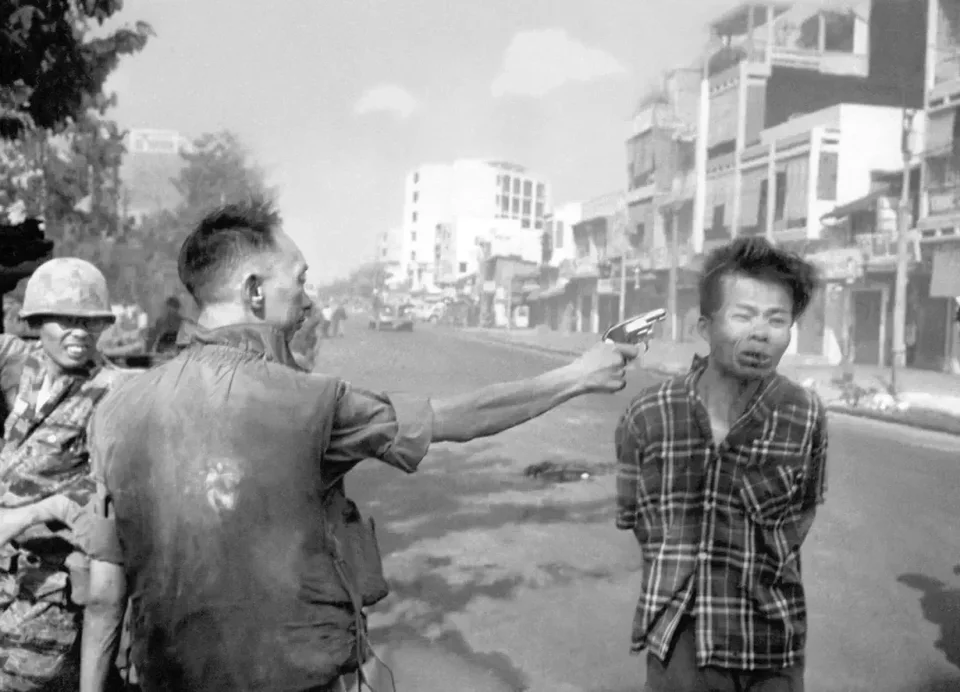
But there's also a process outside the photograph. The photographer didn't know the man firing the gun at the time; he was in fact the local police chief. The man killed could basically be described as a criminal with a long record, guilty of every atrocity, even involving the rape of young girls and the elderly, and he was executed on the street in wartime. You can say this didn't conform to procedural justice, but the photograph viewers received, because its shock far exceeded the mild range of everyday experience, made everyone conclude that the man holding the gun was an out-and-out murderer. Later, he was wounded in the Vietnam War and his leg was shattered; no hospital would treat him, and in the end he was treated in the US and left disabled. The photographer deeply regretted it, saying the photograph killed three people at once: the man executed, the police chief whose later life was miserable, and himself, who felt guilty about it ever after.
Cases like this show why many photographs can't be received only through their form and sensory shock. If we take such reception for granted, photographs may in turn produce new violence and injustice.
Selfies and Self-Identity
Questioner E:
What do you think of selfies?
Guosen Chen:
I'd like to hear what everyone thinks first, because I rarely take selfies—I've basically never done it. Would anyone like to share?
Audience member:
Admiring yourself.
Another audience member:
There's also the case where the camera just maps out your facial features, like a copier or photocopier, which doesn't seem to have much value or meaning.
Guosen Chen:
Anything else? I'm genuinely curious; I really lack practical experience in this area.
Audience member:
Vivian Maier also often took self-portraits, but she photographed her reflection facing outward. That seems similar to the photography we were just discussing, except that what's pointed at becomes yourself in a reflection. Holding up your phone and pointing it directly at yourself seems different.
Guosen Chen:
It's definitely different, which is why I want to know how you feel.
Audience member:
Thinking about the technical details: before phones were used so frequently, when most people still took pictures with cameras, selfies weren't that common. With phones, and especially front-facing cameras, it became extremely easy. Technology and the social transformations it brought must have given selfies many meanings, and that includes tools like Meitu.
Guosen Chen:
Let me show you a passage by Byung-Chul Han. It's too long, so I won't read it; I'll just summarize his view. It's a very representative position: the selfie is a semblance. He first says digital photography is semblance; in his view, things like the phonograph and analog photography are real.
Leaving aside why for now, I think his framework basically comes from Georg Wilhelm Friedrich Hegel. However Hegel thinks about "semblance" (Schein), that's how Han writes. He then says selfies are saturated with exhibition value, exhibition value of course being opposed to cult value.
When I read it, I felt Han was a bit too clever, to the point of glibness. It takes something for someone's writing to strike you as clever to the point of glib, because much of it is hard to refute and even seems quite reasonable. I can't say everything in the book is unreasonable either. When I was talking with Professor Qiu earlier, I think he said Han should be critiqued at the level of the sentence. As I understand it, when you go down to the micro level of individual sentences, some of Han's judgments are indeed sharp and hit home.
But in terms of his overall values, he first holds that the selfie is narcissism; second, that the selfie differs from the analog world because only oneself is in the frame and the world disappears, so functions like historical witness and communication are all lost. In his account, digital photography and selfies are tied together: you raise a device toward yourself, produce no new matter, post it to Moments after taking it, and it circulates within the data world and finally closes in on itself. In his view, this is a completely different concept from taking a camera out into the real world and encountering something unfamiliar.
I don't see it that way. Let me show you two pictures that, in a broad sense, can both count as selfies. I'll come back to "admiring yourself" in a moment. Very often, a selfie is proof that you are really living a certain life, and it also carries the hope of letting others know: I really am here.
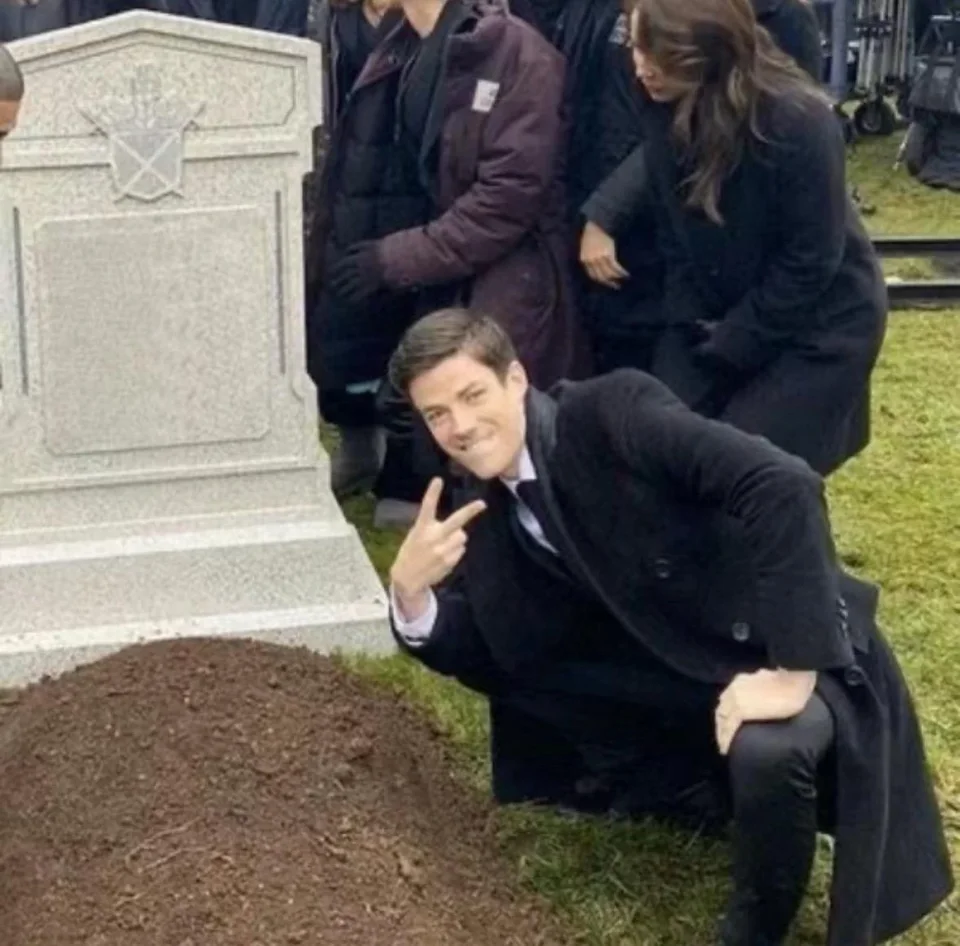

This kind of self-presentation can be called a performative practice. Compared with photographing other things, a selfie may more forcefully prove that you once took part in something and are willing to let others know. Of course, you might take it and not post it, which is fine too. When we used to take pictures, the lens faced outward; the selfie reverses the direction. Especially when you stretch out your arm to take a selfie, you often get the arm and hand holding the camera into the shot. When shooting outward, these body parts connected to the camera are usually excluded from the frame. So formally, the selfie already has an obvious difference: bodily indexicality appears.
I think this especially shows the performative function of photographs today: narrating what I'm doing, displaying my life.
What other functions does this act have? For example, there was once a campaign on Twitter called "I look like a professor." Participants posted selfies with the hashtag, showing that professors aren't only old white men, not only middle-aged white men with glasses. They also recounted experiences of being mistaken at school for dishwashers, cleaners or students. Go to some AI image-generation sites now and type "generate a professor for me," and see how many middle-aged white men you get. Basically, if you're over sixty, under forty, or not white, you're stripped of professor status. Someone like Professor Qiu, or me, if I were a professor, would hardly show up in that category.
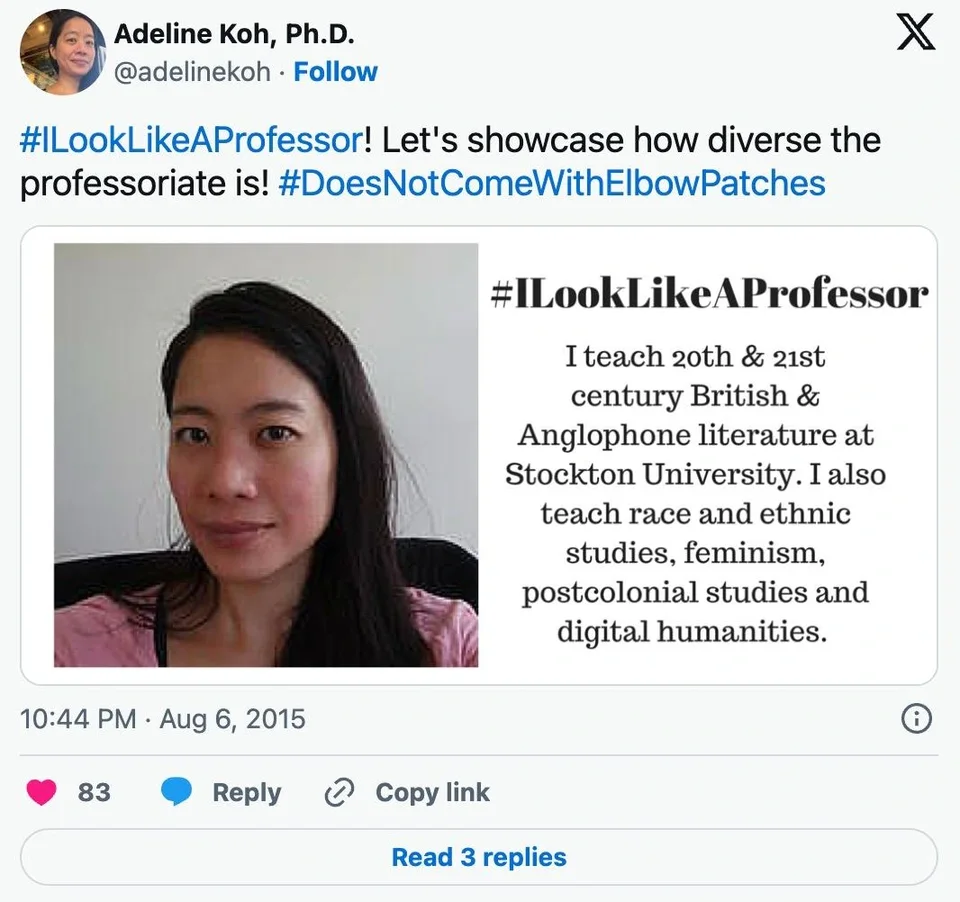
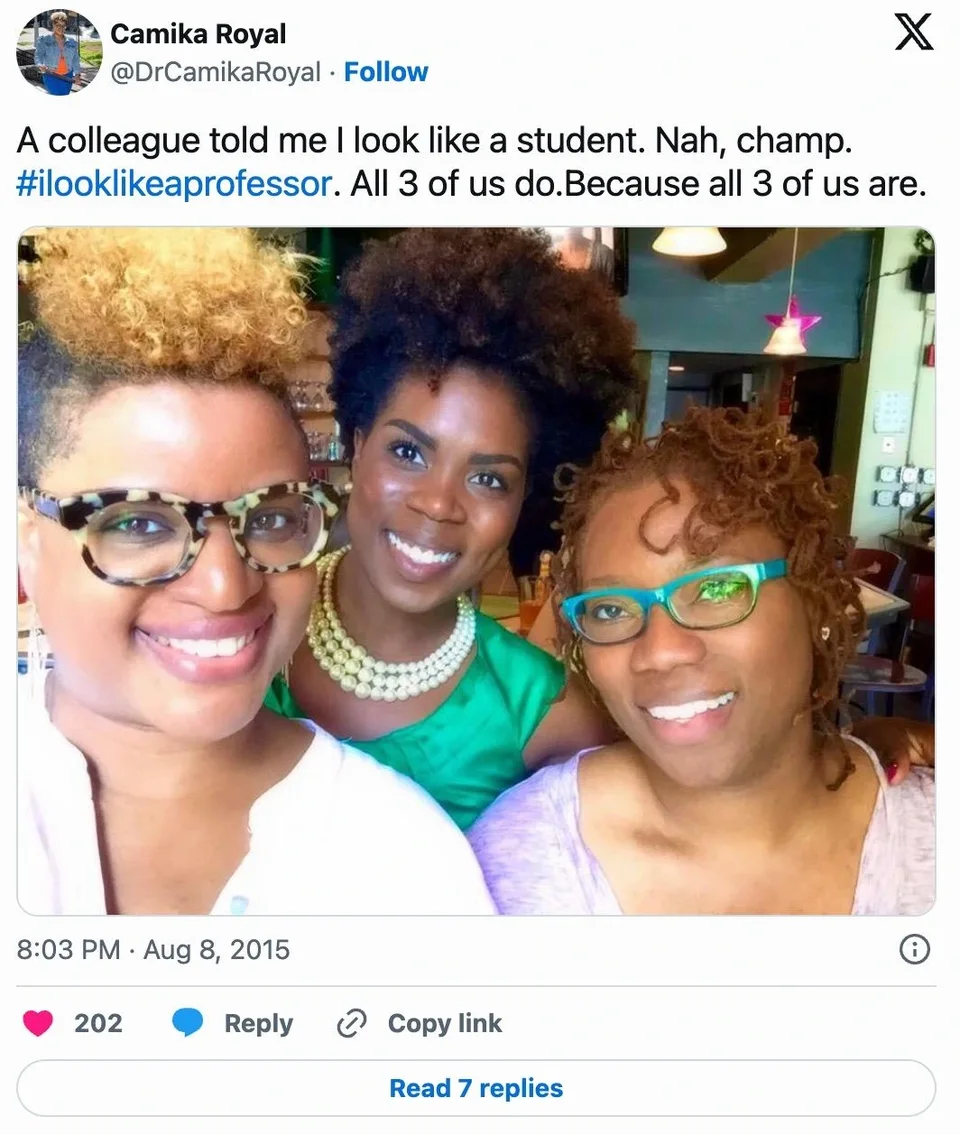
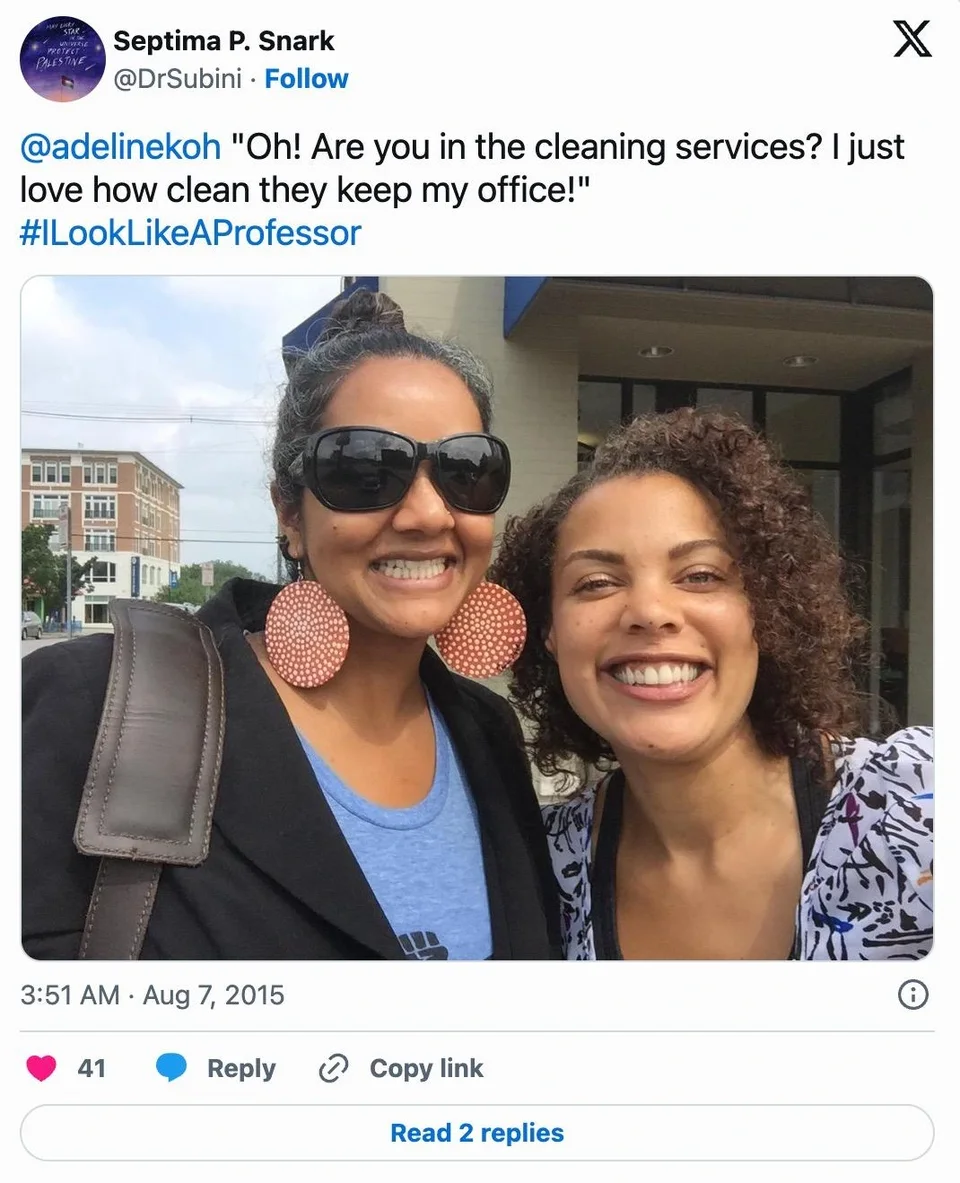
When photographs—especially the self-directed form of the selfie—are linked to broader social practices, they can create new collectives, forming a kind of virtual community. People convey a shared self-identity through selfies. Everyone in these pictures is a professor, but if I hadn't told you, you might not have thought so. That is exactly the stereotype they are using selfies to break through and oppose.
Now back to admiring oneself, enjoying selfies. Han's use of exhibition value to explain selfies has a blind spot: he completely ignores how the selfie-taker feels. Some people say your photos are retouched and therefore fake. Think about a commonsense question: don't I know whether I used a beauty filter? Don't I know I don't look like that in real life? Why write a paper to tell me that selfies don't match how I really look? I've never understood that way of thinking.
The question is, since everyone clearly knows it's so-called "fake," why are they still willing to take them? We need to look at how this self-enjoyment arises, because the feeling, the experience itself, isn't fake. When you use the liquify tool to slim your face, you might even wonder whether you've overdone it, whether others will notice. All this shows that selfie-takers know what they're doing. We can't be like those who apply Marxism in a vulgar, mechanical way, believing that the appearances of life are all false and constructed, with an authentic self and authentic life hidden behind them. Many Marxists don't accept that either and won't simply demand that you embrace some so-called reality.
I think the selfie is in a sense like putting on makeup or wearing clothes: it offers another way of experiencing the self. In reality you may never be able to look like that, but experiencing another self for half a minute or a minute, or viewing yourself from outside yourself—that experience is very real. It's different from looking in a mirror, and different from looking at photos others take of you. The selfie is an act; during the period before and after you pick up the phone and press the shutter, you are constantly looking at yourself, at a self presented in another form. Even if you say it's fake, constructed by algorithms, can you deny that the feeling is real? And even if the feeling itself is provided by algorithmic intervention—so what? With many theories, by the end you really want to ask: so what? Some psychoanalytic discussions, for instance, that Jacques Lacan stuff. I once read a book on this question whose author ended with one sentence: "We know all of this is fake, but we still can't get enough of it." I think that's important. Don't think the people engaged in image-making practices and taking selfies are so stupid. They're not stupid at all.
Likewise, the people who appear in front of the lens aren't necessarily all being manipulated. In critiques of colonial photography, there's a very crude line of thought that simply regards the photographer as the colonizer or the colonizer's spokesperson, ignoring how photographs in turn shaped the colonizers, and how they later became evidence and a source of strength for the resistance of the colonized. One-directional thinking can hardly explain this.
What's really worth considering is also how photographs shape people. If you appear a certain way in a photograph—say, a kind of mad beauty—whether or not it's by your own will, how will others see you? If you use a lot of beauty filters, how will people understand you when they meet you in person? When a photograph presenting one aspect of a person appears, how should we understand the relationship between the photograph and that person? If you are the person in the photograph, will you go on to accept the qualities the photograph assigns you?
Take Andy Warhol's photographs of Edie Sedgwick. She had short hair and was called Warhol's muse, his goddess, but in fact that was largely something Warhol shaped unilaterally. Through drugs and the like, he molded Sedgwick into how she looks in the photographs. People think she's beautiful, but I find this utterly horrifying: when every image of yourself you receive from the world looks like that, how do you form a self-identity? Won't you come to understand yourself as the person in the lens? Later Sedgwick married an ordinary man. If you're interested, look up her wedding photos—she looks like a completely different person from her time at Warhol's studio. But when, after the marriage, she couldn't stop using drugs, people began attacking and abusing her, and in the end she killed herself.
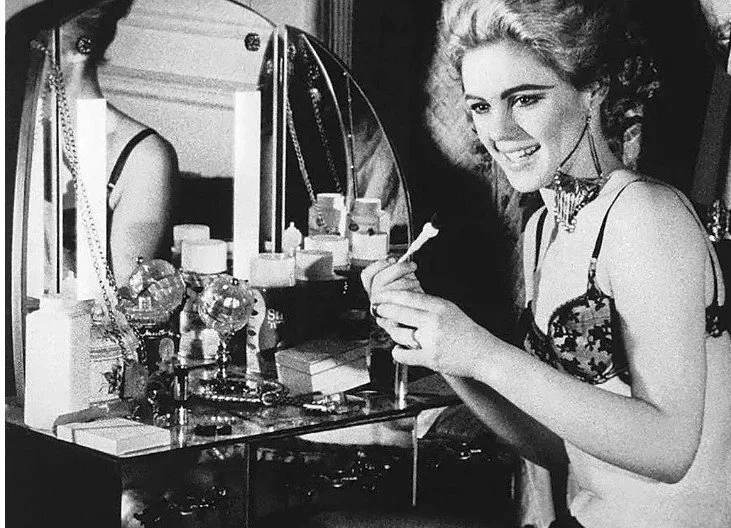
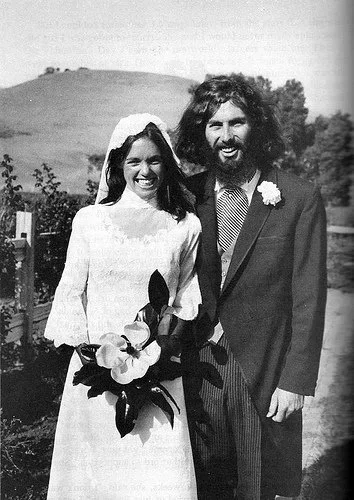
This image was manufactured—manufactured by Warhol and people like him. And photographs intervene in the lifeworld so deeply that you accept it as your self-identity. When that identity is far removed from your own wishes, it keeps pulling at you, until finally it snapped the rope Sedgwick's existence hung on. This is a very sorrowful thing. Thinking about selfies from this angle might bring out more questions.
Research-Based Photography and the Polysemy of Photographs
Questioner F:
When I went to the Arles photography festival, I noticed that photography now has something in common with documentary film: a major turn toward research-based photography. Why this change? For example, more work takes exhibition as its end goal, researching a topic, or vegetation change in some region, and then creating work based on that.
Guosen Chen:
The work I just showed also belongs to what you call research-based photography. Take a look at the exhibition space: viewers enter a dark room and sit there watching. I don't think the reason is that complicated: what a single photograph can do is too limited. If it's no longer just about achieving a complete aesthetic feeling, what else can you do with it? This also concerns what happens once a photograph intervenes in the world. To control a photograph's polysemy and ambiguity, you need all sorts of ways to supplement its semantic poverty.
At the end of A Little History of Photography, Walter Benjamin talks about the caption, the inscription (Beschriftung). He thought that in the future such text might become more important for understanding a photograph's meaning than the image itself. There were no camera phones then, and no metadata like today's, but he saw it very clearly: strip a photograph of all contextual information and what can you still know? It's hard, really hard, and it can easily escape the control of the artist's intention.
Saigon Execution, which I just talked about, illustrates this problem. Photographs have an inherent flaw—or, in a sense, a flaw: they can't be fully tamed by your intention. Whatever you shoot, there's always something your intention doesn't cover. You go home and look at the photos and may find: how did that thing get in the shot? Faced with the causal relationship between photograph and world, human intention can hardly cover every area and corner of the frame.
So all kinds of supplements appear: slides, video, documentary text, captions, historical materials, non-photographic materials, even handmade objects. I once saw a work that photographed a person and also cut a piece of cloth from that person's clothes and placed it next to the photograph. All of these are attempts to tame the polysemy and ambiguity of photographic expression, especially of single photographs. That's my understanding.
Why Images Are Still Necessary
Questioner G:
We often say a picture is worth a thousand words, but if a photograph needs long passages of text behind it to interpret it and express the creative intention, and the text can already express that, why use visual language at all? Why not just use text?
Guosen Chen:
That's an especially important question.
Questioner G:
Is it a photograph, a photographic work, or text? An image should convey information through light, shadow and color, but you're making me decode it through text rather than through visual language and the language of the lens. That's odd.
Guosen Chen:
Some works are indeed like that. But as for why we still use photographs, I think we have to go back to how we receive the world. Photography provides a pointing, image-based mode of reception.
Take the work I just showed: that endless, even boring sense of waiting can't be obtained through text alone. When reading, you control the pace; a slideshow is different. It just keeps playing, and you can only endure it, unless you turn and leave.
As for what you said—that a photograph's meaning could be conveyed entirely by text—sometimes the artist simply didn't do it well, and we have to admit that. Some people insist on using impressive-sounding interpretations to supplement or explain photographs, and much of that is unnecessary. But that doesn't prove, conversely, that the photograph itself has such enormous power that it can convey everything on its own.
That the photograph itself is always awaiting supplementation, and that text and other explanatory means are used to build a more complete whole of meaning, are matters to be discussed separately; they don't cancel each other out. Of course, some works aren't carried through thoroughly enough—that's certain.
Questioner G:
Or the author over-interprets their own work.
Guosen Chen:
I think some undergraduate graduation projects by photography students at Chinese art academies have this problem. What the schools teach always emphasizes "you must have something to express," but must the expression land in text? Must it land in the photograph? Not necessarily. Forced into this either/or, you may produce the kind of work you describe. It still needs to be discussed case by case.
Conceptual Photography and Education
Questioner H:
In conceptual photography, photography is the medium for expressing ideas, but many people, especially students, learn the medium first and then look for ideas within it. I feel the logical order may be wrong, but it seems to be common. What do you think?
Guosen Chen:
I think conceptual photography isn't about expressing ideas; it lies in presenting a process. The point isn't what idea is ultimately expressed—otherwise we really would be back to the question: why use photographs?
As for education specifically, I'm not familiar with the textbooks used in photography programs at Chinese art academies, but there is a tendency to excessively worship profound meaning. It seems to exist across the humanities—in literature too, in photography too—always needing to find something tremendous in a work to prove its value. But at the start, photographs were just for conveying lived experience and pointing at the real world.
You could also ask Professor Qiu this; he certainly knows far more about conceptual art than I do. I'm not clear on the specific facts of education, so it's hard for me to give a very precise answer, and I don't dare say much.
Performance and Photography
Questioner I:
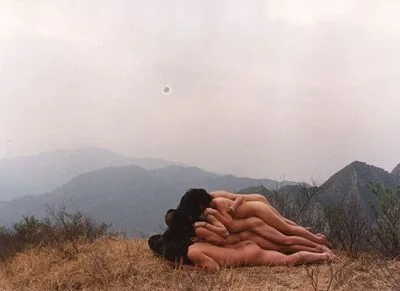
When a performance artwork ultimately comes down to a photograph—like To Add One Meter to an Anonymous Mountain—is it performance art or photographic art? I've thought about this many times. And the photograph can sell for a lot of money. Where does its value lie?
Guosen Chen:
Let me describe a work that illustrates this relationship very well. John Baldessari did a ball-throwing performance: he threw three balls into the air, aiming to photograph the instant they formed a straight line. A roll of film has thirty-six exposures, so he made thirty-six attempts, then selected about twelve photos closest to a straight line to make up the work.
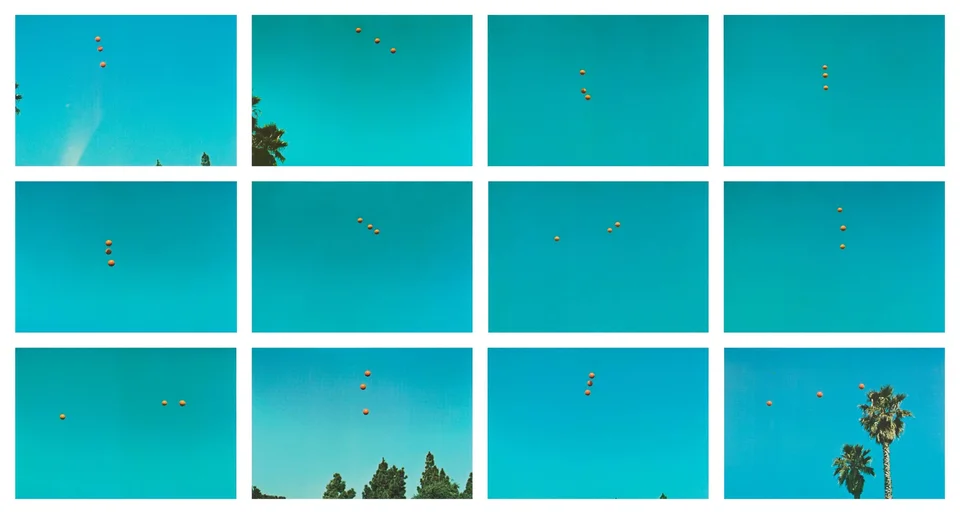
You can say it's performance, conceptual art, and also a photographic work. We didn't see him throwing the balls in person, but we know it really was a performance, with a strong Marcel Duchamp flavor. This work almost abolishes the distinction between performance and photograph, because the performance seems to exist for the sake of the photograph. It pushes your example to the extreme.
Take To Add One Meter to an Anonymous Mountain, or Huan Zhang's 12 Square Meters: in a public toilet he poured honey over his body and sat like an ascetic, letting flies bite him, and finally walked slowly into a pond to wash himself clean. If these performances don't exist entirely for the sake of photographs, then Baldessari's ball-throwing abolishes the distinction between the two. For me, working out whether it's photography or performance isn't important, because such photographs are at the same time interrogating what performance is and what a photograph is. We call certain people photographers because we feel that the photos they take differ from seeing the world in person—they discovered something. But the ball-throwing work abolishes this distinction too. It makes us reflect on whether there really is a special photographic act, an act of genius creation, capable of separating the photographer from ordinary people. So I don't think it's necessary to draw a sharp line between performance and photograph.
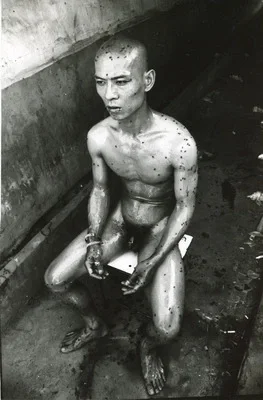
There are also the performances of Yunchang He and Cai Guo-Qiang, which we likewise receive through photographs. Whom does the photograph belong to—whom should it belong to? These questions are hard to explain using the model of "a certain photographer created a work" or "a certain fixed subject created a work."
If, as I said at the beginning, we understand photography as the product of multiple subjects continually encountering one another in the same field, in a specific time and place, with meaning constantly renewed, then these questions no longer need to be handled with that model. Both performance and photography can be understood this way. That's my explanation.
Host:
All right, last question.
Photography, Truth and Publicness
Questioner J:
I'd like to ask a more theoretical question, which may be a bit broad. Simply put, it's about the relationship between photography and reality, or truth, and how the dynamic tension between them changes across the different forms it takes in everyday life. Actually, we've been discussing similar questions all along. The production of images—including the technology, and later interpretation and circulation—involves changes in media, social relations and among subjects, and can't be understood as a fully truthful representation. Take selfies: people may not have pursued complete truthfulness from the start, but they haven't entirely abandoned it either. Whether in production, interpretation or circulation, photography seems to be a re-creation of so-called reality, and also a creation of meaning. What's produced isn't only photographs but also meaning; it's creation, expression, and can't be understood only as reproduction or mass copying. If photography no longer only pursues truthful representation—no longer just captures reality, taking a slice from real things and presenting it—then has the relationship between subject and object, or subject and its object, in the photographic act changed, or even been abolished? Because it seems to have become a very personal, very creative expression, and later interpretation may have little to do with the truth or the object at the time. In that case, does its economic, moral or ethical, and political significance also arise or become apparent only afterward, for instance in the course of circulation, use and exchange? Has the relationship between photography itself and the object photographed changed as a result?
A follow-up question: if the relationship to the object changes, how should we discuss photography's public significance? I want to come back to the theme of publicness in today's talk. If photography's relationship to reality and to its object is changing, must we place it in a larger dimension, linking it with curating, distribution, circulation and use, in order to discuss its public significance, since photography itself isn't necessarily just an act of fidelity to reality?
Guosen Chen:
Thank you, that's a very good question. You extended it from one simple question, so let me also answer first with one simple sentence and then elaborate: everyone has their own truth.
Also, the meaning of the word "真实" in your question kept shifting. Sometimes it meant reality, sometimes truth, sometimes fact, and sometimes the real—the Real in Lacan's sense, for example, or what Roland Barthes thought art should represent. So when we talk about truth, we first have to be clear in which sense it's being used. If its meaning changes in every argument, there's no way to maintain the identity of the concept.
Although I've already mentioned Professor Qiu many times today, I have to mention him once more. I recommend Professor Qiu's Upward or Downward, which includes an essay, "What Is Realism?", discussing realism in the sense of mimetic theory and the relationship between reality and truth. I won't go into it here; if you're interested, have a look. As for the so-called truthful connection between photography and its object changing, or the necessity of that connection no longer existing, my position is that there has never been a fixed connection. What the relationship between photography and its object is ultimately depends on the conditions under which what we call photography, and are prepared to accept as such, is presented and received.
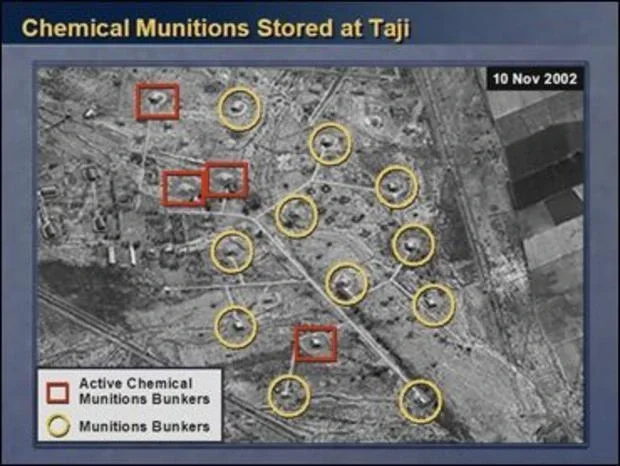
Do you remember how, during the Iraq War, the Bush administration accused Iraq of having facilities for weapons of mass destruction? I don't remember exactly which facilities. That infamous presentation showed slides and satellite photos, telling everyone: "Here they are, let me show you." This was Colin Powell's presentation to the Security Council in 2003. All sorts of things were labeled on the photos—this is a water tower, that's something else—to prove the legitimacy of launching the war. This kind of "truth" or "reality" exploited precisely the view I just described, that whatever a photograph captures must be real. The problem was that those accusations were false. They were false in the factual sense, but in terms of how they functioned, were these photographs any different from true ones? The effect was the same. Within that system, photographs were assigned a position from which they could produce truth effects, and so they played the corresponding role and drove the war forward. So the relationship between photography and truth is very complex. That's roughly my brief answer.
Host:
That brings tonight's Evening Living Room to a close. Happy New Year, everyone, and take lots of selfies!
Guosen Chen:
Thank you, everyone.