
As I understand it, the exhibition rests on two conceptual poles. The first is "indexicality," a notion developed and popularized by Rosalind Krauss and others. The second is the tradition of "absorption" and the "anti-theatrical" championed by Michael Fried. Indexicality concerns the continuity between photography and reality and emphasizes the relationship between a photograph and its cause. The second tradition sets out to break that continuity. It also bears on how contemporary photography established its artistic standing after the 1970s. Photography kept a Diderotian pictorial tradition while acknowledging "to-be-seenness" as a way of handling the relationship between the work and the viewer. Its key means of doing so was the form of the tableau.
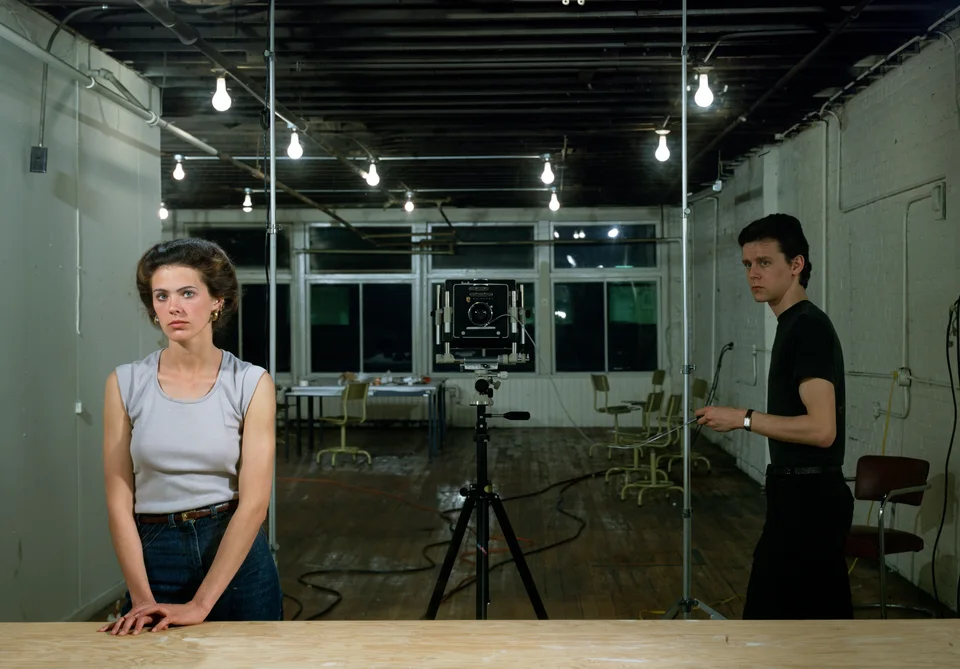
Accordingly, the first thing that catches the eye on entering the exhibition is Jeff Wall's Picture for Women. It is a typical photograph in the tableau form. The Chinese rendering of "tableau" as 巨幅场面 ("large-scale scene") was contributed by Rong Jiang. The term has roughly the following basic meanings:
① From the outset, the work is designed to be hung on a wall and viewed there, rather than viewed up close or held in the hand like an ordinary photograph.
② It uses an unusually large format.
③ It emphasizes its own status as an artifact.
④ It intervenes as an "object" in the space the viewer occupies and produces a kind of "confrontational experience" between itself and the viewer.
In Picture for Women, the work's status as an artifact is made even more evident by the seam where two lightbox panels are joined across the photograph's surface. This seam is only noticeable when one sees the work in person. The tableau was a crucial form on which contemporary photography after the 1970s relied to win its artistic standing. This is even more evident in the section "A World In Itself," which is clearly the part of the exhibition most influenced by Michael Fried. Its wall text uses terms that come directly from Fried, such as "theatricality" and "tableaux." (The "tableau" itself was actually coined by Jean-François Chevrier in 1989.)
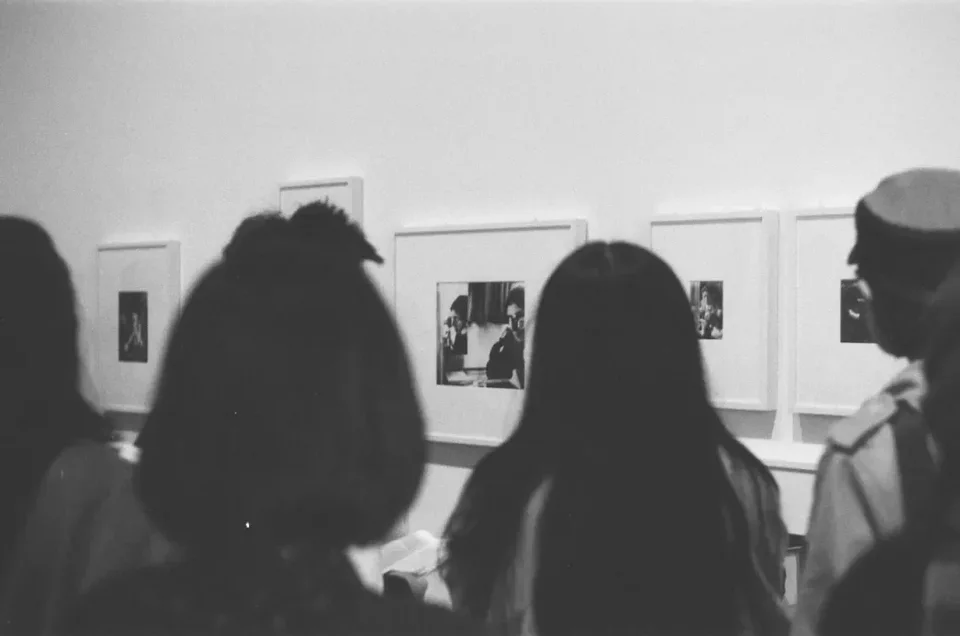
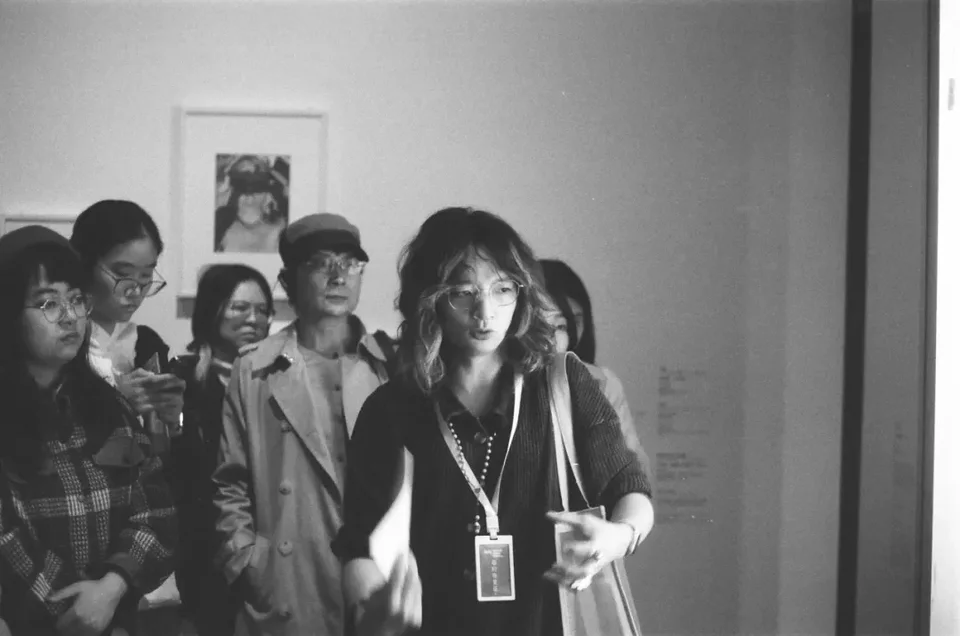
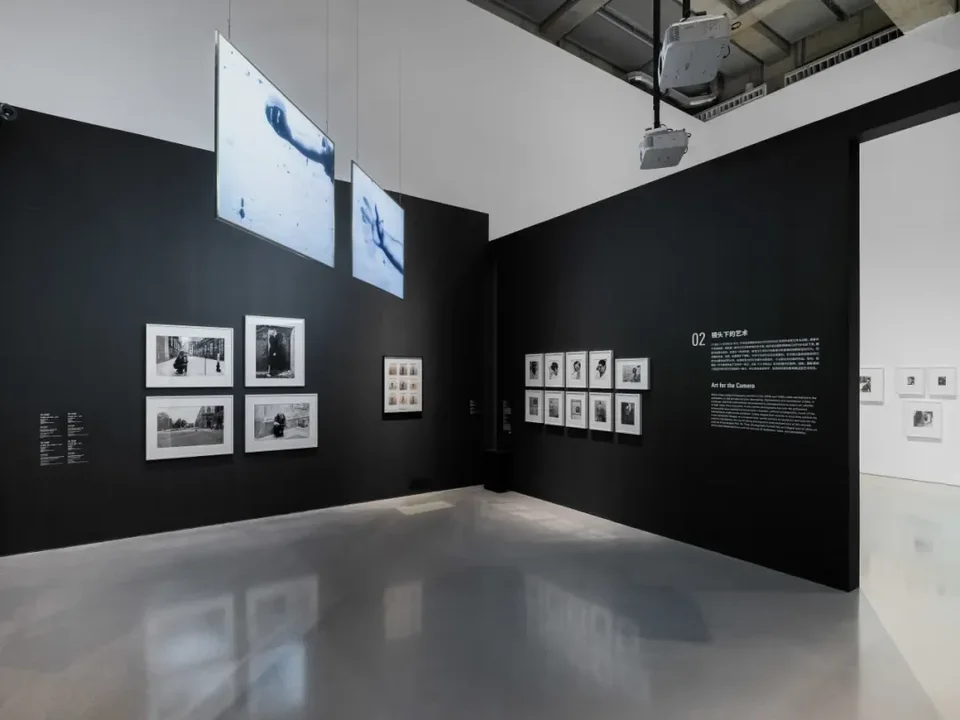
In the second section, "Art for the Camera" (below), the curators chose several frames from the final stage of Huan Zhang's performance 12 Square Meters as documented by Rong Rong. In these frames, Huan Zhang walks slowly into a pond to wash the honey off his body. The curators consider these photographs to be clearly more "Rong Rong" than a straightforward record of Huan Zhang's performance.
This section gave particular attention to a performance work by John Baldessari. In 1971, Baldessari took part in Pier 18, a group exhibition organized by the Museum of Modern Art (MoMA) in New York. Each artist was asked to meet the photographers Harry Shunk and Janos Kender on an abandoned pier and propose a project. Baldessari came up with several ideas. One was to bounce a rubber ball on the pier and ask the photographers to try to center the ball in mid-air in their images. That is the project shown in the exhibition.
Baldessari's rule had a crucial effect, and producing that effect was one of his explicit aims: it set the demands of composition against the photographer's perceptual attention. Paying attention to where the bouncing ball was meant giving up control over the composition of the picture. Baldessari thereby challenged a heroic ideal and its ideological premise: that close attention to a complex, rapidly changing scene would capture the perfect moment and the perfect picture. From Stieglitz to Cartier-Bresson, this ideal sustained the development of photography. At its heart was the effort to overcome the chance character of both reality and the machine itself, and to foreground the photographer's agency in "capturing the moment."
In the task Baldessari designed, the compositional motivation of the entire image was condensed into the ball, so only the ball's position mattered. By tossing the ball, Baldessari also placed this key compositional element beyond precise control, which turned photography into a process governed by chance and contingency. The photographers could not fully control where the ball would be, and this uncertainty became the dominant factor in how the image was composed. In this way, Baldessari inverted the myths that had grown up around the photographer's creative genius.
In fact, the whole exhibition's underlying conception of art runs counter to Cartier-Bresson's "decisive moment."
In the third section, "Questioning Social Images" (below), Ed Ruscha's photobooks are placed right next to Sherrie Levine's After Walker Evans (left in the image below). Levine's work is obviously an "appropriation" of Evans's classic images. Ruscha's photobooks, in turn, are among the works most frequently appropriated in contemporary photography. This is especially true of his Twentysix Gasoline Stations, which many artists, including Michael Maranda and Joachim Schmid, have appropriated.
The key to "appropriation" is "deskilling." Deskilling loosened the strong bond between art on the one hand and genius and skill on the other. Yet it left the artist and the viewer with nothing to do when faced with such works, and art could no longer perform any intellectual function. This is why Jeff Wall and others turned to staged photography. They sought to rebuild a painterly mode of labor that could work in the age of mechanical reproduction. That meant restoring, through the artist's own painstaking labor and arrangement, the skill requirements that Sherrie Levine and others had discarded. For Wall, a single photograph can take a year or two from preparation to shooting.
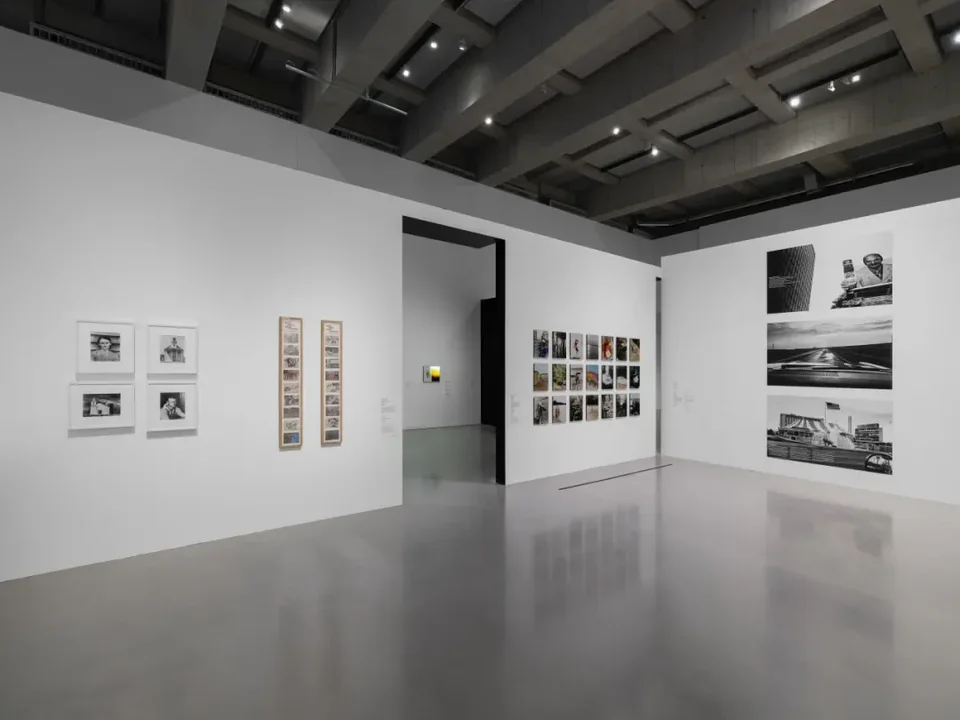
The third section also includes work by Martha Rosler, who may not be very well known in China. The photographs shown here come from Body Beautiful, or Beauty Knows No Pain, and their context is closely tied to the feminist movement of the 1970s. Rosler places a seductive female body back into domestic, private settings. In doing so, she may be interrogating the following question. After sexual liberation, women's bodies became more "accessible." Did this make women's situation more autonomous? Or did it make that situation more constrained, because the value systems governing how bodies appear, and how they are imagined, managed, and desired, remained the old ones?
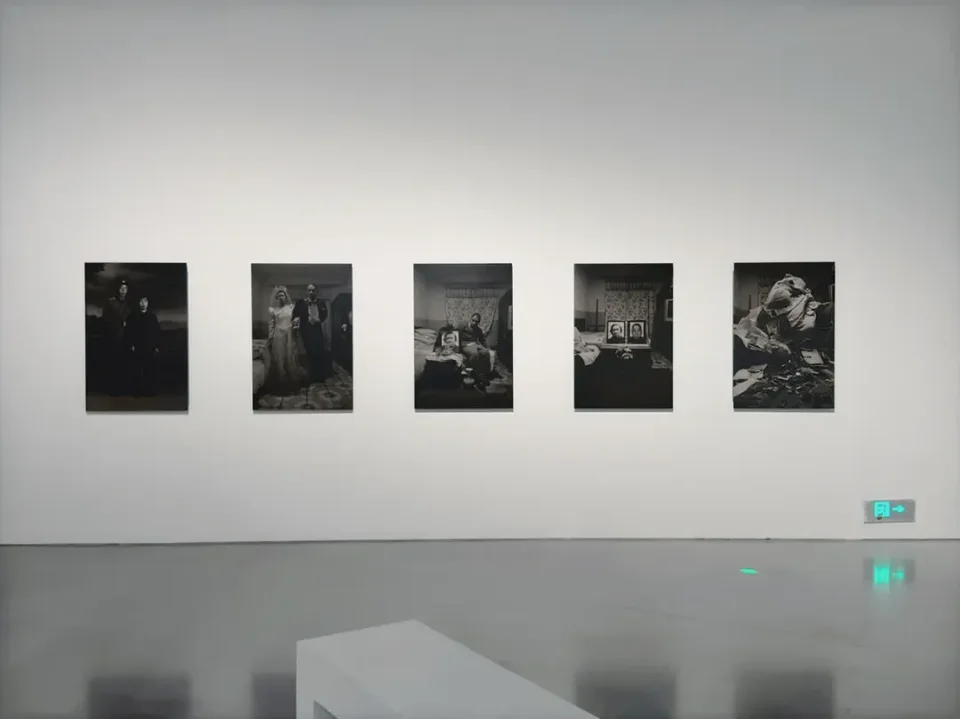
The fifth section, "Transformations of the Portrait," is the largest in the exhibition. Its first half places Patrick Faigenbaum's Italian Families opposite Yongping Song's My Parents series, setting up a dialogue between them.
In Faigenbaum's work, the myth of human interiority is transferred into the interior of the family. A timeless, phantasmal humanity fills these enduring spaces, whose objects have lasted from the past to the present and will go on lasting. Within these spaces, the human figure is merely a point of refraction. The tense of Faigenbaum's photographs is the "future perfect": a past that extends into the future, not simple nostalgia. The human figures seem swallowed by their surroundings. This effect comes not from any disproportion in the architecture but from an existence absorbed into this "future perfect" dimension of time. Faigenbaum's photographs accomplish the "completion" of time in the future.
Yongping Song, by contrast, reconstructs and photographs his parents' wedding image and carries time forward all the way to the ruins of the family home after both have died. What he declares is the abolition of time in the past. In this sense, although the two series share a surface atmosphere of "nostalgia," their conceptions of time are opposed. One points toward an unfinished future. The other points toward a past that has ended and become a ruin.
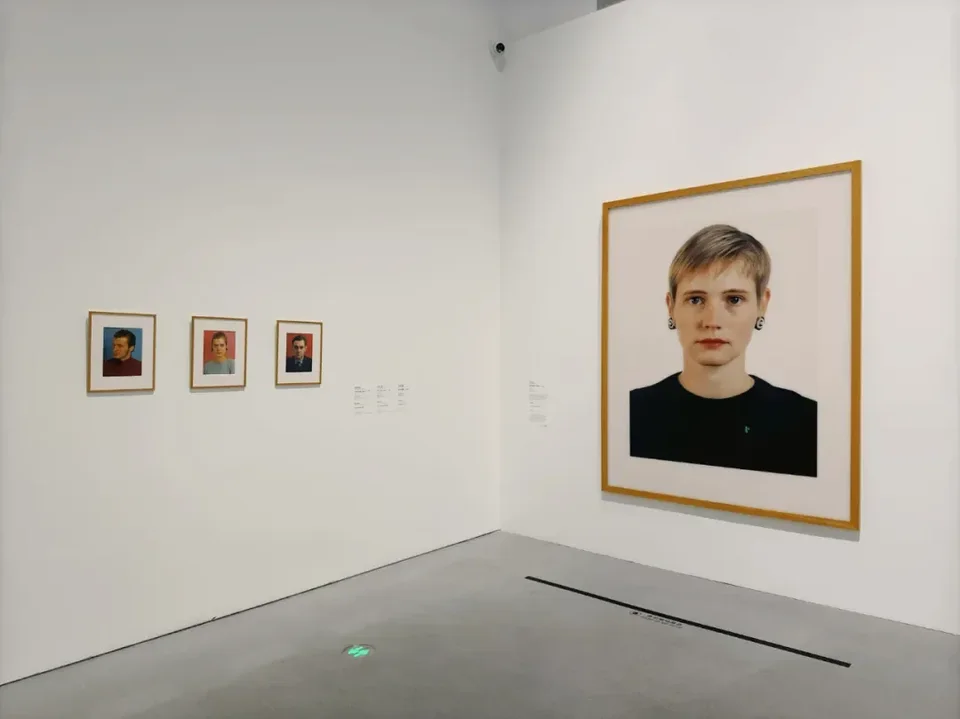
Another major group of works in the fifth section is Thomas Ruff's Portraits series. It includes his color portraits, andere Porträts (1994–95), and the portraits he began enlarging into tableaux after 1986. Each group represents one stage in the evolution of Ruff's portrait series.
The black-and-white andere Porträts series feels "uncanny." In Freud's sense, its figures fall between the "familiar" and the "unfamiliar." Ruff drew on photographs he himself had taken in the 1980s and recombined the portraits of two people into "composite portraits," deliberately keeping the unnatural traces left by the collage. These composites usually combine a man and a woman. Yet they do not give the impression of an androgynous blend. They look more like a woman with a strangely masculine quality, or a feminized man.
For andere Porträts, Ruff used a Minolta Montage Unit, a compositing device used in criminal investigations from the 1970s to the early 1990s. Notably, he borrowed this now-obsolete device from the police history collection in Berlin. This further confirms the concern with "police archives" inherent in Ruff's work.
By photographing "passport-type" pictures, Ruff's portrait series in fact points to the bureaucratic "archive." More precisely, it points to the way the bureaucratic archive "identifies" a person. The archive highlights the "objectivity" of its visual representation by concealing how its meaning is produced. Ruff instead foregrounds that process of meaning-production. He thereby exposes the archive's heterogeneity and the existence of what Allan Sekula, in his well-known essay "The Body and the Archive," called the "shadow archive."
By rendering an extraordinary wealth of facial detail, Ruff actually brings out the "hollowness" of the sitters' identity. The richer the detail, the more evident that hollowness becomes. This is also why Ruff chose to enlarge the Portraits photographs into tableaux.
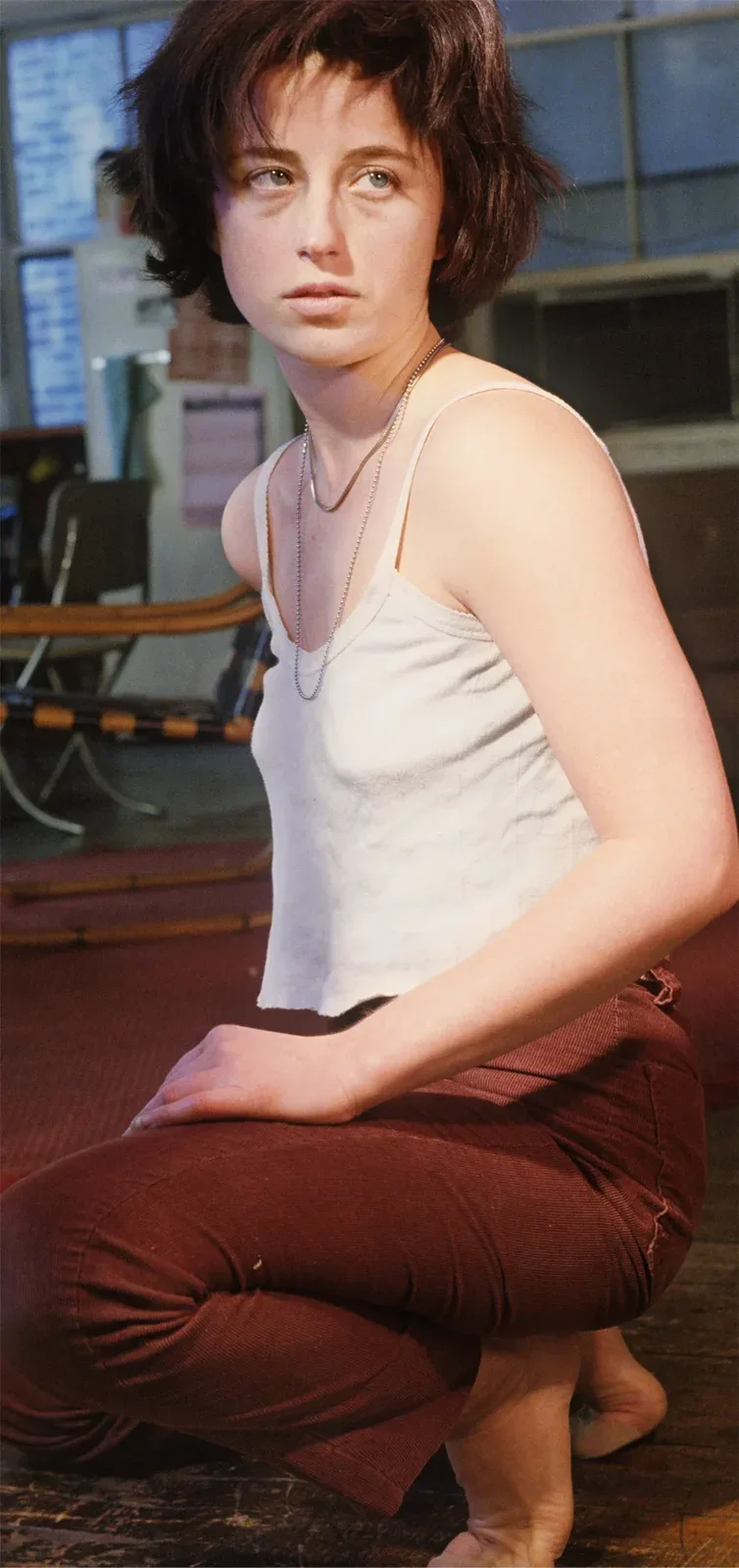
Another important work in the fifth section is Cindy Sherman's Untitled. This print was made specifically for this exhibition. The curators did not choose Sherman's more iconic Untitled Film Stills, in which she plays a typical "sexy woman" figure. The group they selected instead presents a somewhat androgynous "Sherman" whose gaze wanders uneasily. Sherman herself wanted to create works that could give visual pleasure to the women looking at them.
If there is a "punctum" in Cindy Sherman's photograph, it lies in the "feminine body," or more precisely in the female gaze. When a female viewer looks at this photograph, she arrives at a contradictory recognition, at once identification and misrecognition. The figure's contemplative eyes seem not to rest on anything in particular. They look inward, examining her life and her self, reconstructing her autobiography. One might call these "Woolfian moments of being." Her thoughts and soul wander elsewhere, above and beyond appearances. Her gaze pierces the frame, tears through the photograph's edge, and tests the limits of representation, seeking a way of seeing from elsewhere, a transcendent way of seeing.
It is equally evident that the woman Sherman presents in this group is fragile, sensitive, and vulnerable. The work also asks a question: must women's "autonomy" necessarily take the form of qualities like strength and resolve?
This section also includes a group of works that Liuming Ma made after his East Village period. (On one occasion, one of Liuming Ma's performances was reported to the authorities, bringing in the police. This scattered the East Village artists and led in turn to the end of the East Village.) The work consists of thirty-six self-portraits in which Liuming Ma plays his alter ego, "Fen-Liuming Ma." Liuming Ma's performance art aims to make his own body a sign of gender. Huan Zhang, by contrast, emphasizes the two-way interaction produced when an embodied body is placed in a specific everyday setting.
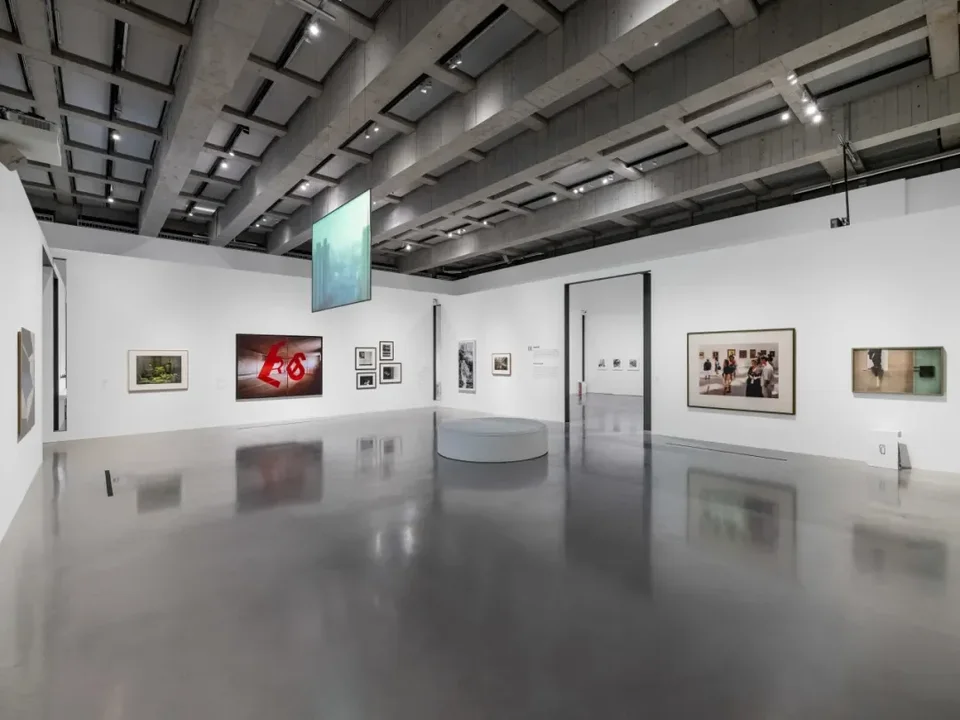
The eighth section, "A World In Itself" (above), is another key section of the exhibition. Its core ideas can all be found in Michael Fried's Why Photography Matters as Art as Never Before.
This section shows Thomas Demand's Diving Board (1994). Demand retains photography's "indexicality" but, by using paper models, detaches it from the historical traces of the original image. Only the indexicality of the model itself remains. In other words, Demand's photographs depict places and objects that are entirely free of traces, indeed systematically stripped of them. The only exceptions are the physical traces of construction left by the cardboard models the artist makes by hand. Because the paper models lack historical traces, the viewer can perceive only the artist's intention, not any "real" scene. This mode of reconstruction excludes every trace of elapsed time and every remnant of events. It produces a "dehistoricizing" effect and thereby creates a kind of indexicality radically different from the traditional kind.
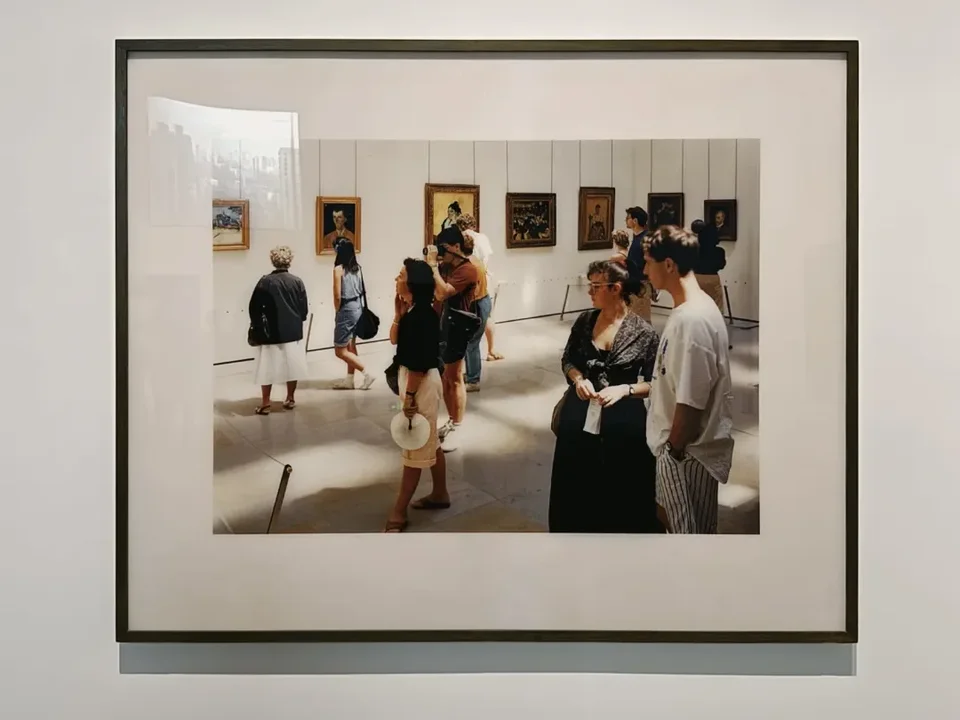
Thomas Struth's museum photographs are also on view. In Season 2 of our "Photography Theory" bootcamp, "(Art) Photography in Social Life," we devoted a whole class to a detailed explanation of Struth's photographic practice. The curators' choice of Musée d'Orsay I again reflects the exhibition's wavering position. They chose a photograph that is not a particularly typical example of the "anti-theatrical." In this picture, the visitors stand rather far from the seven paintings on the wall, which weakens the "severing" effect of the photograph's surface.
It is also worth noting that none of the photographs in Struth's museum series show visitors looking at abstract paintings. He chose only scenes in which visitors "face off" against figurative paintings. Perhaps this is because greater abstraction pushes decorative effect to its extreme, while the narrowness of its subject matter shrinks the "world." In figurative paintings that still embody Diderot's ideal of absorption, the canvas itself is a surface that separates the world inside the painting from the viewer's world. The surface of Struth's photograph likewise serves as an interface separating us from the people he photographed.
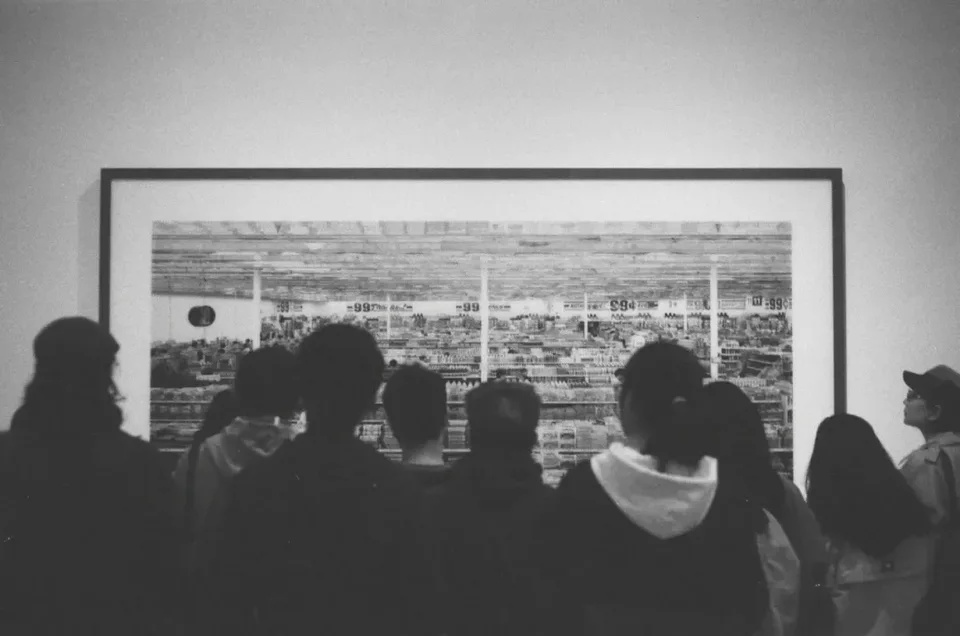
As a transition from the eighth section to the ninth, the curators placed Andreas Gursky's 99 Cent here, another tableau photograph. In Season 1 of our "Philosophy of Photography" series, we explained the aesthetic effect of Gursky's photographs in terms of Kant's "mathematical sublime." Gursky usually shoots from far away from his subjects, and distance, as a means of "severing," plays a decisive role in his art.
Gursky also tends to photograph his subjects from a high vantage point. The effect is that this extreme detachment suspends the camera viewpoint itself. From Gursky's vantage point, one cannot work back to any possible bodily position for the photographer. This further heightens the "severing" effect of his work, so that what it depicts becomes a world in itself. Moreover, Gursky's later works increasingly tend to represent "infinite quantity." This produces a "failure of the cognitive intention" in the judgment of the mathematical sublime, which intensifies the sense of alienation in his work.
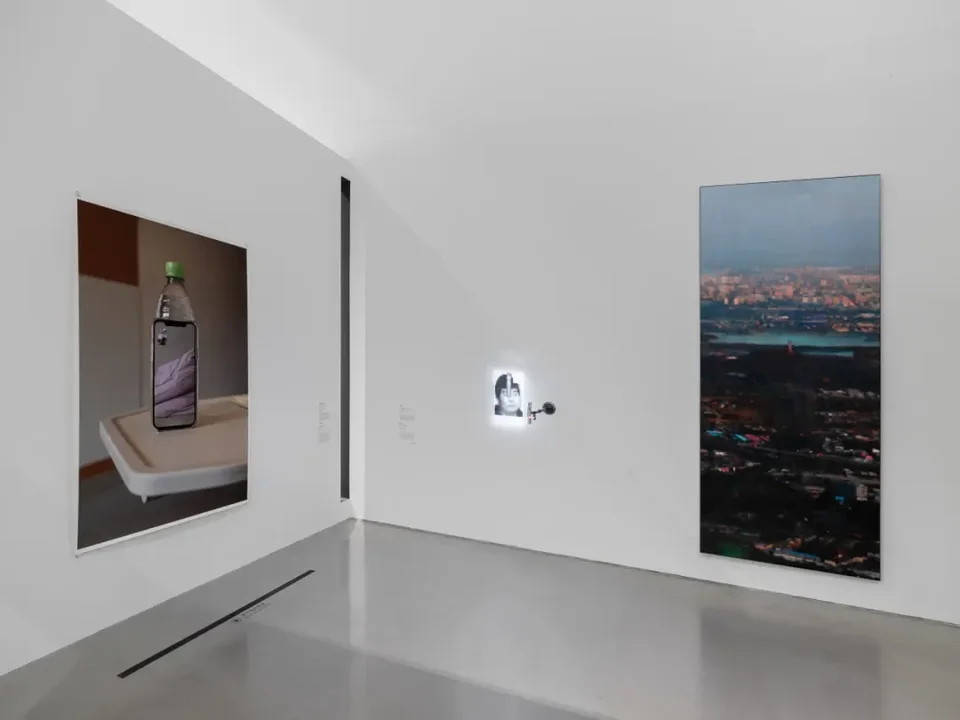
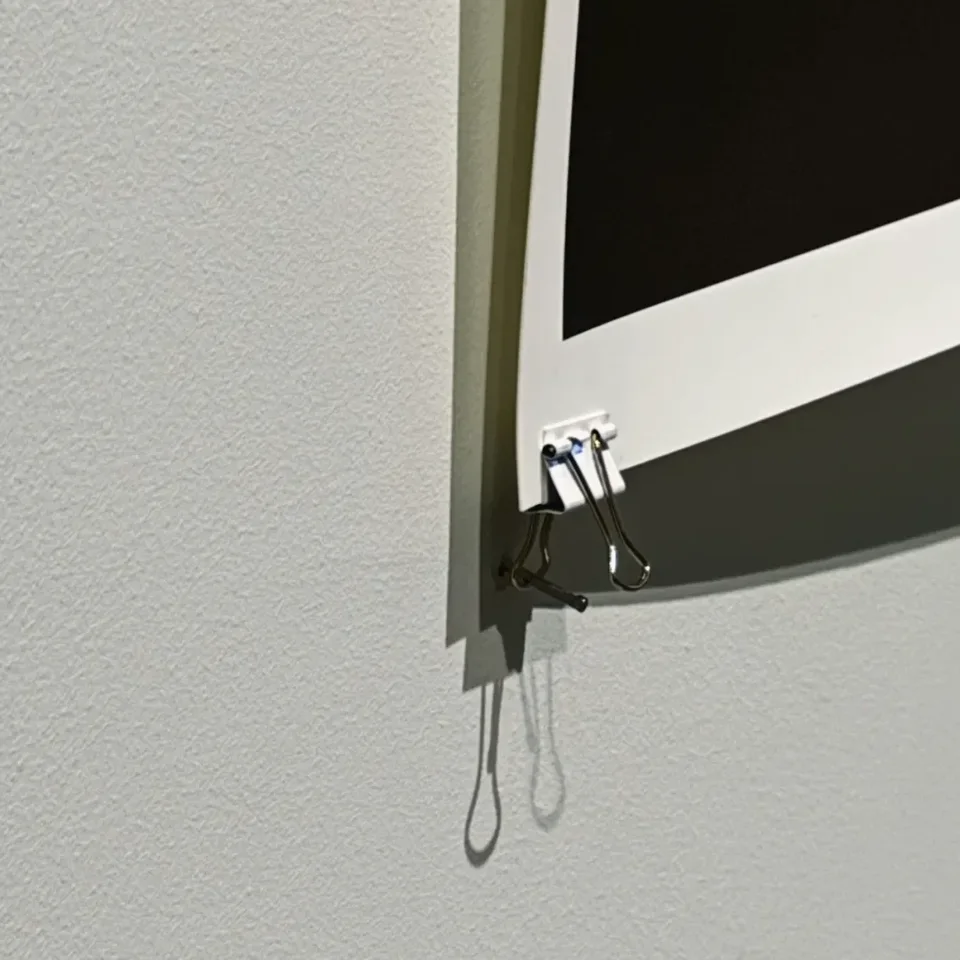
It is worth noting that the final section includes a recent work by Wolfgang Tillmans, Lüneburg (self) (left in the image above). This photograph is a typical Tillmans "wandering image": a migrating, continually decentered image that moves across and is viewed on all kinds of distribution platforms. The platform Tillmans uses most often is gallery display, but even in this familiar space his unorthodox display strategies overturn viewers' habits of looking. Tillmans sidesteps the conventional museum's constraints of material, scale, and subject matter.
The mounting of this photograph is the most unusual in the entire exhibition. Tillmans left a white border around the print, clipped the border with binder clips, and hung the clips on nails hammered into the wall. He even specified the angle at which the nails enter the wall, tilted outward by about 10 degrees.
When exhibiting, Tillmans often arranges every part of a wall as if it were a page layout, making full use of a room's architecture. He hangs photographs in corners, above door frames, even near exit signs, or next to freestanding columns and fire extinguishers. The logic of his practice is visual equality, or "parallelism," which can be summed up in his own words: "If one thing matters, everything matters."
Event planning: Guosen Chen
Event visual design: Zi Lin
Exhibition information and some installation photos provided by: West Bund Museum
Event photos: Mao Xia