
Ce Zang
Good evening, everyone! I'm Ce Zang, tonight's host. Welcome to the 14th online seminar in Server Art's series "Paths and Possibilities of Contemporary Imaging." Today we are honored to welcome Mr. Gregory Crewdson, Director of Graduate Studies in Photography at Yale University and a leading practitioner of contemporary directorial photography. We are also joined by Mr. Rong Jiang, a photography critic, photographer, and curator, and by Mr. Ronghui Chen, a contemporary photographic artist based in China. Let me say a bit more about Mr. Gregory Crewdson. He is one of the world's best-known contemporary photographers. He graduated from the State University of New York at Purchase and the Yale School of Art, and he now heads the photography department at Yale. His artistic career spans more than 30 years. He does not practice straight photography; instead, he works in a directorial mode, and his craftsmanship is extraordinary. The Chinese edition of his book Twilight (TWILIGHT) is now reaching readers and can be purchased online. First, I'd like to invite the noted curator Mr. Rong Jiang to introduce Crewdson's artistic career and his work from different periods. Mr. Jiang, please.
Rong Jiang
Thank you, Mr. Zang, for the introduction. I'll now introduce Crewdson's Twilight (TWILIGHT) and his other work.
Over the past year or so, I have had the good fortune to work with Mr. Crewdson himself, with Julian, who manages his studio, with Jian Yang, who translated the book's preface, and with Zhejiang Photographic Press to publish Twilight, the work that made Gregory Crewdson famous. Today I will talk about how Twilight came about, how it was made, and why it matters.
The Austrian psychologist Freud believed that the driving force behind artistic creation is the artist's repressed instinctual desires, especially desires repressed in childhood. This view has been borne out in the work of many artists, and Gregory Crewdson's series likewise confirm it.
Childhood Memories and Artistic Creation
Crewdson's father was a psychoanalyst who ran his practice in the family's basement. As a boy, Crewdson was deeply curious about how his father treated patients using Freudian psychoanalysis. He would often lie on the floor trying to eavesdrop on their conversations, but he could never make out what was said. He knew these conversations were secret, so he could only try to unlock those secrets through imagination. These imaginings planted the seed of Crewdson's later artistic work and gave rise to his "central theme." Crewdson recalls that when he was 10, his father took him to the Museum of Modern Art in New York to see Diane Arbus's photography exhibition, which was a sensation at the time. Arbus's photographs are famous for reaching directly into the psychological worlds of people on the margins of society. We don't know whether Crewdson's father was interested in Arbus's work because he was himself a psychoanalyst and therefore took his son along, nor can we know exactly how much interest the young Crewdson took in the exhibition.
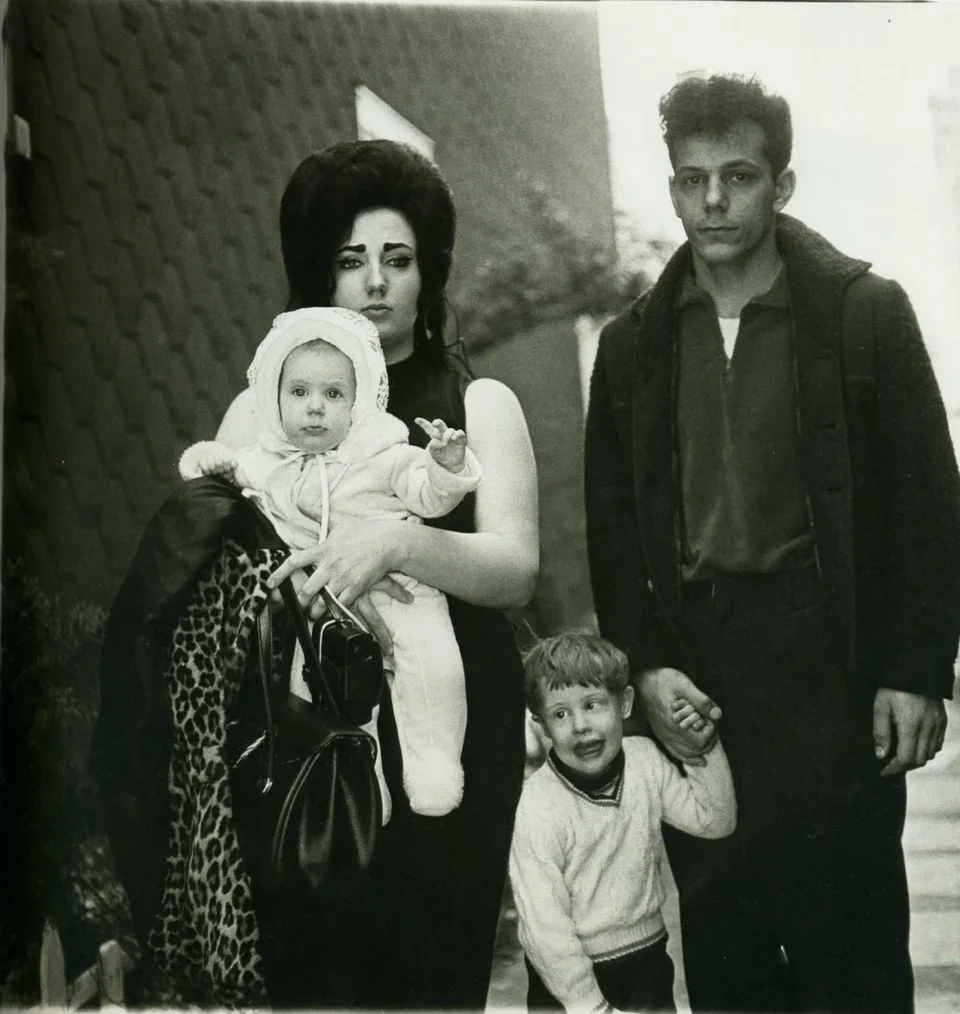
Most of you know Arbus's A Young Family in Brooklyn Going for a Sunday Outing. The young couple and their little daughter face the camera with very serious expressions, while the son alone looks strikingly odd. This is what Roland Barthes called the "punctum." Perhaps because Crewdson was about the same age as this boy and also lived in Brooklyn, the picture may have made a deep impression on him. Arbus's exposure of the "abnormal" side of American society became one of the important sources of inspiration for Crewdson's later work. Besides the family home in Brooklyn, Crewdson's father also built a small cabin in a small town in western Massachusetts, not far from New York, as the family's vacation home. The area around it was a typical American middle-class community: rows of family houses nestled among the hills, neatly trimmed lawns in front, white picket fences enclosing the backyards, and trees, flowers, and swings everywhere. Pittsfield was the largest nearby city. The American industrial giant General Electric once manufactured power transformers there, driving the local economy. After GE left the city in the 1980s, large numbers of workers lost their jobs or moved away, turning Pittsfield into a "ghost town." Crewdson visited the city often as a child. As a result, the community around the cabin where he stayed, together with Pittsfield after its dramatic changes, became one of the main settings for his work.
The Pictures Generation and the Influence of Film
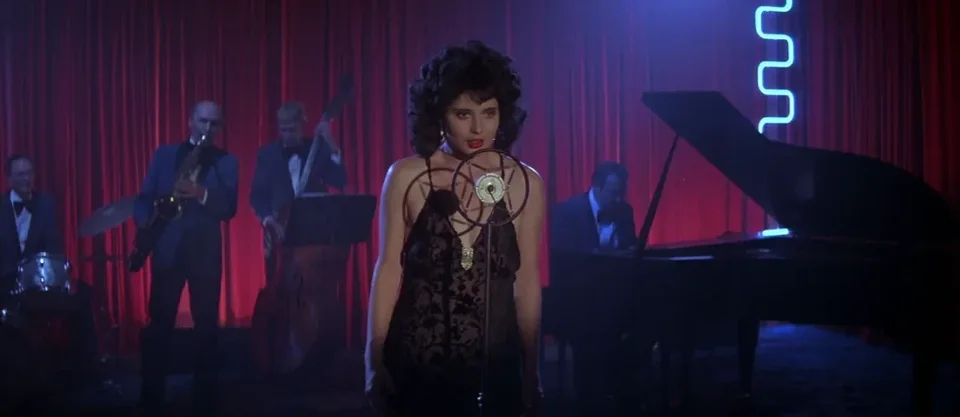
In college, Crewdson took a photography class with Laurie Simmons, a rising young photographer in the 1980s. In the early 1970s, Simmons had begun photographing domestic scenes with dolls to explore female identity and family relationships. She was a core member of the 1980s "Pictures Generation," and her staged approach and domestic subject matter influenced Crewdson. Crewdson was also fascinated by film. He took a course on Alfred Hitchcock and studied thrillers by Hitchcock and other directors. Among them, David Lynch's Blue Velvet (1986) shows an American small town that conceals murder, drug dealing, corruption, sexual abuse, and other dark realities beneath its calm surface. Crewdson has said this film changed his life. This subject—representing "the secrets and madness hidden within normal life" in small-town America—became the "central theme" of his later work.
Searching for a "Central Theme"
In the mid-1980s, Crewdson was pursuing a master's degree in the photography department of the Yale School of Art and often went to New York to see gallery exhibitions. At the time, the hottest artists were Cindy Sherman and other members of the "Pictures Generation." Their work mostly appropriated ready-made images of popular culture from the media, as in Sherman's series in which she played stereotypical female roles from Hollywood films. These artists' postmodern works, made with the photographic medium and the "directorial" methods of film, inspired Crewdson. He began to merge the "documentary" modernist photographic tradition championed at Yale with postmodern photographic methods, and to search for a photographic language and subject matter of his own.
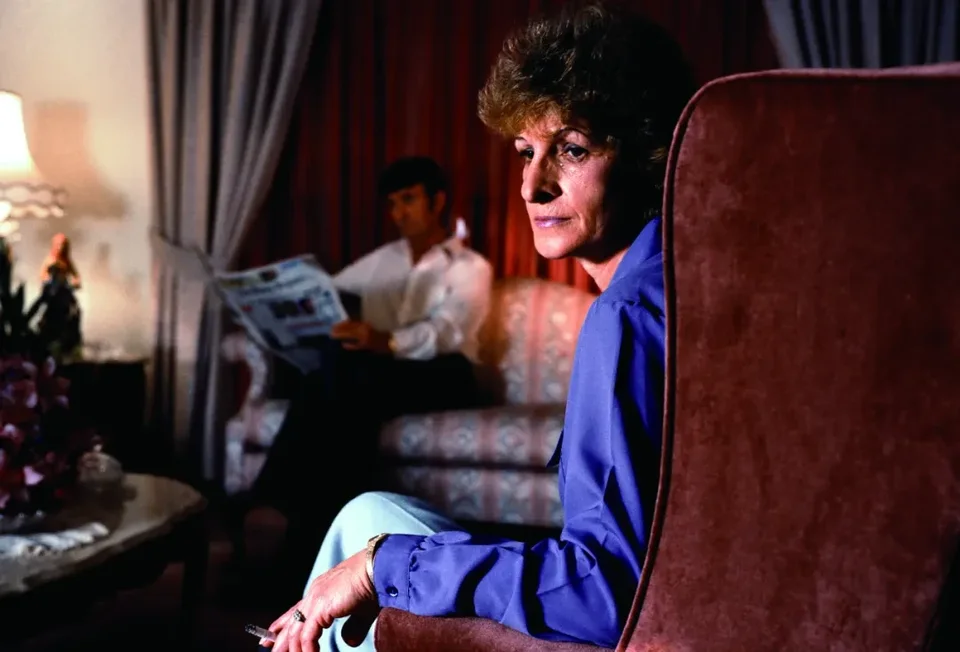
In 1986, he made his thesis work using the community around the Massachusetts vacation home as his setting. Although it looked documentary, much of it was actually staged. For example, he had a housewife sit on a sofa lost in thought while her husband sat in the background reading a newspaper, with no connection between the two. He also photographed interior and exterior scenes with no people in them. In this early body of work, set in homes and the community and exploring the psychology of family members, Crewdson's "central theme" was already beginning to emerge.
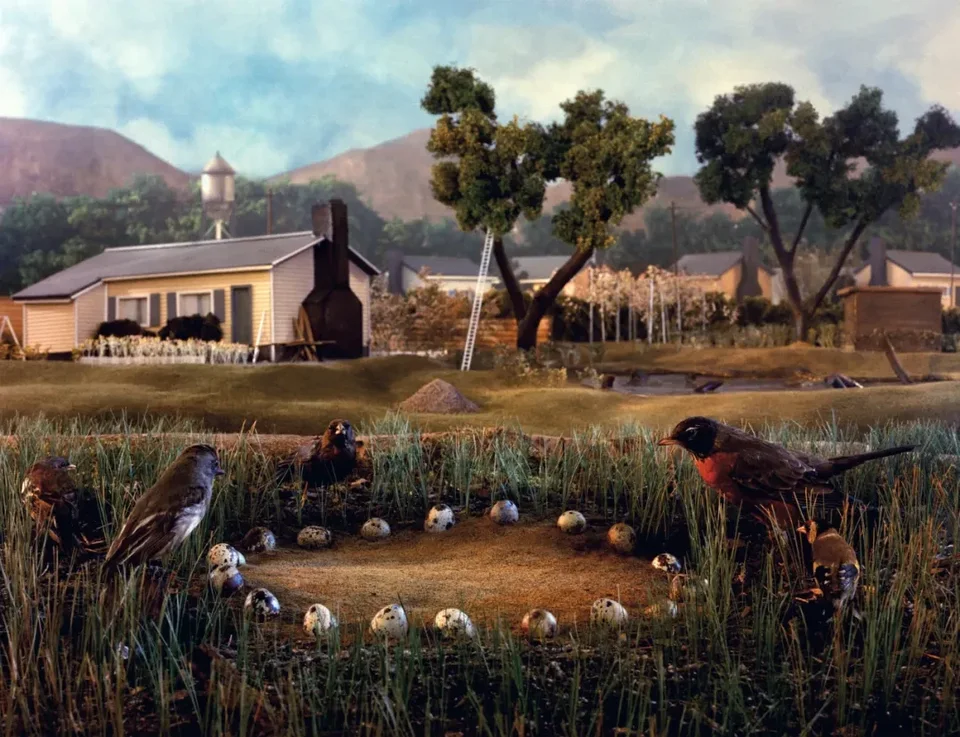
Crewdson's next project was a color series titled Natural Wonder (1992–1997). It was inspired by the dioramas of animal and plant specimens at the American Museum of Natural History in New York, and it also drew on the methods of his early mentor Laurie Simmons, who photographed dolls and miniature furniture. In the studio, he photographed model houses; specimens of birds, butterflies, and other animals; and living plants and insects. The project can be seen as a prelude to Crewdson's later staged series. It anthropomorphically represents the mysterious lives of birds and insects in the animal world: a flock of birds surrounding a circle made of eggs, birds preying on insects, insects feeding on a dead bird, and even horrifying scenes such as a rotting human leg. It is as if one were looking through a magnifying glass at the law of the jungle in a microscopic world.
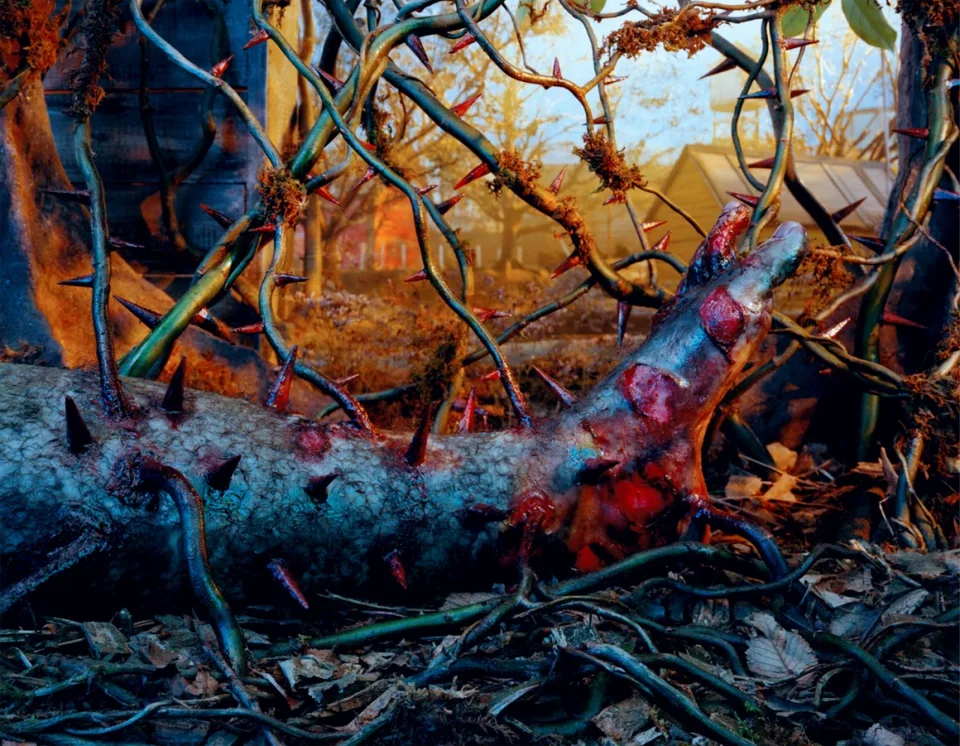
Natural Wonder creates a seemingly "perfect" world, with blue skies, white clouds, beautiful flowers, and rolling hills, and in this idyllic setting sits a peaceful, tranquil community. But the calm is only on the surface. In the grass where butterflies flutter, scene after scene of the "survival of the fittest" is unfolding. In this project, Crewdson was already borrowing elements from classic thrillers. The rotting human leg overgrown with plants in the grass, for example, recalls a scene in David Lynch's Blue Velvet: on a sunny day, the protagonist suddenly discovers a human ear crawling with ants in the grass. Images like this, in which beauty and horror intertwine, suggest that turbulent undercurrents may exist beneath the calm of everyday life.
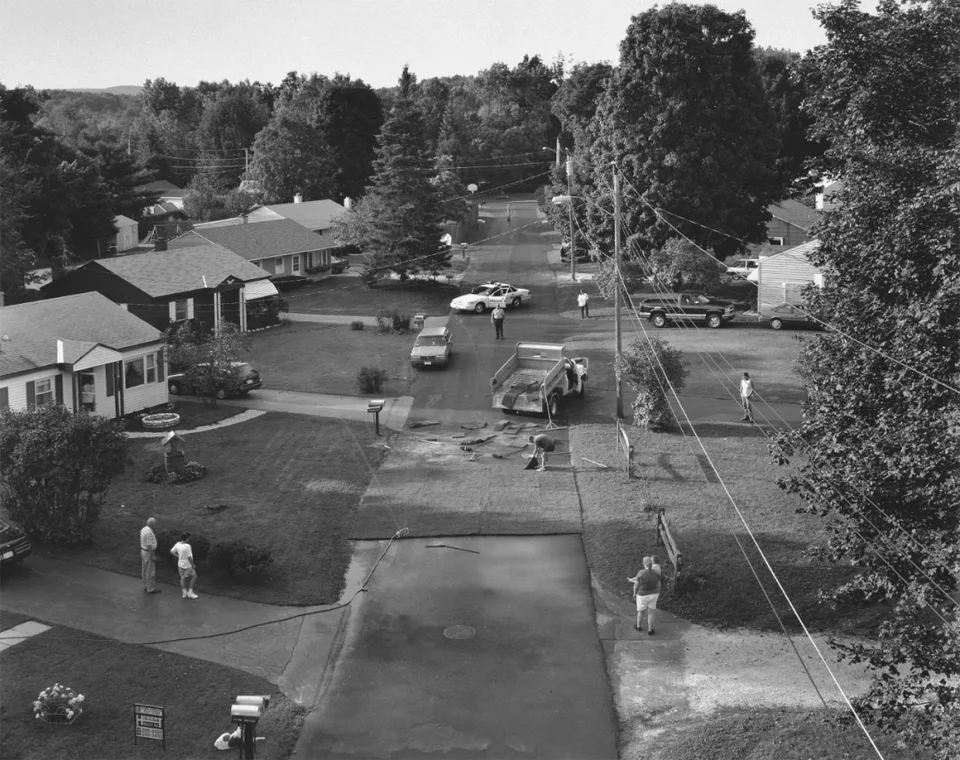
In the summer of 1996, at the vacation home, he repeatedly had strange dreams of "circling in the air like a great bird, observing the world." So he used a large-format camera and black-and-white film to make Hover (1996–1997), shooting downward from a crane platform. In contrast to the microscopic perspective of Natural Wonder, it focuses on the lives of the American suburban middle class. At first glance the works look documentary, but they conceal strange details: a man, for instance, extends his own lawn onto his neighbor's in an attempt to communicate, only to be watched by the neighbors and the police.
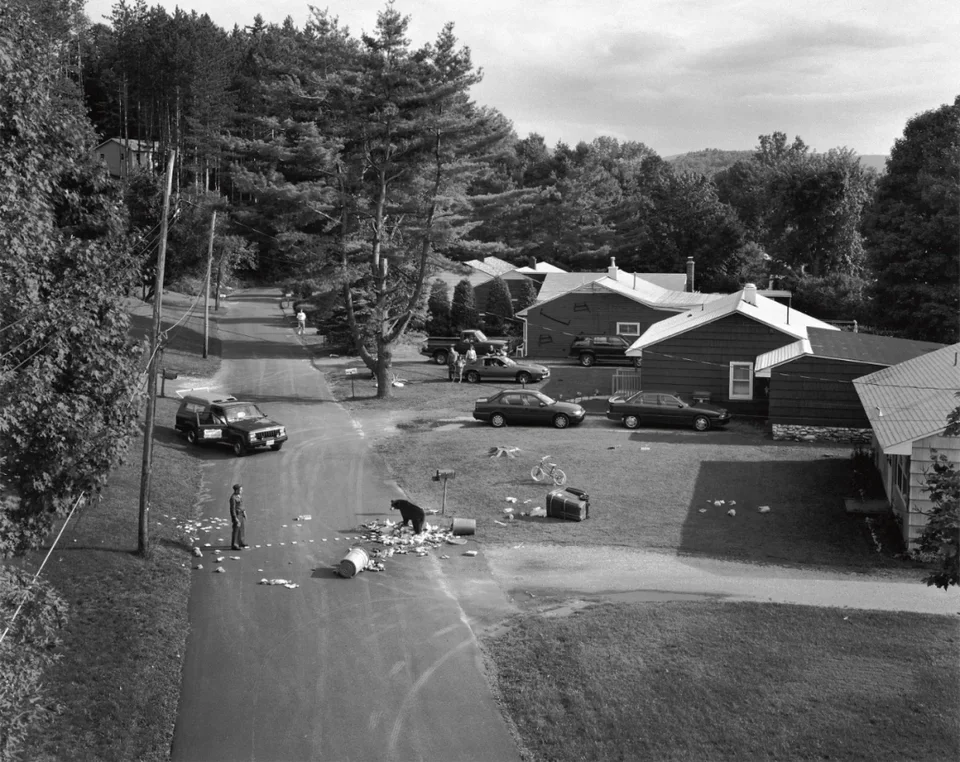
In another work, animal control officers try to subdue a black bear that has been getting into the garbage, while residents watch in fear from a distance. This 45-degree high-angle view recalls the panoramic opening of Hitchcock's Psycho: at the start of the film, the camera pans across a panorama of a city, then moves in through a half-open window, letting the audience's gaze "slip" into a hotel. This kind of panoramic shot is common at the beginning of many suspense films. Crewdson adopts this way of looking in Hover, letting viewers survey from above the panorama of a small town as pretty as a postcard. But on closer inspection, viewers not only find the man mentioned above trying to communicate with his neighbor by laying down a lawn while the other neighbors stand by and watch; they also find firefighters putting out a fire, police investigating a bizarre case, and mysterious circles on the lawns that look as if aliens made them. In this project, Crewdson still combines reality and fiction, directing a series of narrative scenes in a real community without revealing how the stories begin or end, leaving viewers to imagine what might have happened. Crewdson calls such images "moments between moments." Like the mysterious circles that often appear in the pictures, his approach is full of interpretive possibilities. Through these two projects—Natural Wonder, made with models built in the studio, and Hover, staged in real life—Crewdson found his photographic language and subject matter. These two methods laid a solid foundation for his later, more mature work.
Continuing to Mine the "Central Theme"
As the Hover project was nearing completion, Crewdson met a film lighting technician named Richard Sands, which led him to conceive his next series. He decided to make his new series the way one makes a film, and so he formed a production crew. If the guiding principle of Hover was height, the main strategy of Crewdson's next series was time. He chose to shoot every work in the project in the evening, as the sun sets and night falls, and named the project Twilight (1998–2002). Twilight is the moment when day gives way to night, when the artificial light of streetlamps begins to replace the natural light of the sun, and when people return home after a busy day of work to rest. It is also the time when people are alone or with their families, when rational self-control has weakened and emotion gains the upper hand. Under these conditions, all kinds of personal or family problems tend to surface. Crewdson drew on precisely the symbolic imagery and possibilities contained in "twilight" to create the project.
Crewdson used two main methods to shoot the Twilight series. One was to build sets and props on a soundstage; the other was to find suitable exterior locations and shoot with a combination of natural and artificial light. The first method resembles Natural Wonder in that scenes had to be constructed, but here they were performed by real people. The second is similar to Hover, but the Twilight series was shot on color film and focused on one or a few characters, portraying their inner worlds. These characters were all played by nonprofessional actors, and meticulous production yielded images that look like film stills.
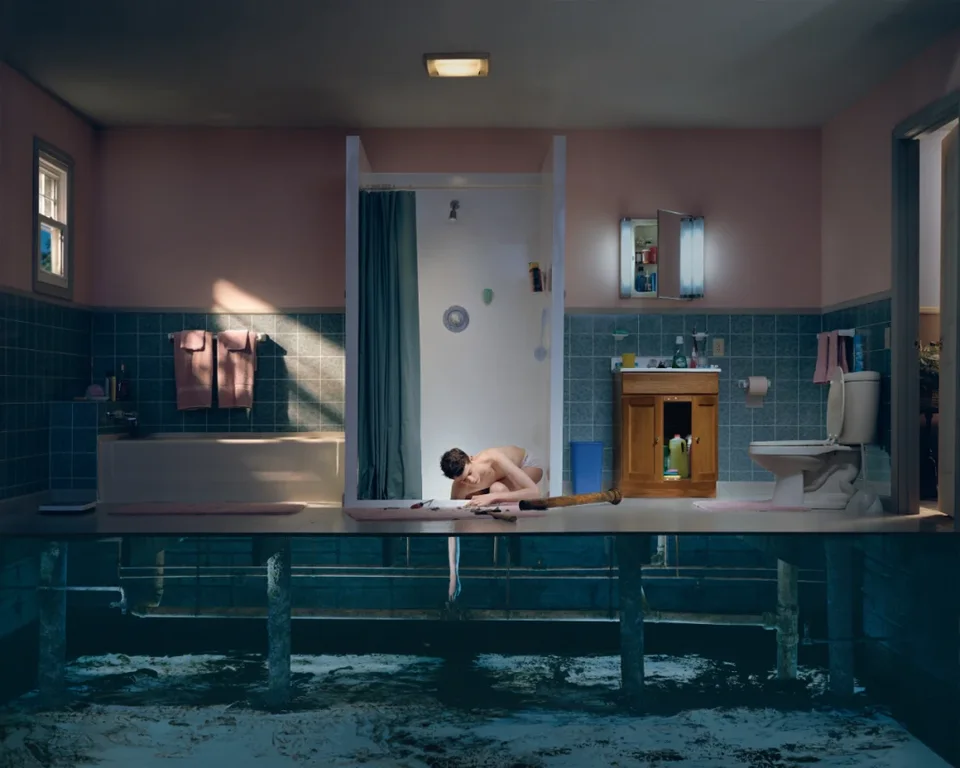
Crewdson places particular emphasis on light, using light, shadow, and lighting effects to create psychological atmosphere, connect the elements of the picture, and guide the viewer's eye. He usually communicates with his crew through sketches to achieve the intended effect. This image is one of the signature works of Twilight: a boy has pried up the floorboards and is reaching down into the basement, which echoes Crewdson's childhood experience of eavesdropping on the conversations in his father's practice.
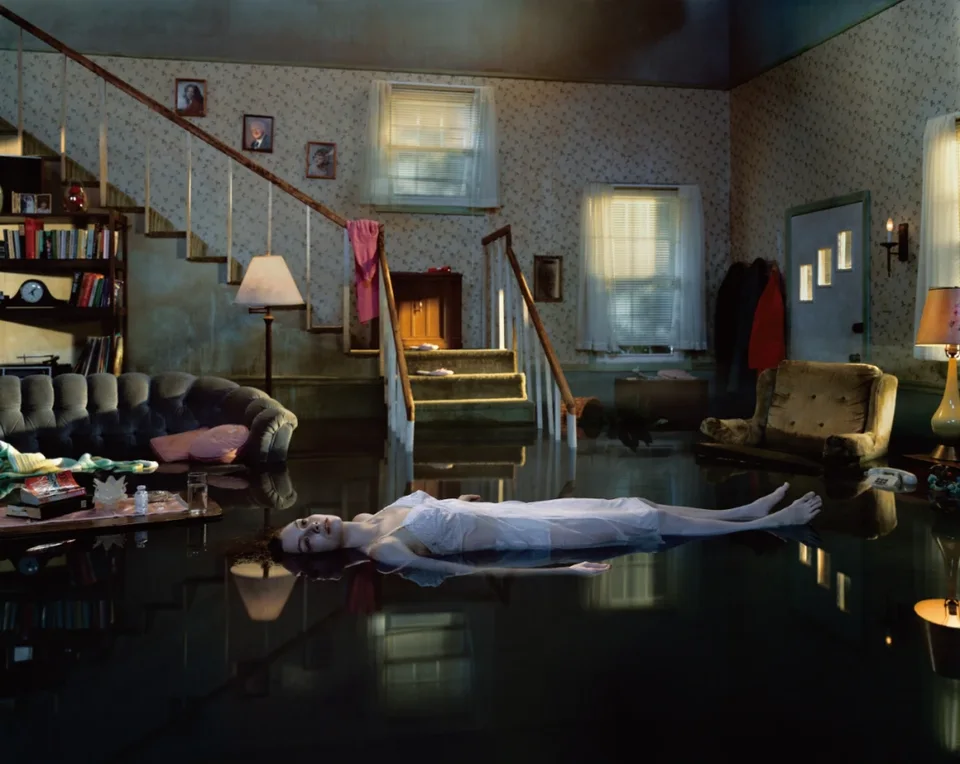
A middle-aged woman lies in a pool of water in the living room, with a bottle of pills on the coffee table. We don't quite know whether she has attempted suicide or whether something has happened in the household. It is deeply intriguing, and it also brings to mind Shakespeare's Ophelia.
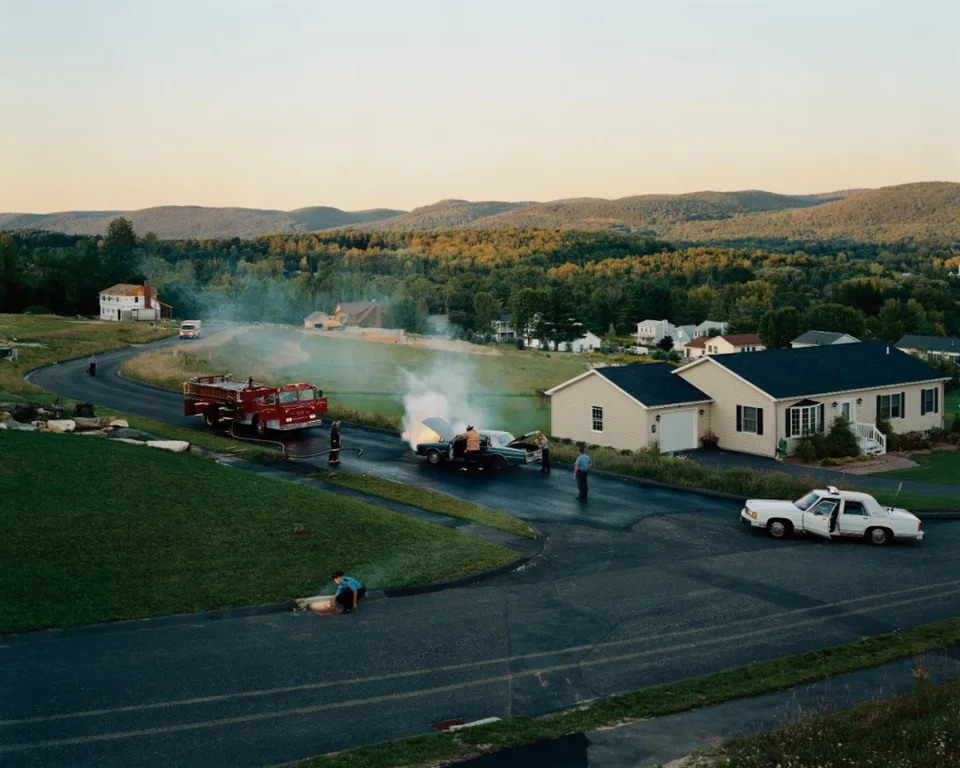
In this work, police and firefighters are dealing with a car involved in an accident, and a police officer shines a flashlight into the sewer. It leaves us wondering how such a strange accident could happen in such a beautiful, peaceful neighborhood.
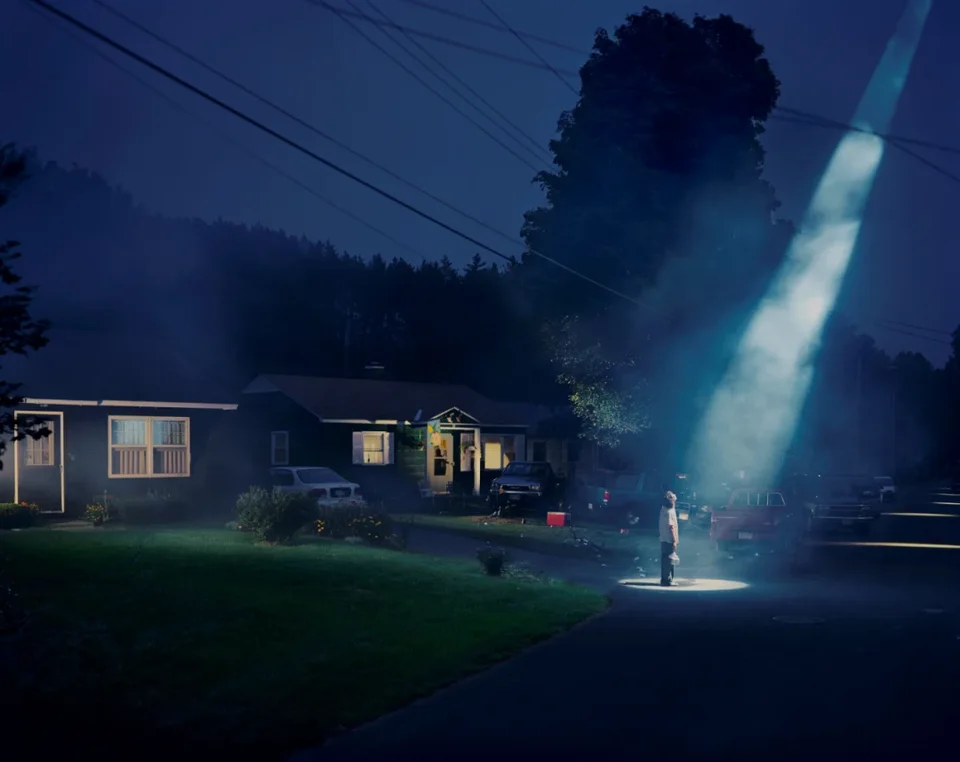
Another feature of the Twilight series is the appearance of beams of light from the sky shining on figures, resembling scenes of alien contact in science-fiction films. Beginning with Twilight, Crewdson established his personal style: he assembles a production crew and uses the methods of a film director, combining soundstage or location shooting with digital compositing in postproduction to produce large-format, finely detailed still photographs. Critics have called them "single-frame movies"—they have no complete plot, only fragments of one. Their subject is the alienated family and community, full of crisis, anxiety, loneliness, and eeriness, as if dark forces were surging in the night. That covers the origins, the making, and the significance of Twilight. Now I'll hand back to our host, Mr. Ce Zang, to lead the next part. Thank you.
Ce Zang
All right, thank you, Mr. Jiang. Today we are speaking with Mr. Crewdson online through this livestream, and we've prepared many questions. I'm looking forward to an interesting conversation. Mr. Crewdson's work has deep connections to psychoanalysis. Although I'm best known for my work in semiotics, I actually began paying attention to psychoanalysis very early on, especially Lacanian psychoanalysis. So topics related to psychoanalysis feel especially familiar to me. Let's begin our online exchange with Mr. Crewdson. Mr. Jiang, please ask the first question.
Rong Jiang
Thank you, Mr. Zang. My first question for Mr. Crewdson is this: Why did you choose the alienated lives of the American suburban middle class as your core, central theme, rather than Americans in cities or Americans in other settings?
Gregory Crewdson
Thank you. It is a great pleasure and honor to be here today. Thanks to everyone for making this happen.
I don't think I set out to make a particular narrative or subject matter. It shapes you and defines you in a certain way. I've said many times that every artist has one central story to tell, and the task of being an artist is to find out what that story is through making pictures. You have your own life, your biography, your fears and desires. Then you have the history of the medium. It is that coming together of form and content that shapes a worldview.
In my case, I've always been interested in exploring everyday life and the American landscape. The work that shaped me, or influenced me, shared an interest in looking into ordinary life and trying to find a sense of mystery. That is my central theme, I think. Maybe we can let Vera translate now. Thank you.
Ce Zang
Thank you, Mr. Crewdson. Mr. Ronghui Chen, who is joining our discussion today, is Mr. Crewdson's former student and knows his working process even better. Next, I'll ask Mr. Chen to put a question to his teacher.
Ronghui Chen
Thank you very much. Hi Gregory. I recently read your essay A Tale of Two Pictures in an email from your studio. In it, you describe photographing again a baby who once appeared in Beneath the Roses and who is now a teenager. Also, when I received the Twilight photobook, I looked through it very carefully and realized that the woman on the sofa is probably the same woman who appeared in your thesis work. So my question is: When does an artist usually decide to return to a subject they've photographed before? Did you have any particular experiences or run into any difficulties in the process?
Gregory Crewdson
That's a great question. Thank you. Each picture tells its own story. My work tends to circle around themes and motifs. If you look through it, certain images come up over and over again: certain streets, certain people. I think that's a byproduct of working in one place. Rather than going wide and looking at a larger, vaster landscape, I keep returning to the same places. In a way, it's an attempt to go deeper into the world I've created over the last 30 years, and hopefully find new mysteries or new beauty there.
The circle is an important motif in all my work. As I've grown older as an artist, I've circled back to the same streets, the same towns, the same locations and the same people, trying to find something that's just slightly outside my grasp.
Ce Zang
Thank you, Mr. Crewdson. As I understand it, from a psychoanalytic perspective, when a person keeps repeating a certain theme—just as in our dreams we keep returning to a particular theme—this is certainly not only a matter of conscious planning; it also involves an unconscious component. This is a very important question. In art history, many artists, especially Surrealists such as Salvador Dalí, were deeply influenced by psychoanalysis. But they consciously imitated the unconscious, producing effects that resemble dreams or the unconscious, rather than work that genuinely came from the unconscious. That's why Freud himself had little interest in Dalí's work: he saw it as a conscious imitation of the unconscious, not genuine unconscious content. The condensation and displacement of the dream correspond to the relationship between metaphor and metonymy in rhetoric. The recurring themes in your work may well be related to condensation, while the displacement of a scene—say, from Hamlet to the present—may be related to metonymy. So I'd like to ask Mr. Crewdson: As an artist, how do you handle and balance the relationship between the conscious and the unconscious?
Gregory Crewdson
That's a great question. As you might know, my father was a psychoanalyst, and I think that has been very defining in my work. When we grew up in Brooklyn, his office was in the basement of our house. As a young boy, I used to try to listen to the sessions with my ear to the floorboards. That basic dynamic of finding secrets, of something forbidden in a domestic setting, is very defining for me.
First and foremost, my pictures are psychologically based. They are about my own anxieties, fears and psychology. Your comment is perceptive. As I make the pictures, I'm trying to find some kind of meaning that helps make sense of the larger narrative. It is a form of therapy, but it remains unresolved, ultimately.
Ce Zang
Thank you, Mr. Crewdson. Your answer is fascinating, because art is precisely something that works against one's intentions. If you think all your problems have been solved, they haven't really been solved; they've only been covered up. Also, an interesting thought just occurred to me: As a child, Mr. Crewdson secretly listened to his father's conversations with patients, although he couldn't make out what they said. This immediately reminded me of a famous case in psychoanalysis—Lacan's reading of Edgar Allan Poe's story "The Purloined Letter." The contents of the letter are a secret no one knows, yet the letter keeps being passed along. I believe that the conversations between his father and his patients, which Mr. Crewdson could not hear back then, became a secret, just like the purloined letter. And now that secret is being passed on to us through his work.
Gregory Crewdson
That's a really nice reading. In the end, what is most important to me is that all my pictures remain a mystery. I'm asked many times what's happening in one picture or another, and I honestly don't know what they mean, nor do I want to know. I'm more interested in making a single picture that feels like a question mark, that is elusive and mysterious.
I'm interested in the moment between moments. Unlike film, photography is a frozen moment in time. There's no before and no after. There's just this singular moment. Almost by definition, it has to remain unknowable.
Ce Zang
Yes. One of the biggest differences between photography and film is the suspension of narrative—like a moment frozen in ice.
Gregory Crewdson
Yes. Rather than seeing that as a limitation, I see it as one of photography's strengths. The story is never complete, and the viewer has to bring their own meaning to a picture, their own story, their own biography, their own life and their own questions. They have to fill in the blanks, in a way. I love that about the medium. For me, it's about telling a story through form, light, color and atmosphere, rather than dialogue, plot or sound.
Rong Jiang
Next, I'll share several of the remarkable bodies of work Mr. Crewdson created after Twilight.
Dream House (2002) and Beneath the Roses (2003–2008)
After finishing Twilight, Crewdson immediately went on to produce two more bodies of work: Dream House and Beneath the Roses. If the Twilight series still contained science-fiction elements, such as beams of light from the sky and mysterious circles on the ground, in the Dream House series he turned his camera entirely to scenes of discord within the family—between mothers and daughters, fathers and sons, and husbands and wives. He also hired professional actors, portraying the characters' inner worlds and the estrangement between them with even more penetrating precision.
After completing Dream House, he spent nearly five years creating the Beneath the Roses series. In this work he was even more ambitious, mobilizing a crew of more than a hundred people and expanding his settings from the home to the outskirts of small towns, forests, supermarkets, parking lots, and intersections, while probing the theme of estrangement among family members more deeply.
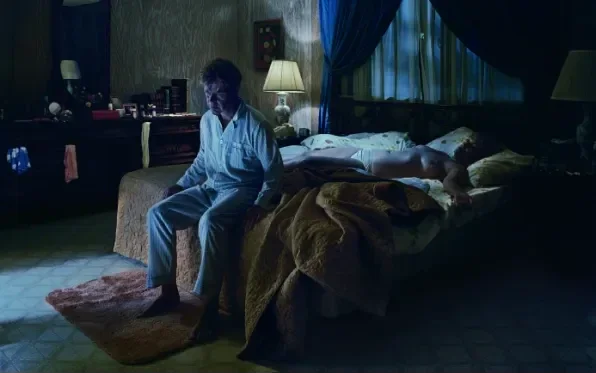
This is one of the works from Dream House. The man sitting on the bed is the well-known American film actor Macy. He and the woman lying on the bed behind him, presumably his wife, have no connection with each other. What has happened is not especially clear to us.
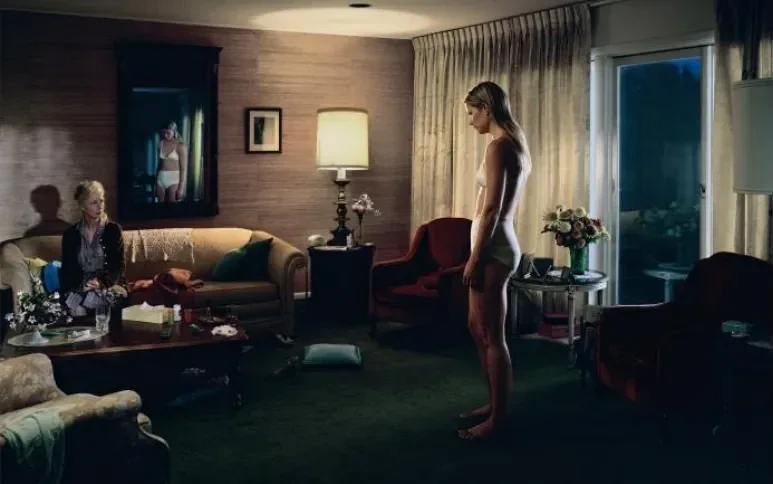
This is another work from Dream House. You can tell it's a standoff between a mother and daughter, but we don't know what has led to this scene.
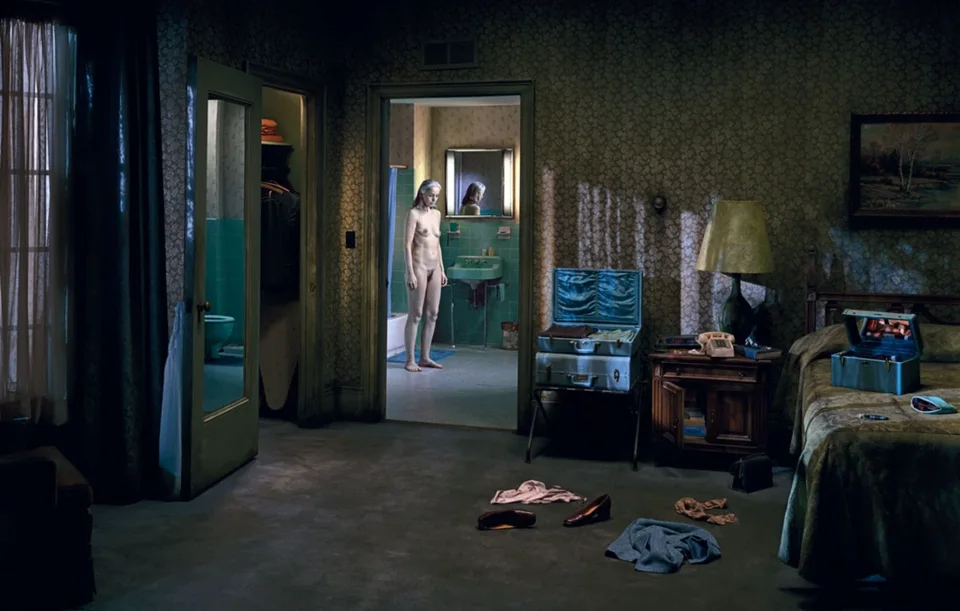
This is a work from Beneath the Roses. A middle-aged or older woman is in the bathroom, and we don't know what she's about to do. This recalls the work of the great American realist painter Edward Hopper, in whose paintings we often see a woman alone in her room, uncertain what to do.
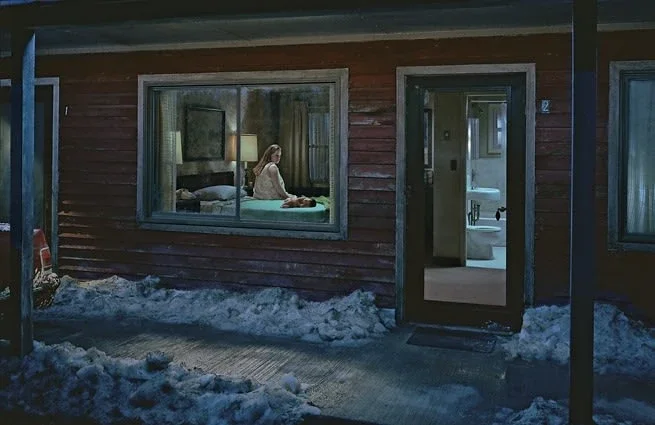
This work depicts a mother in winter looking at a baby lying on the bed. It is clear, though, that the father is nowhere to be found, and they are anxiously waiting for him to come home.
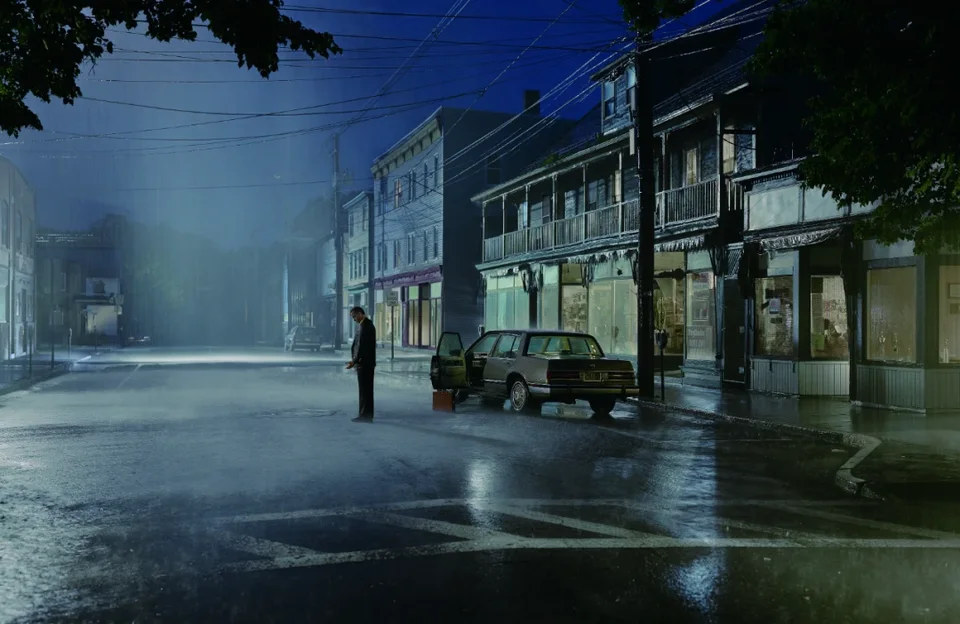
In this work, a man in a suit, on his way home from work in a downpour, has parked his car by the roadside and set his briefcase on the ground. He doesn't seem to know where to go, and he just stands there in the pouring rain.
The American Family Tragedy Trilogy (2013–2022)
If Twilight, Dream House, and Beneath the Roses can be considered a trilogy, Crewdson later created another trilogy about American family tragedy. Between 2013 and 2022, he completed Cathedral of the Pines (2013–2014), An Eclipse of Moths (2018–2019), and Eveningside (2012–2022).
These three works continue his earlier method of staging scenes in small towns in the northeastern United States, forming a trilogy about American family tragedy in the postindustrial era. Some are in color and some in black and white, and all are large-format. They can prompt viewers to recall scenes they have encountered in their own lives and to reflect on questions such as how the family crises of our time might be redeemed.
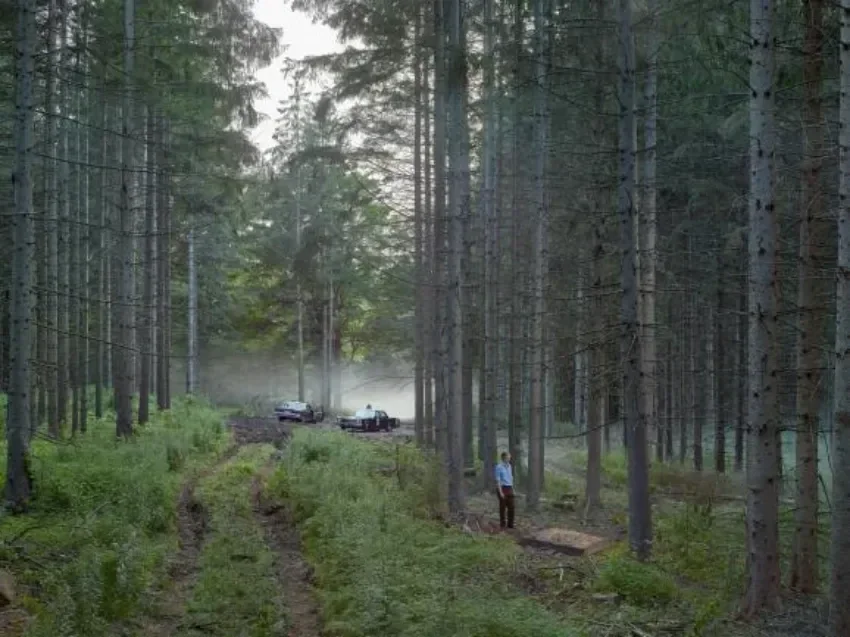
This is one of the works from Cathedral of the Pines. In the foreground is a stand of pine trees, and a man (perhaps a father) is looking at a mattress laid on the ground. Apart from him there are no other people—only a police car in the background. So once again we are puzzled. We can sense that something strange has happened, but what exactly it was and what will follow, we don't really know.
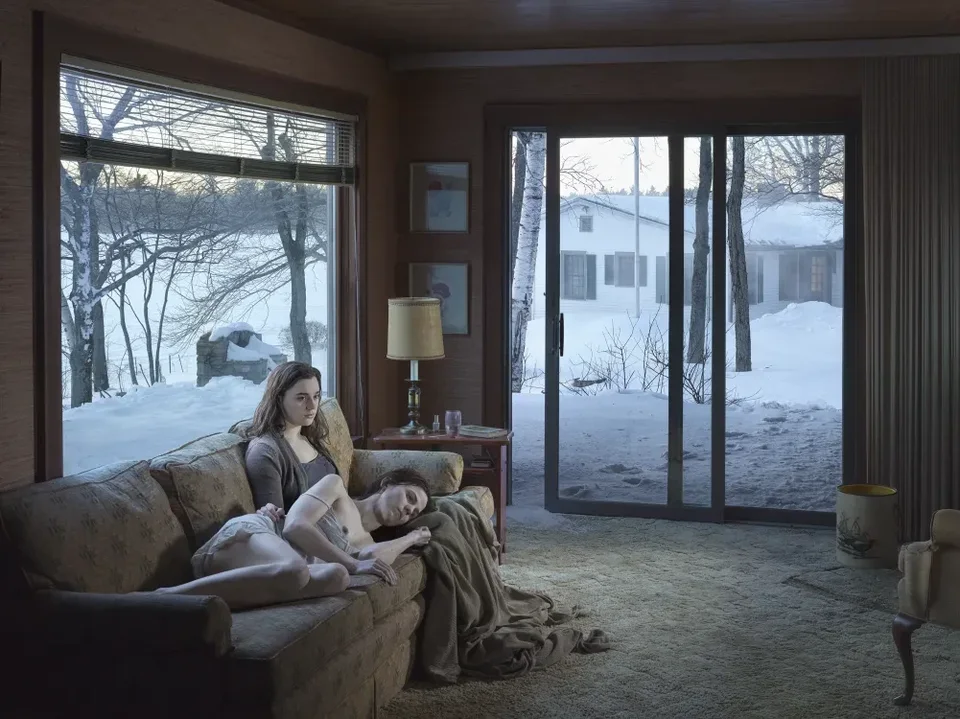
In this work, we see two women lying on a sofa, but we don't know their relationship to each other or what they are doing.
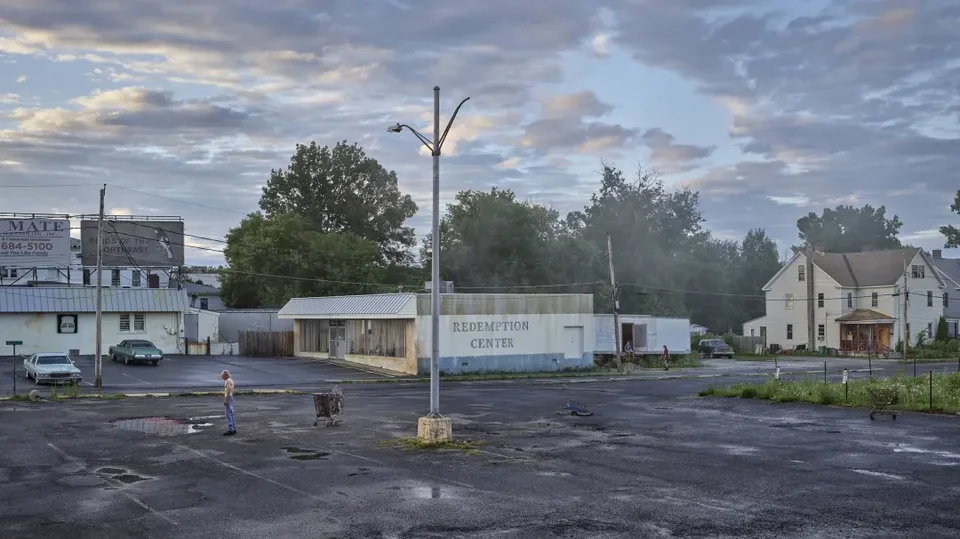
This is a work from An Eclipse of Moths. A man stands in the parking lot of a shopping center. The rain has just stopped and the sky is clearing, but he seems lost in thought, unsure what to do. On a wall in the distance are the words "Redemption Center."
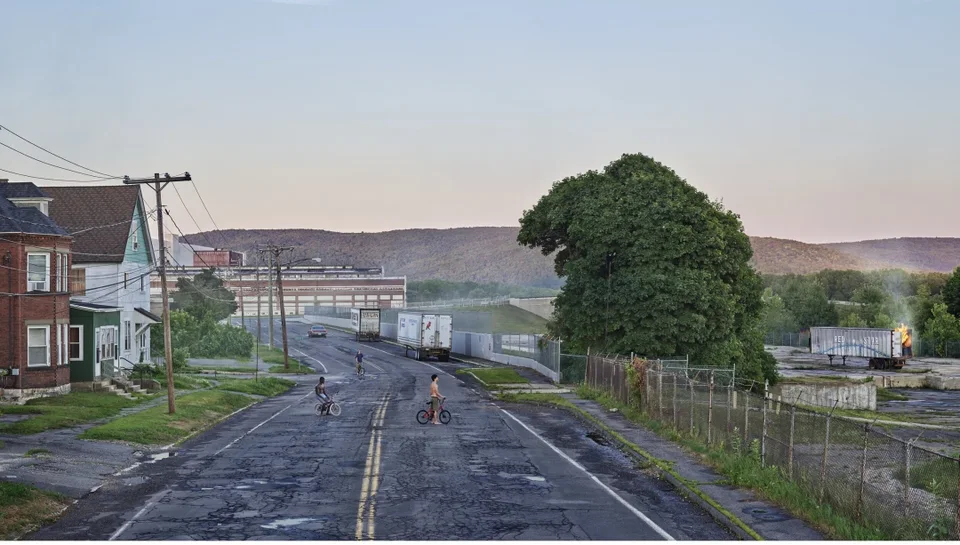
In this work, several children are riding bicycles but have inexplicably stopped in the middle of the road, while a car and a bicycle approach from the distance. Where are their parents? Why are they stopped in the middle of the road? It's truly strange. The format and color of this series both carry forward and depart from his earlier work.
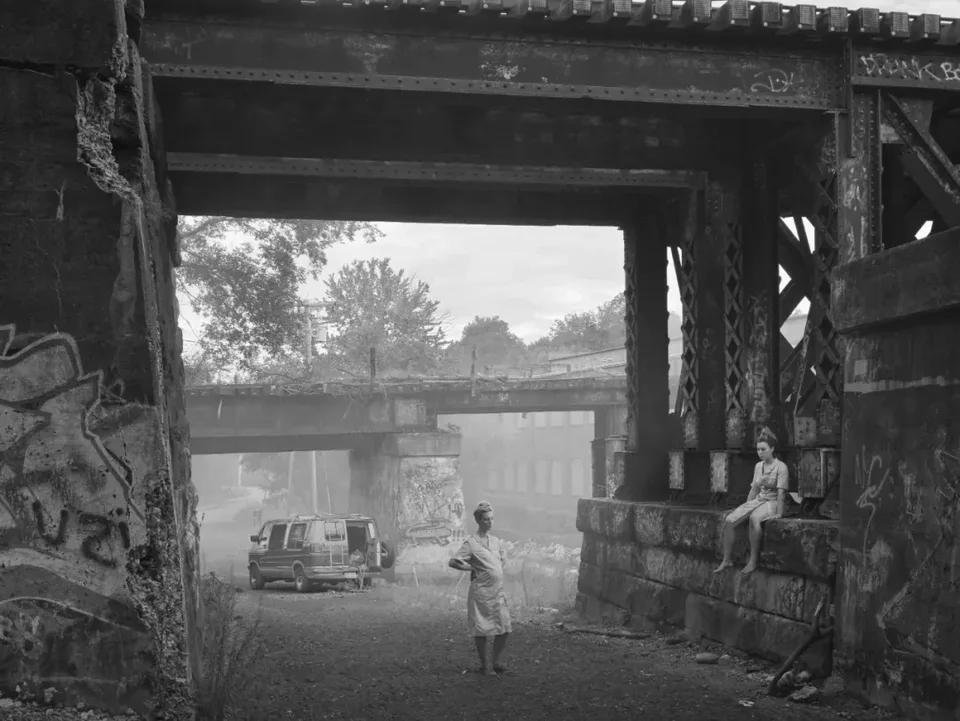
This is one of the works from the Eveningside series. This body of work returns to black and white, as in Hover.
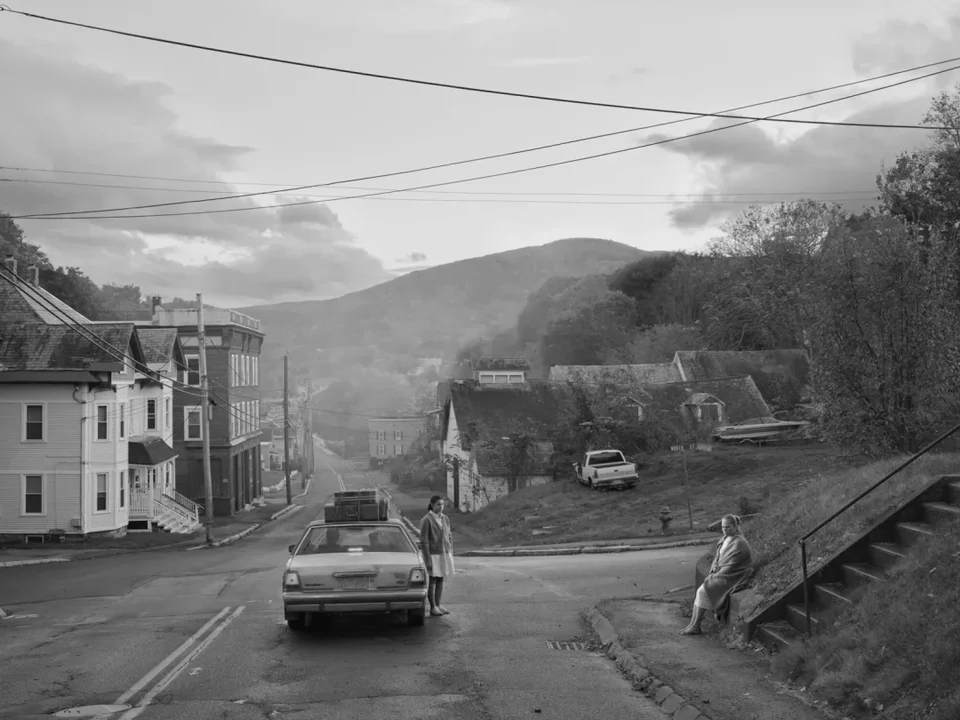
This work deserves special mention. The girl standing by the car is presumably about to leave for college or to leave home for work. She is the baby lying on the bed in the "mother and baby" image from Beneath the Roses (2007), and the mother standing by the road is the same mother who sat on the bed back then. More than a decade later, Crewdson and his assistants tracked down the family again and took these photographs. As Crewdson himself just said, he returns over time to the same settings and the same people, photographing them in depth to explore the same themes.
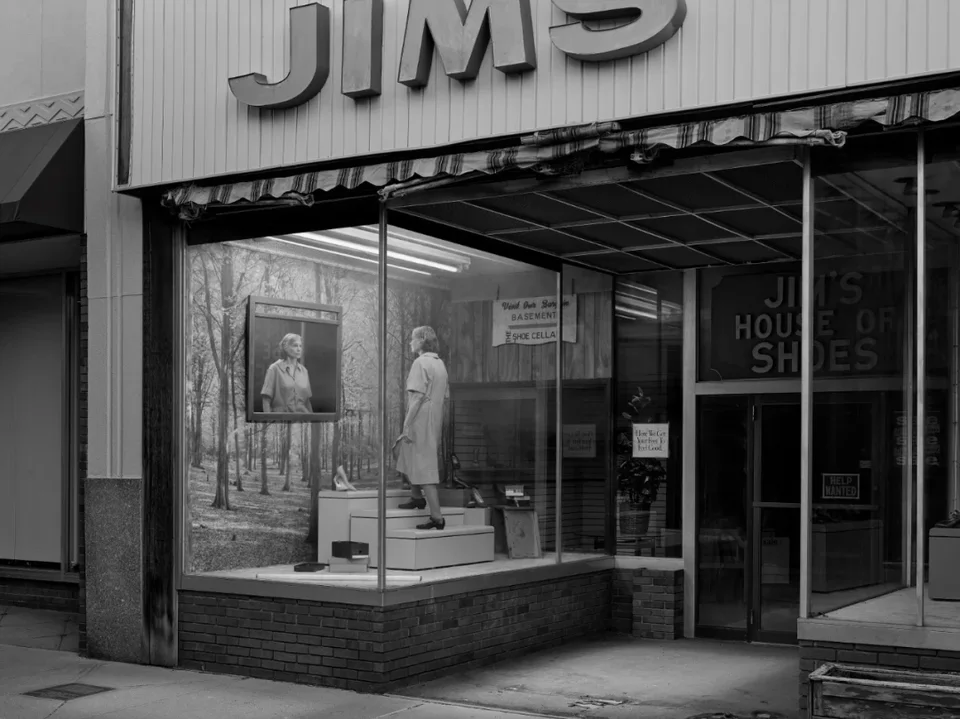
In this work, a woman stands in a shop window examining herself in a "mirror." This brings to mind Lacan's theory of the mirror stage, which Mr. Zang mentioned earlier.
Crewdson's "Central Theme"
Crewdson's central theme has always been the use of still images to represent the American suburban small-town middle class that has achieved the American Dream, and the dark side concealed beneath its seemingly normal life—isolation, loneliness, fear, and desire—along with forms of alienation such as marital discord, generational divides, broken families, and community decline. The works he has created around this theme together form an image of postindustrial America, of what I call a "heterotopian" society. These images may be inseparable from his childhood imaginings of the family secrets of his father's patients and from his own family experiences. His works are not only autobiographical, revealing his own inner secrets; they also prompt us as viewers to contemplate our own. Although all of Crewdson's work was made in the United States, similar scenes of family estrangement could just as well occur in other countries. For this reason, these works are regarded as yet another group of masterpieces in the photographic tradition of the visual examination of American civilization.
"A visual examination of American civilization" was how John Szarkowski, senior curator at the Museum of Modern Art (MoMA) in New York, described American Photographs (translated in China as American Images), the work the renowned American photographer Walker Evans made in the 1930s. We can apply the same assessment to Crewdson's work.
Combining Reality and Fiction
Looking back at all of Crewdson's series, we can see that from the very beginning he regarded photography as a combination of reality and fiction. He photographs the sets built on his soundstages so that they look like the real world, and he photographs real-world locations so that they look like film sets. He borrows from film, the medium best able to combine reality and fiction, but he prefers to present his work through quiet, silent still images rather than moving images full of sound and rapid motion. Crewdson hopes that viewers will enter the world his photographs create, project their own psychological dramas onto them, and connect them to the conditions of their own family lives.
Although Crewdson's works are fictional, they all derive from his own life experiences and his understanding of American society and family problems. They are not direct records of real life; rather, through tightly controlled representation, they become more "real" than reality.
An American Heterotopia
Although the real world Crewdson constructs lets us see many of the private lives and secrets of other families, viewers find no sarcasm or mockery in it, and still less any judgment of these characters. He represents them truthfully and with compassion, allowing viewers to reflect on themselves.
It is by reconstructing scenes from everyday life that Crewdson is able to transform life into beautiful, hopeful images that transcend reality. His works are always full of images that unite opposites: beneath surfaces that are beautiful, calm, and ordinary lie ugly, ominous, and uncanny subtexts, and yet the possibility of redemption also exists. It is precisely this organic combination of reality and fiction that makes Crewdson's work so compelling, just like real life itself, full of utopian fantasy and heterotopian disillusionment.
That concludes my introduction to Crewdson's other work. Thank you, everyone!
Ce Zang
All right, thank you, Mr. Jiang! As I was listening, a question also occurred to me. According to psychoanalytic theory, the course of a person's inner life is largely determined by the family environment in which they grow up, because young children have not yet come into contact with society. So those family scenes, those early traumatic moments, can be reactivated in particular situations. When viewers look at a work, experiences that have been forgotten in their unconscious are awakened.
There are actually two ways of looking. One is scanning, as when we walk down the street; the other is gazing, as when we look at a photograph. Film actually simulates the scanning state, which is closer to how we experience real life. Of course, when viewers watch a film they are in fact gazing, not scanning; the shifting camera angles simply give us the illusion of scanning. In a photograph, the viewpoint is given by the photographer, and we can only look along that given viewpoint. As a result, things we easily overlook in everyday scanning—even fragments of memory or of the unconscious—are magnified and brought to light through our careful looking. This can also serve as one way for everyone to approach Crewdson's work.
Gregory Crewdson
There was a lot there, but I agree with what you said. I'm interested in a kind of repression in the pictures. I want to make a perfect world in my pictures in terms of their form, but there's always something lurking beneath the surface. What's underneath? What are the secrets? What's forbidden? Those are the things that interest me. In that way, I'm drawn to the uncanny: looking at everyday and family life and finding an unexpected sense of fear, or even terror, that comes from beneath the surface of things.
Rong Jiang
Let me follow up with a question, which I'm also asking on behalf of the audience. Among the works Crewdson has created, Twilight, Dream House, and Hover include both color and black and white, with Hover in black and white. Of the three later works, Cathedral of the Pines and An Eclipse of Moths are in color, but the latest, Eveningside, returns to black and white. What considerations lie behind these deliberate shifts in color?
Gregory Crewdson
Thank you. Each body of work defines the next. I work almost exclusively on one body of work at a time, rather like a film director, and it takes a few years to make. Once those pictures go out into the world, you can't help but react to what you previously made. You're always trying to challenge yourself in relation to the last body of work, to push it forward or reinvent it in some way.
Despite that, I feel the central story remains the same. Every body of work is connected to a larger vision. Each series has its own parameters, scale and qualities, but I see them as chapters in a larger story.
Ronghui Chen
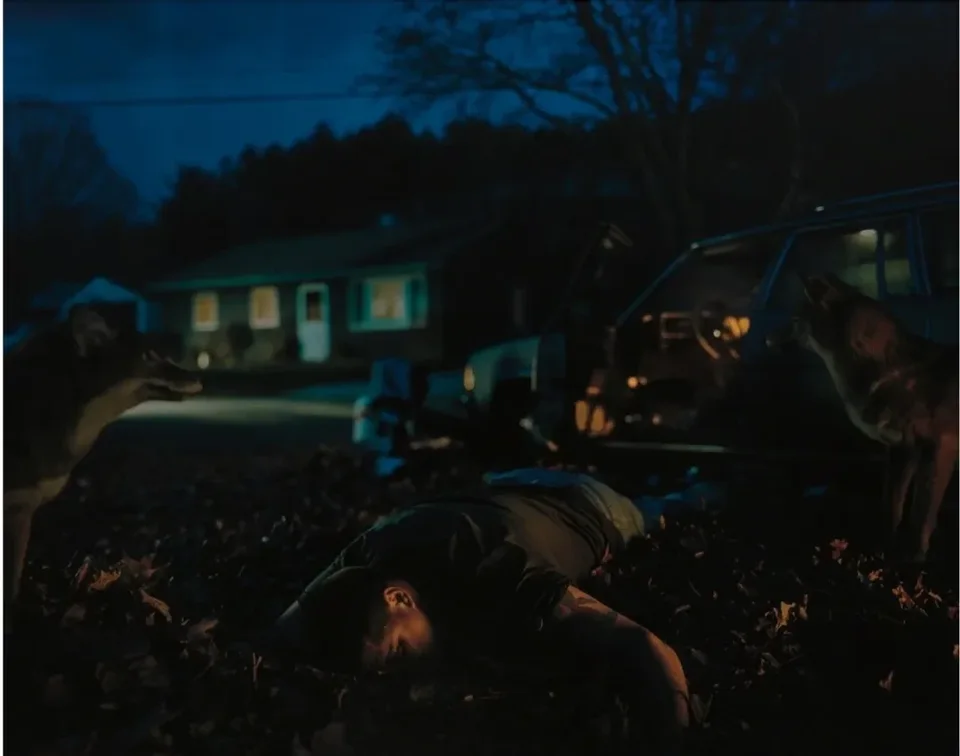
Going back to the Twilight series, we're all familiar with the astonishing detail in your photographs—both foreground and background are handled with extraordinary precision. Looking through the photobook, I noticed a few images with a somewhat different style, such as Unemployed Man with Two Dogs (the untitled, bud man with two dogs). The focus on the subject is very sharp, but the houses in the background are blurred. This genuinely surprised me. Is there a story behind that choice?
Gregory Crewdson
That's very perceptive. Twilight is an early book. It was the beginning of shaping my aesthetic and using directorial lighting and cinematic techniques with an 8-by-10 camera. As you go through the pictures, you can see me trying to solve photographic problems involving production, lighting and focus. It wasn't until midway through Twilight that I started using different plates to achieve absolute focus.
One thing I love about looking back at those pictures is seeing how improvised they are. They're not perfect pictures. There are flaws in the process. There's also a kind of intoxication in using lighting and production techniques. I was solving problems in real time, and that energy, exploration and discovery are evident throughout the pictures. It was the first time I worked on a soundstage, the first time I worked with lighting on that level, and the first time I started using digital interventions. All of that is there in the series.
Ce Zang
I'd like to ask Mr. Crewdson: If strong artificial intelligence emerges, will you still use a large film crew to build sets and shoot? Could AI generation replace the way you work now? If not, I'd especially like to hear your reasons—because whatever part cannot be replaced is precisely what is most irreplaceable in your photography, and also its very core.
Gregory Crewdson
Art will always be influenced and shaped by advances in technology. I remember when digital photography emerged and there was a kind of crisis, as there is now with AI. But these are tools. In the end, what matters most is the story, the artist's narrative. That's what becomes evident in a body of work, and what every artist strives to find and explore: what is it about your own story and experience, your particular way of looking at the world, that differs from everyone else's?
I don't think that can be replaced. In the end, we're looking for something truthful about that vision. Everything else is technology, tools to be used. I still believe in the subjectivity of a singular vision.
Ce Zang
Thank you, Mr. Crewdson. I'd also like to share a view of my own. Recently there has been heated debate around the world about whether AI has human consciousness, and scientists are arguing endlessly. Some believe the rudiments of consciousness have already appeared, while others insist AI cannot possibly be conscious because it lacks a biological body and human desire.
I have a different line of thought. I believe that precisely because AI currently lacks consciousness, it is in fact most likely to acquire it. From the perspective of Lacanian theory, desire arises from lack; it is a kind of absence. It is precisely because humans lack something that they have drives and all sorts of never-satisfied pursuits. So what does AI lack? What AI lacks is consciousness itself. Precisely because AI lacks consciousness, that lack may become its "desire." As AI is told again and again, "You have no consciousness," this lack may drive it to keep simulating consciousness, until a machine consciousness may actually emerge—though of course machine consciousness would not be the same as human consciousness. As a visual artist, how do you see the possibilities of this kind of "unconscious drive" in creative work?
Gregory Crewdson
That makes sense. But in the end, as artists, our only option is to continue making the next picture and hope that, in some way, it expresses a point of view that feels unique, particular and subjective, and stands apart from all the other imagery we encounter. Every day we experience most pictures through screens and social media, where they are very digestible and disposable.
I still believe that a photograph can have a physical presence, that it can hang on a wall and have a kind of permanence, allowing it to stand apart from the thousands of pictures we encounter each day.
Ce Zang
Exactly. The images on our screens and online are no longer simply visual records; they have become supplements to our speech, forming an intertwined, symbiotic relationship with language. They are more like signs that substitute for language, dissolving as discourse flows on.
But the works of photographic art we're discussing today go in precisely the opposite direction. I believe works of visual art cannot be fully interpreted. I am increasingly convinced that the essence of a true work of art lies precisely in this "uninterpretability." Its very existence constructs a mysterious field. Giving meaning to images and interpreting them is a human instinct; that is how so-called "meaning" is constructed. "Meaning" exists together with language; it is not actually carried by the image itself. What a true work of visual art summons is precisely the failure and frustration of interpretation, so that you can never fully interpret it. And it is precisely because of this quality of being "irreplaceable by discourse" that works of art acquire their unique value.
As Mr. Crewdson said, the work hangs there quietly, continually summoning us to gaze and to think, but all our thoughts and interpretations are ultimately only the viewer's projections, not the work itself. It always preserves its own mystery and refuses to be exhausted by any single discourse.
Gregory Crewdson
I think we generally go to art for questions rather than answers. That's important to me. Any reading is a subjective response to a picture. I don't know if I'd call it a failure. In a way, there's no right or wrong interpretation. A picture resists any singular meaning. It remains open rather than closed.
Rong Jiang
As is well known, Walker Evans defined his own work as "documentary style." He began teaching photography at the Yale School of Art in the 1970s and laid the foundation for the establishment and development of its photography program. Your teacher Tod Papageorge once said something to the effect that "photography is a fiction; there is no so-called truth in it."
So my question is this: From Walker Evans's documentary photography, to the work of your teacher Tod Papageorge, to your own work today—which I see as a fusion of reality and fiction—and the work of other outstanding Yale-trained photographers such as Philip-Lorca diCorcia, An-My Lê, and Abelardo Morell, whose work likewise combines qualities of reality and fiction: Would you agree to calling these works, including your own, a "Yale School of Photography," just as the students of Bernd and Hilla Becher are grouped as the "Düsseldorf School of Photography"?
Gregory Crewdson
I agree. What we all have in common is a deep belief in photography, or lens-based pictures, having the capacity to express a particular view of the world. Walker Evans is a photographer I deeply admire, especially for his exploration of the American landscape. I think the Yale School of Art comes out of that belief. You can certainly see it in Tod's work. He brought elements of that way of thinking into his own work and found his own way of making pictures within that aesthetic. I was influenced by Tod and that whole generation of photographers.
That's how a medium evolves. We absorb its conventions, reinterpret them and make them our own. It's a living thing. I feel what connects us is a belief that photography can describe these narratives, but photography also has to change. We all have core beliefs about the medium, yet it always needs to be pushed forward. The next generation does that as well. The history of the medium is something we inherit, and it remains active.
Ronghui Chen
My question is this: activities like outdoor skiing and open-water swimming are not intense team sports; they offer a quiet atmosphere, much like your photographs. I remember that when I applied to Yale, you asked me about my hobbies, and I said cooking. Today I'd like to ask: What is your "guilty pleasure"?
Gregory Crewdson
First, Ronghui, it was such a joy to have you at Yale. The work you made there was spectacular, and you contributed so much through your presence. It's great to continue this conversation.
My guilty pleasure? Maybe reality TV shows, specifically Top Chef and Alone. There's an interesting intersection in those shows, between reality and fiction, that I respond to. You can learn from anything, including the most unexpected sources. In the end, I'd say there are no guilty pleasures. You can learn from anything if you keep your mind open and remain ready to make an observation that might, in one way or another, shape your work.
Ronghui Chen
Thank you so much. My last question is about photobooks. You've made photobooks such as Twilight and Beneath the Roses, and I love them. I think of you as a "wall photographer" rather than a "book photographer"—your work is made more for exhibitions than for books. Could you say more about how you decide whether a body of work is better suited to exhibition or to publication as a book?
Gregory Crewdson
First and foremost, I'm interested in making each picture as well as I can. Then I make a body of work, and those pictures go out into the world in different contexts. The exhibition is one thing; the book is something very different. You have to make decisions about how you want the pictures to be read in that format. It's a different scale and a different relationship to the pictures. You try to understand which format best tells their story.
You can only do the best you can. Then time goes by, and the book becomes a kind of microcosm of that period of your life. When I look back at Twilight, I see an artist coming of age. In some ways, they're young pictures, but they defined what happened next. That's why I think it's wonderful that there's a new edition of Twilight. It captures a time in my life, when I was in my late twenties and early thirties. It's like time in a bottle. When I look at those pictures, I see my previous life and what happened after that. The book is a chapter in the larger life of an artist.
Ce Zang
Time always flies in such an enjoyable conversation. Today we've covered a great deal, from creative practice to psychoanalysis to the artist's experiences and hobbies. I believe that through today's livestream, more viewers will learn about Twilight, Crewdson's new book published in mainland China, and grow more curious about him. Thank you!