
The Second Origin of the World Begins with Islands[1]
"The second origin of the world begins with islands…" Like an oracle, a damp female voice, dissociated as if rasped raw, rises in Indonesian between the islands and the sea. The Kinabalu guerrilla uprising has failed, and the Japanese army is carrying out massacres in Sabah. Perhaps it was 1944. The downpours that collapsed from the sky then, mixed with screams from the forest, kept wounding her eardrums. In Wei Hu's Land Below the Wind, she is "one who, having evolved from fish that came ashore into a mammal, returned to the sea," a "truly sentient entity." Yet she too wonders: "Who am I, really? Why can I breathe liquid oxygen?" Faults of time collide and drift, and her voice and the islanders' voices alternately surface and submerge. This is the method that runs through all of Wei Hu's moving images: letting the transitional state become a permanent condition. Borneo, the island on which Sabah lies, is a fragment of land broken off from Gondwana. Standing on it, you feel separated from the world, and you feel that nothing can be restored. Like every island in the world, it is both real and fabricated. To open one's mouth and narrate is already fiction (fiction / storytelling)[2], but fiction must also become reality itself. One of the best-known versions of the story of Borneo is the one told by the stateless people produced by "Project IC." Its substrate is the multiethnic and economic landscape shaped by colonialism. Wei Hu never romanticizes the island as an exotic utopia. On the island, "the ruins of man-made concrete are overtaken by plants within just a few years," burying the boats that went searching for the dispersed. The island is an agent, and also a "knot" full of generativity and possibility, like the squares and rubble he films again and again.
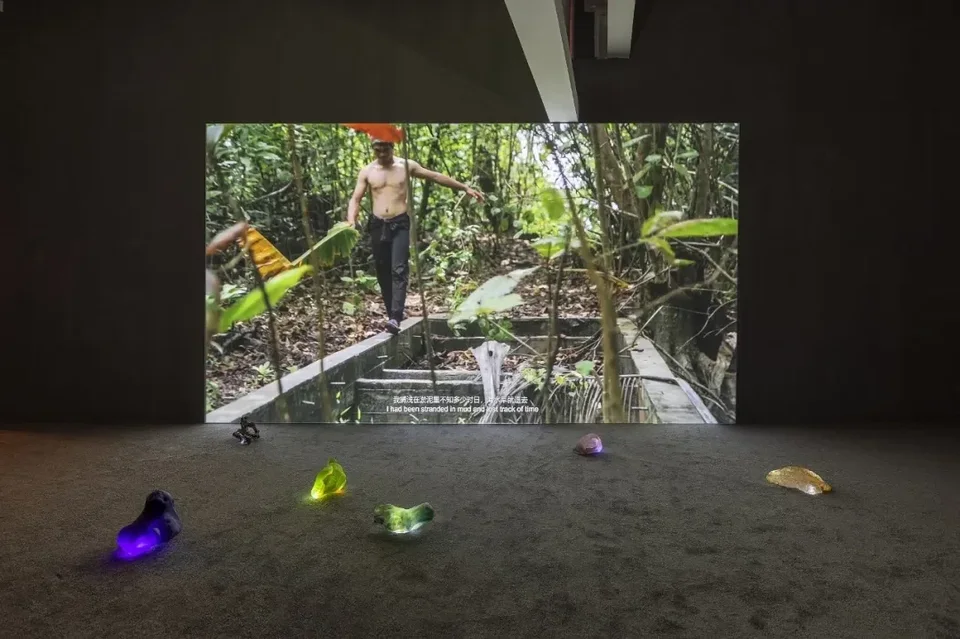
Land Below the Wind "observes," from the vantage of the island itself and of the non-human, how human activity and nature intervene in each other. In a semi-documentary, semi-fictional mode, it explores the multiple entanglements among the island's economy, its geography, and biopolitics. The island seems to be a closed, cyclical ecosystem and economy. On this island not far offshore, tourism infrastructure has only just begun to be built, and people's daily lives and economic activities are still governed by the tides. At night, will-o'-the-wisps and apparitions appear in the dense forest, perhaps the auras of residents massacred in wartime that have not yet dispersed. Beneath the sea, superstitions and legends of water beasts and of the Bajau diaspora still circulate. The stateless, undocumented second-generation migrants on the island mostly come from the very places where these legends originated. Today they scatter across the Malay archipelago in search of a place to dwell, some far from the mainland, separating or being separated.
How do relations among islands come into being? Life does not exist within a boundary or structure understood as a static web. Life unfolds along lines, lines of becoming in the sense of Gilles Deleuze and Félix Guattari, running "transversally to the localizable relation to distant or contiguous points."[15] I have therefore chosen Tim Ingold's "meshwork" to conceptualize Wei Hu's moving-image practice. In a meshwork, "every line lays down its trajectory in the interstices of its binding with others… the knots formed in the process… are always in the midst of things, while their ends are loose, searching for other lines to bind with."[3][32] To be interested in the meshwork is to be interested in how individuals and knowledge become "entanglements" that emerge through encounters with others. The meshwork attends not to connection but to entanglement. Wei Hu's moving images reshape these historical meshworks through tracing and care. He spins thread into yarn (yarning)[4]. Through telling, he weaves together many lines of becoming, each with its own history, trajectory, and future, and through audiovisual language he gives them a shimmering sensory intensity. The letters home of the stateless, the scattered memories of quarry workers, forgotten images of revolution: these are all narratives that were once overlooked. Wei Hu spins them out finely, their ends left loose, with neither beginning nor end, overlapping yet not connected. Seen from the perspective of the meshwork, the world we inhabit, made up of many ongoing relations and beings, is formed by these lines crossing and tangling with one another. By probing the materiality and politics of the island's "knots," Wei Hu spins thread with moving images in response to our deeply troubled world.
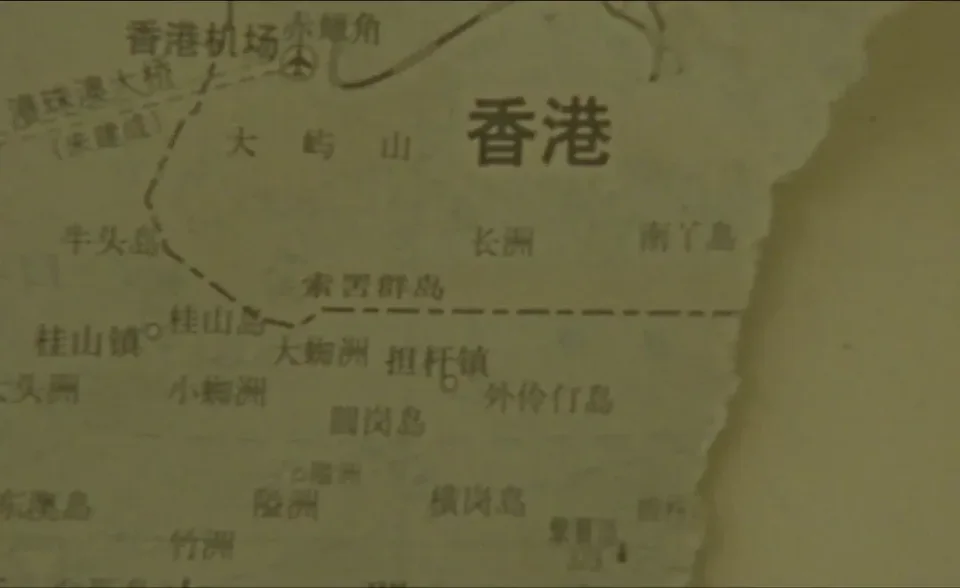
Earth Rumblings, Rubble was filmed at an abandoned quarry on an island in the south. It is a visual variation woven from images of landscape and human traces. Through narrations whose intimacy or distance is hard to discern, and through fragments of speech, it sketches people who vanished without a trace beneath the torrent of the times, along with their "muted" afterimages. Half a century ago, this now-wasted land was also a transit point for people weighing anchor in a last-ditch gamble. In the film, sound becomes a medium for activating matter that is "not quite dead," reverberating with vanished bodies and the lingering echoes of surface rubble. Before a great shock arrives, the "interior" pushes and surges without room to expand, and it deforms and fractures. The resulting sound waves resonate with one another. The cracks and folds of the earth's surface are an ultra-slow-motion film. Historical time, like sandstone or granite, can be extracted from the landscape, and then it sinks into the seabed to vanish or to form new land. Vague memories of terrain, chance encounters with people, and modern ruins together make up a hallucinatory decay. What interests the artist is creating, within that decay, a balanced form that binds together multiple times and narratives.
Pervading and traversing these five films is a sense of decay that keeps submerging and resurfacing above and below the surface of history. The raw materials Wei Hu uses to weave his meshwork are those silenced narrations, the rubble split off from the quarry. In Earth Rumblings, Rubble, Wei Hu does not present the quarry and its bygone era as "ruin." Instead, he presents them as pure "rubble." Designating a site a "ruin" implies a rupture of function. Yet the designation also turns the site into a unified and stable object, the object of a still, motionless aesthetics of nostalgia and fetishism. For Gastón R. Gordillo, "the ruin is an attempt to exorcise the void of rubble and the vertigo it produces."[19] Negativity in Adorno's[5] sense is inherent in rubble. To convert rubble into a ruin available for contemplation is to try to exorcise its ghostly void and its vertigo. Defense brings safety, and Wei Hu cleanly refuses this safety.
In this three-channel video, the central image intermittently flashes vertical sections of cliffs, landforms left behind by blasting and excavation on the island. Meanwhile, flute, voices, the sound of brittle things tumbling, and industrial noise rise and fall. The images on either side are biographical and psychological respectively. With the line "Back then…," a sigh, and within the words, boulders come crashing down and the island trembles. One could say that the rumbling and the sounds of rubble from the quarry on the left act upon the silent, enormous rock face in the center, and then linger long over the ghostly face smeared in pencil on the right. Sound superimposes the three worlds and links them into a single experiential whole. Wei Hu presents this quarry, ultimately hollowed out and abandoned by the flow of capital, as pure rubble. That is, through the negativity and rupture that rubble embodies, he explores the affective dimension of matter. We might call this an affective analysis of rubble.
The quarry's decline runs parallel to the torrent of the industrial age, and its products along the arrow of time are these broken fragments. Space has been destroyed: the materiality of this place was violently dismantled to serve capital accumulation somewhere else. Its geology and history were crushed and folded, becoming the anonymous material of another metropolis. But the crux is this: when space is destroyed, what exactly is startled out of its peace by the firelight of those thousand peaks? Thunder mingles with blasting to become turmoil. "Those sounds, those smells, they all came back again, wave after wave." Voices recount their history, with CPPCC receptions, outstanding investors, and so on, but everything carries the feeling of looking back on the past from the present. Quarrying does give space another form, but it does so negatively. It dismantles not only the integrity of the surface itself but also the social conditions that had gathered at this spatial node. This is precisely what Lefebvre[34] teaches us about the production and abandonment of space. Over time, space is thoroughly destroyed. The cause is not material wear. It is that the social relations that gave this place its life have shattered without a trace.
Understanding this destruction requires an affective understanding of space. For Spinoza[41], affect is both the capacity to be affected by other things and the capacity to affect them. It is through such relations that the body is shaped in its connection with the world. Affect is also primal, uncoded bodily intensity. How, then, does the affective force of rubble itself come about? Affect occurs preconsciously, but its transmission is mediated by sensibilities shaped by society and culture. In Earth Rumblings, Rubble, the medium that activates this affect is listening. I mean not only ambient sound but, more importantly, sound as silence: the silence lurking in the intonation of "Back then…" and in the radio-wave-like blankness that follows. It is in this affective way that the destruction of space shakes and pierces the living. For Gordillo, the politics of affect lies in "how the same object affects people of different class and cultural backgrounds in radically different ways." When affect in this Spinozan sense arises in a political space, what node triggers it?
In another of Wei Hu's works, Proposal for a Public Assembly, the affective node is the toppled monument. The rubble left by its destruction has been swept away, and its absence produces a "present" ghost. The film's narrative tells us that a giant anonymous hand is trying to write a new story on the square. Through a series of technical means, it seeks to inscribe a new mode of feeling into this public space, covering the memory of struggle buried with the fallen monument under a candy-wrapper-bright paradise of joy and consumption. A melancholy voice-over says: "My most vivid memory of the monument is of the moment I discovered it no longer existed." What is thought to be dead and gone returns and persists as a ghost, haunting, and in doing so it makes the living present possible. This is how Derrida sees the relation between the present and its past: "The specter: the concept of the other in the same, the punctum in the studium, the completely other, dead, living in me."[17] The fallen statue is like a body of flesh, bleeding copiously. The narrator's body can still feel its spectral pull. Two levels of affective politics appear here. The anonymous hand guides and shapes the public's collective emotions. Historical trauma, meanwhile, becomes the punctum. It crosses the undercurrents, keeps stinging individual memory, and surges forward again and again, settling layer upon layer and making the present possible.
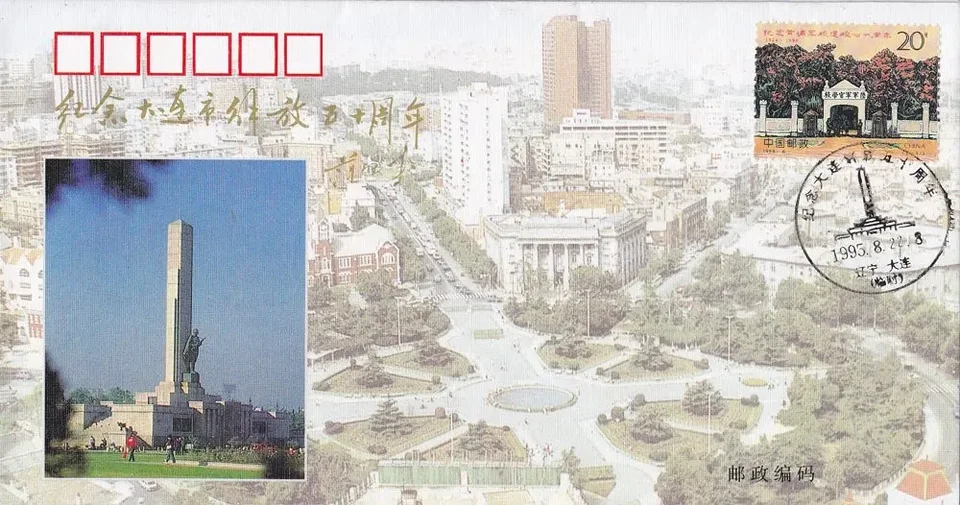
"Assembly" and "encounter" constitute a publicness that lies in a "gray zone." Organized or accidental gatherings, and even individual chance encounters, make up our public life today. This "public sphere" takes shape not only in physical space but also, as it were, in the flow of images. Interested in the relation between images and memory in the post-revolutionary period, the artist researched the history of a square of collective and revolutionary significance in his hometown, City D. The work examines how images (public, collective, and personal) and memory (can memory serve as an archive?) are manipulated by those in power, and how we choose to look. It also asks how the public sphere is depoliticized and how the public becomes a "phantom."
In City D's official image-building, its social image has shifted from "colonial hell" to "socialist paradise" to "market economy." It has landed in an intermediate state somewhere among political seriousness, group identity, mass entertainment, and consumerism, and this gives images a certain performative possibility. Along the temporal dimension that links past and future, this performativity both shapes and dissolves the group identity and public life of the city's inhabitants.
In An Unfinished Film, Wei Hu extends this discussion of historical ghosts from City D into the meshwork of transnational geopolitics. Sound remains important. The first voice-over is long and tedious, laying out the upheavals of the Iranian Revolution and the 1963 coup while archival photographs slide past one after another. The second and third voice-overs alternate, so that the experience of searching through Tehran and reflections on petro-politics ebb and flow in turn. These two are further unified by threads running through both sound and image, presented like a polyphony. A glowing, translucent globe rotates, superimposed on or set beside the image. An Iranian woman poet recites her poems, having added music by Pink Floyd and Camel as background to her recitation. What is discussed? "If oil also has subjectivity, perhaps it is the force that manipulates American and Islamic power." Oil is burning, and cinemas are burning too. The 1958 Fire-Fight at Ahvaz. The Rex Cinema, burned on the eve of the 1978 revolution.
Akhil Gupta[22] points out: "The instrumental infrastructure that drove the rise of industrial capitalism, such as the steam engine, in fact depended on the workings of decaying matter, the ruins of past biological processes in the form of peat, coal, oil, and natural gas." This is the dialectic of decay and growth, of destruction and operation. Even as oil infrastructure propels capitalist progress, it also creates different forms of decay. These include climate change, pollution, and, as we see in An Unfinished Film, the Iranian society that began after the cinemas were destroyed. Building large-scale oil fields and refining systems itself entails destroying the natural environment, and the equipment used in construction often depends on burning fossil fuels. Oil infrastructure is an agent of destruction, and for various reasons, such as that great fire, it also meets destruction itself. Here, however, "decay" must be understood as what Hage[26] calls "late but stalled decay," to distinguish it from "destruction." This decay ought to lead to an end, but decay has failed as a path. It no longer leads to a destination; it is itself the destination. Things in such decay become things that should have died but haunt forever.
The 1953 coup failed to bring Iran a stable pro-Western order, and the 1979 revolution failed to bring the light it promised. The aftershocks of the Cold War keep fermenting. The entire social system has sunk into this kind of decay, with no end in sight. That system is a vast infrastructure made up of the desire for oil, geopolitical maneuvering, and repressed revolutionary memory. If there is an (oil) infrastructure that is itself decay, then maintenance is the assemblage that makes this decay decay.[21] Political designs on oil (the social driver) gave rise to "infrastructure as decay." The material operation and decay of this infrastructure then locked Iranian society as a whole into the kind of decay Hage describes. Seen in this light, the same holds for Operation Ajax and for the entire global oil trade.
In Wei Hu's moving-image world, "destruction" is the dramatic beginning, but his real interest usually lies in the long, endless state of "decay" that follows. The explosion of revolution destroyed the existing order, yet what it opened was a decay, and it locked everything inside. The angel of history is driven forward by the storm of progress while forever facing the ruins, or here, rather, the heaped fragments of rubble. This is what we see in An Unfinished Film: rust-covered iron gates and faded lightboxes, Lalehzar Street. It is also the island in Land Below the Wind, where the legends of the Bajau drift on and on. In the end, An Unfinished Film presents a multilayered "infrastructure as decay." The petro-politics that drives it all is itself a systemic decay, built on decaying matter and constantly producing new decay. The film's own form also refuses to offer a complete history, because it deals with a world in which the very capacity to narrate history is decaying.
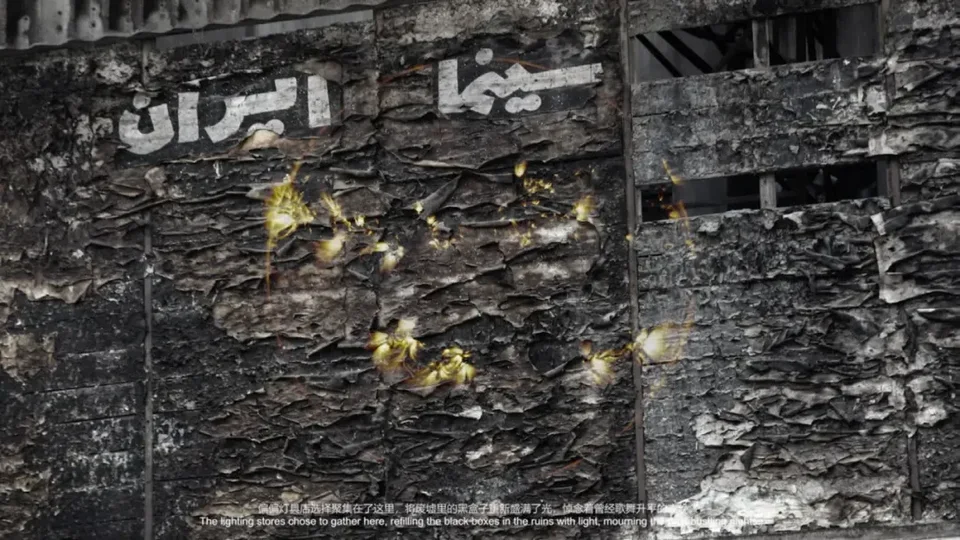
Moving between retrospection and imagination, and between text and moving image, this work is a film built on films. It is also an attempt to rematerialize cinema and the cinematic apparatus. On a research trip to Tehran, the artist and his co-writer revisited the "street" of cinemas burned during the 1979 Iranian Islamic Revolution. They used pre-revolutionary Iranian cinema and cinema venues as a lens for analyzing geopolitics and petro-politics. Text, archives, moving images, film footage, and sound are interspersed within a narrative structure that mixes the real and the fictional, revealing a "silent" manipulation of history and the condition of post-revolutionary Iranian society. The entanglement of war, desire, and matter points to a man-made, apocalyptic "paradise lost." At the level of history, the work also asks the audience in what ways radical revolution is spreading into the present.
Coincidentally, in Earth Rumblings, Rubble, a narrator tells of the fate of another group of people: "When the policy loosened up, along the coast, those people were like little birds. All at once they flew over there." People always try to build their lives through circumspective concern, even after destruction and collapse. I have already discussed the destruction of space. Destruction and annihilation do not bring a void, because negativity always presupposes decomposition, which in turn allows many relations to transform and recombine. At the moment these recombinations occur, people instinctively seize them. As Walter Benjamin puts it: "What exists he reduces to rubble, not for the sake of the rubble, but for that of the way leading through it."[9] Was this their passage to Hong Kong? This destroyer is precisely the bourgeois whom Benjamin criticizes. "The way up and the way down are one and the same." On this road, the dispersed bodies, the deserted quarry, and the streets of Tehran are all what Hage calls the "not-yet-dead"[26]. Wei Hu stabilizes them into a process of decay that can never end, so that apparent transition becomes actual eternity. Like the objects the film ostensibly presents or critiques, it crumbles and deteriorates more each day, ready to be buried at any moment. Yet it also seems able to persist forever in this state of disintegration. This is decay.
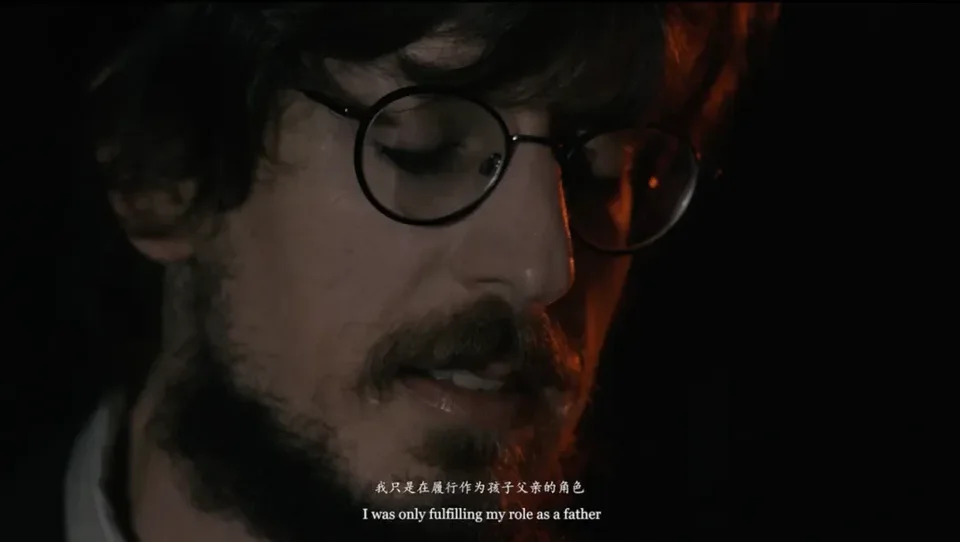
Misdemeanor continues to explore materials of "absence" and "silencing" and their contradictory relation to narration. The work unravels, and fictionalizes, the factual record of a baffling espionage crime (or transnational love affair) from the Cold War era that no one wishes to mention. The artist invites viewers to witness an intimate relationship growing estranged and to become judges and participants in the entangled plot. Through multiple reconstructions drawing on media materials, forensic documents, and works of film and theater, the work turns the investigation of a public historical event into "a detective's obsessive curiosity" and a narcissistic identification with "the criminal." This is a crime without a perpetrator. The law, order, transgression, scandal, and lies it involves also become references to present-day conflicts.
As I have argued repeatedly, sound is always the medium that activates this decay in Wei Hu's moving images. These sounds are like fine sand rubbed together beside one's ear, producing a pure rustling. Beyond their own materiality as sound, they seem to hold nothing at all, as if they belonged to no one. This is a montage of sound. Dialogue and ambient sound entangle, human and non-human sounds entangle, one track chases another while being layered over still other tracks. Layer upon layer. The dialogue is not mainly there to convey information. The overlapping testimonies of Shi Pei Pu and Boursicot in Misdemeanor are a case in point, since the left-right juxtaposition of the two-channel video further dissolves the solidity of the dialogue as testimony.
Misdemeanor takes as its material the love affair and espionage mystery of the 1960s French diplomat Bernard Boursicot and Shi Pei Pu, a Peking opera performer who played female roles. The two were tried separately, one French and one Chinese, and their statements seem to confront each other. A sharp "beep—" cuts in from time to time between the low strings and their testimonies, an interruption that cannot be refused. The "beep—" sounds whenever the two speak of matters related to espionage. In Wei Hu's works, sound too is "not-yet-dead" (not-yet-dead / undead). When Boursicot and Shi Pei Pu talk about gender, Shi says, "I never told Boursicot that I was a woman. I only wanted everyone to know that I might be a woman." Boursicot, for his part, says that (Shi) "was a woman, the mother of my child." At that moment, the "beep—" sounds again. Revolutionary politics and bodily desire intertwine as the two give their unreliable testimonies.
What the sound signifies also slides into a liminal space. The accounts meant to pin down the espionage and the intimacy waver and blur in the stories the two tell, and so historical fact itself enters a space akin to decay. Testimony is usually treated as a trace in the forensic sense. These traces, however, slip away in the very process of our trying to understand history and the two people. As Butler[13] says, "If the trace is a means of marking what came before, then in the marking it is both lost and found." The trace does not lead to any determinate truth. Like trace fossils, it records absence and presence at once. The transnational affair did happen, and the espionage and recruitment did take place. Still, the contradictions and ambiguities in the two testimonies reveal the artist's intention. "Solving the case" is not the point, and it hardly matters who Shi Pei Pu and Boursicot really were. These ambiguities drag us into the torrent of history, a giant wave of loss surging in secret as Shi Pei Pu gracefully assumes the poses of the dan role.
For them, narration in this sense might partly be understood through the conclusion Hage draws in an ethnography of Lebanon. In conditions of failure, narrative works as a mechanism of self-preservation that resists the decline failure brings. For Paul, telling fictional stories allowed him to go on being a "failed warrior," and so to preserve the warrior's history and a near-tragic subjectivity.[24] We do not find in Misdemeanor the smell of rot that Paul keeps describing in Hage's account. But facing trial and imprisonment, the two each chose, through narration, a different way of fashioning and protecting themselves. What is a story? In the meshwork, knowledge grows through storytelling. Ingold's words deserve attention:
A world of stories is a world of movement and becoming, in which anything, caught at a particular place and moment, enfolds within its constitution the history of relations that brought it there. We can only tell the nature of things by attending to their relations, by telling their stories. For the things of the world are their stories, marked out by their paths of movement in an unfolding field of relations. Things happen where things meet, and happenings are interwoven because each is caught up in the other's story. It is in this binding that knowledge is generated. To know someone or something is to know their story, and to be able to join that story to one's own.[28]
In Land Below the Wind, the island itself has already become entangled with the life-form. Azmir, a stateless man trapped on the island, reads aloud a letter he has written to his mother. The figure of Azmir blends Wei Hu's experiences of talking with many stateless people on the island; he is their ghostly avatar. His recitation and the life-form alternate, mixed with the sounds of loss and of the non-human. They are like the two ends of a single thread, forcibly twisted into knot after knot by the shadow the present casts on the ruins of history. The life-form's body is nearly shattered by pain. Swimming through her is a history at odds with the tranquil life the film shows: "The British abandoned Borneo. To take revenge, the Japanese slaughtered locals and Chinese laborers who had taken refuge on the island."
And the fate of the Bajau Laut? Their legends still circulate beneath the sea today, ironically, much like their fluid, unsettled network of maritime nomadism. In the late 19th century, the British North Borneo Chartered Company pushed sedentarization policies widely, and later Malaysia was founded as a postcolonial state. As a result, the ancestral lands of the Bajau Laut, centered on the Sulu Sea, were carved up among Malaysia, the Philippines, and Indonesia, and their livelihood networks and kinship ties were torn apart. The "Bajau Tempatan" (local Bajau), who settled in Sabah and obtained citizenship, put down roots. The "sea Bajau" (that is, the Bajau Laut) keep moving. They are nationals of nowhere, recognized as citizens by no place. Ariella Aïsha Azoulay has discussed the relation between citizenship and non-citizenship: both citizens and non-citizens are governed, and both are therefore in precarious conditions. As she rightly points out, modern citizenship is defined by excluding non-citizens: "In any given historical situation, citizenship cannot be understood without taking into account the noncitizens who form part of the governed population and who exist alongside citizens, yet as an excluded group."[7]
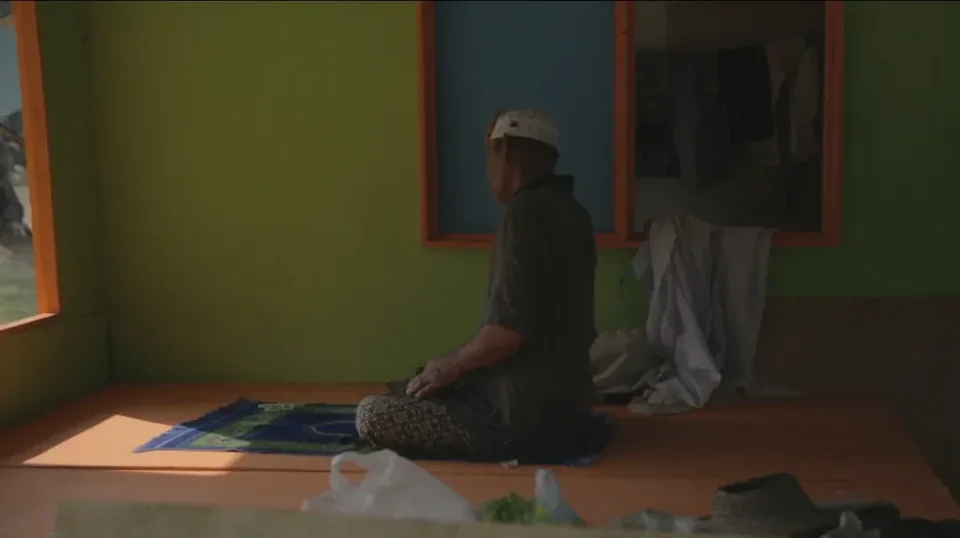
In the 1970s, war broke out again in the southern Philippines, and large numbers of refugees poured into Sabah. For a long time, they and their descendants could survive only on IMM13 refugee passes. The result is what the interviewee Fikri Mustafa describes in the film: "At the seafood market you can see lots of little kids, most of them Filipino." The film's subjects, the stateless people trapped on the island, were produced by "Project IC" in the 1980s and 1990s. Washed over again and again by different forces and blown by monsoons for ten thousand years, they have become near-phantoms within the citizenship system. In the film, Azmir meets the life-form, and she drags him to the seabed, where he comes to know an overwhelming joy and sees corroded machinery.
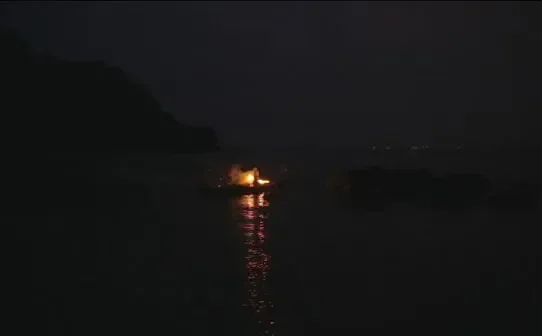
The island's dense forest is hot, humid, and green, and the calls of cicadas and frogs mingle. It is raining all over Malaysia. It is raining on the West Coast. It is raining in Kota Kinabalu. It is raining in Sandakan. The rain comes from the South China Sea across the Crocker Range and Mount Kinabalu and falls on the island's body, and the great events of their lives pass by in this rain. Rain mixes with blood and nourishes the dense forest. "The spiral steel drill pierces my body like the bayonets of the Japanese back then." Layer upon layer of bones, having outlasted the decay of civilizations, sleep inside the island, and each night, meeting the darkness, they turn into phosphorescent fire, rising and falling. Azmir drifts and is trapped. The island is colonized and then developed. Only the monsoon rains return year after year, lashing down like whips and letting the vegetation cover the rebar once more.
These stories interweave, each deeply caught up in the other, and a new kind of knowledge emerges from them: to understand either one's situation, one must first understand the other's story. This entanglement allows blindness and knowledge to be separated. Perhaps blindness will no longer be blindness, and knowledge will no longer appear in the guise of knowledge.[11] "Meshwork" is indeed a metaphor. A metaphor is more than a correspondence between vehicle and tenor; it shapes what we think and how we act[33]. Yet our knowledge must go beyond metaphor and penetrate beneath it, so that the island can become real. Wei Hu's aim is to let the stories become true stories and to join their stories to ours. This knowledge of the silence of being keeps transforming and flowing into itself, and it gives human beings, who come from the infinite and cannot survive without it, the possibility of turning back. The status of the stateless has been suspended, and this suspension is entangled, loosely and intractably, with the island's past of colonization and extraction. The rasping pain endured by the non-human life-form was also caused by the very forces that divided up the world order. Sabah's history reveals an entangled time, in which the past keeps folding back and gets caught up in the future. Here knowledge disables forgetting. It is full of the feeling of both yesterday and tomorrow, and it lets the ghosts of massacre and colonial history return again and again.
This seems to be a story about "loss." All those who narrate it, human or non-human, have gained an empty presence because their pasts were hollowed out. The island has lost its whole body, the Bajau have lost their ancestral lands, and the Filipino migrants have lost citizenship. Each being expresses this loss in its own dialect. For Laura A. Ogden, "Understanding the full story of loss requires 'a sensitivity to entanglement.' This means attending to how loss becomes a habitual experience in the bodies of historically constituted subjects, human and nonhuman alike, and how these losses seep into the webs of relations that make up life."[38] Loss settles into a habit, until it is cut off from any direct link to what was lost. It no longer insists on recovering entities or discourses that have vanished into nowhere. Azmir was shipped to the island along with the building materials. He lives on edge in the city and toils amid mud and exhaustion. At the end of his letter, he tells his mother: "It looks like I can't go home. I hope that one day I'll become the makara in the sea and cross the boundary markers to find you." Loss is mixed with sadness, anger, fear, and anxiety, and it spreads uneasily through daily life. It changes the network of relations among things, and it changes their hopes for the future.[37]
And so the life-form murmurs: "Perhaps only by sinking to the seabed and becoming a beast again can one recover the humanity that was stolen." The island itself becomes an archive of this loss, and it comes alive in the islanders' joyful singing at the end of the film. The bond between history and the place begins to shine again, and the future's possibilities take shape one after another as we listen. Wei Hu recorded this singing on the island. The song resonates with the drumhead. As it rises, it carries space away and brings the film to the end of time, so that it is both song and time-space itself. Together with the island's ageless trees, it will become the reverse of geological time, will become breath. At its farthest boundary, when the song falls silent, loss has quietly seeped into the relationship between Azmir and his mother, into the relationship between the islanders and the ocean, and into the stateless and the refuge they seek. But at the end of loss, we need to conceptualize Wei Hu's moving-image practice once more: to start over, begin again, and stand once more at the starting point of the infinite and of knowledge.
Wei Hu is drawn to networks of relations that are dying, not-yet-dead, suspended at the juncture of past and future, able neither to sink nor to float. What looks ephemeral and transitional becomes eternal. He tells a story and steps back from historical positivity. The aim is not simply to prevent death or loss. It is to "experiment with ways of responding and forms of responsibility different from those of the past," to refuse "violent domination and colonization," and "instead to embrace a shared vulnerability in our lives."[40] Humans and non-humans alike are being harmed: oil gushes, monuments are toppled, rubble tumbles from on high, and people scatter and die. But through fiction and narrative, Wei Hu's moving images release the origin of an event from being a node that must be fixed in place, which is how we usually understand the "nodes" of a network. Each of his stories is an island. By loosening the connections between one island and another, Wei Hu turns the end point of forensic action back into a source, so that every point becomes a point of origin.
The impassioned singing at the close of Land Below the Wind shows this. These multispecies meshworks give birth to us, entwined with one another, and let us be born anew each day under the sun. We become a line layered with death upon death, yet always growing. "Loss" demands a new responsibility, namely to become "meshworkers" (meshworks). This means being sensitive to the lines in one's environment and responding to them with judgment and precision.[30] Such a practice is closer to care work. It lets the currents of rubble reach the "knots" in which history, space, and life are entangled. Its purpose is not to recover lost time but to turn the estuary back into a source and to open the other world within this one, so that we live by it and give it life. This is what Ogden calls "speculative wonder," "an experimental method of engaging with and representing those worlds."[36] Recovering what was lost and gathering what was overlooked is not a way to reconstruct a positivist past. It is a way to practice curiosity toward other assemblages of life and to rebuild, within decay, the contingency of the future. This is a knowledge being born and forever in the process of being born. It too is an island, and by entering every boundary and every ending, it becomes the second origin of the world.
Notes
[1] The core ideas behind this essay, "meshwork" and "island," as well as the main literature on topics such as "rubble" and the "Anthropocene," were all provided by my friend Zi Lin. I offer this essay to her as an explicit expression of my thanks.
[2] In Chinese, "fiction" corresponds both to 虚构 ("fabrication") and to 小说 ("novel"). "Storytelling" corresponds both to 讲故事 ("telling stories") and to 说谎话 ("telling lies").
[3] It should be noted that Deleuze and Ingold work in different domains. The former emphasizes rupture and carries a stronger political tension.
[4] "Yarning" also carries the meaning of "telling stories."
References
[5] Adorno, T. W. (2020). 否定的辩证法 [Negative dialectics] (Feng Zhang, Trans.). Shanghai People's Publishing House. (Original work published 1966).
[6] Azoulay, A. A. (2021). The civil contract of photography. Princeton University Press.
[7] Azoulay, A. A. (2021). The civil contract of photography. Princeton University Press. Cited: p. 35.
[8] Benjamin, W. (1978). The destructive character. In P. Demetz (Ed.), Reflections: Essays, aphorisms, autobiographical writings (pp. 301–303). Schocken Books.
[9] Benjamin, W. (1978). The destructive character. In P. Demetz (Ed.), Reflections: Essays, aphorisms, autobiographical writings (pp. 301–303). Schocken Books. Cited: pp. 302–303.
[10] Broch, H. (2022). 着魔 [The spell] (Chi Xu, Trans.). Beijing United Publishing Co. (Original work published 1953).
[11] Broch, H. (2022). 着魔 [The spell] (Chi Xu, Trans.). Beijing United Publishing Co. (Original work published 1953). Cited: p. 90.
[12] Butler, J. (2016). Introduction. In J. Derrida, Of grammatology (G. C. Spivak, Trans., pp. vii–xxiv). Johns Hopkins University Press.
[13] Butler, J. (2016). Introduction. In J. Derrida, Of grammatology (G. C. Spivak, Trans., pp. vii–xxiv). Johns Hopkins University Press. Cited: p. xi.
[14] Deleuze, G., & Guattari, F. (2004). A thousand plateaus: Capitalism and schizophrenia (B. Massumi, Trans.). Continuum.
[15] Deleuze, G., & Guattari, F. (2004). A thousand plateaus: Capitalism and schizophrenia (B. Massumi, Trans.). Continuum. Cited: pp. 224–225.
[16] Derrida, J. (2007). The deaths of Roland Barthes. In P. Kamuf & E. Rottenberg (Eds.), Psyche: Inventions of the other, volume 1 (pp. 259–292). Stanford University Press.
[17] Derrida, J. (2007). The deaths of Roland Barthes. In P. Kamuf & E. Rottenberg (Eds.), Psyche: Inventions of the other, volume 1 (pp. 259–292). Stanford University Press. Cited: p. 272.
[18] Gordillo, G. R. (2014). Rubble: The afterlife of destruction. Duke University Press.
[19] Gordillo, G. R. (2014). Rubble: The afterlife of destruction. Duke University Press. Cited: p. 10.
[20] Gupta, A. (2021). Infrastructure as decay and the decay of infrastructure. In G. Hage (Ed.), Decay (pp. 37–46). Duke University Press.
[21] Gupta, A. (2021). Infrastructure as decay and the decay of infrastructure. In G. Hage (Ed.), Decay (pp. 37–46). Duke University Press. Cited: p. 43.
[22] Gupta, A. (2021). Infrastructure as decay and the decay of infrastructure. In G. Hage (Ed.), Decay (pp. 37–46). Duke University Press. Cited: p. 37.
[23] Hage, G. (2021a). Decay as decline in social viability among ex-militiamen in Lebanon. In G. Hage (Ed.), Decay (pp. 110–127). Duke University Press.
[24] Hage, G. (2021a). Decay as decline in social viability among ex-militiamen in Lebanon. In G. Hage (Ed.), Decay (pp. 110–127). Duke University Press. Cited: p. 122.
[25] Hage, G. (2021b). Introduction: States of decay. In G. Hage (Ed.), Decay (pp. 1–16). Duke University Press.
[26] Hage, G. (2021b). Introduction: States of decay. In G. Hage (Ed.), Decay (pp. 1–16). Duke University Press. Cited: p. 4.
[27] Ingold, T. (2011). Being alive: Essays on movement, knowledge and description. Routledge.
[28] Ingold, T. (2011). Being alive: Essays on movement, knowledge and description. Routledge. Cited: pp. 159–161.
[29] Ingold, T. (2015). The life of lines. Routledge.
[30] Ingold, T. (2015). The life of lines. Routledge. Cited: p. 47.
[31] Ingold, T. (2016). On human correspondence. Journal of the Royal Anthropological Institute, 23(1), 9–27.
[32] Ingold, T. (2016). On human correspondence. Journal of the Royal Anthropological Institute, 23(1), 9–27. Cited: p. 11.
[33] Lakoff, G., & Johnson, M. (2003). Metaphors we live by. The University of Chicago Press.
[34] Lefebvre, H. (2021). 空间的生产 [The production of space] (Huaiyu Liu, Trans.). The Commercial Press. (Original work published 1974).
[35] Ogden, L. A. (2021). Loss and wonder at the world's end. Duke University Press.
[36] Ogden, L. A. (2021). Loss and wonder at the world's end. Duke University Press. Cited: pp. 12–13.
[37] Ogden, L. A. (2021). Loss and wonder at the world's end. Duke University Press. Cited: p. 5.
[38] Ogden, L. A. (2021). Loss and wonder at the world's end. Duke University Press. Cited: p. 6.
[39] Parreñas, J. S. (2018). Decolonizing extinction: The work of care in orangutan rehabilitation. Duke University Press.
[40] Parreñas, J. S. (2018). Decolonizing extinction: The work of care in orangutan rehabilitation. Duke University Press. Cited: p. 3.
[41] Spinoza, B. (1982). The ethics and selected letters (S. Shirley, Trans.). Hackett Publishing Company. (Original work published 1677).