Abstract: Through his “cinematography” process, Jeff Wall produces large-scale staged lightbox photographs in tableau form. Running against the art world’s enthusiasm for “nonfigural photography” and its transparency, he laid down a labour model of “figural photography” and defended photography’s capacity to achieve a high degree of complexity in the imagery inside the picture, so that photography in this sense can stand alongside painting and film. This model is not only underpinned by pictorialist value judgements and tries to summon the iconicity of the image; because it places painting, as a mediator, inside the industrial process of film, it has also embedded itself, as a contemporary mode of production, in capitalist commodity relations. This complex, studio-based labour model of Jeff Wall’s is precisely the reason he attained his artistic standing, and it has become the dominant mode of image-making in contemporary art photography today.
Keywords: contemporary photography; figurality; Jeff Wall; Manet; pictorial photography
I. Introduction
The image-making process of contemporary art photography seems more and more to have become a strange and unsettled experiment. After conceptual art did away with the superstition surrounding documentary photography, artists from the 1980s onward became keen on staged photography, such as Thomas Demand’s rephotographed paper models or Wang Qingsong’s monumental photographs; at the same time there appeared a representational practice that prized the large panoramic format, such as Luc Delahaye’s war documentation or Andreas Gursky’s images of a mathematical sublime. As far as their artistic end point is concerned, these works do not trade on spectacle, nor do they aim to call up in the viewer an empathetic, absorbed experience of their referents. According to Michael Fried’s forceful account, contemporary art photography has become what it is, and matters as never before, because, without abandoning the tradition of absorptive painting that runs from Diderot (that is, while sustaining an “absorptive” atmosphere), it is able to deal with the problem of “beholding” (that is, the problem of the relation between the photograph and the presence of its viewer)[1].
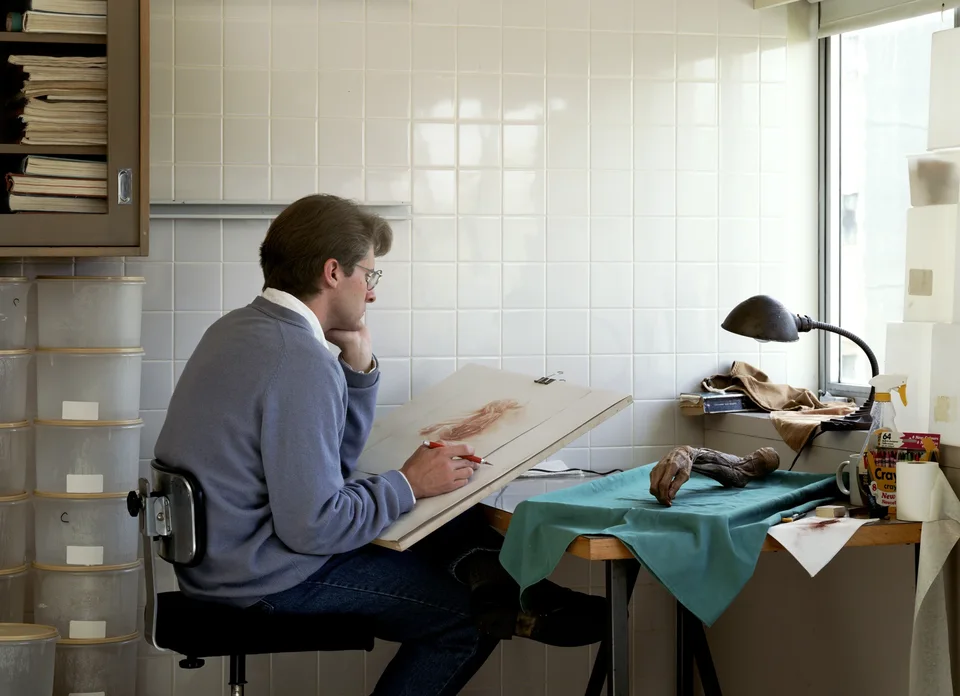
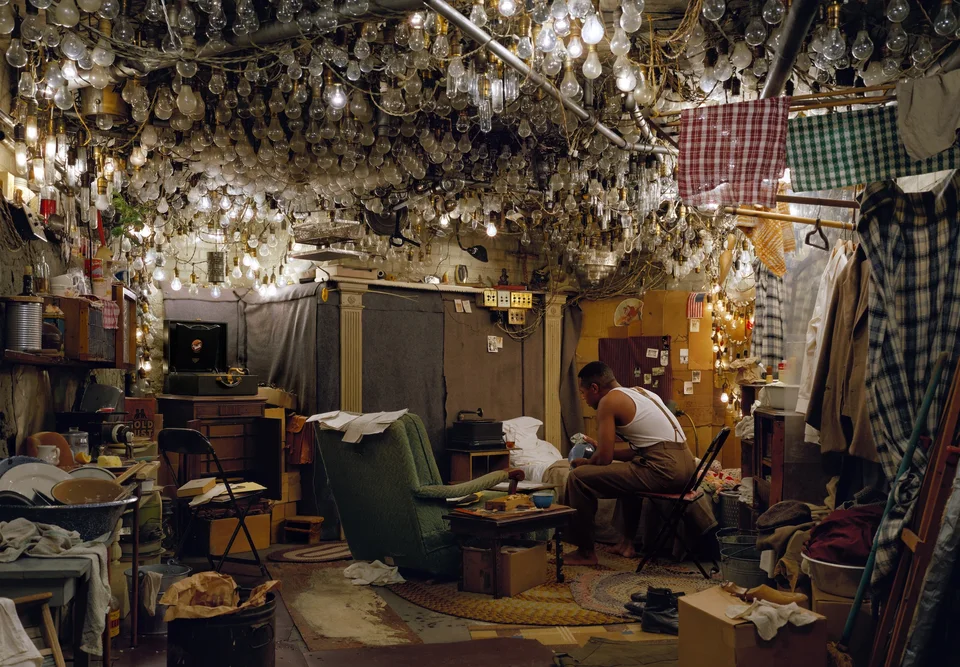
In Fried’s discussion one artist occupies a crucial position: Jeff Wall. From the standpoint of the “anti-theatrical,” Fried discusses in great detail the absorptive atmosphere of works by Wall such as Adrian Walker, Artist, Drawing From a Specimen in a Laboratory in the Dept. of Anatomy at the University of British Columbia, Vancouver (Fig. 1) and After “Invisible Man” by Ralph Ellison, the Prologue (Fig. 2), and sets him up as the rightful spokesman of contemporary art photography[2].
Meanwhile, when commentators discuss Jeff Wall and the reasons for his artistic standing, they mostly connect him to the modernist tradition in art history, and they defend him with roughly two strategies. The first simply uses Wall’s quotation of paintings by Édouard Manet and others to prove the “artistic quality” of his work; the second holds that, by citing paintings, Wall shows a high degree of self-awareness about the relation between photography and painting, and has pushed out the boundaries of the image[3].
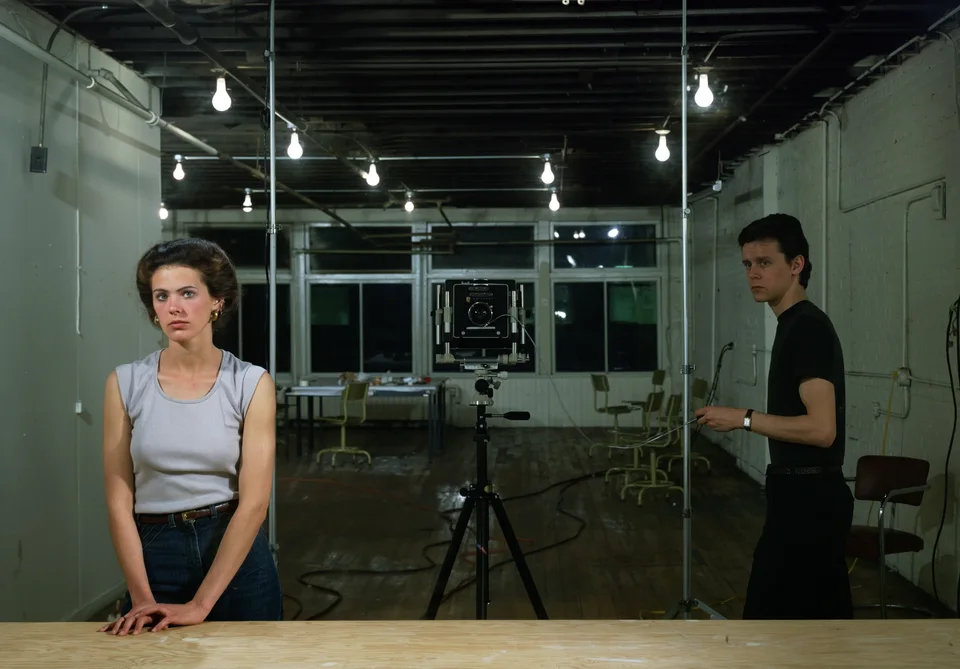
I think, however, that neither of the two currently dominant accounts can convincingly explain how Jeff Wall’s work came to be the “highest” thing in contemporary art photography. My concern is this: could Wall’s work deserve such treatment merely by quoting art history and literature, or merely by being staged photography (even if his “posing”/“staging” costs enormous effort)? Things are by no means that simple. We need to notice that Michael Fried, by gathering Jeff Wall into his own modernist-formalist system of argument organized around “anti-theatricality,” and by presupposing that system as the source of legitimacy, in effect made it hard for this question to be raised on its own terms outside his framework. And I think it is perhaps precisely because of this that Fried finds it hard to give a detailed analysis of Wall’s signature work Picture for Women (Fig. 3) (he mentions it only a handful of times in the whole book). But the key to the whole question lies precisely in this photograph.
II. From Las Meninas to Picture for Women
Hardly anyone would deny that there is one decisive presence in Jeff Wall’s career: Édouard Manet. To this day Jeff Wall and Manet very nearly share a single title: the “Painter of Modern Life”[4]. Although Charles Baudelaire first used this name to praise Constantin Guy[5], everyone today assumes the phrase belongs to Manet. It is no accident that Wall and Manet share it. Before discussing Wall’s quotations of Manet in the figural work he makes through cinematography, there is one particular place that ties Manet and Jeff Wall together: the Museo del Prado in Madrid. In 1856 Édouard Manet came to Madrid, saw the paintings of Diego Velázquez, was deeply shaken, and called Velázquez “the painter of painters”[6]; this short ten-day trip to Spain became a milestone, a turning point, in Manet’s career[7]. After returning to Paris from Spain he painted the famous The Fifer[8]. Velázquez’s Las Meninas (Fig. 4), perhaps the most analysed painting in the history of Western art, likewise inspired Manet’s Self-Portrait with Palette. In Las Meninas Velázquez painted himself into the picture holding a palette, and in Self-Portrait with Palette Manet depicted himself in a pose much like that of the Velázquez in the painting. In an almost historical correspondence, in 1977 Jeff Wall also came to the Prado and was deeply drawn by the complex figurality of Diego Velázquez’s work; this trip became something like the moment of epiphany in Wall’s career, a James Joyce–style sudden illumination[9].
What makes me think we need to approach the complex relation between Jeff Wall and Manet through Velázquez as a mediator is precisely that Las Meninas brings together the problems of mirroring, of looking and being looked at, of facingness, and of reflection. The high degree of figurality that Las Meninas displays through these problems is exactly the resource we cannot do without if we want to understand the figurality of Jeff Wall’s Picture for Women, and it is also the key to understanding Manet’s A Bar at the Folies-Bergère (Un bar aux Folies Bergère, Fig. 9). As Michel Foucault argued, this painting broke with the Baroque tradition of treating painting as a “window onto the world,” because for the first time it “gazes back” at the real space where the viewer stands—as Foucault put it: “We are looking at ourselves being looked at by the painter, and made visible to his eyes by the same light.”[10] As we will see below, this “gazing back” that comes from Las Meninas, the “facingness” that comes from Manet’s A Bar at the Folies-Bergère, and the complex bending of sightlines that both share because a mirror is present, together make up the iconographic theme of Jeff Wall’s Picture for Women.
(1) Las Meninas and Picture for Women
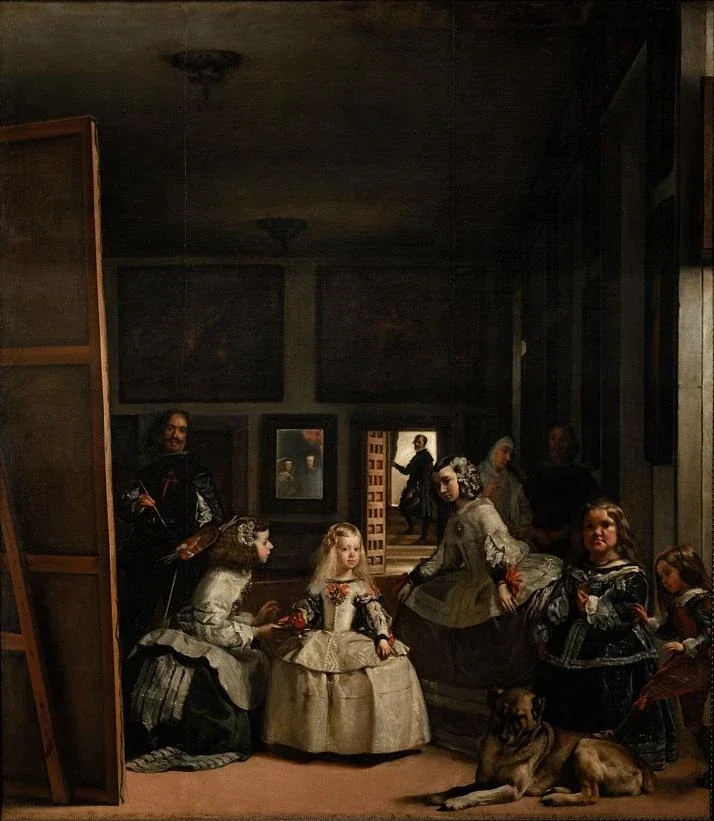
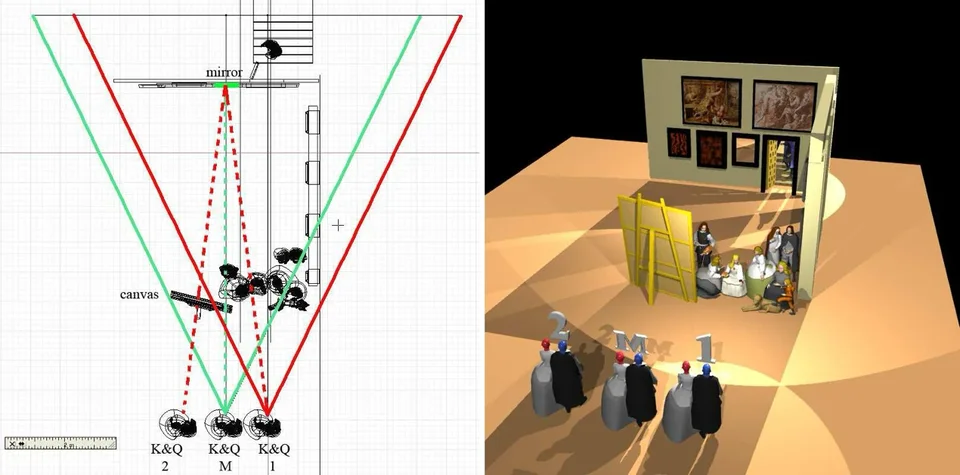
The first thing to point out is that Picture for Women shares with Las Meninas a complex set of relations of looking and being looked at. The core component of this system of relations is the mirror. Although a mirror also appears in Manet’s A Bar at the Folies-Bergère, for Velázquez and Wall, unlike for Manet, the “mirror,” as the mediator that bends the sightlines, means an arrangement of the central point of projection (that is, the point from which the ideal viewer’s gaze issues) and the viewpoint of the painter/photographer himself. On the role of the “mirror” in Las Meninas, Foucault’s summary is extremely precise: “It does not surround the visible objects; it cuts straight through the whole field of representation, ignoring everything it might capture within that field, and restores visibility to what lies outside all view.”[13] That is to say, the mirror does not show things that cannot be seen directly; it points straight at objects that cannot be directly represented because of the structure of the painting and the nature of painting itself. The mirror exposes the limits of representation, and at the same time lets what representation itself conceals appear in an indirect but definite way. It is both the centre of vision and a vacancy in representation.
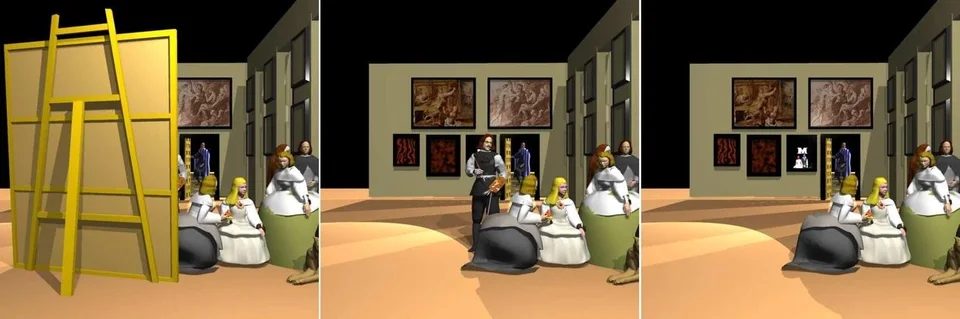
Given that Velázquez painted Las Meninas (Fig. 4) to thank King Philip IV for his newly granted knighthood, the “centre” of this painting has become the focus of debate, because the orthogonals of the pictorial space finally converge on a small figure in the distant doorway: Don José Nieto Velázquez, head of the royal tapestry works. The king and queen appear only as reflections in the small mirror on the wall. As far as aesthetic intuition is concerned[14], Velázquez creates the feeling that the king and queen are standing directly opposite the mirror and looking straight into it, and that the place where they physically stand (outside the picture) coincides with the centre of perspective (that is, the viewer’s viewpoint). David G. Stork, however, has shown through careful computer modelling and sightline analysis that neither of these holds[15]. In fact, if the king and queen stood at that position (the position K&Q M in Fig. 5, left), their line of sight would be blocked by the large canvas; they could not see the mirror, nor could their reflection appear in it (as Fig. 6, left, shows). Moreover, if and only if the canvas and the painter are not where the painting shows them (Fig. 6, right) could the king and queen see themselves in the mirror from K&Q M. In other words, the reflection in the mirror in Velázquez’s painting comes not from the real bodies of the king and queen but from the picture that Velázquez himself is painting within the painting (whose content is not visible). Thus the bending of sightlines that Velázquez accomplishes with the mirror has two effects. First, in aesthetic intuition, he creates a “facingness” of the king and queen, the feeling that they are facing the mirror and the whole scene head-on, and so places them, in the viewer’s perception, at the picture’s centre of projection, which spares him the charge that would follow from unreasonably placing the centre of the picture on Don José Nieto. Second, optically, Velázquez places himself in the picture and makes the otherwise invisible large portrait of the king and queen visible by way of the mirror’s reflection, which also expresses, iconographically, the exalted standing of the king and queen.
But where exactly is the painter Velázquez himself looking? Physically, the king and queen ought to stand at K&Q M, while the viewer’s viewpoint lies at K&Q1, to the right of M. The two points are in fact very close together, and it is very hard to judge whether Velázquez is looking at the king and queen he is painting or at the viewer’s viewpoint (that is, the centre of projection). If we borrow Stork’s modelling images and try to map the sightlines in this painting, we will find that adding the mirror changes the sightline relations of the whole scene enormously. Without that little mirror, the following set of sightline relations would vanish altogether: the real king faces the mirror (but cannot see it) and the painter, and looks at the whole scene in the painting; the real Velázquez faces the king and queen and (possibly) looks at the central point of projection; the mirror reflects the painting of the king and queen, which cannot be seen directly; the reflection of the painting of the king and queen likewise looks at the central point of projection, creating a “facingness” relative to that point. Only the sightlines issuing from the real king and queen and from the central point of projection see the whole real scene.
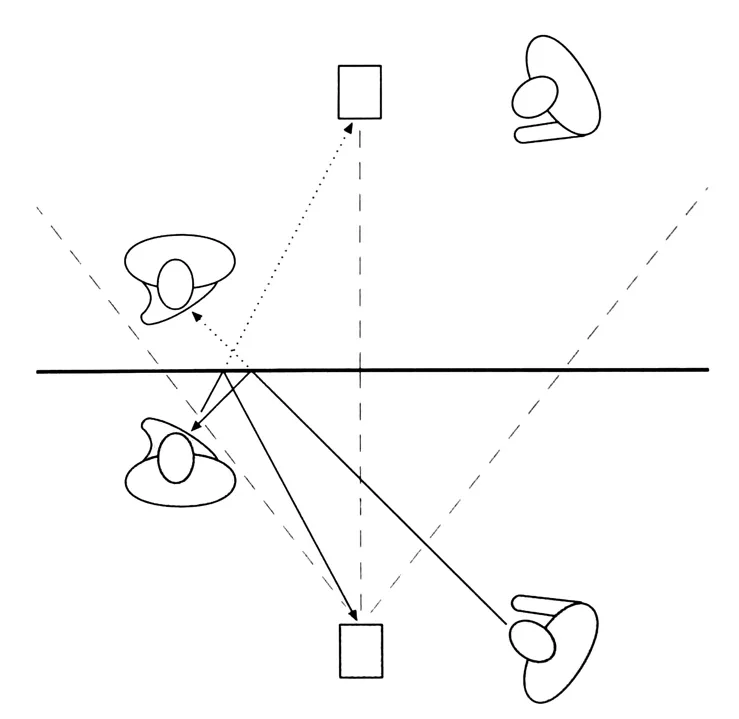
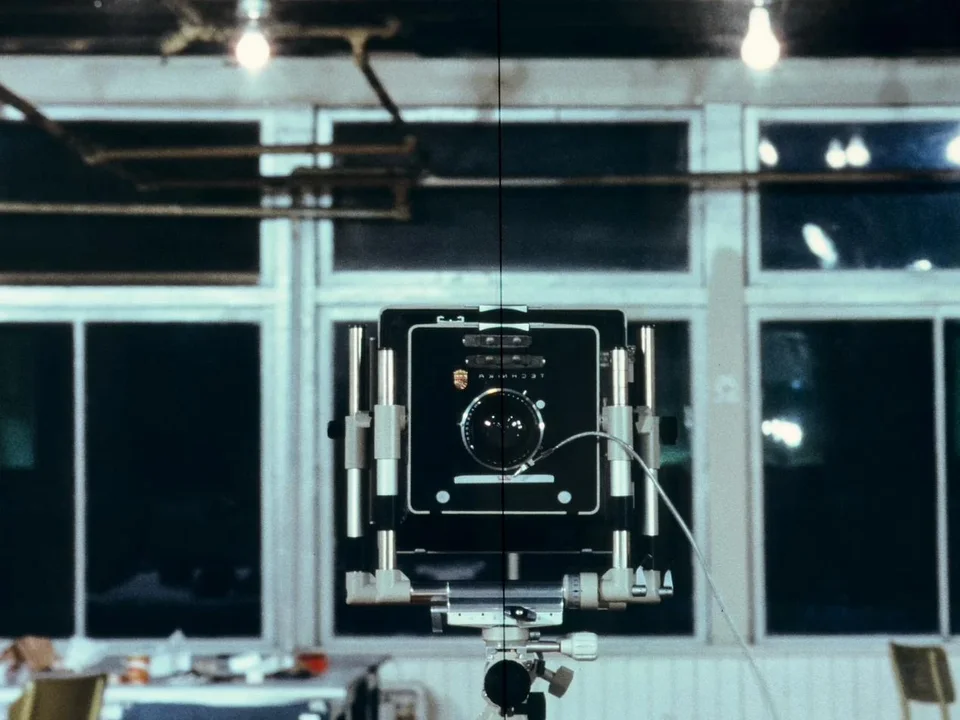
Following the sightline diagram of Wall’s photograph that de Duve himself drew (Fig. 7), we can see that the real young woman is gazing at the reflection of the camera lens, the real photographer is looking at the young woman’s reflection, and only the real camera captures (or, as it were, “looks at”) the whole mirrored scene. The observer’s viewpoint and the positions of the king and queen in Velázquez’s painting all give way, in Jeff Wall’s picture, to the camera in the middle of the image; and what Foucault called the “outward gaze” of Las Meninas is here nakedly replaced by the “facingness” of the camera lens. When viewers stand in front of the photograph, they feel very distinctly that they are being “looked at.”
De Duve further prompts us to notice the two light stands in the picture, which divide it like the borders of a triptych. If we cut the middle of the picture out along the two light stands, we face a consequence: we can no longer tell whether a camera is photographing its own reflection or one camera is photographing another (Fig. 8)[17].
It is precisely because the mirror element is added that the author is both directly present in the picture and involved in the actual relations within it. For Velázquez, the painter is looking at the central point of projection or at the king and queen (we cannot reach a definite conclusion from the picture); for Wall, the photographer is looking at the woman’s reflection. At the same time, the way the mirror complicates the relations of looking also lies in how it acts on the main subject of the picture in each case—for Velázquez, the king and queen; for Wall, the camera itself, occupying the centre of the picture. Like the king and queen in Velázquez’s painting, this camera is both the object of representation and the absolute subject, and, within the real space the work represents, it gathers the whole space with its own “gaze.” Here the camera very nearly becomes a metonymy for the figures of the king and queen, and the many tangled sightline relations hold only because the mirror appears.
More importantly, through the presence of the mirror—or rather, through Jeff Wall’s placing the little mirror of Las Meninas at the centre of the whole pictorial space—the restoration of visibility that Foucault analysed in the mirror of Las Meninas is brought further to the fore. Standing in front of Wall’s huge photograph, facing the camera’s reflection at its centre, viewers also find that this camera is quite openly “looking back” at the viewers outside the picture, as though it meant to suck them, too, into the deep darkness of the lens. Because the camera is present in the mirror, the mirror, although it inevitably duplicates the pictorial space, visually becomes—owing to the “gaze” of the lens’s reflection toward the surface of the photograph (remember that this photograph is always going to be seen on a wall)—what Foucault called the “slender line of reciprocal visibility”; only, for Las Meninas this line comes from the painter in the painting, while for Wall’s photograph it comes from the camera’s own reflection, captured by the camera itself. This dotted line “pierces through the real picture, leaps out from its surface, and connects to the place from which we look at the painting; this dotted line inevitably points toward us, linking us to the painting’s representation.”[18] In this way representation does not depend only on the object depicted; like Las Meninas, it brings about (and also requires) a rupture in the traditional act of looking itself.
(2) A Bar at the Folies-Bergère and Picture for Women
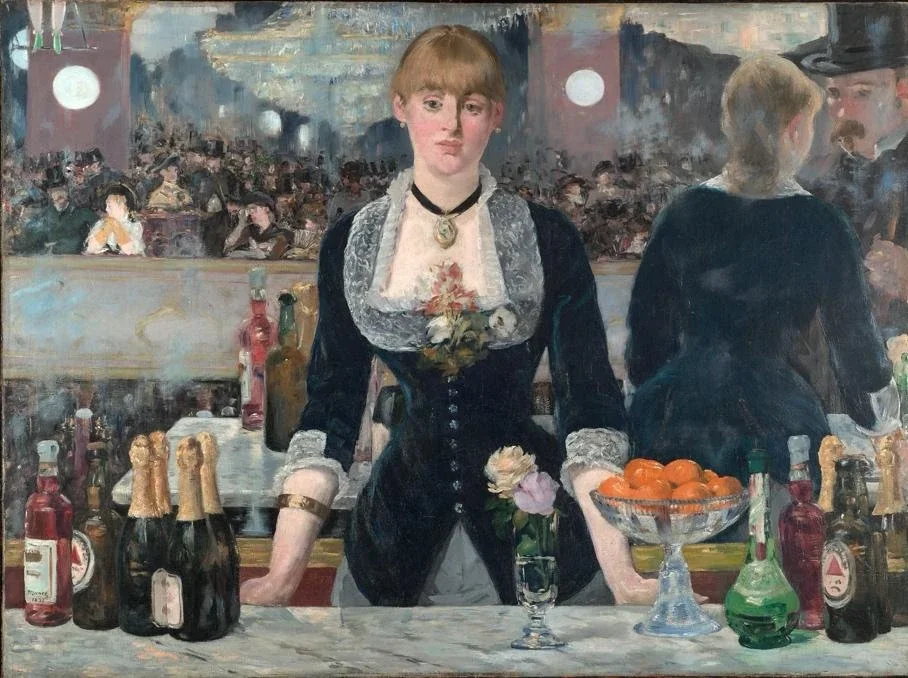
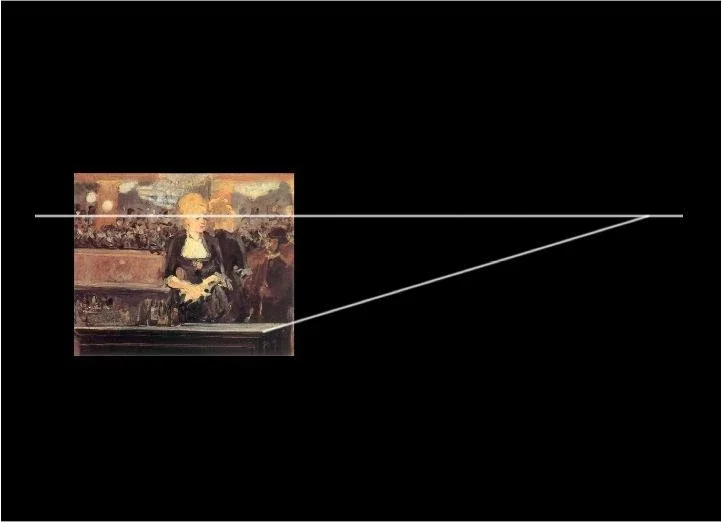
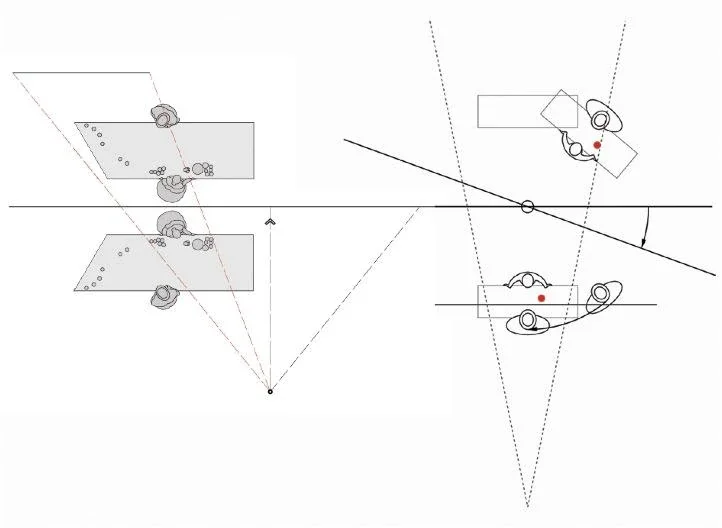
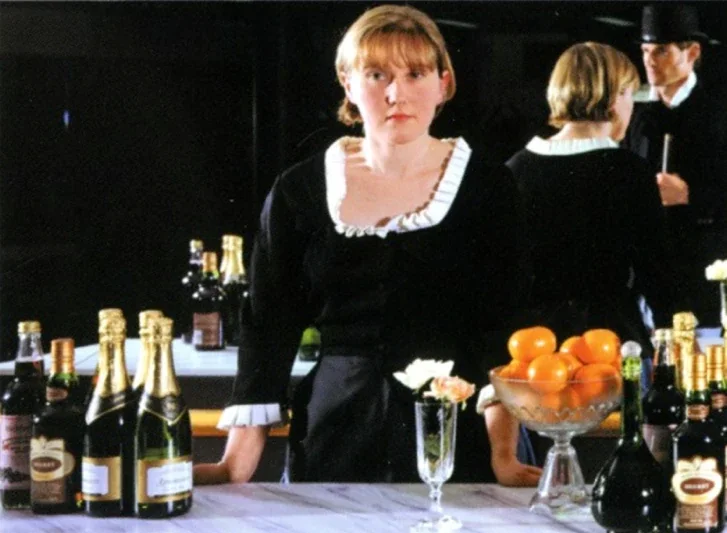
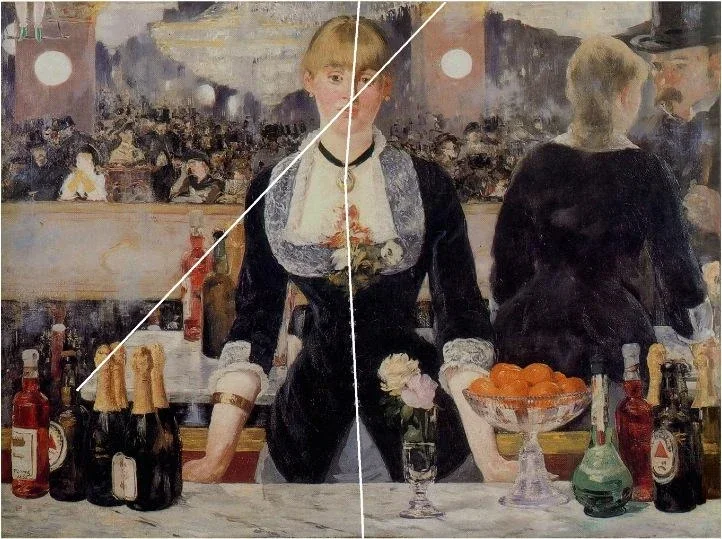
It is generally held that Jeff Wall’s Picture for Women borrows directly from Manet’s A Bar at the Folies-Bergère, mainly because of the resemblance between their pictorial and compositional elements: the huge mirrored background, the man, and the woman looking straight at the viewer. Jeff Wall, however, is not imitating Manet’s composition; if he were, he could not achieve the figural complexity peculiar to photography. He is doing the same thing Manet did: by adding a mirror, he brings about an internal disruption of the picture’s perspective, and the consequence is that in the works of both Manet and Jeff Wall an “impossible spatial experience” appears—that is, a spatial experience that cannot be reproduced at the corresponding central point of projection in the real world.
Shen Yubing has argued that Manet’s A Bar at the Folies-Bergère can be understood as Manet’s defensive reaction to photography. Through an obviously contradictory optical arrangement—having the back of the barmaid Suzon appear on the right side of the mirror, while the light sources in the mirror still show up as frontally lit round dots—Manet tells his viewers that what he has made is a painting, not a photograph that strictly obeys monocular perspective[19].
When Thierry de Duve examined this work of Manet’s, however, he cited the view of Malcolm Park[20]. Park holds that Manet’s painting in fact strictly obeys optical perspective, because its central point of projection lies not in the direction perpendicular to the picture plane but off to the side of the painting; the reason is that in Manet’s small preparatory study for A Bar at the Folies-Bergère the line of sight already cuts in obliquely from outside the picture on the right (Fig. 10). As for the implausible reflections of the bottles and counter in Manet’s painting (which look as if they had been raised in vertical height), they arise because the counter is a trapezoid rather than the usual rectangle; this, together with the field of view slanting in from the right of the picture, means that the reflections of the real bottles are blocked by the real barmaid, and the bottles in the mirror are actually the reflection of another set of bottles that is not in the painting. Nor is the man on the right facing Suzon directly; his line of sight passes Suzon’s left side in a direction parallel to the viewer’s viewpoint. Park’s explanation (Fig. 11, left) looks extremely persuasive optically, because by following exactly this optical hypothesis we can reproduce this composition of Manet’s almost perfectly with a camera (Fig. 12).
De Duve, however, points out that this “against intuition” hypothesis has two flaws. First, in the photograph constructed according to this model, the slope of the counter’s edge is clearly gentler than in Manet’s painting; second, when Manet painted, he followed aesthetic intuition, not optical surveying. Malcolm Park’s model may be optically sound, but it dilutes the aesthetic force carried by Suzon’s melancholy eyes and her pronounced “facingness.” More importantly, going by aesthetic intuition, the vanishing point of this painting (though it cannot be determined optically, since the horizon in the picture is unclear and the only orthogonals are the reflected edges of the counter) falls exactly on Suzon’s face (see Fig. 13). According to de Duve’s hypothesis, the painting is a composite of two moments (Fig. 11, right). The first is an intuitively frontal image: the mirror is parallel to the picture plane, the viewer faces Suzon squarely, the real man is not visible within the field of view, and Suzon looks straight at the beholder. In the second moment the mirror has swung round, the man has moved in front of Suzon, blocking the line of sight between the viewer and Suzon, and the reflections of Suzon and the man appear as we see them in the painting. Manet’s painting is the composite of these two moments. De Duve also admits, though, that his aesthetic-intuition model cannot explain what is implausible about the counter in the mirror. The crux is not what the true optical model is; for de Duve, the crux is that the counter-intuitive position, although optically sound, sacrifices aesthetic intuition, and the price of that is ignoring the artist’s intention. This is exactly where Shen Yubing’s analysis comes to rest: Manet’s intention was to mount a sly resistance to the domination of photographic perspective.
This resistance was later filed by Clement Greenberg under modernist painting’s progress toward “flatness”[21]. When Manet tried to present an impossible spatial experience in painting, he had in fact already broken with the belief, shared at the time by photography and painting alike, in the picture plane as a transparent window. Technically speaking, the picture plane corresponds to the material surface of the photograph or painting, which is physically opaque, yet by convention it is treated as a transparent window. This is precisely how Greenberg defined photography: “Because of the transparency of the medium, the difference between the extra-artistic, real meaning of things and their artistic meaning is even smaller in photography than it is in prose.”[22] Greenberg’s pursuit of photographic transparency led him to hold up Walker Evans as the model photographer, and this was exactly the deification of photographic transparency that appeared in the 1960s. The whole process of modernization, for painting, was on the contrary a process in which the picture plane moved from transparency to opacity. And this process was started by Manet. He did not, like Jackson Pollock and others later, pursue constructedness everywhere from the subject of the picture to the surface of the canvas; instead, by disrupting the conventions of transparency inside the picture, he lured viewers, in the course of looking closely, into grasping his intention, and his method, of making the picture surface opaque.
Through his implausible arrangement of perspective, Manet brought out the reality of the picture plane itself, and thereby set himself apart from the transparent surface of the photograph. For de Duve, this is precisely the first problem Jeff Wall sets out to solve with Picture for Women: how can the picture plane of a photograph be made visible?[23] Wall’s approach is simple to describe: physically set up a mirror able to carry the image itself, and present in the mirror what originally belonged entirely to the picture plane. Here, because the mirror plane is present, the picture plane very nearly coincides with it. But de Duve’s analysis still misses some crucial things.
The first thing to notice is that Picture for Women is displayed in “tableau form.” The “tableau” was first proposed by Jean-François Chevrier; Fried later developed it further and used it to define the dominant display form of contemporary photography since the 1970s[24].
A photograph in tableau form is designed from the start to be shown on a wall rather than held in the hand, so its size usually goes beyond the norm, just as the long side of many of Wall’s photographs reaches three metres or more. More importantly, the tableau photograph foregrounds its own status as an artefact, and uses this constructedness and madeness to resist the illusion of transparency of the photographic image itself; with its enormous size it also enters the viewer’s space as an object with volume, forming a kind of confrontational relationship with the viewer. Fried sets great store by what tableau form means for contemporary photography. For him, it is precisely this form that lets contemporary photography deal, as never before, with the relation between the world in the picture and the presence of the viewer’s gaze—that is, the problem of absorption and theatricality that concerns him. In a word, behind “tableau form” lies an awareness of constructedness, and this matters because: “the new art photography seeks to deal with the problem of beholding in a way that does not succumb to theatricality, while at the same time, by acknowledging ‘to-be-seenness,’ reflecting the significance for its time of everything minimalism and literalism did—just as ambitious French painting after Manet had to acknowledge the ‘facingness’ of painting (rather than, as is usually said, its flatness), while at the same time preserving a fictive space that did not exist wholly to court the applause of the Salon public.”[25]
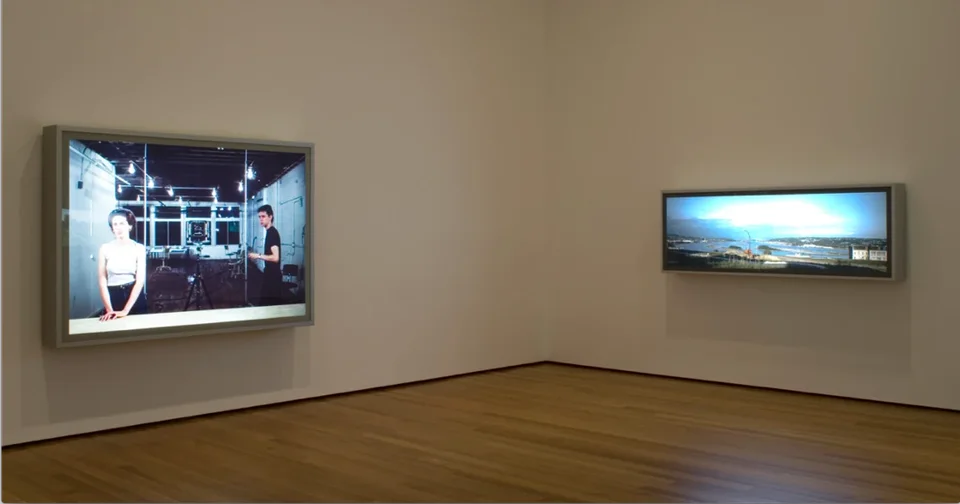
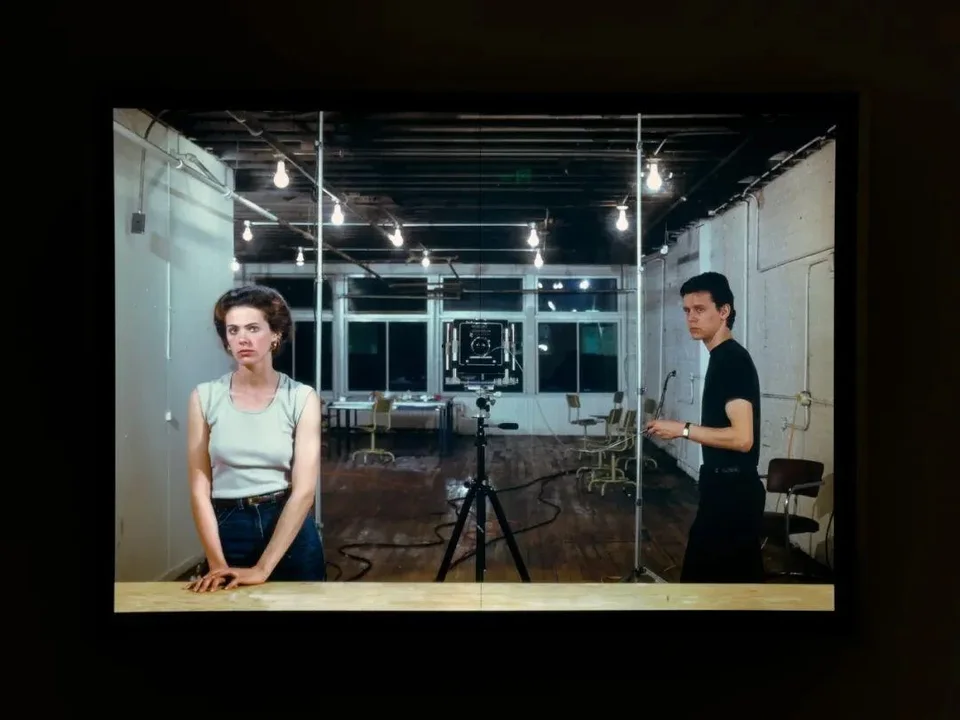
Once Jeff Wall began displaying his works in self-illuminating, advertising-style lightboxes and in tableau form, this way of displaying them first of all assigned the photograph to the class of painting-like objects; and, because the lightbox is unusually and obviously thick (about 23 cm), its status as an artefact cannot be ignored either. The reason I say de Duve overlooked something in analysing how Jeff Wall foregrounds the reality of the picture plane lies precisely in the concrete way this photograph is displayed: the transparency of Picture for Women is made of two pieces, left and right, joined together (Fig. 8). There is an obvious seam on the surface of the lightbox, dividing the picture in two. This seam does not belong to the represented world of the picture; it is simply a real physical dividing line lying across the middle of the picture and running through the camera at its centre[26]. As soon as viewers try to get close to the photograph to study its details, this line is always there at the edge of their perception, disturbing the illusion of transparency. In this sense, through a highly constructive act, Jeff Wall, like Manet, makes the picture plane opaque, though the two do not go about achieving this in quite the same way.
As for the picture itself, by setting up the relation between the mirror and the viewpoints, Jeff Wall synthesizes the ways Velázquez and Manet each handled the relation between the world inside the picture and the world outside it, and makes the problem of “beholding” more conspicuous than ever before. The key is that Jeff Wall, like Manet, presents a space that cannot be experienced in reality. No one in real life could ever reproduce the spatial experience of Manet’s A Bar at the Folies-Bergère or of Wall’s Picture for Women. The former can be put down to Manet’s spatializing of time; the latter arises because the presence of the camera itself makes the central point of projection at once the observer’s all-seeing eye and a blind spot in the bodily sense.
What makes it more complicated is that we cannot say Suzon’s facing gaze in Manet’s painting no longer exists in Wall’s photograph, for by having the woman look at the camera’s reflection, Wall keeps this woman’s direct gaze as well. Our point of observation both issues from the camera’s position and is gazed at by the camera itself. The problem is that a bodily eye could not have this spatial experience from the position of the camera in the picture: when someone stands where the camera is, the observer’s figure must appear in the mirror; and when the observer can “see” the camera in the mirror, he or she will also be “seen” by the camera and appear in the picture. There is no way a bodily observer could view the whole scene from the central point of projection without appearing in the picture. This is therefore a spatial experience that only photography can produce; in terms of reality, it does not make sense.
Picture for Women not only shares with Las Meninas a complex system of looking and being looked at, but also carries on the “facingness” that Manet established. For Fried, facingness does not simply mean that the figures in the picture look toward the central point of projection, because once a painting or photograph aims to call up the viewer’s empathetic identification, this effect of facingness may be covered over, as we see in the work of August Sander or Richard Avedon. Likewise, facingness is a historical theme that Fried has attended to all the way from Manet’s Modernism to Why Photography Matters as Art as Never Before, and its precondition is the complete bankruptcy of the Diderotian tradition, which tried to deny the existence of the beholder standing before the picture. Manet’s Olympia and other works announced a fact: paintings really are made to be looked at[27]. In geometric terms, Manet’s A Bar at the Folies-Bergère, like Wall’s Picture for Women, expresses “facingness” most thoroughly at one spot—Suzon’s face in the former, the camera lens in the latter—which is exactly where the picture’s vanishing point lies in aesthetic intuition. Through constructing facingness, Wall and Manet both nakedly acknowledge the existence of the beholder before the image, and both carry out a kind of disruption of the picture’s internal relations. This disruption may look less radical than Jackson Pollock’s or Mondrian’s, but at bottom it becomes a highly figural construction of an impossible spatial experience.
(3) The “Living Dead” in A Ventriloquist at a Birthday Party in October 1947
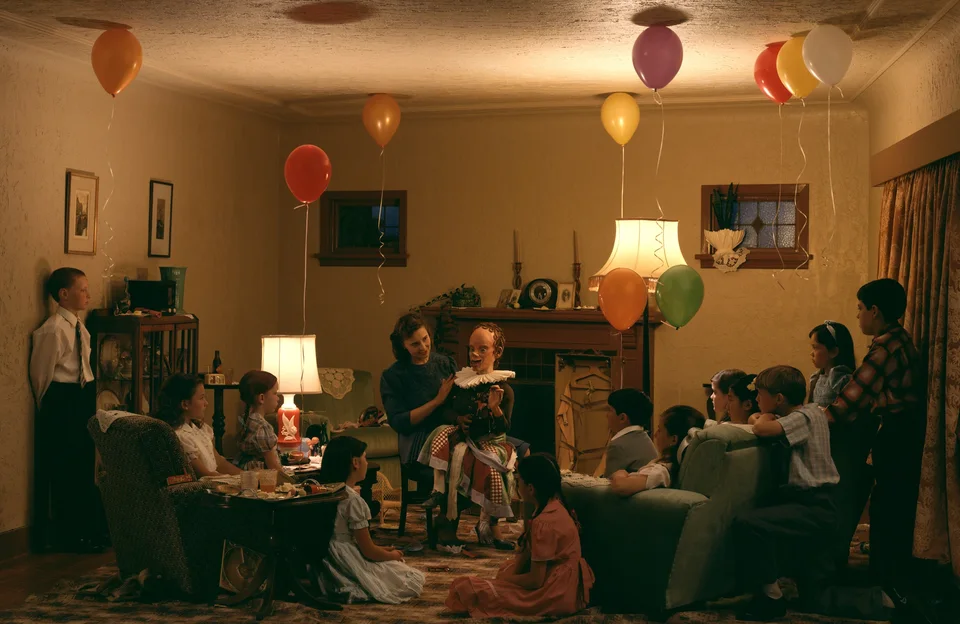
This “impossible” or “implausible” spatial experience also turns up in Jeff Wall’s other works, for example A Ventriloquist at a Birthday Party in October 1947 (Fig. 15). The subject of the whole picture is announced by the title: a ventriloquist’s act at a birthday party. The warm yellow tone of the picture has a gentleness like that of Schumann’s Scenes from Childhood; balloons float up to the ceiling; children gather round the ventriloquist at the centre. And yet the photograph still feels extremely eerie. In this crowded room almost every child’s gaze is forcibly fastened onto the slightly grotesque puppet in the middle of the picture; every child’s face is very grave, and the second girl from the right even looks terrified. This really is the absorptive atmosphere Michael Fried describes: the figures are completely unaware of the beholder outside the picture and are held fast by the world they are in. The ventriloquist herself does not exchange looks with the children; she stares at the puppet on her knee. This closed loop of gazes seems to produce a double isolation: the ventriloquist and the puppet form a closed space, while the children, as outside spectators, are drawn in by this closed system. The puppet’s facial features come from Houdon’s bust of Voltaire—originally a face of Enlightenment reason—shrunk here into a big-headed, small-bodied monster. Its clothing is even more full of temporal disorder, and this is also what I take to be the manifest theme of the whole photograph. The ruff around the puppet’s neck belongs to seventeenth-century dress, but its jacket is a Second World War Eisenhower-style military jacket hung with medals, and its lower half wears a long checked skirt. This collage—military on top and civilian below, male on top and female below—makes the puppet itself a hybrid of several eras. Its right hand makes a Voltairean oratorical gesture, while its left hand takes the form of an animal’s claw, gripping its own belly. One of its feet wears a leather shoe, while the other is bare, its toes charred black and broken. This aggressive ferocity clashes violently with the cosy domestic decor around it.
Look at the whole scene again. There is no doubt that the beholder’s viewpoint comes from above the children, at the geometric centre of the picture. It is not hard to see that the whole room leans implausibly to the left. The left wall seems to have “caved in.” The joins between the ceiling and the walls are completely out of line, and from left to right the top edge of the wall gradually passes from level to sunken inward. This is not a normal room. To achieve on a two-dimensional surface a figural complexity like that of classical painting, Wall built a trapezoidal set. The back wall facing the lens is not perpendicular to the floor but leans backward, and this lean cancels the foreshortening caused by perspective, which in turn shrinks the visual difference in size between objects at the back and objects in the foreground. At the same time, the left and right walls are not parallel to each other but splay outward like an inverted V. This forced perspective is often used in stage design precisely so that the camera (as the sole spectator) can capture a wide enough horizontal field of view in a space that is not very roomy. The figural complexity of this photograph goes far beyond this; it is so complex that only a method like this, “staging + monumental scale,” could convey it just right.
Look at how the light sources are distributed in this photograph. On the face of it, only two lamps light the whole photograph. But the highlights on the balloons and the shapes of their shadows show that things are not so simple (Fig. 16).
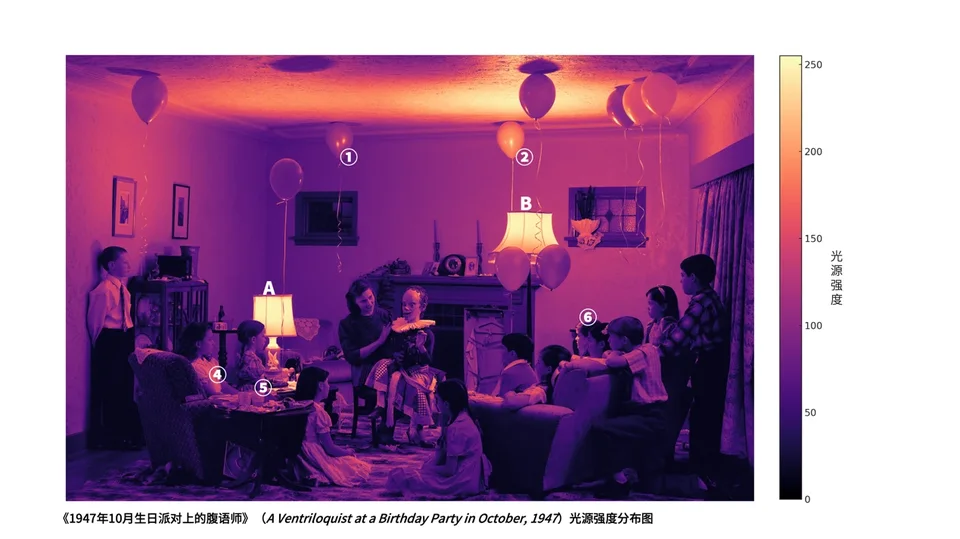
There are two visible light sources in the picture, lamps A and B. By the laws of physics, lamp B, as the main source, ought to throw radiating, hard-edged shadows from the surrounding figures and objects, and its light ought to fall off quickly with distance. But what we see in the picture is lighting that breaks the laws of physics: the light covers everything from the carpet in the very foreground to the deepest corner at an absolutely even brightness. If we compare the intensity of the highlights on the two balloons at ① and ②, we find that, because balloon ① is not much farther from table lamp A than from floor lamp B, and table lamp A is weaker than floor lamp B, the highlight on the left of ① cannot be as bright as the highlight on its right. The highlights on balloon ① look rather as if they were produced by two light sources of equal strength at equal distances, and that does not fit what the picture shows. Now try looking at the shadows of balloons ①, ② and ③ (Fig. 17).
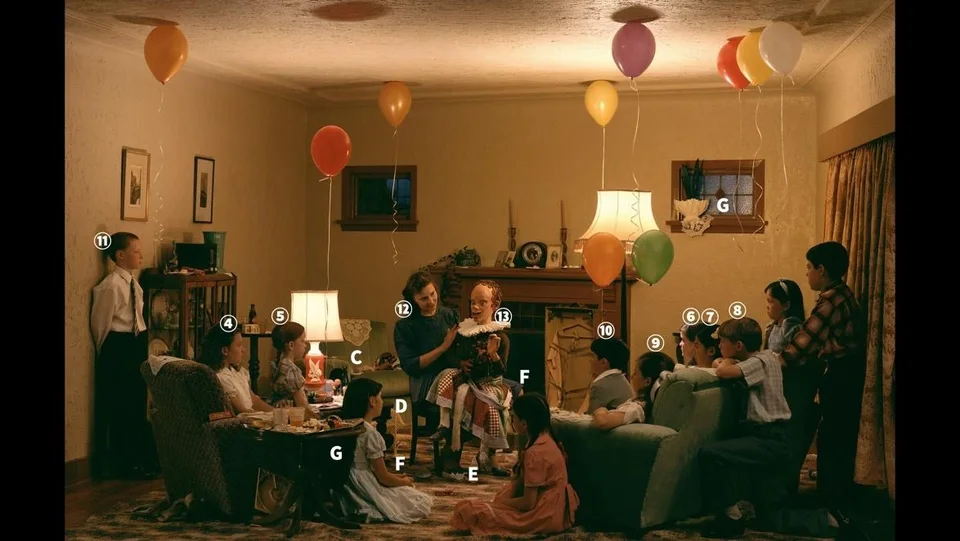
It is plain to see that the light lamp B throws upward is all scattered onto the ceiling behind balloon ③, and this light has a clear boundary, yet the shadow of balloon ③ is not inside that boundary. A hard-light shadow with so definite an outline as balloon ③’s looks rather as if it were caused by a strong point source shining upward from somewhere far below it; by the same token, balloon ②’s shadow is not inside the range of B’s light as the picture presents it. Looking over all these balloons: in a real room lit by one or two sources, the curved surface of a balloon usually reflects the shape of a window or a bulb. Yet the highlights on these balloons have the typical rectangular outline of a large softbox, with very smooth edges. Now look at the relation between the figures and these two light sources. Light from A seems to fall on the clothes of girl ④, so her clothes are fairly brightly lit; but according to the front-to-back relations the picture gives us, girl ⑤ should be between ④ and A—so why does she look as if she were entirely in shadow? Meanwhile, girl ⑥’s face catches a very strong light, while the faces of the two people just in front of and just behind her are completely sunk in shadow; logically, the light from B should not land on girl ⑥’s face alone.[28]
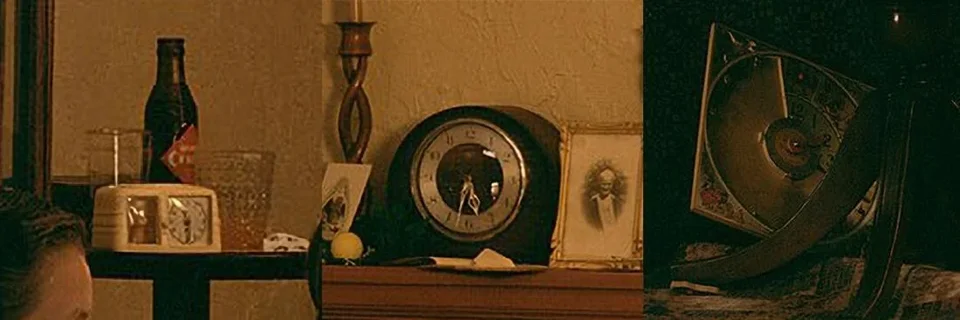
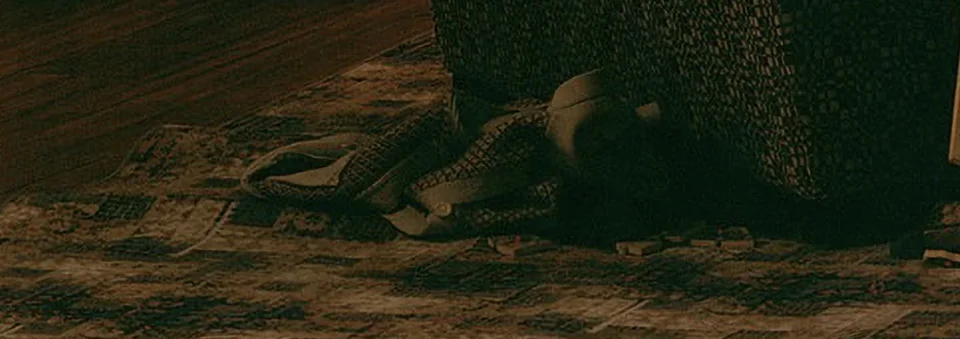
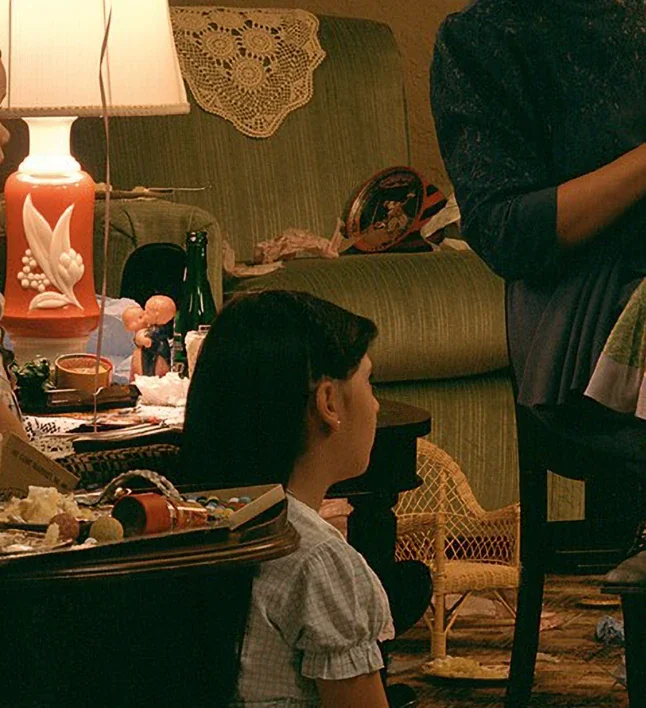
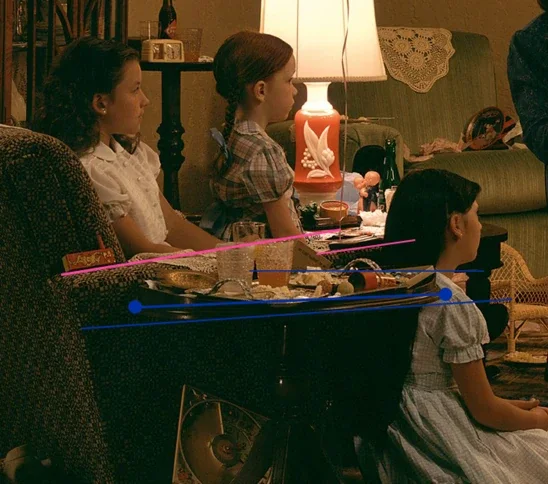
In conversation with me, Lin Zi found still more uncanny things. First, there are three clocks in the picture, and none of them shows the same time (Fig. 18). What time is it, exactly, for the people in the picture? The hour and minute hands of the leftmost clock overlap at the six o’clock position (which would be impossible for a clock in working order); the middle clock points to about 5:32; the hour hand of the lowest clock points to two (it doesn’t even look like a clock you could use). The three clocks each point to a different moment; add to this the abnormality of the puppet, and the contradiction between the deep night shown in the clear window on the left and the strangely bright blue light behind the embossed glass on the right, and one core theme of this photograph comes to the surface: temporal disorder. The temporal order of the whole scene has collapsed, and so the “people” in it cannot be living people in the normal sense. Then look around the whole scene again. All sorts of fragments and rubbish are strewn on the floor, and the tables are covered with food, but all of it looks more like leftovers abandoned and long untended than delicacies to be enjoyed at a birthday party. The carpet in the lower left corner is not flat (it would certainly trip anyone walking by), and clothes are piled up behind the sofa, but no one seems to care (Fig. 19). The green sofa C deep in the picture sags inward in an implausible way: sofa seats in everyday life are generally flat, and we might guess that if you wanted a sofa to look like this, it would probably have to be because someone already dead had been sunk in it for too long. In front of the green sofa there is a small wicker chair D that is completely out of keeping with the perspective of the whole picture. Leaving aside the fact that it does not fit at all with the perspectival relations of the other objects, this wicker chair belongs to no one present; it is so small it hardly seems meant for a person—so why is it here? (Fig. 20) Table G and the tray on it are not on the same plane either; this is a Cézannean tabletop. The tabletop clearly slopes, yet the surface of the liquid in the cups on the tray is level, while the contents on both sides of the tray all tend to tilt upward (Fig. 21, blue lines). The arm of the sofa behind table G also drops, implausibly, like a step, where the things on the tray block it (Fig. 21, pink lines).
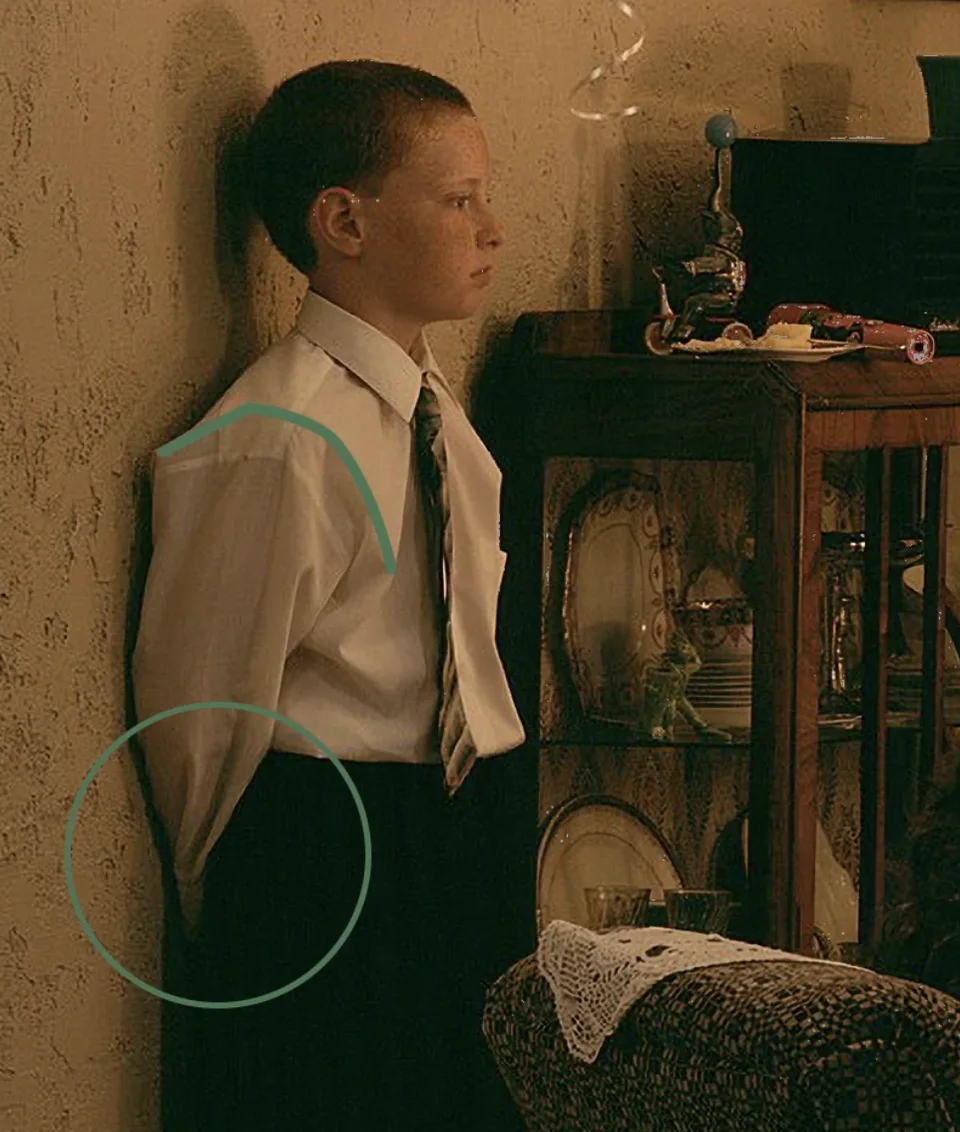
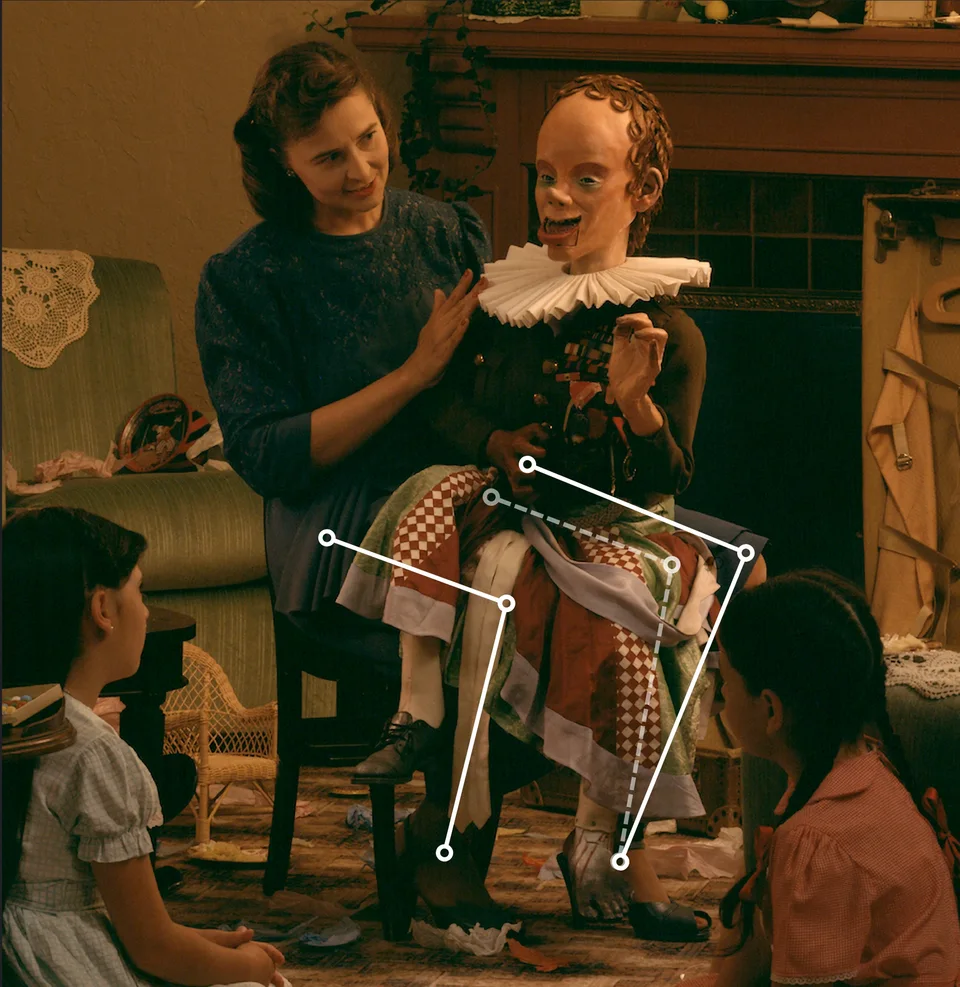
Now look at the figures. First the children. What is the spatial relation between girl ⑥ and girl ⑦? If girl ⑨ is sitting on the sofa, then girl ⑦, of whom only a head is showing, looks as if she had been bodily pasted in between girl ⑥ and boy ⑧. The way boy ⑧’s neck leans forward does not fit the normal structure of the human body at all: he looks as though he were craning his neck out of curiosity, yet his body is held very straight. The boy’s head sits much farther forward than a head normally would, as though his neck were broken. Girl ⑤ is obviously not sitting on girl ④’s lap, and there is no room for her on the sofa, yet the height of her head shows that she is as tall as the girls sitting on the sofa. So where is she sitting? A hair-raising conclusion appears: girl ⑤ is hanging in mid-air. Boy ⑪ at the far left of the picture (Fig. 22) is wearing an outfit much too big for his build. Notice the outline of his shoulders, which shows a very unnatural angled line. His hands are behind his back at the waist, but the wrist, which ought to be between the wall and his waist, has strangely disappeared; the sleeve there is empty. So the boy looks like an armless mannequin in a clothes shop, and it is hard to say that he is really alive. Now look at the protagonists, ventriloquist ⑫ and puppet ⑬. The shoe on puppet ⑬’s left foot is gone, exposing charred, filthy toes; the hem of its skirt is as black with dirt as if it had been fished out of a rubbish heap. Look at E: what sort of chair is this? (Fig. 23) Behind the puppet’s left foot and the ventriloquist’s left foot there ought to be a chair leg, but that chair leg is now gone. The whole seat slants downward at an angle, yet the figure sits as if on a level surface. For ventriloquist ⑫ to sit steadily in such a pose on such a chair, her left leg would have to be far longer than her right.
Beyond this, by taking “ventriloquism” as its title, the photograph announces a further theme: the paradox of sound and silence. Ventriloquism is a performance in which a puppet’s body is borrowed to make a voice, yet in this scene everything that could make a sound (the castanets on the arm of the foreground sofa, the radio on top of the tall cabinet on the left, and so on) is at this moment silent. All the children watch the performance with extreme gravity, and no one makes a sound. Sound has been systematically suspended in this space, just as time in this space has been systematically thrown into disorder.
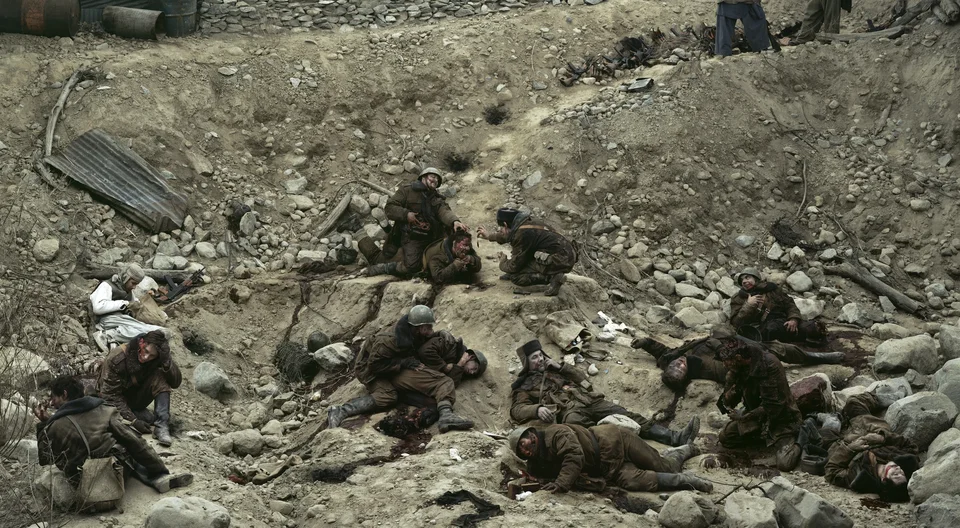
Putting these details together, after looking at this photograph for a long time we cannot help reaching a horrifying conclusion: the people in the picture very likely do not exist; they are “living dead” of the kind we find in Dead Troops Talk [a vision after an ambush of a Red Army Patrol, near Moqor, Afghanistan, winter 1986] (1992) and The Vampires’ Picnic (1991).[29]
Compared with these decodable parts, though, the core of Wall’s work lies in its undecodability. The portrait of an old woman above the fireplace watches everything going on in the room, and forms an intertext with the Voltaire-faced puppet on the ventriloquist’s knee: the dead are watching the living, the dead (the puppet) are speaking to the living. Beside the green sofa in front of the puppet there is also a small, empty rocking chair: the human chair has been taken over by an enormous puppet, while the seat that properly belonged to a puppet has been left abandoned in the corner. These intertextual details drag one ever deeper into a whirlpool of interpretation. Although this whole section has been spent deciphering the picture as a riddle, in Lin Zi’s view the real core of Wall’s picture lies not in the unevenness of the carpet on the floor or in other decodable details of that sort, but in “the untidiness of the riddle itself.” Noticing that the picture is strange is only the start; it is only when viewers really begin trying to solve the riddle Wall has laid out that they discover the riddle points only to a method of solving it, not to an answer—or, to put it another way, the answer to the riddle is not in the method. Alexandra Oliver holds that Wall’s pictures, like Manet’s, present a “puzzle.”[30] Lin Zi does not see it that way, because a “puzzle” implies that the riddle can be broken down, is complete, and can be solved; it must have an answer. That does not fit how Jeff Wall’s photographs actually are. For example, is the shiny, protruding thing at F a raised corner of a table, or a pair of leather shoes? (Fig. 24) The plant at G looks as if it is about to fall—why does no one pay it any attention? And what exactly are all those odds and ends on the floor?
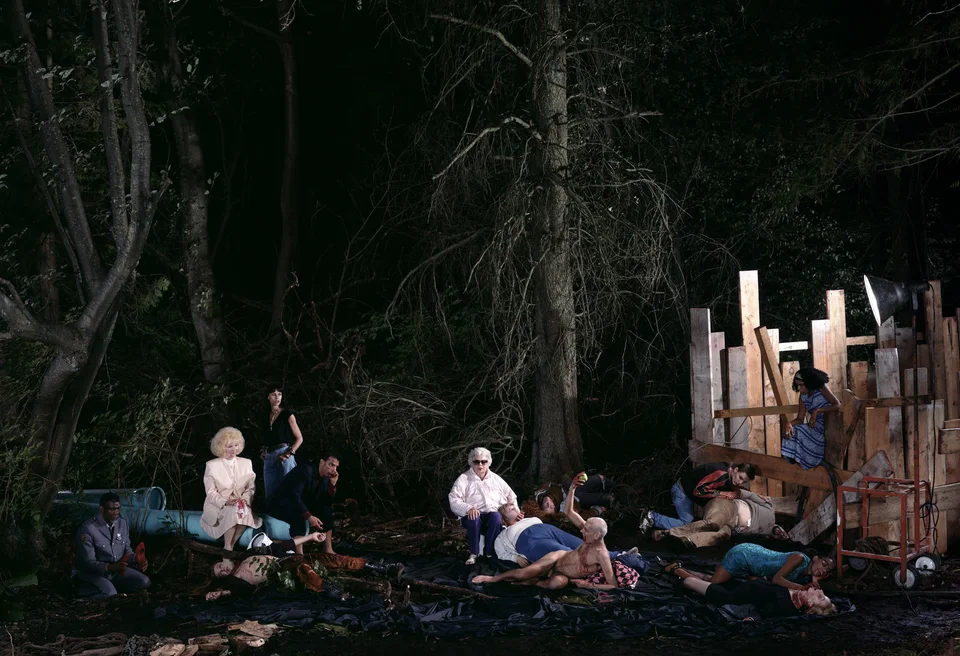
In The Vampires’ Picnic (Fig. 25), a photographic lamp appears in plain view on the right side of the picture, lighting the figures as if they were specimens. The foreground is covered with black plastic sheeting; in subject matter this huge polyethylene film corresponds directly to the picnic cloth in Manet’s Le Déjeuner sur l'herbe, but where the lavish lunch was, there is now the vampires’ “table.” There is also a whole series of systematic inversions between this work and Le Déjeuner sur l'herbe. Manet has a nude woman; here it is a nude man. The abundant still life in Manet’s lower left (basket, fruit, bread) here becomes stakes, chains and other prohibited objects that put vampires to death. The light among the trees in Manet’s background, which offered an “exit” into the depth of the space, is here sealed off into pure darkness. And Manet’s signature frontal light is here replaced by harsh side light. Yet in the context of a “picnic” or “vampire gathering,” the black film covering the foreground also looks, visually, like flowing black blood, and the flow and spread of blood is precisely the core motif of the vampire myth… Seen this way, the black sheet becomes at once a Manet-style “picnic cloth” and a metaphor for “infection” in the vampire narrative. In a similar way, on the left side of the picture there is a blue pipe that looks very plastic; it looks remarkably new, yet very out of place. It does not belong to nature, and because its sheen is so new, it does not belong among the things humans use either. What does this pipe, which cuts through the organic wholeness of the forest, mean? Moreover, the vampires in the picture show no frightening power or mystery at all; on the contrary, they look rather tired, confused, puzzled. Notice that in the lower left corner of the picture there is a Black vampire; besides having a skin colour unlike that of the traditional vampire, he is wearing a uniform, which suggests he might be a police officer or a security guard. At a private party of monsters, a representative of the state apparatus (police/security) usually meets one of only two fates: either he fights the monsters as a hunter, or he is drained of blood as a victim. Here, though, this officer of African descent takes up a crouching posture that is completely at home in the scene, even a little abject. Stranger still, the place he is looking at ought to have someone in it, but there is nothing there—so what is he looking at? And he is holding a pair of red high heels, but those shoes belong to none of the “people” in the picture. The “vampire” in the middle of the picture wears a pink sports jacket and glasses, and looks rather like a tourist who has wandered onto a film set; the extreme composure, even boredom, she shows in this bloody scene dissolves the picture’s atmosphere of horror. The head she holds in her hands looks as if it has already been separated from its body, but its size is completely out of proportion to that fat, swollen body. Furthermore, if we examine the logic of interaction among the figures, we find that although the photograph is titled “picnic,” suggesting a social gathering, the dozen or so figures in the picture have almost no real eye contact with one another. Everyone is sealed inside his or her own bubble.
That is to say, the answer to the riddle is not what Jeff Wall’s work is about; it is more like a deliberate design for drawing the beholder into the game. Wall supplies only a method of decoding, but the answer is not in the method. This is what Foucault meant by “the smallest, most precious, best-protected key is not inside it; the pattern serves merely as a method for discovering the secret.”[31] In this sense Wall’s photographs are different from a “puzzle.” Once viewers start trying to decode it, the riddle, because it is not smooth, “haunts” them for a long time. This is also what Wall calls the “improbable”: “I have always felt there is a touch of the ‘improbable’ in my pictures and characters. [……] I have always thought that even my ‘realist’ works are full of spectral characters, whose mode of existence is not fixed. This is also one of the inherent aspects or effects of what I call ‘cinematography’: things do not need to really exist, or to have existed, in order to appear in the picture.”[32] The “improbable” here means only a method for discovering secrets. It merely lets beholders discover that there is a secret, and then keeps them trapped for a long time by the act of decoding itself (not by the secret’s answer). This is closely bound up with the huge picture format Jeff Wall uses: it is precisely the great capacity for rendering detail that comes with an unusually large size that leads viewers to mistake the staged elements of the picture for something solvable and analysable, while the answer to the picture’s riddle must lie outside the picture; and this boundary must have been set very deliberately. Take the two legs at the very top of Dead Troops Talk (Fig. 26): are they dead or alive?
So we can say that the synthesis of facingness, the reproduction of an impossible real experience (along with this undecodability), and the opacification of the picture plane are woven together, and together they make up Jeff Wall’s basic strategy for constructing a figural picture. This way of constructing the photographic picture I call a strategy of “pictorial figurality.” This figural strategy, combined with the “cinematography” to be discussed below, enables Jeff Wall to set up a new labour model, and through it to give legitimacy to the artistic identity of contemporary photography.
III. Pictorial Figurality: From the Value Model to the Labour Model
If we want an answer to where the legitimacy of Jeff Wall’s work, and indeed of contemporary art photography, comes from, in the end we have to trace it back to how photography’s artistic identity has been justified. And the question of whether photography is art has been fought over without end ever since photography was announced to the world in 1839. Sorting out this question means combing through the orientations of value judgement that serve as the source and driving force from which a discourse is generated. To make clear what I am going to call the “labour model of photography,” we must first know what drives its generation at the level of value judgement.
Since the 1940s, the value orientations that defend photography as art fall roughly into two kinds, and both basically revolve around photography’s automatism and mechanical nature. Diarmuid Costello has distinguished these two value models as the “Orthodoxy Theory” and the “New Theory”[33]. The former is an evolved version of folk opinion and a philosophizing of popular intuition: it stresses photography’s “automatism” and the image’s causal independence from human belief (mind-independent causality), and in the end it leads to a defence of the photograph’s quality of “indexicality”; by affirming the photograph’s unrivalled realism, it distinguishes photography from painting, and also affirms technology’s democratic reproduction of the world. André Bazin and Stanley Cavell are defenders of this camp. The New Theory, represented by Patrick Maynard and others, treats photography as a Wittgensteinian “family of technologies” and understands photographic technology as an extension of human faculties, so that the intelligence and agency artistic creativity requires can show themselves at any link in the photographic image-making process[34]. We can see that the “Orthodoxy Theory” ultimately leads to the confirmation of medium specificity in the sense of modernist formalism; and, when and only when this modernism no longer serves as a dynamic mechanism for adjusting modernity and sinks into a purely aestheticized formalism[35], it produced practices such as those of Paul Strand and Edward Weston. The tendency of value judgement in the “New Theory,” by contrast, is closely bound up with the pictorialist model, except that it relaxes the Victorian demands on content made by the picturesque landscape.
Pictorialism in this sense does not refer only to the art movement of the late nineteenth and early twentieth centuries represented by the Photographic Society, Henry Peach Robinson and others; it refers more to the belief that photographs can achieve a formal complexity inside the picture that is in no way inferior to painting. And this latter, I think, is exactly the content of “pictorialism” as a value model. In fact, the reason the photographer’s copyright in a photograph came to be legally recognized is precisely that the pictorialist value model had been widely accepted, which gave legislators grounds for treating a work as belonging to a particular individual and, beyond that, for recognizing the act of photographing as creative labour. Consider, for instance, France, where photography was invented: in the course of the appeal in the 1862 “Mayer et Pierson” case, the ruling handed down in April of that year by the French supreme court (Cour de Cassation) for the first time explicitly affirmed photographers’ intellectual property in their photographic works. Britain, for its part, settled the status of photographic copyright through legislation. Likewise, the Fine Arts Copyright Act passed in Britain on 29 July 1862 brought “paintings, drawings and photographs” under copyright protection.[36] This affirmation was really an affirmation of the photographer’s Romantic originality, and it is this very originality that later became, for Rosalind Krauss or Sherrie Levine, an illusory object that has to be historically interrogated through recontextualization[37]. This exalting of the photographer’s original status can be summed up as an aestheticization of photography: the photographer is taken to be a trained person with a “photographic eye,” who has creative skills not essentially different from a painter’s and uses them to make works of art.
This aestheticizing position, with pictorialism as its ground, met strong opposition in the twentieth century, however. In famous essays such as “The Work of Art in the Age of Mechanical Reproduction,” “Little History of Photography” and “The Author as Producer,” Walter Benjamin tried to dispel the myth of genius surrounding the photographer, in order to reveal a way of looking at photographs historically and the democratizing potential behind images. Works such as Ed Ruscha’s photobooks, Allan Sekula’s slide sequences, Victor Burgin’s writing and visual practice, and Martha Rosler’s photomontages mainly used photography as a critical tool, to expose how the state apparatus ideologically neutralizes the appearances of social life and the eye of the observer. The positions of these practitioners can be roughly summed up in the words of Allan Sekula, who was deeply influenced by Benjamin and Marcuse: “A cult of authorship, an auteurism, seizes the image, separates it from the social conditions that produced it, and elevates photography above the many ordinary everyday uses to which it is usually put.”[38] This new generation of photographic practice, born in opposition to the aestheticization of photography, would not without reservation understand photography’s representation of reality as unmediated “truth”; rather, it often tried, through strategies such as appropriation and repetition, to bring the historical context of the photograph into the foreground. For them, “the only ‘objective’ truth that photographs can offer is the assertion that somebody or something [……] took a photograph somewhere. Beyond that, everything other than the imprint of the trace is territory up for grabs.”[39]
By contrast, the traditional documentary photography Allan Sekula criticized accepted the indexical character of the photograph without reservation, and, because of its mind-independent causality, equated it with a reproduction of reality. Likewise, news photography and photojournalism do not question the realist efficacy of the photograph, that is, its power of “making people believe.” This power to “make people believe” prompts viewers, on seeing someone’s photograph, to blurt out: “This is so-and-so” (rather than “This is a photograph of so-and-so”)[40]. This belief in documentary photography’s function of claiming truth carries on the “Orthodoxy Theory” mentioned above, that is, the value model embodied in a formalist claim of medium specificity. The main value model of contemporary photography runs the other way; it is closer to the pictorialist value model described above.
These two value models can be linked to historical practice by borrowing the two labour models of photography that John Roberts proposes in Photography and Its Violations. Roberts introduced “figural photography” and “nonfigural photography” to name two practices of photography that differ from each other[41]. “Figural photography” refers to the representational practices exemplified by staged photography, manipulative photography and the like, whose core is “constructedness”; “nonfigural photography” mainly refers to “documentary photography” in Allan Sekula’s sense, along with social-record photography, photojournalism and so on[42]. We might use the semiotic terms of Charles Peirce to clarify the difference between them. Generally speaking, a photograph is defined as an “iconic index”: it keeps the causal connection and belief-independence of an index while also “resembling” its referent in the picture. But as I understand it, in this sense, when we speak of a figural photograph, we mean that iconicity in the photograph has won priority over indexicality, the standard example being Thomas Demand’s paper-model photography[43]. Figurality in this sense is like “mimesis” and “depiction” in painting; if it has any power to make people believe, that credit really comes from a disguised indexicality: it seems, like an ordinary photograph, to come from a causal relation with real events, but in fact it merely resembles real events. In the end this is a photograph that makes people believe in the mimetic sense. In most of Jeff Wall’s staged photographs, what he draws on is precisely this mimetic kind of photographic credit. More importantly, given that “figurative paintings” and “figural photography” share a rhetorical root, we can see all the more clearly in Roberts’s usage a pictorial aspiration on the part of figural photography—just as Jeff Wall’s Picture for Women, analysed in the previous section, is a “mimesis” of A Bar at the Folies-Bergère. A nonfigural photograph goes the opposite way: its indexicality tries to overpower its iconicity, prompting viewers to “believe” that its referent is the truth of reality. Take photojournalism: such photographs do not go through a process of staging, but make people believe in their truthfulness in the causal sense; they are called “nonfigural” because they lack that level of actively “imitating” and seeking resemblance.
In view of this, I will use “figurality” from here on to refer to a high degree of construction in the internal complexity of images (photographs and paintings alike). This definition applies both to judgements about the formal qualities of a single image and to naming the type of photographic labour that aims at those qualities. For Roberts, the representative of figural photography is Jeff Wall’s practice, and the representative of nonfigural photography is the snapshot, which we see everywhere in daily life today. For the latter, the internal complexity of the image does not matter; the snapshot survives mainly on the value model of the “Orthodoxy Theory” mentioned above—that is, the photograph is to be put into the lifeworld, and to act back on it, as a direct medium of lived experience, and so becomes a democratized act of image-making, even a weapon of political action. For the former, what matters is achieving “resemblance” to painting or to other visual resources (though this is not the final goal), so as to bring out the high complexity of its own pictorial composition, and this obviously corresponds to the pictorialist value model described above. The sense of “pictorialism” here needs to be pinned down more precisely. In a conversation with me[44], Stephen Shore said that he thinks the essence of pictorial photography lies in “composition” and “quotation,” which make it a “synthetical” act, whereas photography as he conceives it should be an “analytical” act: by analysing the visual order of the existing world the photographer finds himself in, one extracts its structure and organizes the picture with it. Seen this way, the organizing principle of the pictorial photograph is transcendental with respect to the content of the picture—that is, it is the structural condition that comes before empirical content and makes it possible. And where does this transcendental condition come from? Precisely from what Shore calls “quotation”: the quoting of materials and orders that do not exist in the empirical world in front of one. Shore’s seemingly offhand way of defining “pictorialism” through “quotation” seems to me to have named, without meaning to, a crucial component of the labour model of contemporary photography. For the method of “quoting” art-historical masterpieces, or other orders independent of the empirical picture, is precisely the decisive means by which figural photography achieves complexity inside the picture, and it is also the source of the figurality of Wall’s photographs when we classify his practice as figural photography. This is also why I went on at such length with iconographic and formal analysis of Picture for Women: this figurality can only be established through concrete analysis of Jeff Wall’s photographs.
At the same time, this pursuit of “figurality” can be partly summed up in the words of David Campany: “Can photography have something of painting’s sense of presence, some kind of relation established with space and the viewer, without losing the characteristics of its own medium?”[45] But Campany’s use of this to understand how Jeff Wall’s practice differs from that of Jean-Marc Bustamante and others still has a strong Friedian colouring. Moreover, figurality itself, as a pursuit of structural complexity inside the picture, is not enough to explain why Wall’s practice is so important. For if figurality pointed only toward painting, it would at most be an inheritance of the pictorial photography model centred on “quotation”—how could it become the main way contemporary art photography wins its artistic legitimacy? We need to notice that when John Roberts put forward “figural photography,” he meant to establish it as a model of productive labour, not merely to stress the formal qualities of images produced in a certain way[46]. That this model of productive labour is possible is, in my view, inseparable from the image-making process Jeff Wall adopted; it is precisely this process that allowed a practice like Picture for Women, focused on pictorial figurality, to really become a widely used labour model.
IV. The Labour Structure of Cinematography
“Cinematography” is the label most often stuck on Wall’s mode of working, and it is also the term Wall uses in his own statements to define how he works[47]. He explains it like this:
“Cinematography” just means the techniques usually used to make films: collaboration with performers (as Italian neorealism showed, the performers need not be “actors”); the techniques and equipment that cinematographers invent, build and improvise; and an openness to different subjects, styles and modes of expression. Restricting these things strictly to filmmaking rather than still photography may be something of an exaggeration, since photographers use, more or less, almost all of the same techniques and methods; but it helps me concentrate on how to create pictures that have the kind of physical presence I am after.[48]
“Cinematography” does not mean taking pictures that look like film stills. The point is to draw on, or appropriate, the industrial system of film and to place the production of photographs within relations of production similar to it; only in this way can photography, as a contemporary medium in the true sense, be brought into the relations of production in which it stands. This is also why Jeff Wall’s practice, despite its painterly effects, is utterly different from historical pictorialism. The cinematographic mode of image-making Jeff Wall established completes a photograph through a series of steps—casting, location scouting, set building, rehearsal, the shoot itself, post-production—which often take months or even years; it frees the process of photographic creation entirely from the so-called “decisive moment,” and makes preparation before the shoot and post-production necessary parts of what determines the image’s composition. If we really want to see clearly how Wall’s “cinematography” reshapes, and re-embeds itself in, the existing relations of production, we have to compare it with conceptual art photography. For conceptual artists, the photography in their hands was a typical nonfigural medium, and it was precisely this nonfigurality that let the image’s representation, through the truth-claiming efficacy that its indexicality brings, carry out an ideological concealment of historical factors such as relations of political struggle and conditions of economic production. In Roland Barthes’s view, this also lets the photograph, by virtue of its purely denotative character, neutralize the connotation that comes from cultural sign systems[49].
Hence an artist like Sherrie Levine, in her signature work After Walker Evans, directly appropriated Walker Evans’s classic photographs in order to steer the way we understand photographs toward attention to their context of production, and at the same time to commit an offence against that context.
Conceptual and post-conceptual art of this kind did liberate artistic creation from the long-standing injunction of high skill, which required the artist also to be an experienced and adept craftsman, and by defeating originality it made artistic production democratic and de-elitized. The problem, though, is that this “deskilling”[50] mode of image-making instead left the agency of both the artist and the viewer with nothing to do in front of the image: the image becomes extremely impoverished in terms of figural complexity, cannot call up any empathetic, absorbed experience in the viewer, and everything has to rely on the operation of concepts to explain it.
To borrow Qiu Xiaolin’s words, conceptual art, while liberating artistic creation, also eliminated the “free bodily feeling” that is crucial to artistic creation; it was precisely the loss of this freedom to command one’s bodily feeling that once sank Jackson Pollock into depression. And it is precisely this command of bodily feeling that lets hyperrealist painting move us far more powerfully than photographs that look no different from it[51].
This capacity for “command” is really what Nietzsche, in The Birth of Tragedy (Die Geburt der Tragödie aus dem Geiste der Musik), called the “Apollonian spirit”: a capacity for constructing self-aware dream and illusion, which is also the capacity for commanding order. And this capacity can by no means be cut off from bodily feeling, because Nietzsche treats the Apollonian and the Dionysian as “instincts” (Trieb)[52]; this is the point of the opening of The Birth of Tragedy: the artistic instinct comes from the level of the body. And the Dionysian can only be realized once the Apollonian has been built up to a high degree; the relation between the two is one of absolute mutual need, as Nietzsche says: “Behold! Without Dionysus, Apollo could not live!”[53]
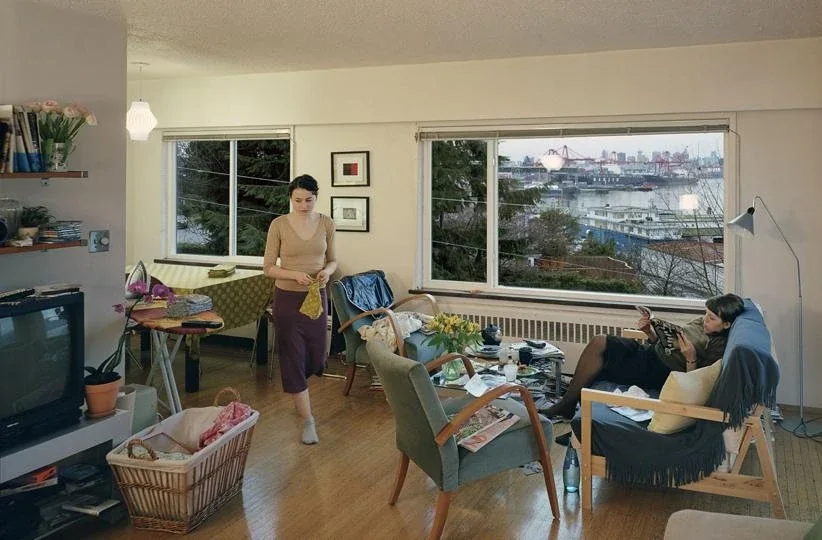
Summoning the command of bodily feeling—or, if you like, summoning the Apollonian spirit in Nietzsche’s bodily sense—is, it seems to me, also the goal that cinematography of Jeff Wall’s kind sets out to reach. Before Jeff Wall’s model spread, this freely commanded bodily feeling, this Apollonian spirit in the sense of instinct, could be found almost only in figurative painting, while conceptual art’s cancellation of photography’s identity all but wiped out this free bodily feeling from the photographic process. Michael Fried has described how Jeff Wall made A View from an Apartment (Fig. 27)[54]. Making the photograph took a year and a half. During that time Wall first scouted locations, searching around Vancouver for a suitable apartment interior and a view outside to go with it. Having chosen the location, Wall signed an open-ended lease with the landlord. Then Wall began casting, to find the woman who would finally appear in the picture (in the result as we have it, the woman on the left of the picture). Wall then gave her a sum of money to decorate and furnish the apartment to her own taste, and to spend as much time as possible living and moving about in it. Later Wall decided that another woman should also appear in the picture, and that the two women should know each other. So the other performer was a friend this young woman brought in. The final shoot lasted about two weeks; Wall had the performers repeat particular actions over and over to get the effect he wanted. And to get consistent exposure between the interior and exterior in conditions of high contrast, Wall photographed the indoor and outdoor scenes separately and then combined them in post-production. All told, from renting the apartment to finishing the work, A View from an Apartment took two years.
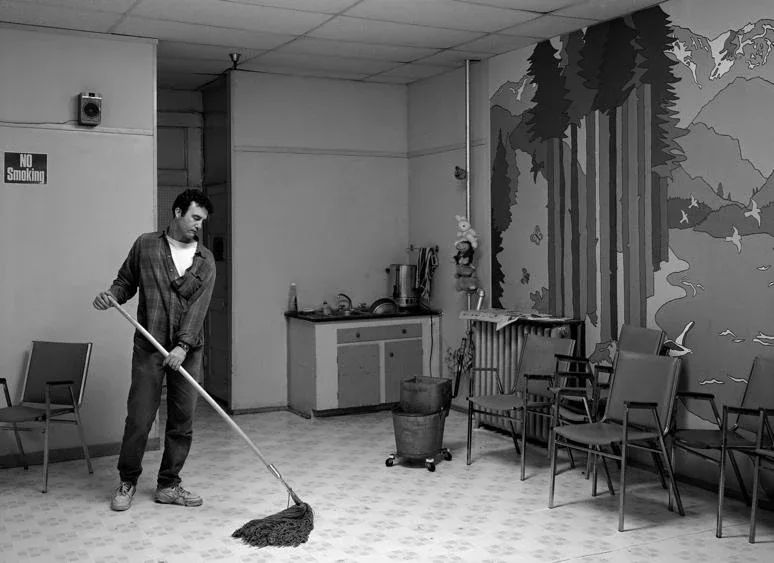
This demand for command over free bodily feeling shows up even more clearly in The Volunteer (1996, Fig. 28)[55]. Jeff Wall set up a space resembling a shelter and recruited a volunteer, inviting him to clean it for him five days a week for a month. During this time Wall kept his communication with the subject to a minimum and photographed the volunteer’s cleaning again and again. After a while he found that the volunteer was no longer “performing cleaning”; instead he was treating the set as a real shelter and cleaning it in earnest. Out of the many attempts, Wall finally picked the work we see.
More importantly, this need for command over free bodily feeling is tied to Wall’s awareness that he was building a complete labour model. For conceptual artists, photographic creation was still a cottage-industry, small-workshop affair. In John Baldessari’s ball-throwing works, for example, the principle of composition is reduced to demands such as “get the balls into the centre of the frame” or “get the balls into a straight line,” and every other element in the photograph becomes a by-product of following that rule, spilling entirely beyond what the photographer’s intention could reach. And for the photographer, controlling the position of the balls meant that he could no longer concentrate on organizing the complex elements of the picture, still less make the photograph a complex figural picture. Robin Kelsey therefore saw, sharply: “Baldessari thereby challenged a heroic ideal and an ideological premise: that of capturing the perfect moment and picture by monitoring a complex and rapidly changing scene. From Stieglitz to Cartier-Bresson, it was this ideal that sustained the development of photography.”[56]
By hanging the figural capacity most prized by photographers who honour pictorialist values—that is, photographers who try to extend the reach of their intention over the whole picture—on the most uncontrollable random accidents and chance, Baldessari turned the traditional structure of the photograph completely upside down, so that the whole picture revolved around “chance,” the very thing that had always been regarded as something to overcome. In this way each act no longer has any real meaning outside its photographic record; the image even becomes the result and the goal of the event of the act itself. For traditionally, for photographers working within the pictorialist value model, their images mean something precisely because the image is clearly distinct from the event it records, as we see in the praise of Henri Cartier-Bresson’s “decisive moment”[57]; this is the way we have long affirmed the photographer’s originality.
But by drawing on the image-making processes of the film industry, what Jeff Wall achieves is not just a return of the reach of intention over the picture for the photographer. More importantly, as Roberts sees it, this is an attempt “to re-socialize artistic production in a period in which ‘domesticity’ of production served as the guarantee of radicalism.”[58]
In this way, by placing the pre-photographic stage and the post-production stage in a position crucial to the production of the image, Wall expanded photographic creation into a multi-stage process of production that includes both technical application and material practice, and he also expanded the artist’s own social relations. In this process the artist can no longer, like the conceptual artist or the traditional documentary photographer, set himself apart from the crowd as a hero; nor can the artist, as a clear-headed critic, stand outside the commodity relations he means to criticize. For Jeff Wall, photography and conceptual art are clearly distinct. In 1995 he held that conceptual art and photography were continuous[59]. In 2016, however, Wall explicitly revised his end-of-century judgement and held that the relation between photography and conceptual art was not what he had previously thought[60].
Just as important, we cannot simply take Jeff Wall’s work to be an attempt to affirm photography’s medium specificity as distinct from painting. For, historically, that goal had long since been achieved in the 1960s by curators of whom John Szarkowski is the representative. Only at that point can we say that photography had been fully absorbed into an American model of modernism. The problem, though, is that from Beaumont Newhall and Edward Steichen to Szarkowski, what curators ushered into the halls of the museum and the art institution was either straight photography, represented by Walker Evans, Alfred Stieglitz, Stephen Shore and others, or photomontage with a historical avant-garde colouring, represented by László Moholy-Nagy, John Heartfield and others. Compared with Jeff Wall’s works, the figurality of photography like this is quite feeble.
Still, we cannot simply set Jeff Wall’s practice in a binary opposition to the critical commitments of the historical avant-garde, because even that opposition does not sit comfortably with Wall’s practice; his practice is not pure pictorialism with no critical import. The more important reason is that the practices of the historical avant-garde, productivism and situationism of the 1920s and 1930s, and the deskilling they brought to artistic creation, were not in themselves acts of thoroughgoing opposition and destruction. Their point was to open up, through making work, new possible connections between art and productive labour, and to rebuild the relation between artistic autonomy and social heteronomy within the technical system of capitalist society[61]. John Heartfield’s photomontages satirizing the Nazis were not merely a search for so-called photographic specificity, nor merely an instrumentalizing of art; the crux was to open up a redemptive moment or path inside capitalism by giving art a temporary, processual social function. In this sense the practices of Moholy-Nagy and Heartfield were necessarily political, and their political meaning was this: through modern means such as photography, film and industrial production, and with the help of techniques such as montage, they merged artistic creation into the technical domain of social production, and so could change the context they stood in, and then let the new context, once changed, turn round and take part in producing artistic autonomy. This made the relation between the autonomy and heteronomy of artistic labour not just an apparently contradictory relation but a productive tension.
By the 1960s, however, photography had gradually lost this function of critical intervention. Because American modernism discarded the legacy of the historical avant-garde, photography became more and more wrapped up in the concept of transparency, and came to be seen as a transparent transcription of spiritual or material reality; this went along with the museum’s romanticizing of the photographer’s subjectivity, which further eroded the avant-garde’s demand for the anonymity of the artist as subject. It was in this context that conceptual art photography, and later the practices of Jeff Wall and others, appeared.
By the same token, we cannot regard Baldessari’s practice as wholly opposed to Jeff Wall’s staged practice, because it was precisely the conceptual photographic practice of Baldessari and others that turned an everyday game like “throwing balls” into an objection to the mainstream art world’s habit of treating formal factors[62] as the internal generative force of photography, and that relocated photography’s internal force in the structure of everyday social practice. So the photographic practices of Baldessari, Sherrie Levine, Jeff Wall and others that appeared from the 1970s and 1980s on can all be seen, to varying degrees, as important efforts by photography to summon up its own historical avant-garde legacy. It is only that, although conceptual art photography tried to carry on the legacy of the historical avant-garde, it still could not summon the viewer’s empathetic absorption; as pictures, these photographs could hardly be said to have any power to move us at all. Jeff Wall’s photographs are entirely different, and this power to move is probably the absorptive atmosphere of the photographs themselves that Michael Fried values. And Jeff Wall’s absorptive atmosphere is achieved, to a great extent, through his construction of highly figural pictures.
So we can understand what Roberts means when he says: “Out of the critique of photography’s Cartesian ‘I/eye’ and of photographic transparency, two important new ideas emerged: first, a new awareness of photography’s own ‘constructedness’; second, and closely related, the attempt to combine this constructedness with a conceptualization of reality. By returning to the studio, by constructing scenes and objects for the camera, photography sought to internalize this awareness of the constructedness of the world through a series of pre-photographic and photographic labours. This hidden or distinctive labour mimetically incorporates the representational labour of appearances (labor of appearances, that is, the productivity of appearances) into the act of photographic representation.”[63]
Affirming photography’s figural capacity through pictorial quotation does not mean that Wall wants to revive Manet’s modernism, because at the same time he still believes in photography’s realist efficacy founded on indexicality, which is why he has his position of the “near documentary”[64]. Only photography can achieve this realist efficacy without giving up the possibility of empathy that high figurality brings. The authenticity of photography cannot be handed over to either side, figural or nonfigural. Photography’s relation to the figural and the nonfigural is one of “catachresis,” which is what Richard Shiff means by “it can be both, while keeping itself outside both”[65]. Seen this way, we can, like Sekula, acknowledge and analyse photography’s role in managing reality, without having, against the facts, to cut photography off from expressive functions.
In other words, the value of Jeff Wall’s labour model goes far beyond bringing the value model of pictorial photography back in the present. More importantly, through the critique of the myth of photographic transparency, this awareness of “constructedness”, combined with a renewed conceptualization of reality, enables staged photography to internalize visually, through a complete labour process, the constructedness of the world (in the sense of social abstraction), and so to incorporate mimetically (or metonymically) the productivity of the world as appearance into the process of photographic representation.
V. Conclusion: The Photographer of Modern Life
On the basis of the analysis above, we can see that it is precisely through works such as Picture for Women that Jeff Wall pioneered a “labour model” that did not exist before him (or at least was not widely recognized as a model), and that this brought about a fundamental change in what “making images with photography” means in the context of art.
Specifically: on the one hand, by quoting art-historical paintings, Jeff Wall called the already outmoded pictorialist model back into pictorial composition at the end point of creation. In their pictorial arrangement, his “large-scale staged lightbox photographs in tableau form” still lean toward the values of pictorial photography: they try to bring out iconicity by way of construction, and to give complexity to the picture’s internal relations through the strategy of “quotation” (which makes it pictorialist), so as to return to the unity of a modernist aesthetic. This strategy also comes from his dissatisfaction with post-conceptual art’s practice of suppressing photography’s figural capacity in exchange for the deskilling and democratization of artistic creation. By raising the importance of both pre-production and post-production in photography, Jeff Wall, while keeping hold of the possibility that traditional photographic documents have for criticizing social structure, also tries to make the photograph itself a site where pictorial figural complexity happens. Along this path, combined with cinematography, he built a complex, studio-based labour model of photography, to prove that even at the artistic end point the internal complexity of a photograph can be in no way inferior to that of a painting, and in this way he secured his own place in art history. He also proved that photography, in the complexity of producing a picture, can likewise stand alongside the figurality of painting and the mise-en-scène of film.
On the other hand, by using “cinematography”[66], Jeff Wall rebuilt the labour model of photography at the level of the creative process, so that photography, in the complexity of its production, can stand alongside the internal complexity of the painted picture and the mise-en-scène of film shooting. That is, by putting the mediation of painting inside the framework of cinematography, he re-established a complex, studio-based labour model of photography, to prove that even at the artistic end point the internal figural complexity of a photograph can be in no way inferior to that of a painting. In this way Jeff Wall truly pioneered a mode of image-making grounded in studio labour, which does not stop at arranging the picture, but instead, through restoring the photographer’s bodily feeling and embedding itself in modern modes of production, expands the social relations of the artist’s identity. And this is exactly what conceptual and post-conceptual art photography lack. The reason Jeff Wall can inherit the title “Painter of Modern Life” lies not only in his having affirmed, through staging, photography’s figural capacity and so presented modern life in a unified aesthetic way; more importantly, cinematography, as a model that concerns labour, inserted itself into the relations of production of Wall’s own time. The feminist issues, the critique of commodity relations and the other themes in his works all, in this sense and together with the details of his pictures, come into relation with the divisions and alienation, contradictions and conflicts rooted in society. The task of the “photographer of modern life” is twofold: how, while presenting modern life in a unified aesthetic way, can one also express the non-unified content of capitalist social relations? Put simply, the former belongs to “modern life”—that is, as Baudelaire hoped, distilling the most contemporary, fleeting elements and fixing them as eternal—while the latter is what the “photographer” has to accomplish through photography’s realist efficacy.
This is what I take to be the main reason Jeff Wall has attained his present place in art history. It was the wide popularity of this way of working that gave contemporary art photography its present face. But identifying Manet and others as the sources of Wall’s work is not the same as interpreting the meaning of Wall’s work, because the sources themselves and the act of choosing those sources both stand in need of explanation. In this sense the act of tracing sources is, as Alexandra Oliver puts it, “placing Wall in this art-historical process both gives legitimacy to his practice (and drives up its prices) and confirms Manet’s position as the source of (still vigorous) modernist energy. In the end, the tracing of sources stands for the whole system of cultural distinction.”[67]
Jeff Wall almost completely remade the dominant labour structure of photography at the moment it systematically entered the museum in the 1970s (photographs then did not much question their own transparency, nor did they set out to prove photography’s figural capacity). Moreover, after the 1980s, as the abstraction of space by finance capital and the state system grew ever more intense, the earlier path of historical avant-garde photography, its critique of the spectacle of modernity, also turned into the transcendentalism of Ansel Adams, inherited from the nineteenth century, whose critical spearhead was turned against the masses; by stressing the reimagining and re-experiencing of nature, it gave up the commitment to collective action almost completely and retreated into ideas of individual spirit and the worship of nature. In this way the critique, within modernism, of spatial abstraction/abstract space[68] grew weaker and weaker, until it became something close to self-anaesthesia and aesthetic sentiment. Under these circumstances the situation photography faced was in fact extremely grave: how, under the new art institution, could one affirm photography’s figural capacity, so that the picture itself could still stand up to Fried-style scrutiny, and at the same time keep the picture from becoming a mere object of aesthetic contemplation, so that it could do the work of criticizing reality? Jeff Wall’s labour model of figural photography can, by this means, give artistic legitimacy to the main path of contemporary photography, though there is no room in this essay to set out the grounds of its critical efficacy.
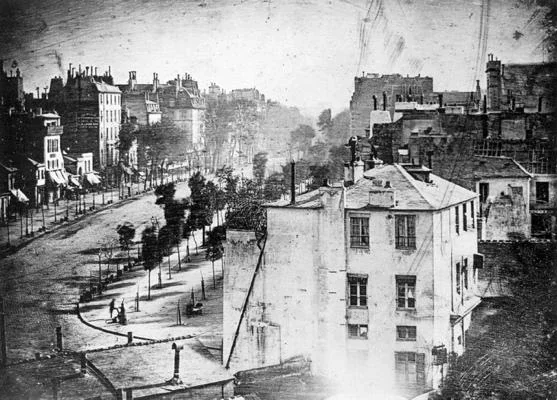
Not without irony, when Jeff Wall works by way of cinematography, the subject-identity of the creator is captured once again by Wall himself, this unquestioned individual; the myth of originality is staged again, the hermeneutic pendulum swings back toward subjectivism, and positivism gives way to subjective metaphysics[69].
The list of crew that traditionally appears at the end of a film does not appear in the production notes for Wall’s photographs. Most of the time we know nothing at all even about the models who appear in Wall’s photographs.
Yet in Jeff Wall’s cinematographic process, the labourers who are crucial to realizing the picture and to raising photography once more to the rank of a figural medium become, like the bootblack in Louis Daguerre’s Boulevard du Temple (Figs. 29–30), phantoms in the progress of history—not only blurred in aesthetic intuition but forgotten by almost every interpretation[70]. To this day we cannot know these people’s names. Whenever Boulevard du Temple comes up, everyone says that it was the first image to record “a” human figure. From the first image Daguerre made to the dominant contemporary image-making process that Jeff Wall laid down, these invisible people run through the whole story like ghosts, and when they are discovered they become a kind of curse. What does it mean to work in a trade that cannot shake off bourgeois relations of production? This irony spares no one, not even Allan Sekula, who criticized this very phenomenon.
As it happens, in one of Jeff Wall’s signature works, After “Invisible Man” by Ralph Ellison, the Prologue (Fig. 2), the Black man has no name either. The work is based on Ralph Ellison’s novel Invisible Man. This “nameless one” lives in a basement in Harlem and, because he is Black, has been made “invisible” as society’s other. In a sense this photograph turns into an irony directed at Jeff Wall’s own labour model. When Wall’s photographs make a brilliant sensuous world visible, who is it that they make vanish without a trace? This is probably a question to which no answer can be found.
Notes
[1] In the book’s conclusion, discussing Jeff Wall’s After “Spring Snow” by Yukio Mishima, Chapter 34 (2004–2005), Fried holds that Wall’s picture both acknowledges “to-be-seenness” and is, in its overall import, a work of absorption. See Michael Fried, Why Photography Matters as Art as Never Before (Yale University Press, 2008), 349.
[2] Ibid.
[3] Chinese-language scholarship basically belongs to the first kind. The second view is much more complex and can be represented by de Duve’s essay; see Thierry de Duve, “The Mainstream and the Crooked Path,” in Jeff Wall (Phaidon, 2002), 24-55. See also Naomi Merritt, Jeff Wall and the Concept of the Picture (Routledge, 2021), and David Campany, Jeff Wall: Picture for Women (Afterall Books; Distribution by the MIT Press, 2011).
[4] Stefan Gronert’s book is titled Jeff Wall: The Painter of Modern Life; see Stefan Gronert, Jeff Wall: The Painter of Modern Life, trans. Wang Ling and Yang Jian (Huazhong University of Science and Technology Press, 2023). Recently there have also been exhibitions of Wall under this name, such as “Lewis Baltz & Jeff Wall: Painters of Modern Life,” which opened in Cologne, Germany, in March 2024.
[5] Charles Baudelaire, “The Painter of Modern Life,” in Selected Essays on Aesthetics by Baudelaire, trans. Guo Hong’an (People’s Literature Publishing House, 1987), 473–514.
[6] Richard Friedenthal, Letters of the Great Artists: From Blake to Pollock (London: Thames and Hudson, 1963), 118.
[7] Laura R. Bass and Elizabeth R. Wright, “An Actor Beckons,” Bulletin of the Comediantes 69, no. 2 (2017), 5-7, available at: https://doi.org/10.1353/boc.2017.0020.
[8] Michael Fried, Manet’s Modernism, or, the Face of Painting in the 1860s (University of Chicago Press, 1999), 103. Michael Fried mentions Velázquez’s influence on Manet in at least several dozen places in this book.
[9] Dot Tuer, “Jeff Wall,” CV Photo, no. 46 (1999), 16-23.
[10] Michel Foucault, The Order of Things: An Archaeology of the Human Sciences (London and New York: Routledge, 1989), 7.
[11] David G. Stork and Yasuo Furuichi, “Computer Graphics Synthesis for Inferring Artist Studio Practice: An Application to Diego Velázquez’s Las Meninas,” The Engineering Reality of Virtual Reality, 723086 (2009), 44.
[12] Ibid., 45.
[13] Foucault, The Order of Things: An Archaeology of the Human Sciences, 8.
[14] This is the term de Duve uses to define his way of reading Manet’s paintings; see Thierry de Duve, “Intentionality and Art Historical Methodology: A Case Study,” Nonsite.org 6 (2012), available at: https://nonsite.org/intentionality-and-art-historical-methodology-a-case-study/.
[15] Stork and Furuichi, “Computer Graphics Synthesis for Inferring Artist Studio Practice: An Application to Diego Velázquez’s Las Meninas,” 41-50.
[16] De Duve, “The Mainstream and the Crooked Path,” 31.
[17] De Duve, “The Mainstream and the Crooked Path,” 31.
[18] Foucault, The Order of Things: An Archaeology of the Human Sciences, 5-6.
[19] Shen Yubing, “On the Visual Mechanism of Impressionism,” Academic Frontiers, no. 3 (2021), 13.
[20] De Duve, “Intentionality and Art Historical Methodology: A Case Study.”
[21] Clement Greenberg, “Modernist Painting,” in Shen Yubing, ed., Guides to Classic Texts in Art Studies: Fine Arts Volume (Beijing Normal University Press, 2010), 259–276. See also Shen Yubing, “Greenberg: Modernism and Its Discontents,” in Shen Yubing, Twentieth-Century Art Criticism (China Academy of Art Press, 2003), 153–180.
[22] Clement Greenberg, “Four Photographers: Review of A Vision of Paris by Eugène-Auguste Atget; A Life in Photography by Edward Steichen; The World Through My Eyes by Andreas Feininger; and Photographs by Cartier-Bresson,” in Clement Greenberg: The Collected Essays and Criticism, Volume 4, Modernism with a Vengeance, 1957-1969, ed. J. O’Brian (University of Chicago Press, 1993), 183.
[23] De Duve, “The Mainstream and the Crooked Path,” 30.
[24] Chevrier’s famous essay is Jean-François Chevrier, “The Adventures of the Picture Form in the History of Photography,” in The Last Picture Show: Artists Using Photography, 1960-1982, trans. Michael Gilson (Walker Art Center, 2003), 113-128. For Fried’s discussion of it, see Fried, Why Photography Matters as Art as Never Before, 14-27, 34, 100, 143-146, 152, 187-188, 341-342.
[25] Fried, Why Photography Matters as Art as Never Before, 43.
[26] This is a detail I discovered when I saw the original of Wall’s Picture for Women at the exhibition “Another Avant-Garde: Photography 1970–2000” at the West Bund Museum in Shanghai. I later noticed that David Campany had in fact spotted this long ago, holding that the physical seam and the backlighting serve flatness in Greenberg’s sense and the materiality of the work. In my view, though, the physical seam and the lightbox technology should be discussed separately, because not all of Wall’s photographs have a seam placed so perfectly. Campany, Jeff Wall: Picture for Women, 45-49.
[27] This concise summary was likewise put forward by Fried when discussing the “facingness” of Ruff’s ID-photo-style portraits, and is worth consulting (trans. Guosen Chen): Another dimension of this theme is historical. As I showed in Manet’s Modernism, the portrait as a genre, and the way of addressing the beholder that I have called “facingness,” played a key role not only in Manet’s epoch-making paintings of the 1860s but also in the work of those contemporary painters who, in my view, together with him made up the “Generation of 1863,” chiefly Henri Fantin-Latour, James McNeill Whistler, and Alphonse Legros. The painterly manifesto of this generation was Fantin-Latour’s Homage to Delacroix (1864), a frontal group portrait depicting a group that includes the four painters just mentioned, with a portrait of Delacroix, who had died shortly before, at its centre. The painting also includes Baudelaire and Champfleury, the staunch supporter of Courbet. In Manet’s work, however, especially in his paintings of the first half of the 1860s, such as Old Musician (1862), Déjeuner sur l’herbe (1863), and Olympia (1863)—works that in the ordinary sense are not portraits in the traditional meaning—there appears a radicalization of the portrait in the service of “facingness,” which had a decisive influence on later painting. The precondition of this development was the final failure of Diderot’s project, that is, the attempt to deny or neutralize the presence of the beholder, whether by absorbing the figures in the painting wholly into the painting so as to achieve a metaphysical illusion of being entirely unbeheld, or by the extreme means Courbet (Manet’s immediate predecessor) adopted, the effort to “paint himself into” the canvas—an attempt that, had it succeeded (it goes without saying that this was impossible), would have removed him, as “first beholder” or “painter-beholder,” from his place before the painting. In other words, by 1860 the supreme fiction Diderot advocated, that “paintings are not made to be beheld,” could hardly be sustained any longer. In Manet’s art it was replaced by a new acknowledgement, namely the acknowledgement that paintings are indeed made to be beheld. In Manet’s Modernism I described this acknowledgement as an attempt to make not only each painting as a whole, but every part of its surface—every brushstroke, so to speak—face the beholder in a way it never had before. This is what the radicalization of the (frontal, facing) portrait means. (Fried, Why Photography Matters as Art as Never Before, 150-151)
[28] Most of the analysis of this photograph in the next two paragraphs was put forward by Lin Zi in a conversation with me. My heartfelt thanks to her.
[29] Daniel Spaulding pointed out that these three photographs belong to a single series, yet he overemphasized their independence. Spaulding did not explain, however, why A Ventriloquist at a Birthday Party in October 1947 also shows the “living dead,” and Lin Zi’s observations plainly provide solid evidence for this point. See Daniel Spaulding, “Death Valley ’89: Jeff Wall vs. Photography,” Gagosian Quarterly (October 18, 2021), available at: https://gagosian.com/quarterly/2020/11/09/essay-death-valley-89-jeff-wall-vs-photography/.
[30] Alexandra Oliver, “Illuminating Obscurity: An Interpretation of the Relationship Between Jeff Wall and Édouard Manet,” Journal of Visual Art Practice 12, no. 1 (January 2013), 112.
[31] Michel Foucault, Raymond Roussel, trans. Tang Mingjie (Shanghai People’s Publishing House, 2023).
[32] Arielle Pelenc and Jeff Wall, “Arielle Pelenc in Correspondence with Jeff Wall,” in Jeff Wall (Phaidon, 2002), 13.
[33] Diarmuid Costello, On Photography: A Philosophical Inquiry (Routledge, 2018), 5-10, 30-31.
[34] Ibid., 75-77.
[35] It is extremely important to point this out. Shen Yubing gives a very important answer in his essay “What Is Modernism?”, which keeps us from understanding modernism simply as a static, rigid category; see Shen Yubing, “What Is Modernism?”, in Shen Yubing, Twentieth-Century Art Criticism (China Academy of Art Press, 2003), 3–29.
[36] Anne McCauley, “’Merely Mechanical’: On the Origins of Photographic Copyright in France and Great Britain,” Art History 31, no. 1 (2008), 65-66, 68.
[37] Rosalind E. Krauss, “Photography’s Discursive Spaces,” in The Originality of the Avant-Garde and Other Modernist Myths (The MIT Press, 1986), 131-150. Sherrie Levine, for her part, directly appropriated Walker Evans’s signature works (see below).
[38] Allan Sekula, Photography Against the Grain: Essays and Photo Works, 1973-1983 (Press of the Nova Scotia College of Art and Design, 1984), 58.
[39] Ibid., 57.
[40] Hilde Van Gelder and Helen Westgeest, Photography Theory: Historical Context and Case Analyses, trans. Mao Weidong (China Nationality Photography Art Publishing House, 2014), 32–36.
[41] John Roberts, Photography and Its Violations (Columbia University Press, 2014), 3-4, 76-77, 84-85, 89-90. To settle how to translate the two words “figural” and “nonfigural,” I wrote to Professor John Roberts and received the following concise explanation:
On the question of figurality and nonfigurality. In Photography and Its Violations I use “figurality” to refer to the introduction of constructed or staged scenes or elements into photographic space. “Nonfigurality” indicates the opposite: a firm defence of the “naturalistic” sign in documentary practice or snapshot photography. Since the mid-1980s “figurality” has dominated much art photography, as photographers turned to a cinematic aesthetic and refused to submit to the naturalistic, mimetic image. Jeff Wall is of course one of the key figures in this shift, since he saw himself as engaged in the process of constructing images for the camera. Indeed, since the 1980s the return to the photographic studio to make work has become the main mode of image-making. (13 November 2024, private correspondence)
[42] Ibid., 143.
[43] In Demand’s photography, however, the chain of indexicality in the traditional sense is not broken (Demand’s paper models are also taken from photographs, only those photographs are not visible in his final works), so Demand’s works can be said to have a kind of “second indexicality.”
[44] Guosen Chen, Stephen Shore, Yang Yunchang, and Jiang Rong, “In Conversation with Stephen Shore: Photography as an Experience of Meaning?”, “Little Cain Sanctuary” WeChat official account, 19 September 2024.
[45] Campany, Jeff Wall: Picture for Women, 14.
[46] Roberts, Photography and Its Violations, 67-71.
[47] Jeff Wall and Arielle Pelenc, “Arielle Pelenc in Correspondence with Jeff Wall,” in Jeff Wall: Selected Essays and Interviews, ed. Peter Galassi (The Museum of Modern Art, 2007), 251.
[48] Wall, “Frames of Reference,” in Jeff Wall: Selected Essays and Interviews, ed. Galassi, 179.
[49] Roland Barthes, “Rhetoric of the Image,” in Roland Barthes, The Obvious and the Obtuse: Critical Essays III, trans. Huai Yu (China Renmin University Press, 2018), 20–42.
[50] This term, contributed by Benjamin Buchloh, is common in discussions of avant-garde and conceptual art; see Hal Foster, Rosalind Krauss, Yve-Alain Bois, Benjamin Buchloh, and David Joselit, Art since 1900: Modernism, Antimodernism, Post-modernism, 3rd ed. (Thames & Hudson, 2016), 603-609.
[51] See Qiu Xiaolin, “From Pollock’s Anxiety to the Question of AI Art,” “Longsan Tingshuo” WeChat official account, 3 December 2023.
[52] In existing Chinese translations this word is rendered as “impulse,” but in German the sense of “Trieb” as “instinct” is very plain; for Nietzsche it is a basic biological function.
[53] Friedrich Nietzsche, The Birth of Tragedy, trans. Sun Zhouxing (The Commercial Press, 2012), 39.
[54] Fried, Why Photography Matters as Art as Never Before, 57-59.
[55] David Campany and Jeff Wall, “Jeff Wall Artist Talk: A Conversation with David Campany,” Kunsthalle Mannheim, Germany, 2 June 2018, available at: https://davidcampany.com/jeff-wall-conversation-david-campany/.
[56] Robin Kelsey, Photography and the Art of Chance (The Belknap Press of Harvard University Press, 2015), 295.
[57] Putting a modernist-formalist attempt at photography side by side with pictorialism, which is usually thought to stand opposite it, may seem contradictory. But in fact, once I define “pictorial photography,” following Shore’s explanation, as a way of making work through “quotation,” it turns out that Cartier-Bresson-style formalism, pushed to the extreme, ends up at the very pictorialism it set out to oppose. It is just that what Cartier-Bresson “quotes” is not art-historical masterpieces but an extreme geometric order—as when Cartier-Bresson liked to stand at one spot waiting for someone to pass through a certain point; what he photographs at such moments is the apex of order, not the unfolding of reality.
[58] Roberts, Photography and Its Violations, 74.
[59] Wall, “ ‘Marks of Indifference’: Aspects of Photography in, or as, Conceptual Art,” in Jeff Wall: Selected Essays and Interviews, ed. Galassi, 143-167.
[60] Jeff Wall, “Jeff Wall on Photo-conceptualism,” interview by Alexis Dahan, Purple, issue 25 (2016), available at: https://purple.fr/magazine/ss-2016-issue-25/jeff-wall/.
[61] John Roberts, Revolutionary Time and the Avant-garde (Verso, 2016), 34-37.
[62] What I mean here are the five ontological properties of photography that John Szarkowski set out in The Photographer’s Eye; this claim can be seen as a version, in the field of photography, of Greenberg’s medium specificity. See John Szarkowski, The Photographer’s Eye, trans. Tang Lingjie (Posts & Telecom Press, 2012).
[63] Roberts, Photography and Its Violations, 143. This claim is very important, but this essay cannot develop it. Internalizing the constructedness of the world itself into the form of the photograph through photographic labour is precisely the root from which the practices of Jeff Wall, Thomas Demand and others are able to achieve political critique, and it is also the guarantee that the feminist themes in Jeff Wall’s works and the critique of capitalism’s global system of circulation in Andreas Gursky’s photographs can be effective. In short, this is because, once capitalism has abstracted real space (what Henri Lefebvre calls “representations of space” [representation of spaces]), there is no longer any possibility of social critique by directly representing space in reality. Readers interested in this may see John Roberts, The Art of Interruption: Realism, Photography and the Everyday (St. Martin’s Press, 1999), and Henri Lefebvre, The Production of Space, trans. Liu Huaiyu et al. (The Commercial Press, 2021).
[64] Jeff Wall defines the “near documentary” as follows: “The subjects of these photographs are all things I experienced myself; I tried to recall the experience as accurately as I could and to reconstruct and present it precisely. Although these pictures of people were made with the cooperation of the people in them, I hope they feel that the pictures could easily be documentary photographs. To some degree, the pictures are credible descriptions or reports of what the depicted events were really like—events that really existed when they were not being photographed.” See the press release for Jeff Wall’s 2002 exhibition at Galerie Marian Goodman: https://www.mariangoodman.com/usr/documents/exhibitions/press_release_url/244/wall_paris_2002_pressrelease.pdf (2002). On the “near documentary,” see also Jeff Wall and Robert Enright, “The Consolation of Plausibility: An Interview with Jeff Wall,” Border Crossings 19, issue 1, no. 73 (2000), 50.
[65] Quoted in Roberts, Photography and Its Violations, 70.
[66] Wall, “Frames of Reference,” in Jeff Wall: Selected Essays and Interviews, 173-181.
[67] Oliver, “Illuminating Obscurity: An Interpretation of the Relationship Between Jeff Wall and Édouard Manet,” 111.
[68] “Abstract space” is a core concept of Lefebvre’s The Production of Space. This spatial abstraction is what Lefebvre calls the “representation of space” (space of representation), and at root it is produced by “real abstraction” and “social abstraction” in the sense of Marx’s political economy. See Henri Lefebvre, The Production of Space, trans. Liu Huaiyu et al. (The Commercial Press, 2021), 51–52.
[69] Sekula, Photography Against the Grain: Essays and Photo Works, 1973-1983, 58.
[70] For an analysis of this photograph, see Allan Sekula, “An Eternal Esthetics of Laborious Gestures,” Grey Room, no. 55 (2014), 16-27.