
I. Introduction: "Formalism" Itself as an "Object"?
The Second World War created not only the American empire but also American art. In the 1950s, the rise of Abstract Expressionism, or "'American-Type' Painting," marked the shift of the world art center from Paris to New York.[2] Clement Greenberg and his formalist theory played an important, even decisive, role in this process. From the 1960s onward, however, as Minimalism, Pop Art, and other new art forms proliferated, both Abstract Expressionism and Greenberg's formalist theory faced crisis and challenge.
Research and commentary on this history, in China and abroad, is voluminous.[3] One point deserves emphasis here, however, and it is one Thierry de Duve has made. As early as 1962, when Greenberg tried to defend formalism with the "blank canvas," he had in effect already "abandoned" what he called the formalist principles of "toward flatness" and "medium autonomy." He soon realized that the "blank canvas" was no longer self-sufficient, nor was it flat. It was simply an object, a mundane thing destined to be painted on. In other words, he had by then unconsciously yielded to his opponent, Minimalism.[4]
In 1967, Michael Fried published "Art and Objecthood" in Artforum. Through the terms "literalism," "objecthood," and "theatricality," he tried to explain how Minimalism had betrayed formalism.[5] He had set out to defend formalism, yet the essay became one of the most effective theoretical bases for explaining "post-formalism."
The following year, another art historian and critic, Leo Steinberg, delivered a lecture titled "Other Criteria" (1968) at the Museum of Modern Art (MoMA). In it he systematically examined the theoretical model of formalism and subjected it to penetrating interrogation and critique. Six years earlier, though, Steinberg had already tried to work out a new interpretation along formalist lines, in "Contemporary Art and the Plight of Its Public" (1962). That was also the year Greenberg published his two essays on the "blank canvas," "After Abstract Expressionism" and "How Art Writing Earns Its Bad Name." Taking Jasper Johns as his example, Steinberg found that Johns's brilliance lay in his having brought illusionistic painting to an end.
In Johns's pictures, the handling of paint is no longer treated as a medium of transformation. Like abstract art, it disregards human subject matter, but it also intimates an absence: the absence of humanity in a man-made environment. Only objects, the traces of man-made things, are left behind, and in the absence of human beings these traces ultimately become objects. On the one hand, this points to the tortuous process by which a new kind of artistic creation finds its audience. On the other, it reminds us that such coldness and desolation also herald the arrival of a new era.[6]
In a sense, the 1968 lecture "Other Criteria" continued this line of thinking about "reification" and "dehumanization." Steinberg's point there is that formalism is itself a dehumanized, objective thing. He was also delighted to discover that the descriptive terms of the American formalist criticism that had dominated the previous fifty years paralleled the evolution of the Detroit auto industry over the same period, and that this was no mere coincidence. He did not mean that cars look like paintings. He meant that formalism's reductive terminology and the assembly methods governing the American automotive industry in fact belonged to the same system.[7]
Steinberg traced formalism's roots to America's "Protestant ethic and the spirit of capitalism," but he was not the first to make this claim. Greenberg had already hinted at it in his 1953 essay "The Plight of Culture." Steinberg did not say so explicitly in his lecture, but he may well have been responding to Greenberg's view. Greenberg wrote:
"Perhaps the greatest change that industrialism (along with Protestantism and rationalization) has brought about in daily life is the radical and almost absolute separation of work from leisure. As the efficacy of work comes to be valued more and more, work itself must become more and more purposive, that is, more efficient. To this end, everything irrelevant to work must be cleared away entirely; work becomes more concentrated and purer—in attitude, in method, and above all in time."[8]
The "purity" here refers to the patterns of work and ways of living in the industrial age, that is, to how people and work are "objectified" or "reified." It also hints at the fundamental logic of formalism. In a sense, this already frees formalism from Greenberg's own theoretical framework. It suggests that there is no absolute rupture between "formalism" and "post-formalism" (including Minimalism, Pop Art, Land Art, and so on). One might even say that the two were bound in a relationship of continuity from the start. Put differently, elements of "anti-formalism" or "post-formalism" were already present in the very formation of Greenberg's "formalist" theory.
II. "Reification," "Dematerialization," and the Split at Artforum
Critics are not prophets. By the time Steinberg, Fried, and others were making these "anti-formalist" arguments or defending formalism, and indeed even earlier, Abstract Expressionism as "American-Type" painting was already in decline. Beginning in the early 1960s, a series of exhibitions followed one after another:
- "New Painting of Common Objects" (Pasadena Art Museum, 1962)
- "Six Painters and the Object" (Solomon R. Guggenheim Museum, New York, 1963)
- "Popular Art" (Nelson-Atkins Museum of Art, Kansas City, 1963)
- "Pop Goes the Easel" (Contemporary Arts Museum Houston, 1963)
- "The Popular Image Exhibition" (Washington Gallery of Modern Art, 1963)
- "Pop Art USA" (Oakland Art Museum, 1963)
These shows marked the end of Abstract Expressionism's "unified reign," and they had much to do with why formalist theory came under question and attack.
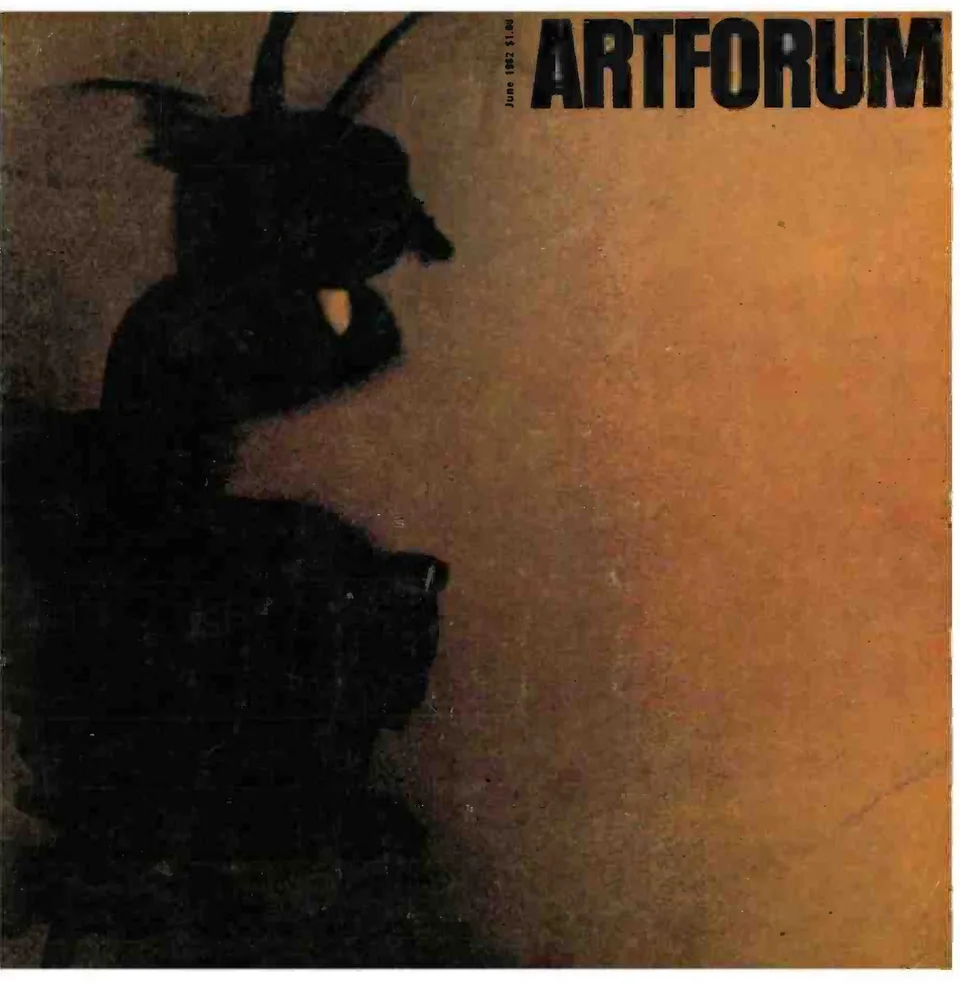
Most of the exhibitions listed above took place between 1962 and 1963, which shows that these two years were when Pop Art erupted in concentrated form in the United States. By coincidence, Artforum was founded in this very period (Fig. 1). In 1962, the art critics Philip Leider and John Coplans launched the magazine in San Francisco. In 1965 it moved to Los Angeles, and two years later to New York, where it remains today.
Since its founding, the magazine "has always been committed to independent art criticism. Advertisements from a given gallery often ran alongside serious criticism of the art that gallery exhibited, and galleries frequently found this editorial strategy and structure baffling and resented it. Yet precisely because of this, it was cherished and protected by artists and audiences."[9] This tells us that Artforum always existed in the crevice between independence and commerce. It was precisely this peculiar structure of survival that laid the groundwork for the split within its editorial board fourteen years later, and in particular for the founding of October.
In its tenth issue of 1963, Artforum published Coplans's "Pop Art, USA," one of the earliest articles to describe the fast-developing American Pop movement. If Abstract Expressionism was thought, over the previous decade and at least domestically, to have finally solved the puzzle of creating a distinctly American art, Coplans argued, then Pop represented an entirely new generation. "They have abandoned all moral judgment, employing a range of mass images and pictorial means that bear no relation to the European tradition, with the aim of concentrating a new kind of force."[10] Although Coplans did not mention Pop's relation to the art business or to consumer society, the latter was undoubtedly Pop Art's most important point of value and conceptual dimension.
The rise of postwar American art owed a great deal to political impetus. The relationship between Abstract Expressionism and the CIA in particular has become a well-known historical controversy.[11] One cannot say for certain whether the CIA was the main driving force behind the rise of Abstract Expressionism. What is certain is that Abstract Expressionism was indeed drawn into the postwar U.S. government's cultural strategy.
By comparison, Michael Leja's view is clearly more objective: "In essence, the art of the New York School stood in a relationship of consonance rather than opposition to American culture during the Second World War, and this characteristic also determined what kind of coherence the group would achieve. By rewriting European modernism, they attended to certain specific cultural concerns and played an ideologically inflected role."[12] This suggests that their practice did not originate as a political strategy of the liberal camp. Still, living under the shadow of the Cold War, they could hardly avoid being tainted by it or drawn into it.
That is one side of the story. The other is the power of the art business, which cannot be ignored. In a sense, one could even say that the market shaped the New York art world. In the 1940s, there were perhaps only about twenty galleries devoted to selling contemporary American art. By one estimate, no more than twelve institutions collected contemporary avant-garde art. By the 1960s, however, two-thirds of the city's 134 galleries were showing contemporary work, and by the 1970s professional collectors numbered in the thousands.
At the same time, contemporary art began appearing at auction. Records show that from the 1970s onward, contemporary art not only appeared frequently at auction but also rose steadily in price. Between 1960 and 1982, the auction value of 26 percent of Abstract Expressionist works rose by 500 percent. The number of museums and corporate collectors also grew explosively, and new patrons emerged. All of these were important supporters of the contemporary art market.[13] As Steinberg put it, if Abstract Expressionism was "hard currency," then the "flatbed" painting inaugurated by Rauschenberg and Warhol in a sense "affirmed" the commercial logic of art through its own practice.[14]
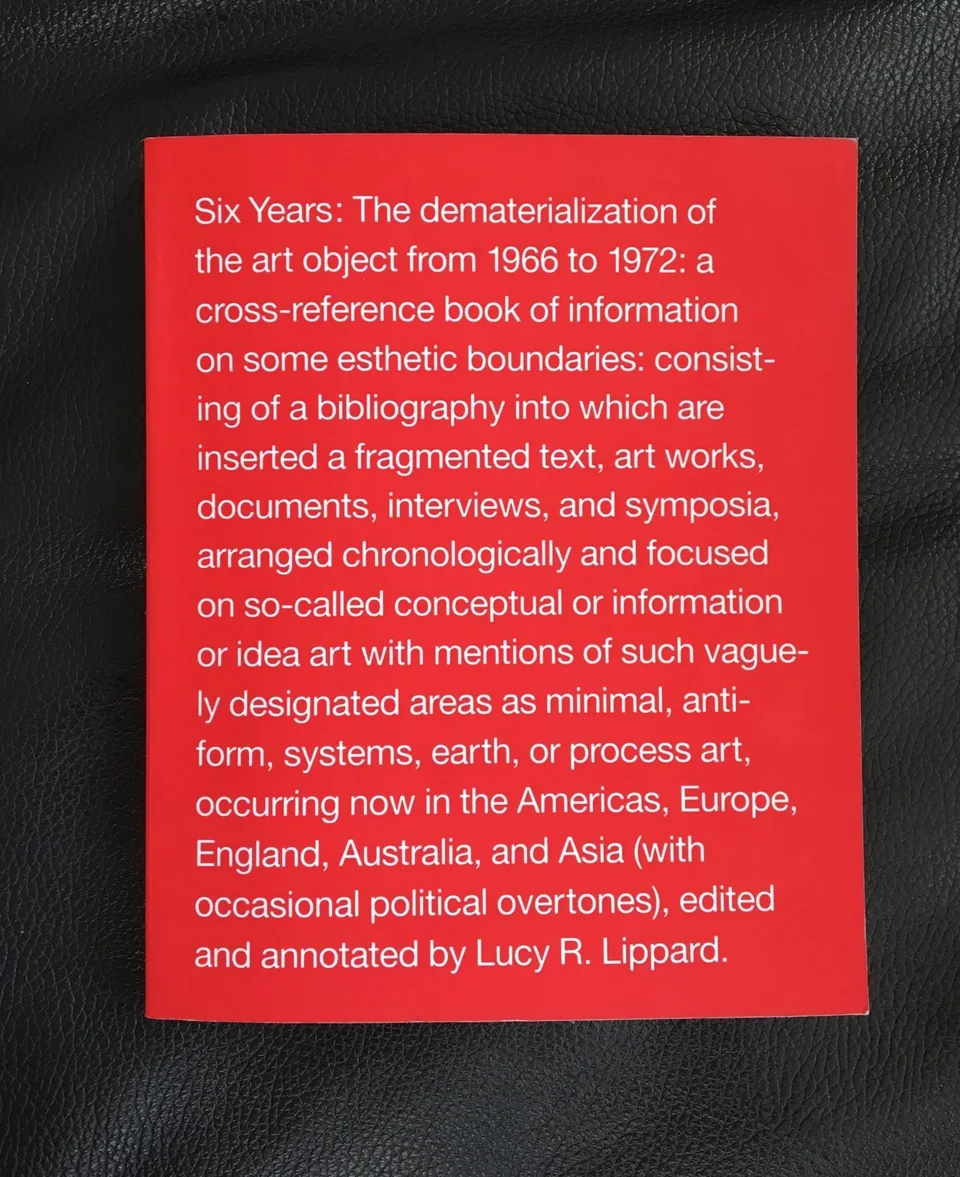
A new moment arrived in 1968. That year, when the civil rights movement, the Vietnam War, the women's liberation movement, the counterculture, and other cultural and political movements all erupted and collided, a new artistic current was born: Conceptual Art. By this point, artists no longer wished to be confined by form, nor to be bound by "literalism" or the "object." Conceptual Art emerged from this ecology and context, and its appearance at least opened up a possibility for artists' self-liberation. In February of that year, Art International published "The Dematerialization of Art," co-written by John Chandler and Lucy R. Lippard, which explicitly discussed art as idea and art as action.[15]
By Lippard's definition, Conceptual Art means work in which the idea is paramount and the material form is secondary: lightweight, ephemeral, cheap, unpretentious, and/or "dematerialized."[16] (Fig. 2) For Ken Friedman, leader of West Coast Fluxus, Conceptual Art was less an art movement or style than a stance or worldview, a focus of activity.[17]
It was undoubtedly a product, or a sympathizer, of the political turmoil of its time. The most direct and basic reason for its emphasis on dematerialization was that materialization had become part of the art market, and the art market was one of the supporters of the Vietnam War. Conceptual practice was therefore itself a form of antiwar action. Benjamin H. D. Buchloh keenly observed of this wave: "At this moment an entirely different foundation was formed, one that could intervene critically in the discourses and institutions determining the production and reception of contemporary art. Unlike the critical model invoked by Bürger, it began to generate a series of ideas concerning reader reception, forms of distribution, and institutional critique."[18]
The most exciting "art" may thus always lie buried in social energies that have not yet even been recognized as art. Paradoxically, though, even with the possibility of parole, such art is eventually recaptured and returned to the white-cube prison of art.[19] In the case of Conceptual Art, then, "the apparent jubilation of criticism could not conceal its substantive failure, and among the reasons was an unforeseen external determinant. It not only proclaimed—as artists and critics had hoped since the early 1960s—the death of the author and the birth of the reader (Susan Sontag's Against Interpretation, for instance, championed the message conveyed early on by Roland Barthes and other French post-structuralists), but also triggered a major structural transformation within the institution of art."[20]
This also shows that formalist theory could neither analyze nor explain these new art forms, and that a new theory of art criticism was already germinating. Such writing could no longer enjoy the absolute autonomy of criticism in Greenberg's era. It became merely one link in the art institution. Even so, the new criticism did not give up its claim to independence. As Buchloh wrote, "By the late 1970s, the traditional division of labor, or the traditional separation of powers, had completely collapsed. If in the past the functions of the museum, the gallery, and the magazine had been strictly separated, now, as the powerful management apparatus of the culture industry was successfully appropriated into the cultural institutions of the bourgeois public sphere, the traditional division of powers and the distinctions of professional competence began to erode and were eventually abandoned."[21]
This helps explain why an art publication like Artforum could survive only in the gap between independent criticism and commerce. A little more than a decade after its founding, fierce tensions and conflicts broke out within the editorial board for exactly this reason. The "Lynda Benglis incident" of 1974 was the trigger. It brought the split within Artforum's editorial board into the open and led directly to the founding of October.
That year, the radical feminist artist Benglis offered to pay $3,000 to place an advertisement in the eleventh issue of Artforum. In the ad, the nude artist held a latex dildo against her crotch with her right hand, satirizing and critiquing the male-dominated art world. The same issue was also set to run a long review of Benglis's solo exhibition at the Paula Cooper Gallery. This provoked strong opposition and protest from Rosalind Krauss, Annette Michelson, and other editors. The person who had insisted on running the ad was the editor-in-chief at the time, Coplans.
Years later, Krauss and Michelson were still indignant in interviews and remained "scornful" of what Coplans had done. Krauss asserted that Artforum had by then become thoroughly corrupt.[22] Michelson said she did not object to the magazine running advertisements. What she truly could not tolerate was the metaphor implicit in Benglis's ad: that commercialization had made the magazine little different from a brothel.[23]
Looking back today at New York, and indeed the whole United States, in the 1970s, one can also understand the predicament Coplans faced as editor-in-chief of Artforum. In the early 1970s, the Cold War entered a new phase and America's economic contradictions intensified. When Middle Eastern oil-producing countries sharply raised oil prices, the "dollar-dominated Bretton Woods monetary system" finally collapsed completely in 1973. The United States sank into stagnation and recession, which spread to other capitalist countries and set off a widespread economic crisis. None of this halted the art market's expansion, however. To some extent it further heightened the tension and conflict between the art business and independent criticism. Yet magazines depended heavily on commercial advertising to survive, and Artforum was no exception.
Beyond this, the Watergate scandal of 1972 plunged American politics and the news media into an unprecedented crisis of trust. Two years later Nixon was forced to resign. The "Patty Hearst affair" of the same year was undoubtedly an emblematic event of this political and media crisis. All these crises left most ordinary people and intellectuals in a state of unease and despair. At the same time, they reignited dissatisfaction and resistance among some of the public and some intellectuals. For many critics of the time, this was without doubt a moment for choosing anew. The "Benglis incident" may have been merely an accident, but it was precisely this incident that directly prompted Michelson and Krauss to leave Artforum's editorial board resolutely.
III. Greenberg, Montage, and October
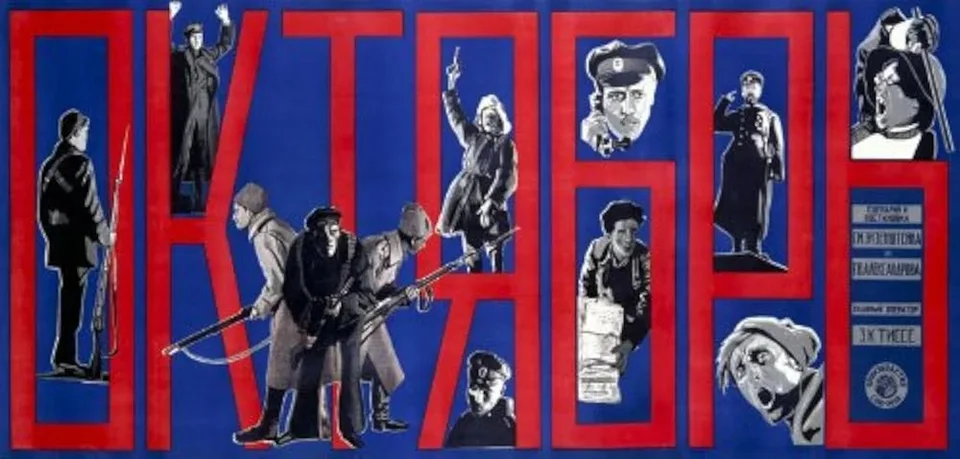
In 1976, Krauss and Michelson founded a new journal, October. Its name came from Eisenstein's 1927 film October (Fig. 3), made to commemorate the tenth anniversary of the October Revolution. That was also the year Trotsky was expelled from the party, soon to be exiled abroad. Eisenstein had lived through both the February and the October Revolutions. After October, he volunteered for the Red Army and served as a technician with the Second Military Engineering Unit of the Petrograd district, setting off from Petrograd for the northeastern front. The film recounts his firsthand experience and understanding of the two revolutions. It opens with enraged crowds pulling down a statue of the tsar: the Romanov dynasty ends and the February Revolution triumphs. It closes with "the salvo of the October Revolution," as the main gun of the cruiser Aurora opens fire.
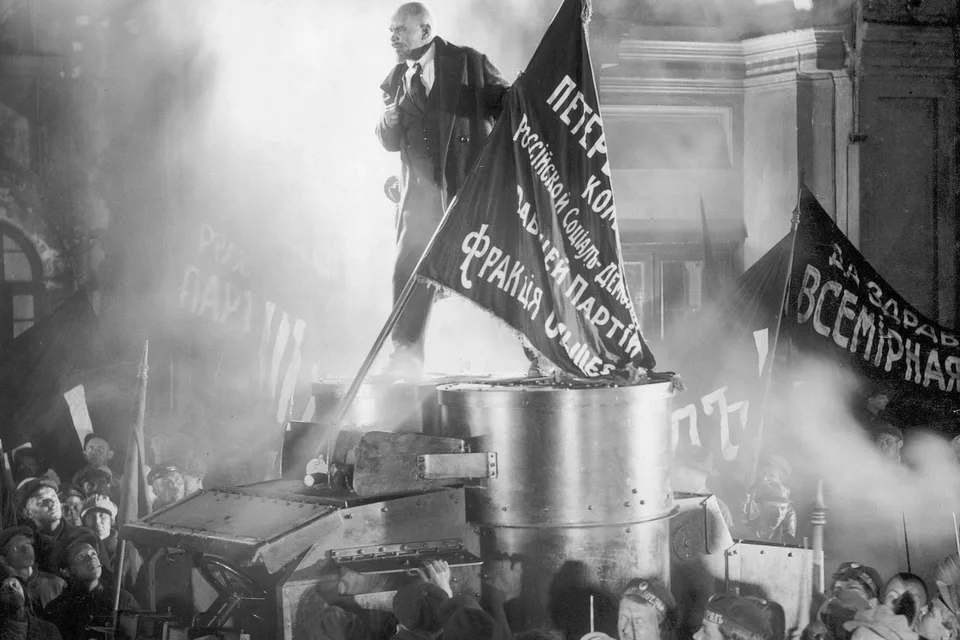
In an essay titled "A Dialectic Approach to Film Form," Eisenstein argued that everything new arises from the struggle of opposites. The October Revolution, in his view, was a historical turning point that changed world history and gave birth to a new system, and montage vividly revealed the revolution's character as struggle. The February and October Revolutions were fundamentally different: the former was a bourgeois revolution, the latter a proletarian one. What "dialectical montage" presented on screen was precisely the rupture between the two.[24] Eisenstein was the master synthesizer of Soviet silent cinema. His October not only inaugurated a new artistic paradigm but can itself be regarded as a political act (Fig. 4).
This moment, uniting revolutionary practice, theoretical exploration, and artistic innovation, became the starting point for the thinking and action of October's two founding editors, Krauss and Michelson. What mattered to them was not only the artistic revolution in Soviet Russia more than half a century earlier, which radiated into literature, painting, architecture, film, and other fields. They also could not ignore the particular circumstances that had nurtured that artistic revolution and historical movement: civil war, factional strife, and economic crisis. In October's "About OCTOBER" statement, the two founding editors stated plainly that their aim was neither to immortalize the myth or sacred teachings of the revolution nor to share in self-validating pathos. They hoped instead to re-examine the relations among the several arts in their own culture at that time, and on that basis to reconsider the role of those arts at this
important historical juncture.[25]
Before October was founded, Michelson had already published an essay on the Soviet avant-garde cinema in Artforum (No. 1, 1973), "Camera Lucida/Camera Obscura." The essay examined the work of two directors from different periods, Eisenstein and Stan Brakhage, and focused on analyzing the cinematic language of Eisenstein's October. For Eisenstein, Michelson argued, cinema inherited the function of philosophy. He concretized aesthetic principles into an epistemology that ultimately led to an ethics. In her view, therefore, "montage thinking is inseparable from the thought of totality." October, for instance, is an exemplary case of thinking that constantly returns to "Film Form" and "Film Sense." Eisenstein's active and profound consciousness of his own intervention, his placing of himself within the historical process of revolution, makes us recognize his work as a kind of vector in the process of historical transformation.[26] Michelson reaffirmed the unity between the cinematic language, or "epic style," of Eisenstein's October and revolutionary politics.
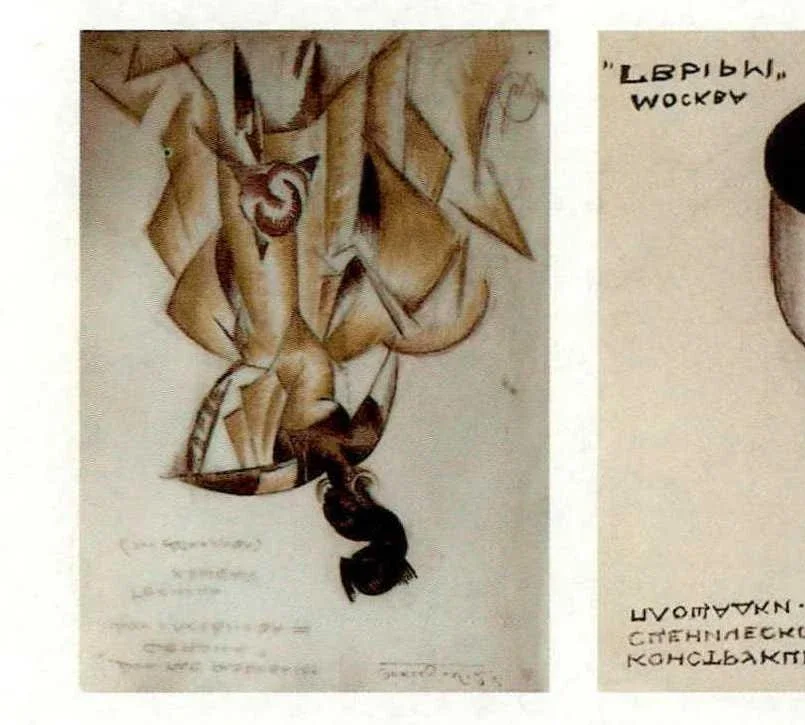
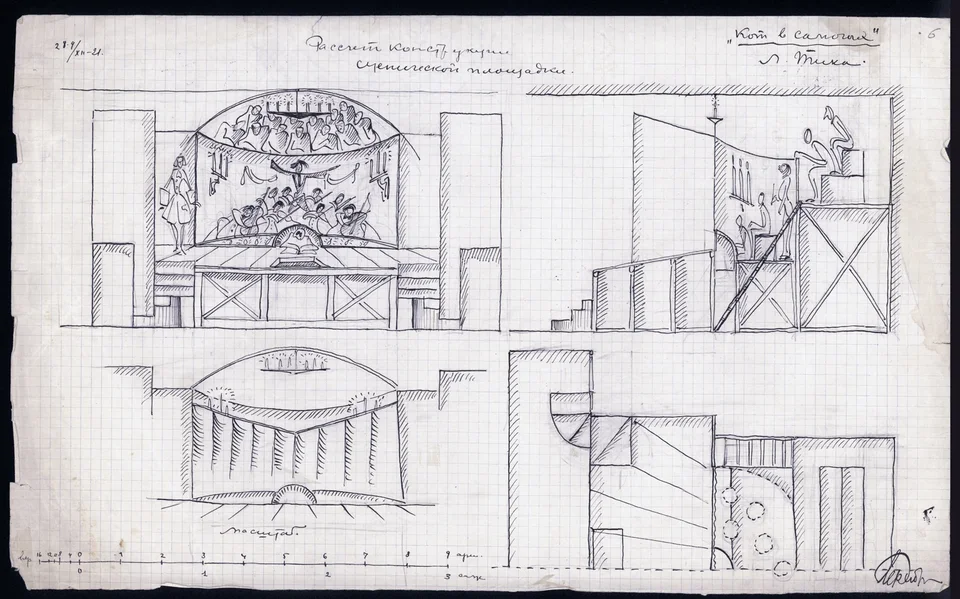
For her, however, cinema was only one part of the picture. She noted that Eisenstein had been deeply nourished by the poetry, painting, and theater of his time, and that all these arts had unfolded one after another along the complex paths surrounding the October Revolution, from Futurism through Cubism to Constructivism. Some scholars have found that his editing style derived from "Cubist principles" (Figs. 5–6). Only through an understanding of Tatlin and Rodchenko, and of how they understood Cubism, can we arrive at a deeper understanding of Eisenstein.[27] Michelson also observed that "in the dialogue between Malevich and Eisenstein on film aesthetics, opposing concepts centered on the problem of abstraction and figuration were conveyed."[28]
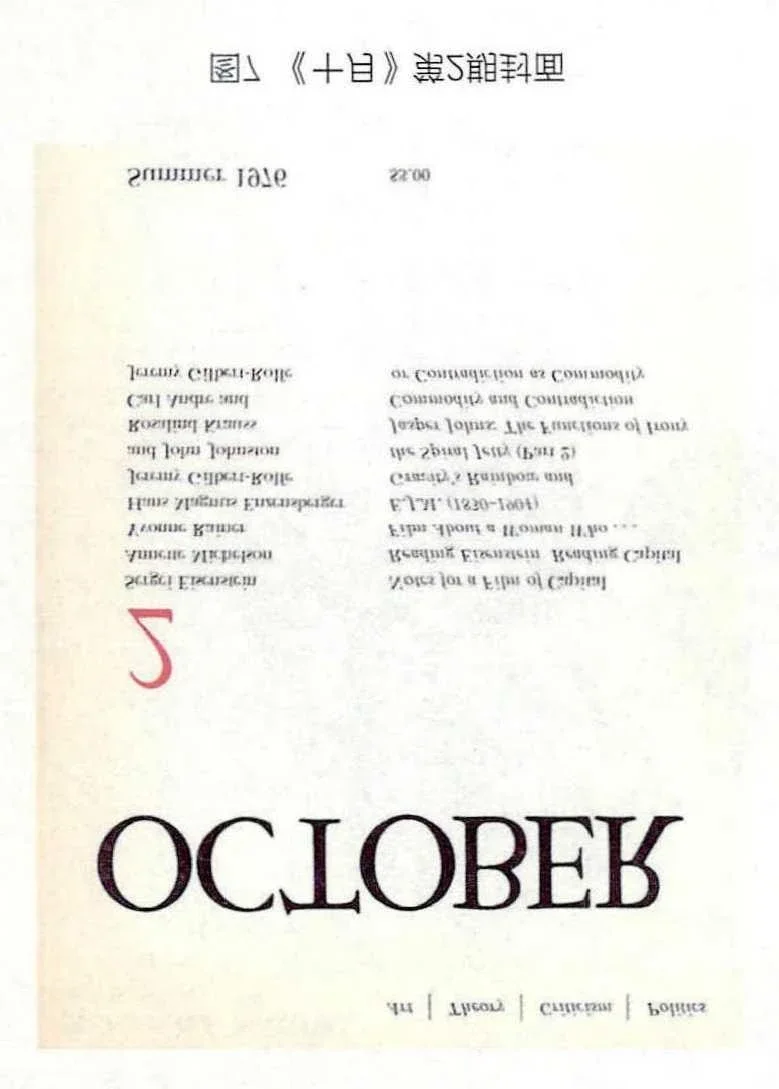
Three years later, the second issue of October (1976) published Eisenstein's 1927–1928 notes for a film of Capital, together with a brief introduction and commentary by Michelson (Fig. 7). In her commentary Michelson also discussed the film October: "October is Eisenstein's most refined and most complex effort toward a thoroughly artistic cinema. ... By altering the temporal flow of events and of the narrative structures surrounding them ... it attracts new attention and provokes inferences about spatial and temporal relations." "Here the power of montage lies in the 'primal' fact that the ideal image is not fixed or ready-made but produced; it gathers in the perception of the viewer."[29] Thus "the viewer is compelled to proceed along a path consonant with the process by which the author made the image. Viewers must not only see the finished representational elements but also experience the dynamic process of the image's emergence and assembly that the author went through."
On this basis, Eisenstein offered his own understanding of what Marx defined as "the process of genuine inquiry": "Not only the result, but the road leading to it, is a part of truth."[30] This self-referential mechanism happens to echo Greenberg's formalist principles.
The following year, the journal Jump Cut published Murray Sperber's long review of Eisenstein's October. As Eisenstein himself said, "Art is conflict; montage is the capturing of conflict on the screen." Sperber laid bare the historical-dialectical logic of contradiction and conflict and showed that montage was precisely the artistic means for expressing this dialectic.[31] The Cold War formed the shared backdrop of both Michelson's and Sperber's commentaries. Their texts show, however, that Sperber emphasized montage and its historical dialectic, perhaps deliberately avoiding its politics. Michelson valued not only the artistry of Eisenstein's films but also their politics, and especially the relationship between the structures of artistic practice and political society.
In a sense, Michelson's essay restated the motivation and basic principles behind the founding of October. If we return to the context of the time, we might put it simply, as the journal's name suggests. The October Revolution had overthrown Russia's bourgeois Provisional Government and established Soviet power. By analogy, the commercialized Artforum had become a mouthpiece for, or a part of, the bourgeoisie, while October was a symbol of revolution. To this day, the upper right corner of the journal's cover still bears four keywords, "Art," "Theory," "Criticism," and "Politics," which serve as its basic orientation and values. From the very beginning, the editors made clear that October was anti-commercial, anti-academic, and anti-institutional, and it has never carried commercial advertising of any kind.
In a sense, this is also what distinguished it from Abstract Expressionism and formalism, which had by then been commercialized. It was no coincidence, however, that the revolutionary avant-garde of the early twentieth century formed a shared narrative starting point for both. "About OCTOBER" mentions the leftist journal Partisan Review. The two editors broadly endorsed its politics but felt that it had later become increasingly "indifferent to innovation in art and criticism," and had even "encouraged the development of a new philistinism in intellectual life."[32]
Interestingly, Partisan Review was also Greenberg's main theoretical platform in his early years. In 1939 he published "Avant-Garde and Kitsch" there. In that essay he took a clear stand against kitschy academicism, commercialism, and Socialist Realism. For him, what truly represented the avant-garde was abstract painting. On the surface, "abstraction" here referred to formalist painting. In fact, it alluded to the entire avant-garde movement inaugurated by the October Revolution of 1917. This included Mayakovsky and the LEF (Left Front of the Arts) group in literature; the Formalist and Constructivist tendencies in painting; Eisenstein, Pudovkin, and Dovzhenko in film; Tairov and Meyerhold in theater; and others.
"The priority of form over content was the battle cry of early Russian Futurism."[33] Mayakovsky, for example, wrote in one essay: "Art is not a copy of nature but a product that distorts nature according to its reflection in the individual consciousness." This was not only a principle of Futurist poetry but also a shared principle of creative deformation in the visual arts, Cubism, and Surrealist painting.[34] The crucial point is that the spiritual leader of these avant-garde movements was Trotskyism. In "Manifesto: Towards a Free Revolutionary Art," Trotsky wrote: "We believe that the supreme task of art in our epoch is to take part actively and consciously in the preparation of the revolution."[35]
Pi Li has laid out this background clearly. In August 1939, Stalin and Hitler signed a non-aggression pact and secretly partitioned Poland. The Molotov–Ribbentrop Pact completely shattered European progressive intellectuals' ideals about the Soviet Union and Stalinism. In their eyes, it marked the convergence of fascism and Stalinism. When they recalled the Soviet Union's banishment of Constructivist artists, Stalinism seemed to them almost a synonym for fascism. The honeymoon between modernism and (Stalinist) communism thus came to an end at this moment.[36]
Greenberg published "Avant-Garde and Kitsch" in the same year the pact was signed, and this was probably no coincidence. Although Greenberg criticized Socialist Realism and fascist art, he did not abandon revolutionary politics or modernism. Trotskyism formed the underlying tone of his theory. At the end of the essay he wrote: "Today we no longer look toward socialism for a new culture—as inevitably as one will appear, once we do have socialism. Today we look to socialism simply for the preservation of whatever living culture we have right now."[37] The socialism here was not Stalin's but Trotsky's.
About twenty years later, in a footnote to an essay titled "New York Painting Only Yesterday" (1957), Greenberg wrote: "Though the art of those years was political, it was not entirely so; some day it will have to be told how 'anti-Stalinism,' which started out more or less as 'Trotskyism,' turned into art for art's sake, and thereby cleared the way, heroically, for what was to come."[38] This made his relationship to Trotskyism explicit. That he placed it in a footnote may have been meant to "avoid attracting notice." After all, the United States had not yet emerged from the shadow of the McCarthy purges. Large numbers of antiwar activists and civil rights participants were still being illegally arrested and persecuted, and this did not come to an end until the House Committee on Internal Security was forced to disband in 1975.
As noted above, Trotsky was expelled in 1927, and his exile soon followed. That same year, Eisenstein completed October to mark the tenth anniversary of the October Revolution. Notably, in 1924 Trotsky had published an important long essay titled "The Lessons of October." In it he systematically reviewed and examined questions that had arisen since the October Revolution of 1917 (and the February Revolution), such as "the democratic dictatorship of the proletariat and peasantry," "the July Days and the Kornilov revolt," and "the 'legality' of the Soviets." On that basis he reaffirmed the necessity of the "Bolshevization" of the Communist International. He wrote: "Bolshevism is not merely a doctrine but a system of revolutionary education for the proletarian revolution. ... 'That is Hegel, that is book wisdom, that is the meaning of all philosophy!...'"[39]
Trotsky ends by mentioning Hegel. By coincidence, Eisenstein's so-called "dialectical montage," with its "opposing movements" and "unity of laws," is consistent with Hegel's dialectic. Both proceed through "thesis–antithesis–synthesis" into a new "thesis–antithesis–synthesis," and so on, so that contradiction rises and develops in a spiral through ceaseless conflict. We do not know whether Eisenstein's October drew directly on Trotsky's long essay, but there is indeed a hidden internal connection between the two. This was also one of the reasons why, half a century later, the two American art critics Krauss and Michelson chose it as the inspiration for founding October.
The October Revolution, Eisenstein, and the (early) Greenberg together constituted the starting point of their action. The United States and the Soviet Union were then locked in the Cold War, but the editors clearly stood on neither side. What they truly identified with was the Fourth International, that is, "Trotskyism."
October's return to Eisenstein's October was not, however, simply a matter of revolutionary political aspiration. The editors were more concerned with the relationship between revolutionary politics and the various art forms, including painting, film, literature, and theater. Greenberg's avant-garde, by contrast, was confined to abstract painting and its formalist aspect.
Trotskyism (or, more broadly, Marxism) was not Greenberg's only theoretical source. He had another: Kant. In the 1960 essay "Modernist Painting," he argued that Kant was the first real Modernist because Kant was the first to criticize the means of criticism itself. Greenberg wrote: "The self-criticism of Modernist art has never been carried on by any other discipline; it has been a spontaneous and largely subliminal affair. As I have indicated, Modernist self-criticism has been altogether a question of practice, immanent to practice, and never a topic of theory."[40] This is precisely what he meant by "purity," that is, self-definition. This point also happens to echo Eisenstein's view. Whether or not Michelson's restatement of it was influenced by Greenberg, the two converge, and not by coincidence.
Greenberg, like Michelson and Krauss later, was drawn to abstraction. But he became an important promoter of Abstract Expressionism for another reason as well: he shared a similar background with most of its artists, who had also belonged to the left. Most of them had worked for the Federal Art Project during the New Deal, receiving government subsidies to make work for the government. The most important of them was Pollock. Besides being fascinated by Orozco's mural The Epic of American Civilization,[41] in the 1930s he was drawn into the communist workshop run by the Mexican muralist David A. Siqueiros. Beyond Pollock, Adolph Gottlieb, William Baziotes, and several other Abstract Expressionists had also been communist activists.[42]
Greenberg did mention the practical side of modernism. Yet from the late 1940s through the 1960s, he almost never discussed modernism as revolutionary political action, and his critique of the bourgeoisie and of kitsch culture all but disappeared. One important reason was the right-wing "witch hunt" of 1950 to 1954, that is, the purges of McCarthyism.[43] In a sense, these purges directly forced Greenberg to give up revolutionary politics and devote himself solely to constructing a "closed" formalist discourse.[44] That discourse even became a unipolar hegemonic narrative. Soon, however, it colluded with the rising art market and more or less echoed the liberal ideology that had already become dominant and was beginning its global expansion.
During this same period, voices opposing formalist hegemony rose one after another amid the waves of the civil rights movement, the antiwar movement, and the counterculture. The rise of Conceptual Art and its "dematerialization" movement in particular eventually led to formalism's retreat. The art world was waiting for a new revolution, and October was undoubtedly part of that new revolutionary camp. As Greenberg wrote in "Avant-Garde and Kitsch": "Where there is an avant-garde, generally we also find a rear-guard."[45] The sentence can also be reversed: where there is a rear-guard, there is an avant-garde.
IV. The Entry of "Post-Structuralism" and the Turn in Art Criticism
By the mid-twentieth century, literature departments at many American universities had become public squares of critical discourse. The New Criticism, born at this time, gave literary criticism a central position and unrivaled prestige in American intellectual life. Its figures included Cleanth Brooks, Robert Penn Warren, René Wellek, and Austin Warren. Their criticism was chiefly "intrinsic." Its method was reading that stuck closely to the text (close reading), and it aimed to establish the ontological status of the text (following the maxim that "a poem should not mean but be") and a new theory of language as untransmissible rather than communicative.[46]
Greenberg's formalist criticism embodied the same closed and stable conception of the text. Like Greenberg's formalism, "the New Criticism emphasized the existence of autonomous mechanisms of criticism and of literature and their irreducibility to history and social structure; they habitually substituted an 'internal history' and the customary self-sufficiency of the text for history in general."[47] We might even say that they were anti-historical, anti-experiential, and anti-political. As mentioned earlier, "during the campus purges of McCarthyism, they turned their departments into refuges for formalists far removed from political struggle."[48]
From the 1960s onward, however, the emergence of new literary forms (including art forms) and new political forms unsettled the New Critics (or formalists). Their indifference to the politics of the text came to be seen as intolerable. Some chose belated combat, some chose European universities, and the great majority, by reading French structuralist and related works and founding departments of comparative literature, opted for theory-based knowledge and a political criticism grounded in ordinary language. French theory became a third way between the impasse of formalist criticism and the political obstacles of the university institution, even though the university of this period was constrained by both the government and the market.[49]
At first, these new theories seeped across the Atlantic into the United States through certain university journals, simple mimeographed manuscripts produced as soon as they appeared, with French texts especially in the lead. This work was clandestine and handmade, but full of passion. People eagerly passed the texts around in classrooms and at parties. A number of young scholars were drawn to these theories, among them Alan Bass, Tom Conley, James Creech, Janet Horne, John Rajchman, and Mark Seem. They gathered together to translate, introduce, and publish the first essays.[50]
From the late 1960s to the mid- and late 1970s, over roughly a decade, more than ten journals devoted to translating and introducing French theory appeared in the United States, among them Glyph, Diaspora, Semiotext(e), and Boundary 2. French ideas first entered American theory and criticism through these journals. They included Derrida's "the ends of man" and "the displacement of writing," Foucault's "death of the author" and "society of surveillance," Lyotard's conflictual mechanisms incorporating the individual, and Deleuze and Guattari's "lines of flight" and "schizophrenic" subject.[51] Although October was founded somewhat later, it quickly became one of the most important venues.
In the early 1960s, Michelson was living in Paris. She was fluent in French and remained especially enthusiastic about cutting-edge French theory. At the time, many French theorists' works had not yet been translated into English. After returning to New York in the mid-1960s, she threw herself into translating and introducing French theory and developed a new critical vocabulary.[52] This vocabulary soon "replaced" formalism, providing an effective theoretical entry point and interpretive path for the art movements that followed Abstract Expressionism and formalism.
As October's founding editors, Michelson and Krauss together fused aesthetic theory with political philosophy and extended their view to the major artistic events of their time. From Lyotard on Daniel Buren, to Derrida on painting, to Hubert Damisch on photography, October became the only journal to seriously examine what French theory gained and lost in relation to art and artistic practice.[53]
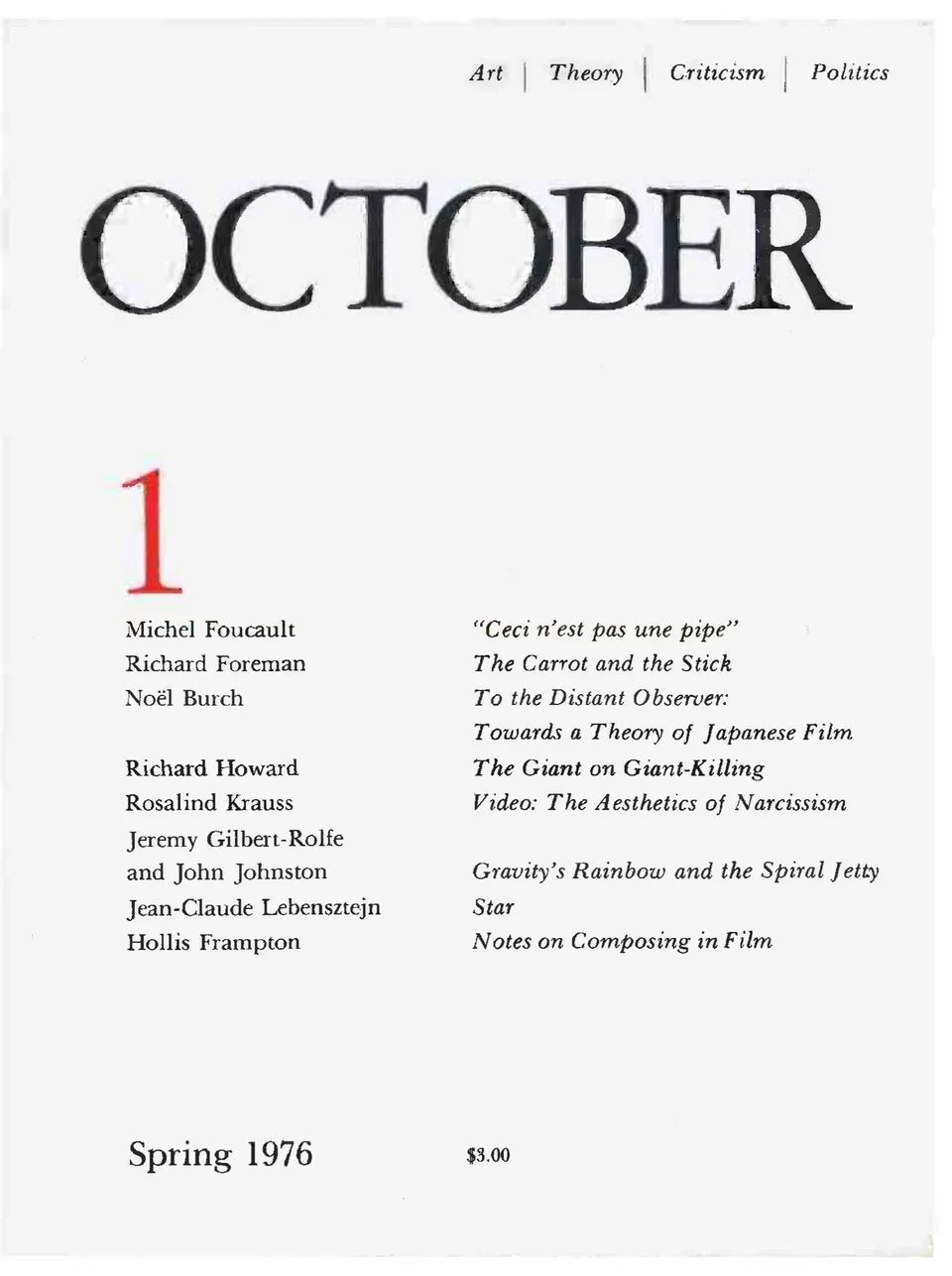
According to one account, Coplans, then editor-in-chief of Artforum, refused to publish Foucault's "This Is Not a Pipe," which Michelson had recommended. "In a fit of anger," she and her colleague Krauss broke away and founded October, running Foucault's essay as the lead article of the inaugural issue (Fig. 8). In a sense this was symbolic. Foucault did not accept the label "post-structuralist," but from then on contemporary French theory, dominated by "post-structuralism," undoubtedly became October's most important theoretical foundation and discursive resource.
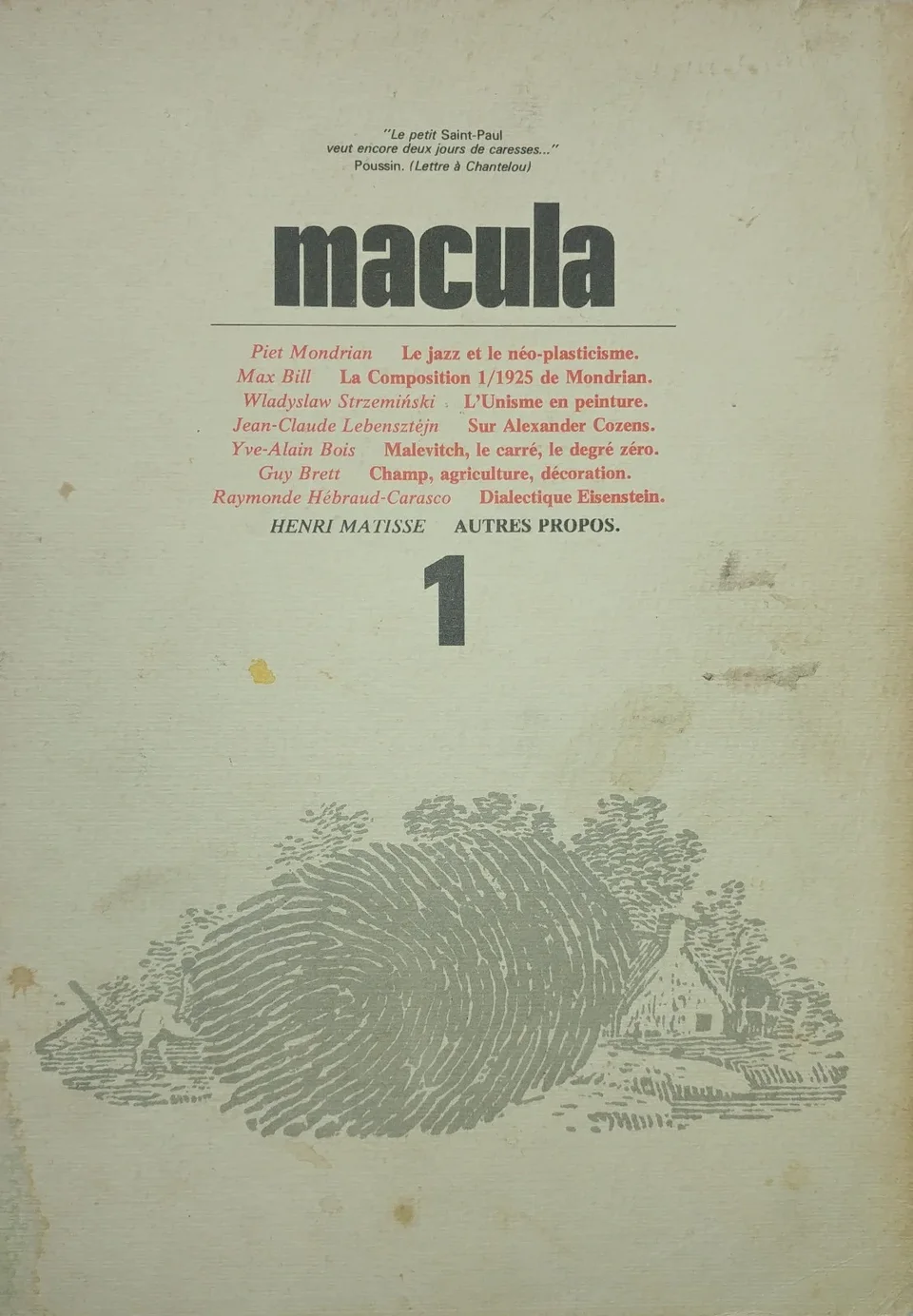
It is also worth noting that while Michelson and Krauss were carrying French theory to New York, the Parisian art-historical and theoretical world was changing too, and began introducing the theories of Greenberg and Krauss into France. In the same year October was founded, Yve-Alain Bois and two other scholars launched the journal Macula (Fig. 9). Its focus and politics could not compare with October's, but in orientation and style the two journals were strikingly similar.
Notably, Bois's first article in the inaugural issue of Macula was "Malevich, the Square, the Zero Degree [of Writing]." Its subject, Malevich, happened to echo the Eisenstein mentioned in October's founding statement, which at least suggests that they shared common interests. Unfortunately, Macula folded after only six issues (four volumes). In the early 1980s, through Fried's recommendation, Bois moved to New York to live and work, and he later became one of October's core editors and an important contributor. "Post-structuralism" always occupied an important place in Bois's intellectual system. We may therefore regard him as another source of October's French theory.
"Post-structuralism," which arose in France in the late 1960s and is also called "deconstruction," encompassed feminism, psychoanalysis (especially Lacan's thought), revised versions of Marxism, New Historicism, and other critical schools. It differs from structuralism in the following way. Structuralism posits an objective truth of the text and holds that one can examine the text with standard, objective methods and obtain a determinate interpretation. "Post-structuralism," by contrast, generally stresses the indeterminacy of textual meaning and claims that the text may possess no objective truth within itself. "Post-structuralism" also questions the various assumptions long held in reading and writing and in the metaphysics of language.[54]
Formalism, with its essentialist cast, was undoubtedly the "natural enemy" of "post-structuralism." The "post-structuralists" concentrated on the paradoxes of the text and its perpetual fragmentation. They believed they were practicing a "closer" reading, one nearer to the text's obscurity. Defenders of formalism feared that this would weaken the autonomy of art and perhaps dissolve it altogether. In their view it would lead to textual relativism and the disappearance of the canon, and would even damage the universalism of an ahistorical aesthetics that they had defended at great cost.[55]
Clearly, though, the aim went beyond theory or criticism itself. Theory itself was also a form of political action. More precisely, both the "post-structuralist" current and October itself were part of the "counterculture" movement of the 1960s and 1970s, that is, the dismantling of the hierarchies at the core of aristocratic culture. The "counterculture" was not opposed to all culture. Because aristocratic culture regarded itself as the only culture, the "counterculture" was in fact opposed to aristocratic culture. In the same way, Sontag's "against interpretation" was not against everything, but against the single interpretation that "culture" supplied. The "counterculture" sought to make culture yield ground to those cultures it did not recognize as "culture."[56]
The "counterculture" was therefore first and foremost a liberation. For October, Abstract Expressionism and formalism had become "aristocratic culture." It had closed off the medium, ossified language, and even blocked the channels through which art could open onto society. October set out to open up both medium and language. Its objects were no longer limited to painting and sculpture: film, video, performance, Land Art, and all kinds of media, old and new, came under discussion. More importantly, the journal also sought to use them to re-examine and rebuild the relationship between art, society, and politics.
At this point we must mention the relationship between "post-structuralism" and the May 1968 events in Paris. Not all of these intellectuals necessarily took part in person, but the shadow of May 1968 can be seen in the thought and action of every one of them. Take Foucault. When May 1968 erupted, he was more than 1,000 kilometers away, teaching at the University of Tunis, yet the events profoundly shaped his intellectual and political trajectory. Foucault himself acknowledged this. He called May 1968 an unexpected "political beginning" that gave him the courage to investigate the mechanisms of power operating in Western society and to "pursue [his] research in the direction of penal theory, prisons, and discipline." By the early 1970s, Foucault had transformed himself into a radical intellectual and an entirely new kind of public figure. By working side by side with militants of the Gauche prolétarienne (Proletarian Left), Foucault "personally became involved in the very object of his theoretical research."[57]
Whether or not Michelson and Krauss were directly inspired by this, their theoretical practice certainly accorded with Foucault's positions and methods. In the United States, the counterparts of France's May 1968 were the civil rights movement, the antiwar movement, the women's liberation movement, and the counterculture. According to Richard Wolin, the prevailing view in the 1950s was that government administered by elites (mostly white male elites) was preferable to the risks of popular participation, and political mobilization from below was seen as irrational and unreliable. The debacle of Vietnam and similar foreign-policy disasters, which led to massive and odious human rights abuses, ended this illusion. Radical intellectuals and ordinary people then tried to "wrest" control from the elites. They countered the ills of "technocratic liberalism" by appealing to the logic of grassroots political participation, and in this way sought to restore faith in basic democratic norms.[58]
In the 1970s, political crisis and economic depression did not break up the left's radical actions; they intensified them. In this sense, October not only brought "post-structuralist" theory, together with the spirit of May 1968, into the United States. It also quietly carried forward the "counterculture movement" that had arisen in America itself since the 1960s. Hal Foster, who later became one of the mainstays of October's editorial board, put it this way: "Critical theory secretly took over the charge of avant-gardism by other means: after the climax of the 1968 uprisings, radical theoretical rhetoric served as some compensation for a declining activism (in this regard critical theory is itself a kind of neo-avant-garde)—at least in this sense it also assumed the duties of cultural politics."[59]
Overheated political movements always carry a tinge of anti-intellectualism, but for "post-structuralism," politics was first of all grounded in intellect. Besides, not everyone among these thinkers was keen on political movements. Derrida, for instance, avoided street protests as if they were the plague. Although October embraced "post-structuralism," it rarely discussed May 1968 and almost never mentioned its Maoist background. This may be because the rebels of May 1968 had always rejected Trotsky, who had looked down on the prospects of Chinese communism.[60]
Rather than any particular political goal, what Michelson and Krauss cared about more, at least first and foremost, was a revolution in art criticism and a revolution in the understanding of art. Opening October's inaugural issue with Foucault's "This Is Not a Pipe" was thus clearly symbolic. Many earlier interpretations of this classic essay focused on the "calligram" and its internal mechanism of "the visible and the sayable."
Shubao Dong's analysis shows that Foucault was in fact analyzing "resemblance" within the mimetic framework of classical painting, using "resemblance" to denote a relationship of copying. To resemble is to imitate an original: it refers to an external, transcendent, originary element according to which copies can be ranked by their proximity to it. This element may be called the "prototype" or "original." It is something akin to an Idea and carries a distinctly Platonist tendency. Similitude, by contrast, denotes a relationship between "image" and "image" that has no external referent. The similar thing, or "image," is like the "pipe" caught in an endless loop of self-reference: "an 'image' without resemblance," with no beginning or end, no hierarchy, merely spreading ceaselessly through difference and repetition.
Foucault argues that Magritte lets the "pipe" float freely. The "This is a pipe" silently hidden within resemblance-based representation becomes the fluid, simulacral "This is not a pipe." Andy Warhol's "Campbell" quietly makes its entrance, and the age of the simulacrum suddenly arrives: "A day will come when, by means of similitude relayed indefinitely along the length of a series, the image itself, along with the name it bears, will lose its identity. Campbell, Campbell, Campbell, Campbell."[61] Foucault's argument here was in fact inspired by Deleuze's Difference and Repetition and The Logic of Sense.[62] Their shared aim was to oppose Platonism, or singular essentialism.
Foucault's account clearly differs from Greenberg's formalist criticism, which also bears an essentialist cast. Magritte's This Is Not a Pipe lay outside Greenberg's theoretical purview, but this "post-structuralist" mode of narration in itself thoroughly overturned the theoretical framework of formalism. Greenberg evaluated works according to a set of principles he had laid down. Foucault, by contrast, first gave up evaluation. He neither posited principles nor led toward any. He treated the essay instead as productive writing, intended to open up a new understanding of the work: a multidimensional, dynamic, "de-subjectified," installation-like mode of understanding. Unlike Greenberg, who sought to provide a single hegemonic interpretation, here there is no single interpretation. "Post-structuralism" precisely frees writing, or criticism itself, from singularity.
"There is nothing outside the text" is perhaps Derrida's most controversial dictum. In The Truth in Painting, Derrida overturned the interiority of the work itself and brought out the crucial significance of the "parergon." Such external appendages appear to be mere decorative supplements. Yet by surrounding the center or interiority of the work, they form elements marked even more strongly by différance. He overturned logocentrism and phonocentrism, liberated all constrained meanings, and let the world open up, without reserve, its diverse artistic aspects.[63]
This mode of writing and understanding appears throughout the scholarly articles and reviews October published. It is especially visible in the writing of its editors, including those who later joined the editorial board: Douglas Crimp, Hal Foster, Benjamin Buchloh, George Baker, Mignon Nixon, David Joselit, and others. There were clear theoretical disagreements and differences of style among them, but their writing all bears the coloring of "post-structuralism" to some degree. This is especially true of Krauss, for whom "post-structuralism" (along with "structuralism") became the principal theoretical support. Her classic early discussions of the "grid," "originality," and "reproduction/repetition" fully embody this perspective and logic of thought.[64]
Krauss even argued that formalism was in fact a misreading of Greenberg's theoretical system. She wrote: "As a deeply committed historicist, Greenberg's method was to conceive of the field of art as something about to be eternal and in a state of ceaseless flux. It was precisely because he attended to art's ontology and its unbreakable continuity that Greenberg so strongly opposed critical writing focused on method rather than on the content of judgment. And it was precisely because there was no way to separate judgment from the content of evaluation that Greenberg held criticism to be primarily concerned with value and to have almost nothing to do with method."
Through the interpretive paths of "structuralism" and "post-structuralism," Krauss offers us an entirely different, even diametrically opposed, answer: "On the one hand, structuralism refuses the historicist model as a way of understanding the production of meaning.[65] On the other hand, in post-structuralist theory, those eternal, transhistorical forms once thought to constitute a solid system, within which aesthetic development took its place, must now open themselves to historical analysis." Unlike Greenberg's "historicism," "the historical analysis here abandons history as the way in which things (statements, works of art, and any cultural production) signify, and instead hands the means of production over to their own history for verification."[66]
For this reason, the writing of this small group, Krauss included, was no longer limited to the art of its own time. Its objects might sometimes be modernism, or might even extend to premodern art. Yet this writing was undoubtedly contemporary in itself. Put another way, the writing itself, as an artistic act, was continually drawn into the radical art scene of the present.
David Carrier once characterized Krauss's writing as exemplary of American philosophical art criticism. Carrier argues:
"A philosophical art critic must be an art critic and at the same time attend to philosophy; philosophical art critics are therefore a strange breed situated between the two. Their rigorous philosophical interests often puzzle art historians, while their concern with the history of art may be ignored by philosophers."[67]
Carrier was not alone in this view. In the early 1980s, his teacher Arthur C. Danto repeatedly asked, in his correspondence with Michelson, whether October intended to philosophize art criticism.[68] In fact, there is a great misunderstanding here. It is true that their arguments borrowed many philosophical concepts and that their prose was relatively obscure and difficult. Some even likened their essays to a kind of "Martian script." Yet their aim was not to turn art criticism into philosophy. Like the theorists of "post-structuralism," they wrote across art, art history, visual culture, philosophy, history, literature, anthropology, sociology, and other fields. In a sense, this writing itself resisted and dissolved traditional disciplinary boundaries, so it is hard to classify as philosophy, history, or anything else. In short, October's aim was to create a new way of writing art criticism, one that would "innovate the intrinsic qualities of art."[69]
Many years later, Hal Foster assessed October's history as follows:
The first decade of October was key to bringing contemporary art and critical theory together: parsing the relationship between postmodernist art and poststructuralist criticism. The second decade expanded the theories in play, such as feminism and psychoanalysis. During that time it also opened up the field of modernism to occluded movements such as Dada and Constructivism, while offering new readings of well-known movements—for example, rethinking Surrealism through Bataille. This historical dimension, both documentary and revisionist, has always been important and remains so. The next period, affected by globalization and the culture wars, sought new footing amid transformation. It was during this time that institutional questions were addressed, such as art history versus visual culture. Old formats such as the roundtable and the questionnaire were also redesigned, making the journal more open, receptive to and inclusive of other perspectives and voices.[70]
This assessment shows that for October, "revolution" and "intellect," or "politics" and "theory," have been its two most important pillars of value. That remains true today.
V. Conclusion: Reassessing October
From its founding in 1976 to the late 1980s, October carried out a series of radical experiments in criticism and writing. It took up cutting-edge topics such as "historical materialism," "psychoanalysis," "institutional critique," "body politics," and "spectacle," and its in-depth discussions of them had wide influence both inside and outside the art system. In 1990, Douglas Crimp, one of the core editors, left October. This was more than one editor's departure. It revealed the predicament and challenges the journal faced as the tide of globalization swept in. Soon afterward, the journal reorganized its editorial board and began to attend to a wider range of artistic practice and art history. "Race," "class," and "postcolonialism" became important topics of concern and debate.
Since the turn of the twenty-first century, however, as contemporary art has changed rapidly, October has increasingly shown its conservative side. More importantly, the arrival of the internet age has confronted theory, criticism, and art media alike with new crises and challenges. If the end of formalism opened a new era of criticism, then the theoretical impasse October has encountered marks the end of that era. "The crisis of theory" and "the end of criticism" have become a widespread consensus.
During this same period, online writing began to rise. Short, simple, and fast became the new mode of critical discourse. Criticism became a new object of consumption and gradually lost its function as theoretical reflection. In Foster's terms, this is an age of "post-criticism."[71] Correspondingly, the ecology of art media has also been changing. The rise of new art media such as Frieze and e-flux has thoroughly transformed the practice of art criticism, the habits of reading it, and indeed the entire art system. With the rise of self-media in particular, the power of traditional media has begun to shift, and big data has gradually replaced theoretical models. As a result, October has found it increasingly difficult to keep pace with the rapid changes of the art scene.
As a leftist academic journal, October's positioning and style destined it to remain a niche, elite, specialist publication. The paradox is that it was founded in the name of anti-academicism and anti-commercialism, yet today its readership is largely confined to academia, and it is tightly tied to the institution. Precisely for this reason, reassessing its significance is especially necessary and urgent today, when anti-intellectualism is rampant.
Since its founding, October has maintained close ties with the art scene. Its editors have never missed a chance to plunge into the "chaos" of the scene, while always holding to a distinctive stance of independence. Unlike the smooth, frictionless writing of the internet age, their research and writing have always retained real depth and speculative rigor. The journal took its impetus from Eisenstein's October and inherited Greenberg's avant-garde, along with the "Trotskyism" behind both. This means that it was not only a revolution in art criticism and in the understanding of art, but was itself a (sustained) political act. As Foster says, avant-gardism is certainly problematic (it can be heroic, elitist, and so on). Yet it has been recoded in resistant or alternative interpretations in art and politics, and to abandon this construct would still be a loss for the left.[72]
Notes
[1] This article presents interim findings from the author's research on the American journal October. The research project was funded by the Asian Cultural Council (ACC) and the New Century Art Foundation (NCAF).
[2] At the 1954 Venice Biennale, Abstract Expressionism made a sensational name for itself, even overshadowing the work of other painters. See Clement Greenberg, "'American-Type' Painting," in Greenberg, Art and Culture, trans. Yubing Shen (Guangxi Normal University Press, 2009), 271.
[3] In Chinese-language scholarship, important studies include Yubing Shen, Twentieth-Century Art Criticism (China Academy of Art Press, 2003); Guiyan He, The End of Formalist Criticism (Culture and Art Publishing House, 2009); Pi Li, From Action to Idea: The Transformation of Late Modernist Art Theory (Artist Publishing, 2015); and others.
[4] See Thierry de Duve, Kant after Duchamp, trans. Yubing Shen, Xiaojian Zhang, and Zheng Tao (Jiangsu Phoenix Fine Arts Publishing House, 2014), 183.
[5] Michael Fried, Art and Objecthood: Essays and Reviews, trans. Xiaojian Zhang and Yubing Shen (Jiangsu Phoenix Fine Arts Publishing House, 2013), 155–178.
[6] Leo Steinberg, Other Criteria: Confrontations with Twentieth-Century Art, trans. Yubing Shen, Fan Liu, and Guangshu Gu (Jiangsu Phoenix Fine Arts Publishing House, 2013), 27–32.
[7] Steinberg, Other Criteria, 103.
[8] Greenberg, "The Plight of Culture," in Greenberg, Art and Culture, 33.
[9] Lee Ambrozy, "Preface," in Lee Ambrozy, ed., In and Out of the White Cube: Fifty Years of Contemporary Art Criticism (SDX Joint Publishing Company, 2017), 2.
[10] John Coplans, "Pop Art, USA," in Ambrozy, ed., In and Out of the White Cube, 7.
[11] See Serge Guilbaut, How New York Stole the Idea of Modern Art: Abstract Expressionism, Freedom and the Cold War (Chicago: University of Chicago Press, 1983); Frances S. Saunders, The Cultural Cold War and the CIA, trans. Dapeng Cao (International Culture Publishing Company, 2002), 284–310; Gan Zhang, The Triumph of Painting? The Triumph of America? — A Study of American Abstract Expressionist Painting (Culture and Art Publishing House, 2001).
[12] Michael Leja, Reframing Abstract Expressionism: Subjectivity and Painting in the 1940s, trans. Mao Qiuyue (Jiangsu Phoenix Fine Arts Publishing House, 2015), 33.
[13] Diana Crane, The Transformation of the Avant-Garde: The New York Art World, 1940–1985, trans. Chang Peijie and Wenchao Lu (Yilin Press, 2019), 3–5.
[14] Steinberg, Other Criteria, 109.
[15] Lucy Lippard, Six Years: The Dematerialization of the Art Object from 1966 to 1972, trans. Miao Zijin, Furi Song, et al. (China Nationality Photographic Art Publishing House, 2018), xx.
[16] Lippard, Six Years, xviii.
[17] Quoted in Lippard, Six Years, xxii–xxiii.
[18] Benjamin Buchloh, Neo-Avantgarde and Culture Industry: Essays on European and American Art from 1955 to 1975, trans. Weihua He et al. (Jiangsu Phoenix Fine Arts Publishing House, 2014), 7.
[19] Lippard, Six Years, xliii.
[20] Buchloh, Neo-Avantgarde and Culture Industry, 13–14.
[21] Buchloh, Neo-Avantgarde and Culture Industry, 14.
[22] Mingjun Lu, "Interview with Rosalind Krauss," August 2019. Unpublished manuscript.
[23] Amy Newman, Challenging Art: Artforum (1962–1974) (New York: Soho Press, 2003), 417.
[24] Yan Wang, "Farewell to 'October,'" Guancha.cn, https://www.guancha.cn/comment/2012_04_25_70835.shtml (accessed October 12, 2019).
[25] Annette Michelson and Rosalind Krauss, "About OCTOBER," OCTOBER, no. 1 (Spring 1976), 3.
[26] Ambrozy, ed., In and Out of the White Cube, 144.
[27] Ambrozy, ed., In and Out of the White Cube, 145.
[28] Annette Michelson, On the Eve of the Future: Selected Writings on Film (Cambridge and London: MIT Press, 2017), xx.
[29] Annette Michelson, "Reading Eisenstein Reading Capital," OCTOBER, no. 2 (Summer 1976), 30.
[30] Ambrozy, ed., In and Out of the White Cube, 153.
[31] Murray Sperber, "Eisenstein's October," Jump Cut: A Review of Contemporary Media, no. 14 (1977), 15–22.
[32] Michelson and Krauss, "About OCTOBER," 4.
[33] Victor Erlich, Russian Formalism: History—Doctrine, trans. Bing Zhang (Commercial Press, 2017), 53.
[34] Ibid., 55.
[35] Quoted in Paul Wood, "Modernism and the Idea of the Avant-Garde," in Art Museum, 2007 vol. B (Shanghai Bookstore Publishing House, 2007), 212.
[36] Pi Li, From Action to Idea, 70–71.
[37] Greenberg, "Avant-Garde and Kitsch," in Greenberg, Art and Culture, 20.
[38] In 1960 this essay was included in the collection Art and Culture, and Greenberg moved this note into the main text, though he still set it off in parentheses. Pi Li, From Action to Idea, 70–71; Greenberg, "The Late Thirties in New York" ("New York Painting Only Yesterday"), in Greenberg, Art and Culture, 275.
[39] Trotsky, "The Lessons of October," in Yifan Zheng, ed., Selected Works of Trotsky (People's Publishing House, 2010), 197.
[40] In "Modernist Painting," Greenberg even traced the pursuit of flatness back to David and Ingres. Of Ingres in particular, Greenberg held that "his portraits are among the flattest, least sculptural paintings done in the West by a sophisticated artist since the fourteenth century. Thus, by the middle of the nineteenth century, the inexorable tendencies of painting converged amid their divergences, all pointing toward the anti-sculptural." Greenberg, "Modernist Painting," trans. Zhaokai Qin, Art Observation, no. 7 (2007).
[41] Steven Naifeh and Gregory White Smith, Jackson Pollock: An American Saga, trans. Yubing Shen et al. (Zhejiang University Press, 2018), 294–295.
[42] Saunders, The Cultural Cold War and the CIA, 285–286.
[43] Pi Li points out that the 1950s were a decade of decline for Western leftist intellectuals, and that the marginalization of leftist culture came not from external political pressure but from within. The Eisenhower administration's economic reforms under the banner of a "war on poverty," together with Europe's postwar urban reconstruction programs, improved employment and housing and raised social welfare, weakening the popular base on which leftist culture depended. By the late 1950s, leftist intellectuals were entering universities to teach one after another (Rosenberg eventually became a university professor as well). Practical political struggle thus began to turn into critique within the cultural and symbolic sphere (magazines, universities, and education). See Pi Li, From Action to Idea, 96–97.
[44] Many years later, in Farewell to an Idea: Episodes from a History of Modernism (1999), the art historian T. J. Clark followed Greenberg's cue and traced the history of modernism back to David's Death of Marat, emphasizing in particular its relation to "Year II" of the French Revolution. Such an argument could no longer help formalism in its situation in the 1970s. What is certain, though, is that the situation of that time is precisely what gave rise to October. See T. J. Clark, Farewell to an Idea: Episodes from a History of Modernism (vol. 1), chap. 1, trans. Jian Xu et al. (Jiangsu Phoenix Fine Arts Publishing House, 2019).
[45] Greenberg, "Avant-Garde and Kitsch," 8.
[46] François Cusset, French Theory in America, trans. Linlin Fang (Henan University Press, 2018), 47.
[47] Ibid., 48–49.
[48] Ibid., 50.
[49] Cusset, French Theory in America, 50.
[50] Ibid., 57.
[51] Cusset, French Theory in America, 57.
[52] Ambrozy, ed., In and Out of the White Cube, 142.
[53] Cusset, French Theory in America, 62.
[54] "Keywords of Western Literary Theory," Douban, https://www.douban.com/note/726257406/ (accessed October 16, 2019).
[55] Cusset, French Theory in America, 51.
[56] Wei Cheng, Children of the Middle Class: The Sixties and Cultural Hegemony (SDX Joint Publishing Company, 2006), 135.
[57] Richard Wolin, The Wind from the East: French Intellectuals and the Legacy of the 1960s, trans. Shubao Dong (Central Compilation and Translation Press, 2017), 336–337.
[58] Wolin, The Wind from the East, 3.
[59] Hal Foster, The Return of the Real: The Avant-Garde at the End of the Century, trans. Juanjuan Yang (Jiangsu Phoenix Fine Arts Publishing House, 2015), 6.
[60] Wolin, The Wind from the East, 318.
[61] Shubao Dong, "The Floating Pipe: The Early Foucault on the Simulacrum," Literature and Art Studies, no. 7 (2018). See also Michel Foucault, This Is Not a Pipe, trans. Xing Kechao (Lijiang Publishing House, 2012).
[62] Shubao Dong, "The Floating Pipe."
[63] Xiaobin Yang, Forms of the Sensible: Reading Twelve Western Masters of Theory (SDX Joint Publishing Company, 2016), 107–113.
[64] Rosalind Krauss, The Originality of the Avant-Garde and Other Modernist Myths, trans. Wenji Zhou and Jue Lu (Jiangsu Phoenix Fine Arts Publishing House, 2015).
[65] Krauss, The Originality of the Avant-Garde and Other Modernist Myths, 1–2.
[66] Ibid., 5.
[67] Wenji Zhou, "Rosalind Krauss's Philosophical Art Criticism," Theoretical Studies in Literature and Art, no. 1 (2017); David Carrier, Rosalind Krauss and American Philosophical Art Criticism: From Formalism to Beyond Postmodernism (Westport, CT: Greenwood Publishing Group), 2002.
[68] "Correspondence between Danto and Michelson," May–June 1981. Provided by the Getty Foundation.
[69] Foster, The Return of the Real, 8.
[70] Anonymous, "Interview with Hal Foster," 2018, unpublished manuscript. Original provided by Foster.
[71] Hal Foster, Bad New Days: Art, Criticism, Emergency (London and New York: Verso Book, 2015), 115–124.
[72] Foster, The Return of the Real, 8–9.