
Abstract: In 1929, the large international photography exhibition Film und Foto, initiated and organized by the Werkbund (the Deutscher Werkbund, or German Association of Craftsmen), was held in Stuttgart, Germany. The exhibition set out to break down the boundary between fine art and applied art and presented a large number of photographic layouts without text. Its exhibition design in particular drew on Moholy-Nagy's vision in motion and on the form of Lissitzky's "Proun Room" to create a dynamic visual field. Through it, the avant-garde forms the artists had long pursued, including "photomontage," the "image matrix," and the "mediatized museum," were fully displayed, and their political force was released.
Keywords: "photomontage"; "Proun Room"; vision in motion; mediatized museum
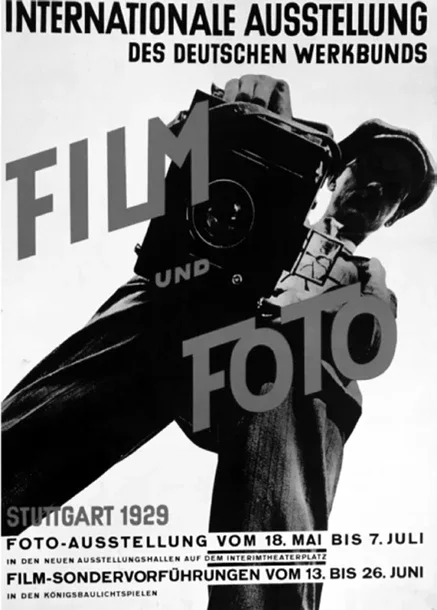
From May to July 1929, a large exhibition titled Film und Foto was held in Stuttgart, Germany, at the new municipal exhibition halls and the Royal Cinema (Figure 1). Initiated and organized by the German Werkbund (Deutscher Werkbund), the exhibition was arranged by country. It brought together the photographic experiments and visual techniques of the most avant-garde Western artists of the day, including Edward Steichen and Edward Weston from the United States, El Lissitzky from the Soviet Union, László Moholy-Nagy and John Heartfield from Germany, F. T. Gubler and Sigfried Giedion from Switzerland, Piet Zwart from the Netherlands, and Christian Zervos from France. The exhibition aimed to break down the boundary between fine art and applied art. It mainly displayed photographic layouts without text, including advertisements, posters, film stills, and scientific images, along with photographic equipment from different periods.[1]219 Its exhibition design in particular drew on Moholy-Nagy's vision in motion and Lissitzky's image-matrix form to create a dynamic visual field. It was less a photography exhibition than an experiment in displaying (photographic and cinematic) images.
Moholy-Nagy and Lissitzky, the exhibition's core creators, were not professional photographers, but photography had always been part of their cross-media experiments. Moreover, debates about photography had already taken place in both the Soviet Union and Germany before the exhibition. In the Soviet Union, for example, what to photograph and why to photograph it in a particular way were the focus of debate. For the Constructivist Lissitzky, however, his "photomontage" was concerned not with the act of photographing itself but with its compositional form. By contrast, in Weimar Germany, apart from the photographs produced by worker-photographers, ordinary photographers were not required to meet social demands.[2]202-203 Perhaps this is why media experiments such as Moholy-Nagy's could emerge at all. The "New Photography" he championed was devoted mainly to visual (formal) invention and experiments with photographic technique. Yet, like Lissitzky, he was a committed socialist, and "production" and "the new" were goals the two men shared.
Moholy-Nagy's practice sought constant innovation and the opening of new ground,[3]15 while the original meaning of Lissitzky's key term, the "Proun Room," was "a project for the new era."[4]256 In a sense, the exhibition can be seen as the product of an encounter and collision between these two figures, representatives of the European and the Russian avant-garde respectively.①
The exhibition undoubtedly opened a new path for modernist photography, and Symbolism naturally became their common enemy. In their eyes, Symbolism was a dishonest photography masquerading as painting. So although photography was the exhibition's main medium, what truly interested them was not photographic subject matter but photography's compositional form, and above all the form of display. In the 1920s, Lissitzky designed spaces for numerous exhibitions in Berlin, Amsterdam, Cologne, Stuttgart, Leipzig, Paris, and New York. Almost without exception, these were devoted to the "world of objects": the press, film, theater, aviation, medicine, agriculture, and trade. What he truly cared about was how to present them through a meaningful, effective, and intensified mode of representation, and in doing so he "developed an advanced system of exhibition techniques employing montage."[4]279 These experiments were highly pioneering. In the words of Lucia Moholy, without Lissitzky's efforts in this arena, contemporary exhibition design would be unimaginable.[5]111
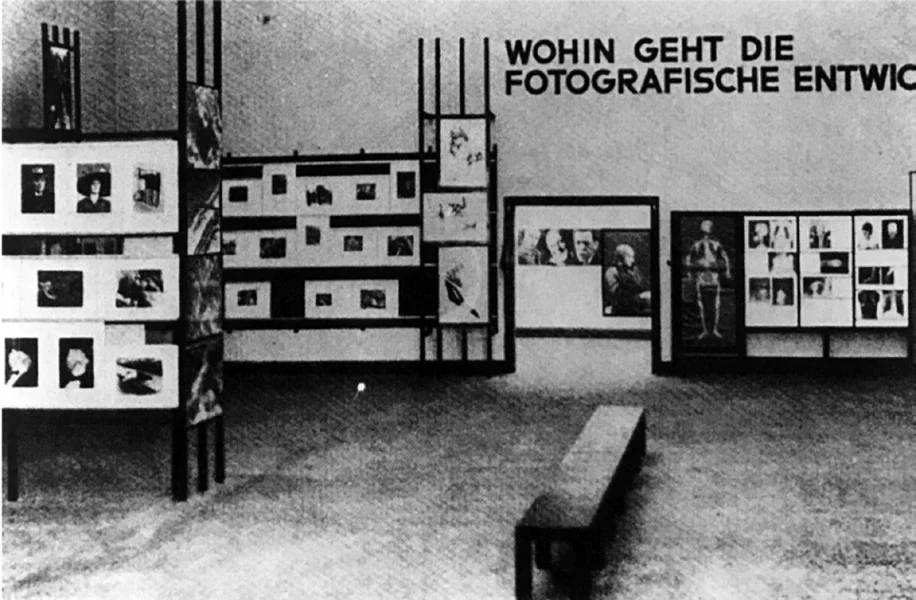
It is worth noting that in 1929, the year of the exhibition, the Great Depression in the United States spread throughout the Western economy and severely damaged it. The Weimar Republic, heavily dependent on American loans, was hit first and hardest. Strictly speaking, the Weimar Republic had been beset by crises from its founding. The left accused the Social Democrats of betraying the workers by blocking a communist revolution, while the right opposed democracy and insisted on returning Germany to its former imperial system. The so-called golden age of the Weimar Republic was only a false prosperity. The economic crisis was therefore fatal for it and even directly led to the Nazis' later rise to power. This is precisely what cast a political shadow over an exhibition originally conceived for wholly practical purposes. Besides, the artistic practices of Moholy-Nagy, Lissitzky, and Heartfield had always been highly political. They chose photography because, for them, photography was a force capable of changing society. Of course, photography here did not mean how to take a picture. Advertising posters, political propaganda, book illustrations, advertising images, and abstract light-projection materials all fell within the scope of photography. For instance, beside the works of Erich Stenger in the exhibition, Moholy-Nagy deliberately hung a wide variety of works that fit his theory of photography. They came from many different sources, including news agencies, research institutions, public archives, and individual photographers. One of the section's titles, "Where Is Photography Heading?", clearly shows his position and that of the exhibition as a whole.
I. "Photomontage": From Image to Form
Born in Hungary, Moholy-Nagy was a pioneer of early twentieth-century avant-garde movements such as Russian Constructivism and Dada, but his most important achievement was advancing the Bauhaus in Germany. Seen from today, many of his works are not necessarily outstanding, but judged by their experimental aims they were all highly avant-garde. Many of his experiments marked the opening of twentieth-century modernist photography. The spread of the "New Photography" in Germany owed a great deal to Moholy-Nagy. In 1925, in the first edition of Painting, Photography, Film, he gave a new definition of photography and its cross-media character and argued that photography's potential was immeasurable.[6]35-36 Section 1 of the exhibition, the "Historical Section," curated by Moholy-Nagy, mainly displayed nineteenth-century daguerreotypes from the collection of the German photo-historian Erich Stenger, together with photographic works from different genres (including zoology, advertising, and aerial views) and the corresponding photographic technologies (Figure 2). For Moholy-Nagy and for the Werkbund alike, reclassifying and reintegrating different forms of knowledge from the standpoint of technology and production meant progress and innovation. Moholy-Nagy was clearly dissatisfied with the order of knowledge classification that had taken shape since the eighteenth and nineteenth centuries. In his view, the political, economic, and cultural decay of the present was largely its result. As he put it, the whole world is in social and economic chaos, and individuals suffer greatly in intellect, emotion, and spirit. ......
Our generation has to accept this challenge and turn anew to the basic elements of healthy living, so as to use them as a foundation for making sense of the conditions around us. By integrating this newly gained knowledge with existing social dynamics, we can move toward a harmony between individual and social needs.[7]6
For Moholy-Nagy, there were no clear-cut boundaries between photography, painting, sculpture, printed matter, essays, graphic design, film, exhibitions, theater, architecture, poetry, novels, and other objects that resist classification. He even deliberately abolished the boundaries between them, reintegrating and reworking them into a new art-object. So although this appeared to be an exhibition of photographs, it fully embodied Moholy-Nagy's artistic program of a "cross-media visual-art movement." "Photomontage" was one part of it, and another section of the exhibition displayed a series of his photomontages.
Moholy-Nagy, however, was neither the inventor nor the first practitioner of "photomontage." As early as around 1920, the Dadaists were already experimenting with the form. It was a mosaic made of magazine clippings, measuring tapes, catalogue illustrations, and the like, its elements roughly pasted together, much like a Cubist collage. In short, it was a kind of "photo-plastic," whose aim was to explore the possibility of expanded vision.[2]211 To the Dadaists, this process of savagely tearing and crudely cutting up photographs expressed contempt for, and rebellion against, the traditional aesthetics of illusionism. These works were full of anger and satirical emotional clamor, aimed directly at the conduct of imperialism during the First World War and at the social defects of the age as a whole. Later, "photomontage" became a "rational" mode of organization that was relatively easy to understand and master. Yet it was still accompanied by the interpenetration and fusion of bizarre relationships, and by the wicked, witty, humorous, and tragic sides of human beings. We can also see it as a technique used chiefly to record events at the border between dream and consciousness. It usually takes the form of a violent collision of bizarre details, in which meaning is often fleeting, sometimes a bitter jest, sometimes a poetic profanation.[7]204
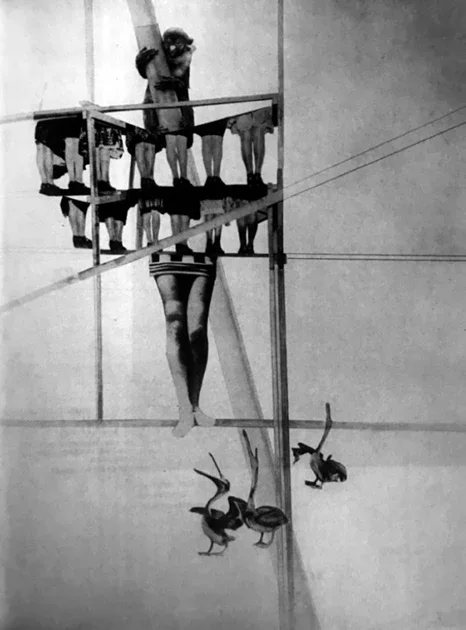
A typical example of "photomontage" is Structure of the World (1925) (Figure 3). The whole image is cut and collaged. On the upper part of a scaffold-like support stands a group of figures arranged in three orderly tiers. The image shows only the half-naked legs of the figures, their upper bodies cut away. At the very top stands a monkey clutching the scaffold's main pole, and the whole construction looks like a mutant species. In the lower right, three long-billed pelicans echo the slanting "scaffold" formally, while also hinting at themes such as evolution, mutation, and the productive relationships among humans, animals, and modern industry. Moholy-Nagy described it as follows: "This photomontage can be dramatic and lyrical, natural and abstract as well...... The photograph here is a combination full of irony, mocking the frightened monkey and the squawking pelicans, who discover that this simple world is made of a leg dance."[7]204 Here he posits an animal's gaze, and what it reflects is precisely a possible perspective from which humans view or imagine the future world. "Photomontage," however, is in fact anti-Symbolist. Its essence lies not in image and meaning but in form and the perceptual force that form conveys. In Painting, Photography, Film, Moholy-Nagy imagined the future of photography. He argued that "compared with the static, dynamic light phenomena can generally produce more differentiation, which is why film (the dynamic relations of light projection) has become the culmination of all photography. Film practice so far has been largely confined to the reproduction of dramatic plots and has not creatively exploited the full potential of photographic equipment. People have clearly overestimated this, so that the other essential elements of filmic form have not been sufficiently refined, including shape, penetration, light-dark relations, and the opposition of movement and speed."[6]31-32 This also explains why Moholy-Nagy turned to "photomontage": it is anti-plot and anti-content and gives more weight to the form of the image and its dynamism. This dynamism comes not from narrative plot or moving images but from the potential of form itself. Clearly, the slanting main pole of the "scaffold" is both the dominant form of Structure of the World and the source of the image's internal kinetic energy. The same holds for the diagonals and
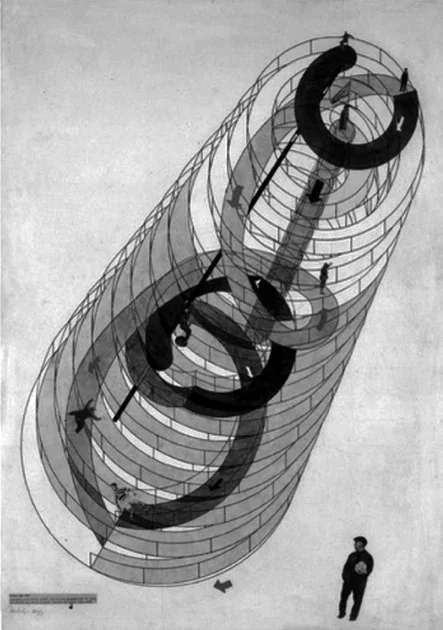
the kinetic structure of another of his works, Kinetic Constructive System: Structure with Movable Play and Conveyance Components (1922–1928) (Figure 4). For Moholy-Nagy, this was the essence of art. He said: "Art may be the result of an inner drive, a relief and a catharsis; it may also be a release from repression and conflict, or a purification of emotional overflow."[7]19
This corresponds to the works of the German photographer John Heartfield shown in Section 3.
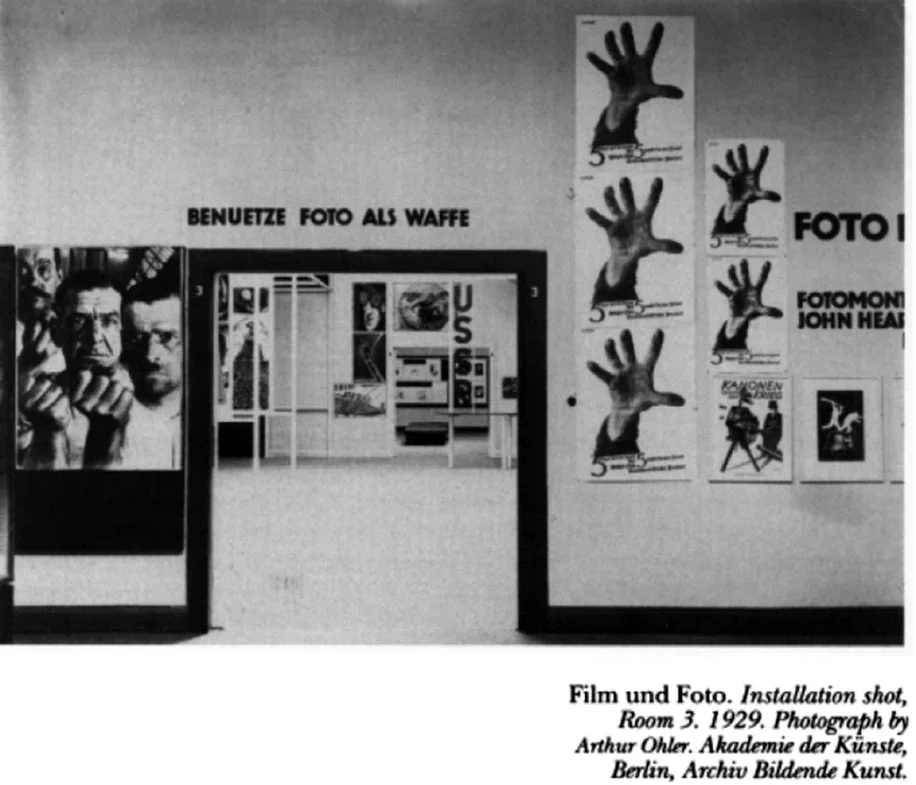
A pioneer of "photomontage," Heartfield chose some of the most powerful emblems of the Weimar era as his subjects: military figures, the New Woman, prison bars, national flags, opposition parties, the American electric chair, and the speculum of the abortion doctor. He devoted himself to criticizing the Nazi regime and thereby achieved great political influence. Above the entrance to his section was written: "Photography as a Weapon" (Figure 5). In the poster on the left, three men with clenched fists foreground the aggressiveness of photography itself. This aggressiveness comes less from the image than from the image's form. The same is true of a group of German Republican Party campaign posters on the right, which form a whole with the figures on the left and turn the entire white-cube space into a Hyde Park speakers' corner. Heartfield offered a powerful "counter-strategy" here. The works drew in and provoked an uncontrollable audience, and the viewers he hoped for were never contemplative (museum) viewers but aimless, staring, furious flâneurs.[8]27 By coincidence, the exhibition's slogans, "Photography as a Weapon," "Painting with Photographs," and "Writing with Photographs," echoed the political demonstrations taking place that same day. Heartfield installed his own works. His task was to design expressive images and forms so that potential consumers would see, at first glance, an attractive and politically inflammatory image. The exhibits in the display windows also caught the attention of passers-by. For Heartfield, the window display was a political stage to be viewed while walking past. This viewing experience was akin to a stirring political debate, not the sensory stimulation of the modernist aesthetic vocabulary. So for Heartfield, the purpose of the exhibition was not to regulate the vitality of a new society but to remind viewers why the politics of a broken society was so hesitant.[8]41 "Photomontage" is not limited to images; letterforms and typefaces can also serve as elements of montage. Piet Zwart, the graphic designer exhibiting in the Dutch section, devoted himself to experiments in "typographic photomontage." In terms of pictorial form, he was deeply influenced by Lissitzky and Moholy-Nagy. In the late 1920s, his series of "typographic photomontage" experiments found a new language combining image and text for modernist design. He typically used large typefaces as "planes" to construct the layout. Within the planar composition, he set these "planes" against one another, contrasted lines, and treated images as blocks against the typographic "planes." Through collision or superimposition, he produced a montage-like design effect.[9]29 This political force grounded in the montage form showed not only within the picture but also in the display design of the works. To keep the exhibition space formally unified, Heartfield, Piet Zwart, and others borrowed Moholy-Nagy's design in their installations, and Moholy-Nagy's design was itself largely influenced by Lissitzky and the Russian avant-garde as a whole. This is evident from his unrealized project, the Room of the Present (Figure 6). This ingeniously designed multimedia gallery was originally commissioned in 1930 by the pioneering curator Alexander Dorner for the Hanover museum in Germany, but unfortunately it was not realized at the time. Only in 2009 was it precisely reconstructed by the art historian Kai-Uwe Hemken and the designer Jakob Gebert. With undulating glass walls, interactive devices, industrial materials, mechanical reproductions, advanced display technologies, and images from every field of Bauhaus design, the Room of the Present fused academic art history and mass media in an unprecedented way. This article cannot discuss the existing literature on the Room of the Present in detail, but its central ambition has not faded. It sought to use contemporary media and technology to focus on contemporary media and technology (for example, automatic slide projection that captured moving images, and backlit rotating displays of exhibition photographs), and to become the culmination of an art history running from medieval altarpieces to Lissitzky's Abstract Cabinet (Abstraktes Kabinett, 1927–1928).[10] To trace it to its roots, then, we must return to Lissitzky. Formally, it is clearly not fundamentally different from Lissitzky's Abstract Cabinet and Proun Room. Moholy-Nagy's paintings from this period, such as G5 (1925), Construction 1280 (1927), and p27 (1927), also bear the style of Lissitzky's Constructivist painting. No wonder he was called Germany's "futurist Constructivist."[2]63 It should be remembered that Constructivism was at first plainly called "production art," and the artists consistently placed their emphasis on the technical level, even
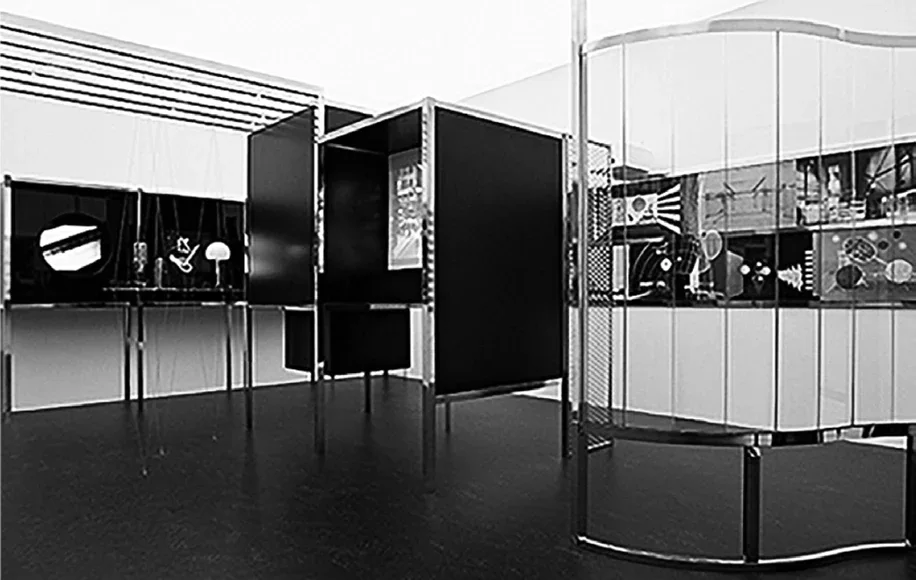
demanding that technology replace any form of style.[4]259-261 In 1922, Moholy-Nagy published the short essay "Production–Reproduction" in the journal De Stijl, which likewise stressed the importance of production and technology. As he put it: "Creation is valuable only if it produces new, hitherto unknown relationships."[11]339 Both the form itself and the principle of "production" show that the relationship between viewer and work is no longer one of "seeing" but of "making,"[12] of "acting." So if the meeting of Moholy-Nagy and Lissitzky symbolized the convergence of the Soviet Russian and European avant-gardes, the Film und Foto exhibition signaled their shared intention to launch an international Constructivist movement.
II. Lissitzky's "Image Matrix" and the Politics of Form
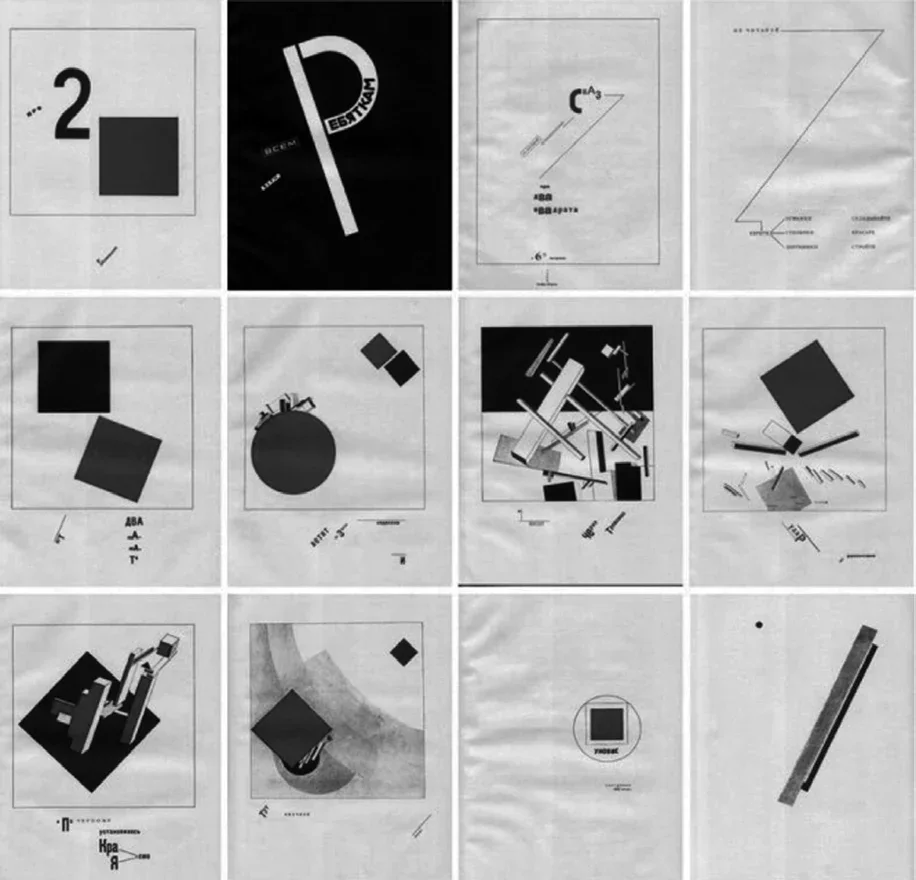
Section 4 of the exhibition was the Soviet pavilion curated by Lissitzky (Figure 7). It presented Soviet film and photography, including Eisenstein's film techniques. Most of the images on display had a pronounced montage character; one could even say that these images, derived from film, were already a kind of "photomontage." In his many poster designs, Lissitzky showed his mastery of the "photomontage" technique. As with Moholy-Nagy, the diagonal was an important dominant stylistic element in his posters. Acting as a vector, it gave the picture a kinetic energy spiraling toward the upper right or upper left. This clearly derives as well from his corresponding abstract planar or Constructivist works. A Tale of Two Squares (Figure 8), completed between 1920 and 1922, is one of Lissitzky's most representative Constructivist works and his first "simultaneous" book describing the future. The book simultaneously adjusts the spatial and temporal dimensions of words, that is, their image and sound, bringing the two into a new unity. This in turn leads toward the moving image, and there is evidence that the idea of the moving image was central to his thinking about new forms of the book. One could even say that his ambition was to create a dynamic "book form."[2]49-56 In fact, even before this, he had been experimenting with the "Proun series" (1919).[4]257 A Tale of Two Squares can be regarded as another form of the "Proun," and in 1923 he extended it into the three-dimensional Proun Room (Figure 9). According to the complete diagram of the Proun Room provided by Lissitzky, when viewed from different angles (front, left side, and above), it is a continuous or integral A Tale of Two Squares. In Lissitzky's conception, it was not only a space that could be unfolded flat but also a rotatable topological space. However its orientation, position, and structure changed, its ultimate dominant form remained a Constructivist work. In designing the Soviet pavilion for Film und Foto, Lissitzky carried this form over; in other words, its dominant framework was still the Proun Room. The only difference was that here he replaced abstract points, lines, planes, and numbers with photomontage images.
In fact, from the very beginning of the Russian Revolution, Lissitzky stood at the forefront of painters. While bullets were still whistling through the streets of Moscow, he was already seeking permission and opportunities to create propaganda works. His enthusiasm for propaganda posters shows that he identified with the revolution wholeheartedly and threw himself into its torrent. The most typical example is the long photomontage frieze he and Sergei Senkin created for the Soviet pavilion at the 1928 International Press Exhibition (Pressa). The frieze assembled all kinds of images of the Russian Revolution, joined together through various montage techniques. It had neither narrative nor plot; form alone was enough to manifest the energy of the revolution. Although Film und Foto included no such frieze, the joining of single images and their continuous mounting deliberately created a similar form. Lissitzky did not hang these images at normal viewing distance and height. Instead, like an image-matrix installation, some were pasted on the walls and some hung on specially designed cubic frames. This form was highly consistent with Lissitzky's revolutionary aesthetic style.
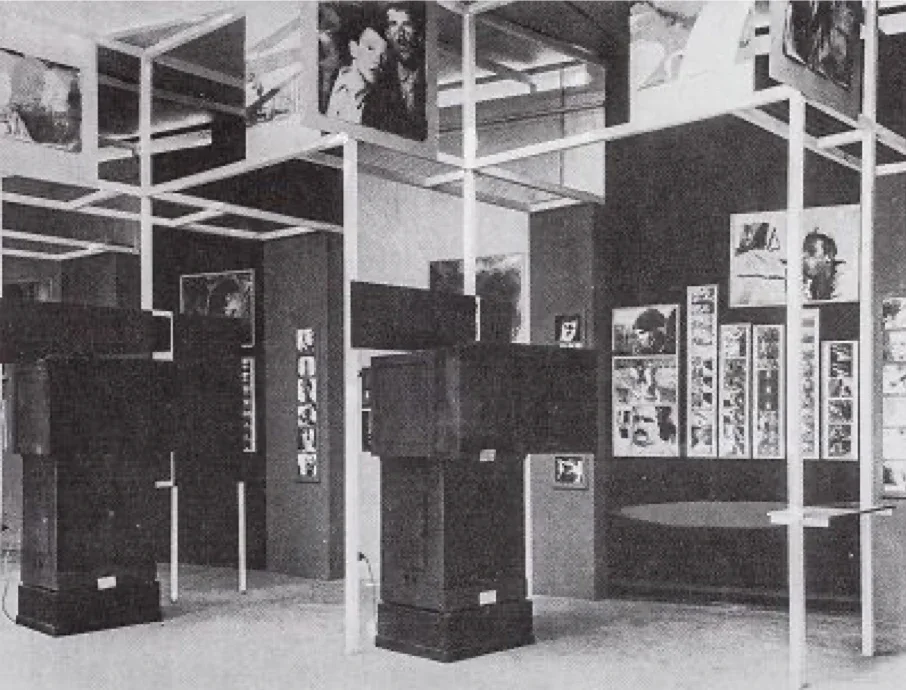
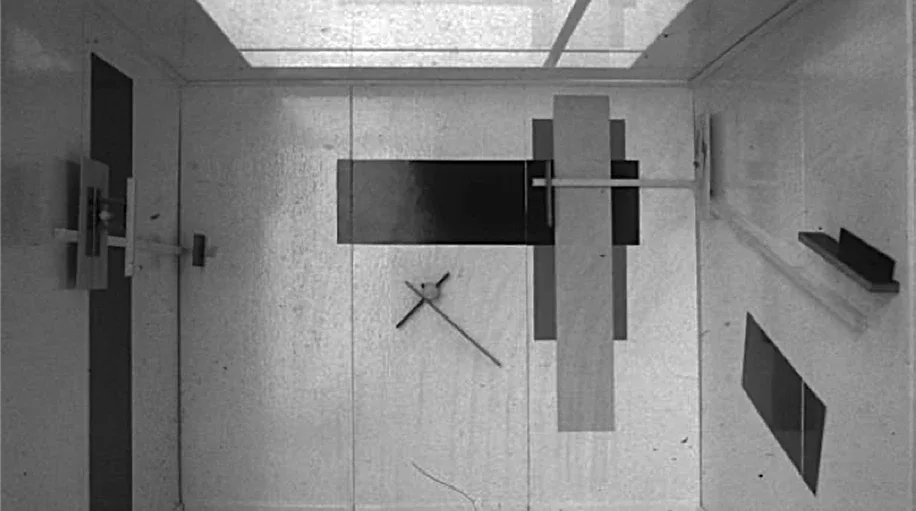
As Camilla Gray pointed out, in the Soviet pavilions of numerous international exhibitions in the 1920s and early 1930s, Lissitzky developed an advanced system of exhibition techniques employing montage.[4]279 This installation method was based entirely on the dynamic fusion of the exhibited works with the room as a whole.[4]261 Lissitzky and his team exploited photography's physical adhesiveness, its capacity to be pasted onto complex surfaces. Through the advantage of compressed multidirectionality, they greatly intensified this perceptual experience of spatial montage. This strategy accelerated the images' leap out of their original domains. Here it was more like a three-dimensional interactive medium in which visitors played an active role, shaping his or her own reality. Removed from their original contexts, these images were stuck to walls or scaffolding like rescued orphans and formed new relationships within the linear matrices in which they were arranged. The exhibition enveloped visitors in a dynamic space and encouraged them to participate actively and immerse themselves in it. Many of its sensational elements flashed on their own, while others shifted and transformed as visitors wandered through the space. Formerly, a viewer walking past a wall of paintings would be enthralled by them and fall into a kind of passivity. Now the exhibition activated the viewer. It prevented contemplation and prompted viewers to become shapers of the artwork, jointly creating a moment of collective perception. Of course, Lissitzky's aim was not only to regulate active experience but also to stir up political agitation; he wanted to see how his images would be reshaped in the everyday spaces of the Weimar era. It was precisely through this distinctive mode of display that photomontage achieved the greatest possible superimposition and proliferation. Every exhibition room Lissitzky designed sought to develop his avant-garde idea, which had already been realized in its purest form at the 1922 Berlin art exhibition and ran through all his later display designs. Clearly, the idea behind this image-matrix exhibition design came from the "Proun Room." Lissitzky once said: "Cubism moves along tracks on the ground; the structure of Suprematism follows the straight and curved lines of the airplane; the Proun Room, by contrast, leads us to build a new body, a spatial model that begins from the plane and becomes three-dimensional, from which all the objects of everyday life can be constructed."[5]113 Architecture and urban space, for example, also fell within his purview. Not coincidentally, Moholy-Nagy had also conceived a film script on a related theme, Dynamic of the Metropolis.
In Moholy-Nagy's conception, film, arising from recording apparatus and kinetic vitality, was undoubtedly a highly radical proposition. The purpose of film lay neither in edification nor in exhortation, nor in narration. What it sought to show was purely visual effect: making maximal use of the equipment, autonomous visual action, and the division of visual speed, rather than literary or dramatic plot. It sought the vitality of the seen, in which many movements even escalate into violence.[6]198 Although only a script, Dynamic of the Metropolis aimed to draw the audience into the dynamism of the metropolis through "the purely visual effects among visual elements." Moholy-Nagy believed that a "unity of impressions" constructed in this way would be more real than "life itself."[11]162 Thus, "in the vertigo brought by photoelectronics, everything flows into vision, and vision becomes myth. Function and desire are subtly confused, and there is a covert switching between the functional order and the symbolic order. At the moment when the 'design inspiration' kindled by light bursts forth, 'all the images detached from life merge into a single stream.'"[11]164-165
III. Vision in Motion, the "Total Theater," and the Mediatized Museum
Both "photomontage" and the "image matrix" show that the Film und Foto exhibition as a whole sought to display, and to release as fully as possible, a movement and speed of innovation and production. "Photomontage" demands intense concentration of eye and mind in order to accelerate visual comprehension and widen the range of associative relationships.[7]204 In other words, "photomontage" in itself carries a sense of movement and speed. Likewise, for Lissitzky and Moholy-Nagy, the "image matrix" was from the outset a visual space in motion, a stage of light and shadow in motion. Earlier, in a discussion of "indoor picture galleries," Lissitzky had said that the future development of exhibition display "will very likely place the emphasis on dynamic projected forms, even on interpenetrating beams and patches of color floating freely in space without any direct projection surface."[6]23 Moholy-Nagy likewise believed that "the film stage of the future will be a combination of movement, light, and shadow effects. It will be either a skeletal structure or walls, planes, surfaces, and textures for the absorption, reflection, and organized distribution of light. Such a stage concept, rather than a backdrop, will be for vision in motion."[7]264
For Moholy-Nagy, distinctions between media had never existed in the first place. Film was a medium he returned to again and again, and one of his ways of perceiving reality and envisioning the future. Yet his understanding of film in fact went beyond film itself. In his eyes, for example, the Suprematist Malevich's "white square" paintings were screens. We can see them as a transition from painting with pigment to painting with light. In this process, the white surface became a "theoretical" screen for the direct projection of light, that is, light in motion, or a space-time reality. "It anticipates a new prospect. It may be seen as an intuitive victory over the present misguided efforts of film, (because) present-day film more or less successfully imitates the pictorial composition of past easel painting, with its monocular vision and picture-like scenes."[7]264 In such a statement, it is easy to see that what Moholy-Nagy understood by film was not narrative and content but a form of movement. He even held that the key to filmmaking lay in how to generate movement. In the perceptual, conceptual, and emotional realms there are countless ways of editing a film. For instance, the "cubist" editing that profoundly influenced montage aimed to overcome the psychological and physical (that is, experiential) sense of time and space. He therefore argued that future montage must give more consideration to the film as a whole and place greater emphasis on perceptual information, light, space, movement, and sound, rather than foregrounding visual detail.[7]271
On this basis, Moholy-Nagy proposed "abstract film." As an extension of "photomontage" and "vision in motion," "abstract film," like all other modes of expression, initially acts directly on the senses through specific visual and perceptual elements. If ways could be found to consciously control the "photobcreative" in order to heighten its appeal, the importance of such film would steadily grow. Here, the increasing use of pure color in film is no different from abstract painting.[7]265 "Abstract film" can therefore be called an abstracted "photomontage."
By comparison, Moholy-Nagy's "Lightspace" and "total theater" were more extreme and thoroughgoing than "abstract film" (Figure 10). If Lissitzky's "Proun Room" opened up a multi-perspectival space made of movement and flows of energy, Moholy-Nagy's "Lightspace" sought to have viewers abandon physical space and immerse themselves more deeply in a field woven of light, shadow, color, and movement. The circus and variety theater inspired his "total theater" to some extent. For him, though, one should not ask what contemporary abstract painting is or what it represents, because it is simply a form, and also an organism. What he called theater was therefore in fact a "synthetic performance" composed of sound, light, color, space, form, and movement. Human beings were no longer even necessary performers; they might be replaced by a puppet or a purely abstract object. Light was no longer merely one element of stage narrative but was itself a form of energy.[13]210 On this basis, the whole space also released a power strong enough to command every plastic medium.[14]72-98 It is also worth noting that as early as the mid-1910s, the Russian Futurists and Constructivists had, in the name of production art, incorporated traditional forms of theater (such as the circus, music hall, variety theater, Japanese theater, and puppet theater) into their work. By the late 1920s, in pursuit of the lofty mechanized utopia they envisioned, theater design had even become an important direction of their practice and action.[4]270 Evidently, Moholy-Nagy and Lissitzky shared similar ideas about and experiences of theater from the very start.
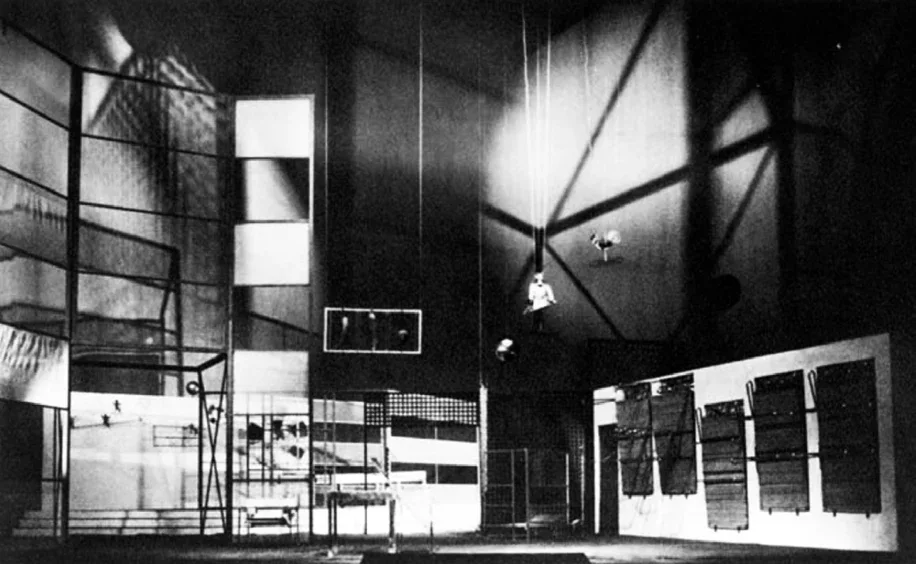
We might therefore imagine the overall display design of Film und Foto as a variant of Moholy-Nagy's "abstract film," "Lightspace," and "total theater," and of Constructivist theatrical experiments. Fundamentally, both Moholy-Nagy and Lissitzky hoped to arrive at such an abstract space of vision in motion, and thereby to "distill the limits of sensory capacity."[2]86-87 Lissitzky emphasized the abstraction of compositional elements precisely in order to find a force capable of expressing something beyond individuality or nationality. For him, it was precisely such a force, "a mad force before which all men shrink back in shame," that would shape a new world.[2]42-43 This also explains why the exhibition was titled Film und Foto even though it showed no films. There were some film stills, but they came nowhere near forming the main body of the exhibition. What "film" really referred to here, then, was how the entire exhibition constituted what Moholy-Nagy called an "abstract film" or "total theater." This was a revolutionary mode of display. In it, the works on the one hand relied on the walls and on the other destroyed them, so that the exhibition space itself became mediatized. In other words, the museum's function here was not only to provide a space for displaying works but also to give itself over and become an element of the work or the exhibition, so that the whole space, not just the works, formed a dynamic organism. Conversely, in such a mediatized space, the works were actually submerged in waves of casual perception and distraction. To activate the space of reception, Moholy-Nagy did not treat film or photography as the problem but as the means of solving it. Nor did he seek to negate or subvert the desire for film or photography; rather, he dialectically preserved and abolished that desire at once. That is, it was an interpretation of the rise of a mediated conception of time and space. The museum here was no longer a passive and fluid space of "registration" but a "spaceless darkness" freed from the constraints of time, space, and gravity.[15]25-52 Lissitzky's experiments were not quite so radical, but this was, needless to say, also the original intention of his "Proun Room": "to create a directionless vacuum world."[12] Of course, space here refers not only to the physical space of display but also to social space. Vision in motion refers not only to artistic or perceptual movement but also to social movement, or social revolution. It was, rather, a challenge to and revolution against the museum order and its conception of time and space that had formed since the nineteenth century, launched after the First World War. Nor were the avant-garde artists in the exhibition, such as Moholy-Nagy and Lissitzky, the only ones behind this countercurrent; it also included Futurism, Dada, Cosmism, and art historians and thinkers such as Aby Warburg and Walter Benjamin. In 1952, The Voices of Silence, the precursor of André Malraux's famous Museum without Walls, was published in Paris. The book was once regarded as the text closest to Warburg's unfinished Mnemosyne Atlas (1927). In discussing the background to the formation of "form-style theory," Malraux took an original approach and attributed it to the expansion of museums and the rise of photography.[16]5-6
Yet it was also photography that became his starting point for opposing "form-style theory" and his path toward the "museum without walls." On this point it indeed comes very close to Warburg's method and ideas. Both Warburg and Malraux used photography (photographic images) to thoroughly demolish the museum order and its conception of time. Warburg even declared that the Mnemosyne Atlas was a kind of montage, a kind of Dada.[17]214 In this sense, the Mnemosyne Atlas is undoubtedly the best gloss on the Film und Foto exhibition. Futurism was even more extreme by comparison. In the Futurist Manifesto, Filippo T. Marinetti declared:
"Museums are cemeteries!...... How alike they are from the start: dismal gathering places of bodies unknown to one another. Museums are public dormitories where enemies or strangers sleep forever side by side! Museums are absurd slaughterhouses of painters and sculptors, who butcher one another with colors and lines along the walls of rivalry!"[18]
At the same time, Cosmism, a current of thought then popular in Russia, also cast the museum in an important role. In the eyes of its founder, Nikolai Fedorov, only when the museum turned to dust could every dead person be resurrected.[19] After Stalin came to power, Cosmism was banned as heresy. Yet Fedorov's "museum turned to dust," Marinetti's "museum as cemetery," and the "mediatized museum" of Moholy-Nagy and Lissitzky all flowed together into the then-clamorous wave against the museum order. Their aim was not only to oppose the museum order but, more importantly, to create a new future. This is exactly where the avant-garde and revolutionary character of Film und Foto lies. It was, rather, a form of Futurism, a "propagator of movement, speed, and vitality, a bard of technology."[3]302
Coda
Lucia Moholy reminds us that the Film und Foto exhibition actually grew out of a magazine founded in 1927, i10: Internationale Revue (1927–1929). The magazine was founded by Arthur Müller Lehning, and its editorial team included J. J. P. Oud (architecture), Willem Pijper (music), and László Moholy-Nagy (film and photography). Its roster of contributors was even more impressive, including Le Corbusier, Gropius, Kandinsky, Mondrian, Moholy-Nagy, Benjamin, Ernst Bloch, Alexandre Berkman, and J. J. P. Oud. Clearly, Moholy-Nagy carried the ideas of i10 straight into the exhibition. Lehning had a clear understanding and clear goals when he founded the journal. He hoped that i10 would gather documents of new currents in art, science, philosophy, and sociology and become an organ of modern thought. He wanted to establish a platform for expressing the constant renewal in every field and to build as many connections as possible among these different fields. Lehning said: "Since this journal advocates no dogmatic tendency and represents no political party or group, its content will not always have a fully unified character, and it can offer more information than if it followed a single line of thought. Present-day culture is undergoing renewal; the journal hopes to present this comprehensively and to be open and international for all who express it." They hoped to "give voice to a generation, believing that a common endpoint would be found in diverse fields of knowledge. They opposed narrow conceptions of specialization and set the goal of building a framework in which advocates of every discipline could be heard, whether they used Dutch, German, French, or English."[20]109-110
This kind of international alliance inspired Moholy-Nagy to some extent, which is why Film und Foto was structured by country. It was also in keeping with Moholy-Nagy's consistent artistic and political program. Victor Margolin summarized it as follows: "Artists belong to the vanguard of social change and should strive, through material practice, to make visible the nature of a utopian society; art is not practiced in isolation and at random within its aesthetic domain; form and image can be built upon a common, universal understanding."[7]X Clearly, these ideas and practices of Moholy-Nagy permeated the Film und Foto exhibition. Yet the exhibition was like the last great echo of a turbulent age. With the decline of the Weimar Republic, the rise of Hitler and Stalin, and the outbreak of the Second World War, this avant-garde wave gradually subsided.
References
[1] Bruce Altshuler. Salon to Biennial: Exhibitions That Made Art History (Volume 1: 1863-1959) [M]. London: Phaidon Press Inc., 2008.
[2] Victor Margolin. The Struggle for Utopia: Rodchenko, Lissitzky, Moholy-Nagy (1917-1946) [M]. Translated by Fumei Zhang, Changzheng Zhang, Cheng Zhu. Beijing: Peking University Press, 2018.
[3] László Moholy-Nagy. The New Vision: From Material to Architecture [M]. Translated by Yi Liu. Chongqing: Chongqing University Press, 2020.
[4] Camilla Gray. The Russian Experiment in Art [M]. Revised by Marian Burleigh-Motley. Translated by Xinwei Xu. Hangzhou: Zhejiang People's Fine Arts Publishing House, 2019.
[5] Lucia Moholy. "El Lissitzky" [J]. Translated by Jorden Troeller. OCTOBER 172, 2020(1): 111-116.
[6] László Moholy-Nagy. Painting, Photography, Film [M]. Translated by Yao Zhang. Chongqing: Chongqing University Press, 2019.
[7] László Moholy-Nagy. Vision in Motion: The Foundations of the New Bauhaus [M]. Translated by Bo Zhou, Cheng Zhu, Yun Ma. Beijing: CITIC Press, 2016.
[8] Andrés Mario Zervigón. "The Peripatetic Viewer at Heartfield's 'Film und Foto' Exhibition Room" [J]. OCTOBER 150, 2014(3): 27-48.
[9] Jingjing Liu. Modernism: The Mother Tongue of Design [J]. Art & Design, 2017(8): 22-35.
[10] Noam M. Elcott. László Moholy-Nagy [EB/OL]. Translated by Keke Du. http://www.artforum.com.cn/print/201608/9960, 2016-10-15/2021-3-25.
[11] Shiyan Zhou, Jiahao Wang. The Bauhaus Paradox: The Critical Point of the Avant-Garde [M]. Wuhan: Huazhong University of Science and Technology Press, 2020.
[12] Jingzhi Pan. The "Paradox" of Exhibition: This Is Not a Conclusion [Z]. Unpublished manuscript, 2021.
[13] Rosalind Krauss. Passages in Modern Sculpture [M]. Translated by Ke Qiao, Yan Wu. Proofread by Lin Lin. Beijing: China Nationality Photography and Art Publishing House, 2017.
[14] Oskar Schlemmer, László Moholy-Nagy, Farkas Molnár. The Theater of the Bauhaus [M]. Translated by Jiali Xu. Guangzhou: Lingnan Fine Arts Publishing House, 2020.
[15] Noam M. Elcott. "Rooms of our time: László Moholy-Nagy and the stillbirth of multi-media museums" [G]. Screen/Space. Edited by Tamara Trodd. Manchester: Manchester University Press, 2011: 25-52.
[16] André Malraux. Museum without Walls [M]. Translated by Ruihua Li, Nan Yuan. Proofread by Yixue Sun. Guilin: Guangxi Normal University Press, 2001.
[17] Margaret Iversen. Retrieving Warburg's Tradition [G]. In Donald Preziosi, ed. The Art of Art History: A Critical Anthology. Translated by Yi Ying, Chunchen Wang, Jun Peng, et al. Shanghai: Shanghai People's Publishing House, 2016: 207-225.
[18] Filippo T. Marinetti. The Futurist Manifesto [EB/OL]. http://www.doc88.com/p-742552413048.html, 2012-4-28/2021-4-1.
[19] Molly Nesbit. Cosmist Rays: The Rise of Cosmism [EB/OL]. Translated by Juan Guo. http://www.artforum.com.cn/pri nt/201802/11175, 2018-2-12/2021-4-1.
[20] Lucia Moholy. "International Avant-Garde, 1927-1929" [J]. Translated by Jorden Troeller. OCTOBER 172, 2020(1): 109-110.
Notes
① According to Lucia Moholy's recollection, around 1926 Moholy-Nagy and Lissitzky discussed photography, typography, and related questions on many occasions. Lucia Moholy. "El Lissitzky" [J]. Translated by Jorden Troeller. OCTOBER 172, Spring 2020: 116.