
Gregory Crewdson's work rewards long looking. Whether we gaze at a single image for a long time or take the pictures in as a sequence, we notice one thing: these images are so dense and so richly detailed that our eyes can't help lingering in them. At the same time, it is often remarkably hard to say what a given work is about, or to convey to someone else how it feels to stand before one of Crewdson's pictures. All that is left is to keep looking.
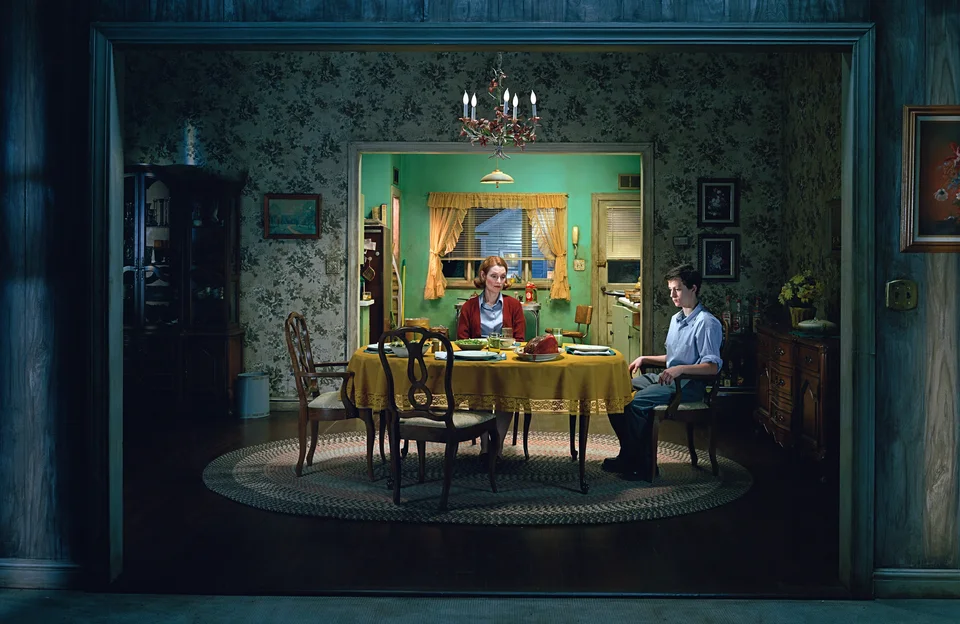
Let us begin by looking closely at one image from Beneath the Roses (2003–2008), the series that marks the maturity of Crewdson's method. In this dinner scene, the first thing that strikes us is the way the dramatic lighting brings everything into focus: a man and a woman sit at a table covered with a yellow cloth. The dark teal wallpaper and dark furniture on either side of a wide doorway form a frame within the frame. What is on the table? Plates, a roast, salad, cutlery, napkins, wine glasses. The food is neatly laid out and shows no sign of having been touched. The woman, in a red jacket and blue blouse, stares blankly at some indeterminate point. The man sits turned to the side. His gaze is not directed at the woman, and it is hard to say he is even looking at the food; his eyes seem to pass beyond the edge of the picture. Behind this main scene is a second doorway. A moment's thought tells us it leads to the kitchen, where we can make out green walls, yellow curtains, and a cold blue dusk beyond the blinds. Strangely, the sharp contrast of the lighting compresses this physical depth into a flat plane, so that what lies behind the woman looks less like a space than like another enormous painting hanging on the wall. Physical depth would normally mean accessibility: the space behind the scene really is there. Once it is compressed into a painterly surface, that accessibility disappears. We all know that the surface of a canvas is only an illusion of the three-dimensional world it represents.
What does this work show? Everything is ready, yet nothing has begun. Everything is over, yet no one has gotten up to clear away what is left. Has the meal just been served, or has it already gone cold? Are the two of them in the aftermath of a quarrel, or in the middle of a long silence? The image holds us in a low-grade tension and unease. There is no sign of conflict, but the scene is plainly not warm either. It contains nothing horrific, not even a hint of death, and so there is no threat.
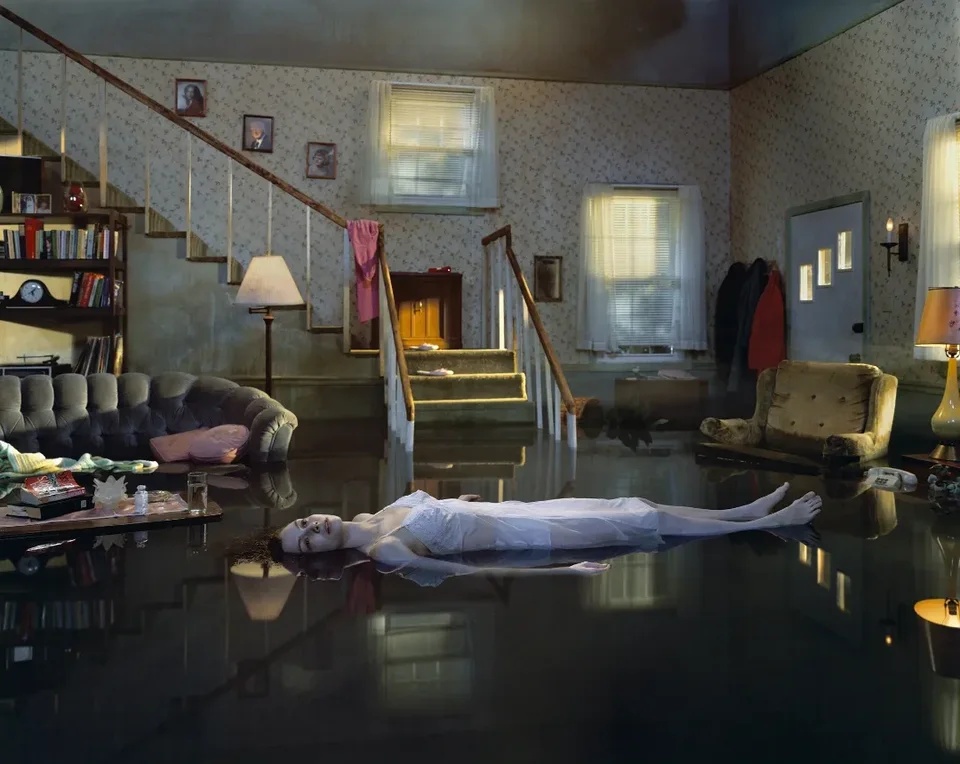
Now consider Untitled (Ophelia) (2001), a celebrated image from the Twilight series (1998–2002). A woman in a white nightgown floats on her back in a flooded living room. The water's surface is as still as a black mirror. The scene ought to be horrifying, yet it gives off a serene stillness. Her eyes are open, but we do not know what she is looking at, nor can we tell whether she is "awake." Are we seeing the moment before the "event," or after it? Again there is no answer. Still, the image nimbly calls up thoughts of suicide, drowning, flood, or dream. Our attention settles on nothing definite, yet some force keeps guiding its free movement.[1]
What these two works share runs through nearly all of Crewdson's output. The light is obviously not natural, yet unlike "stage lighting" it does not serve any particular object. It diffuses and seeps, but unevenly. Viewers can see a great deal, but nothing has yet been "marked" by the light as the one meaning that governs the image. Cinematic photography, the uncanny, loneliness, alienation: these familiar labels each capture something real about Crewdson's work. Yet when we face these images, part of our response still seems to lie beyond what those terms illuminate.
How are we to account for this response? Crewdson himself may have offered a way in long ago. His father was a psychoanalyst whose early practice was in the basement of the family's brownstone in Brooklyn (the basement is also a recurring motif in Crewdson's work). Crewdson has said: "I would put my ear to the floor above his office and try to imagine what was happening, constructing a picture in my mind of the scene below."[2] He has also said more than once: "What he did beneath the living room floor was forbidden and mysterious. Why were these strangers coming to the basement door of the house? Somehow I was shaped by this idea that there are secrets beneath the surface of things."[3] In the most literal sense, what Crewdson does is eavesdrop. This is the first key term I want to use to define his work.
What does eavesdropping feel like? A child lies on the floor with his ear pressed to the gaps between the boards, listening to faint rustlings. His body is still, but it is held in an intense state of self-restraint. He must not move, because moving makes noise, and noise would drown out the faint sounds beneath the floor. The creak of the floorboards, the distant hum of traffic, muffled voices from below, even his own heartbeat rise and fall one after another. He hears far more than usual but understands far less. The voices have a rise and fall, a rhythm; he may even pick out something with the texture of crying, but he can never be sure that it is crying. So the eavesdropper has to call on his imagination. That imagination is drawn out by the blurred sounds from under the floor, and each fragment of sound both sparks it and limits it. The eavesdropper can sense that something important is happening, but its actual content will never be open to him. Eavesdropping at the door has no ending, unlike watching a play or reading a book, which eventually reach a conclusion. The eavesdropper waits for a clarity that will never come, and what drives the eavesdropping is precisely this search for clarity.
The eavesdropper never gets the voyeur's satisfaction. When the voyeur sees his object, his perception is fulfilled; when he doesn't, he is frustrated. But the child on the floor can never confirm what it is that he has heard, and his perception can never be fulfilled. This is why Crewdson's images never offer a moment of sudden understanding. His is a secret with no solution, and it leaves the viewer permanently outside the consulting room door. Crewdson himself has said: "If I knew exactly what the story was, I wouldn't need to make the picture."[4] Like the viewer, he is trying to make out that sound. His entire practice, then, consists of pressing his ear to the floor again and again, using every means at his disposal to make the sound a little clearer, and then clearer still. His grand "cinematic" productions are simply the inevitable result of this effort. Yet the floor has never become transparent because of it.
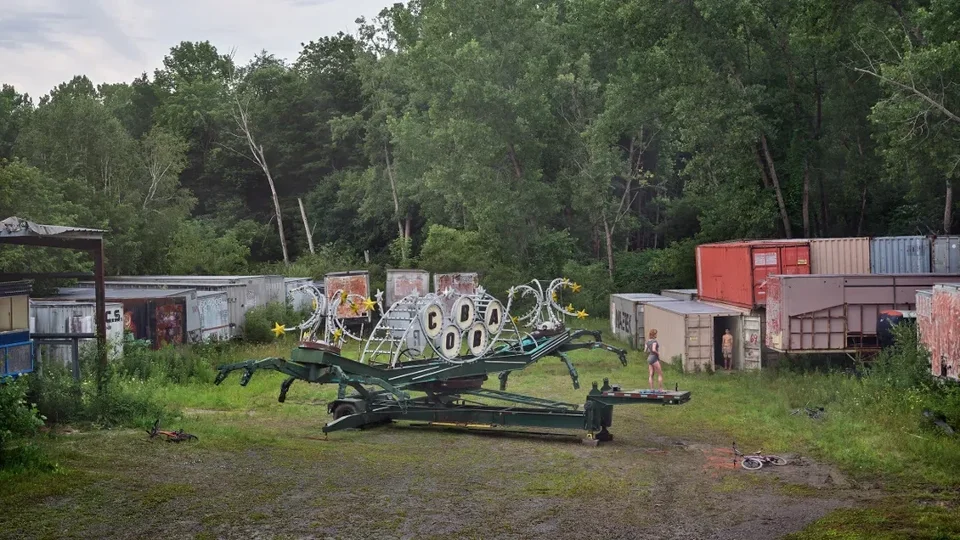
Eavesdropping, however, presupposes that something really is happening beneath the floor, even if it cannot be heard clearly. In Crewdson's later work, this presupposition itself begins slowly to give way. In The Cobra (2018–2019), for example, almost everything that triggers the urge to eavesdrop has vanished. Unless you look carefully, you might not even notice the two tiny human figures among the shipping containers and trees. The sky is a leaden gray-white; the light still keeps the whole scene visible, but its drama has clearly faded. Is there still an "object" here in any real sense? And in Madeline's Beauty Salon (2021–2022), even the color has been reduced to black and white. A pane of glass simply separates us from the two women inside, telling us outright that eavesdropping is impossible.
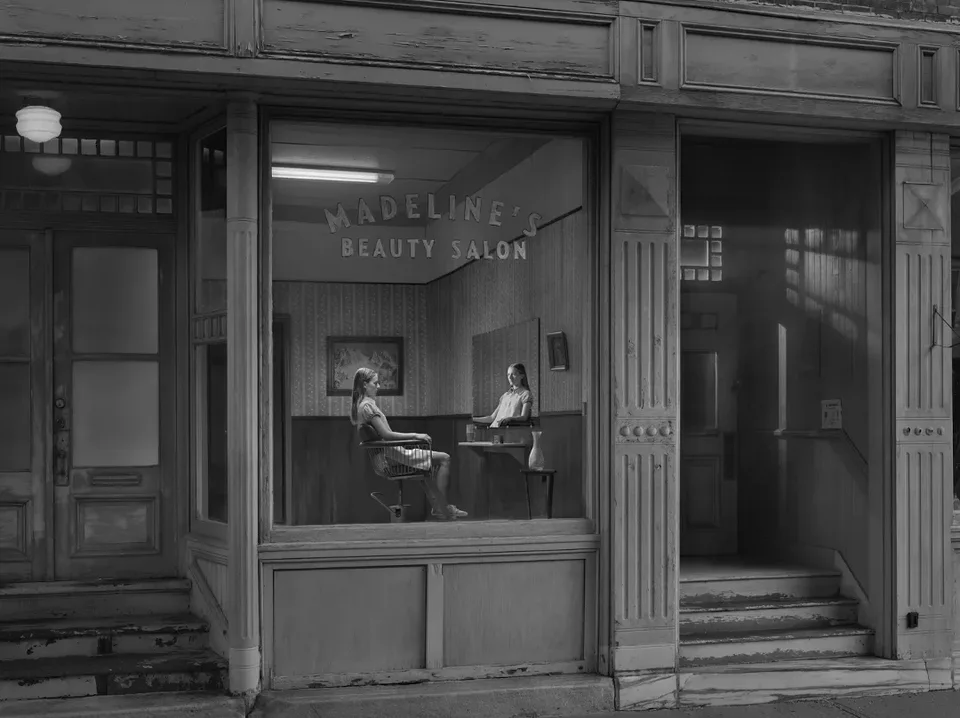
This is where the shift happens. The experience of eavesdropping has an internal tendency, a tense, straining posture, and that posture cannot be sustained forever. At some moment the eavesdropper will realize that he can never truly grasp his object. The tension then changes from a sharp-edged feeling that calls up murder, horror, and suspense into a more diffuse and more anti-dramatic presence. The structure of eavesdropping is still there, just as the shop window in Madeline's Beauty Salon remains a literal eavesdropping device, but the way it is felt has grown steadily heavier and more grave.
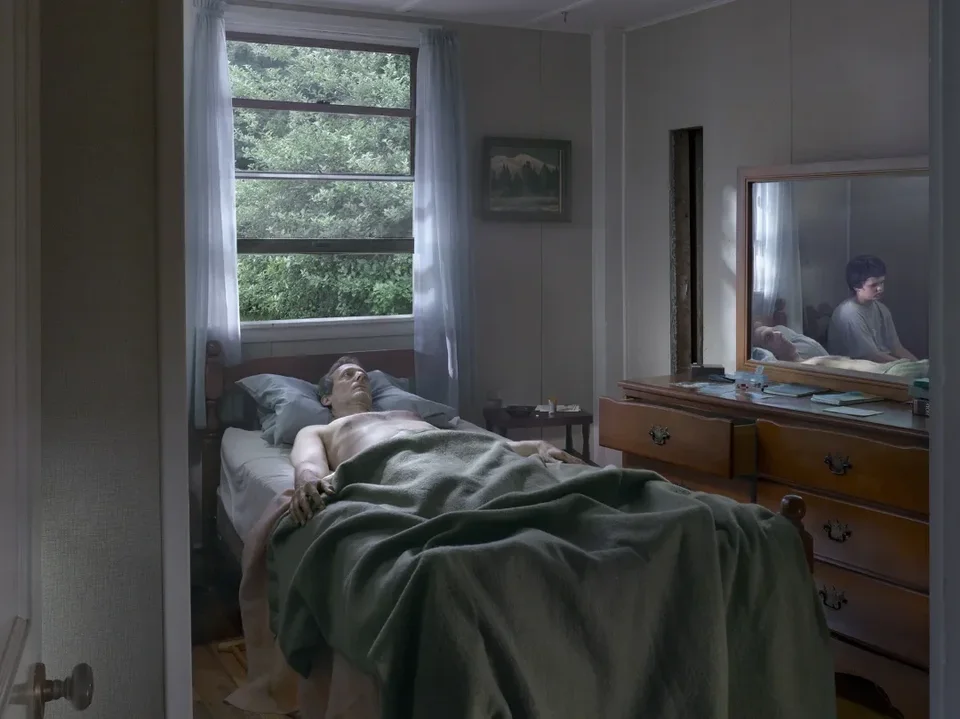
Having given up the search for clarity, the eavesdropper still does not get up off the floor and leave. His attention keeps working; it has simply stopped trying to identify anything. What remains is something close to pure "presence" itself: a sustained attention that no longer fixes on an object yet never slackens. This feeling comes close to a vigil. What is it like to keep vigil? It means staying awake, even staying attentive, while others sleep, without being able to intervene. The one keeping vigil cannot bear the patient's suffering for him, just as the son in Father and Son (2013) can only sit there, seemingly indifferent. In this image, a half-naked man lies on a bed, a green blanket covering the lower half of his body, one hand hanging limply over the edge. A mirror on the dresser reflects a boy in profile. The boy is not in the picture's direct space; he exists only as a reflection, sitting in the narrow gap between the bed and the wall, and the wall in the picture happens to block our direct view of him. Neither looks at the other. The daylight in this work is gray-white and even. The boy's posture is no longer that of an eavesdropper. He is not trying to hear anything clearly; he is simply there, keeping watch. He cannot enter his father's world and does not try to, but he has not left. All the watcher can do is watch. Presence itself is the whole of the action.
The dusk "twilight" (Twilight) and "evening" (Eveningside) that Crewdson loves are exactly the moments when a vigil begins: the sky is darkening but not yet dark, and night has not yet covered the land. This will be a long journey into the night, and the nature of a vigil means we cannot fall asleep in the middle of it. Before Crewdson's work, viewers are not only eavesdroppers. When they finally give up the need to hear something clearly, they become night watchers. The night watcher must stay alert at every moment, because he is keeping watch over something. The feeling is close to a particular kind of insomnia: waking in the middle of the night, the house utterly silent, without knowing why you are awake. The hum of the refrigerator, the whir of the air conditioner, white noise that normally recedes into the background of life, becomes unusually distinct. But this distinctness does nothing to help me understand why I am still awake. The French philosopher Emmanuel Levinas gave this feeling a strikingly precise name: "There is nothing to watch over, and no reason to keep watch, yet we keep watch all the same."[5] If there were a definite object, the vigil would become waiting: waiting for a phone call, for someone to wake up, for things to get better, even waiting for "Godot." But the night watcher is not waiting for anything in particular. The only thing that can bring him to an end is time, which he cannot control, and the arrival of the dawn in all its splendor. Yet dawn has nothing to do with his vigil. Dawn does not care that someone in the world is keeping a painful watch, and it would arrive on schedule even if no one kept watch at all. The vigil can go on because it has no object.
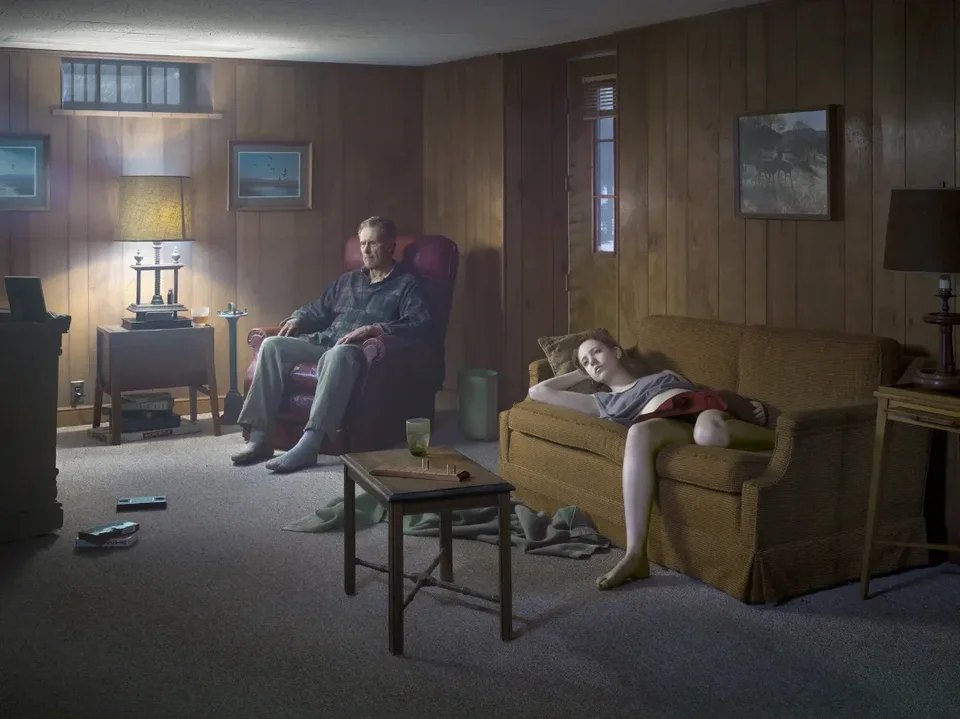
The experience of a vigil is necessarily unpleasant, because it means losing control. What the night watcher feels is an "oppression" (to use Levinas's term again), and this oppression comes from the very fact that "I am present." The vigil lets me feel this fact, which ordinarily escapes my awareness. Just look at the two people in The Basement (2014). We needn't speculate about what pain or dread they might really be in. They are simply sitting or lying there, awake, as if everything will go on like this forever with no dramatic turn to come.
As the word suggests, a night watcher is always watching over something. In other words, watching over implies an almost ethical commitment: though I am powerless, I still give my attention. Crewdson's images have this quality even when they depict subjects that look horrifying on the surface. They are not made for consumption; they ask the viewer for sustained, patient looking.
Oddly, Crewdson's work usually gives you no reason to "keep looking." There is no suspense waiting to be resolved, and you know you will never find a definite answer to the question "what happened here?" Nor can the images really be called "captivating," since being captivated means being drawn into the work. And yet, before his pictures, it is hard simply to decide to look away, because they create conditions in which not looking takes more effort than looking. The stillness in the images seems to have a kind of stickiness that keeps resisting any shift of the gaze. At bottom this resistance is ethical, and I believe it is the key to Crewdson's work. It is like sitting at the bedside of someone in a coma. He has lost consciousness and cannot sense that we are there, and our watching has no effect on his condition and does nothing to help. Still, we feel it would be wrong to stand up and walk out. Faced with a situation we can neither understand nor change, we keep looking. Not because looking accomplishes anything, but because the act of looking away causes a kind of friction, sometimes an enormous one. Giving it our attention is already the only thing we can do before the image. This is the relationship Crewdson's work awakens in the viewer.
The figures in the images do not need to know the viewer exists.[6] But faced with such a situation, the viewer immediately senses that their own presence is necessary, even though the people in the image pay it no mind. In one conversation, Crewdson used the phrase "psychological paralysis" in response to the "deep sense of waiting" his interlocutor had described.[7] His use of this psychoanalytic term is purely descriptive, even tender, rather than diagnostic. His images may be doing the same thing: keeping vigil for those caught in "psychological paralysis," and bringing the viewer into that same position. The whole ethics of the vigil lies in this: having accepted that understanding and change are impossible, one still insists on being present, still faces the other, and keeps all of one's perception open to them. Perhaps what makes Crewdson's work more than an aesthetic display of loneliness or alienation, and more than a source of aesthetic pleasure for the viewer, is precisely that it awakens in viewers the experience of this ethics.
Notes
[1] Strictly speaking, the imagination moving freely under the guidance of a certain sense of direction without being brought to a halt by any determinate concept is, for Kant, the general structure of every judgment of taste, namely the free harmony of the imagination and the understanding. See Immanuel Kant, Critique of the Power of Judgment (annotated edition), trans. and annotated by Qiuling Li, China Renmin University Press, 2011, Part One, Book One, §§5–9, especially §9. My point is not that this structure is unique to Crewdson's work, but that it acquires a special palpability there. The narrative fragments (the untouched food, the gazes whose direction cannot be pinned down, a temporal state that cannot be judged as "before" or "after") mean that the free play of the imagination does not unfold in formal pleasure but is always wrapped in a layer of anxiety. In the terms of Section IV of the Introduction to the Critique of the Power of Judgment, the judging at work here is closer to reflective (reflektierend) than determining (bestimmend) judgment: it starts from a given particular and seeks the universal, pointing attention in a direction without supplying a concept that could fix the meaning of the image.
[2] Crewdson, Gregory. “Gregory Crewdson.” Interview by Bradford Morrow. BOMB, 1 Oct. 1997, https://bombmagazine.org/articles/1997/10/01/gregory-crewdson/. Accessed 28 Aug. 2026.
[3] Sooke, Alastair. “Gregory Crewdson: What Dark Secrets Does This Picture Hold?” The Telegraph, 19 Apr. 2008, https://www.telegraph.co.uk/journalists/alastair-sooke/3672716/Gregory-Crewdson-what-dark-secrets-does-this-picture-hold.html. Accessed 28 Aug. 2026.
[4] Crewdson, Gregory. “Interview: Gregory Crewdson, Mystery in Everyday Life.” Interview by Marc Erwin Babej. Popular Photography, 13 Mar. 2014, https://www.popphoto.com/american-photo/interview-gregory-crewdson-mystery-everyday-life/. Accessed 28 Aug. 2026.
[5] Emmanuel Levinas, Existence and Existents (Chinese edition), trans. Huiyi Wu, revised by Heng Wang, Jiangsu Education Publishing House, 2006, p. 77.
[6] Within Michael Fried's framework, this comes close to the quality of "absorption." See Michael Fried, Absorption and Theatricality: Painting and Beholder in the Age of Diderot (Chinese edition), trans. Xiaojian Zhang, Jiangsu Phoenix Fine Arts Publishing House, 2019; Fried, Michael. Why Photography Matters as Art as Never Before. Yale UP, 2008.
[7] Crewdson, Gregory. “Gregory Crewdson: An Eclipse of Moths.” Interview by Cate Blanchett. Gagosian Quarterly, 17 Sept. 2020, https://gagosian.com/quarterly/2020/09/17/interview-gregory-crewdson-cate-blanchett-eclipse-moths/. Accessed 28 Aug. 2026.