
Hello, everyone. I'm Guosen Chen. I'm currently a PhD student in the Department of Philosophy of Art at the School of Philosophy, Fudan University, and a co-founder of "Photography Theory Shelter." If you have any questions about this talk, you're welcome to leave a message on the backend of our "Photography Theory Shelter" official account. I'll reply whenever I see it. The topic of photography and literature was actually suggested to me by a member of our "Photography Theory Shelter" community. The moment I saw it, I thought it was excellent, because the very first paper I ever wrote was about the relationship between photography and literature. I submitted it for a general education course taught by Professor Yubing Shen, who is now my supervisor. Professor Shen gave the paper a fairly positive assessment, and that is really what gave me the opportunity and the confidence to set out on the path of scholarship and photography studies. Looking back, the paper seems very immature, but without it, and without that assessment, I would never have taken this path.
When we talk about "photography and literature," the relationship is not, as one might intuitively assume, a relationship between specific photographs and specific literary works. What we are discussing is photography and literature, not photographs and literary works. In a certain sense, photography and the photograph are two different categories, though we often conflate them in discussion. To be clear from the outset, what we will discuss today is not the practice of quoting, appropriating, or rephotographing literary works in photographs. We won't be talking about that, and we will hardly talk about specific photographs at all. In this sense, today's content is more of a theoretical inquiry, since I myself work on the history and theory of photography, which remains a relatively neglected field in China.
I. Clement Greenberg and the Theory of Medium Specificity
First, we need a brief introduction to Clement Greenberg. If you know even a little about the history of art or photography, you will have run into the concept of "modernism" in many contexts. In a fairly rigorous sense, who answered the question "What exactly is modernism in art?" and offered a remarkably precise conclusion? It was the American critic Clement Greenberg. He was arguably one of the most important American art critics of the twentieth century (perhaps even the most important), and the years in which he was active were the last glory days of a traditional kind of art criticism centered on judgments of taste and standards of quality. Greenberg's most important historical contribution was his defense of American abstract art. At first, these American abstract paintings were unpopular not only with the general public; even the American president disliked them. When we look at paintings, we tend to appreciate classical or figurative painting easily, but with abstract painting we often don't know how to understand it or how to get into it. In this situation, Greenberg began defending the abstract painters of New York. In the process, he developed a whole theory of modernist painting, and the method and basic theoretical stance behind that theory are also closely related to what we will talk about today: "literary photography."
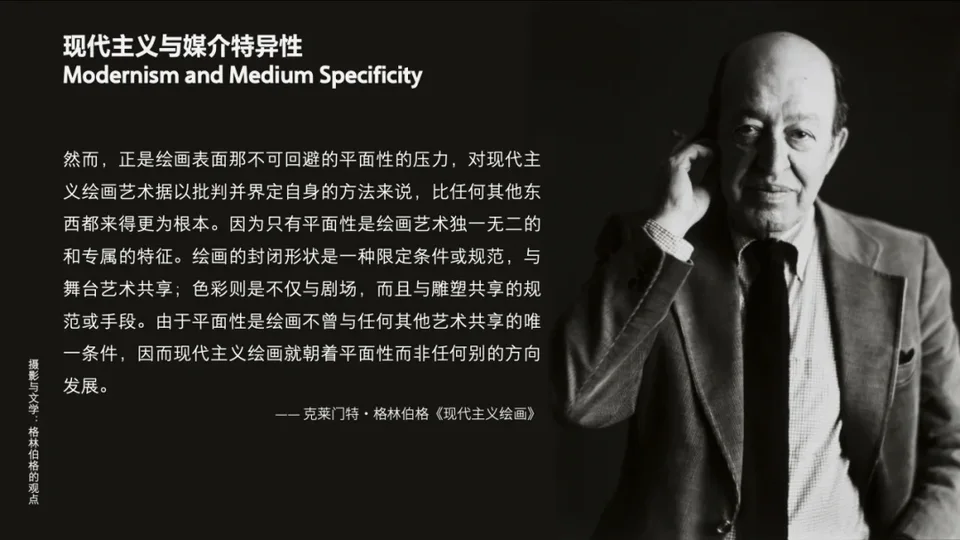
We can call Greenberg's theory the theory of "medium specificity." What exactly is it? Put simply, each artistic medium must discover its own distinctive characteristics and its defining, clearly marked boundaries, and the artist's task is to identify those boundaries and bring them forward as subject matter.
So when Greenberg undertook this project, he first asked a question: in the painting of his time (from the 1940s to the 1960s), where did its unique, defining boundaries lie? In other words, what is it that makes painting painting? That is what he set out to explain. Is it color? Apparently not, since theater and sculpture also have color. Is it the image? Apparently not either, since photographs also have images. In the end, in his essay "Modernist Painting," Greenberg gave his theory of "medium specificity" its most concentrated expression:
It was the stressing of the ineluctable flatness of the surface, however, that remained more fundamental than anything else to the processes by which pictorial art criticized and defined itself under Modernism. For flatness alone was unique and exclusive to pictorial art. The enclosing shape of the picture was a limiting condition, or norm, shared with the art of the theater; color was a norm and a means shared not only with the theater but also with sculpture. Because flatness was the only condition painting shared with no other art, Modernist painting oriented itself to flatness as it did to nothing else.
He believed that what is irreducible in painting, the defining essence that makes painting painting, is in fact "flatness." In other words, flatness is not only the defining boundary and essence of what he called "modernist painting," but also the core of the driving force and mechanism behind modernist painting's development into what it had become.
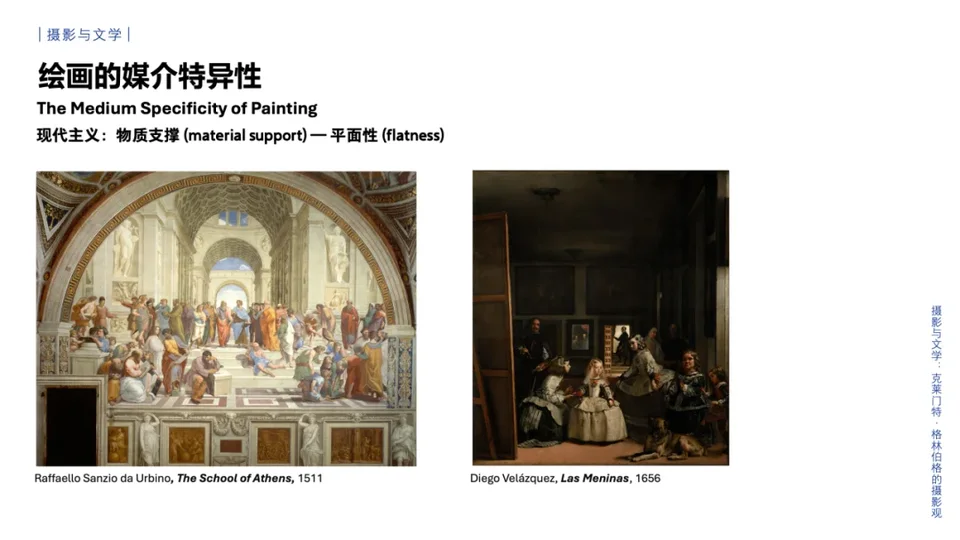
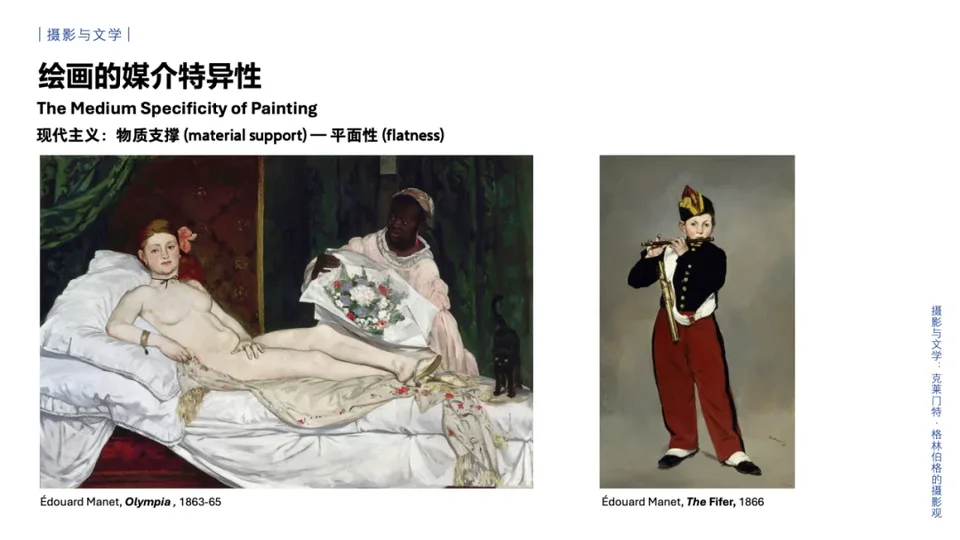
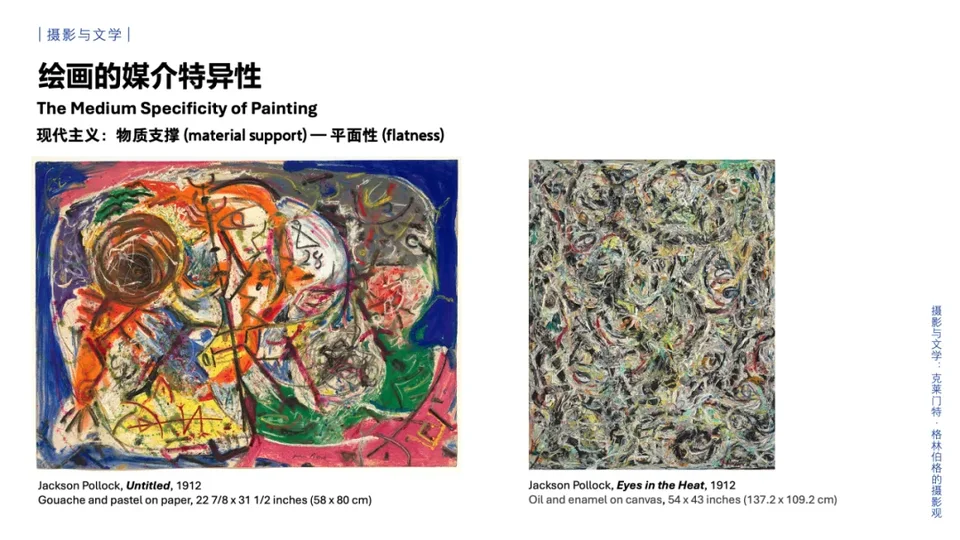
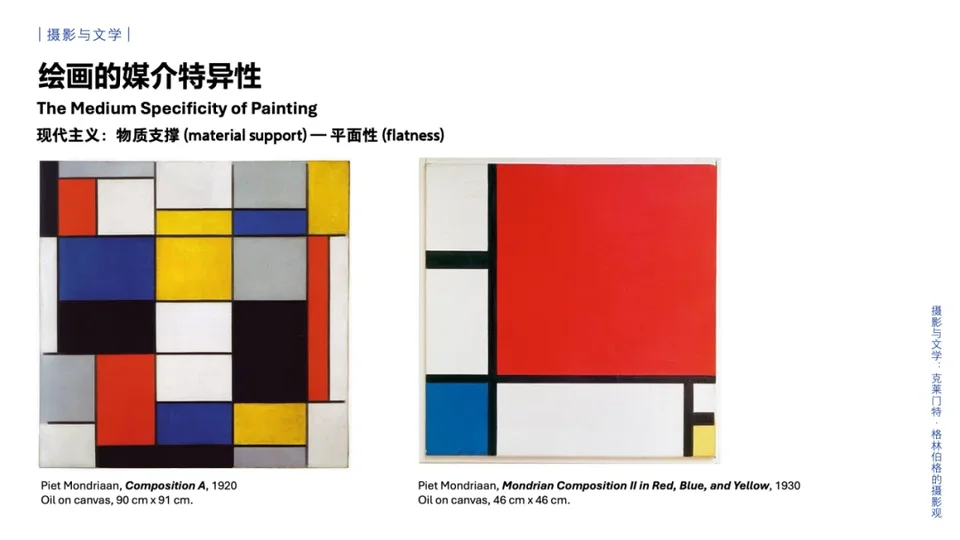
From the standpoint of "medium specificity," Greenberg held that each art, in a given period, must seek out its own irreducible essence, the thing that makes it what it is. Let me clarify something here: this does not mean that painting was forced toward abstraction under pressure from photography. Greenberg would not agree with that view. He believed that in the broader development of modern painting, a drive emerged from within the medium of painting itself, a drive "to defend and confirm the value of painting's own existence." In this sense, Greenberg did indeed start from Kant and end up at Hegel. How was that value to be confirmed? By finding what could not be replaced by any other medium, which is what we call "medium specificity." For painting, Greenberg ultimately located it in "flatness." Put simply, flatness means that the surface of the canvas is just a flat plane: however convincing the perspective or illusion you construct, relative to the two-dimensional plane of the canvas it remains an illusion. Only flatness is truly irreducible in painting. As a result, the subject matter of painting evolved toward an ever greater emphasis on flatness, until it became a form that foregrounds the pigment, the flat surface of the canvas, and the material factors on which painting depends. As we saw in the slides above, from The School of Athens to Édouard Manet, in works like The Fifer and Olympia, the figures are lit almost entirely from the front and the sense of spatial depth is compressed nearly to a plane. Then, later, with Jackson Pollock's drip paintings and Mondrian's red, yellow, and blue grids, painting became increasingly flat. What we think of as abstraction was really just a by-product of this process, not a goal set at the outset of this evolution.
II. The Medium Specificity of Photography
So for Greenberg, if the medium specificity of painting is "flatness," what is the medium specificity of photography? In 1946, reviewing an exhibition by Edward Weston, Greenberg wrote at the end: "Let photography be 'literary.'" Then, in a 1964 essay, he said: "The art in photography is literary art before it is anything else." In other words, for Greenberg, if photography is to become art, the photograph must first, in some sense, become a literary work.
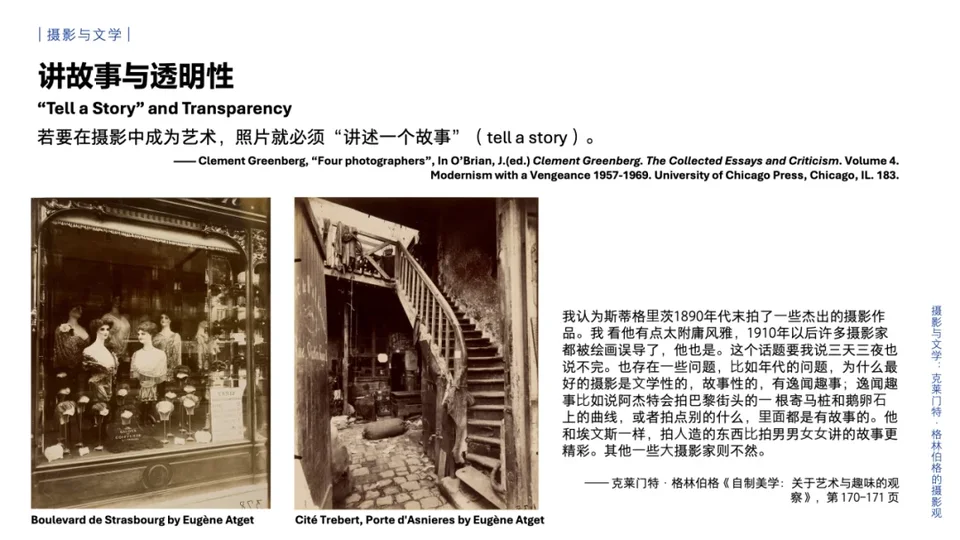
But what exactly does "literature" mean here? For Greenberg, its core is actually very simple: "to tell a story." This "telling a story," however, is not merely recording what happened in front of the lens. A police evidence photograph, for example, does not "tell a story"; it merely provides information. For Greenberg, such photographs, like purely abstract ones, go against the essence of photography as art. Greenberg therefore held that photography's medium specificity lies in its literariness, and that "literariness" is the impulse to tell a story, or the result of doing so.
The question is: why should photography's medium specificity lie in its literariness? Doesn't this contradict Greenberg's earlier criticism of "literary painting"? Recall that in another classic essay from the 1940s, "Towards a Newer Laocoon," he stated clearly that painting in the seventeenth and eighteenth centuries had become subservient to literature:
It was the literary effects of seventeenth- and eighteenth-century literature that seventeenth- and eighteenth-century painting strove so hard to imitate. [……] On the whole, painting and sculpture in the hands of the lesser talents—and this is what tells the story—become nothing more than ghosts and "stooges" of literature. All emphasis is taken away from the medium and transferred to subject matter. (Chinese translation by Yubing Shen)
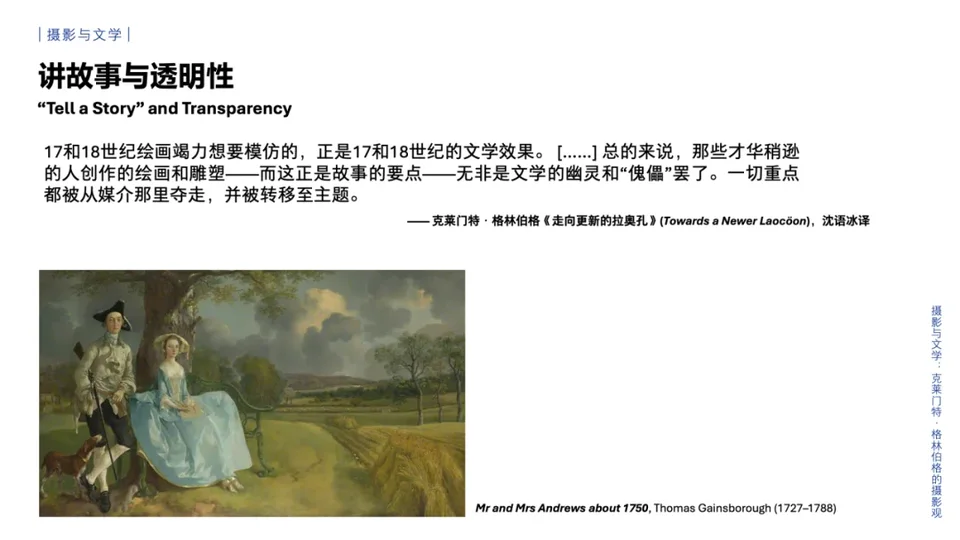
In other words, the characteristics of literature are undesirable where painting is concerned. So why, when it comes to photography, does Greenberg want it to "be literary"?
The key here is "transparency." Greenberg says: "Because of the transparency of the medium, the difference between the extra-artistic, real-life meaning of the things photographed and their artistic meaning is even smaller than it is in prose."
This "transparency" refers to the high degree of resemblance between the photographic image and reality. It is even more lifelike than representational painting, to the point that the surface of the photograph becomes a "transparent" window onto the photographed world. By analogy, for Greenberg the photograph is like prose: it often narrates an event, a character, or a plot directly, while the author's style or technique recedes, letting readers focus their attention on the objects the words describe (or on the things the photograph presents). If photography places too much emphasis on formal operations such as composition, texture, and abstract shapes, it weakens the "transparency" that would otherwise let us "see directly what was photographed," and thereby loses its innate potential to "tell a story" or "evoke emotion." It's like a college-entrance-exam essay stuffed with showy parallelisms and ornate rhetoric: it is still prose, but in fact it's rather poor prose. For Greenberg, the artistic value of a photograph lies largely in how it tells a story (especially an "anecdote"), or suggests or evokes some emotional meaning, rather than in making too much of light and shadow, technique, or material—that is more the business of traditional painting. In other words, photography can rely on its innate capacity to "record visible things" to lift the subjects of the real world—people, street scenes, objects, and so on—to an artistic level. The exemplars here are the photographs of Walker Evans and Eugène Atget. Greenberg worried that elaborate operations that deliberately display artistic technique would shift the viewer's attention to "how exquisite / how strange / how gorgeous this photograph is," and weaken the "reality" the photograph refers to. For Greenberg, this "reality" means anecdotes and reportorial content full of "human interest."
Greenberg had two purposes in emphasizing this. The first was to vindicate photography's status as art. Since the nineteenth century, people had thought photography too mechanical and automatic to possess genuine artistic value: if a good photograph could be the product of "luck," could it count as art? For Greenberg, if the photographer could embody in the photograph "the careful selection and distillation of the subject," and genuinely tell a "human story" or "anecdote" that goes beyond information and description, that would show the photograph to be an expression of authorial consciousness, possessing an internal organic unity like that of a literary work. This would prove that photographs are not "random," not dependent on accident, and not purely mechanical products.
The second purpose must be understood in terms of his position on medium specificity. Greenberg insisted that photography should not try to become painting, should not be regarded as "small-scale painting," and should not go to the extremes of abstraction or flashiness, but should instead embrace its transparency and its narrative (literary) potential. In the 1940s, he wrote many essays about how modernist painting should maintain its autonomy and the self-awareness of its medium (such as "Towards a Newer Laocoon," "Avant-Garde and Kitsch," and "Modernist Painting"). In those essays, he held that if painting is too "literary," this hinders it from realizing its own specificity; photography is just the opposite, and can establish its artistic status by becoming "literary." One obvious example is that Greenberg often used words like "anecdotal," "historical," "reportorial," and "observational" to describe photography's literariness, meaning that photographs should focus more on people, events, and scenes, and show off less "technique." This argument still serves his overall modernist binary: opaque painting vs. transparent photography; painting that rejects literature vs. photography that embraces it. Of course, it is quite obvious that Greenberg is using another "medium" to vouch for photography's own value. Is there a logical self-contradiction here? It would be hard to say there isn't. But the key point is that for Greenberg, "literature" here is more of a metaphor, or a mediating, descriptive concept, and its substantive content is perfectly clear to him: transparency and narrative. And as for the "story" being told, he defined its core further: anecdotes and reportorial content.
III. Distance
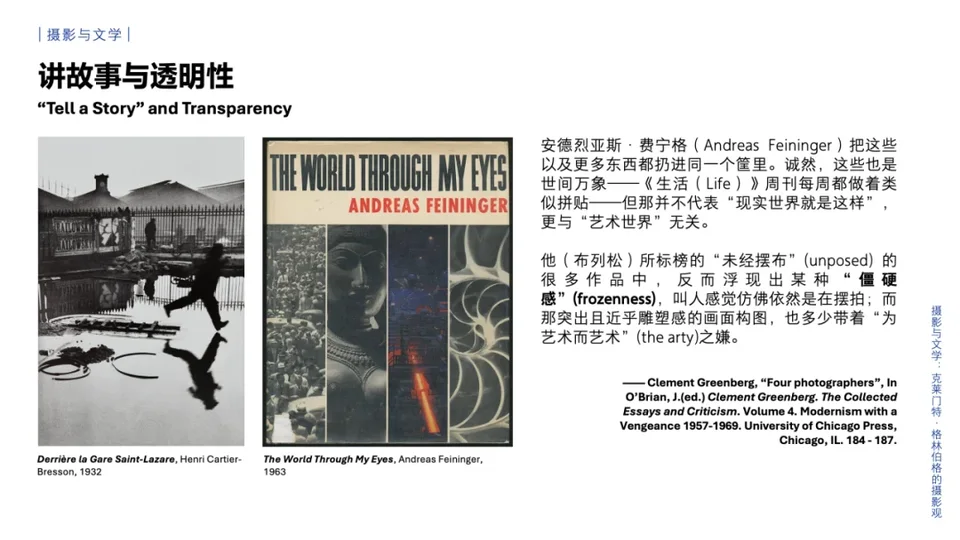
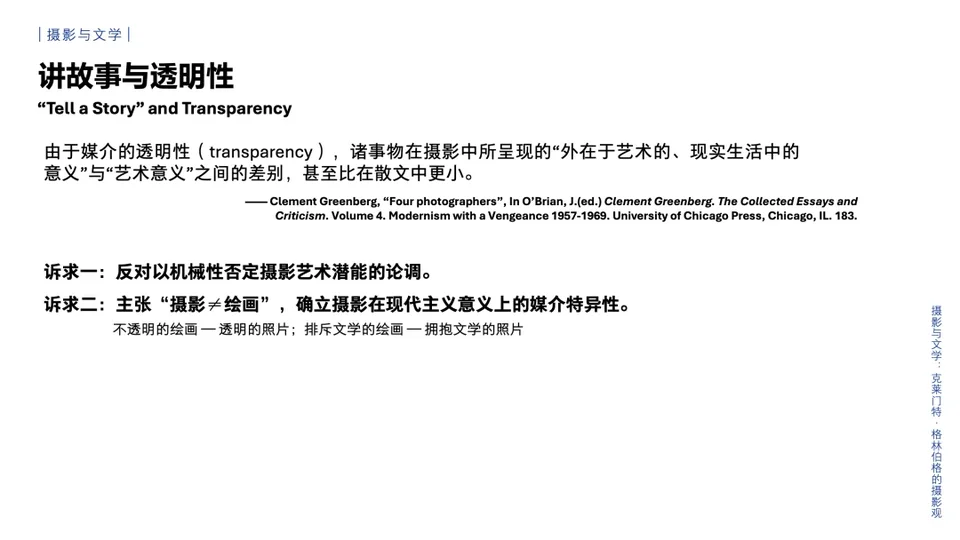
In this way, photography can naturally exercise its quality of "seeing reality directly through the photograph." This transparency is therefore exactly why photography should become literary. Or rather, instead of saying that photography's medium specificity lies in its "literariness," we might say it lies in "the transparency of its products." The counterexample is Cartier-Bresson's photography: form completely overwhelms content, the composition is too deliberate, too preoccupied with geometric shapes, and reality itself is weakened. Greenberg therefore regarded this approach as "artiness." Likewise, some works by Andreas Feininger or Edward Weston, in their pursuit of bizarre effects or extremely refined form, sacrifice "readability" or "narrative significance," and Greenberg considered them to have departed from "the literariness of photography."
Bresson's photographs, with their "frozenness," are of course bad photographs in Greenberg's sense, and non-literary photography. So what does the exemplar look like? If "artiness" and "frozenness" are bywords for Bresson-style photographs, we can also find another word to define the literary photography that makes full use of transparency: "distanced."
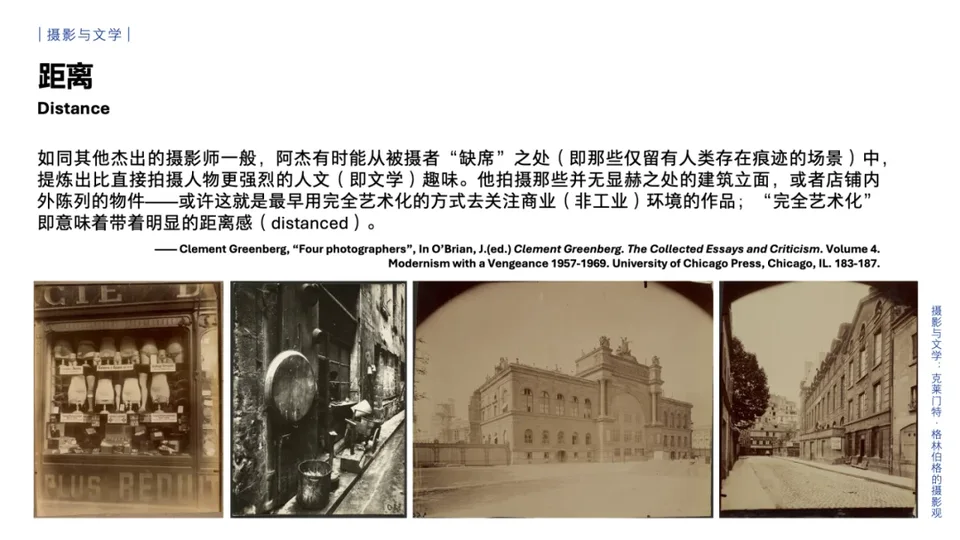
Greenberg describes his exemplar this way:
Like other outstanding photographers, Eugène Atget could sometimes extract a stronger human (that is, literary) interest from the "absence" of his subjects—that is, from scenes that retain only traces of human presence—than from photographing people directly. He photographed building façades with nothing distinguished about them, or objects displayed inside and outside shops—perhaps the first works to attend to the commercial (not industrial) environment in a completely artistic way; "completely artistic" meaning with a marked distance (distanced).
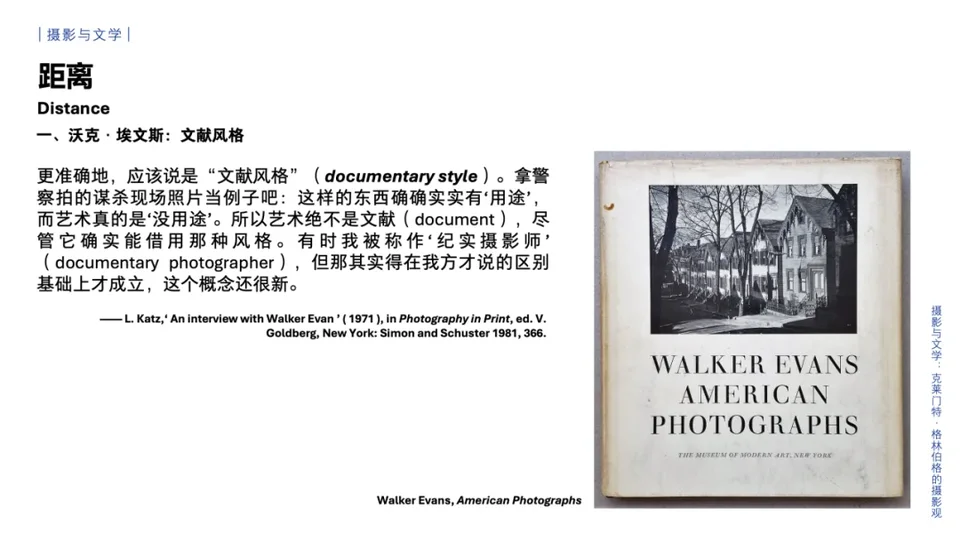
This "distance" should be understood in two respects. For the first, we can consider what Walker Evans called "documentary style":
More precisely, it should be called "documentary style." Take a police photograph of a murder scene as an example: a thing like that really does have a "use," whereas art is really "useless." So art is never a document, though it can certainly borrow that style. Sometimes I'm called a "documentary photographer," but that only holds on the basis of the distinction I just made, and it's a very new concept.
In other words, read alongside Evans's remarks, Greenberg's "distance" in this sense can be understood as follows: the photographer does not intervene too much, does not overly display his personality, and does not romanticize the subject. For Greenberg, good photographs are those taken in a "distanced" way. He used the word to praise the photography of Eugène Atget and Walker Evans. "Keeping one's distance" when photographing means, simply put, not making the composition too deliberate for the sake of "art for art's sake," which would instead turn art into something arty and affected; rather, it means photographing with a calm, restrained attitude, so that the work presents an aesthetic space that is "transparent but not mechanical." In this way, viewers can use their imagination to fill in the historical, social, and human interest of the photographed subject, rather than having all of it supplanted by the photographer's subjective manipulation. The counterexample is Bresson: he often lets perfect geometric composition dominate the entire frame, confining the viewer's attention to the point of visual pleasure toward which he steers them through his manipulation of geometric form. In this sense, Bresson's photographs not only lack an anecdotal quality; they reduce the anecdote that should and could have been presented to pure geometric order, draining it of its observational and reportorial content. Photographers like Bresson fill in this distance themselves through their own operations, rather than leaving it open to the viewer and letting the viewer's experience of looking fill in the distance between the thing itself and its representation. Greenberg's use of "frozenness" to describe Bresson's photographs is, one might say, spot on.
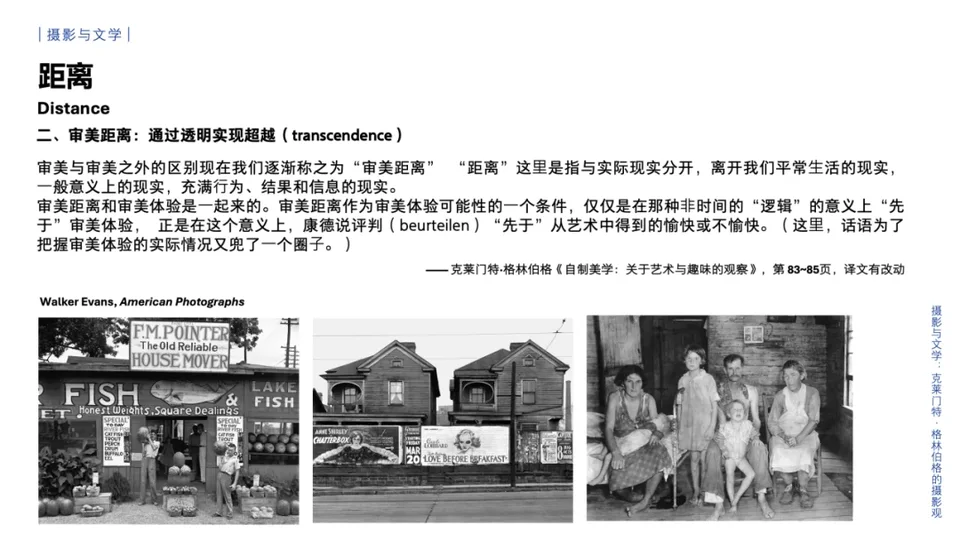
The second respect in which to understand "distance" is what we call "esthetic distance." For Greenberg, mere mechanical reproduction or faithful depiction of reality can hardly become art. Although photography is transparent, it must also achieve a kind of transcendence by "keeping its distance" from what is photographed. Transparency alone is not enough; what matters for photography is how to achieve transcendence through transparency. The medium used is clearly very transparent, and yet it manages to open up a distance from reality. That is precisely the difficulty and the allure of straight photography. "Esthetic distance" is the distance that separates us from the whole of the reality we live in. If you just purely "photograph reality," you end up with a police evidence photograph of a murder scene. Such things may be very "objective," but aesthetic experience also requires that a certain "esthetic distance" be maintained between viewer and work. (But is it impossible for a forensic evidence photograph to be moving? Greenberg is unwilling to answer this question. In fact, the answer is no, it is not impossible: just as with literary works, no one can stop viewers/readers from being moved chiefly by a chance detail in the work, nor from being moved chiefly by the sense of a world that the work presents, just as we sometimes shed tears even over popular works of mediocre artistic quality. This is what is inherent in what Benjamin called photography's "optical unconscious.") Greenberg's notion of "esthetic distance" is essentially inherited from the aesthetic theories of Kant and Schopenhauer: for aesthetic experience to arise, the subject must break away from everyday utilitarian concerns or interests and focus on the form or significance of the work itself. The reason photographs like those of Eugène Atget and Walker Evans provoke profound humanistic associations is that they photographed in a restrained manner that kept a certain distance, rather than treating the image with drastic means.
For Greenberg, if Weston and Adams represented the wrong path, Walker Evans represented the right one. But it cannot really be said that Greenberg fully understood Evans's practice. The crux is that Greenberg always placed too much weight on the aesthetic value and artistic qualities of the single photograph. Did he really give full consideration to how Evans constructed his projects?
IV. Visual Syntax and Narrative
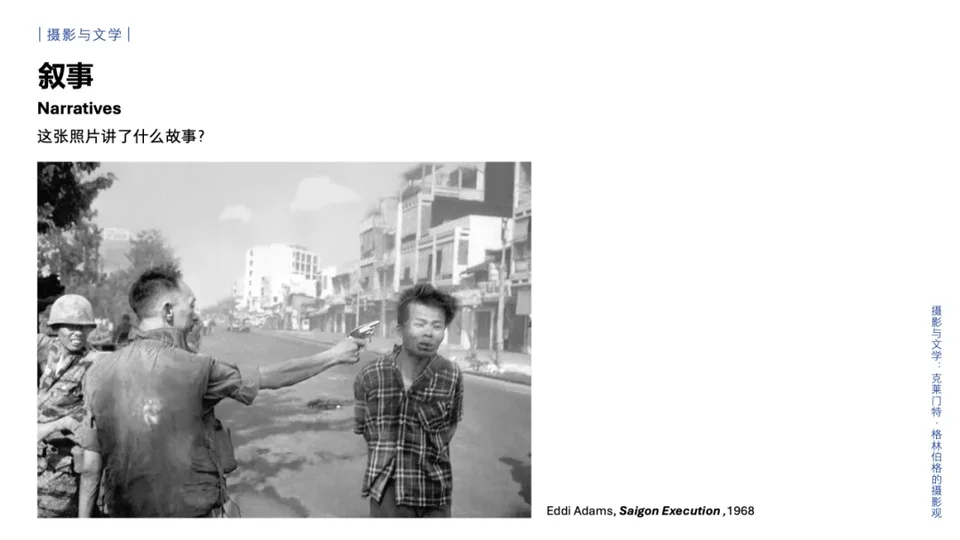
This raises a question: how is it possible to tell a story with "a single" photograph? Did Greenberg ever seriously consider this? Take this photograph, a very famous one taken by Eddie Adams during the Vietnam War. It has even been called a picture that changed the course of the war. On the surface, what story does this photograph tell? You'll find that in many cases it seems to have been read as a brutal, cold-faced officer killing an innocent civilian. In fact, many people at the time did read it that way, with the result that when the man on the left—the local police chief, Nguyễn Ngọc Loan, head of South Vietnam's National Police—was wounded later in the war, hardly anyone was willing to treat him. And why is the face of the man being executed on the right so contorted with pain? Some say it's because the photographer happened to capture the instant the bullet entered his head, so his face was violently distorted by the bullet piercing his skull. But in reality, the man being executed on the right, Nguyễn Văn Lém, was an utterly heinous criminal who had committed inhuman atrocities—killing, burning, and looting—against local women, children, and elderly people. He had murdered the wife and six children of one of Loan's colleagues. His crimes were so monstrous as to be beyond enumeration, and so during the war he was shot in the street by the police chief. You could say the procedure was not exactly just, but was this really, as people understood it, a story of police abusing their power and killing civilians at will? You'll find that it was definitely not so. The photographer later deeply regretted it. He said: "I showed a man killing another man, and I got paid for it," and "Two people's lives were destroyed, and I got money for it and became a hero." In 1998, Nguyễn Ngọc Loan died of cancer, and Adams later wrote: "Two people died in that photograph. The chief killed the Viet Cong; I killed the chief with my camera."
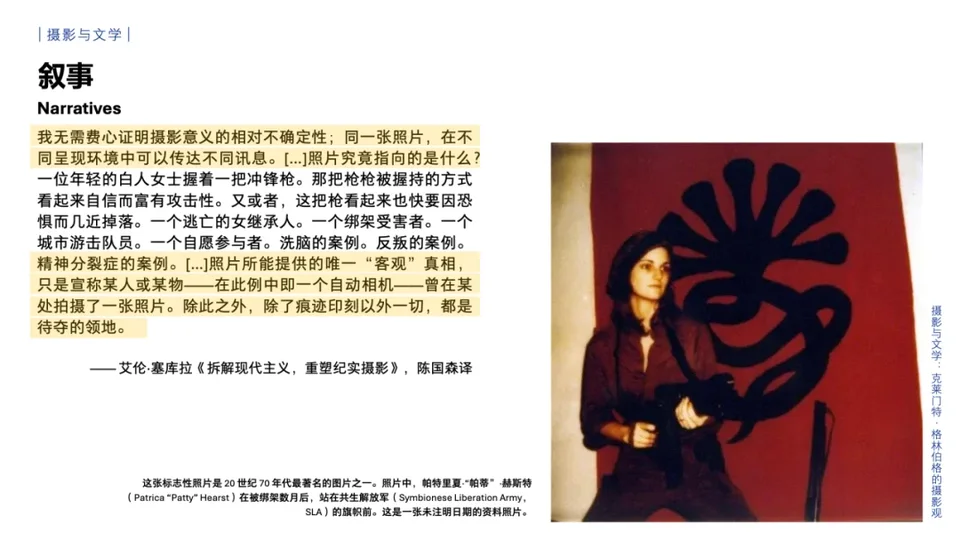
In other words, to return to our concern: what kind of story can a single photograph actually tell? When Greenberg solemnly declares that photographs must tell stories, and must tell them through their own transparency in order to become themselves, what is he talking about? If we consider examples like these, you will find that in his argument Greenberg has quietly suppressed many aspects of how photographic meaning is produced. Let's look at this photograph, also one of the most famous photographs of the 1970s. The American photographer Allan Sekula, in an essay that discusses it, says:
I needn't argue for the relative indeterminacy of photographic meaning; the same photograph can convey different messages in different presentational circumstances. […] What does the photograph point to? A young white woman holding a submachine gun. The gun is held in a way that looks confident and aggressive. Or else the gun looks about to slip from her grasp in fear. A fugitive heiress. A kidnap victim. An urban guerrilla. A willing participant. A case of brainwashing. A case of rebellion. A case of schizophrenia. […] The only "objective" truth that the photograph can offer is the claim that somebody or something—in this case, an automatic camera—took a picture somewhere. Beyond that, everything other than the imprint of the trace is territory up for grabs. (Chinese translation by Guosen Chen)
We should recognize that the causal chain by which a photograph is produced and the causal chain by which a photograph comes to be understood are not the same. The former may be accidental, but the mechanism of the latter is something we can explain and ought to explain. A photograph may come about by chance or by accident, like the Vietnam War photograph we just saw. Why did it come into being? Because there was a mechanical causal chain: the photographer happened to come across this scene in the street. He thought Loan merely intended to intimidate Lém, so he raised his camera, never expecting that Loan was about to execute him. In a sense, the causal chain that produced this photograph was objective and independent of the photographer's will—what we might call "mind-independent." But why the photograph came to be understood in a particular way—that is, why the photograph produces meaning in this way—is another matter. The meaning of such a photograph, and the way its meaning is produced, can very often be artificially manipulated. How you explain this photograph in fact determines how its meaning will be produced. The way the media explains a photograph that we couldn't make sense of without a caption, for example, is exactly this kind of thing, and we often find it hard to notice that this way of understanding has already been artificially neutralized and naturalized.
In fact, Walker Evans had long been aware of a certain "semantic poverty" of the single photograph. That is, a single photograph is actually very impoverished in expressing meaning: what a single photograph can say is far too little and too uncertain, making it hard to establish a "narrative." At most it can have a "sense of story," but it cannot (or can hardly) establish a complete narrative.
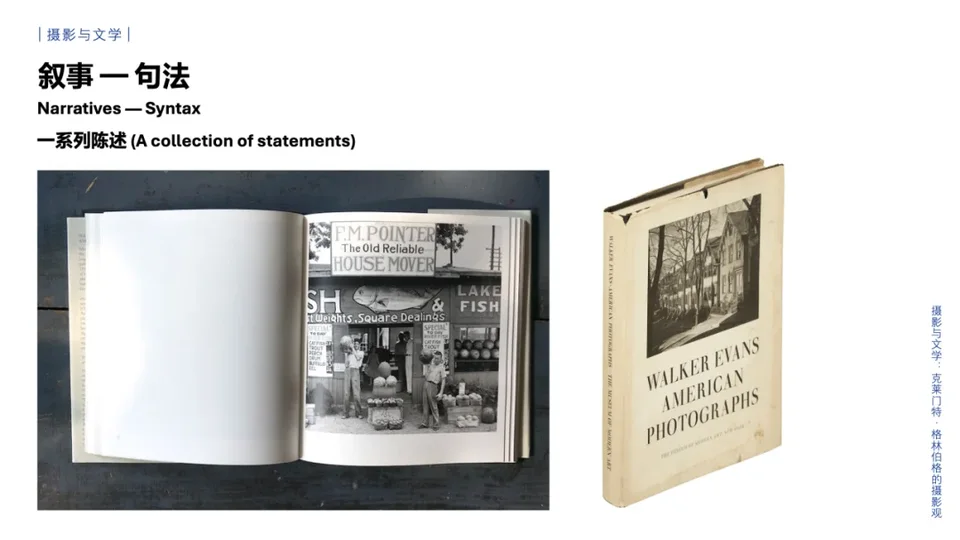
Let's return to Evans's practice to illustrate this. In 1938, while the Museum of Modern Art (MoMA) in New York was building its new premises and borrowing temporary space for exhibitions, its executive director Thomas Mabry, working with Lincoln Kirstein, brought in Evans to mount a photography exhibition. During the preparations, Evans and the curatorial team selected, cropped, and sequenced the photographs with great care. Evans also refused to frame the photographs the way paintings are framed, and instead pasted them directly onto the walls. They also produced a special catalogue for the occasion, dividing the photographs into two parts, with only one photograph per page, a blank facing page, no titles, and the notes gathered at the end of each part.
Throughout his critical career, Greenberg repeatedly used Evans as a yardstick, but Greenberg was not the first to regard Evans as a "literary photographer." Evans himself often saw himself this way. And in his catalogue essay, Kirstein went further, linking Evans to many modern poets and writers. He placed Walker Evans at the end of a long line of literary giants, from Hart Crane to T.S. Eliot. Kirstein also emphasized that what Evans presented in American Photographs was "a collection of statements," not a number of "isolated images." This means that Evans's "literary quality" lies not only in his subjects and scenes, but also in the "visual syntax" between photographs; in other words, he presents the work as a whole in an internally structured way. Although Greenberg ostensibly endorsed Evans, he did not particularly thoroughly understand what Evans was doing "at the level of syntax." One might say that Greenberg was, after all, strongly shaped by the criticism of painting.
The literary techniques Evans and Kirstein employed were in fact also a way of dealing with the problem of "chance." It's true that a good single photograph can sometimes be captured by sheer luck, but when you carefully select, crop, and combine a number of photographs into an organized series, things are different. Anyone can get lucky and take one stunning photograph, but no one can produce a series like American Photographs by luck. This is the function of "visual syntax." Photographs echo, oppose, and contrast with one another, overcoming the semantic poverty of the single photograph. From Talbot's The Pencil of Nature at the very beginning to Walker Evans's American Photographs, you'll find that the best photographers all seem to have tacitly understood this: the meaning of photographs must achieve its full realization at the level of the collection. Although the meaning of a single photograph may be impoverished, when we embed such photographs in a syntactic system, this way of working on photographs after they have been taken can likewise achieve, or even create, an originality no less than that of the single photograph itself. In this sense, incorporating photographs into a visual syntax can also overcome the uncertainty of the single photograph in conveying meaning, and its excessive dependence on context. So in a sense, Evans actually constructed a context for these photographs that allows us to understand them in a particular way, yet he did not do so in the manner of Bresson; rather, he built this visual syntax in a way that always leaves an esthetic distance for our appreciation.
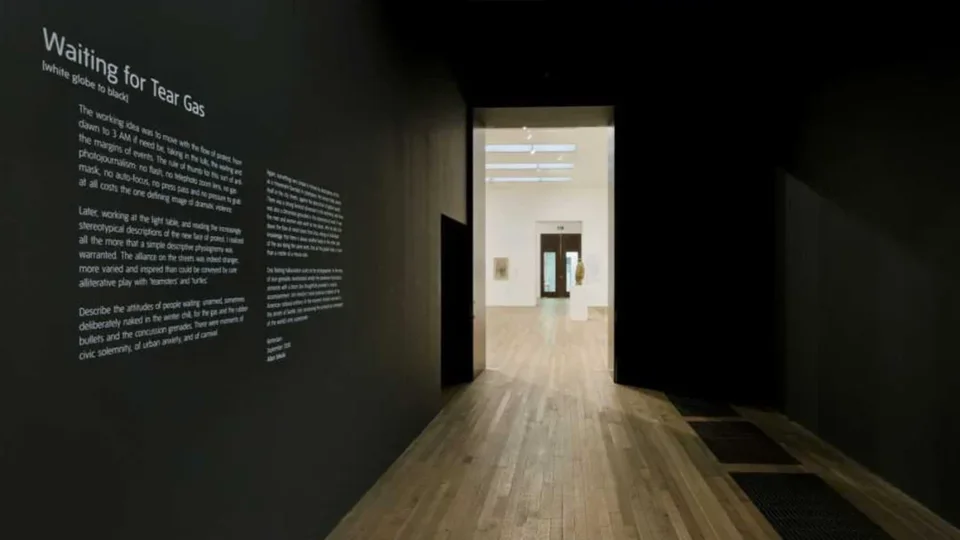
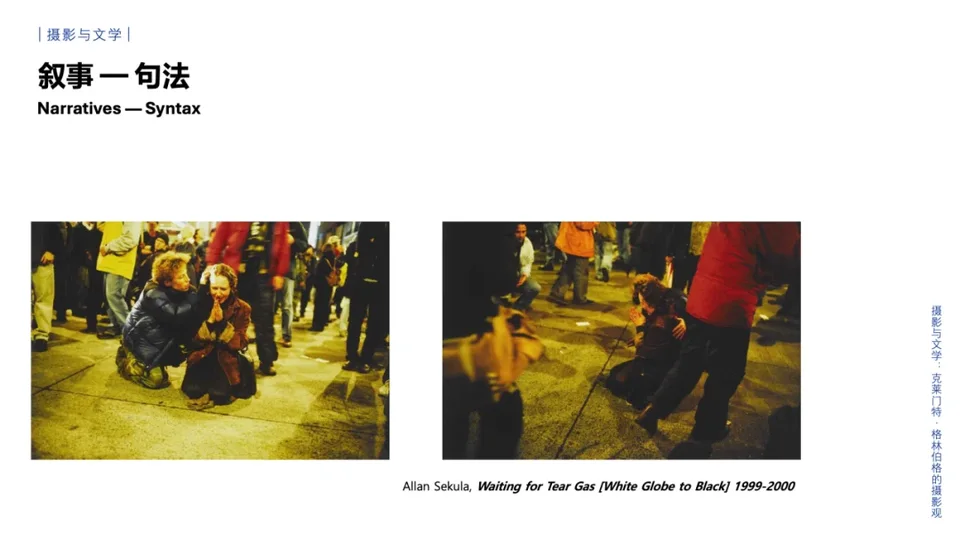
Whether we speak of truth or of how things look, we often fall into a trap when we discuss them. That is, if we set "narrative" aside, then talking about what truth a particular photograph conveys is in many cases incomplete. It has to be incorporated into a narrative to take effect. Once narrative appears, it can construct a great deal. Syntax can be seen as narrative's structural counterpart at the level of grammar. Allan Sekula, whom we mentioned earlier, also made a work called Waiting for Tear Gas, a series based on the anti-WTO protests of 1999–2000, consisting of 81 slides that take about 15 minutes to show in full. In the original projection sequence, the two photographs I've shown above are actually separated by some eight or nine others. If you look closely, you'll notice that these two photographs actually show the same scene from two different angles; Sekula simply placed them differently in the sequence. This makes a very clear case to the viewer for the necessity of photo series, or of photographic projects built through visual syntax.
In this sense, perhaps only when a visual syntax has been established, together with the transparency and narrative that Greenberg valued, can we say that such photography is literary photography. That is, if literary photography in Greenberg's sense is really to hold up, then on the one hand there must of course be a commitment to transparency, striving through "transparency" to transcend the things photographed. On the other hand, a complete visual syntax must also be constructed for the photographs. Only when both are present at the same time can we say that this kind of photography, devoted to medium specificity in Greenberg's sense, truly holds up.