
Abstract: Azoulay's theory of photography begins with the fundamental question "What is photography?" and observes how radically photography's effect on life differs from what it was before photography became widespread. This perspective is widely accepted in international scholarship but remains little known in Chinese scholarship, which tends to examine photography through formalist methods. Interpreting Azoulay's core works and steering them toward a phenomenological reading brings a question into view: why does photography matter so much to contemporary experience of reality? Azoulay's political ontology of photography is anchored in the concept of the "citizen." On one side it points to "regime-made disaster" as oppression. On the other it points to photography's civil contract as liberation. At its core is a "civil imagination" of a desirable world built around political recognition and plurality, and her definition of photography therefore moves beyond the unipolar paradigm of the philosophy of the subject. By turning to affirm the subject-status of the other (the photographed person), Azoulay sketches, within her "citizenry of photography," the possibility of a desovereignized, pluralistic dialogue that photography brings about. Because the "event of photography" has taken place, all members of the citizenry of photography have become relational beings mediated by photography. They share with one another the horizons formed by each person's particular world of interests. This sharing is itself, in the phenomenological sense, an interruption of reference, and from it we can begin to imagine a new form of communal life.
Keywords: civil contract; the citizenry of photography; ontology of photography; civil imagination
1 Introduction
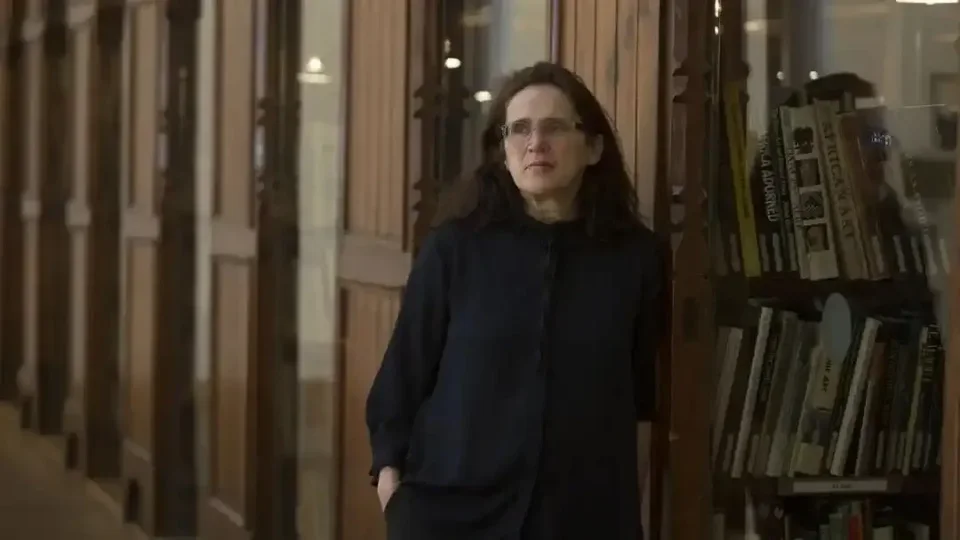
Born in Israel, Ariella Aïsha Azoulay is one of the "anomalous" researchers to have emerged in international photography studies and visual culture studies since the new millennium. She is also a photographic practitioner and curator. She currently teaches at Brown University, writes in Hebrew, and publishes and curates prolifically. At the time of writing, six of her monographs have been translated into English and several other languages.
By the 2010s Azoulay was already a household name in Western visual culture studies[1]. She has devoted her life to the Palestinian question. Her major works all concern the military partition produced by the "Palestinian question" and the long confinement of Palestinians to a marginal state of disaster, and they lead us to reflect on imperialism and the legitimacy of citizenship. Strictly speaking, Azoulay's research on the ontology of photography cannot be separated from her life as a descendant of Algerian Jews and as a feminist. Indeed, it exists precisely for the sake of the latter, and this "embodies how one can (and should) be both a scholar and a citizen."[2]
In my view, Azoulay's conception of photography has three facets, which usually form an indivisible trinity: ① the political ontology of photography; ② feminism and the condition of women; ③ potential history. Given my angle and the limits of space, this article mainly discusses and develops the first facet, so my interpretation of her will inevitably leave much out. Azoulay's thought is sometimes compared with that of Georges Didi-Huberman or Michael Fried. Set against the former, Azoulay reveals photography's potential both for submission and for resistance in the face of imperial power[3]. Set against the latter, she exposes the enormous gaps that open up when a paradigm like Fried's confronts non-art photography, especially photographs of suffering[4].
As will become clear below, Azoulay's insights have great liberating potential for breaking the current scholarly fashion of defining photography in nominalist terms. This is especially true for defining photography in its broadest sense, the kind we ordinary people encounter every day, which art history and journalism and communication studies are often unwilling or unable to do. Yet the strengths and weaknesses of Azoulay's scholarly system are equally evident. Her books often run to five or six hundred pages, monumental tomes indeed, but one critic has observed that she "often repeats theoretical arguments introduced in earlier chapters without developing them further."[5] More importantly, her point of departure is the problem of governance created by the Palestinian question, and her ultimate aim seems to be to reveal the "potential history" buried by colonial and imperial rule.
- A word or two on Azoulay's national identity and her middle name:
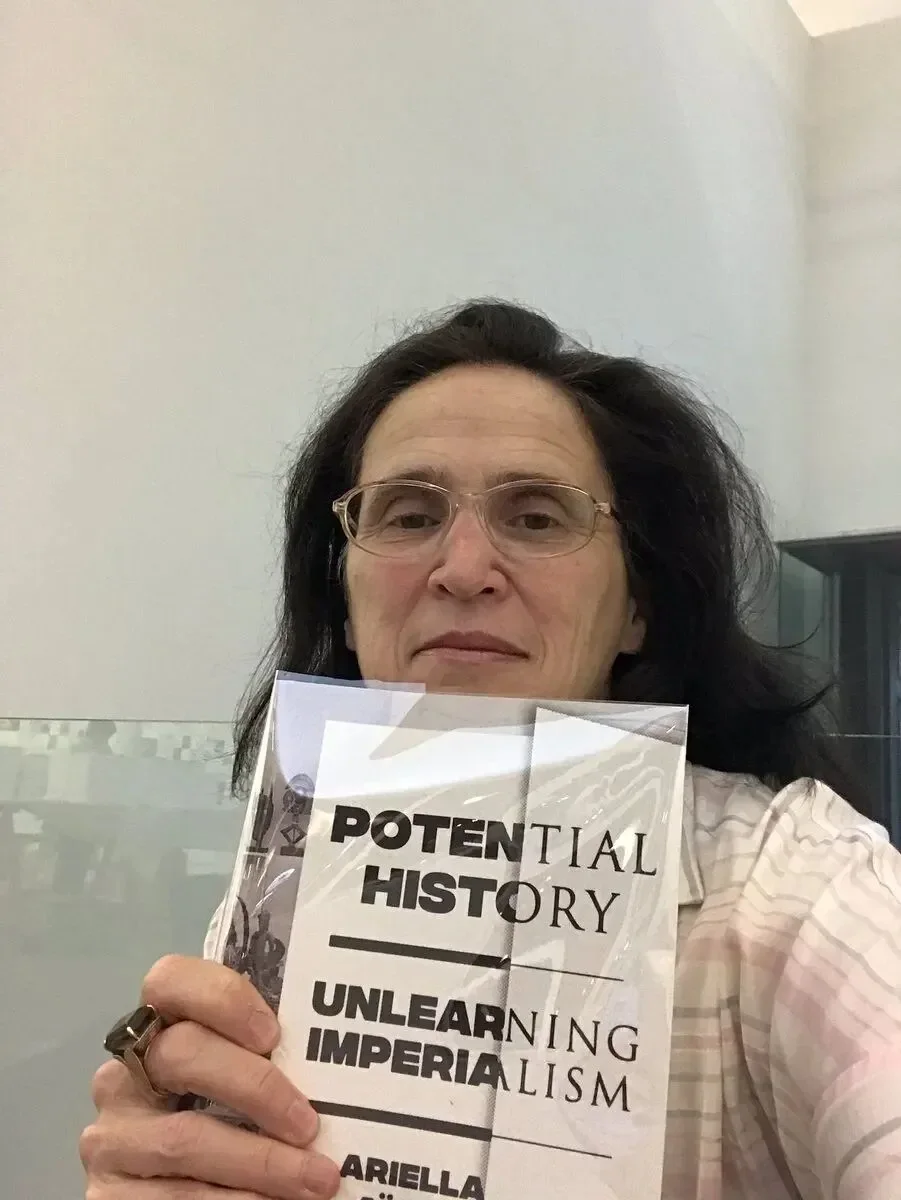
In the preface to Potential History: Unlearning Imperialism, Azoulay admits that she was born "by default" as an Israeli and raised as a member of that country's Jewish community. She wrote the book precisely to refuse to become, think as, identify as, or be recognized as an "Israeli," because for her Israeli identity means taking for granted the enjoyment of land and property stolen from others. She recalls that her mother was originally a Palestinian Jew but was forcibly transformed into an "Israeli" at nineteen when the new state was founded, and was induced to forget every language except Hebrew, including Ladino, which had been passed down for generations. This nation-state project sought to replace, by violent means, the richer sense of belonging people had once had within their communities. Before 1948, "Palestinian Jew" was a commonplace designation. Only because of the later political project of destroying Palestine did the phrase come to seem strange.
In addition, after her father's death she recovered and adopted her grandmother's Arabic name, "Aïsha," as a way of resisting the imperial command that Jewish identity be absolutely opposed to Arabness, and of reaffirming her deep historical ties as an "Arab Jew." In her earlier works (such as The Civil Contract of Photography), however, her usual byline was generally "Ariella Aïsha Azoulay."
Thanks to Shuyue for reminding me to pay particular attention to this point.
Since her methodology leans so heavily on visual culture studies, might Azoulay easily overlook the composition of specific images and the singularity of individual cases? Might she replace them with the "civil knowledge" produced by the "civil gaze" she values, when that singularity is precisely what art history holds dear? (Then again, do that many photographs really need to be examined through art history's formal analysis?) At the same time, since political problems and the value judgments tied to them drive the production of her knowledge, might they limit the level at which Azoulay can sketch photography? Might they confine her to photography's potential for ameliorating the Palestinian question, making it hard for her to turn her definition of photography into a more universal ethical program at the philosophical level? For these reasons, although she herself does not make extensive use of phenomenological vocabulary and terminology, I want to try to draw out, from a phenomenological angle, the potential for a political phenomenology contained in her thought. The aim is to clarify more plainly the universal democratic potential in her work, and to distill from it an approach that strikes, in an ontological sense, at the heart of what "photography" means for our lives today, while preserving the complexity and plurality of its object of study.
2 From Political Citizen to Photographic Citizen[52]
For Azoulay, scholarship is a path that begins at its origin. Her thinking starts from the specific conditions of civil existence produced in Palestine under Israeli rule, which she calls "regime-made disaster"[6].
The harm and oppression suffered by people in this condition hover only at the edge of humanitarian catastrophe. They do not meet the fate of the Tutsi slaughtered in the Rwandan genocide. Yet they remain in this condition for so long that people even grow used to it and often do not regard it as a disaster at all. For the authorities, then, even the aid or measures used to fend off the consequences of disaster are never deployed as a full solution to end it. They serve only as patchwork repairs meant to keep this condition of diminished existence going.[7]
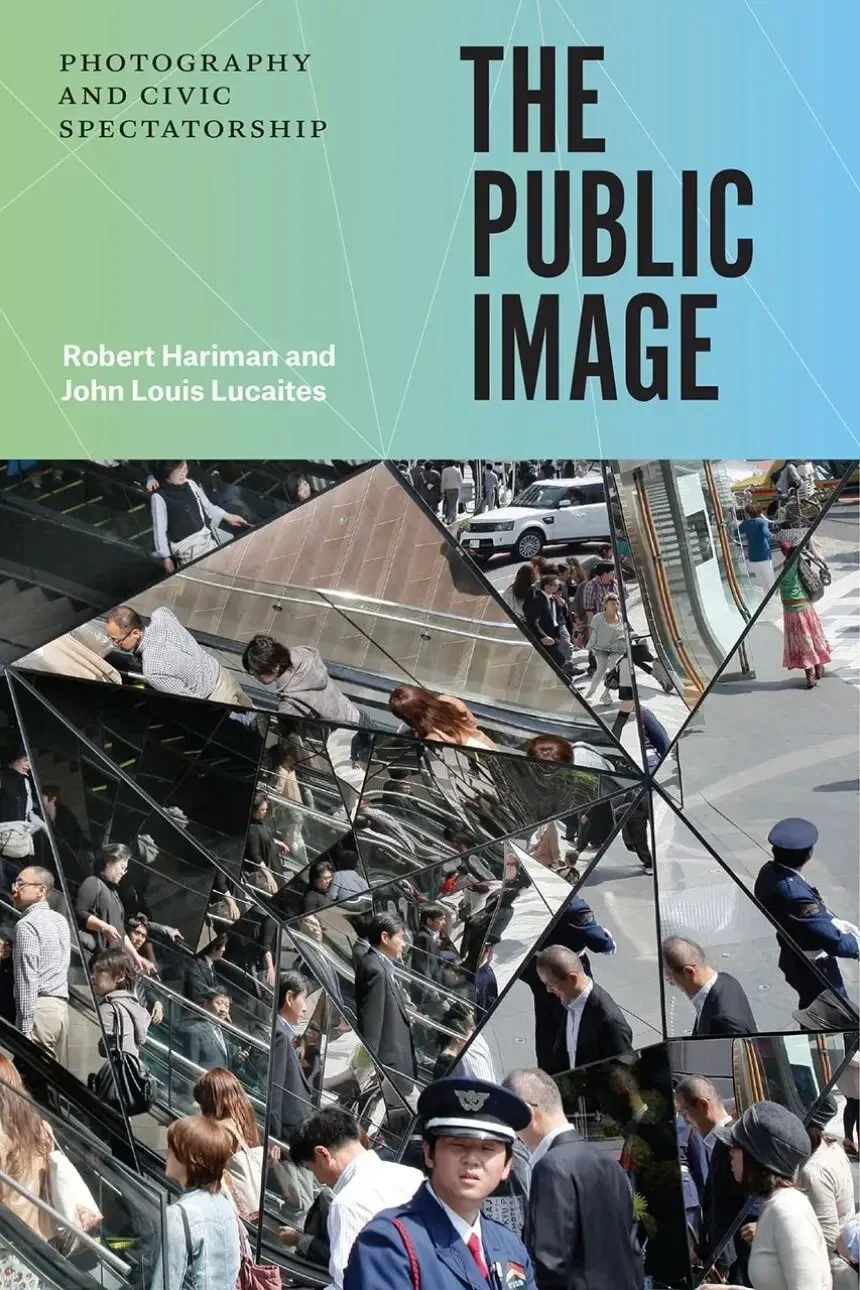
In the case of the Israeli regime, the authorities manage the limits, margins, and intensity of the disaster through measures such as partitioning roads, designating restricted zones of passage, and carrying out militarized demolitions of Palestinian homes, so that it befalls only particular groups of people. Robert Hariman summarizes this precisely:
Regime-made disaster usually falls below the threshold of violence, and its effects can be mistaken for the ordinary vicissitudes of a hard life. Hence a paradox: on the one hand, it takes place in full view of media coverage; on the other, it is very hard to get the world to face a sustained but dispersed process of dispossession. Farmers must pass through checkpoints to work their fields, pregnant women must pass through checkpoints to reach the hospital, and at the checkpoint there may be long, uncomfortable, frustrating, and frightening delays, and it may close unexpectedly at any moment—closing again and again just when someone urgently needs it open. […] When violence is distributed through a system of state practices and is often reduced to the "petty sovereign" making decisions at the checkpoint, the result is the wholesale destruction of civil society in a banal way.[8]
This condition of existence imposed on Palestinians by the Israeli regime led Azoulay to reflect on a cornerstone of modern politics, and one of the factors that underwrites such disaster: citizenship. Azoulay examines the tradition of contractual politics and reminds us:
In any given historical situation, the meaning of citizenship cannot be understood without taking into account the noncitizens, for they too are part of the governed population; they constitute an excluded group alongside whom citizens are governed.[9]
In other words, citizenship means that those who hold it are entitled to protection by the regime (the sovereign), and it also means the expulsion of another group of people. Azoulay pays particular attention to Israel's female citizens and to Palestinians in the territories occupied by Israel since 1967. The citizenship of the former is being damaged. The latter are noncitizens stripped by the Israeli authorities of the basic rights citizens should enjoy. At the same time, the sovereign government uses paramilitary force to control this group's political potential, systematically sabotaging their efforts to create a public sphere.
Azoulay develops this theme further in her recent work Potential History: Unlearning Imperialism. There she tries to find a way to break the monopoly of the imperial, linear view of history by recounting the plunder of artifacts and artworks during colonization and by critiquing the museum. More importantly, in this work she revises the views of the early writings this article focuses on. She pushes the spatiotemporal conditions of photography's "invention" back to 1492, arguing that photography's practice of naturalizing fragments of the world into another world possessed by the photographer shares exactly the same logic as imperial governance[10].

At first glance, starting from the tradition of political contract theory, which concerns relations among the governed, seems to have nothing to do with photography. I will show, however, that Azoulay's key term "citizen" here anchors two problem-layers at once. The first is imperial politics and colonial atrocity as oppression. The second is the civil contract and the ethics of the other as liberation.
As for the first problem-layer, the existence of photography allows a modern civic understanding, which Azoulay calls "civil knowledge"[11], to be produced. That is, photographs, as a source of this civil knowledge, enable citizens with modern visual literacy to read them and identify the traces left by past dispersed, banal violence. They can identify the "condition of unprotected exposure to power"[12] that regime violence imposes on noncitizens.
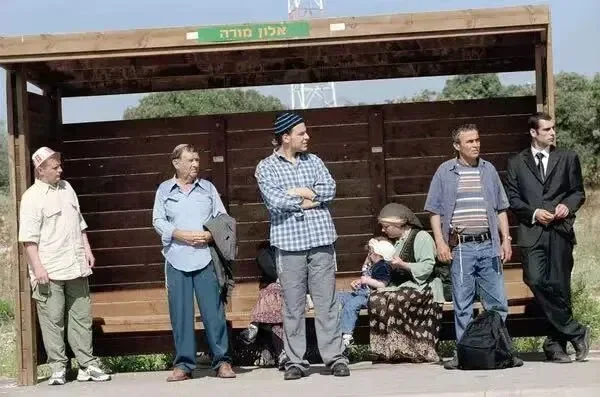
For Azoulay, the most typical instance of this is the Israeli regime's intrusion into the private sphere of Palestinians. Photographs of the demolition of buildings in Palestinian residential areas reveal the excess of this sovereign state's prerogatives. These photographs also record the large-scale military force employed by Israel's rulers, which, combined with engineering know-how, ensures that the oppression never crosses the threshold of humanitarian catastrophe. What fundamentally makes such identification possible is the second problem-layer to which the concept of the "citizen" points here. Photography is a complex that cannot be reduced to any single element, whether camera, producer, photographed person, photograph, or viewer. In this light, photography itself possesses a plural space of meaning, which is also a space of political relations.
This space is constituted by the "encounter" of multiple parties. Its members make up what Azoulay calls "the citizenry of photography" [13]. It is a borderless, open group, defined not by distinctions of interest such as amateur versus professional, but by the political premise of shared human life. In this space the photographer is no longer seen as the producer of the photograph's meaning. Instead, the situation of the photographed person and the viewer's understanding matter just as much. There is no sovereign in the citizenry of photography, only partnership among the governed. This sets it apart from the approach of Carl Schmitt and others, who focus on the exercise and limits of sovereign power[13].
The citizenry of photography often shows its ties and partnership precisely when faced with the disasters suffered by those who are noncitizens in the sense of real-world politics. In such cases,
the use of photography is in fact the exercise of citizenship—not the citizenship stamped with the mark of belonging to a sovereign state, but citizenship as the partnership of the governed, taking up their responsibility as citizens and using their status for one another rather than for a sovereign state.[14]
This situation is the starting point of what Azoulay calls "the civil contract of photography." The contract resembles a tacit agreement. It precedes the citizen/noncitizen division brought about by political sovereignty and is a more primordial form of mutual obligation[15]. In this contractual relation, the public "owns" the photograph just as the photographer does. This ownership is not ownership in the legal sense, however. The photograph's owners are more like "addressers" and "addressees." As a photograph circulates, each person is both addressee and addresser. On the one hand, each receives and understands the meanings others have attached to the photograph. On the other, each can create new meanings for it and pass it on.
In this situation, the addressers and addressees are in fact exercising a civilian skill that is not wholly subordinate to governmental power. By sending and receiving letters along the chain of photographic circulation, they also affirm their partnership with others, even though in real life these addressers and addressees could never meet. Photography thus becomes a practice through which the public can put some distance between itself and power, so as to observe how power operates and what consequences it produces. Hence "citizenship is redefined as equal, and as a capacity to recognize others under conditions of plurality rather than being divided by the distinctions of governing power."[16]
More concretely, looking at photographs is always, in a sense, a vita contemplativa, a way for the viewer standing in the present to face a distant past, and distance arises from this. Yet because of the existence of the addresser's role, it is also deeply embedded in the vita activa, entering and acting upon an ongoing present. This is most evident in the circulation of photographs of atrocity. In this situation, the public is also spared from becoming the agent through which power inflicts violence.
Azoulay insists that photography is a tool for exercising power, but "it is in the hands of the governed, not only in the hands of the sovereign or of those who seek to seize power."[17] The photographed persons, like the photographer and the viewer, are plaintiffs rather than owners, and equal participants in this compound encounter. As Noam Leshem puts it:
To acknowledge the civil space opened up by photography is also to acknowledge that photography's addressee—the viewer—can no longer remain in the position of a passive spectator, since in that position one can only be asked to observe and contemplate a static object, one that can be scrutinized at any time.[18]
Having sketched this, we can turn back and ask what exactly Azoulay means by "politics." Understanding this ultimately leads to the phenomenological potential in Azoulay's thought that I aim to reveal at the end. It is neither possible nor necessary to define and fully discuss "politics," a term fraught with endless dispute. We need only ask two questions. First, what does Azoulay's "politics" actually mean? Second, in that sense, what does the "politics" of photography mean?
In my view, although Azoulay seems to cite and analyze in detail the critiques of the state and of politics from Schmitt to Agamben, her real core support seems quite direct. It is simply the mutual recognition and plurality among human beings that can be found in many definitions of politics. This is precisely what allows Azoulay to call her ontology of photography "political."
Let me say a little about this. David Easton's definition of politics was highly influential in its day: politics is "the authoritative allocation of values for a society." Hannah Arendt, who most influenced the formation of Azoulay's thought, held instead that the meaning of politics is freedom. In freedom, people "as equals among peers, could interact without compulsion, without force, and without ruling over one another, commanding and obeying one another only in emergencies—that is, in time of war—and otherwise managing all their affairs by speaking with and persuading one another."[19]
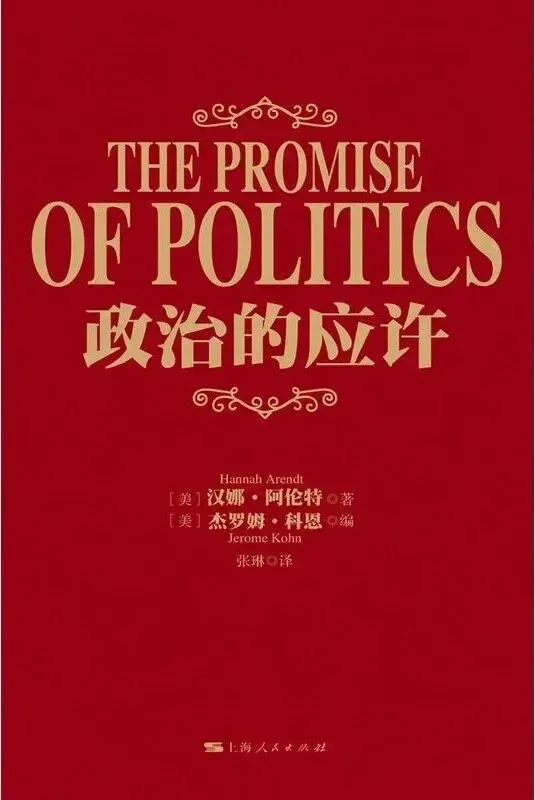
Arendt goes on to clarify that these definitions of politics and freedom come from ancient Athens. In debates over the workings of the state, struggles over rights, the maintenance of group relations, the institutional management of law, education, and the economy, and the balance between rulers and ruled, one can find the "coexistence and association of different people"[20] with which politics is concerned. In short, politics leads to a better plural life in common. The criterion of value judgment here is mutual recognition in the intersubjective dimension, and such recognition in turn opens the possibility of reconstructing the truth of all the events that sovereignty has obscured. "Politics arises between men and is established as relationships."[21]
Azoulay adopts Arendt's use of politics, and so a premise that gives photography its political character readily emerges. As Gil Pasternak puts it:
Wherever photography enters into relation with groups or individuals, separating, managing, or changing them—whether physically, perceptually, or emotionally—it has always already entered the political realm.[22]
Of course, Azoulay's reception of Arendt shows most clearly in her definition of "action," but allow me to leave that part for section three. From this perspective, citizenship in this political sense achieves its greatest effect in debate within the public sphere. In this sense, the "politics" of photography appears, on the one hand, in the limiting effect of looking on sovereign power, as I noted earlier. On the other hand, it appears in what Azoulay describes: "photographs bear the traces of plural political relations, which can be realized through the act of looking, of translating what is seen into a claim that calls for action, and of disseminating it."[23]
To restore the equal standing of the members of the citizenry of photography, and to restore the condition of human beings in the plural, the position of sovereignty must be weakened. Politics must be restored as a dynamic relation of plural negotiation rather than a question of the authoritative distribution between governing and governed. Photographic practice inherently carries a plurality of positions and an egalitarian potential. This makes it easy for power to manipulate, but it can also become a tool against power. It is dispersed, and every participant can play a role in it. In short, the politics of photography in this sense necessarily leads toward others, because "the photograph and its meaning are the outcome of an encounter among participants—the photographed, the photographer, and the spectator—none of whom has the authority to fix and determine the photograph's meaning; photography thus negates any particular claim to sovereignty."[25]
Plurality in this sense differs from the plurality of John Tagg, for whom photography's character is determined solely by the power behind it[24]. Tagg's position is in fact an extreme nominalism. It fundamentally cancels the fact that photography has an identifiable nature, and so it cannot see the enormous democratic and liberating potential contained in photography.
3 Turning to the Other: Against the Myth of Originality
As argued above, a politics concerned with recognition and plurality calls for a desirable life in common. An adequate political theory would try to argue which form of common life is desirable, and why. Starting from here, Azoulay moves toward an ethical politics that emphasizes the "other," and toward an account of photography that differs from traditional critiques of photographic discourse. For the latter, the photographer's dominant position as producer of photographic meaning is always beyond question, especially in the codified histories of photography represented by Beaumont Newhall.
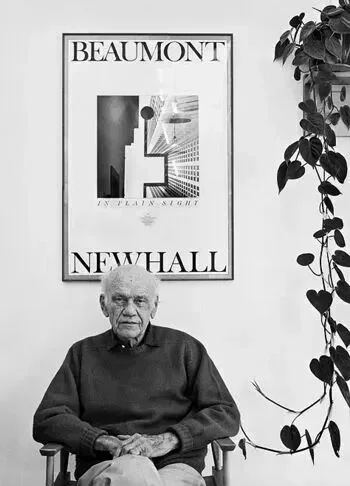
In terms of its conclusions, Azoulay firmly opposes the master narratives dominated by photographers, as well as any artistic myth of originality in the field of photography. Taken on its own, this conclusion seems quite similar to the position Rosalind Krauss and others have long held[25]. Yet if we consider how their knowledge discourses were generated, the vast difference between the two becomes apparent. Azoulay's opposition to originality and to the photographer's ownership of the photograph does not, as with Krauss, come from an already codified Euro-American art-historical tradition. It originates in the respect for and recognition of plurality described above. It is precisely in this dismantling of the myth of originality, I believe, that we find the most illuminating part of Azoulay's thought.
First, regarding the invention of photography, Azoulay has abandoned the traditional narrative's attempts to find who the "first" inventor was or to determine when photography acquired its identifiable features. Her approach also differs from Geoffrey Batchen's effort to find a group of "proto-photographers," to name a certain desire for photography, and to define it as photography's origin[26]. In my view, Azoulay's account of photography's origin grasps with great clarity the possibility and preconditions of photography's saturation of our everyday lives today, and so has theoretical value that cannot be ignored.
For Azoulay, "photography was invented at the moment a plural space was opened, the moment a great many people—not merely a circle of acquaintances—picked up the camera and began using it as a means of producing images."[29] This argument is desovereignized from its very origin. It is easy to see that both Baudelaire's disparagement of photographers and Stieglitz's praise of them confine photography to an image-making technique manipulated by a single subject. In such pronouncements, photography has been conceptualized as a transparent technique lying between photographer and photograph, a technique that leaves no trace on its product, the photograph.
Azoulay reminds us, however, that in our time photography has become an omnipresent potential event. A switched-off camera standing at the scene can already change how everyone present perceives and behaves in the moment. The camera need not even be present to affect people's relations[27]. Photographic technology has become a social technology capable of blurring the boundaries between fiction and reality, between the bodily world and the external world.
The essence of Azoulay's view is that she regards photography as a way of intervening in our everyday life, a technique of living. Such photography is closer to life than to death. It is no longer a mummifying technique of preservation. It has become a mediating event that is forever unfinished and awaits continuation. This touches the essence of photography, namely the reshaping of our sense of existence. From then on, photographer and photographed become relational beings mediated by photography. Because of its plural character, this relational existence is fundamentally and necessarily political, and must be understood by way of politics.
For citizens of modern society, this has become the transcendental structure through which we experience life. In this relational existence there is no sovereign, and the members stand in partnership with one another. Yet merely emphasizing this partnership is not enough to dispel the specter of authority. Azoulay takes a path somewhat similar to that of Emmanuel Levinas. She inverts the paradigm of the philosophy of the subject, turning our gaze from the subject's powers to the other's appeal to us[28].
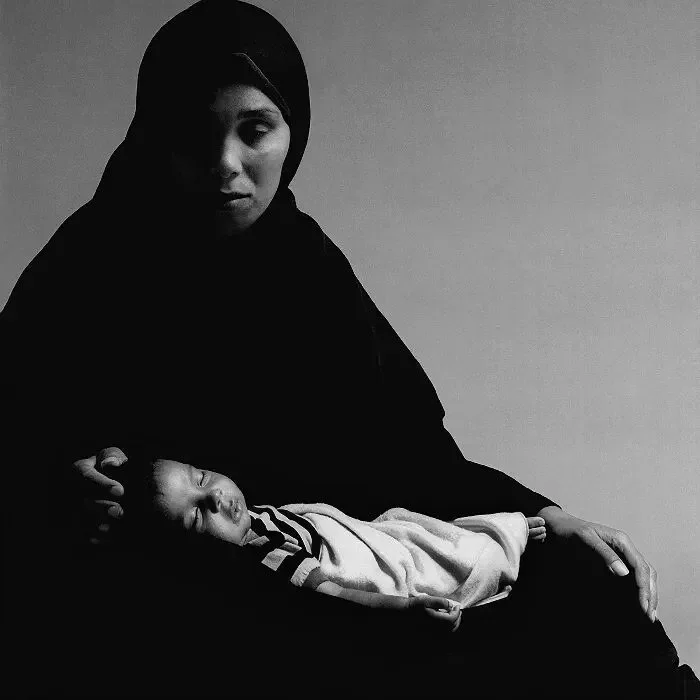
Let me illustrate this with a particular kind of photography. A considerable part of the material Azoulay draws on consists of images of atrocities suffered by Palestinians. Among these, she draws our attention in particular to a photograph by Micha Kirshner of Aisha al-Kurd (above). In a makeshift studio, Kirshner had Aisha dress in a black robe, cradle her son, and gaze at him. The tones of the photograph are soft and suffused with an unmistakable "Madonna" quality.
Kirshner's representations of Palestinian suffering are never raw or snapshot-like. They are always carefully planned and arranged. It is easy to imagine that photographs like this often draw criticism, accusing photographers like Kirshner of aestheticizing suffering. The best-known example is probably the kind of criticism Sebastião Salgado has faced. More broadly, photographs of suffering with evident aesthetic qualities often draw accusations of "disaster pornography."
All these ethical reproaches against modes of representation, however, fall into a trap. They completely ignore the identity of the photographed person and their existence as a concrete human being. Susie Linfield argues that critiques like Solomon-Godeau's charge that Salgado refuses to deal with ethical questions[29] are "more concerned with whether the viewer's conscience is clear than with the plight of the injured subject."[30]

Azoulay likewise sees the conceit in this line of argument and its neglect of the sufferers themselves. She argues:
Although these people believe they are speaking on behalf of those photographed, they in fact ignore an important mark the photographed have left on the photograph—their explicit consent to be photographed, that is, their active participation in the photographic act.[31]
All the traces in these carefully constructed photographs of suffering are in fact the result of mutual understanding and cooperation between the photographed and the photographer. This is especially true of more extreme atrocity photography, for example photographs that depict people shortly before their execution.
Blaming the act of representation itself and the photographer's moral inclinations actually brackets the real enemy. It also fails to treat the photographed person as a subject, dismissing them simply with "one should not photograph" or "one should not look." Such a simple refusal of the aestheticization of disaster may well turn into the fault of "being generous with other people's property." We must recognize that a considerable portion, if not all, of the images of the dead who look out at the viewer through the photograph's surface are asking us to see and remember the disaster they suffered. They leave traces of having lived in this world not only through images, but through diaries, reports, and every other possible form of information.
In this situation, what matters is not that they were photographed, but that they have been killed. However we look, the latter cannot be undone. Whatever our manner of looking, viewing the photographs of the victims of Lubyanka prison in David King's Ordinary Citizens means confronting this fact: these people existed, and now they are dead. This irreparable fact resists any moral justification of representation and viewing.
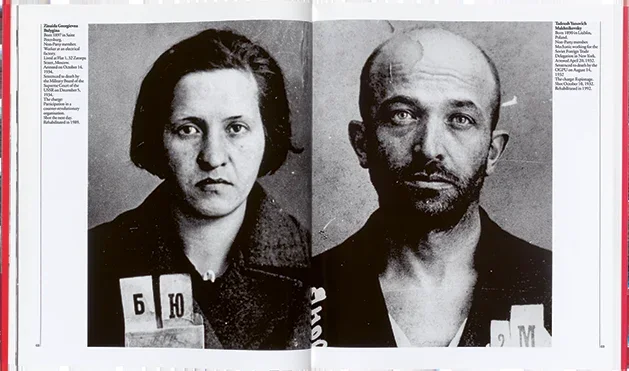
Restoring the subject-status of the photographed matters for more than this. More importantly, it allows us to become aware of a more complex, fluid plurality. This is not to affirm every mode of representation, for exploitative representation does exist. The point is to recognize that no subject frozen by a photograph should be congealed into a single identity.[32]
For example, Dorothea Lange took that photograph of a migrant mother (below). It has become the century's most iconic hymn to human resilience in the face of suffering. Yet how many people know the mother's name?
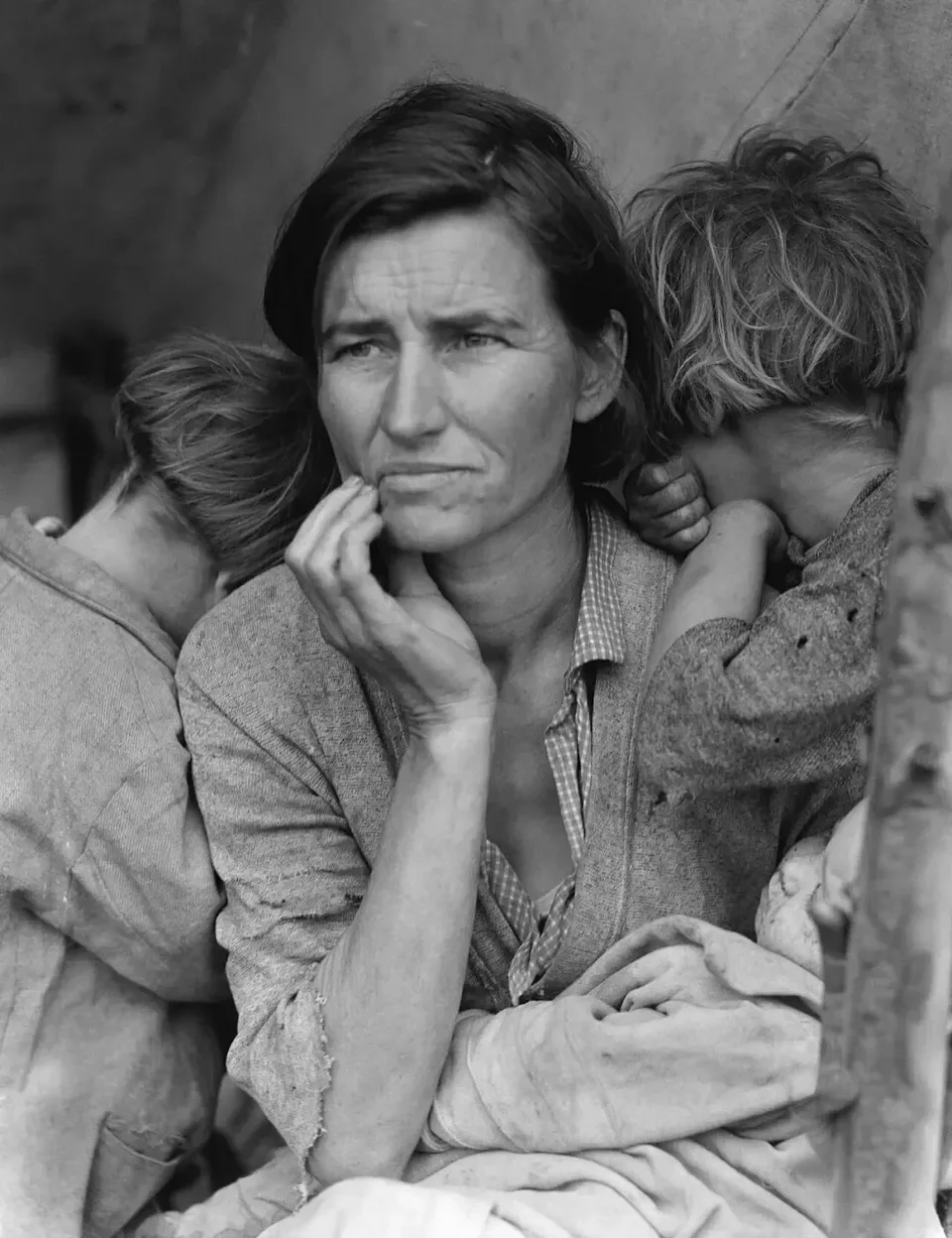
The mother in the photograph, Florence Thompson, not only had no real say in interpreting it, but was turned into a symbol of the suffering of the American Great Depression. In this sense the representation did become an exploitation of her. She herself protested: "I wish she hadn't taken my picture […] She said she'd send me a copy, but she never did." But if the matter stopped there, it would become an unfair indictment of the photographer. In another interview, Florence said: "I'm tired of being a symbol of human poverty, and besides, my life has gotten better."[33]
This is not mere complaint, for improvement and violence were indeed happening at the same time. The case shows well what complexity is erased when the representation of the photographed person is congealed into a sign. Azoulay reminds us that the widely accepted indexical nature of photographs readily produces the view that the represented person is congealed into a sign and accepted through statements like "these are refugees." Such congealment is in fact an extreme simplification and polarization of the encounter that takes place in photography's political space. But once we suspend our assent to such linguistic statements, we can see that "viewing photography as an indeterminate encounter between people, rather than an encounter delimited by the photograph, allows us to see photography anew as an open encounter that permits others to take part."[34]
Further, to regard the people in certain photographs as refugees is precisely to use photographs for the purpose of representation as sign. And the political system behind this congealed sign, a system that divides the governed into citizens and noncitizens, is itself polarized. This view is essentially unconcerned with what the photographed person actually "is." It merely follows how the photographer or other users see the photographed person. There are no "refugees" in the citizenry of photography. Concepts such as "refugee" are used only within the category of sovereign politics, to stabilize the identity of the governed and to make them legible and manageable. They serve identification more than recognition or understanding. To go along with this understanding without reflection is to acknowledge the authority by which sovereignty divides and rules people, and to strip those people of the civic rights that should be theirs.
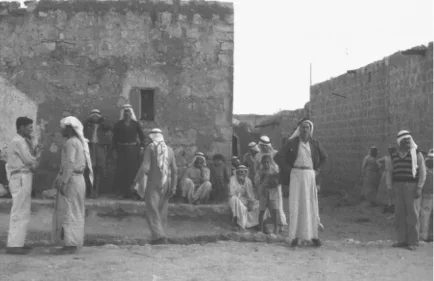
To identify oneself as a member of the citizenry of photography means not first seeing these represented people as refugees. It means seeing that it was regime-made disaster that reduced them to "refugees," and also seeing that the actions of spectators may help them escape their condition of exile and expulsion. Azoulay draws our attention to the fact that in those images in which the photographed gaze into the lens (below), "
at least some of them have not yet acquiesced in their erasure as political subjects or in becoming 'refugees'; they try to show the camera everything they have suffered, seeking recognition of the injustice or help in preventing the disaster from happening.[35]
4 Beyond Azoulay: A Political-Phenomenological Reading
Attempting an ontology of photography that opens toward the other can, from a wider horizon, remind us of photography's function and status in today's society. Atrocity photography in itself means a rupture of our banal everyday life. Such photography shows us most forcefully the conditions of life beyond ourselves. In short, atrocity photography presents us with a new visibility, and this is why it is worthwhile to follow Azoulay's gaze toward the Palestinian question. Yet confining our gaze solely within Azoulay's own arguments would limit the value of an account of photography that emphasizes plurality and the other.
Let us set out again from Azoulay. Borrowing Arendt's distinction among labor, work, and action, Azoulay distinguishes three corresponding kinds of gaze:
The identifying gaze and the directed gaze have accompanied human existence from the start. Before the invention of photography, however, it is hard to find a gaze analogous to action as Arendt defined it. […] The invention of photography added a new way of looking at the visible, one that did not exist before, or at least existed differently. This gaze is based on a new attitude toward vision. It constitutes an attitude toward objects, situations, customs, images, or places that, before photography, were not in themselves worthy of reflection.[36]
The third gaze is what she calls the "civil gaze." This insight points not only to the photographs she values that expose regime-made disaster and the oppressed condition of Palestinians. More importantly, it opens onto the contribution that photography, broadly understood, makes to the redistribution of visibility. This shows that photography is not merely a way of recording the world. It is a way of being in the world. The nature of photography cannot be clarified through photography alone.
When we raise our phones and aim them at something, this is in fact a reference, which is what Martin Heidegger means when he says: "It is precisely orientation (Ausrichtung) toward something that reveals to us that we have a body, or more precisely, that we are bodily beings."[37] Heidegger's thinking on de-severance and orientation reveals the fact that "the boundary of embodiment is the horizon of being in which I dwell."[38].
Reference does not point toward another thing or purpose. Its meaning lies in the fact that reference itself constitutes our world. Consciousness points toward something according to a certain interest, but that interest does not come from consciousness itself. It is provoked and awakened by that something. Our existing horizon does not supply the understanding of the thing itself. It only supplies the possibility of understanding it, a pre-understanding. The person taking a photograph points toward something, and that something does not persist on its own but points in turn toward something else. In this unbroken chain of references, the world appears.
"The person who takes photographs," as a new historical subject, differs from everyone before not only because life has become visible to them in an entirely different way. Today, when the rapid distribution and explosive quantity of images are defining features, the person who takes photographs not only constructs a world through their own references, but also shares the worlds that others constitute through the referential act of "taking photographs." Contemporary life has thus become displayed life. John Szarkowski once used the term "pointer" to define the role of the photographic practitioner:
As a way of beginning, one might compare the art of photography to the act of pointing. All of us, even the most polite of us, occasionally point, and it must be true that some of us point to more interesting facts, events, circumstances, and configurations than others. It is not difficult to imagine a person—a mute Virgil of the material world—who might raise the act of pointing to a creative level, who would lead us through fields and streets and indicate a sequence of phenomena and features.[39]
My point is that what matters here is the visibility of others' actions, not the creativity Szarkowski cared about. Whether such pointing can be raised to a creative level has nothing to do with equal rights as such. Such photographs, for lack of self-representation, are also likely to be regarded as "banal" or "sentimental" by curators such as Newhall.[40] But as I noted above, this line of argument still falls into a unipolar perspective and fails to notice the plural nature of photography as a practice of life. Before achieving anything aesthetic, every photographic practitioner is first telling us, through their photographs, "what is there." Without their pointing, the realities involved might be completely invisible to viewers.
This is especially true of forensic photography that deliberately explores the aftermath of disaster. If they had not been photographed for some particular purpose, who would pay special attention to things seen everywhere in daily life, such as clothes, cups, or wooden tables? This act of pointing, and the new visibility it brings, is precisely what the invention of photography brought about. In this respect, it is not only the act of pointing that enriches and complicates our sense of existence. The mere possibility of a camera or photograph being present has already changed our sense of existence.
Azoulay distinguishes between the "event of photography" and the "photographed event." The former refers to the change in people's experience brought about by the possible presence of the camera. The photograph is merely an additional factor in the unfolding of the event of photography. The photograph and the event of photography do not coincide: the photograph operating here may have been taken elsewhere. Azoulay gives the example of an interrogation room, where even if no such photograph exists, the interrogator's mere claim that one exists is enough to oppress the person under interrogation[41].
In this sense, the event of photography does not need to produce a photograph, for the mere possibility that we might be photographed is enough to affect us. The presumed existence of a camera or photograph can set the event of photography in motion. Accordingly, the event of photography is never completed. It can only be suspended, because the citizenry of photography may always encounter this presumed existence. Every person in it may, at any moment, occupy the position of spectator. Viewers may at any time concretize the potential meanings it contains by encountering the photograph's presence or absence. The direction and grounds of this concretization come from the viewer's own existential horizon. Thus the event of photography, like the citizenry of photography, rejects every form of sovereignty. No one can claim that the photograph belongs to them and thereby end the possibility of encounter within this system of relations.
We can see, then, that photography is not a one-way activity of producing meaning but a plural mode of relation, belonging to what Azoulay calls the "civil contract." People who take photographs are companions who share their horizons. In becoming the active agent of "looking," they simultaneously surrender private ownership of their own actions and become the ones looked at by others. A new ethics of representation arises in exactly this way. Those who refuse to represent atrocity may be unable to imagine this fact: if we had never seen the traces of these victims' lives, how could compassion ever arise? What would a world be like in which no one had ever seen the sufferers far away? We know that Husserl's late phenomenology developed the concept of "horizon":
The apprehension of any individual object takes place against the background of a world… Every experience has its own horizon, and this horizon is from the outset a field of possibilities.[42]
A finite horizon also opens up a view onto the possibilities within it. Each of us lives with a horizon bound up with our own interests, and the world therefore appears to us as we perceive it. Yet the truth of this existence is not merely the bodily existence revealed by Heidegger's thinking on de-severance and orientation. Existence is always communal existence, existence within the whole citizenry. Klaus Held sees the political potential in this connection:
People must go beyond what is their own in the interested states of their respective particular worlds and encounter one another in a shared world; only then can they take life seriously by assuming responsibility for themselves in the course of giving justifications. On this basis, in the Athenian polis—not by chance contemporaneous with philosophy—the first democracy in world history took shape, and with it "politics" in its most original and genuine sense.[43]
According to the phenomenological theories of the world in late Husserl and in Heidegger, existence itself unfolds among references and their connections. There is no such thing as an independent act. Referential connections lead from one thing to the next and so constitute the lifeworld. This is the world we ordinarily live in naturally, without needing to reflect. Events appear to us within this horizonal world, and this appearing is always in a process of ongoing occurrence. In a word, the lifeworld in the phenomenological sense is the universal interconnection of horizons. Everyone orients their actions within such a world, and this world also provides a pre-understanding of all events.
In this sense, the atrocity photographs Azoulay values, which represent regime-made disaster, interrupt our habitual inertia of reference by showing us another lifeworld. Take the celebrated photographer Gilles Peress. In 1996 and 1997 he photographed the book Graves in Bosnia. With Eric Stover, president of Physicians for Human Rights, he followed the work of two forensic anthropologists, William Haglund and Andrew Thomson, photographing their excavation of mass graves at Srebrenica and Vukovar.
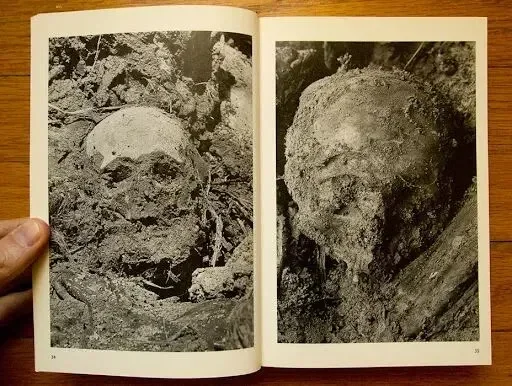
Graves combines Peress's photographs with Stover's text. The former represent the visual details and sites of the process, while the latter records the activities and findings of the forensic technicians. Peress's visual emphasis falls on fragments of life: personal belongings, damaged family photographs, the clothing of the dead, children's drawings, and so on. In this case, we can see that objects from another's world come to the fore before us. This formally overly transparent mode of representation makes us, at the level of experience, equate the signifier as image with its referent. We say that this "is" the object the dead person once used, that this "is" the shoe the dead person once wore.
It is in this sense that the photograph's form takes effect. This form is not the exposed brushwork of Manet's paintings or the multiple contour lines of Cézanne's. It gains its full power to move us by being placed within a whole of meaning provided by its authors, and by our being told "what we are looking at" before and while we look. The text juxtaposed with the photographs tells us these are the belongings of the murdered. As Azoulay says:
What is seen, the photograph's referent, is never given; it must be constituted to the same degree as the interpretations attached to it.[44]
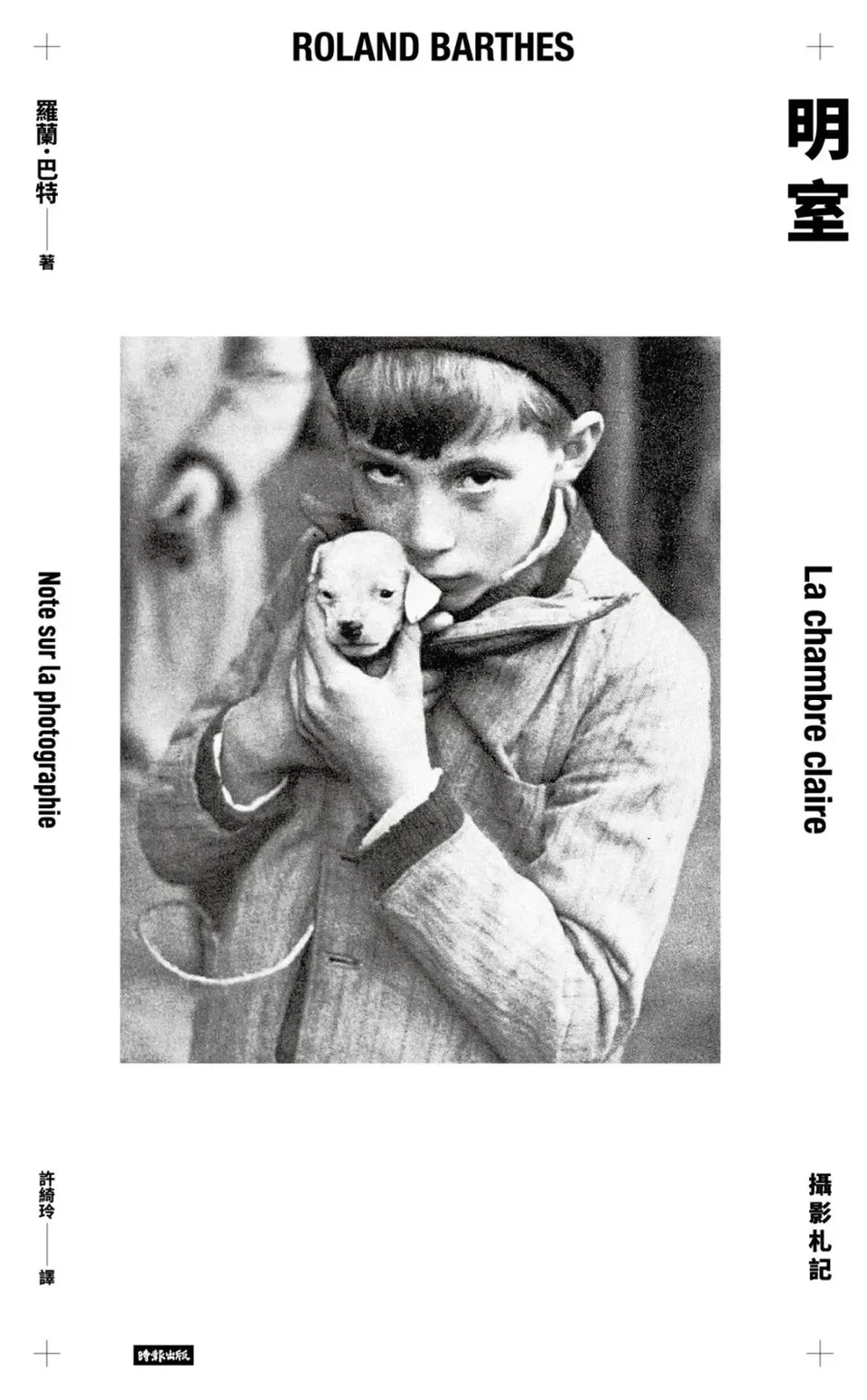
Although this equation of the photograph's signifier with its referent may carry some sovereign influence, the photograph nonetheless inscribes traces of the encounter among participants at the moment the event occurred. Not all these traces can have been planned, nor can they all be attributed to acts of will. On Roland Barthes's view, it is precisely this quality that gives the photograph the power to naturalize culture, endowing it with a kind of natural evidentiary force[45].
Yet even the fact that a photograph is briefly occupied by some sovereign power cannot end the permanence and mutability of the event of photography. Nor does a photograph necessarily reflect the influence of the most dominant sovereign. The most typical examples are photographs taken by perpetrators, which "speak for the victims and stand on the victims' side."[46] After reading the text accompanying a photograph, we suddenly realize that the thing sticking out of the boot like a broken stick is none other than a human bone, left behind after skin and muscle have been absorbed by the earth. If we did not know that the shoe came from someone who died unjustly, we would probably see it as an ordinary object.
This shoe is not Van Gogh's shoe from the dispute between Meyer Schapiro and Heidegger. It carries no art-historical controversy, only death. In looking at Peress's photographs, we do not connect the broken shoe with the possibilities of understanding supplied by our own lifeworld. We do not understand it, according to the possibilities our horizon discloses, as worn out, accidentally burned, or deliberately discarded. We try instead to accept another possibility of understanding.
This understanding cannot be reached through our own horizon alone, a horizon that has never seen such photographs. It points to the existential situation of another individual within what Azoulay calls "the citizenry of photography." He or she suffered atrocity, and this broken shoe with a bone in it is the evidence. The shoe stands on the barren, cluttered ground. It was photographed at the excavation site, which carries a different force from its being placed in a memorial museum as evidence. This horizon from the other does not flow docilely into our existing experience. On the contrary, it constitutes a violent, even traumatic interruption of that stream of experience. It forcibly intrudes into our otherwise coherent network of everyday references, compelling us to face this world we inhabit, a world torn apart by atrocity.
In this breakout from our own horizon produced by looking at photographs, the citizen/noncitizen division set up by the sovereign breaks down, and we instinctively try to stand with the sufferers:
The citizenry of photography neither precedes citizenship nor is conditioned by it; it is fundamentally defined solely by citizenship: membership in this citizenry implies citizenship, and citizenship implies membership in this citizenry. The citizenry of photography has no sovereign and therefore no mechanism of exclusion. In principle, everyone is a member of the collective. The basis of collective membership is each person's renunciation of exclusive rights over his or her image, and each person's willingness and right to be photographed, to become a photograph.[47]
More importantly, because the representation of traces appeals to the banal, trivial objects of life rather than to the sufferers themselves, its display of the setting is especially effective in arousing the viewer's emotions. This fragmentation makes us realize that war and atrocity do not necessarily lead to the justice, well-being, dignity, and law described in sovereign narratives. They are first of all the destruction of one small thing after another. And it is precisely such small destructions, like the "petty sovereign" mentioned earlier, that destroy civil society.
Looking back now, it is not hard to see that Azoulay's political ontology does not in fact focus on any single, homogeneous photography. All her definitions of photography oppose the paradigm of the philosophy of the subject and strive to let photography be reflected upon in a more holistic way. The political space of photography that Azoulay identifies is, at its most essential, political in the Greek (ancient Athenian) sense. It transcends each person's own world and allows many finite opinions to arise and enter into dialogue. Conversely, this finitude itself is rooted in the interests of each person's particular world. Yet this is the meaning of political judgment: each party transcends its own particular world, "in the prospect of this shared world, a shared world that concerns the 'common essence' of politics, that is, the shared world concerning what is held in common."[48] The political character that Held elaborates in his "phenomenology of the world" is precisely what Azoulay calls "civil imagination":
It is a form of imagination that transcends the single individual, existing between individuals and shared by them. […] The capacity to imagine a new state of affairs and to make it a natural part of our shared world itself comes from political imagination, a product of its shared nature: common to many, and often bound up with the existence of common resources.[49]
Civil imagination takes place in the intersubjective dimension, and it makes it possible for us to envision a better world. Civil imagination sees not only the citizens protected by sovereignty. It can also take oppressed noncitizens into account, and thereby seek new openings for reshaping society. The civil knowledge we gain from photography already constitutes a precondition for this imagination. In other words, the structural failure of modern politics is that it has made noncitizens absent from the political imagination of the people. Citizens' vision has been confined by democratic sovereignty or the popular will to a homogeneous discourse of citizenship, so that they cannot see the scene of the noncitizens who are governed alongside them. Civil imagination must first envision the existence of noncitizens, envision noncitizens and citizens standing together as partners, and then imagine the citizenry as a whole.
This whole is made up of irreducible individuals, each with their own particular world of interests. Such co-existence in the phenomenological sense always remains in an unfinished, open state, and it requires struggle. Precisely because each person's horizon is formed on the basis of their particular world of interests, "the citizenry of photography" must maintain the openness of this space through ongoing negotiation, argument, and even confrontation. To look at the obscured horizon of the noncitizen is also to resist sovereign power's monopoly over visibility.
The individuals who, in Azoulay's sense, seek to maintain this openness do indeed resemble the individuals Levinas describes: the other is an inexhaustible "infinity." There is therefore a plurality in it that no single description can exhaust. The significance of photography lies in this:
It is a site where traces of this plurality can be found; although attempts are made to govern it, even seemingly trivial governance such as control over the photographic frame, this plurality nonetheless persists. […] Within the citizenry of photography, she cannot impose on others what she has or has not seen.[50]
In sum, the phenomenological potential of Azoulay's political ontology lies in this. As viewers of photographs, we are at the same time members of the citizenry of photography. We look at photographs from our own individual horizons, and this equally determines our capacity to open ourselves to others' horizons. This is the path into the political world. Through looking at photographs, we discover new visibilities. And the civil world, in the sense of modern politics, exists only when all citizens have the right to argue, a right that means acknowledging the validity of every person's horizon. This is why despotic atrocity is the destruction of the civil world. This space is not static, for argument never ends. Nor can a photograph's meaning ever be fixed once and for all, for no party to the civil contract of photography can anchor its meaning.
The event of photography has become embedded in our lives and has become the transcendental structure through which all of us unfold our existence today. In the circulation system of photography, we are at once addressees and addressers. This shows that what Azoulay's phenomenology of photography ultimately points to is not a contemplative aesthetic experience but a demand, even an imperative. It is the ethical imperative that we constantly take up responsibility within this unstable network of relations and exercise our response-ability toward others. It is also in this sense that we can properly understand why what Ben Burbridge calls "the experience of photography provides a sensible principle for social reorganization"[51] is possible.
References
[1] VICENTE F. L., AZOULAY A. A. Ariella Aïsha Azoulay–Unlearning, An Interview with Ariella Aïsha Azoulay[J]. Análise Social, 2020, 55(235): 417
[2] VICENTE F. L., AZOULAY A. A. Ariella Aïsha Azoulay–Unlearning, An Interview with Ariella Aïsha Azoulay[J]. Análise Social, 2020, 55(235): 418.
[3] DE CAUWER S. Ariella Aïsha Azoulay and Georges Didi-Huberman: The Persistence of Lost Worlds[J]. Journal of Aesthetics & Culture, 2021, 13(1): 1-12.
[4] LESHEM N., WRIGHT L. A. Why Photography Matters as Art as Never Before by Michael Fried, and The Civil Contract of Photography by Ariella Azoulay[J]. Critical Quarterly, 2009, 51(2): 113-120.
[5] WOOLSEY J. The Citizenry of Photography[J]. Reviews in Cultural Theory, 2010, 1(1): 23.
[6] See AZOULAY A. Infra-destructure. In: KENNEDY L., PATRICK C. (eds.). The Violence of the Image[M]. New York: Routledge, 2020: 126. And AZOULAY A. A Tour of the Museum of Regime-Made Disasters[J]. Humanity: An International Journal of Human Rights, Humanitarianism, and Development, 4(3): 345-363.
[7] AZOULAY A. A Tour of the Museum of Regime-Made Disasters[J]. Humanity: An International Journal of Human Rights, Humanitarianism, and Development, 4(3): 360-361.
[8] HARIMAN R. Watching War Evolve: Photojournalism and New Forms of Violence. In: KENNEDY L., PATRICK C. (eds.). The Violence of the Image[M]. New York: Routledge, 2020: 139-163.
[9] AZOULAY A. The Civil Contract of Photography[M]. Princeton: Princeton University Press, 2021: 35.
[10] AZOULAY A. Potential history: Unlearning imperialism[M]. London: Verso Books, 2019.
[11] See AZOULAY A. Civil Imagination: A Political Ontology of Photography[M]. London: Verso, 2015: 125-218.
[12] AZOULAY A. Civil Imagination: A Political Ontology of Photography[M]. London: Verso, 2015: 141.[13]AZOULAY A. The Civil Contract of Photography[M]. Princeton: Princeton University Press, 2021: 93.
[13] See SCHMITT C. Political Theology: Four Chapters on the Concept of Sovereignty[M]. Chicago: University of Chicago Press, 2005.
[14] AZOULAY A. The Civil Contract of Photography[M]. Princeton: Princeton University Press, 2021: 99.
[15] AZOULAY A. The Civil Contract of Photography[M]. Princeton: Princeton University Press, 2021: 100.
[16] HARIMAN R. Watching War Evolve: Photojournalism and New Forms of Violence. In: KENNEDY L., PATRICK C. (eds.). The Violence of the Image[M]. New York: Routledge, 2020: 151.
[17] AZOULAY A. The Civil Contract of Photography[M]. Princeton: Princeton University Press, 2021: 100.
[18] LESHEM N., WRIGHT L. A. Why Photography Matters as Art as Never Before by Michael Fried, and The Civil Contract of Photography by Ariella Azoulay[J]. Critical Quarterly, 2009, 51(2): 117-118.
[19] ARENDT H. The Promise of Politics [Chinese edition][M]. ZHANG Lin (trans.). Shanghai: Shanghai People's Publishing House, 2018: 110.
[20] ARENDT H. The Promise of Politics [Chinese edition][M]. ZHANG Lin (trans.). Shanghai: Shanghai People's Publishing House, 2018: 92.
[21] ARENDT H. The Promise of Politics [Chinese edition][M]. ZHANG Lin (trans.). Shanghai: Shanghai People's Publishing House, 2018: 93.
[22] PASTERNAK G. Politics and Photography: Being Together, with Photographs. In: PASTERNAK G. (ed.). The Handbook of Photography Studies[M]. New York: Routledge, 2020: 215.
[23] AZOULAY A. The Civil Contract of Photography[M]. Princeton: Princeton University Press, 2021: 23-34. [25]WOOLSEY J. The Citizenry of Photography[J]. Reviews in Cultural Theory, 2010, 1(1): 22.
[24] See TAGG J. The Burden of Representation: Essays on Photographies and Histories [Chinese edition][M]. LIN Wei (trans.). Taipei: Yingyan She, 2022.
[25] See KRAUSS R. E. The Originality of the Avant-Garde and Other Modernist Myths[M]. Cambridge: MIT Press, 1986.
[26] BATCHEN G. Burning with Desire: The Conception of Photography [Chinese edition][M]. MAO Weidong (trans.). Beijing: China Minzu Culture Publishing House, 2016.[29]AZOULAY A. The Civil Contract of Photography[M]. Princeton: Princeton University Press, 2021: 89.
[27] AZOULAY A. Civil Imagination: A Political Ontology of Photography[M]. London: Verso, 2015: 18-22.
[28] LEVINAS E. Totality and Infinity [Chinese edition][M]. ZHU Gang (trans.). Beijing: Peking University Press, 2016.
[29] SOLOMEN-GODEAU A. Lament of the Images: Alfredo Jaar and the Ethics of Representation[J]. Aperture, (181): 36-47.
[30] LINFIELD S. The Cruel Radiance: Photography and Political Violence[M]. Chicago: University of Chicago Press, 2011: 44.
[31] AZOULAY A. Civil Imagination: A Political Ontology of Photography[M]. London: Verso, 2015: 120.
[32] On the "atrocity photography" discussed here, see my other article: "The Ethics of Representation: The Aesthetics of Traces in Atrocity Photography," Twenty-First Century, December 2025, pp. 120-134.
[33] DAVIS L. J. Migrant Mother: Dorothea Lange and the Truth of Photography[EB/OL]. Los Angeles Review of Books. [2023-12-25].
[34] AZOULAY A. Civil Imagination: A Political Ontology of Photography[M]. London: Verso, 2015: 222.
[35] AZOULAY A. Civil Imagination: A Political Ontology of Photography[M]. London: Verso, 2015: 228.
[36] AZOULAY A. The Civil Contract of Photography[M]. Princeton: Princeton University Press, 2021: 92.
[37] HEIDEGGER M., BOSS M. Zollikoner Seminare: Protokolle — Zwiegespräche — Briefe[M]. Frankfurt am Main: Vittorio Klostermann, 1994: 294.
[38] HEIDEGGER M., BOSS M. Zollikoner Seminare: Protokolle — Gespräche — Briefe[M]. Frankfurt am Main: Vittorio Klostermann, 1987: 113.
[39] Quoted in SHORE S. Modern Instances: The Craft of Photography[M]. London: MACK, 2022: 91-92.
[40] SCHWARTZ D. Camera Club Photo-Competitions: An Ethnographic Approach to the Analysis of a Visual Event[J]. Research on Language & Social Interaction, 21(1-4): 279.
[41] AZOULAY A. Civil Imagination: A Political Ontology of Photography[M]. London: Verso, 2015: 23.
[42] HUSSERL E. Experience and Judgement[M]. Churchill J. S., Ameriks K. (trans.). London: Routledge & Kegan Paul, 1973: 31-32.
[43] HELD K. Phenomenology of the World [Chinese edition][M]. NI Liangkang et al. (trans.). Beijing: The Commercial Press, 2023: 13.
[44] AZOULAY A. The Civil Contract of Photography[M]. Princeton: Princeton University Press, 2021: 27.
[45] Roland Barthes writes: "The type of consciousness the photograph involves is indeed truly unprecedented, since it establishes not a consciousness of the being-there of the thing [which any copy could provoke] but an awareness of its having-been-there. What we have is a new space-time category: spatial immediacy and temporal anteriority, the photograph being an illogical conjunction between the here-now and the there-then. It is thus at the level of this denoted message or message without code that the real unreality of the photograph can be fully understood: its unreality is that of the here-now, for the photograph is never experienced as illusion, is in no way a presence (claims as to the magical character of the photographic image must be deflated); its reality that of the having-been-there, for in every photograph there is the always stupefying evidence of this is how it was, giving us, by a precious miracle, a reality from which we are sheltered." See BARTHES R. Image/Music/Text[M]. Heath S. (trans.). New York: Hill and Wang, 1977: 44-45.
[46] LINFIELD S. The Cruel Radiance: Photography and Political Violence[M]. Chicago: University of Chicago Press, 2011: 52.
[47] AZOULAY A. The Civil Contract of Photography[M]. Princeton: Princeton University Press, 2021: 120.
[48] HELD K. Phenomenology of the World [Chinese edition][M]. NI Liangkang et al. (trans.). Beijing: The Commercial Press, 2023: 15.
[49] AZOULAY A. Civil Imagination: A Political Ontology of Photography[M]. London: Verso, 2015: 5.
[50] ZOULAY A. Civil Imagination: A Political Ontology of Photography[M]. London: Verso, 2015: 74.
[51] BURBRIDGE B. Photography After Capitalism[M]. London: Goldsmiths Press, 2022: 187.
[52] The term "political citizen" here differs from Azoulay's own usage. In this article, "political" in this phrase means "having a sovereign," so a "political citizen" is a citizenship subject to sovereign governance and marked by divisions of status. In Azoulay's sense, by contrast, "political" refers to the capacity of members of a community to interact and negotiate with one another as equals.