
Hello, my name is Matthias Pfaller. I am assistant curator at the Centre Pompidou, and I curated the exhibition Another Avant-Garde: Photography 1970–2000 with Florian Ebner at the West Bund Museum in Shanghai. I am very grateful for the invitation. I don't know who I'm speaking to right now, but I hope you will find some of these insights interesting, especially at the intersection of photographic theory and photographic practice, from my position as a curator in the room. Some questions refer to the very physical presence of photographs, and I think it is important to make the link between photographic theory and the experience in the room.
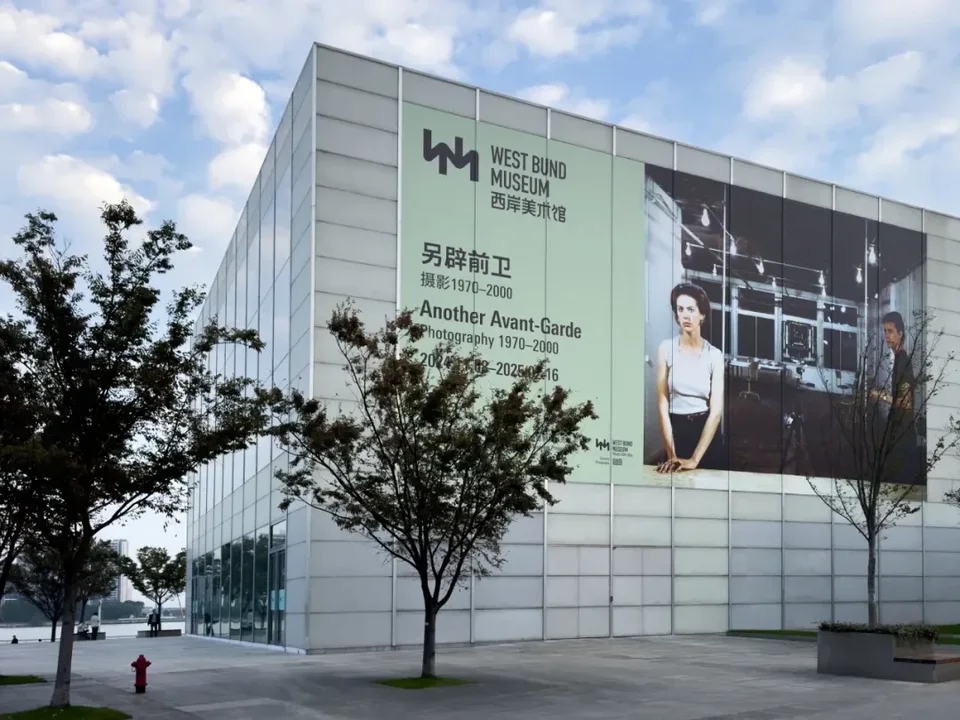
Question 1: In the exhibition, some photographs carried reflections of other photographs, while others were displayed completely on their own. How did you handle the presentation of individual photographs and the relationships between them?
I would like to start with the question of interference between some of the photographic works that we have in the exhibition.
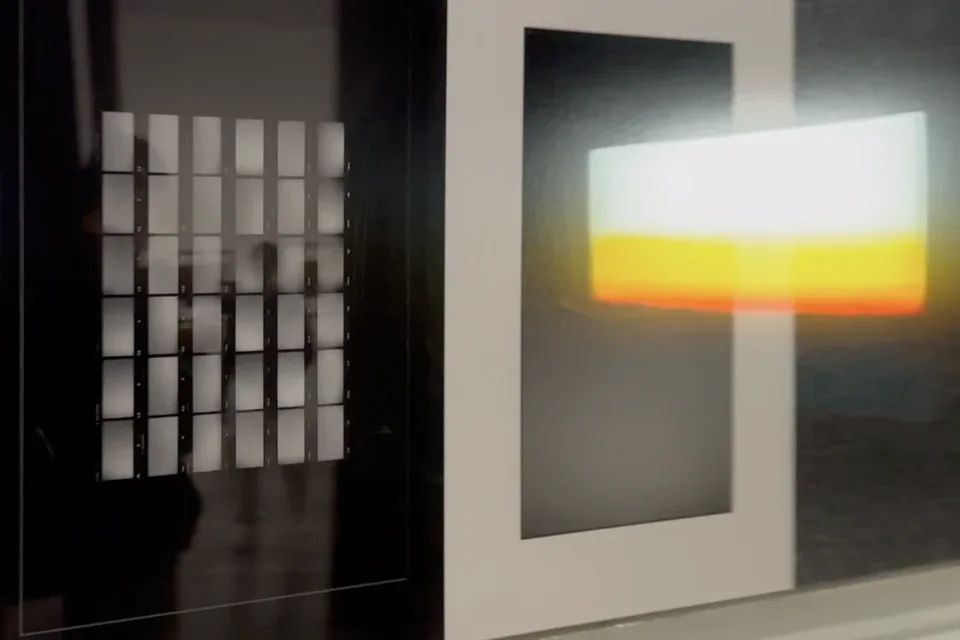
Especially Tim Ulrichs's lightbox, which consists of a Cibachrome transparency: an enlargement of a small strip of negative from the end of a film roll, which is usually broken off and thrown away because it has these color degradations. Often it is just a test, but Tim Ulrichs has transformed it into something else. He plays with our perception, because in enlarging this little piece of the negative, he wants us to look very closely but also to see something else. What we see is a landscape. The work is called Landscape Epiphany. An epiphany is a sudden idea that you get spontaneously, without even thinking about it, so it is a very serendipitous experience.
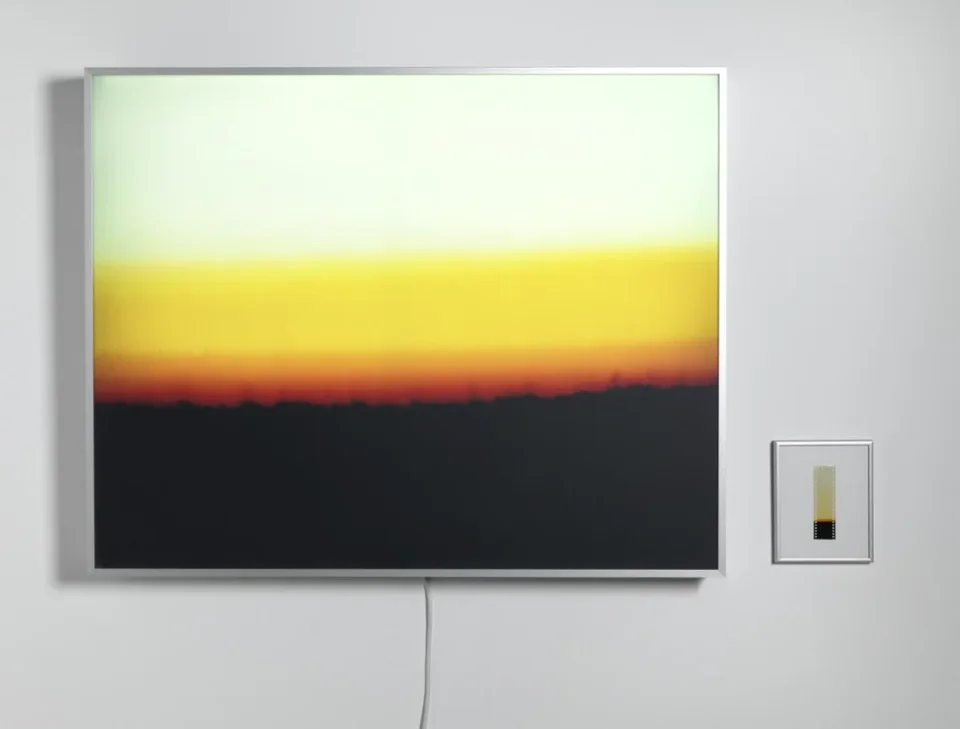
This work has a very strong glow. We presented it in a dark room with black walls. As you will see in the gallery, the light shines on or is reflected in the plexiglas in the frames of other works. You actually see the reflection of this very orange piece in the other works. This is very hard for a curator to anticipate. There is software that can calculate reflections nowadays, especially for concerts or the theater, where people use software to simulate light. Most museums do not have that, and I think it would also be too much to simulate everything. When we were in the gallery, we saw that this might make it difficult to see the other works clearly. Then you have to consider that some works are framed with normal plexiglas or glass, while others have special museum glass that reduces reflections. But if light comes from a specific angle, that glass throws it back in a greenish tone.
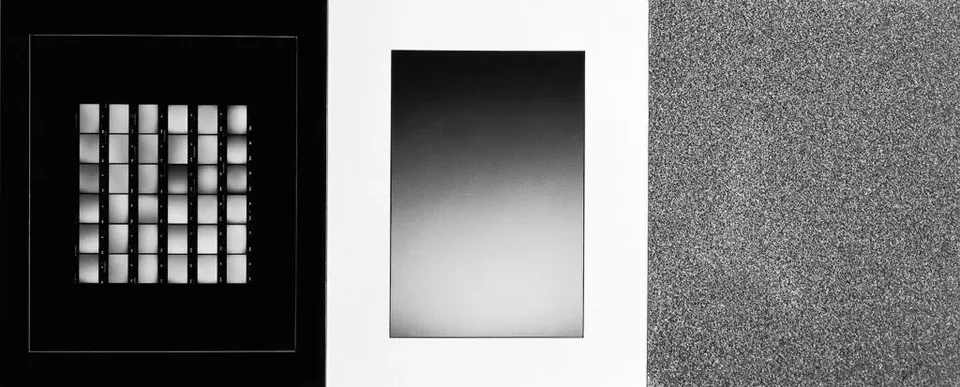
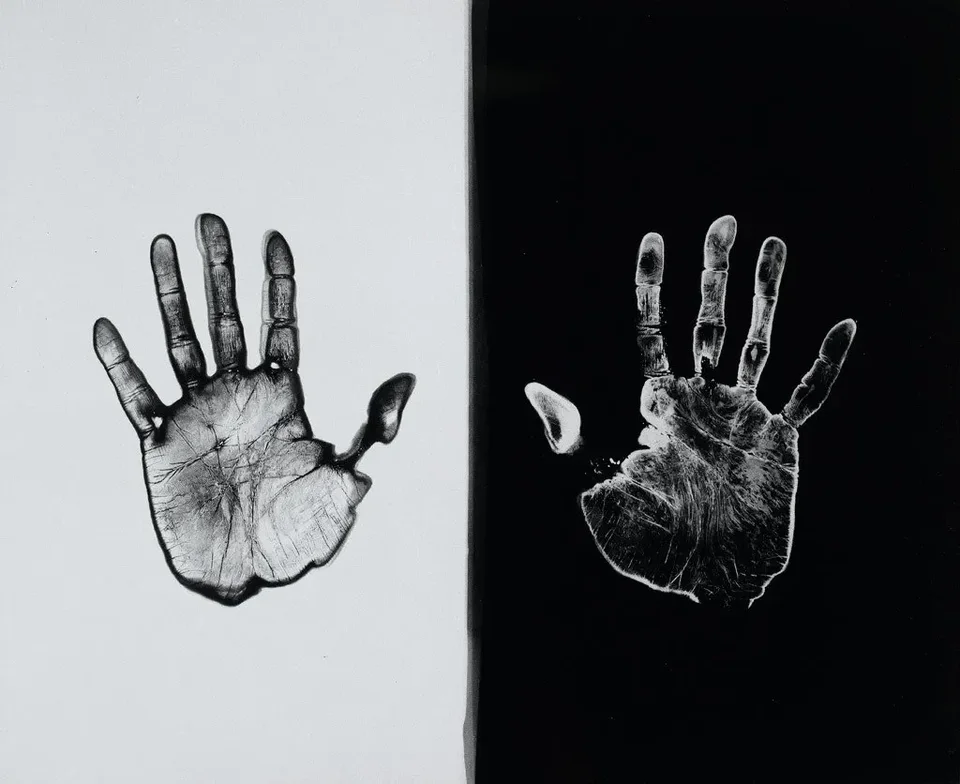
These are very practical questions, but they might offer some interesting new viewpoints. The third gallery in our exhibition is all about the photographic process in the darkroom and the functioning of the camera. When we see this reflection of the negative on works by Ugo Mulas, for instance, which show contact sheets and enlargements where you can see the grain of the photographic film, there is a superposition of two very similar ideas of the negative and the print with visible grain. It doubles the message of what a photograph actually consists of.
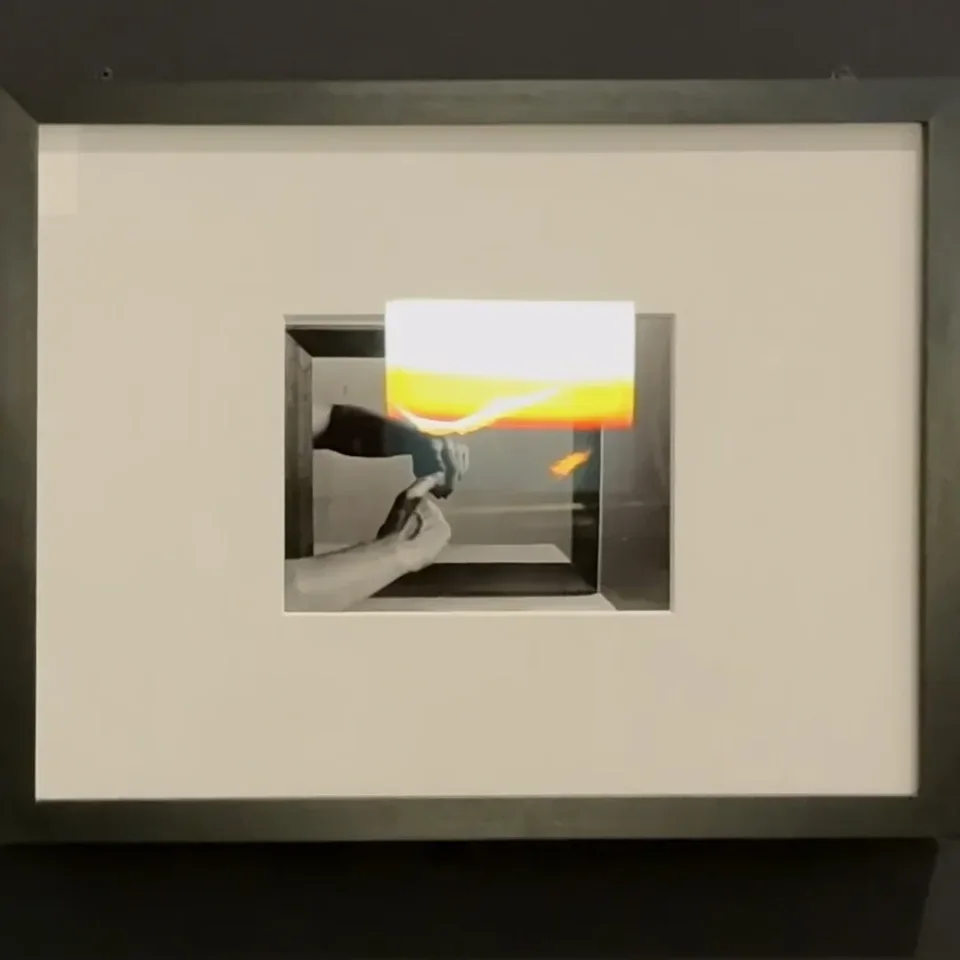
Right opposite, we have the series Zerkalo III by Ivan Chuikov, who plays with the idea of the mirror. He put an empty frame in front of his camera and simulates a mirror by placing his hands in a very symmetrical manner. But in one instance he changes the position of a hand, and the illusion that it is a mirror is broken. There are actually two hands, one in front of and one behind the empty frame.
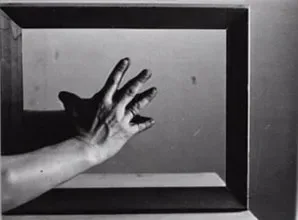
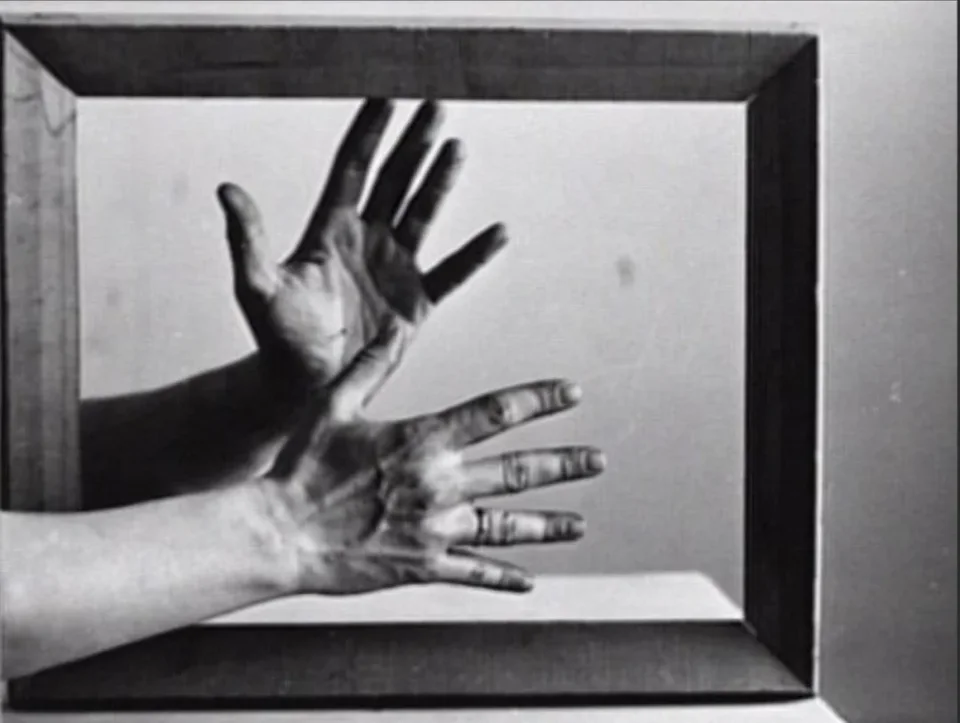
It may be a fortunate coincidence that the illusion of a mirror, of a reflection, is repeated in the reflection of Tim Ulrichs's work in Ivan Chuikov's images. It is all about doubling, about reflection and how it can sometimes be symmetrical and sometimes distorted. In this case it works. In other cases, curators really have to pay attention to these things to guarantee the visibility and the isolated experience of some artworks, because some works want to be left alone and do not need interference.
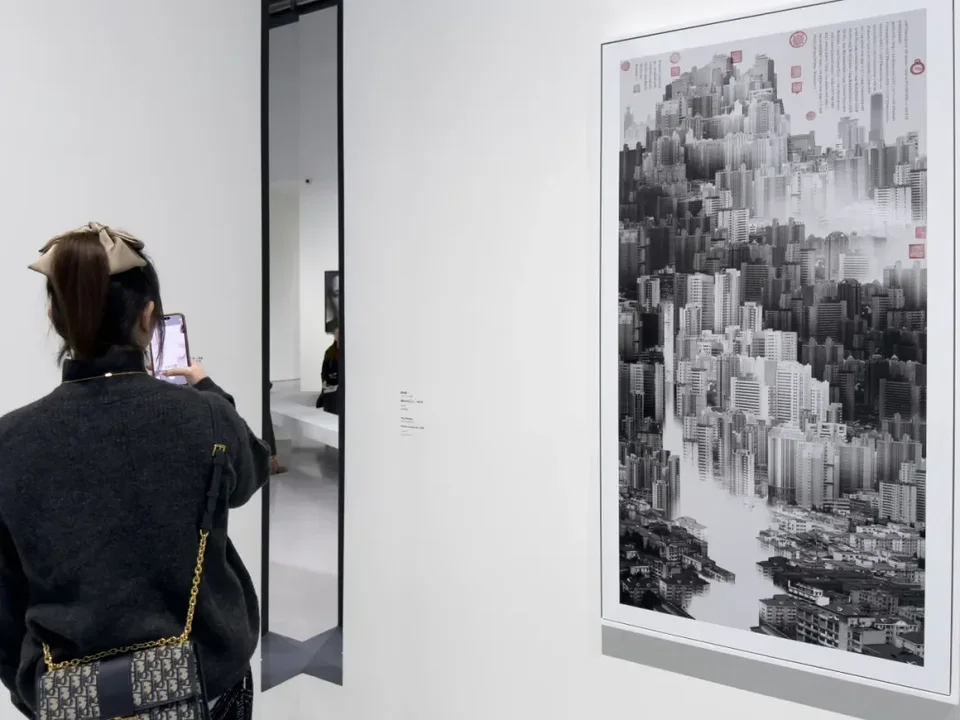
Another, more conscious aspect of our exhibition is the gaps in the walls. At the corners of each gallery you can see through the rooms into the next room, or even diagonally across. We wanted to keep our works in connection with other works, although we categorize them quite clearly under certain aspects, for example the functioning of the camera, images in society, or the image as a world in itself. By seeing through into other spaces, we want to express that all the works we exhibit coexisted or were created at a very similar moment, and that the artists did not work in isolation from what was happening around them. This is important for breaking the chronology and the categories we establish. We do not want to put our framework on top of this history or these works; we want to leave it open.
You will also see in the exhibition and on the object list that we mix photographs from the 1970s and the 2000s. We might think they would be separated by the many events in photography and the art world that happened in between. Our idea was to step back and consider these thirty years as a period in which many things were going on at the same time, with effects on photography today. By seeing works in the same room that come from completely different geographical contexts, artistic pursuits, eras and countries, we want to foster an understanding of photography in general and break down these temporal or geographical limits.
Question 2: How do you see the relationship between a work and its caption?
There is another interesting question about the captions of photographs, and everything around the photograph. First and foremost there is the title. Titles are always included in exhibitions, and I find them very important.
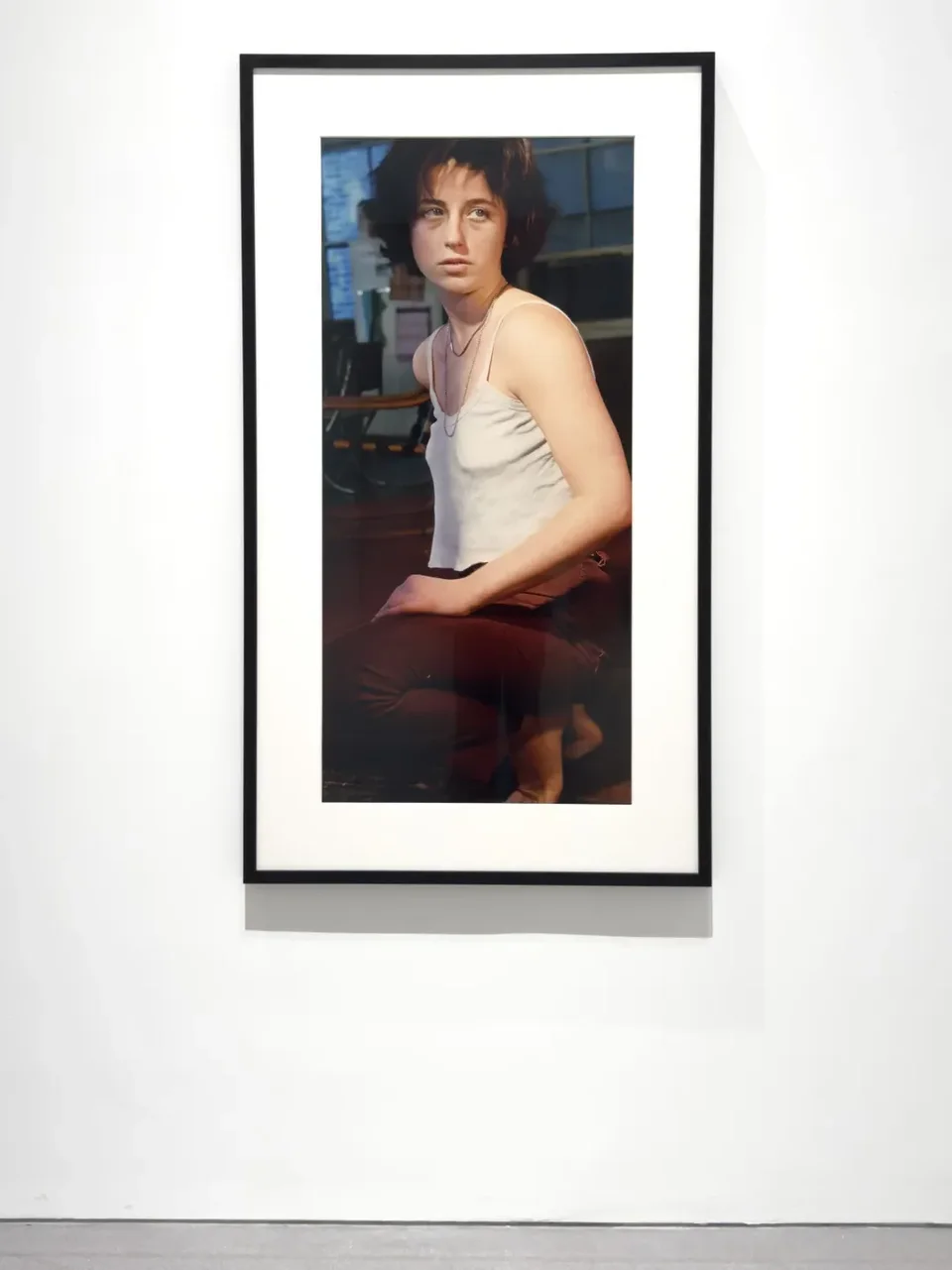
I do not like untitled works so much, because they are very hard to identify. Cindy Sherman's works, for instance, are always Untitled. When you have hundreds of images, how do you differentiate them on a practical level? In her case they are numbered, but this obviously leaves more space for interpretation. That is very important for Cindy Sherman, because she wants us to put our stereotypes onto her images and thereby show how an image is co-created by the viewer.
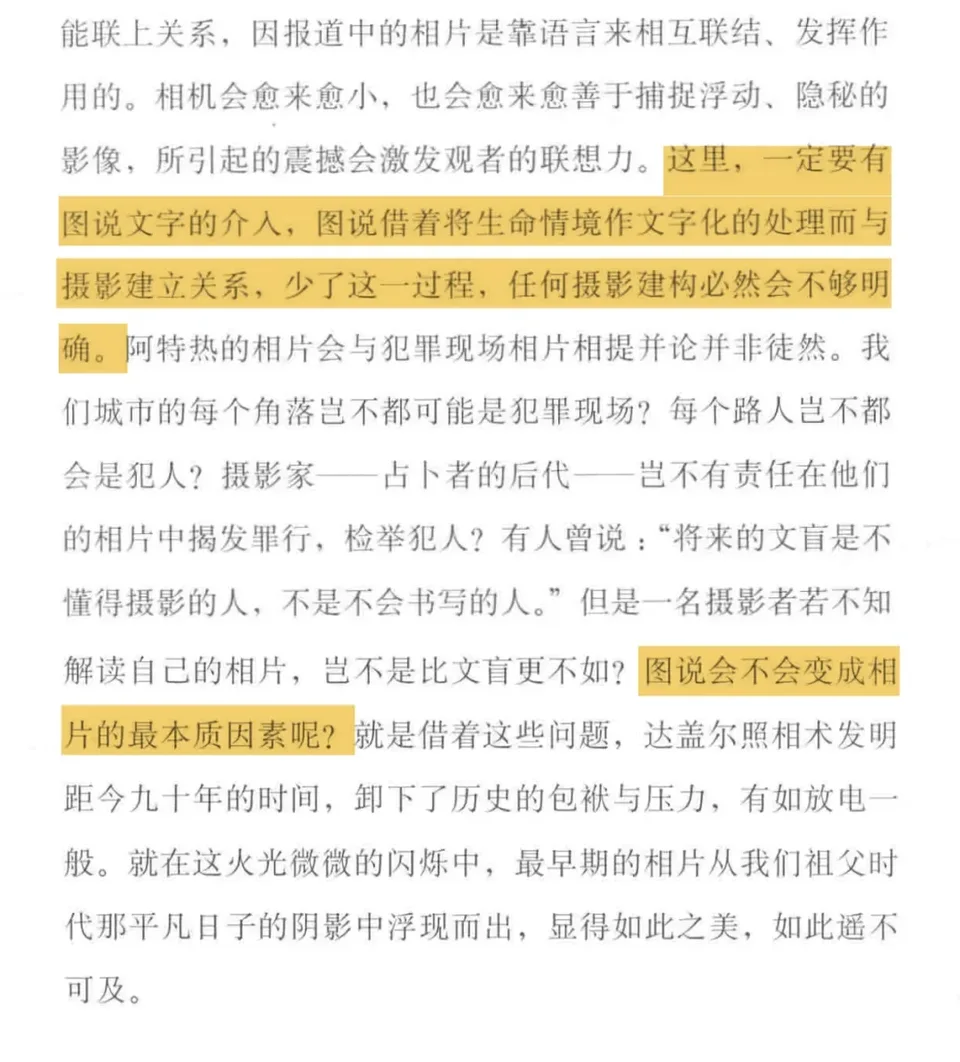
Walter Benjamin was right in saying that the caption is probably more important than the image, because it steers the reception. As other theorists have said, the photograph says either too much or not enough. It is always very specific to its context. You can have a photograph from a war that shows violence, but you do not know where that violence comes from. Context is therefore very important.
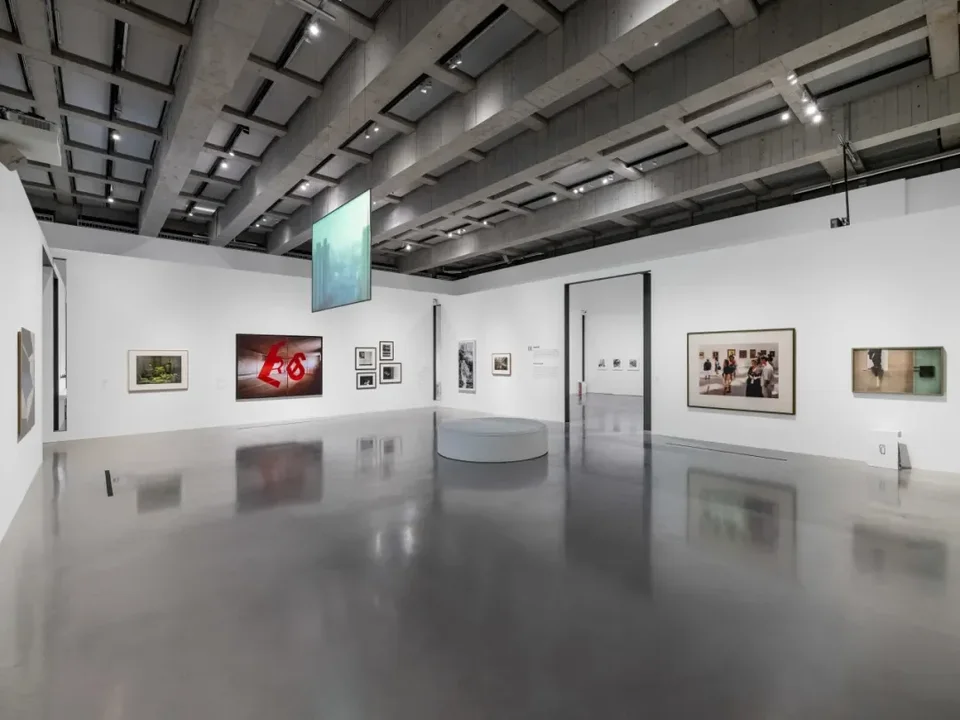
For many artworks in our section A World In Itself, we eliminated this context, because the artists said that the works have to be looked at in isolation from everything else: everything needed to understand an image should be in the image. We had a discussion with Victor Burgin, for example, about today's art, which can be very context-heavy. This is especially true of political art, which you cannot really understand if you do not know about social struggles or the artist's biography. We agreed that it is very difficult always to be on top of all that context. It is also interesting to have works that function on their own and can be understood in different social and artistic contexts. There is richness in drawing on the image without having to be a historian, a politician and an anthropologist at the same time, although obviously there is a lot of potential in those other approaches.
Question 3: Does Exif data also count as a kind of "caption"?
The idea of having Exif data or metadata is very interesting, and I am grateful for this question. In the last room of the exhibition we have NTFs_aaajiao. There the Exif data, or the entire infrastructure around the image, is zipped and protected by a password. You can see it only when you buy the NFT and receive the password to open the zip file. That is very interesting.
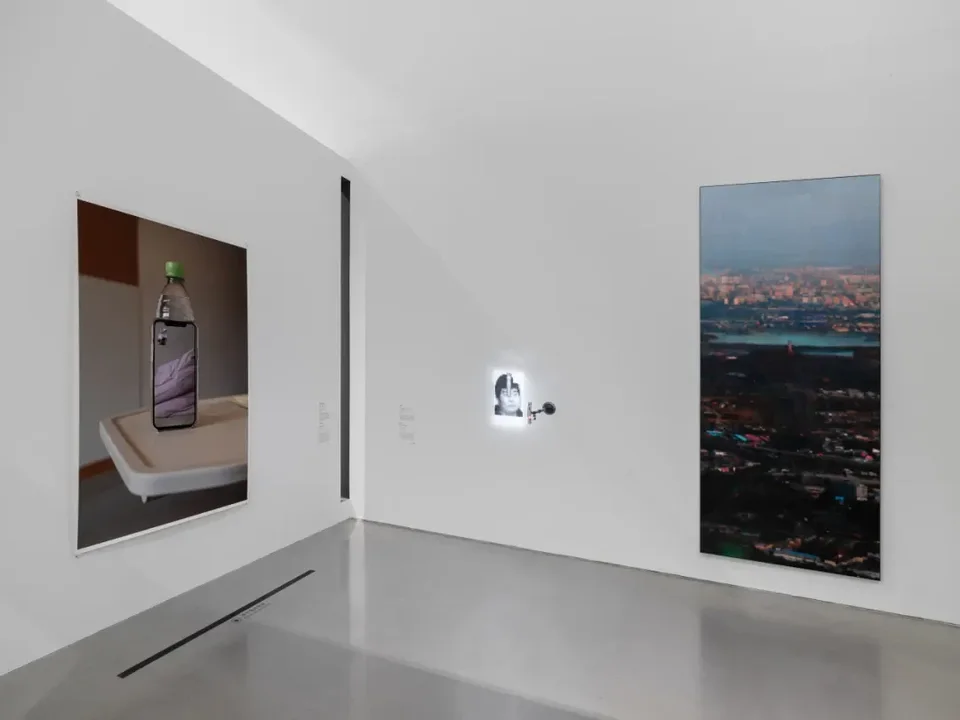
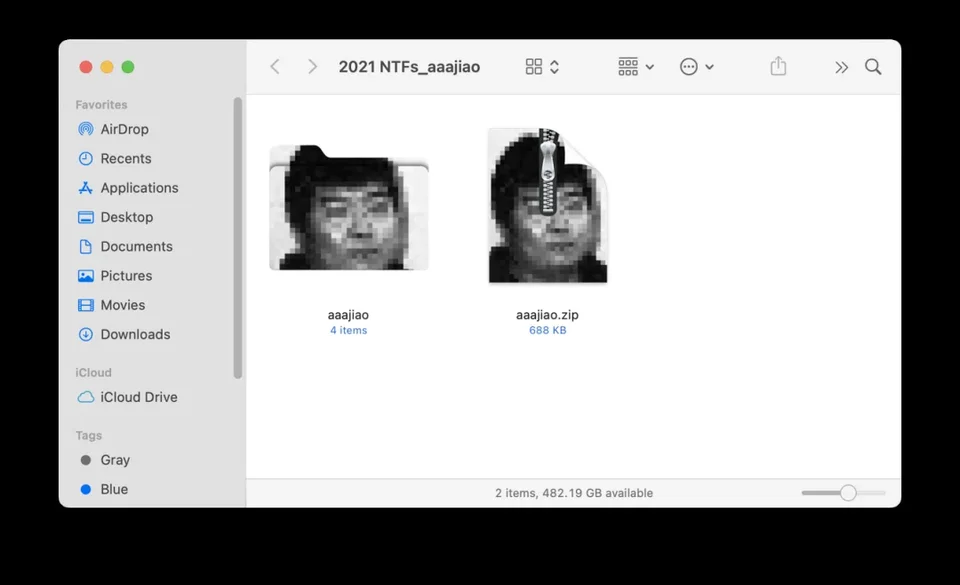
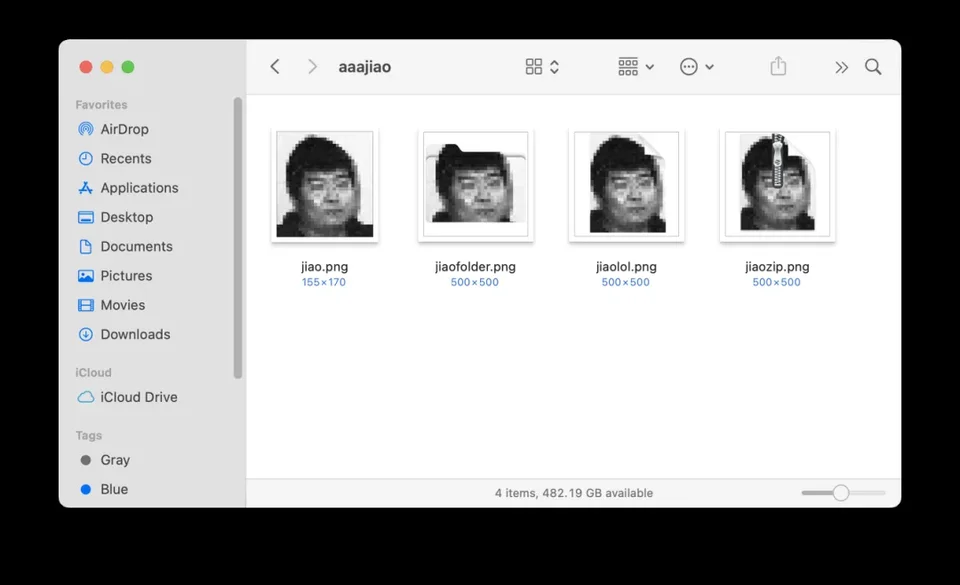
I am not sure yet how this will be used in the future. It will probably be very important for works that deal with artificial intelligence and draw on a big dataset. The information does not come from a single image but from a bulk of images. Software can work with this Exif data to tell us more about production, provenance and technical specificity. I think this is still in its infancy, probably because so much of the art world is still analog and the digital art sector is growing only bit by bit. Three years ago I worked on the project Image Capital (image-capital.com ↗), a large artistic creation and investigation by the photographer and artist Armin Linke and the photo historian Estelle Blaschke. They draw precisely on the idea of what a photograph can do as an object of value, as something that is traded.

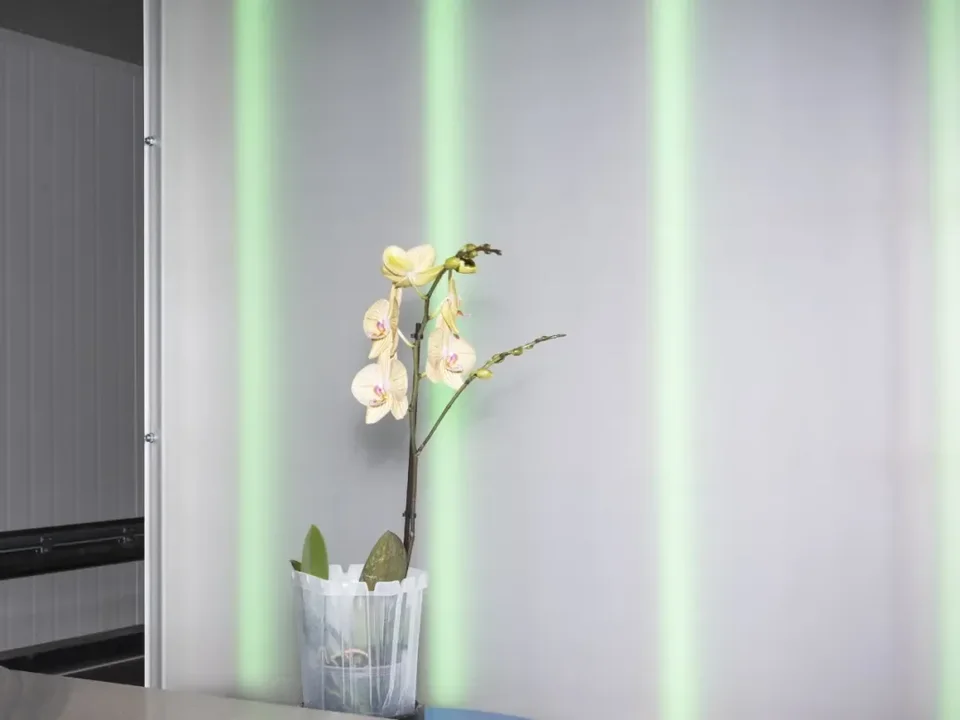
It can also be operational in Harun Farocki's sense: machines see images and act depending on what they see. A machine might stop production on a vegetable or orchid farm, for example. In this work, Armin Linke examines an orchid farm that analyzes orchids by photographing them and counting their blossoms. Depending on how many blossoms the machine sees in the picture, production continues or the product is sold. In this sense, Exif data does much more than provide context or a cultural interpretation. It is also key to the functioning of our highly industrialized and automated world.
Question 4: What do you think the role of the photography curator is today?
As a last point, about the presentness of photography: as curators, we are very privileged to work with physical artworks. In my work as a curator and as an academic, I always have to switch ways of thinking. For an article, for instance, I can combine a lot of images, zoom in and talk about only parts of them at a time. That would not always be possible in a gallery, because some things cannot be exhibited if they are too fragile or cannot be found.
It also does not work in a gallery if all you have is a really bad JPEG. Sometimes an image can only appear on the printed page or in a PDF. At the same time, seeing artworks in a gallery opens many more possibilities. We are sometimes asked to produce reproductions as wallpaper because transport is too expensive. That is a very valid point: transporting art costs a lot of money and is bad for the environment. We should think about reducing it and making museum practice more ecological.
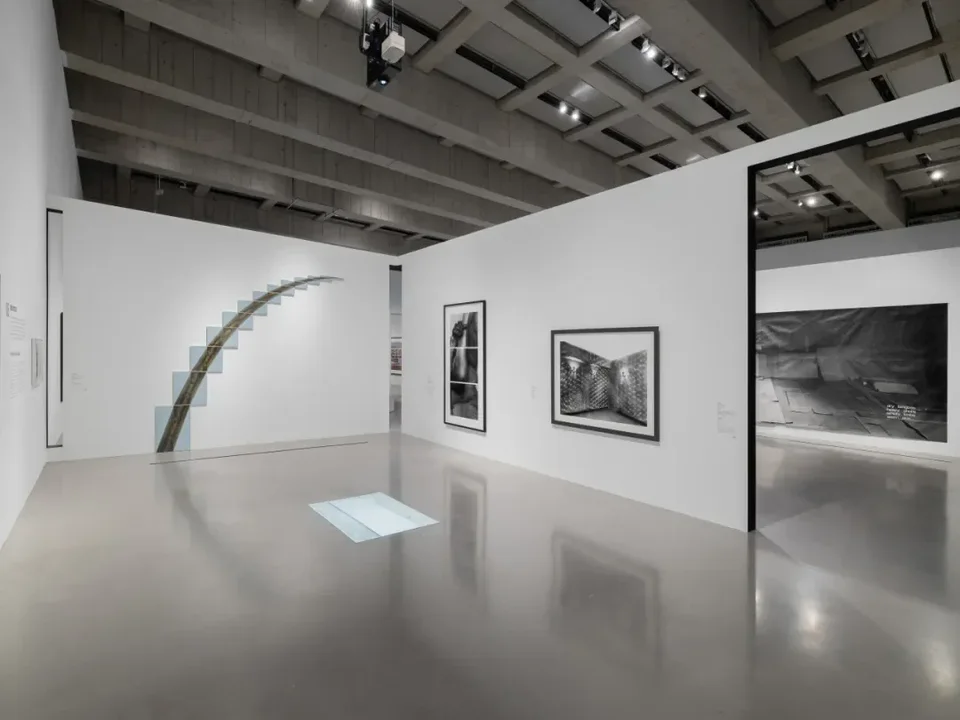
What is interesting in seeing different photographic techniques is their materiality. It is not only about physical presence. We also have three-dimensional works in the exhibition by Jan Dibbets and Leung Chi Wo. You need the space to see how big they are and what you can do with them.
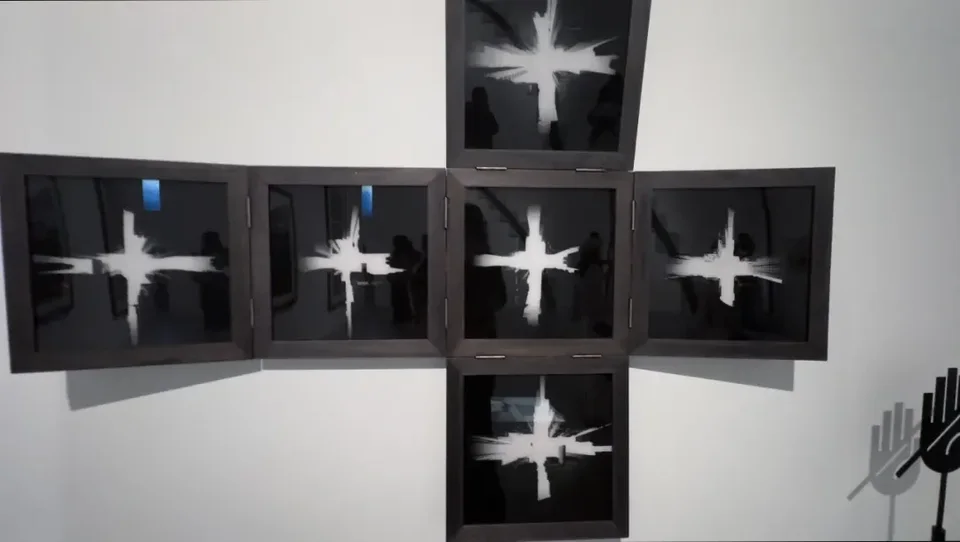
With Leung Chi Wo's Lascar Block, for instance, you can fold it together into a box. That is another dimension we would miss if we worked only on paper or in the digital realm, though those have other possibilities. In silver gelatin prints, the analog way of producing photographic prints, the silver in the photosensitive layer sits on the paper. The print is already a three-dimensional object. In the black areas, the silver particles that reacted to light give you a much deeper blackness and stronger contrasts than other printing techniques. But you have to experience it. It is something you can hardly tell someone.
Another limitation is that, although Lascar Block could be folded in the gallery, we cannot allow visitors to do it because we have to protect the artwork. It might be different for a loan, or for a work that an artist wants people to use and touch. Everything in a museum collection, however, needs to be protected. Even if this is a very theoretical group, there are many limitations in an exhibition. Everything from our collection needs to be protected and, ideally, preserved forever. This is part of French cultural law: the work is French patrimony and part of French identity.
It is paradoxical that some works can never be used again or experienced in the same way, simply because they would break down. With photographs and other works that are digital or can be reproduced according to rules prescribed by the artist, we have more options. Some photographers give us digital files, so if a print fades or is damaged in a few years, we can print it anew. But some works are difficult and expensive to produce, and need to be produced by the artist. This will be a problem in the future.
I hope I have responded to some of your questions, perhaps in a more practical way than you hoped. Maybe at another meeting we can talk more about theory. For now, I invite you to our exhibition at the West Bund until February 16, to feel and experience this presence of photography for yourself. Maybe then we can theorize more. Thank you very much for the invitation. I hope you have a good time, and greetings from Paris.
Interview: Guosen Chen
Produced by: Photography Theory Shelter
Video editing: Guosen Chen, SOMA