
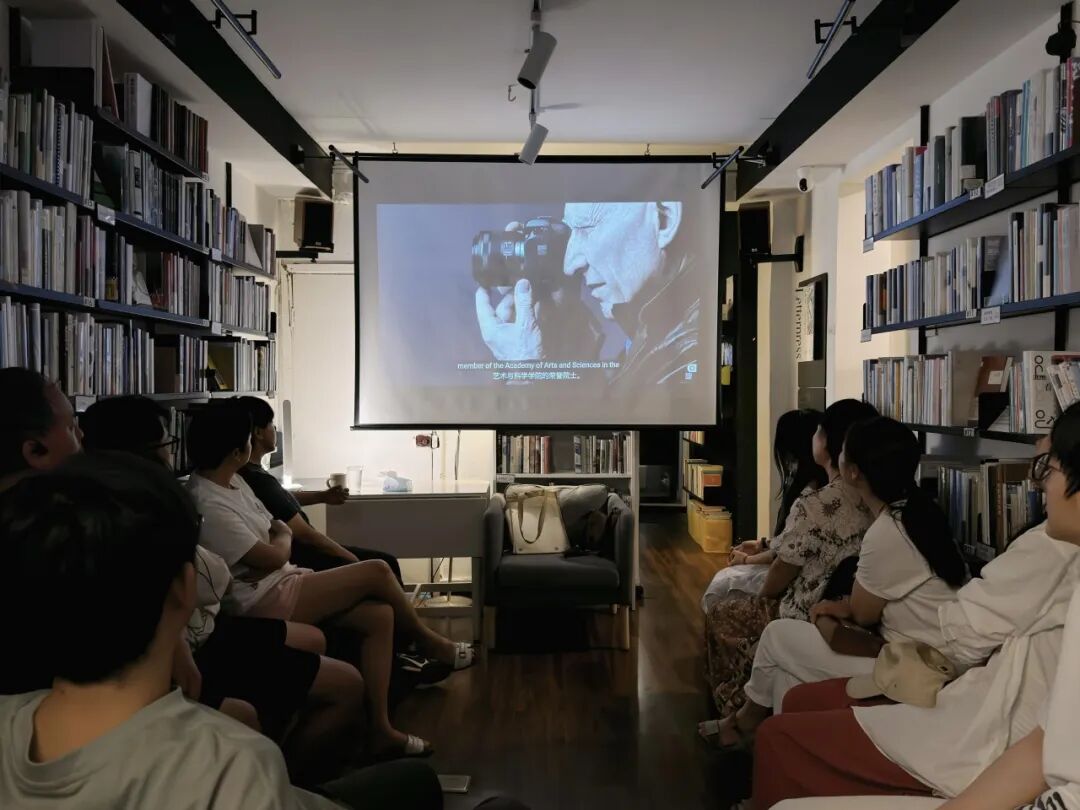
The Talk:
Thanks, everyone, for coming out today. Thanks to Yanzhen for the introduction, and thanks to Butread Bookstore (白读书屋) for launching a new "Monument Valley" series just for this talk. Our "Photography Theory Shelter" group is also a community that pays ongoing attention to photography and photographic theory. You can search for "小该隐避难所" (Little Cain's Refuge) to learn more about us. My talk will run about half an hour. I haven't prepared slides or a script, so it will be fairly improvised. It centers on three questions. They came from Mr. Weimai when he invited me yesterday and we chatted, and here I've tied them together into a whole.
The first question is this. Salgado's way of shooting tends to take people who are struck by disaster or who are suffering, in all kinds of living conditions that are worse than those of ordinary people like us who enjoy so-called "human rights," and turn those conditions into something more aesthetic, or at least more visually pleasing. Why was this approach popular for so long? For a considerable period after World War II in particular, whenever pain, poverty, or conditions of diminished human rights were involved, it became in some sense a mainstream and well-received way of working. So the first question is: why was it so popular? And what role did the nature of photography itself play in that?
The second question is: when we, as viewers, look at images like the ones we just saw, how do we react? And why do those reactions arise?
The third question builds on the first, about production, and the second, about reception. What criticisms have been leveled at the kind of photography Salgado represents? Roughly what directions do these criticisms take? What grounds do they rest on, and do they actually hold up?
I'll treat the second and third questions together.
1. Origins: The Question of Human Rights
1.1 Historicizing Human Rights
First, one thing I find very interesting is that there's a crucial keyword for understanding photographers like Salgado, and that's "human rights." The documentary we just watched mentioned that he joined some human rights association (I forget the exact name). Every subject he has photographed, whether the workers or his signature work Genesis, has at its core a concern with human rights conditions. If you're interested, I hear the Chengdu Contemporary Image Museum currently has an exhibition of his work that you can go see.
But when did human rights become a question? Actually, a little over two hundred years ago, the American Declaration of Independence was issued and France was setting up various democratic governments. By then people seemed to have already established the concept of "human rights": the idea that everyone is equal. Whether you're poor, Black, a woman, or a child, each of us equally enjoys rights to freedom, to residence, to livelihood, to private property free from infringement, and so on. That's what we call "human rights." But human rights only truly became a global, universal idea, one that humanity now generally recognizes as something to be protected and not violated, much more recently. How recently? In 1948, when the United Nations issued the Universal Declaration of Human Rights, human rights reappeared and gradually became a universal idea. And the moment human rights truly became a "problem" is historically bound up with the fact that many photographers and news organizations used photography to depict conditions of diminished human rights.
That's because "human rights" contains a dialectic within itself. How do we come to feel or perceive that human rights exist? It's precisely when you see people who have no rights, and see how they live, that you become aware that "human rights" exist. In other words, human rights became a crucial topic in photography and in every other field largely because, after the First and Second World Wars, humanity suddenly discovered how far human barbarity could go in destroying the world we live in, and what catastrophic suffering it could bring. Only once people's despair about human nature, or about human rights, had reached a certain depth did they start standing up to say that we must establish, restore, and defend these rights.
So what does this have to do with photography? You'll find that human rights are actually very hard to photograph. Or rather, most of the time we can only photograph their opposite: what people without human rights look like. Those who live within a reasonable, secure sphere of rights, like us, just look like normal people. If you photograph a scene of "having human rights," it's hard to reveal anything; there seems to be no subject. But what photography can do, and do especially well, is reveal the opposite: what people who aren't doing so well actually look like. Such images also very easily sting viewers or provoke strong emotional reactions. That's especially true when what you see isn't aestheticized like Salgado's pictures, but naked depictions of injury, disaster, and poverty. For instance, in the history of photography, Jacob Riis has a famous book called How the Other Half Lives, and Walker Evans made Let us Now Praise Famous Man. These basically show directly what life was like for America's poor in the 1920s and 1930s, so that the rich and the middle class could see it.
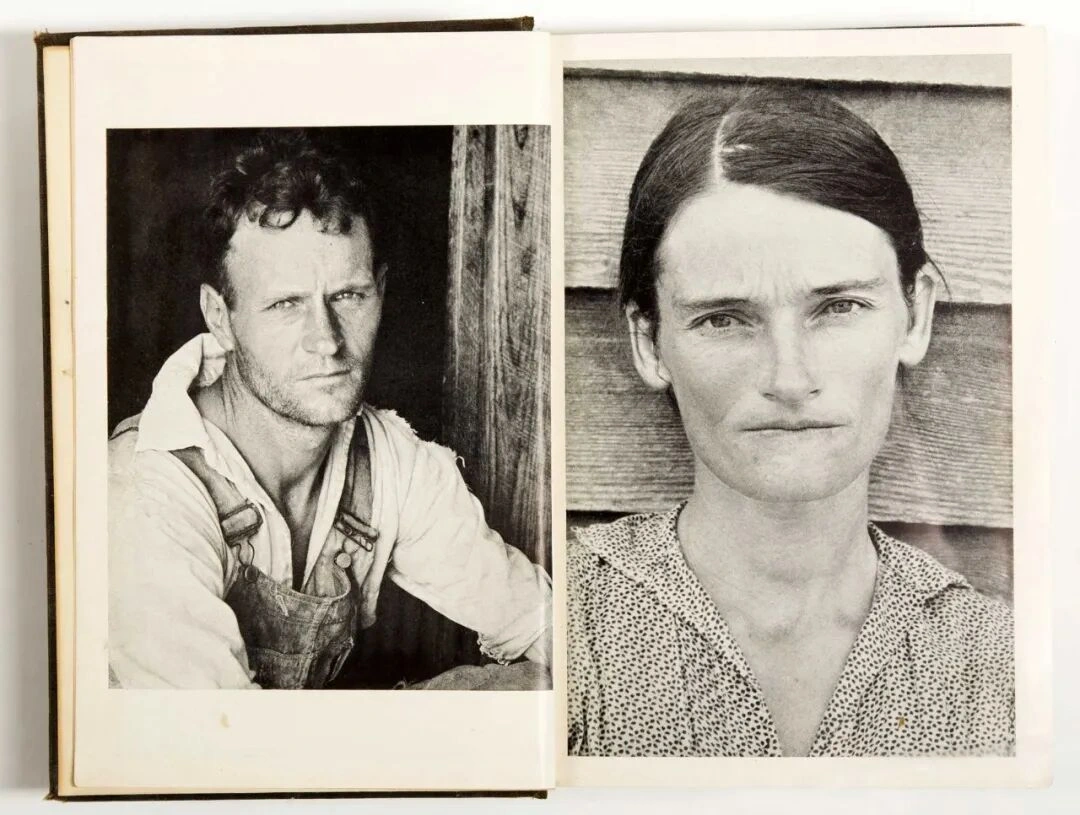
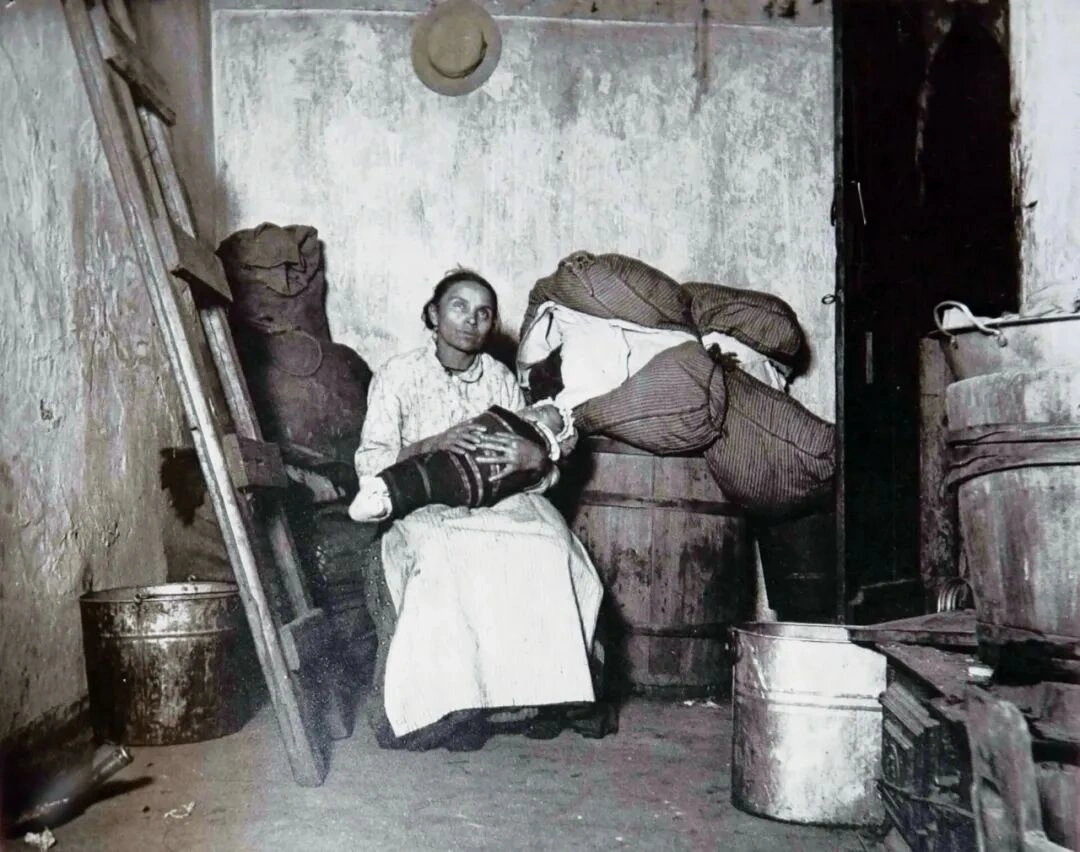
So there are two sides to this. On one side, historical developments made human rights a universal problem precisely because of their absence, which drew attention from every field. On the other, depicting that absence is in some sense photography's "nature." But that nature isn't something that simply brings you pleasure or joy. If we've read Susan Sontag's famous On Photography, we know it contains a well-known claim: photographing someone is like shooting them with a gun; it has an obvious aggressiveness. Whether or not that claim holds in general, when it comes to "suffering" it's absolutely right.
1.2 Photographic Aggression as a Means of Producing Knowledge
Think about it. When news photography, documentary photography, or the photography of suffering exposes the conditions of poverty, the word "expose" already implies "offense." Without the photograph, we wouldn't know this was happening. We wouldn't know these people existed, let alone what conditions they were living in. Put the other way, breaking open states and circumstances that had for some reason been hidden, revealing what had lain beneath the surface, is already an offense in itself. It's an assault on existing boundaries. This trait is latent in any medium whose foundation or mission is revelation and reporting.
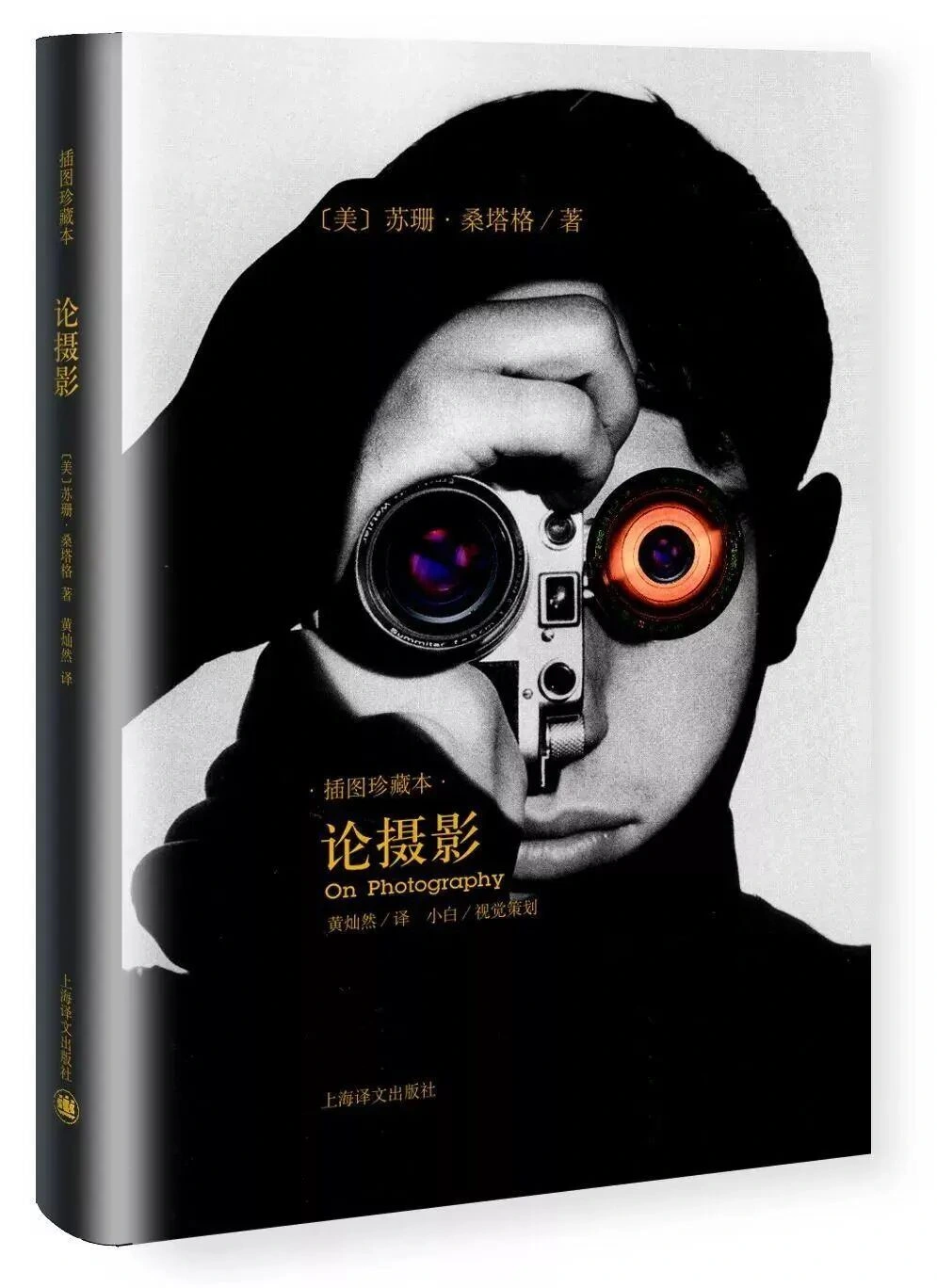
So in a sense, I think the aggressiveness Sontag attributes to photography in On Photography is somewhat overstated. That was her early work, of course; by the later Regarding the Pain of Others her view had changed a great deal. For the early Sontag, when we're in a room together, the moment I raise a camera, whatever we're doing, it's a kind of violation. But I don't think it's that bleak. When you take a family portrait, for example, you'll find the nature of this violation is actually complicated. In a sense it requires cooperation between the photographer and the people being photographed. Any posed photograph is, in some sense, a rebuttal of Sontag's claim about aggression. Then there are family snapshots, intimate snapshots, and so on. That said, the violation that happens in the realm of representing suffering is actually productive. It isn't only the negative, harmful thing that immediately comes to mind when we use words like "violation" or "aggression."
Where does its positive, productive character lie? In our knowledge of the world. How does what we call "knowledge" come into being? Knowledge in this sense, our understanding of the world, arises from collisions and confrontations between you and others, and between you and the life-worlds of other people. It can't come from drawing a circle inside yourself, sealing yourself in, and saying, "This is my very safe, very stable self; inside this circle is me and what I already have, and no one else exists." Knowledge can't arise from such a self-identical circle. Producing knowledge means enlarging your circle through what is not you. It has to break through an existing boundary of identity. Knowledge always appears when you push out beyond that self-centered circle, enter the world of others, try to understand how other people live, and listen to their voices. So "violation" is exactly this kind of act. A photographer goes somewhere uninvited. He shows up without anyone having asked him, and he may even be unwelcome; many photojournalists simply are unwelcome. But he has this mission. He goes there and, through the act of photographing, offends the epistemic order of that time and place, letting everyone see what some people don't want us to see. That in itself means producing knowledge. So in a sense, this act of violation carries a very clear epistemological meaning.
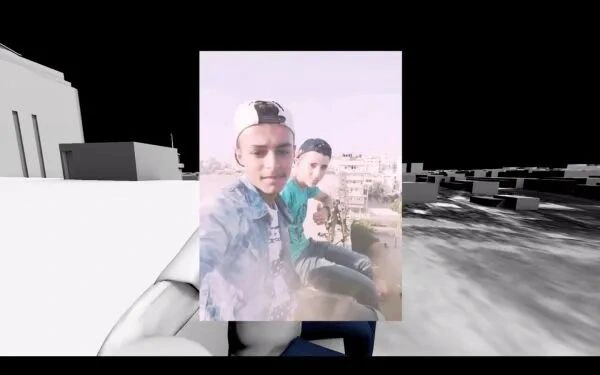
There's another angle, too; we can think about it in reverse. Suppose none of us had ever seen photographs like Salgado's, or Walker Evans's, or Magnum's. Suppose we had never seen what appears in all kinds of newspapers: upbeat news photos, symbolic images with a somewhat propagandistic character today like the "Big Eyes Girl," or artworks that present things in more complex ways, such as the investigative imagery made by Forensic Architecture. If all these photographs of other people's suffering vanished from our world, would our world be better or worse for it? What kind of understanding of other people would we have? Would our knowledge of others, and our felt sense of them, still be what it is now? Thinking in reverse like this shows, to some degree, that knowledge production is inseparable from the aggressiveness of photographs and photographing when they represent suffering. That's roughly my first question.
2. Viewing Experience and Three Critical Positions
My second question is: how do we look at these kinds of images when we see them? This is where it gets interesting. Salgado's photography represents only one side of how we represent suffering: the side we describe as "aestheticizing" suffering. But there's another direction, which refuses that kind of beautification. For example, as I just mentioned, Walker Evans and many photographers in the Farm Security Administration (FSA) documentary project in 1920s–30s America did something rather different from Salgado. Evans especially was very restrained. You basically see no rhetoric, no beautification, no posing. He had people sit there with no particular expression, as if for an ID photo, and photographed them together with their surroundings. When this approach was combined with the writing of Agee and others, it produced a different ethical effect, which we also can't ignore. And of course there are many other approaches.
But when we look at Salgado-type photographs on their own, we get a fairly typical, or rather contradictory, feeling. On the one hand, you find them beautiful; they give you visual pleasure. But where does that pleasure come from? When you become aware of it, you often also realize that your pleasure rests on "enjoying" suffering someone else has gone through. Many of the people Salgado photographs can't be said to be living "well." He's doing a human rights project, which means these people's actual conditions may be even worse than what we see in the photographs.
This produces a moral or emotional contradiction. What is the relationship between your pleasure and someone else's pain? The person in the photograph lives in such degraded circumstances, yet through the photographer's mediation we can now stare straight at the image of their suffering body and feel pleasure. Is that immoral?
Precisely because of this reaction, Salgado has faced a classic criticism: the "aestheticization of suffering," or, put more plainly, "beautifying suffering."
Here I'll take the second and third questions together.
2.1 The Aestheticization of Suffering
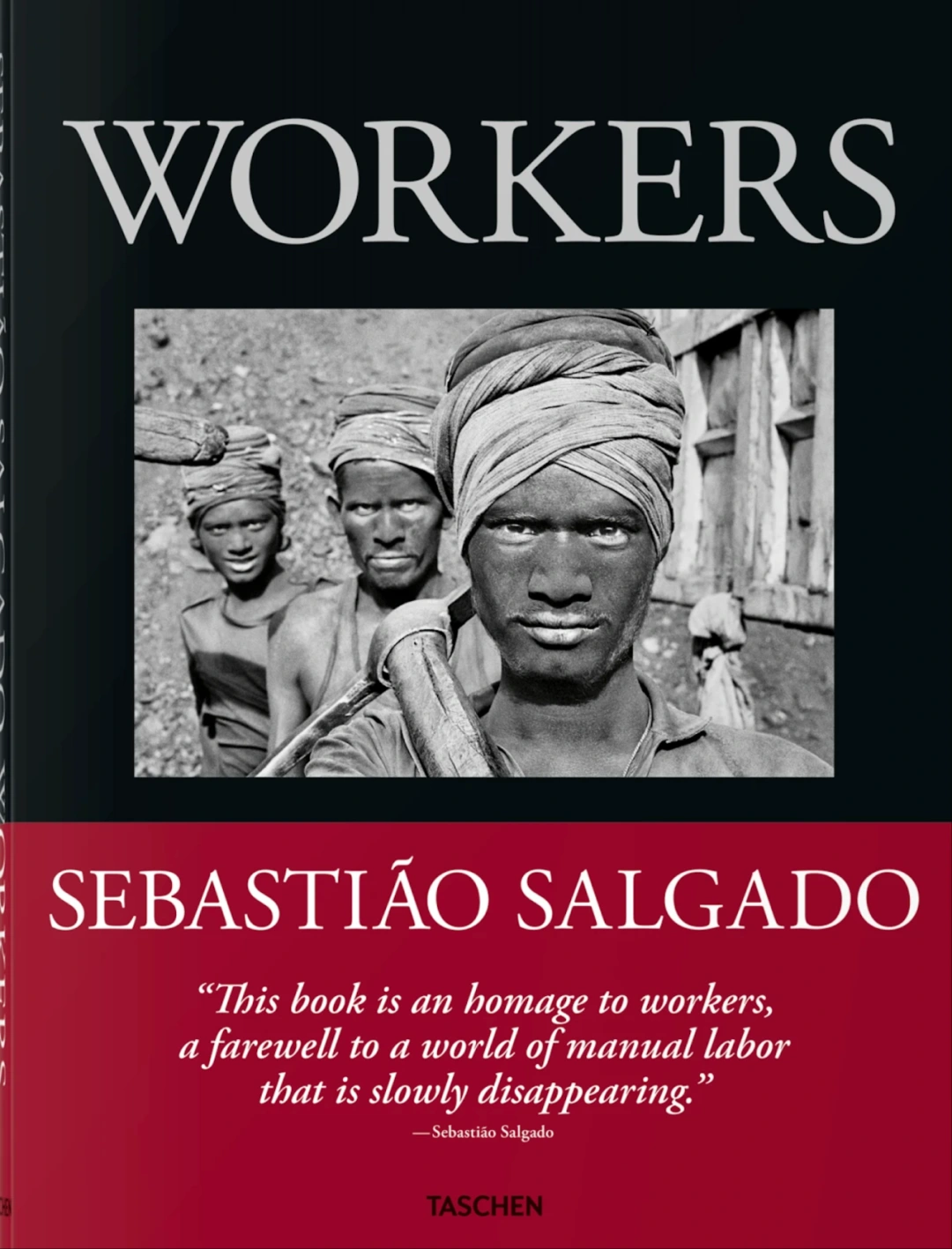
Some people think Salgado shouldn't present these poor, suffering people as monumental figures, as heroes. In the documentary we just saw, for instance, the cover of his signature book Workers shows a man like an ancient Greek statue, staring into the lens steadily, resolutely, confidently. And did you notice his photograph of gold prospectors in Brazil, with crowds of people climbing the hillside like ants? It's a highly apocalyptic, highly religious scene. So many people criticize Salgado for turning his subjects' suffering into a tool: a tool for satisfying his own desire to construct form, for making money and a name, and for building his reputation as a master photographer.
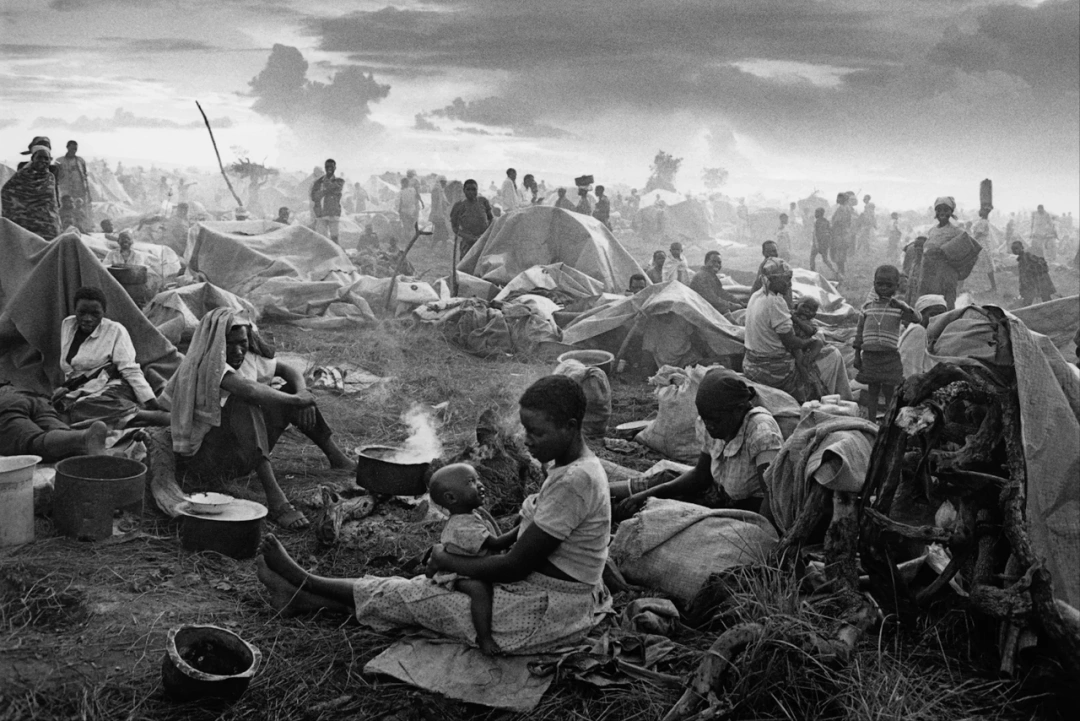
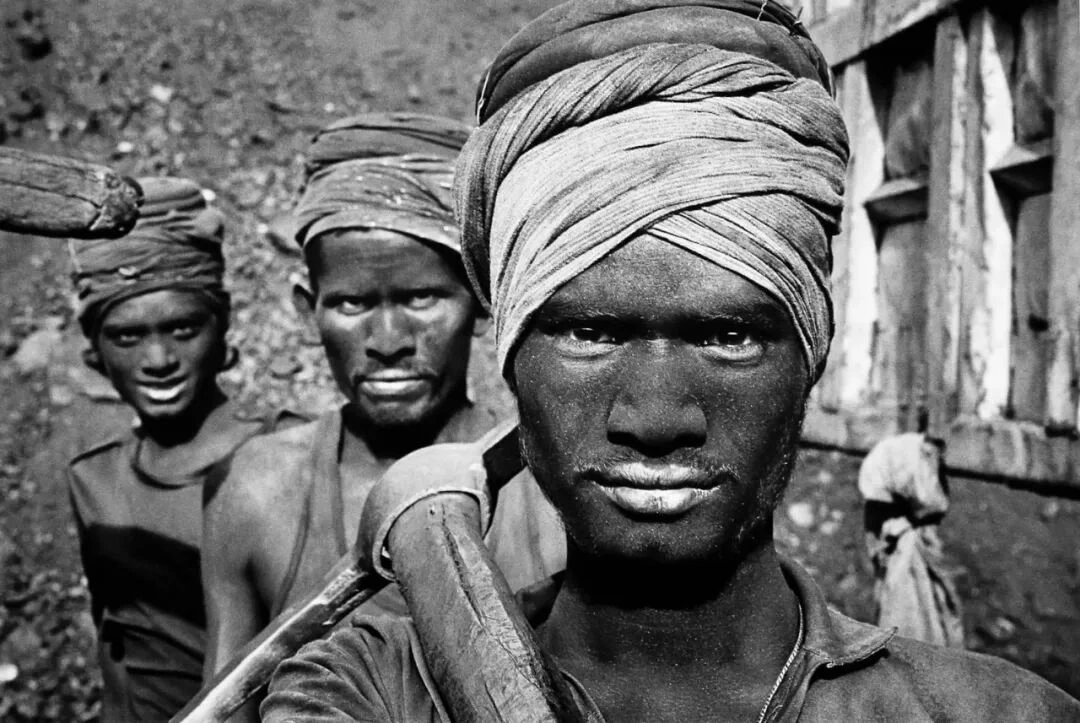
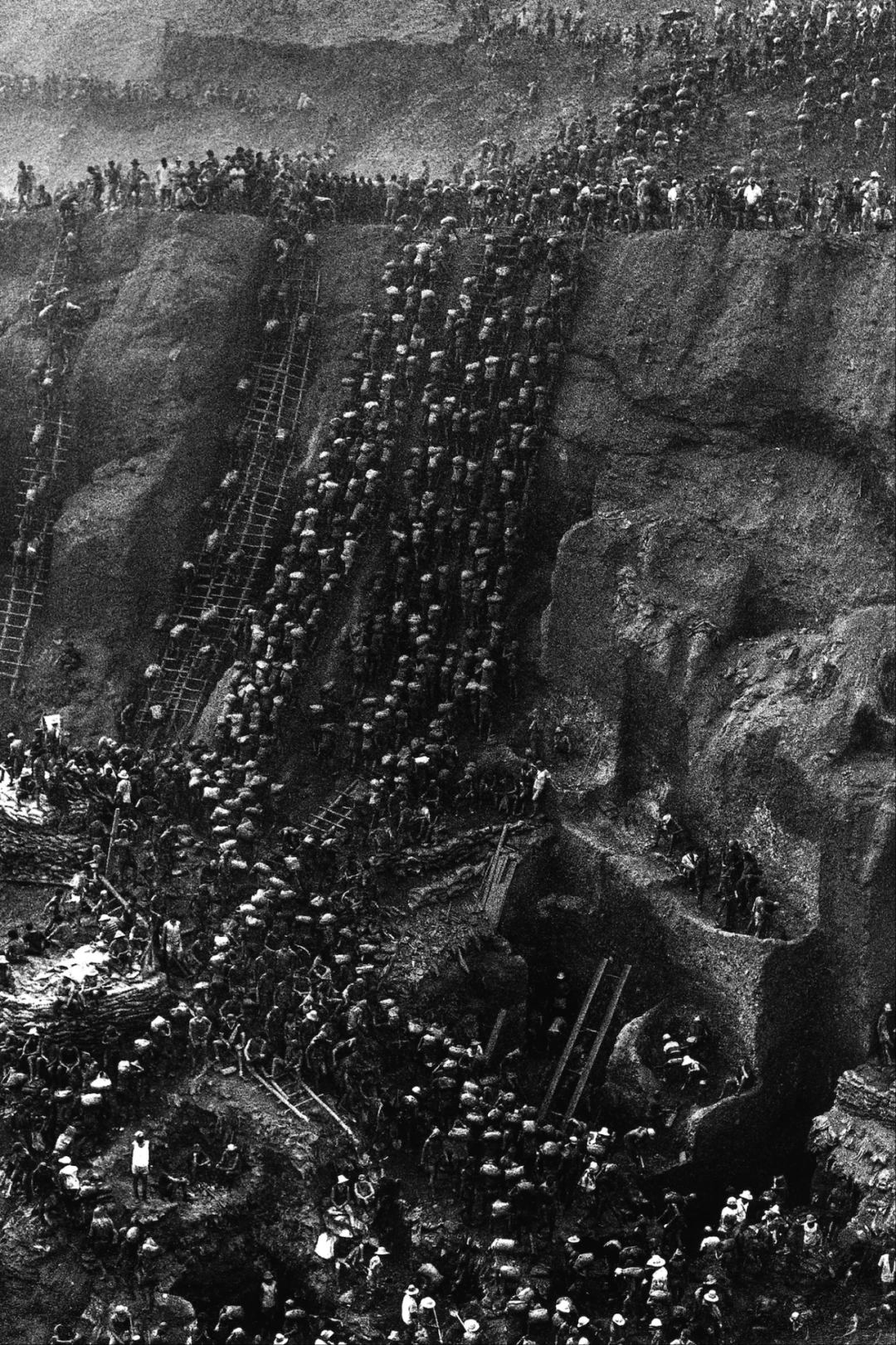
It's hard to say these criticisms have no merit, because such instrumentalization really does exist. So some people argue that no suffering should ever be photographed this way. Within the mainstream camp of Salgado's critics, a smaller faction then splits off. If you say we can't do it this way, what should we do? They think the poor should be photographed looking poor. In other words, if their living conditions really are a mess, if they really live in a slum, then the photographer should faithfully record that filthy, chaotic situation. Only that counts as respecting their suffering.
I don't know how you all feel about this criticism. And, interestingly, from my own experience I've noticed a phenomenon. It may not be accurate, and it's certainly partial. People without so-called academic training in the humanities and social sciences tend to accept Salgado-type photographs readily and think they're good. By contrast, people who've read some photographic history, some aesthetics, some philosophy, or who have what's considered a more sophisticated education, tend to look down on Salgado. They're inclined to feel he doesn't respect his subjects' suffering, or that he simplifies the facts, and so they reject the whole approach.
What makes this complicated? For me, I find that some of these so-called "high intellectual" positions are, in a sense, and to exaggerate a little, a kind of "hypocrisy." Why hypocrisy? Think about it. When someone's suffering is presented aesthetically and it troubles our conscience and makes us angry, what exactly am I angry about? Or, if you're unhappy with this mode of representation, what is it that you want?
On Chinese social media today, reactions like this go by another term: "lens bullying" (镜头霸凌). That's photographing sanitation workers, elderly people collecting scrap, and others. Of course the two things can't be completely equated. There are similarities, but they aren't identical. After all, so-called "lens bullying" often really is a valid charge. I think it's complicated.
Back to my question. When some intellectuals criticize photographs like Salgado's for inappropriately beautifying the suffering of the poor, you'll find that in some cases what they truly care about, in a sense, is this: as a viewer, can my conscience be let off the hook? After seeing aestheticized photographs of suffering, my conscience is uneasy. I feel reproached. I feel I shouldn't be looking at this, and I shouldn't take pleasure from such suffering. So what's the solution? Simply let the poor appear as the poor, ideally returned to their slum conditions. That way, as a viewer, I no longer have to endure the torment of my conscience, and I no longer have to reproach myself.
So what those who demand, in a sense, a "slum aesthetics" ultimately want is a kind of "pure looking." "Pure looking" means that when I see a photograph of suffering, I bear no moral guilt and face no ethical interrogation of myself. I can treat other people's pain very objectively, very fairly, very "cleanly."
But does such a thing really exist? Can we really find a pure gaze, one uncontaminated by any distortion of suffering? When it comes to other people's suffering, I don't think it exists, and there's no need to look for it. Why? Because when you enter into a relationship with someone else's suffering and you aren't in that suffering yourself, two consequences have always already arisen.
The first is that you're already removed from the scene and the environment that caused their suffering. You aren't the suffering subject; there's distance between you. And that distance in itself brings you pleasure, or delight, or a sense of having survived: "Thank goodness it's not me." It creates the conditions for your pleasure. In Kant's terms, we could call this distance "aesthetic distance." Without it you can't have aesthetic experience at all. What is the aesthetic? It's contemplation, a very quiet state. Contemplation means that only after you've stepped back can you treat something as an object to look over and examine, and draw formal or other kinds of pleasure from it. When you're immersed in it, say we were put at an oil rig and got splattered all over with drilling mud, you wouldn't be in the mood for aesthetics. Only after you extract yourself and gain some distance are the conditions in place for aesthetic activity, for contemplation. That's an important feel for grasping Kant's aesthetics intuitively: "contemplation," a person sitting there, adopting a disinterested stance toward an object that has nothing to do with them. They judge whether it pleases according to how the object's representation in the mind sets imagination and understanding into play, and on that basis make an aesthetic judgment. That's the aesthetic. So this is the first layer: a pleasure you gain by having gotten out of, or because you are removed from, the scene of the disaster.
The second layer is that you naturally also feel uneasy in conscience about your pleasure, or feel morally that you deserve reproach.
These two layers are always happening at the same time.
This leads some people to want to deny, or wash away, the second layer, to find a way to achieve so-called "pure looking," or "blameless looking." Hence they attack the aestheticization of disaster.
And that raises another question. Is this about making life better for the people photographed, or about sparing the conscience of a viewer who stands outside it all? When they oppose "lens bullying," or oppose it indiscriminately, is their concern the person being photographed, or themselves? I think that's a problem you can find in some of these positions.
I also jotted down a passage from Theodor Adorno that's very close to what I just said. It's a bit academic, but let me read it:
The victims are turned into works of art, tossed out to be gobbled up by the world that destroyed them. The so-called artistic representation of the naked bodily pain of those beaten down by rifle butts contains, however remotely, the potential to wring pleasure out of it. The unthinkable … is transfigured, and something of its horror is removed. This alone does an injustice to the victims; yet no art that evaded the victims could withstand the claims of justice. Even the voice of despair pays tribute to a hideous affirmation.
Adorno's stance here is complicated. On the one hand, he's saying what I just said: in any artistic representation, once you step back from the scene of disaster, what you present can no longer be the disaster itself. You're already failing to respect it; you're already betraying suffering to some degree. But if for that reason you simply decide, "I won't photograph it, I won't look," if you see others going through pain, or someone being shot, and you just don't photograph it, then Adorno says that is actually a greater injustice to the victims, a greater moral repudiation.
2.2 The "Disaster Porn" Argument
The last attitude Adorno criticizes, avoidance, "don't photograph, don't look," reminds me that besides the aestheticization of suffering there's another well-known criticism, or family of views, aimed at Salgado and this kind of photography: "disaster porn." It likens consuming such photographs to watching pornography. Some people feel that looking at this stuff is a kind of voyeurism. Like a furtive rat, you secretly look at others' pain through the photographer's pictures and get a thrill out of it. That's how they describe us viewers, and they argue that what works like Salgado's do is present disaster pornographically.

What's the problem with it? The defining feature of pornography or sexual activity, at least as the term is used in this context, is that pornography is something you can only watch secretly in your own room. The same goes for all sorts of private sexual acts and games; they belong to a relatively private sphere and shouldn't be put on public display for everyone to watch together. That's probably the connotation of "porn" in this argument. But if the domain you're dealing with is "the pain of others," can you still demand that pain remain private? There's a contrast here between private and public: do you want to make this private or public? And if we describe such work or documentation as "disaster porn," what follows?
First, is someone's suffering a private matter? A photograph may well show a single person suffering, right? But the photographer's intent goes beyond that. Salgado shows individuals, but what he's ultimately after is presenting the universal condition of suffering populations. That suffering isn't private; it's necessarily a public condition.
Second, if we demand that representations of suffering stay private, the only result will be more atrocities, more lynchings, more inhuman violence. On these two points, I think the "disaster porn" argument can be rebutted.
2.3 Compassion Fatigue
The third typical view is the claim that "seeing too much of it makes people numb," technically known as "compassion fatigue." But first, if you're interested, I can post some materials in the group later. I've read some empirical studies in which researchers used data to show that seeing a lot of this kind of material doesn't actually make you numb. We assume that seeing too many disaster photos will numb you, the same way we'd analogize it to porn, where watching too much of one genre dulls you. That's our intuition, but the facts don't match it. And Susan Sontag herself later accepted, in Regarding the Pain of Others, that viewing large numbers of photographs of suffering doesn't actually make people numb and incapacitated. So that's the first point: if you look at the research, it's not like that, and there's literature to prove it.
The second problem: in this context, "compassion fatigue" is used to accuse us viewers of numbness, right? It's used to charge that "our capacity for empathy is weakening." But what did the term originally mean? Why does the phenomenon arise? "Compassion fatigue" first appeared in caregiving work, for example among caregivers looking after elderly people living alone. It arises precisely because those caregivers have a surplus of compassion, so much that they can't bear the burden that empathy places on them. It doesn't come from numbness. So in a sense, using this term to indict viewers' psychological responses gets its original meaning backwards.
3. The A Priori Priority of the Communicative Sphere over the Aesthetic Sphere
3.1 The Priority of the Communicative Sphere
I've just gone over three objections to Salgado-type photographs. Finally, I want to make one point that occurred to me while chatting with Mr. Weimai and the others yesterday. Roughly, it's this: for representations of suffering and the photography of suffering, morally speaking, the grounds for value judgment in the "communicative sphere" take absolute, a priori precedence over the grounds for value judgment in the "aesthetic sphere."
That's a bit convoluted, so what do I mean? When we look at photographs of suffering, our gaze always unconsciously focuses on the "photograph." What you see is the relationship between the photograph and the photographer. That means you treat it as a work, the creation of an author, something in the aesthetic or artistic sphere. But before photography of suffering is any of those things, what is it first? It is first and necessarily the most real form of communicative interaction between people.
I'm talking here about the actual interactions between people in real life in modern society. My point is that, as a real event and a communicative activity, the photography of suffering takes precedence over the activity of producing photographs. Picture two concentric circles. The larger outer circle is "communication": the sphere in which we, through language, ultimately seek mutual understanding and recognition. The smaller inner circle is the "aesthetic sphere." Can the grounds for value judgment you use within the closed aesthetic sphere, such as composition, light and shadow, and so on, revoke, cancel, or replace values in the larger communicative sphere? They cannot.
Photography that concerns others' suffering isn't a matter of a subject using a camera as the center to capture an object. It isn't a matter of pinning everything onto the image in the end and letting the image's value determine the value of the whole act. Because the photography of suffering is first a question of "communication," a question in the communicative sphere. The meaning of the image can't determine the meaning of all the other events connected with it, nor can the image's value replace, revoke, or subsume the value of the many events associated with it. They're two different things.
Why do I say the photography of suffering is necessarily, a priori, a question of the communicative sphere rather than the aesthetic sphere? If we shift our view of this kind of photography from the aesthetic sphere to the communicative sphere, what problems does the communicative sphere deal with? It deals with how people interact with and understand each other. And the aesthetic sphere? It is usually a matter of subject–object creation: I'm the subject, my work is my object, I create it, I create an object, and I may even treat the person I photograph as an object. It's a subject–object problem. The communicative sphere isn't like that. Its premise is that you're a subject and the other person is also a subject, and the two of you must establish an equal, mutual recognition and understanding not based on any coercion. That's what communication is.
This can be understood on two levels. First, in the aesthetic sphere, whether you're judging the creator's intentions or weighing the conflicts in your own motives, you're still working within a closed system to achieve the effect of a work. But what sustains the healthy, equal functioning of our life-world is a normative demand based on intersubjective mutual understanding and recognition among people. It must take precedence over the instrumental logic of any closed system, whether economic or aesthetic. That's the first level.
The second level: how valuable your photographs are, or how many conflicts of interest your project contains, all these value judgments are just one level. On another level lies the value produced within the communicative sphere of the photograph, in the event itself: does it promote understanding between people, or does it inflame conflict between them? These levels run in parallel without contradicting each other. We can't use value judgments from the first level (the aesthetic sphere) to cancel or even replace those from the second (the communicative sphere). And for me, morally, value judgments in the communicative sphere always take priority over those in the aesthetic sphere. That doesn't deny that the aesthetic sphere has its own closure and autonomy. However perfect an image is aesthetically, however much it sells for on the art market, however much you agonized while making it, all of that is a closed system. None of it can revoke or replace the ethical responsibility such a work carries as a "thing" that really operates in social life, one that builds, damages, or mends relationships between people. Photography is different. It can't easily put distance between itself and the world the way painting can. People very often unconsciously equate it with the real world. When we look at a photo, we often point at it and say "this is so-and-so," not "this is a photo of so-and-so." We just say "this is so-and-so," and that already says a lot. That statement itself is made within the communicative sphere.
So whether any action is legitimate as a communicative action ultimately depends on whether it can establish a consensus among subjects based on mutual respect and recognition, and that consensus must not be coerced. Conversely, if an image aestheticizes a suffering person into an object stripped of subjectivity, one who can no longer speak to others and is forever fixed in place, that image fails on every level. So what I mean really comes down to two levels, and the values of these two spheres can't revoke each other. My personal view is that, when it comes to the photography of suffering, the value criteria of the communicative sphere take a priori precedence over those of the aesthetic sphere.
If you carry this over to the actual sites where suffering is photographed, you notice some interesting things. Some of Salgado's critics don't realize that Salgado, as we saw in the documentary, worked with Doctors Without Borders. He really went to all sorts of places in Africa and South America, lived with the people he photographed, camped with them, and helped them in all kinds of ways. He used money from selling photographs to support them, to improve the environment, and to carry out all kinds of humanitarian work. Yet some people still think Salgado is one of those hypocritical rich people "experiencing life" in the slums. That just doesn't make sense logically. From a communicative standpoint, if a foreign stranger lives in your community for a long time, can't you tell, as you deal with him, whether he's really trying to do you good or really treating you as a tool for his own profit? As the person being photographed, could you really not tell at all? Many of Salgado's critics seem to have a blind spot: they've presupposed that the people photographed are lifeless objects incapable of thought or reflection. But look at it in the communicative sphere. Can't these suffering people judge his intentions through their verbal and practical interactions with him? If they can't even judge that, what else could judge whether his actions are fair to the people he photographs?
So I think this kind of criticism is, in a sense, "being generous at someone else's expense." The people photographed, based on their own understanding of the situation, choose to cooperate with the photographer. Why ignore the value of their consent? Why ignore their wishes? Why insist on stepping in to say, "Your consent doesn't count, because the photographer may be deceiving you, you're becoming his tool, so don't let yourself be photographed"? Whose conscience is really being absolved here?
In other words, the overall value of a photographic act is not the same as the value of the photograph it finally produces. The aesthetic value of the "photograph" produced by the photography of suffering can't be reduced to, or substituted for, its value as a "communicative event," nor vice versa. You can't take the photograph's aesthetic value and use it to directly dismiss the value of the whole chain of communicative events that grow out of that photograph in the public sphere. They're two different things.
And why did Salgado make his photographs so accessible? Some people want a more complex way of seeing, where you might find all sorts of historical traces and investigative materials, with restrained expression and a presentation that's calmer, more systematic, more structured, more analytical. But here's the problem. That mode of expression is indeed somewhat more "objective," and it doesn't aestheticize their suffering. But can it raise money? If it can't, or raises very little, who benefits in the end? Will the people photographed be better off because of your project? Early in his career, Salgado was deeply troubled by this question. Many people accused him of "eating steamed buns dipped in human blood," of profiting from others' misery, so for a while he stopped. Only after some time, once he'd thought it through, did he take the work up again. What Salgado came to understand was that he would take exactly those kinds of photos, deliberately a bit "vulgar," so to speak. It's not that he didn't know what he was shooting. But only by shooting that way could he get rich people to open their wallets. Only that way would people understand them, and only if people understood them would they give money. Otherwise, representing suffering just becomes revealing suffering. However thoroughly it reveals, it remains a cognitive revelation. How do you turn it into action? How do you explain the suffering? Photography alone can't do those things. Much of the time, what photography can do is only "present" suffering. In some cases, it can't even "explain" it.
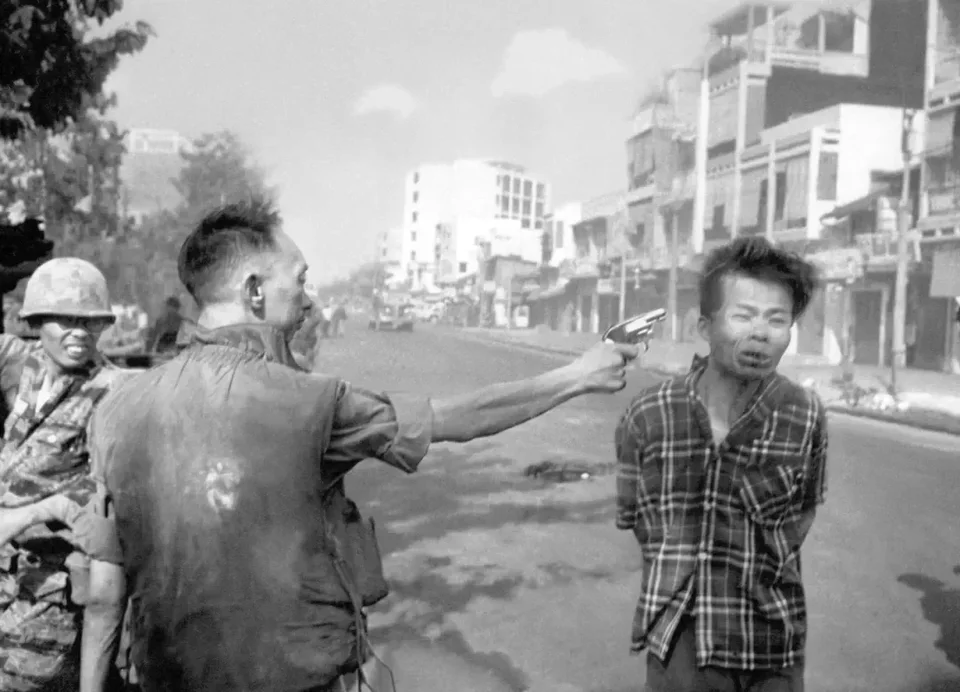
Take the famous photograph "Saigon Execution" by Eddie Adams. On a street in Vietnam, an officer (Nguyễn Ngọc Loan) points a gun at another man who looks rather shabby (Nguyễn Văn Lém) and pulls the trigger. The bullet enters his head, and his face begins to contort. Many people say this shows the indiscriminate killing of civilians. Faced with such a picture, a uniformed officer confronting a man in rags, we naturally think that way. But the facts were exactly the opposite. The officer was executing an utterly heinous criminal; the photo dates from the Vietnam War. The man executed had, the day before, killed an 80-year-old woman and a 6-year-old girl, and also killed many innocent family members of South Vietnamese officers. He was, you could say, beyond redemption. Yet because of this photograph, the general who carried out the execution never had a good day for the rest of his life, and the photographer carried a lifelong sense of guilt. That's because a photograph often can't explain causes; it can only present.
As for action, another photographer, James Nachtwey, whose subjects are somewhat similar to Salgado's, once said that across the whole of twentieth-century human history, "the greatest politicians, philosophers, humanitarians… have not been able to end war. Why impose that demand on photographers?"
So I think this is a very interesting point. Salgado is by no means unaware that he's aestheticizing his subjects, nor unaware that doing so "distorts" their suffering, so to speak. But only by doing this can he turn the presentation, through various channels, into real resources that help the people he photographs. Mobilizing resources is very hard. In artistic creation, sometimes you don't need to actually enter society and form real relationships with many people. Creation can be something where you treat them as material to be processed; you might even do it all in your studio. But once you want to do something concrete in the world, once you have to build economic ties and ties of interest with others and change certain structural problems, things get very complicated.
So I think the whole critique of Salgado, and the phenomenon his kind of photography represents, is actually quite complex. There's an overarching principle, the one I keep repeating: as a matter of the "communicative sphere," it necessarily takes precedence over the value judgments it receives in the "aesthetic sphere."
3.2 Recognizing and Restoring the Voice of the Photographed Subject
Building on this position, what kind of theory can we develop for thinking about photographers and the people they photograph? Last time I also gave a talk at Butread Bookstore, where I introduced a theorist named Ariella Aïsha Azoulay, a scholar who now teaches at Brown University. Her whole conception of photography is, to some extent, based on this "communicative sphere" perspective. One goal of her theoretical project is to restore the subjectivity of the person in front of the lens: to stop seeing them as the photographer's passive tool, to stop seeing them as mere subject matter.
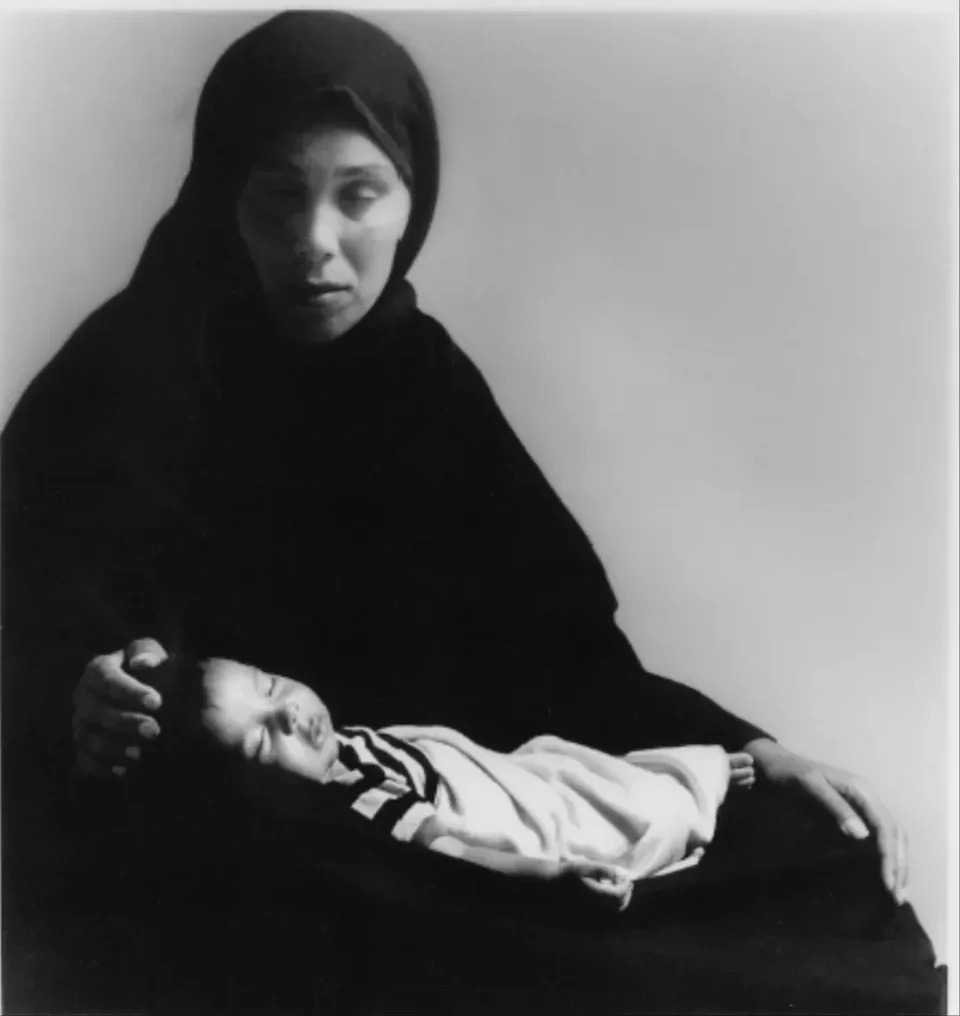
Nearly all her concerns center on the living conditions of Palestinians in the Israeli–Palestinian conflict. She gives an example. As we know, Western visual history has a full iconographic tradition called the Pietà: the noble Virgin holding Jesus in her arms, eyes lowered, gazing tenderly at her child. That's the schema. A photographer named Micha Kirshner took a photograph like this of a Palestinian mother and her child. At the time many people attacked him, saying he was beautifying Palestinian suffering. In my terms, if you look at it at the level of communicative action and communicative events: to make this photograph, the mother and child had to enter a studio and spend several hours in a room with the photographer. There was thorough communication between them, and the person photographed explicitly gave consent. So why did she consent? Because she, too, wanted her suffering to be seen, in whatever way, as long as people saw it. They didn't want to be forgotten, or buried beneath the strata of history. Moreover, as the person depicted, your photograph may well endure for a long time. Would you want people to see you and your child in rags amid the ruins? Or in a studio, where you could preserve at least a surface dignity, however brief and however touched up?
So is the mother's own consent in this event invalid? What Azoulay means is that we must fully acknowledge her agency as a photographed subject. She or he is a living person, standing on an equal footing with the photographer. The person photographed isn't necessarily thinking any less than the photographer. We need to recognize that fact. Hence her whole theoretical framework.
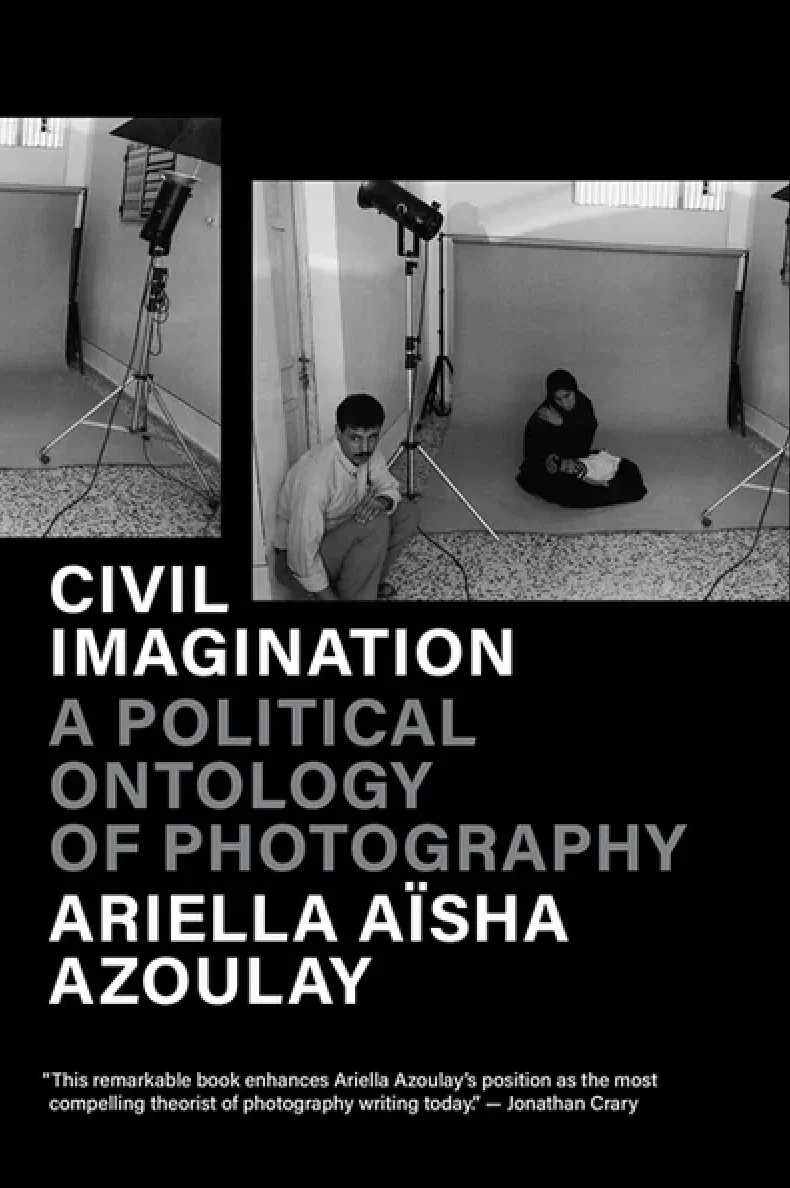
I won't go further into her theory, but where it fits with what I'm saying today is this: we need to learn to think about the whole practice of photography, and so-called "creation," from the standpoint of the person photographed. At the same time, we must admit that looking at such images is itself painful, is itself "guilty." The key is how we, as viewers, balance the guilt and pleasure we feel in the process, and, once we've weighed them, what we do next and how we deal with the image. We shouldn't be searching for an impossible way of looking. There's nothing that pure in the world.
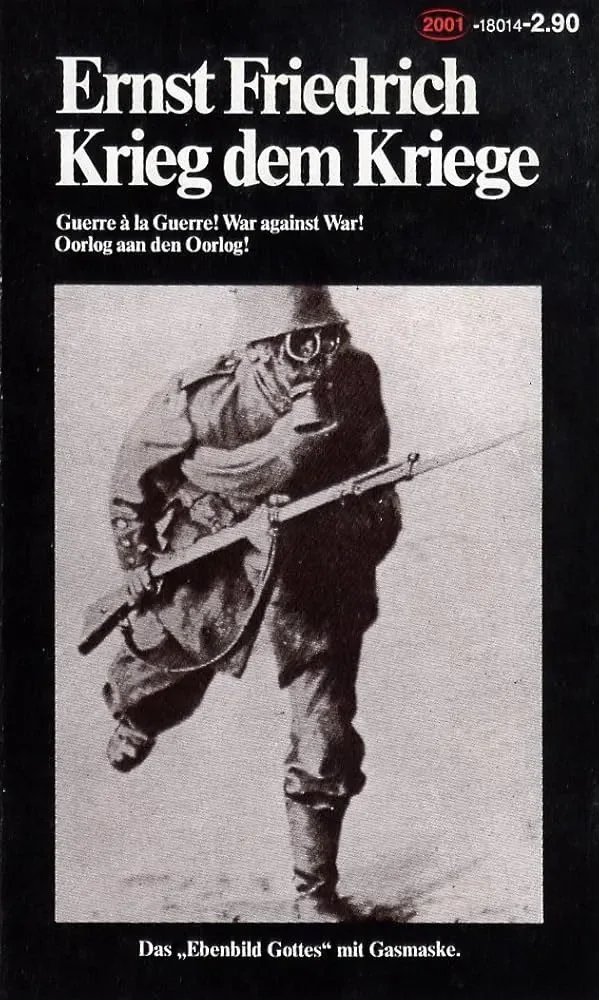
One last thing I'd like to add. If you're interested, look up a photobook called Krieg dem Kriege (War Against War), compiled by a pacifist named Ernst Friedrich. It consists of photographs of the wounds of soldiers who survived World War I, and you see all kinds of "inhuman" faces. In a sense, those faces are more monstrous than any "monster" in normal human experience; the state of those wounds is beyond what imagination can reach. Once you've seen them, they haunt you. Why does such a work exist? In a sense, precisely so that this pain can be acknowledged and accepted to the fullest extent. Before such pain, no one's conscience can be let off. Everyone, myself included, looking at these photographs might feel that if war can turn people into this, into something completely inhuman, then no war is legitimate in any sense. Photography has an innate advantage in showing the human body, more so than any painting, and its most extreme way of showing suffering is to show the suffering body.
That's all for my talk today. Thank you, everyone.
Discussion:
Yanyang
I have a question that may not be fully formed. When you brought up the second criticism of Salgado, about "voyeurism," I didn't quite follow. As far as I know, film theory also has a mechanism called "voyeurism." Film and photography are certainly different, but they're both related to images, so I thought their theories might overlap a little. That's just my half-formed thought. In film theory, voyeurism describes a psychological or identificatory mechanism when someone watches a film. So I was thinking: you mentioned porn, saying it can only be watched privately and isn't suitable for mass viewing. But in the voyeurism mechanism I know of, the emphasis is on the "peeping." It's as if, as soon as you sit in a cinema or pick up a device to watch a film, you're already peeping into other people's lives and getting pleasure from it. And as I understand it, that applies not just to porn but to all films. So I'm a teeny-tiny bit (okay, more than a tiny bit) confused; I didn't quite keep up with your argument just now.
Guosen Chen
Here's how I see it, if I've understood you correctly. I think "voyeurism" refers to a pleasure that comes from crossing a boundary that shouldn't be crossed, or that has been set up. Any peeping or voyeurism presupposes something first: why is it called "peeping"? Because it's something you shouldn't see, but you've seen it, so you feel pleasure.
Another example comes to mind: in Yukio Mishima's The Temple of Dawn, Honda Shigekuni hides behind a bookcase to peep at the Thai princess Ying Chan changing clothes. He has a hole cut through the wall behind her bedroom, sets a bookcase in front of the wall, and watches the princess change through it. Mishima writes something very interesting. I don't remember the exact words, but the idea is that through this peeping, the world that is seen is permanently altered by the act of peeping itself.
(Note: Mishima's original passage is as follows.) What Honda most wanted to see here was a Ying Chan whom no one in this world had ever seen. The moment he saw her, the condition "never seen by anyone" would no longer exist. And yet, never having been seen by anyone at all, and having been seen without being aware of it, look similar but are in fact entirely different things. [.......] Thus Honda's longing to glimpse Ying Chan's naked form, unknown to anyone, had become an unfulfillable desire straddling the contradiction between knowledge and love. Why? Because what he saw already belonged to the realm of knowledge. Although Ying Chan was not yet aware of it, from the instant he peered at her through the hole in the wall behind the bookcase, she had already become a resident of the world created by Honda's knowledge. The world of Ying Chan, suddenly contaminated once he had laid eyes on it, would never contain what Honda wished to see. Love could not be fulfilled. And yet, if he did not look, love could never reach the other shore.
So if we use "peeping" to describe viewing photographs of suffering as a kind of "voyeurism," I don't think that holds up. It isn't peeping in that sense. If we call viewing photography of suffering "voyeurism," that implies we shouldn't look at it, and that looking produces pleasure; that's why it's called "peeping." But the mechanism of representing suffering isn't like that. I don't think so. I don't think "voyeurism" applies here. When you see someone else's suffering, on the one hand, distance from the scene of suffering produces pleasure, but on the other, your pleasure is illegitimate, something you shouldn't have. So you bear a double feeling: pain and enjoyment at once. That's an objective fact of sorts; we needn't insist that it's pure enjoyment. If you frame it as "voyeurism," the element of "enjoyment," of pleasure, weighs somewhat more. But in the experience of viewing photographs of suffering, "pain" is also an important dimension. It appears together with pleasure, and may even carry equal weight.
So my argument just now was that the concept of "voyeurism" isn't suited to describing the experience of viewing photographs of suffering.
Yanyang
So I can take it that the theory (disaster porn) used the wrong critical tool?
Guosen Chen
Right, I think it doesn't fit.
Chengche
Let me say something. Looking at that photo of the oil workers, you see suffering, but who knows how many people wouldn't. I used to be an oil worker. I've been covered in drilling mud myself, and some of my former colleagues worked in the oil industry; when you trip the drill in and out, you get situations like the one in the photo. But here's the thing. When I saw the photo, my thought was that these people have it better than some of their fellow workers. Why? These people were basically in China, and they were mostly veterans or people transitioning out of the military; that's who could get into outfits like PetroChina, Sinopec, and CNOOC as oil workers. And they got six months of leave. You might feel they're suffering in that moment, but I also feel their lives were probably full of other things too. Of course, when I was working, one feeling I had was, say, you'd go to work singing "I Offer Oil to the Motherland." In the moment, covered in mud, you might feel pretty wretched, but when you remember it, or think about it again, it seems quite interesting, even happy.
Also, there's another issue involved. When I was extracting oil in the Ordos Basin, every day I could see that magnificent scene, like the line from the poem, "over the long river the setting sun is round." Desert, a sun shining on the desert, and what does that feel like? You lie on the sand, and the sand is especially clean. I think how you interpret this kind of image has to do with a person's knowledge structure and experience. That's how I understand it. Cognitive theory says that each person's cognitive structure, the basis of their cognition, may determine how they interpret an image. So I think there's a contrast here. I bring this up because I was an oil worker and I happen to have former colleagues who were oil workers, so when I see this image, it's not right for me to simply assume it's suffering.
So it has to do with your experience, your knowledge structure, your culture, even cultural differences, right? Take American oil workers. I know that back then, if they worked abroad, they made ten thousand dollars a month, definitely a lot more than they'd earn in the US. That was the going rate about a decade or so ago. It all depends on how you read it. If some people see oil workers in an industrial setting or whatever, they'd assume these people must have fairly good living conditions, and that's not a… I use this example to illustrate that our understanding of the photo still depends on our own interpretation, our cognition, and our experiences. That's my first point.
Second, this reminds me that images also have a function called "projection." They may reflect our projections more than anything. Some of us see suffering in this; some say, "I see that I need to change this situation"; some say, "I understand this world." It's like psychological assessment tools, projective tests. The Rorschach inkblot test and so on are all based on projection theory. I think it reflects more of our individual selves. Of course, through these images we can also see some of what the photographer wanted to express or convey to us. But I think they also have a function of letting us examine ourselves, of seeing what our own cognitive processes and structures really are. That's what I wanted to share about this photo, since I happen to have done this work, and my experience and way of feeling may be different.
Guosen Chen
I think the two points you just made are especially interesting and important. The first is actually something my whole talk was trying to express, but I didn't spell it out. The "suffering" I talked about throughout is more of a concept; it's not that I think those experiences "simply are" suffering. I also have a relative who works as an oil worker in Saudi Arabia. His income is very high, but he's in a PetroChina camp where almost everyone is Chinese, he has hardly any social life, and he can't be with his family. Life is complicated; everyone's life is made up of many layers. Some people, ourselves included, when looking at such things, shouldn't casually treat them as "this is suffering, this is misery." Because, as I said, the whole framework I'm describing is trying to restore the agency of the people photographed, the people in the frame. How do they experience their own lives? What do they think their lives are? Rather than saying, like an outsider, "You're suffering, so I'm going to save you." That's actually a very lofty, very arrogant attitude that completely ignores the multilayered, complex, constantly changing life everyone has.
And something else comes to mind. Azoulay, whom I mentioned, also discusses a particular word: "refugee." When we call Palestinians "refugees," in a sense the word is branded on them like a criminal's mark, as if they'll be refugees their whole lives. But this ignores that before becoming refugees, and even while they are refugees, they have all kinds of lives, and they can't remain in the condition of refugees forever. They have all sorts of possible futures, and they don't want to always be known as "refugees." So that's the first point: how to think about this from the standpoint of the photographed subject, truly from the other person's position. Casually labeling someone else's life as suffering is actually disrespectful of their lived experience.
The second point is "projection." On projection, I want to raise a somewhat different point: where it can be dangerous. I mentioned the bad consequences of the "Saigon Execution" photo, didn't I? In a sense, that was a consequence of personal projection. If we trust our own projections onto the photo too readily, we see it as an officer killing an innocent civilian, when in fact the situation was exactly the reverse. Facts often don't match our projections. In a sense, your first and second points pull in opposite directions. The first is about stepping out of self-centered presuppositions…
Chengche
The projection I'm talking about has two layers. The first is the photographer's own projection onto the phenomenon; the second is our own projection when we interpret the photo… Those are the two kinds I mainly mean. But I believe that if each of us has enough self-awareness, you should know there are two layers of projection at work. Then you'll find you won't be easily fooled, won't be triggered by your fixed, what we'd call stereotyped, preexisting cognition, the first reaction that appears at first glance. I think it may be a multidimensional transmission process, a chain of transmission, rather than a single line.
Guosen Chen
Yes, I think that's right; it's something determined by many dimensions. Besides the familiar one-way transmission from photographer to viewer, I'd add two points. First, photographs capture many things that neither the photographer nor a particular audience notices. Walter Benjamin, in his "Little History of Photography," called this the "optical unconscious." People have an unconscious or subconscious; the camera, as a mechanical optical device, has its own "unconscious." You take a photo of a particular subject, but maybe years later, when you look back, you find that something else crept into the frame unintentionally. It was overlooked at the time, but at the moment you notice that detail it can play a huge role or take on a different meaning. This always happens. The conclusion that follows is that the production of a photograph's meaning is always an unfinished process. A photograph's meaning is something unfinished. Its meaning isn't the same as the meaning assigned or produced when it was taken. Even with your own photos: when you take one, you think, "I want this photo to express this." But later in the darkroom, when you're selecting, your reasons for choosing it may not be the same as your reasons for taking it. And after you've selected it, when you circulate it or look at it again, new meanings keep being added. That's the first point.
Second, since a photograph's meaning is always awaiting supplementation, its meaning isn't self-sufficient. That's also why I said to be cautious about "projection": very often the image alone can't explain much, and you'll end up with many misunderstandings. So you need an awareness that you have to investigate and supply all kinds of context. Those are my two points.
Wanshi Ruyi
Following on what this gentleman said, let's stick with the oil worker example. One issue is the photographer over-interpreting, turning something that isn't suffering into a glorification of suffering. That's one side. Second, for instance, I know Salgado photographed the firefighting in Kuwait; that photo was in Kuwait too. The "suffering" we see in oil workers seems to be being covered in oil, but the real suffering is the occupational disease from fighting the fires or living in that environment. When the Sichuan Petroleum Bureau went to Kuwait to put out the fires, the pay was very high, but after they came back, for three months straight they coughed up nothing but black phlegm. What am I getting at? Look at the oil workers he photographed in Kuwait, right? What he saw was the surface. He didn't get to the level of "I see your occupational disease."
Conversely, like the Israeli photographer you mentioned earlier… Here's what I want to say: the image a photographer takes may just be the surface you see. Setting aside the Palestinian issue for a moment, might the subject be "playing up their misery"? The photographer might say, I'm treating my subject as material, and, setting photographers' ethics aside, using that material to win fame. By the same logic, from the subject's side, I might "turn the tables" and use the photographer to spread my own ideological message. But you, the photographer, have simply turned the surface you saw into an image and then interpreted it. That's the first thing, the photographer's encoding.
Second, on decoding, and again following what this gentleman said, different people see different things in the same image. The simplest example is the "Hope Project" Big Eyes Girl photo. Some people might say, "What an adorable kid, those big eyes," but someone in education would see, "Yes, children in the mountains really have it hard." By the same logic, if your photography expresses things only through images and doesn't fully let me see what you want to express, it becomes a guessing game. The other day I read a very good article about how today's photography, whether news, reportage, documentary, or even creative photography, all of it, has become what? It used to be "three parts shooting, seven parts darkroom"; now it's "three parts hiding, seven parts talking," replacing writing with light and shadow by interpreting with words. What does that strip away? It strips away photography's own "craft," its technical craftsmanship. So I've been thinking about this: when every image becomes something the photographer over-interprets, that's strange. Including Salgado, whom you mentioned. I think a good photographic work, whether black-and-white documentation or a color landscape, should give me an image and maybe a caption of 30 or at most 70 Chinese characters. If you say too much, it shows your thing is just self-justifying. It's like film: good directors never go around explaining what their films are meant to express. So I'm wondering whether photographic theory leans too heavily on words. Can't you just give me a universal image, a universal expression, instead of one picture plus three or eight thousand words of explanation?
Guosen Chen
I understand. You've raised roughly two points. As I understand your values, you lean toward modes of photographic presentation that more fully establish, or reveal, the broader living conditions of the photographed subjects, and what you see as deeper, structural factors. Such modes of presentation certainly exist, and they're absolutely necessary. Many photographers today, to avoid Salgado-style criticism, increasingly tend to present a complete "project," a presentation grounded in some kind of investigation, with very rationally organized material, rather than just delivering visual shock. That's certainly legitimate. I fully agree it's necessary; Salgado's can't be the only mode of presentation.
Because in representing suffering, you can see a spectrum. At one end is the most extreme representation of the body, like Ernst Friedrich's work, or depictions of torture. At the other end is the representation of "traces." How far can that go? You might photograph the space where the subject lived, but the person never appears. You can't see any part of their body; all you see are the traces they left, how the environment changed after the event. Without explanation, we might not even know the work addresses a social issue. Those are the two extremes, and many works look for their own position and balance between them. Some choose the most extreme approach; some take what you were describing, somewhere in the middle of the spectrum, striking a good balance. And some make work outside the spectrum altogether.
But Salgado probably leans toward the "body" end. He isn't too concerned with, or chooses not to photograph, "traces." I don't think it's a question of which is better, because each approach, "body" and "traces," has its strengths and weaknesses. With "traces," it's hard to raise as much money as Salgado did and genuinely help people. As for the "body" end, what you described—occupational disease, or the causes behind these injustices—photography can present those structural problems too, but done that way (through traces), it has a hard time reaching a wide audience. So every approach comes at a cost; it depends on what you ultimately intend to do.
The second point I find more interesting: which matters more, text or image? If we limit the question to photographing so-called suffering and injustice, I don't think the question itself is important. Framing it that way still means we're concerned with the completeness of a work's self-contained expression of meaning: how its meaning is self-persuading, self-identical, autonomous. But in fact, any artistic representation involving suffering, as I said, must always give priority to communicative action and the communicative sphere. Because your work eventually becomes a "thing," a thing that acts, an object embedded in all kinds of social relations. A photo of yours might go out and change many people's fates. In that sense, your captions and your texts must all serve one consideration: how you grasp, or try as best you can to control… because much of the time we can't control it. Did Mr. Hailong Xie know this photo would have such an impact when he took it? Not necessarily, right? Then there's another very famous one, Dorothea Lange's Migrant Mother.
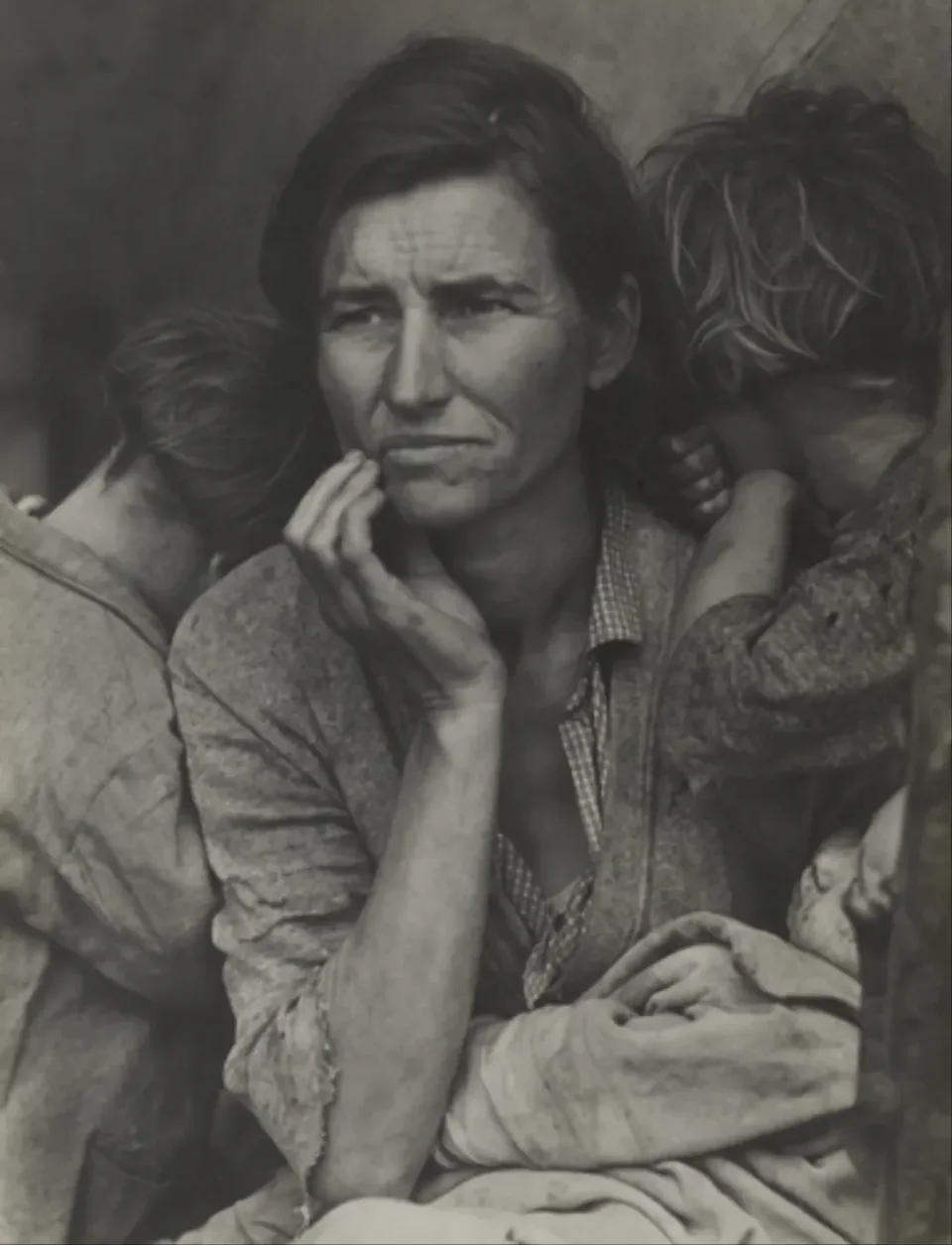
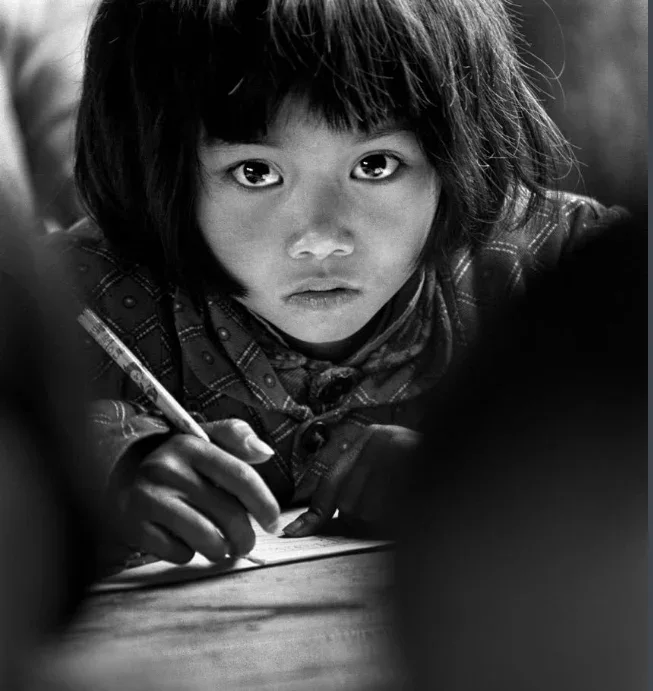
Notice that neither photo is named after the person in it. The "Big Eyes Girl" is Su Mingjuan; the "Migrant Mother" is Florence Thompson. How many people know their names? Probably many only know her as the "Big Eyes Girl" and not as Su Mingjuan, and the same goes for Florence Thompson. So when photographers title their works, sometimes they need to start thinking about this: how to balance these interests, how to take as much responsibility as possible for their subjects.
And Dorothea Lange's photo, we tend to think, is fairly calm and has a certain investigative feel. But the mother later protested. She said she was tired of being treated for so long as a symbol of Americans' unbowed spirit in the face of hardship; she hated that. I don't know how Su Mingjuan feels about her photo now, but Florence Thompson later said, first, that she really did hate the label; second, that her life had indeed improved because of the photo. But she still had a complaint. What was it? When Lange persuaded her to be photographed, she said she'd mail her some copies afterward. But Florence said that right up to the interview, she had never seen those copies; Lange never sent them.
You'll find that if you really examine things within the sphere of communicative action, who is "instrumentalizing" their subjects? Someone like Lange, or someone like Salgado? José Saramago, the Nobel Prize–winning Portuguese author of Baltasar and Blimunda, was very fond of Salgado. Yet many Americans accuse Salgado of "eating steamed buns dipped in human blood," or of not respecting suffering, or of not revealing problems structurally enough. So I think sometimes we shouldn't be too harsh on these techniques; we should be more tolerant and allow more possibilities, so that more constructive things can emerge. That's roughly my view. Don't confine it to the domain of the work, because what we're discussing is the social relations and social effects of representing suffering. For photojournalists especially, these things must be even harder to balance. When you capture a shot like that, you might think to yourself in the moment, "Holy sh*t, got the shot!" There's that pleasure, and there's nothing wrong with it. The key is, after you feel that pleasure, how do you handle what comes next, right? Just agonizing over the pleasure itself, saying "I shouldn't be happy," is pointless. It should be acknowledged: people do feel pleasure in this, and they also feel guilty about that pleasure. Yes. That's about where I'll leave my response.
Yanyang
I've heard of a kind of "end of art" thesis… The idea is that art used to be about reasoning with you, or I'd have a concept, an idea, and I'd express it through a narrative, like a good story, or through some form. But now it probably leans more toward conceptual art. How to put it? For example, on short-video platforms you often come across clips that tell you some life lesson in a single sentence. They just state it directly, rather than conveying it in the slower but more sensuous way of before. This may relate to what Arthur Danto said about the shift in art's center. Anyway, I didn't study very well, and I've forgotten half of what I learned in college, so this is all I can think of that's related. And if you don't have some grounding in philosophy, you might not understand this kind of modern art. It may be a trend; I won't judge whether it's good or bad, but there's not much to be done, that's kind of the feeling.
Momo
Whether it's literature, art, film, or photography, I understand it as a form of expression. Once that form of expression has produced a work, does the interpretation still belong solely to the author, or can all of us interpret it?
Yanyang
Right. Earlier there was the Marxist account of the process from artistic production, to the artwork, to artistic reception. Earlier eras emphasized the author, focusing on artistic production. Then came work-centered theories, focusing on the characteristics of the work. But now, the focus may be more on the reader. So however many explanations the author gives, there are a thousand Hamlets for a thousand readers; what each reads will definitely differ. And who the author even is—you as an individual, or a collaboration shaped by others—is itself hotly debated. So the more popular view now may be reception aesthetics, or artistic reception. So I'd definitely lean toward what you just said.
Momo
Yes, I'm also following up on the gentleman's point earlier: explaining too much, using three or four thousand words to explain a picture—isn't that a bit excessive, or like you're frantically pushing your views onto me? What I see isn't necessarily that, and doesn't what I put out also need to be seen?
Guosen Chen
Let me add a couple of points. The attitude you've been describing, as I see it, goes back to the late 1940s, when New Critics like W.K. Wimsatt and Monroe C. Beardsley started talking about the "intentional fallacy." You can't rashly infer the author's intentions and treat them as the source of a work's meaning; you can't use the author's intent to explain the work. The work is a self-contained whole. You can't appeal to the author's will, nor to the audience's feelings; you should arrive at a relatively independent and objective meaning of the work through a series of rigorous procedures. From there it gradually moves on to Jauss and reception theory, where the grounds for interpreting meaning shift from the work, seen as self-sufficient, to the reader's own horizon of expectations. That becomes what you just described.

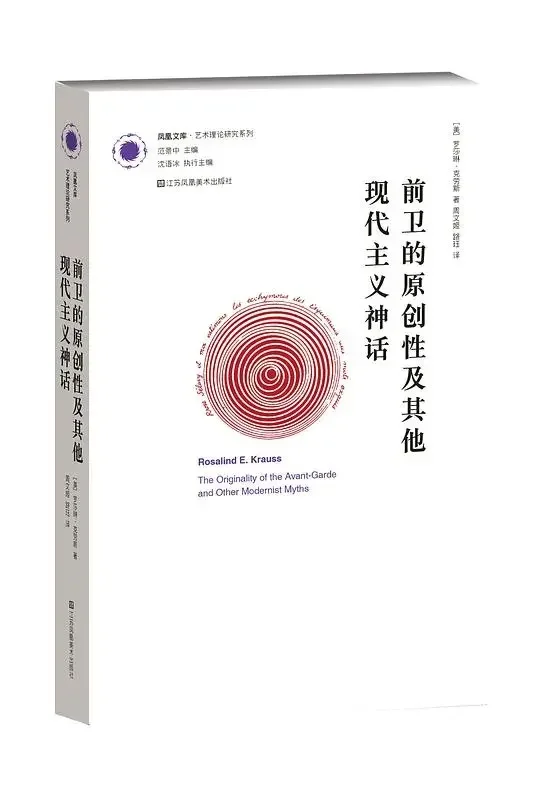
But first, this is related to the broader "dematerialization" of the whole art world in the 1960s. Lucy Lippard has a book called Six Years: The Dematerialization of the Art Object from 1966 to 1972, about that era's dematerialization of art. "Dematerialization" is the consequence, or manifestation, of conceptual art. You'll find that crowd would put a stack of scrap paper in a gallery and say, "This is art," without any physical work at all. What was dematerialization for? It carried on the process, beginning in the 1950s, by which interpretive authority over a work gradually shifted from author to reader. And shifting to the reader meant dispelling the aura of "originality" attached to authorship. Later Rosalind Krauss wrote a book called The Originality of the Avant-Garde and Other Modernist Myths, about how various artistic practices of that era dismantled the originality of authorship, holding that the author was no longer the figure of absolute authority and genius it once was. That's one side. There was also 1960s Pop Art, the "This Is Tomorrow" exhibition in Britain, Andy Warhol's piles of Campbell's soup cans, and so on, all attempts to dissolve the aura of originality.
But what I'm saying today isn't, in a sense, about championing the centrality of the viewer. It's this: as you just said, the author can include a statement. Is it valid? Yes. As a reader, is my added opinion valid? Also yes. And the consequence? In the process of producing a photograph's meaning, you'll find a great many actors and institutions, all kinds of readers and recipients, adding interpretations to the photo, and their interpretations are, in a sense, all on an equal footing. The mode of interpretation I'm advocating is a fairly pluralistic, overdetermined meaning of the work, so it's always something open.
To give an analogy: where photographs differ from literary works is that when you receive a photo, you can forward it and keep interpreting it. Think of it as a letter. Someone writes the letter, you receive it, and for any number of reasons—aesthetic, ethical, moral—you choose to forward it. Forwarding it is already an act of interpretation. So the photo becomes different because you forwarded it. That's why forwarding generates political force, or a potential for political emancipation, especially in today's social media age. So it's no longer something determined entirely by any one party. From the photographer, to all the viewers, to the institutions that publicize the photo, to all sorts of institutions that use photographs, each party adds its own interpretation, and all of them are valid. That, I think, is the current landscape of photographic meaning. The "de-originalizing" project that began in the 1950s doesn't quite apply anymore; we may have entered a new stage.
Also, many photographs from the last century have an iconic status. Including the "Big Eyes Girl" we just talked about, Nick Ut's "Napalm Girl"—though there's now a dispute over whether he actually took it—and "Saigon Execution," photos that helped change the course of the Vietnam War. But a few days ago I was chatting with a teacher who said that today, with the emergence of AI, social consensus is coalescing less and less, and it's hard to build a mechanism of trust through photographs or spark a movement anymore.

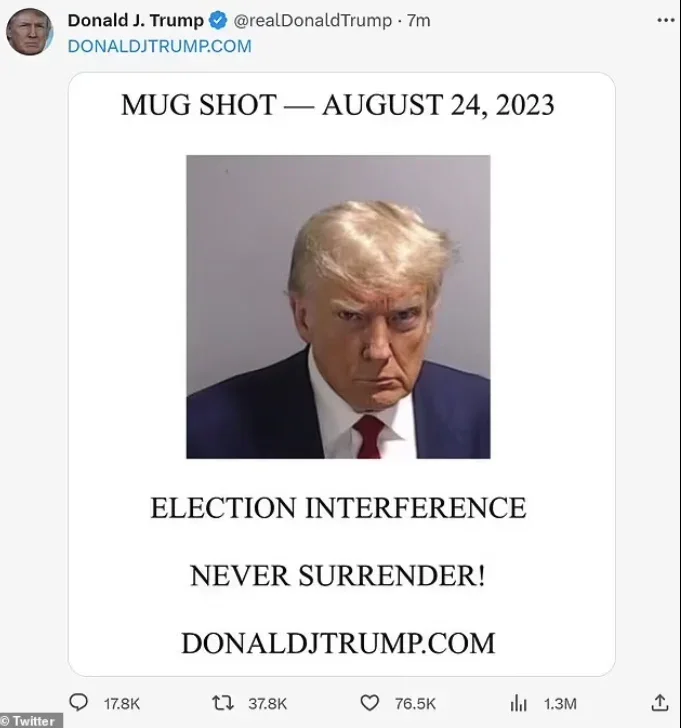


Will no photograph ever again be able to shoulder the responsibilities of the old news era or spark movements? I'm not that pessimistic; I think there still will be. Because it's almost certain that many photographic images are still entering our era's collective memory. Trump's mug shot and the assassination-attempt photo, for example, are real photographs. It's just that both carry an ironic meaning. Trump is obviously not a hero comparable to the goddess in Liberty Leading the People. The event his mug shot represents—he and his associates surrendering en masse—has a kind of black humor to it, even a sense of toying with and mocking the American justice system. What enters our collective memory now, while standing in some ironic relation to such images, may take more diverse forms, like the AI-generated image Trump posted on X of himself as the pope in white robes. In a sense, that too can be seen as collective memory, though it doesn't necessarily lodge there as something that triggers a concentrated event. "A picture is proof": that often doesn't hold anymore. When we see a photo that seems unbelievable, our first reaction may be, "Is this AI-generated?" That means AI has already been implanted in how we now perceive the world, whether or not you admit it or are willing to accept it. There are many more complicated situations, too. Doubao previously released an AI image generator that could produce extremely realistic mirror selfies of young women with flash, and people would use them to run scams.
Jane
Yes, and people use them on Xiaohongshu to build up accounts.
Chengche
But now that there are so many more images, won't people's adaptability increase?
Guosen Chen
I think it will.
Chengche
Then wouldn't the power of images to change something drop drastically? Because people's adaptability will surely… after seeing so much…
Guosen Chen
I think you just need to look at how scammers use photos. In a sense they represent a kind of "wisdom" about using photographs. And seeing a lot doesn't mean the effect weakens; I think it actually enhances people. You could say that in an aesthetic sense you grow tired of a certain kind of image, and after seeing lots of them they all look the same. But the more that's the case, the more I think we need to realize that not everything that looks the same has the same causes and circumstances behind it.
Momo
If too much gets piled on, doesn't it become hard to understand? I still think it should be more accessible to the general public. Not piling up every theory until it becomes a hugely complicated problem that no one but a few elites can take in, just to show how sophisticated it is. Is it piling things up to look sophisticated, or is it for…
Guosen Chen
I don't think it's that simple either, because complexity is very necessary. It's not that everything should be simplified, or that we should always pursue simplicity, or that only what can be explained simply is good. There has to be a minimum degree of complexity. Even the whole process of the evolution of life isn't what most of us imagine, a movement from simple to complex, where "one begets two, two begets three." The initial "one" is already something very complex. The evolution of life and all your behaviors have an original complexity, rather than proceeding along a linear path from simple to complex. We all seem to like that kind of narrative, but quite possibly the thing you're examining was very complex from the very beginning. There are only different stages in the evolution of complexity. That doesn't mean you have to reduce it to something simple in the end in order to grasp its more essential existence.