
Abstract: The Russian Cosmism of Fedorov, Tsiolkovsky, and others provides an important intellectual-historical coordinate for situating Futurist art and Soviet avant-garde cinema. Eisenstein’s unrealized “Glass House” and “Spherical Book” projects point toward a spherological structure with cosmological significance. The use of scale models in early Soviet cinema suggests a harmony between mechanical spirituality and the cosmic spirit, while the clay used to make these models served as a carrier of solar energy. The “flying machine” (cosmic technology) was understood as a Suprematist experience that liberated the subject from a flattened mode of existence, and was subsequently translated into symbolic forms of “stratospheric politics” or “cosmic cosmopolitanism.”
Keywords: avant-garde cinema; Cosmism; Glass House; model; vitalism; flight
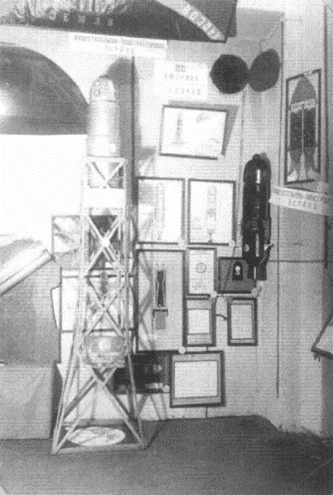
On April 24, 1927, an exhibition titled the “First World Exhibition of Models of Interplanetary Apparatus, Mechanisms, Instruments, and Historical Materials” opened in Moscow. Upon entering the exhibition hall, its curator, Mikhail Popov, declared with excitement: “I crossed the threshold from one era to another, into the cosmic [era].”[1] In the 1920s, research groups, publications, and exhibitions devoted to the cosmos and space technology proliferated explosively in the Soviet Union; “the October Revolution of 1917 unleashed a wave of far-reaching ‘cosmic’ utopias.”[2] This “cosmic cultural fever” was closely tied to “Russian Cosmism” (as an intellectual movement) of the early twentieth century, and it also constitutes an important frame of reference for situating the revolution of the Russian avant-garde in art and cinema: “Combined with utopianism and millenarianism… [the liberation of the masses] was represented in early Soviet cinema as a cosmic revolution.”[3]
“Cosmism” is not a rigorously ordered academic school; rather, it generally serves as an umbrella term for a range of cosmologies formed under the influence of Nikolai Fedorov’s Philosophy of the Common Task (Filosojiia obshchego delà) as well as early-twentieth-century Theosophy and occult philosophy. In The Russian Cosmists: The Esoteric Futurism of Nikolai Fedorov and His Followers, George M. Young understands Cosmism as a utopian thought emphasizing the evolution of humanity toward a higher level and the radical transformation and spiritualization of the material world.[4] It is evident, then, that Cosmism shared ideas with contemporaneous avant-garde movements such as Futurism and Suprematism, and with avant-garde cinema. As a convert who joined the Rosicrucians in 1920, Eisenstein maintained a hidden connection with the occult throughout his life. His unfinished “Glass House” (Glashaus) and “Spherical Book” projects, preserved in his manuscripts, point to a womb-like spherological structure, and the spatiotemporal structure of montage is in essence cosmological. Scale models (of airplanes, spaceships, and so on) were important signifiers in avant-garde art and cinema; their use in early film suggests a harmony between mechanical structure and the cosmic spirit, and early cinema’s fascination with the phenomenon of “vibration” can be understood in the vitalist sense of vibration as the vigor of the soul. Interplanetary flight (interplanetary revolution) became fashionable as a theme: Yakov Protazanov’s cosmic fiction film Aelita (1924) and Kuleshov’s The Death Ray (Luch smerti, 1925) were both indirectly influenced by Fedorov (with Tolstoy as intermediary), while Vertov proclaimed in his manifestos that the experience of flight was a Suprematist form of creative perception, endowing the “flying machine” (cosmic technology) with the utopian power to liberate the subject from a flattened mode of existence.
I. Return to the Womb: The Glass House and Eisenstein’s Cosmic Spherology
In the late 1920s, Eisenstein simultaneously launched two interrelated projects, the “Glass House” and the “Spherical Book.” The former effectively evokes an intellectual genealogy running from the Crystal Palace and the arcades to avant-garde glass architecture, while the latter offers a spherological structure of epistemological significance. The womb-like sphere became a Fedorovian site of resurrection and hinted at the millenarianism latent behind the ontology of the early moving image.
(1) The Glass House Project
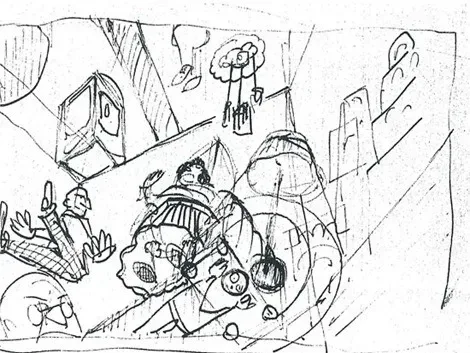
In a note dated November 17, 1927, Eisenstein mentioned the Glass House project, writing: “I imagine it in Berlin. Hotel Hessler, Kantstrasse. Under the influence of glass architecture.”[5] In March 1926, Eisenstein traveled to Berlin for the premiere of Battleship Potemkin. Because of censorship problems, the film’s German premiere was postponed, and during this period Eisenstein, introduced by Dimitri Marianoff, came into contact with Berlin’s art circles and visited Fritz Lang on the set of Metropolis (1927). “The sets of Metropolis and the glass dome installed there made a considerable impression on Eisenstein.”[6] Inspired by Metropolis, Eisenstein set about making a “glass house” film of his own, which was at the same time a response to the glass architecture of Bruno Taut and Ludwig Mies van der Rohe. In Eisenstein’s hand-drawn storyboards, modern high-rises, street scenes, and all kinds of urban landscapes are chaotically interspersed. Although the “Glass House” ultimately remained on paper, Eisenstein’s diaries indicate that the project had in fact reached a rather concrete stage (a factory had even been settled on to produce the film’s glass architecture[7]).
In his notes, Eisenstein was keen on exploring the complex optical manifestations of the surfaces of glass cubes and glass spheres, testing different lenses, glass textures, and reflective effects—what might be called Eisenstein’s “glass montage”:
Eisenstein liked to explore every possible kind of glass: colored glass; “polished” or “matte” and “embossed” glass; completely transparent invisible lenses and optical lenses; glass burned by fire, shrouded in smoke, assailed by rain and snow, pierced by nails or machine-gun bullets.[8]
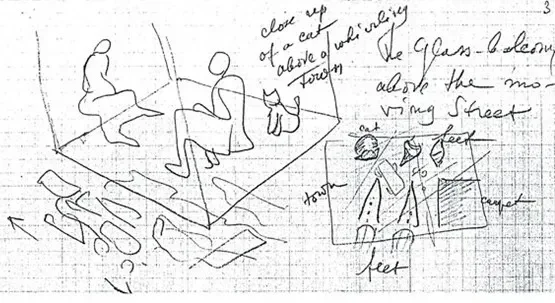
These playful, experimental elements can hardly fail to recall László Moholy-Nagy’s light-and-electricity installations. Glass is a particularly typical medium for presenting the effects of light (a fundamental cosmic element, a cosmic velocity) in space. Eisenstein stated explicitly in his notes that the chief motivation of the Glass House project was a profound modification of traditional cinematic space. In June 1928 he wrote in German: “Falling onto glass (Sturz aufs Glas): the theory of composition is based on the conflict between vertical and horizontal (dem Konflikt von Vertikalen und Horizontaler). In Glass House, everything is reversed (alles umgekehrt).”[9] Glass produces an unreal lightness and a dematerializing effect. Owing to its transparency, images based on different visual focal points and perspectival relations would be superimposed upon and pass through one another on the same image plane; with the constant switching of camera angles, this would create a fragmented space—non-hierarchical and polycentric—that could not be distanced or temporalized. “Cinematic space is no longer a space of montage but a space that bridges ruptures and gaps… the distinctions between above and below, near and far, inside and outside are eliminated; the field of vision is open.”[10] Eisenstein seems to have hoped to achieve in Glass House a kind of total “Cubist editing.”
This spatial mode also appears in the set design of Aelita, the famous cosmic fiction film of the 1920s. The film’s designer, Alexandra Exter, likewise made extensive use of glass (as well as aluminum and metal foil) and other industrial materials with special optical effects to construct a monochrome, dreamlike cosmic world. The staging of Aelita descends directly from the avant-garde opera Victory over the Sun (Pobeda nad Solntsem); both, through shifts in lighting and perspective and the optical play of materials, create “an impression of infinite space,”[11] in which hierarchical space is replaced by topological, fluid space. “Industrial materials… in their transparency or reflectivity, merge with the surrounding space.”[12] Under this spatial logic, the basic constant that sustains the physical order of traditional space (gravity) is naturally abolished as well: “Glass House breaks the representational system of cinema and frees objects from gravity. Objects and bodies float in glass space.” As Eisenstein wrote in German in his notes, this is “a weightless space (schwebender Raum).”[13] In Eisenstein’s manuscripts, objects are surrounded by smoke and light, while human bodies seem to have been placed among the clouds. The “weightless” “glass-house space” is a cosmic space.
It should be noted that the glass house (and glass as material), as an important element of early-twentieth-century Futurism and avant-garde art, carried in itself an easily overlooked cosmological connotation. As early as 1914, Paul Scheerbart, a pioneer of the glass house, envisioned an entirely new architectural form in his Glass Architecture (Glasarchitektur) (there is evidence that Eisenstein had read articles introducing Scheerbart). These buildings made of glass would give people direct access to the cosmic landscape—“Scheerbart’s houses… bathed in the radiance of the sun, the stars, and the moon”[14]—and glass signified a light, free cosmic life. By contrast, traditional architecture was bound by rectangular windows, symbolizing the loss of an open relationship with nature and the cosmos. Inspired by this, Taut even organized a loose group called “The Glass Chain” (Die gläserne Kette), whose central program was “to bring the inhabitants of glass architecture closer to the cosmos… the residents of the glass house will become spectators of the infinite panorama of the universe and the vast theater of nature.”[15] Beyond this, traces of a similar cosmic utopia can be found in Velimir Khlebnikov’s poetry, Tatlin’s Monument to the Third International, El Lissitzky’s “cloud-iron” skyscrapers (Wolkenbügel), and Georgii Krutikov’s “Flying City” project.[16]
(2) From the Spherical Book to the Womb
The glass house is both a cosmological space and a “spherological” space in Peter Sloterdijk’s sense. As a cozy sphere, the glass house provides the subject with a womb-like dwelling and suggests a harmony between an open terrestrial structure and the cosmos. The symbiotic mode of glass and sphere is fully displayed in Eisenstein’s “Spherical Book” project, pursued alongside the Glass House: Eisenstein hoped to complete a book that would comprehensively present his theory of montage, and as he envisioned it, this could not be a “two-dimensional” book but only a “spherical book.” In Eisenstein’s view, the spherical book could not be read according to a linear logical sequence; it would instead be offered to the reader simultaneously and as a whole. Its contents would have no “center” or “distance,” but would move around the theme like a constellation, interpenetrating and mutually reversible.[17] Eisenstein wrote in his diary on August 5, 1929:
It is hard to write a book. Because every book is two-dimensional… In any case, I would like these essays to be perceived simultaneously, synchronously… I would like to create a spatial form that would allow one to pass directly from each essay to another… Only in the form of a sphere… could such synchronous circulation and interpenetration of essays be realized.[18]
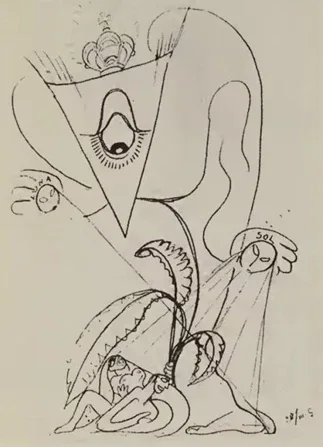
This non-linear, non-hierarchical logic of spatial narration clearly complements the “Glass House project,” while the epistemological principle of “perceiving the whole simultaneously and synchronously” recalls the occultism and spiritualism popular at the time, which likewise emphasized grasping the object on the basis of the whole cosmos (rather than local history) and beyond linear time. In fact, as a convert who joined the Rosicrucians in 1920, Eisenstein always had a keen interest in cosmological occultism. Hakan Lovgren states outright: “Eisenstein’s projects have an alchemical flavor… some of his colleagues regarded him as an alchemist.”[19] Lovgren’s view hints at the similar operating mechanisms of montage and alchemy, namely the transformation between division and unification, fragmentation and recombination. In a sketch Eisenstein drew for a production of Die Walküre, one can clearly see how he fused Masonic symbols, the alchemical ouroboros (an androgynous structure), and astrological cosmology (the influence of the sun and moon) in a single drawing. When discussing questions of artistic ontology, Eisenstein likewise resorted to the alchemical polarizing process of descent and ascent to develop his argument, writing: “In a work of art two processes take place simultaneously: one is a rapid ascent along the most developed levels of ideology, the other a descent, through the formal structure, into the deepest layers of emotional thinking.”[20] Lovgren argues that this “descent” signifies a return to the cosmos and the womb, to the moment of gestation and creativity: in the last phase of his life, Eisenstein became increasingly obsessed with the idea of the “circle”—his final theoretical text was an 80-page draft titled Circle (Krug), which discussed circular forms in Christian art and architecture as well as various forms of womb symbolism. And in his last work, Pro domo sua, created a month before his death in February 1948, he attempted to transform his own signature into an embryo-like circle.[21]
In the last phase of his life, Eisenstein thus returned to the “womb.” The womb is a singularity of life; it bends the linear flow of time into a loop and at the same time becomes a site of resurrection.[22] The Glass House and the Spherical Book are both montage apparatuses, and both hint at the millenarianism–Cosmism behind Eisenstein’s projects. “Resurrection” is the core issue of Cosmism, and the task Fedorov proposed in the Philosophy of the Common Task—resurrecting all those harmed by progress—implies a montage-like spatiotemporal structure: “For Fedorov, time was not linear but topological; the past could be the future, and the future the past.”[23] Death and resurrection break the meaning-structure of time; montage is therefore cosmological in itself.
Indeed, in many fashionable discourses of the early twentieth century, we can find a conjugate relationship between the ontology of the image and cosmology. As early as 1911, the Russian theoretical physicist Nikolay Umov declared at the Second Mendeleev Congress that cinema should serve as “a non-mathematical model of Einstein’s universe.” In his speech he stated that “the cinematograph shows how phenomena would appear in a world moving faster than the speed of light,” and that by altering the mode of projection one could make “a corpse come back to life… return to its mother’s womb, that is, death in reverse.”[24] “Cinematization” itself constitutes a kind of resurrection. In 1914, Voitolovskii likewise used the metaphor of the “Flying Dutchman” to emphasize cinema’s role in preserving images of life after death: “We love cinema because its trembling ghosts reenact the legend of the Flying Dutchman, whose passengers are rejected by life and abandoned by death.”[25] The image constitutes a spectral existence between life and death. Alexander Kluge’s The Cosmos as Cinema offers a contemporary version of this “cosmic image ontology”: the messages of life are preserved in the cosmos in the form of light trails. This claim rests on a kind of cosmic vitalism that regards the cosmos as the evolution and form of existence of life. As Tsiolkovsky proclaimed, life would ultimately be transformed in the course of cosmic evolution into some form of cosmic energy or radiation, thereby becoming “immortal in time and infinite in space.”[26]
II. Models and Solar Energy: The Mechanical Heart of Avant-Garde Cinema
The use of scale models (of trains, airplanes, spaceships, and other vehicles) was an important phenomenon in Soviet cinema of the 1920s and 1930s. As symbols of industrial creativity, models implied an ideological narrative of transforming the world (the cosmos) while also providing a dialectical transition between pure concept (the blueprint) and sensory reality (production). In this sense, the “model” also signifies an epistemological structure: through “proportion,” the model promotes a cosmic harmony between spirit and matter, and in energetic terms it constitutes an expression of “mechanical vitalism.”
Nikolai Lebedev’s To the Moon with a Transfer (Na lunu s peresadkoi, 1934) is a typical case of the use of models. In the film, a group of children on a collective farm, led by Lenia Glebov, build a model spaceship called the “Earth–Moon 24-Hour Express,” which embodies a profound dialectic between play and labor, toy and technology, the real world (Earth) and the cosmic-technological utopia (the Moon). Similarly, in Vasili Zhuravlyov’s Cosmic Voyage (Kosmicheskiy Reys, 1935)—a film supervised by Tsiolkovsky—a long take lasting a minute and a half, beginning at the seven-minute mark, presents a motionless, magnificent spaceship (a scale model), and the model special-effects photography effectively creates a sense of the ship’s “colossal” scale. The Constructivist Kornelii Zelinskii directly likened the function of cinema to that of an experimental model: the task of Socialist Realist cinema was to provide a “film-model” of the future interplanetary communist world.[27] In Cosmic Voyage, as cinema becomes a “model,” the model also becomes cinema.
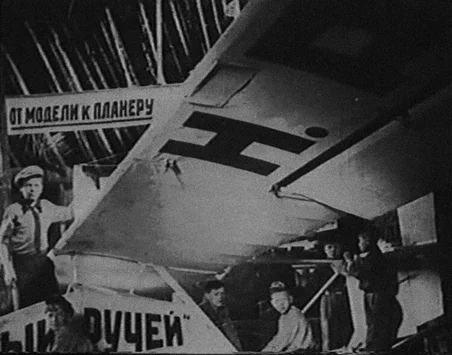
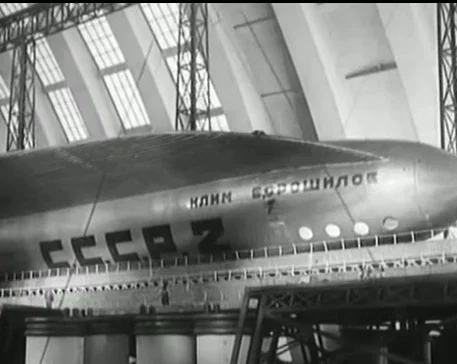
The obsession with models must be traced back to the sensory revolution of the Russian avant-garde, and thus also involves the organization and reshaping of the energetic structure of matter. Avant-garde cinema and contemporaneous avant-garde art both emphasized direct intervention in, and reshaping of, the structure of relations between the subject and the material world (the dialectic between the sensory rediscovery of the world itself and the transformation of the world), and the model occupies precisely the mediating position in this interaction. “The model is at once a symbolic image with a strong signifying charge in the present, an experimental object that inspires future achievements, and a machine that transforms the subject who uses machines.”[28] The model thus constitutes an unfolding or variation of the following basic proposition of avant-garde art: to “construct” (konstruktsiia) and “process” (obrabotka) things according to their “faktura” (the material, stylized experience and primal essence of a thing, charged with ideological meaning), transforming them into socialist things. Buchloh describes this process of “modeling” as “a form of organization of the kinetic life of objects”[29]—a formulation that already implies the correlation between model and energy. On the other hand, although it is not the object, the model is conceived as the object’s prior givenness: through “proportion,” the model promotes a “harmonia analogica” between spirit and matter. In this sense, the epistemology of the model can also be examined as a Cosmist “mode of projection.” Fedorov held that “true knowledge is neither subjective nor objective but ‘projective’ (proektivnoe).”[30] “Projection” is a kind of modeling, a mediation, which reflects how both Cosmism and the avant-garde sought to awaken a three-dimensional, synthetic perceptual capacity within the flattened modern mode of cognition: “Projectivism is the epistemology of the artist rather than the critic, of the engineer rather than the theoretical scientist… Fedorov’s imagination not only allows us to perceive the essence of the cosmos but also provides images, icons, and models for our project of reshaping the cosmos.”[31]
Model-making was one of the core elements of the Higher Art and Technical Studios in Moscow (VKhUTEMAS). In fact, VKhUTEMAS itself had direct connections with the Cosmists: the mathematician Pavel Florensky, one of its instructors, was closely associated with Fedorov’s disciple Vasily Chekrygin;[32] both were core figures of the Makovets artistic group, and Florensky also corresponded directly with Vladimir Vernadsky, another important Cosmist. On the epistemological level, Florensky did not stray far from Fedorov’s “projectivism”: “In a 1919 essay titled Organ Projection, Florensky discussed how human capacities could be extended to the entire cosmos through the projective function of artificial organs.”[33] Florensky’s view further reinforces the commonality between the avant-garde “model” and Cosmist “projectivism,” while also implying the idea of grasping the human body as a “model” of the cosmos.
At VKhUTEMAS, “students used clay to imagine space, shaping and forming their architectural ideas by hand in a malleable organic material.”[34] Nikolai Ladovskii held that “clay prompts an automatic connection among mind, body, and matter, thereby achieving a cognitive leap and ultimately stimulating the creation of new forms.”[35] Such formulations—“automatic connection,” “leap,” “stimulating creation”—hint at the transcendental dimension of “model–projection” and at a vitalist energetic leap immanent in matter (clay). In “The Poetics of Peat in Soviet Literary and Visual Culture, 1918–1959,” Robert Bird analyzes how “earth” constituted a “carrier of solar energy,” as well as the strategic material–energetic metaphors in post-revolutionary culture and art.[36] In a similar sense, the use of clay models in VKhUTEMAS courses also signified the transformation of unconquerable nature (mysterious, obscure earth) into “second nature.” As Boris Arvatov put it, the “thing” in bourgeois society is finished, fixed, and inert, whereas the socialist thing possesses an active inner energy that can be dynamically transformed by the subject.[37]
At the level of the body (the microcosm), this energetics of “projection” found expression in various “psychotechnics” (psikhotekhnika) projects aimed at reshaping sensory relations with the material world and transforming bodily perception—for example, the psychophysiological section of the State Academy of Artistic Sciences (GAKhN) in Moscow, established on Kandinsky’s initiative, and the psychophysiological department in Leningrad (INKhUK). These projects of bodily energetics intersected directly with Soviet avant-garde film practice: Vertov had studied at Bekhterev’s Psychoneurological Institute in St. Petersburg; Eisenstein was closely associated with Zalkind and likewise took extensive notes on Bekhterev’s reflexology; and in recent research, Mikhail Yampolsky has revealed the bodily dimension behind Kuleshov’s montage theory: montage derives from the human body; it is a record of bodily movement and a mechanical expression of the body’s natural rhythms, and the “body” of the world is transformed into the “body” of cinema.[38] In this sense, montage itself also becomes a corporeal “principle of modeling.”
In the aforementioned Aelita, one can find a direct visual expression of this “montage body.” Alexandra Exter and her student Isaak Rabinovich were responsible for the costume and set design of Aelita, respectively, and the film’s absurd, geometricized costumes closely resemble those Malevich designed for the 1913 Futurist opera Victory over the Sun.[39] The mechanized characters embody the concepts of speed and motorization found in Futurism and Rayonism. Andrei Nakov remarked: “As with the sets of Victory over the Sun in 1913 (the true prototype of this formal sequence)… the new pathos of the ‘machine age’ was born.”[40]
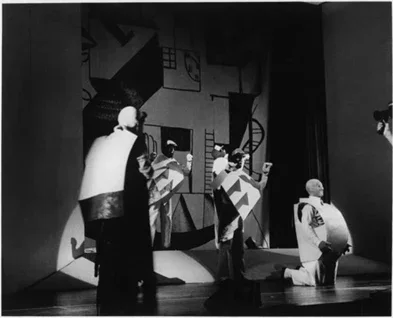
And as the body was automated and mechanized, the machine was also vitalized: through the “projection” of the model, the body’s vital energy (vigor) was converted into mechanical energy. As Vertov said in We: “To reveal the soul of the machine… to grasp the rhythm of the machine, the points of excitation of mechanical labor.”[41] Mechanical rhythm achieved an inner unity with the unfolding of life and the vibration of the soul. A great many Soviet films of this period were keen on presenting such human–machine energetic exchanges: for example, the tractor in Aleksandr Dovzhenko’s Earth (1930); the “mechanical life-movement” of spinning machines, hinges, and rotating bearings in Vertov’s Man with a Movie Camera (1929); and the cream separator in Eisenstein’s The General Line (Staroye i novoye, 1929). In 1931, in a series of reports including “Socialist Reconstruction and the Struggle for Technology,” Nikolai Bukharin proclaimed that the socialist technological revolution would replace the laws of mechanics with the laws of energetics. Bukharin synthesized the realms of nature, labor, and society into a monistic energy field, which at high energy levels would break the constraints of physical law.[42] Peregudov’s novel Solar Treasure from this period embodies this energetics, describing how the natural energy of the sun is transformed into mechanical and electrical energy, as well as the “spirit” (pafos) of the earthly landscape. Victory over the Sun likewise suggests this energetic, Chizhevsky-style worldview, in which the sun symbolizes eternal cosmic energy,[43] and the revolution of “victory over the sun” celebrated “the extinction of the sun and the plunge of the cosmos into chaos.”[44] Energy is at once mechanical, organic, spiritual, and cosmic; the “pathos of the machine age” is both energetic and Cosmist. Bukharin’s monistic energetics is very close to Tsiolkovsky’s cosmic monism: a faithful disciple of Fedorov, Tsiolkovsky believed that every material particle in the universe possessed an “atom-spirit” (atomdukh), and that the cosmos itself was therefore a “living form” (zhivotnoe). “Since all matter can, under favorable conditions, be transformed into an organic state, we may conditionally say that inorganic matter too exists in a state of potential life.”[45]
This vitalist cosmology is also reflected in early cinema’s fascination with “vibration.” Owing to projection speed, shutter type, sprocket holes, and other factors, early film images were in a constant state of flicker and vibration, which, far from being a flaw, became a kind of “fashion” of early cinema.[46] In fact, this fascination with vibration, restlessness, and vertigo can be found in many new artistic styles (including even the “vibration of light” effects of Post-Impressionist painting). As Christoph Asendorf observes: “Around 1910, the concept of vibration… became a central theme of aesthetic debate.”[47] In the Theosophical theories popular in the early twentieth century, vibration was further interpreted as the vigor of the world-soul: “Invisible ‘penetrating oscillations’ are the way the cosmos operates.”[48] This is inherently consistent with Tsiolkovsky’s atomism and cosmic vitalism. The eternal, ceaseless oscillation of atoms constitutes the soul of the machine. In this sense, the “cine-sensation” (kinooshchushchenie) of avant-garde cinema also points toward a revelation of the object’s inner energy (spirituality) and vital force. As Münsterberg put it: “[In film] the massive outer world has lost its weight, it has been freed from space, time, and causality… mind has triumphed over matter.”[49] “Cinema… reveals to us a profound spirituality.”[50] The optical unconscious of cinema thus also becomes a vitalist energetics.
III. The Wings of Icarus: From Suprematist Flight to Interplanetary Politics
The Cosmist forerunner Sukhovo-Kobylin outlined the historical stages of human development as a progressive sequence from terrestrial man (bound to the earth) to solar man (dwelling within the solar system) to cosmic man (dwelling within the cosmos). In his view, only the last stage could bring absolute freedom, and the entire task of social-historical movement lay in humanity’s own spiritualizing evolution toward the cosmos:[51] “The whole of humanity and the theory of its infinite development, that is, the philosophy of human history, is the process of its liberation from the bonds of space.”[52] With the Icarian wings of the flying machine, humanity would draw closer to the angelic state, or to ideal humanity; cosmic technology became a utopian force for approaching absolute freedom, completeness, and divinity.
As early as Méliès’s A Trip to the Moon (1902), scenes of interplanetary flight had appeared on screen, and the documentary A Journey through the Air (Puteshestvie po vozdukhu), screened in Moscow in 1908, showed a balloon flight from Paris to Verdun. In addition, films such as Ladislas Starevich’s The Night Before Christmas (Noch’ pered rozhdestvom, 1913), Edward Puchalski’s Antosha Ruined by a Corset (Antoshu korset pogubil, 1916), and Protazanov’s Jenny the Maid (Gornichnaya Dzhenni, 1918) all involved flight and aviation technology. “Flight” is both an ideological, panoramic (cinematic) dynamic mapping of space and the definition of a free vector of spiritual dynamics and an active cosmic perception. As Candyce Veal puts it, “Whether as an aviation emblem or as a cinematic device (the mobility of the camera, the aerial view, meaningful connections and cognitive links between frames, the ecstatic representation of vital movement), cinematic flight and aerial imaging describe inner dynamics.”[53] Iurii Tarich’s Wings of a Serf (Kryl’ia kholopa) provides an important example of such an activated “inner state” in the aeronautical (dynamic) sense. At the 54-minute mark, Nikishka, wearing a winged suit, is enveloped in a kind of lens flare, which reveals the “Russian Icarus’s” act of “spreading his wings” (raspravliat’ kryl’ia) as a spiritual self-expansion—in creative work (aerodynamic research) and in the flight of the winged “new man” (the emancipation of the serf)—expressed through an icon-like “aura.”
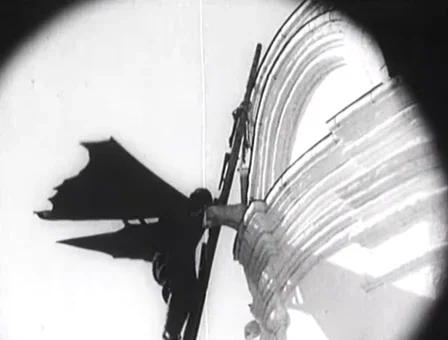
On August 14, 1913, Petr Nesterov became the first Russian aviator to take a camera aboard an airplane. Nesterov’s aerial photographs also entered Malevich’s photographic collection. For Malevich, flight signified a soul-awakening Suprematist cosmic experience and a creative, liberating new mode of perception. In his Kino-Pravda series of the early 1920s, Vertov had already experimented with aerial shots to present an unstable “cine-eye” in motion. The aerial perspective became a new way of perceiving space through cinema, and the motion blur of aerial footage produced a cosmic experience grounded in a sense of speed (the “moving ground”): “The ‘moving ground’ is common in Vertov’s early aerial shots… Vertov… proposed a vision of cinema as ‘practice,’ in which the airplane expanded and transformed the perceptual experience of the world.”[54] Also in 1913, Malevich absorbed Peter D. Ouspensky’s concept of the “fourth dimension” via Mikhail Matyushin, seeking thereby a cosmological ascent (flight) toward a higher reality. As Malevich said: “In human consciousness there is a striving toward space, a pull to ‘take off’ from the earth… to be transported into the endless void, where you feel the creative points of the universe around you.”[55] Around 1915, Malevich produced a series of sketches, compositions, and works related to airplanes (the experience of flight). In this sense, Futurist flight constituted a real blueprint for Cosmism. Robert Wohl rightly points out that “what attracted Malevich was not so much the actual sky through which airplanes flew as an imagined planetary space.”[56] The infinite freedom of Suprematism is isomorphic with cosmic consciousness: “The highest form of art is the path to cosmic consciousness.”[57] Suprematist flight therefore also signifies a cosmic revolution. In 1919, Malevich stated explicitly that Suprematism should be understood as part of a space program:
Between [the Earth and the Moon], a new Suprematist satellite can be constructed, equipped with all components, moving along a new orbit… I have torn through the lampshade of blue. I have come out into white. Follow me, comrade aviators! Swim into the abyss! I have set up the semaphores of Suprematism. I have overcome the bonds of the colored sky… Swim! The white free abyss, infinity is before you.[58]
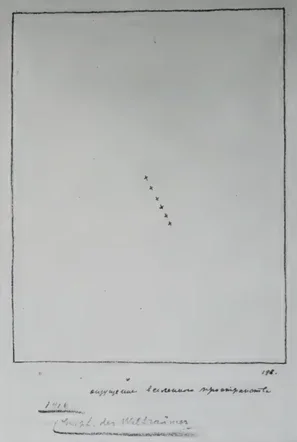
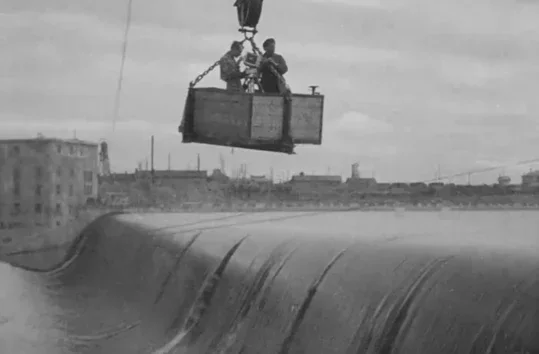
The flying machine gives humanity the capacity to leave the surface of the earth, just as the “cine-eye” gives the subject the capacity to leave the plane of consciousness. Both modes of cognition liberate the subject from a flattened everyday existence, thereby redefining time and space. Vertov wrote in We: “Relativity on the screen… our eyes spin like propellers, flying into the future on the wings of hypothesis.”[59] Correspondingly, at both the beginning of Man with a Movie Camera (two biplanes modeled on the de Havilland type are pulled past the camera from a hangar by a running crowd) and its end (an editing sequence of three airplanes in formation on the cinema screen and the “machine-gunner” cameraman), the airplane constitutes a key image. The film’s famous opening (a man with a movie camera appears above the horizon within the camera) can also be understood as an ascent to a higher plane of consciousness; he seems “to climb out of the mists of creation into a new world.”[60] As N. E. Livanova notes, the film creates a sense of “liberation” through archetypes of freedom universally associated with flight.[61] In an editing sequence at the 40-minute mark, the cameraman glides (flies) over a dam on a cable; this aerial wide-angle shot is cut together with close-ups of high-speed spinning disks and industrial assembly lines, which seems to suggest that flight constitutes the higher expression of the energy of the mechanical heart. Flight itself became a symbol of “universal vitality” in the sense of cosmic vitalism, which in turn inspired the ultimate dream of the union of human (cosmonaut) and machine.[62]
On the other hand, the flying machine also points to a close coupling of spatial politics and technological utopia. “The airplane (the aerial shot) provided a controlling gaze that could map and command. This was a gaze unaffected by movement but abstracted and framed.”[63] As Viktor Shklovskii observed, the bird’s-eye view or the extremely “distant” perspective erases individual destinies from the landscape, leaving only uniform geometric shapes (Odnoobrazna i Geometrichna).[64] The Suprematist, cosmological geometric blueprint thus also became a means of topographic decoding and spatial control.[65] This “control” can be seen as a vertical enactment of the ideological function of the “kino-poezd” (cinema train), and as a concrete form of the “technological mastery” (Ovladenie)[66] in the sense of Aleksandr Bogdanov, author of the utopian novel Red Star (Krasnaia zvezda). “(Sacred) technology will secure humanity’s ultimate dominion over nature and the cosmos.”[67] Vertov similarly defined aviation in Give Us Air (Daesh’ vozdukh, 1924) as a kind of “technological gift” (or grace). The aforementioned Aelita extended the themes of interplanetary flight and technological salvation even more directly to Mars. Similar expressions also appear in Kuleshov’s The Death Ray. “Interplanetary communism” is a Promethean anthropocentrism, which to some extent can also be understood as a restoration of the Christian cosmology: “The Christian promise of victory over death is here reinterpreted as the promise of the cosmos’s victory over chaos through secular politics and technology.”[68] And with the secularization of millenarianism and of radical experimental living, Aelita became the last “flight” of the Futurists. In the 1930s, Stalin declared that utopia had “become reality,” and the technological-utopian core of Cosmism was re-intensified (or covertly substituted) as an ambitious, secularist “stratospheric politics,”[69] or “cosmic cosmopolitanism.” Suprematist, cosmological flight was transformed into the Stalinist motto “ever higher and higher.” The revolutionary “new man” was metaphorically constructed as the “winged man” (aviator, cosmonaut).[70] In the famous 1920s song “Aviators’ March,” the word “reason” in the line “Reason gave us steel wings for arms” was replaced in the 1930s with “Stalin.” The renewed expressions “interplanetary flight” (Zvezdnyi perelet) and “great flight” (Velikii perelet) powerfully suggested a longing for a new world and for modernization. Revolutionized terminology expressed the infinite possibilities of human progress. Travel toward the stratosphere (or the cosmos) symbolically represented the realization of a revolutionary dream of equal scale: the coming of communism.

Conclusion: A Hidden History
As a fashionable intellectual movement of the early twentieth century, Cosmism constituted one of the important theoretical backgrounds of the Russian avant-garde revolution in art,[71] directly inspiring the work of avant-garde artists and groups such as Malevich, Chekrygin, Alexander Labas, and the Amaravella art group. Its influence extended to cosmic fiction film projects such as Klushantsev’s Road to the Stars (Doroga k zvezdam, 1957) and Tarkovsky’s Solaris (1972), and even to the Moscow Conceptualism of the 1980s represented by Ilya Kabakov, Erik Bulatov, and others. Eisenstein’s unfinished projects (the “Glass House” and the “Spherical Book”) hint at the hidden connection between Eisenstein himself (as a Rosicrucian convert) and cosmological occultism. The glass house symbolizes an open relationship with nature and the cosmos, and the “weightless” “glass sphere” is a non-hierarchical cosmic space; the “Spherical Book” must be understood as a montage apparatus. Both disrupt the meaning-structure of time and suggest a conjugate relationship between the ontology of the image and cosmology. The “model” is an important signifier in avant-garde art and cinema; “model–projection” signifies a three-dimensional epistemological structure. Through the mediation of “proportion,” the model promotes a cosmic harmony between spirit and matter and constitutes an expression of “mechanical vitalism.” The clay used to make models is a carrier of solar energy, while “vibration” was interpreted as cosmic vitality. The eternal, ceaseless oscillation of atoms constitutes the soul of the machine, and the “cine-sensation” of avant-garde cinema is both energetic and Cosmist. Vertovian “flight” is both an ideological, panoramic (cinematic) dynamic mapping of space and the definition of a Suprematist cosmic consciousness. The flying machine gives humanity the capacity to leave the surface of the earth, just as the “cine-eye” gives the subject the capacity to leave the plane of consciousness, liberating the subject from a flattened everyday existence and thereby redefining time and space. Cosmic technology became a redemptive force for approaching absolute freedom, completeness, and divinity. Thereafter, the technological-utopian core of Promethean “interplanetary communism” was re-intensified as an ambitious and secularist “stratospheric politics” or “cosmic cosmopolitanism.”
References
[1] Sergei Samoilovich. Grazhdanin vselennoi. Kaluga: GMIK im. Tsiolkovskogo, 1969: 181. Cited in: Asif A. Siddiqi. The Red Rockets’ Glare: Spaceflight and the Soviet Imagination, 1857-1957. New York: Cambridge University Press, 2010: 74.
[2] Eva Maurer and Julia Richers. Introduction: What Does Space Culture Mean in Soviet Society? Soviet Space Culture Cosmic Enthusiasm in Socialist Societies. Eva Maurer and Julia Richers, eds. New York: Palgrave Macmillan, 2011: 15.
[3] Dmitry Shlapentokh and Vladimir Shlapentokh. Soviet Cinematography 1918-1991: Ideological Conflict and Social Reality. New York: Aldine de Gruyter, 1993: 40.
[4] See: George M. Young. The Russian Cosmists: The Esoteric Futurism of Nikolai Fedorov and His Followers. New York: Oxford University Press, 2012: 7-11.
[5] Sergei Eisenstein. S. M. Eisenstein, Glass House. F. Albéra trans. Dijon: Les Presses du reel, 2009: 26.
[6] Soo Hwan Kim. A Cultural Genealogy of The Glass House: Reading Eisenstein with Benjamin. E-flux Journal, 2021, 116(3): 58-69.
[7] See: Oksana Bulgakowa. Eisenstein, the Glass House and the Spherical Book: From the Comedy of the Eye to a Drama of Enlightenment. (2005-12-28) [2024-05-02]. http:// rouge. com.au/7/eisenstein.html.
[8] Antonio Somaini. Utopies et dystopies de la transparence. Eisenstein, Glass House, et le cinématisme de l’architecture de verre.(2011-03-04)[2024-05-02]. http:// journals.openedition.org/appareil/1234.
[9] Sergei Eisenstein. S. M. Eisenstein, Glass House. F. Albéra trans. Dijon: Les Presses du reel, 2009: 78.
[10] Oksana Bulgakowa. Eisenstein, the Glass House and the Spherical Book: From the Comedy of the Eye to a Drama of Enlightenment. (2005-12-28) [2024-05-02]. http:// rouge. com.au/7/eisenstein.html.
[11] Robert Wohl. A Passion for Wings: Aviation and the Western Imagination, 1908- 1918. New Haven and London: Yale University Press, 1994: 157.
[12] Ian Christie. Down to Earth: Aelita relocated. Inside the Film Factory: New Approaches to Russian and Soviet Cinema. Richard Taylor and Ian Christie, eds. London: Routledge, 1991: 95-96.
[13] Sergei Eisenstein. S. M. Eisenstein, Glass House. F. Albéra trans. Dijon: Les Presses du reel, 2009: 57.
[14] Antonio Somaini. Utopies et dystopies de la transparence. Eisenstein, Glass House, et le cinématisme de l’architecture de verre. (2011-03-04) [2024-05-02]. http:// journals.openedition.org/appareil/1234.
[15] Oksana Bulgakowa. Eisenstein, the Glass House and the Spherical Book: From the Comedy of the Eye to a Drama of Enlightenment. (2005-12-28) [2024-05-02]. http:// rouge. com.au/7/eisenstein.html.
[16] The glass house also has a dystopian dimension. In “Experience and Poverty,” Benjamin discussed the same connection between glass architecture and the loss of individuality, and understood Scheerbart’s architecture as one of the signs of the loss of aura in modern culture. Evgeny Zamyatin, author of the dystopian novel We, was likewise terrified by the transparency of glass. In the novel, the city of the future consists entirely of glass buildings, enabling total surveillance. In her 2014 essay film Glass House, Zoe Beloff partially reconstructed Eisenstein’s unrealized project and extended its problematic to panoptic surveillance in the digital age.
[17] This structure is similar to the “oval reading room” of the Warburg Library. [See: Hongkai Qiao. The Mnemosyne Atlas: Warburg’s Experiment with Images. Journal of Beijing Film Academy, 2023(3): 23-25.] Like the glass house, the architectural structure of the reading room also has epistemological significance. (See: Thomas Hensel. Wie aus der Kunstgeschichte eine Bildwissenschaft wurde: Aby Warburgs Graphien. Berlin: Akademie Verlag, 2011: 90-101.)
[18] Oksana Bulgakowa. Sergej Eisenstein: drei Utopien : Architekturentwürfe zur Filmtheorie. Berlin: Potemkin Press, 1996: 31-32.
[19] Hakan Lovgren. Sergei Eisenstein’s Gnostic Circle. The Occult in Russian and Soviet Culture. Bernice Glatzer Rosenthal, ed. Ithaca and London: Cornell University Press, 1997: 283.
[20] Sergei Eisenstein. Izbrannye proizvedeniia v shesti tomakh. Tom 2 . Moskva: ISKUSSTVO, 1970: 120-121.
[21] See: Hakan Lovgren. Sergei Eisenstein’s Gnostic Circle. The Occult in Russian and Soviet Culture. Bernice Glatzer Rosenthal, ed. Ithaca and London: Cornell University Press, 1997: 293-296.
[22] In “The Museum: A Place of Unease,” Sloterdijk calls the “museum” a “womb” in the spherological sense, and in the same essay also calls it a “cemetery.” Coincidentally, Fedorov, in “The Museum, Its Meaning and Mission,” likewise understood the museum as a tomb, a place of resurrection for all those harmed by progress. For Fedorov, the museum was first and foremost an observatory, a site where life and death directly intersect.
[23] Trevor Paglen. Fedorov’s Geographies of Time. E-flux Journal, 2018, 88(2): 36-42.
[24] See: Yuri Tsivian. Early Cinema in Russia and Its Cultural Reception. Alan Bodger, trans. London and New York: Routledge, 1994: 47.
[25] L.Voitolovskii. Chudesnyi Gost. Vestnik Kinematografii, 1914, 85(5): 17.
[26] Michael Hagemeister. The Conquest of Space and the Bliss of the Atoms: Konstantin Tsiolkovskii. Soviet Space Culture Cosmic Enthusiasm in Socialist Societies. Eva Maurer and Julia Richers, eds. New York: Palgrave Macmillan, 2011: 31.
[27] See: Robert Bird. How to Keep Communism Aloft: Labor, Energy, and the Model Cosmos in Soviet Cinema. E-flux Journal, 2018, 88(2): 81-88.
[28] Robert Bird. How to Keep Communism Aloft: Labor, Energy, and the Model Cosmos in Soviet Cinema. E-flux Journal, 2018, 88(2): 84.
[29] Emma Widdis. Socialist Senses: Film, Feeling, and the Soviet Subject, 1917-1940. Bloomington: Indiana University Press, 2017: 30.
[30] George M. Young. The Russian Cosmists: The Esoteric Futurism of Nikolai Fedorov and His Followers. New York: Oxford University Press, 2012: 79.
[31] George M. Young. The Russian Cosmists: The Esoteric Futurism of Nikolai Fedorov and His Followers. New York: Oxford University Press, 2012: 79.
[32] Chekrygin’s two famous paintings, The Resurrection and Resettlement of People in the Cosmos, were both explicitly inspired by Fedorov’s cosmology.
[33] George M. Young. The Russian Cosmists: The Esoteric Futurism of Nikolai Fedorov and His Followers. New York: Oxford University Press, 2012: 131.
[34] Emma Widdis. Socialist Senses: Film, Feeling, and the Soviet Subject, 1917-1940. Bloomington: Indiana University Press, 2017: 31.
[35] Emma Widdis. Socialist Senses: Film, Feeling, and the Soviet Subject, 1917-1940. Bloomington: Indiana University Press, 2017: 31.
[36] See: Robert Bird. The Poetics of Peat in Soviet Literary and Visual Culture, 1918-1959. Slavic Review, 2011, 70(3): 591-614.
[37] See: Emma Widdis. Socialist Senses: Film, Feeling, and the Soviet Subject, 1917-1940. Bloomington: Indiana University Press, 2017: 32.
[38] This formulation is also cosmological. As Yampolsky puts it: “The history of Kuleshov’s theoretical research reminds us once again… from the theory of macrocosm and microcosm to the astrological doctrines of the eighteenth and nineteenth centuries, the human body has always been a model of the cosmos.” (See: Mikhail Yampolsky. Kuleshov’s Experiments and the New Anthropology of the Actor. Inside the Film Factory: New Approaches to Russian and Soviet Cinema. Richard Taylor and Ian Christie, eds. London: Routledge, 1991: 50.)
[39] Between 1908 and 1914, Exter lived in France, Italy, and elsewhere, moving widely in Futurist and Cubist circles. The cut-out collage animated film Interplanetary Revolution (Mezhplanetnaya Revolutsiya), released in the same year as Aelita, likewise had important ties to Malevich: its producer, Zenon Komisarenko, had been Malevich’s student.
[40] Ian Christie. Down to earth: Aelita relocated. Inside the Film Factory: New Approaches to Russian and Soviet Cinema. Richard Taylor and Ian Christie, eds. London: Routledge, 1991: 94.
[41] Dziga Vertov. We. A Version of a Manifesto. The Film Factory Russian and Soviet Cinema in Documents 1896-1939. Richard Taylor and Ian Christie, eds. London: Routledge, 1994: 71.
[42] See: Robert Bird. How to Keep Communism Aloft: Labor, Energy, and the Model Cosmos in Soviet Cinema. E-flux Journal, 2018, 88(2): 81-88.
[43] In Victory over the Sun, Malevich designed a curtain performance resembling a solar eclipse: the sun is covered by a black shadow, until finally only a ring of white sunlight remains suspended in the air around the shadow. Malevich regarded the black square in the stage curtain as the origin of Suprematism. The black square constitutes a kind of zero point of art (and at the same time a singularity of cosmic space-time); it is a meta-matter, an impenetrable mysterious surface, and what the black square presents is the ground color of the cosmos.
[44] Boris Groys. Introduction: Russian Cosmism and the Technology of Immortality. Russian Cosmism. Boris Groys, ed. London: The MIT Press, 2018: 3.
[45] George M. Young. The Russian Cosmists: The Esoteric Futurism of Nikolai Fedorov and His Followers. New York: Oxford University Press, 2012: 151.
[46] See: Yuri Tsivian. Early Cinema in Russia and its Cultural Reception. Alan Bodger, trans. London and New York: Routledge, 1994: 88-89.
[47] Christof Asendorf. Ströme und Strahlen: Das langsame Verschwinden der Materie um 1900. Giessen: Anabas Verlag, 1989: 154.
[48] Yuri Tsivian. Early Cinema in Russia and its Cultural Reception. Alan Bodger, trans. London and New York: Routledge, 1994: 88.
[49] Hugo Münsterberg. The Photoplay: A Psychological Study. New York: Appleton, 1916: 220.
[50] Antonin Artaud. Cinema and Reality. French Film Theory and Criticism: A History/ Anthology, 1907–1929. Richard Abel, ed. Princeton: Princeton University Press, 1988: 411.
[51] See: George M. Young. The Russian Cosmists: the Esoteric Futurism of Nikolai Fedorov and His Followers. New York: Oxford University Press, 2012: 18-21.
[52] George M. Young. The Russian Cosmists: The Esoteric Futurism of Nikolai Fedorov and His Followers. New York: Oxford University Press, 2012:18.
[53] Candyce Veal. “Air-mindedness” and Air Parades: Images of Flight and Aviation and Their Relation to Soviet Identity in Soviet Film 1926-1945 . PhD Thesis, London: University College London, 2015: 17.
[54] Emma Widdis. Visions of a New Land: Soviet Film from the Revolution to the Second World War. New Haven and London: Yale University Press, 2003: 128.
[55] See: Charlotte Douglas. Swans of Other Worlds: Kazimir Malevich and the Origins of Abstraction in Russia. Ann Arbor: UMI Research Press, 1980: 54.
[56] Robert Wohl. A Passion for Wings: Aviation and the Western Imagination, 1908- 1918. New Haven and London: Yale University Press, 1994: 175.
[57] Robert Wohl. A Passion for Wings: Aviation and the Western Imagination, 1908- 1918. New Haven and London: Yale University Press, 1994: 163.
[58] Larissa A. Zhadova. Malevich: Suprematism and Revolution in Russian Art, 1910– 1930. London: Thames and Hudson, 1982: 57.
[59] Dziga Vertov. We. A Version of a Manifesto. The Film Factory Russian and Soviet Cinema in Documents 1896-1939. Richard Taylor and Ian Christie, eds. London: Routledge, 1994: 72.
[60] Candyce Veal. “Air-mindedness”and Air Parades: Images of Flight and Aviation and Their Relation to Soviet Identity in Soviet Film 1926-1945 . PhD Thesis, London: University College London, 2015: 90.
[61] See: N. E. Livanova. Sny o poletakh. Sny i videniia v narodnoi kul’ture: Mifologicheskii, religiozno-misticheskii i kul ’turno-psikhologicheskii aspekty. Ol’ga Khristoforova and S. I. Nekliudov, eds. Moscow: Russian State University of the Humanities, 2002: 116-142.
[62] Filippo Tommaso Marinetti was likewise ecstatic about the idea of the union of human and machine; for him, the airplane signified a lethal, omnipotent utopian war technology capable of influencing the human mind.
[63] Emma Widdis. Visions of a New Land: Soviet Film from the Revolution to the Second World War. New Haven and London: Yale University Press, 2003: 122.
[64] See: Emma Widdis. Visions of a New Land: Soviet Film from the Revolution to the Second World War. New Haven and London: Yale University Press, 2003: 122.
[65] Emma Widdis reads the Russian word “proctor” (wide, open space), related to “prostranstvo” (space) in the general sense, as an ideological signifier. As an open land not yet encoded or colonized, it had (in the post-revolutionary era) to be incorporated, through “Osvoenie” (mastering, taking control), into the total form of (visual) spatial organization denoted by “Kinofikatsiia” (cinefication). This horizontal mode was in turn superseded by the vertical, panoramic control of space symbolized by the flying machine (the bird’s-eye view, the aerial shot).
[66] Bogdanov sought to create a monistic science of natural and social organization, thereby replacing chaos with the Cosmos.
[67] Dmitry Shlapentokh, Vladimir Shlapentokh. Soviet Cinematography 1918-1991: Ideological Conflict and Social Reality. New York: Aldine de Gruyter, 1993: 204.
[68] Boris Groys. Introduction: Russian Cosmism and the Technology of Immortality. Russian Cosmism. Boris Groys, ed. London: The MIT Press, 2018: 5.
[69] In 1932, Glebov published a famous article titled “Storming the Stratosphere” (Storming the Stratosp) in the magazine Tekhnika.
[70] See: Slava Gerovitch. New Soviet Man Inside Machine: Human Engineering, Spacecraft Design, and the Construction of Communism. Osiri, 2007, 22(1): 135-157.
[71] At the 2017 Locarno Film Festival, Anton Vidokle presented his “Cosmism trilogy” film project. In the same year, together with Boris Groys and Arseny Zhilyaev, he co-curated the exhibition “Art Without Death: Russian Cosmism” (Art Without Death: Russian Cosmism) at the Haus der Kulturen der Welt in Berlin, and five years later he curated the 14th Shanghai Biennale, “Cosmos Cinema.”