
Conversation
Guosen Chen (hereafter Chen)
Hello, everyone. I'm very glad to see you all here. I'm Guosen Chen, the moderator of today's conversation, which is hosted by the Photography Theory Shelter. We would also like to thank our co-organizers: the Fudan University Photography Association, the Fudan University Graduate Photography Association, and Jihe Bookstore. Thanks as well to our livestream platforms, the "Zaiyi" app and the "Art Sharing Platform," and to Chunxi Photo Studio and the other platforms that helped share the registration link. Thanks to our event planner, Zi Lin, and to our executive planner, Wentao Sun.
We are deeply honored to have with us the world-renowned contemporary photographic artist Stephen Shore. Over the past fifty years, Mr. Shore and his work have continually inspired and encouraged photography professionals and enthusiasts around the world. His works, including American Surfaces, Uncommon Places, Elements, and Topographies: Aerial Surveys of the American Landscapes, vividly embody the characteristics of the medium he works in and of the era in which he lives. At the same time, his attention to and awareness of "the present" in his practice is an important reason he has always remained at the forefront of his time. We are very grateful to Mr. Shore for joining this conversation and seminar, and we hope that our exchange will feel smooth and enjoyable to you.
We are also very fortunate to have with us Rong Jiang, curator of "The Enduring Present: A Retrospective of Stephen Shore." Mr. Jiang is also a professional translator, writer, and photographer. In today's conversation, he will serve as Mr. Shore's consecutive interpreter. Thank you, Mr. Jiang, for your continued patience with and support for our team. Welcome.
Finally, we are pleased to welcome Yunchang Yang, assistant professor in the Department of Sociology at Peking University, whose research focuses on the anthropology of photography. Welcome, Professor Yang.
In addition, although I am introducing the program as moderator, I will also take part in our discussion as a participant. For detailed biographies of our guests, please refer to our conversation announcement post and invitation.
Lastly, many thanks to our simultaneous interpreters, Shang Jing and Tingting Sun. During this seminar, if you would like to listen to the English audio, simply switch your interpretation setting to the English channel, and vice versa.
Now allow me to outline today's format. In the first part, the conversation will take the form of thematic discussions, each built around a guiding question. As moderator, I will pose a guiding question and invite Mr. Shore to respond. In the second part, each guiding question will be followed by an open discussion. We expect to discuss three main questions today.
Here is our first main topic.
Dear Mr. Shore, hello! As you know, in China, one of your best-known ideas is a way of photographing centered on "structure"[4], which you set out most fully in "Form and Pressure." At the same time, there is a widespread view that understands your "structure" as a more advanced way of organizing the picture, a more refined substitute for "composition," rather than as a photographic attitude connected to non-formal factors such as "experience," "attention"[2], and "the present." Based on this understanding, the most popular Chinese translation renders the word "pressure" in your title with a term similar to "tension," which is not close to its meaning in Shakespeare's original. So I would like to ask you: what does "pressure" mean to you in "Form and Pressure"? Is it on the same level as "form" in the title?
[1] Note: In this text, "structure" is mainly translated into Chinese as goucheng ("constitution/structure"), and sometimes, depending on context, as jiegou ("structure").
[2] Note: Depending on context, the word "attention" is also rendered below as "with attention" or "focus."
Stephen Shore
So first, it needs to be understood that Shakespeare is speaking poetically in the same play, Hamlet. He uses the phrase “the teeth and forehead of our faults.” What does that mean?“The teeth and forehead of our faults.” He's speaking in poetry. And that's the same with form and pressure. I think that the closest word that might help understand it is, in fact, the word 'impression.' Because 'impression' has several meanings. If I place my thumb on a block of soft clay, it will leave an impression. At the same time, if someone says something to me that's startling, I will have an impression, so both the physical and psychological aspects of the term 'pressure', I think, be captured fairly closely in the word 'impression.'
I would also like to comment on what you said at the beginning about structure being a refined composition. What I'm saying is composition, is completely unrelated to photography in my essay 'Form and Pressure.'
When I say photography, I mean 'straight photography.' Photography is different from painting in that the painter starts with a blank canvas. And every mark they make on the canvas adds complexity to it. They are putting it together. A photographer does, in a sense, the opposite; the photographer starts with the whole world. And every decision they make, rather than adding complexity, distils their experience. A process where things are putting together, like painting or music composition, is referred to as synthetic. The work is synthesized. The process of photography, which is taking a whole and distilling it, is a process that's analytic. The English word 'synthetic' comes from a Greek root: “συντιθέναι” (syntithénai), which means literally to put together. The English word composition comes from a Latin root: “componere”, which also means to put together. Composition refers to a synthetic process, not an analytic process. It doesn't describe what a photographer does. It would be more accurate to say that a photographer solves a picture. I see structure as the visual grammar of photography. Grammar is the structure of language. The results of choices in photography, of where to stand, where to place the frame, where to focus the camera, and when to release the shutter, those decisions are the root basics of a photographic solution. Just as it's inconceivable to have a sentence that has no grammar, it's equally inconceivable to have a photograph that has no structure. I'll leave it there for now.
Chen
Thank you very much, Mr. Shore, for your answer. Following on from this topic, I'd like to ask Mr. Jiang: what do you make of Mr. Shore's point just now that "pressure" and "impression" are a pair of closely related words? In our Chinese context, how do you think "pressure" is best translated? Could you briefly share your view? Thank you.
Rong Jiang (hereafter Jiang)
Thank you, moderator. As a professional interpreter and photographer, I have thought about this word for a long time, and I have also consulted many Chinese versions of Shakespeare's Hamlet. In the process, I noticed that Chinese translators have always rendered this word in various ways. Early on, many people translated "pressure" as "tension," zhangli, or as "force," liliang, and so on. Later, I asked Shore several times how he understood the word. He told me that, as he understands it, it is like the "impression" left by a heavy object pressing down on something else. As he just mentioned, he believes the English word closest to "pressure" is "impression." But as we all know, in the vast majority of cases "impression" is translated into Chinese as yinxiang, and yinxiang usually refers to a psychological impression. The word Mr. Shore just discussed, which we render as yinji, is actually used by Shakespeare in a poetic way, and it contains two levels: the physical and the psychological. So I don't think yinxiang is an appropriate translation. In fact, at first I wanted to translate it as yinji written with the character ji 迹, as in "trace," like the tire tracks a car leaves as it drives across a muddy field. Recently, I saw a newly published Hamlet translated by Ping Fang, who renders it as yinji with the character ji 记, as in "memory" or "record." I came to feel that the ji 记 of "memory" may be better than the ji 迹 of "trace," because the "trace" character only indicates the physical level and carries no psychological meaning. If we translate it as yinji 印记, I think the ji here does not mean "record" but "memory." The yin, "imprint," can be physical, while "memory" is psychological. So I agree with translating it as yinji 印记.
Chen
Thank you, Mr. Jiang, for such an illuminating reply. Professor Yang, do you have any comments on the question of how to translate "pressure"?
Yunchang Yang (hereafter Yang)
Having listened to Mr. Shore's and Mr. Jiang's responses, I feel the question has actually become quite clear. First of all, his replacement of composition with structure reflects, in my view, a fundamental way in which the photographer relates to the surrounding world in which he is situated. As Mr. Shore just explained, the painter assembles a series of objects through synthesis, ultimately forming a complex "composition." But the photographer's way of dealing with the world is to structure it and analyze it. This also explains the sense of order we see in Shore's photographs. In my view, it is closer to the photographer's grasp of an overall impression of the surrounding world. The "impression" here is in fact the "impression" Mr. Shore just mentioned, and of course also what Mr. Jiang called yinji. Yinji encompasses both the physical and the psychological.
The word "pressure" that Mr. Shore uses comes from Shakespeare's Hamlet. I'm very grateful for this usage, because it opened up my own associations. We are all photography enthusiasts and photographers, so the word "pressure," or yinji, made me think of "press," the act of pressing the shutter itself, a gesture we are all very familiar with. So to some extent, I feel the expression "pressure" gives an embodied treatment to the "imprint," the result produced by the act of pressing the shutter, thereby defining a certain so-called essence of photography: photography as a process rather than as a result, that is, the photograph. Yet this process seems to differ from the event, a concept emphasized in much philosophical discourse today that is more external, objective, and concrete. My sense is that "pressure" is more like a form of linkage, connecting a holistic individual experience with the general experience belonging to a particular era.
At the same time, as an anthropologist, I have my own rather preconceived image of the word "structure," especially the structures that Claude Lévi-Strauss described as pervading the human mental system. It is a concept almost akin to "essence," perhaps something transcendental yet also empirically observable. Moreover, we know that Lévi-Strauss's structuralism derives from Saussure's linguistics, and Mr. Shore just mentioned the connection between structure in photographs and the structure of language. So I wonder whether Professor Shore would agree with my assumption: in the 1970s, were you also paying attention to structuralism, which was so influential in the humanities and social sciences?
Stephen Shore
I'll answer the question. My use of the word ‘structure’ is not based on any knowledge of Levi-Strauss. I was just trying to find a word the closest word, to describe what it actually feels like, to make a picture, to make the decisions behind making a picture.
Chen
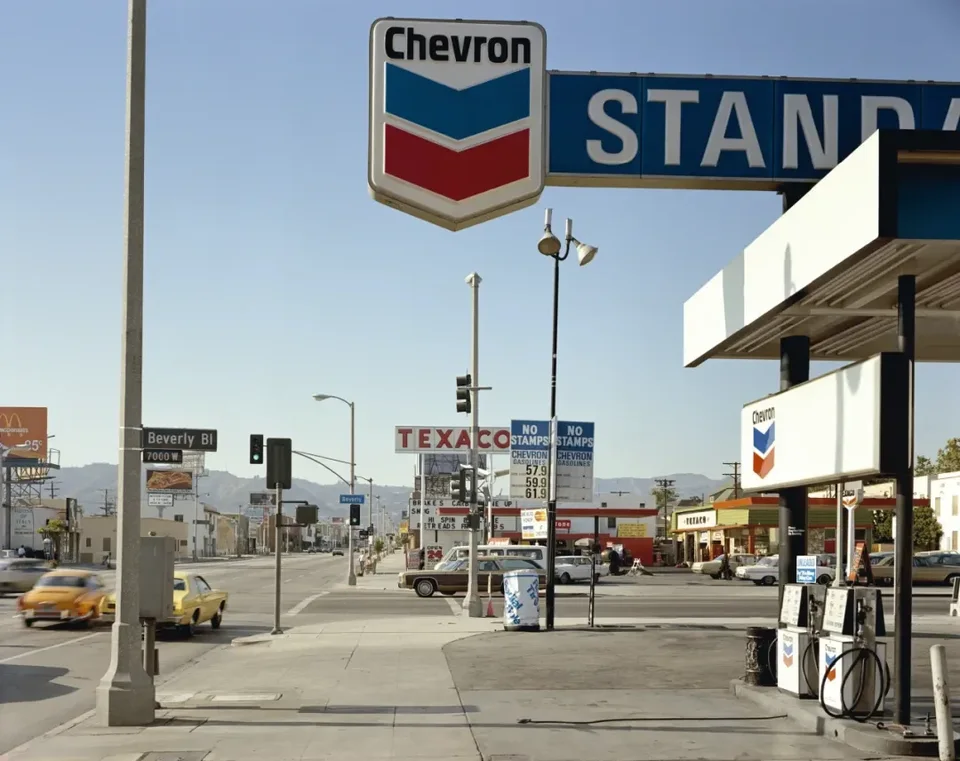
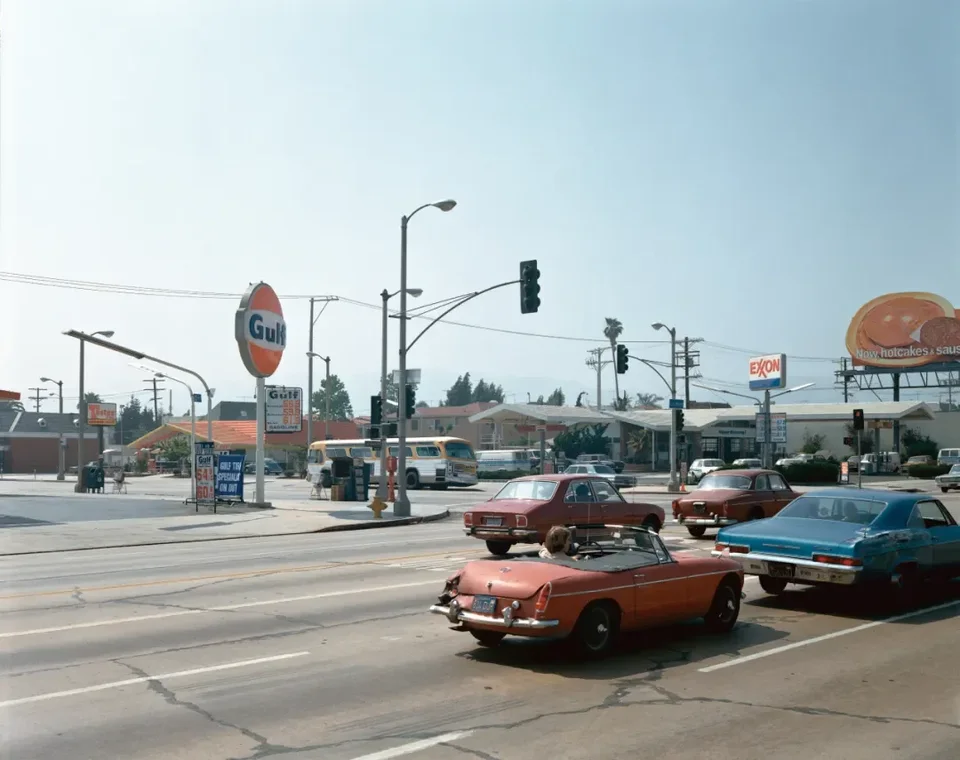
Thank you, Mr. Shore, for your answer, and many thanks to Professor Yang and Mr. Jiang for their responses. Professor Yang, Mr. Jiang, and Mr. Shore have all touched on a crucial point: the connection between the photographer and the actual life in which he is situated. The understanding of the word "pressure" we just discussed led you, after taking the photograph on the left, to return to the same intersection the next day and take the one on the right. You also mentioned that a change in where you stood leads to a change in the meaning of the space. So I'd like to ask: with regard to these two photographs taken at the same intersection, is the thinking about "pressure" embodied in them related to the "iconic experience" you try to convey, the iconic experience you also discuss in your writing when referring to Walker Evans and Bob Dylan? And how is it achieved? Thank you.
Stephen Shore
More than pressure, I would use the word form. I would emphasize 'form' and 'structure' in the picture on the left. I tried to hold as many visual elements in my mind as possible and organized space pictures. And when I made this picture, I realized that in my effort to pay attention to everything in the picture and to organize the space, I used essentially an organization that might be found in 17th-century Western landscape painting. And I wanted to find out if I could create a picture where the form of picture or the structure itself of the picture reflected more the structure of the contemporary experience. So I went back to the same intersection the next day and made the picture on the right, in which the camera is as carefully placed as the picture on the left, but rather than imposing a structure on the scene to the best of my ability, knowing that I'm always projecting something, but still to the best of my ability, I let the structure of the picture, my decisions, grow out of the scene itself as opposed to, as I said, imposing a structure on it.
Something occurred to me just now. Jang Rong and I have been having a discussion about how to define what pictorialism is in photography. One aspect of what he and I both feel about pictorialism is, perhaps, let me ask you this Rong, that those photographers are trying to quote and compose a picture, and that's why it looks, in a way, divergent from the central experience of photography. So I'm asking you, could this be one of the ways of describing pictorialism that the photographer is trying to compose a picture? That there is a sense of forcing the world into a composition rather than structure in a picture.
Jiang
My response is that I agree with the way Mr. Shore defines pictorialist photography. Pictorialist photographers use all kinds of strategies and techniques to produce photographs that look like paintings. In practice, this produces a contrived result, what in English might be called "artifice." Although this "artifice" is beautiful, it does not look natural, and it prevents us from truly experiencing the photographer's sense of "the present" at the moment of shooting. So although it looks beautiful, it covers over the photographer's real experience. That is why I agree with Mr. Shore's definition.
Chen
Mr. Shore and Mr. Jiang have just offered very in-depth interpretations of these two photographs. In an article I wrote in 2022, building on the translation of "pressure" as yinji, I tried to explain the difference between them. To me, the structure of the second photograph is more "transparent" than that of the first, so it may do more to convey what Mr. Jiang just called "the photographer's experience of being in the present." This leads directly to the second question we hope to discuss today. You have said that, in the structure of a photograph, you care particularly about the so-called "illusion of space." That is, how can viewers, by looking at a two-dimensional image, grasp the meaning of the three-dimensional space you photographed? And you just mentioned that the key lies in the photographer's experience of being in that scene. It seems to me there is a crucial dimension here, namely "perception"[4]. You just said that composition has nothing to do with photography; in other words, composition at the formal level seems to be merely the elementary stage of mastering the discipline of photography. But when I realized that in your photographs you are trying to work on perception, I immediately thought of explanations external to the photograph's form: the example of Walker Evans you have mentioned, the state of white heat, "trimming your wick," as well as "action" and "attention." It seems that what lies outside the image is what actually makes it possible for us to convey the experience of the present, what allows the aesthetic value of a photograph to emerge. I'd like to ask: how do you see the relationship between dimensions such as "attention" and "action," which lie outside the image and are closely bound up with bodily perception, and the form within your images? Thank you.
[3] This word is translated in this text as zhijue or ganzhi ("perception"), depending on context.
Stephen Shore
When a photographer has spent some time exploring the materials of photography, the technique of photography, so that technique becomes second nature, and that might take years and then explores the formal qualities of photography, the grammar of the image as I put it before, And that may take years. Then the photographer may find that qualities of perception, the subtleties of their attention become embedded in the photograph itself. If such a photographer who's had those years of experience, is in a state of heightened awareness, is, as an athlete might say, 'in the zone' if that photographer is acting in the center of the present, that experience will be embedded in the photograph.
Chen
Professor Yang, do you have any thoughts on the explanation Mr. Shore just gave?
Yang
Listening to Mr. Shore's interpretation, a question came to mind that I'd like to ask him. Mr. Shore spoke of the photographer being in a highly concentrated state, one that can only be reached through a great deal of training, in which he pays close attention as he tries to photograph what is before his eyes and grasp the whole surrounding world. I'd like to know whether the perceptual issues he deals with in that state also include other factors, such as the photographer's social networks and cultural background. Is this perception rather different from perception as we generally understand it, purely individual or purely physical?
Stephen Shore
So I would say two things. The first is, that it would be hard for me to imagine that the cultural background does not affect perception that all of the conversations I had, works of art I looked at, music I listened to. All the experiences of my life, my relationships with my wife and son. I imagine all of these have an impact on the experience. But there's a second part, which is that in the midst of work, I'm not thinking about any of that. It's almost like I'm not thinking. The pictures just happened. During the decade that I worked on Uncommon Places, This was the time I was learning, in a new, clearer way, the formal attributes of photography. During that time I would have formal questions in my mind. They would 'arise'. And I use the word arise because it wasn't like I was sitting around thinking about them. As I answered, visually answered one question, a new question would just come into my mind. So I was thinking in those terms in a very concrete way, like what happens when I have the curb of the road go exactly into the corner of the picture as opposed to just above the corner of the picture. How does that change perception? At the same time, even though I was thinking about those, all the other aspects that make the photograph, that was what I described before as simply happening. And then, after that decade, when I was learning the formal aspects of photography, from that point on, there weren't many specific questions in my mind. I would just let the process take over.
Chen
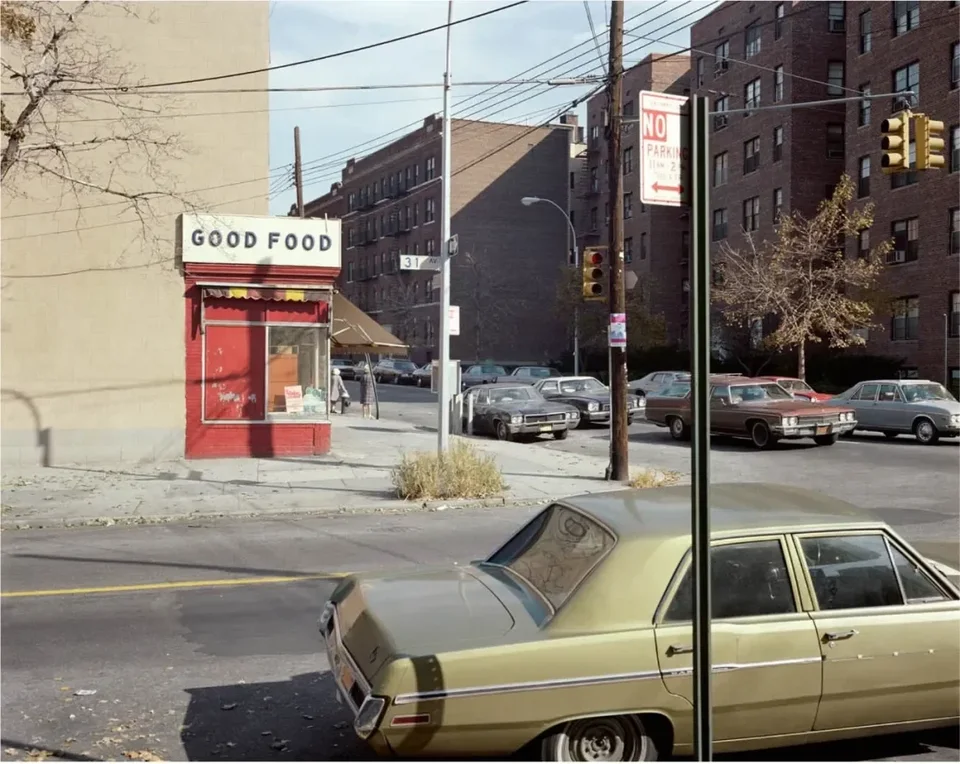
You mentioned that photographers should train their abilities, and that as their mastery of the discipline of photography deepens, certain questions will automatically "arise" in their minds. I'd like to return to this process of training, but I'll use an example concerning perception to explain what exactly I'm curious about. Earlier, when you spoke about how photographs present space, you said what you care about is visual logic and continuity of space, and you gave this photograph as an example. You mentioned that because of visual logic and spatial continuity, viewers can move their focus of attention around within such a picture. Using this photograph as an example—this is my own observation, perhaps presumptuous, perhaps biased—the key to this picture, for me, lies in the relationship between the three utility poles and the frame. I did an experiment: if I use software to remove the three poles, or if we imagine you had taken a step back when shooting, then the three poles would have no relationship to the frame. How would viewers perceive the space in this photograph in that case? When I removed all three poles, or when I expanded the photograph using AI so that the relationship between the poles and the frame no longer existed, I found that viewers would very noticeably attend to the road in your photograph, a kind of Z-shaped path, and would then look at the picture by following the road. But because you set up this relationship between the three poles and the frame, viewers are now free to, and indeed compelled to, move their focus of attention around the photograph. In other words, through the relationship between the lines and the frame, you seem to force the viewer to scan every part of the picture. In this sense, when viewers turn the photograph over, they will have a very clear memory image of the space in their minds (in Kracauer's sense). And in this sense, looking at your photograph seems able to reproduce the experience of a real person looking while standing at a real intersection, because when we stand at an actual intersection we also keep scanning; we rarely fix our gaze on a single point. I don't know whether my reading is reasonable, but as you said, such a process takes a long time to train: specifically, it requires training one's mode of perception and one's attention throughout the process.
Stephen Shore
So, I think that the experience of focusing your eyes through the picture is not simply a function of the car in the background in the center, being further away from me than the car in the foreground. I think there are formal qualities that lead to the sense of refocusing. And I think there are psychological qualities that lead to that sense of focus. So let me mention a formal quality decision I made. That the first pole, the one closest to the camera is cut off by the frame on the bottom. That places it exactly on the picture plane. It reads as though it is sitting right on the surface of the picture, which establishes the picture plane so that the rest of the image falls behind it. And let me add one other thing. I talked about the visual logic in this picture. If I lowered the camera so that the top of the car cut off the bottom of the telephone pole right behind it, that would destroy the visual logic by giving that little bit of space. I allow the viewer the clarity to read the space in the picture.
But there's also a psychological aspect, which is when I'm looking at this, my mental image has great depth and let me explain what I mean by mental image. Our eyes work exactly like a digital camera. The lens focuses light on the retina, which is, in fact, a digital array. The retina sends an electrochemical signal along the optic nerve to the brain. And in the brain, like a computer opening a JPEG, our mind opens the digital signal. They create images. This is how we see everything because the image is mental. It is a mental formation. It is influenced by our thoughts and our feelings. For example, If we feel very strong emotions, the mental image will become flatter. If we tell ourselves to be deeply aware of the depth of space in front of us, our mental image becomes deeper. It becomes more three-dimensional. We see a mental image all the time when our eyes are open, and when we're sleeping, we see it when we dream. One doesn't need to be aware that they are seeing a mental image to, in fact, have a mental image. But what I'm suggesting is that if you are able to stand back in a meta-cognitive way and observe your mental image, then as a photographer, you have the ability, you can learn the ability to refine it.
[4] Note: This can be understood in light of another example Shore has given: "One formal quality that the camera's optics imposes on a photograph is that a photograph always has only one plane of focus. This creates a hierarchy within the image's illusion of space: the single plane of focus is emphasized. But this does not happen in Frederick Sommer's photographs. In his photographs, apart from a few over the course of his career, the plane of focus and the picture plane are one. To explain what I mean by 'picture plane,' I'll ask you to imagine an image. Imagine a stage in a theater, with the scenery on the stage receding into space. Imagine that in front of the stage there is a transparent, rectangular scrim. This scrim represents the picture plane, and behind it is the illusion of receding space. In most of Sommer's photographs, there is no illusion of space behind the surface of the image; the picture plane is the plane of focus." (See "A Conversation with George Miles", in Modern Instances: The Craft of Photography, a Memoir, MACK BOOKS, 2022.)
Chen
Thank you very much, Mr. Shore, for your reply. Next comes the focus of our final topic today. Put simply: when you think about and train your perception and your mental images from the standpoint of making pictures, does your experience in everyday life change because of the experience gained through photography? That is, does your experience in reality when you're not holding a camera come into conflict with your experience when training to take pictures? Has your experience of reality changed between before and after training? What is the relationship between the two?
Stephen Shore
So the process I'm talking about involves learning to see with attention. Photography, for me, was the tool that focused me. It was the tool for me to learn this. But the end goal is not to take alive and attentive photographs. The end goal is to live a vivid life. Photography was the training method. It was by learning photography. It was the discipline to help me learn to live with attention, but the goal is to live with attention, not to make good photographs.
Yes, Rong, do you think it would be possible for me to hold my phone up to the camera here so that people could see the photograph of my family?
Jiang
Shore would like to take out his phone and show everyone a photo he took recently. Please wait a moment and see whether you can clearly make out the photo Shore wants to show you on screen.

Stephen Shore
Okay. I'm saying I want to keep it in the middle of the screen. RONG, do you know what I'm going to say?
Jiang
Because Shore has shared some of the effects of this photograph with me before, he's asked me to explain it to everyone. Shore took this photo with his phone. On the left is his wife, Ginger; on the right is his son, Nick, with their two dogs. Of course, his wife and son are the people closest to him, so when he was shooting, his attention was certainly on the expressions on their faces. So Shore picked up his phone and took this picture. Afterward, when he looked at it, he wondered: why are the two people in front so sharp, while the woods behind are blurred? That wasn't the result he had in mind when he pressed the shutter. He kept thinking about this question afterward. Why did this happen? The conclusion he reached was that in his mental image, because he was too focused on...
Stephen Shore
You need to use the word collage. It is the sense of “collage” that's important.
Jiang
I was just about to get to that, thank you for the reminder. When Shore looked at this photo, he couldn't make sense of it, but after thinking about it he understood. He said that when he was taking the picture, the focus of his mental image was on the expressions of his wife, his son, and the two dogs. His mental focus was not on the trees in the background. The result is this very strange phenomenon: the people and the background look as though they were two photographs superimposed on each other. Does everyone get that feeling? Moderator, if you look closely now, do you get that feeling? The people in the foreground look as if they've been pasted on, collaged in.
Chen
Yes, the background looks like a backdrop in a photo studio.
Stephen Shore
So let me explain what you are seeing the difference between a part of a picture that the photographer is paying clear and focused attention to and the part of a picture where the photographer is not paying attention. This discrepancy, this valley between the two, becomes greater as the photographer develops stronger and more focused abilities of attention.
Chen
Thank you very much, Mr. Jiang and Mr. Shore, for your explanations. As we're almost out of time, is there anything Mr. Shore or our other guests would like to add?
Stephen Shore
I would simply share that my experience here and the attention and reception to my work here have been very meaningful to me. I'm grateful.
Jiang
I'd like to thank your team, on Shore's behalf, for organizing today's seminar, which allowed people to think carefully about Mr. Shore's responses, and also to thank Professor Yunchang Yang. I'd also like to thank the whole team supporting us behind the scenes, as well as our two simultaneous interpreters. And I'd like to thank all the friends who have been listening to our conversation today. Thank you, everyone.
Yang
I'd like to say that what Mr. Shore said at the end was quite inspiring to me. He said that the photographer should step back through metacognitive attention while still maintaining a power of observation toward the world. I think this is also quite illuminating for the anthropological topic of "participant observation." I've written a little something earlier and shared it with Mr. Shore, and I hope we'll have the chance to continue the exchange in the future. I'd also like to thank Mr. Jiang.
Chen
Today we discussed Mr. Shore's work and questions in his practice relating to experience, attention, and life. Many thanks to all our guests and teachers for taking part; we've received wonderful answers and had a wonderful conversation. Due to time constraints, our seminar will end here for now. Thank you all very much, thank you to our guests for their contributions, and thank you to everyone who took part on the platforms. We are very grateful that Mr. Shore could join us. Thank you again for sharing; it means a great deal to all of us. We hope to have the chance to meet you in the United States someday. Thank you for your participation.
Q&A
Question 1:
Zhiwei Wu
I'd like to ask about the two "Beverly Boulevard" photographs. You took the second photograph because you wanted the structure to be more transparent, more invisible. But decades later, the first photograph is still the more famous one, and it's the one people like best. People consider photographs like the first one, with its obvious structure, to be the most characteristic of your personal style and the kind they want to learn from. What do you think about this? Thank you!
Stephen Shore
I find them both interesting. The first seems iconic. It is as structurally dense as any picture I’ve made. The second is a more difficult image. It’s not as classically grand. It looks like I’m almost not doing anything. That’s why I like it. It has a less pictorial feel. It’s more like being there.
Question 2:
Ji Xiang
Do the words "impression" or "pressure" have epistemological implications? For example, Aristotle's notion of the blank slate (tabula rasa): a person learns or perceives things through "impressions" given by the outside world.
Stephen Shore
I don’t think of it that way.
Question 3:
Lin Liu
Good morning, dear Mr. Stephen Shore. Thank you very much for this precious opportunity to take part in your online talk. My question is: when we try to understand a photographer's work, do we need to know the photographer's personal background first? For example, their historical, geographical, and cultural background (Where do they come from? What era do they live in? What kind of person are they? and so on). Or can we appreciate and understand a good photograph without knowing anything about the photographer?
Stephen Shore
I know nothing or very little about the creators of much of the music, literature, and art that means the most to me.
Question 4:
Pharaoh Kans
Hello, dear Mr. Stephen Shore! In a previous interview you made a wonderful point: "A big difference between photography and painting is that painting is synthesis and photography is analysis." That is, you place great emphasis on expressing the feeling of "the present" and letting "structure" or "composition" grow out of it. How can a photographer better express this "sense of the present"? In other words, how should we understand the relationship between structure, the picture, color, and the photographer's thinking? Thank you!
Stephen Shore
The clearest answer I could possibly give you, I wrote in my essay. “Form and Pressure”.
Question 5:
Long Xuan Li
Dear Mr. Shore, in Steel Town, how did you depict the declining towns of the American Rust Belt and the conditions of workers' lives? What kinds of images do you tend to use to accomplish this sort of narrative?
Stephen Shore
The answer to this question is the pictures in the book.
Question 6:
Kun Liu
Hello, Mr. Shore. I'd like to ask how you see the relationship between your work and the German Düsseldorf School. Many scholars seem to believe that your work also influenced the later development of the Düsseldorf School.
Stephen Shore
Hilla Becher and I became friends in 1973. In 1977, Bernd Becher organized an exhibition of my photographs at the Kunsthalle in Düsseldorf. Bernd told his students, “This is what your work should look like”. In 1995, I visited the Becher class at the art academy in Düsseldorf. I spent the evening discussing my work and critiquing the students’ work. The students had prepared a dinner for us. The session went far into the night. For years, Bernd and Hilla had some photographs of mine hanging in their house. I still have one of theirs hanging in mine.
Question 7:
Nan Shan
Hello, Mr. Shore! I noticed that when you began photographing Las Vegas, it was exactly when architects such as Robert Venturi were beginning to explore the complexity and contradiction of the landscape. I'm curious whether this influenced your photographic aims. I imagine you may all have been thinking about the structure of the "scene."
Stephen Shore
Robert Venturi, Denise Scott Brown, Steven Isenour and I were friends. In the mid-1970’s, I did all of the photography for their firm. Our largest collaboration was an exhibition, “Signs of Life: Symbols in the American City”. 1976, Renwick Gallery of the Smithsonian Institution, Washington, D.C.
Venturi wrote the following for the first, 1982, edition of Uncommon Places:
“STEPHEN SHORE captures the essence of the American landscape by framing particular, ordinary elements so that they reveal the universal and the extraordinary. The viewpoint of his camera is never special; it is that of our own absent-minded eyes as we wander through familiar places doing ordinary things – waiting for a bus or driving on an errand. In Shore's photographs we discover the mislaid images that we ignored because of their very familiarity or rejected because of their banality. Our conscious minds seek more interesting or less objectionable scenes – Alpine peaks or Italian piazzas; in Shore's art we confront what we usually do not notice, streets and façades at once well known and remote, half-remembered and half-forgotten.
Shore's is the art of deadpan – rejecting exotic compositions, artful editing, or facile simplification. He accepts the threadbare banality of the American scene, the jerry-rigged, down-at-the-heels seediness of our rural landscapes and the spatial looseness of our towns, recapturing the overfamiliar, making it poignant, coherent, and almost lovable.”
Question 8:
Ji Xiang
Perhaps the continuity of space in a photograph is more important than the photograph's perspective (a kind of surface). Every painter or photographer is aware of the perspective that goes from the real world to the surface; this has nothing to do with inner feeling but is about structure, about things visual and non-visual.
Stephen Shore
The “continuity of space” is not a matter of perspective. It has to do with the visual relationships between shapes, lines, forms, surfaces. It’s about the connections and interstices between them when 3-dimensional space is flattened onto the picture plane. It can exist in pictures that do not have one-point perspective.
Question 9:
CHEN CHEN
In recent years, contemporary photography seems to rely increasingly on external context—such as the artist's background or detailed descriptions—to fully convey its meaning. As someone who has continually pushed the boundaries of photography, how do you view this shift? Do you see it as a limitation of photography as a medium, or as a new opportunity for photography to merge with other art forms?
Stephen Shore
Neither a limitation nor a new opportunity.
When I began working in photography there were hardly any colleges or universities in which photography was offered as a course of study. Institute for Design in Chicago, Brooklyn College, San Francisco Art Institute, The Rhode Island School of Design. Perhaps a few others. Most photographers of my generation learned by looking at books and by meeting with like-minded friends to discuss each other’s work. Now most photographers learn in colleges and graduate programs. There they have to critique each other’s pictures, describe their intentions, and defend their work, So they hone these skills as well as their ability to make photographs.
Question 10:
Hao Gao
Hello, Mr. Shore. As is well known, you have always been very open to new photographic equipment, from smartphones to drones. Recently a phenomenal video game called Black Myth: Wukong appeared in China. In the game's virtual world, the developers have recreated many traditional ancient Chinese scenes and buildings in great detail and provided a screenshot interface with photographic features, allowing players to have a photography-like experience within the game. How do you view this kind of secondary creation in virtual cyberspace? Can it exist as serious photography?
Stephen Shore
I think so. I once had a very talented student who took a US military VR program for training soldiers to fight in villages and the countryside in a desert environment. He took 3-dimensional “snaphots” within this VR environment. He then created a VR exhibition hall. The viewer could put on a VR headset, walk through the “gallery”, and view the individual pictures on the wall. In making the “snapshots”, he made the same kinds of decisions a photographer would make in the real world: where to stand, where to place the frame.
Question 11:
Tu Hu
Hello, dear Mr. Shore. I began studying your work many years ago, and I translated your essay "Form and Pressure" into Chinese. Your work has been an enormous inspiration to me, and I thank you very much for it. I'm very excited to have the chance to ask you questions today. I think there are two different perspectives from which to view artworks: that of the viewer and that of the creator. Today I'd like to ask two questions as a creator.
The first concerns the relationship between photography and art. Your early works, such as Conceptual Sequences, All the Meat You Can Eat, and American Surfaces, have strong characteristics of Conceptual art, but afterward your practice moved further and further away from the influence of the mainstream art world of the time and returned to work grounded in photography itself. How do you see the difference between "photography-based art" (such as conceptual photography, photo collage, etc.) and "art that proceeds from photography itself" (such as the work of Walker Evans, Robert Frank, and others), and why did you ultimately choose the latter? The British photographer Paul Graham once said at a MoMA forum that the mainstream art world often "doesn't get" photographic works that "proceed from photography itself." What do you think?
The second concerns the formal structure of photographic series. In "Form and Pressure" you advocate using the word "structure" in place of "composition," and argue that structure is the primary form of a photograph. But Elements, published in 2019, clearly sets out to explore the structure of a photographic series. That work contains only 24 photographs, so a museum can exhibit all of them without difficulty. But most project-based works contain a very large number of photographs and depend heavily on the sequence between them. In such cases, do you think the photobook is more suitable than a museum exhibition? For example, Paul Graham's A Shimmer of Possibility was produced as twelve photobooks, which I personally think is more suitable than exhibiting a selection of the photographs in a museum. My question is: for project-based works that depend heavily on overall structural relationships, how should one balance the photobook (a holistic presentation) and the museum exhibition (possibly a presentation of individual photographs)? How should one think about this when making the work?
Stephen Shore
I began in the world of traditional photography. My time at Warhol’s Factory exposed me to the broader contemporary art world. Even my conceptually based work had a strong visual component. I understood the visual meaning was being conveyed beyond the concept. About 25 years ago John Baldessari and I gave a public talk about our work of that period. We found we had similar intentions: to use the determining concept to help lessen the stamp of personal style from the work. To seek an image less mediated by visual convention. Finally, I wasn’t totally satisfied with this approach. I wanted to find a new path of photographic seeing. I wanted to make pictures that didn’t look like someone was making pictures but looked like seeing itself. This was the beginning of American Surfaces. From that point on, my work evolved in response to questions of content and form that “arose” in me, more than they were guided by me.
A book is strictly a linear sequence. Because a gallery presents a 3-dimensional space, photographs on one wall can resonate off of pictures across the room. At my retrospective at the Museum of Modern Art, the gallery showing my 1980’s landscapes had panels suspended from the ceiling, with a picture of each side. Books and shows need to be treated uniquely. For example, American Surfaces is always exhibited as a grid, three rows high. The order of the pictures is random. For the book, the pictures a run in chronological order and printed 2, 3, or 4 to a spread.
Notes
[1] 注:“structure” 在本文中主要翻译为“构成”,视语境也译为“结构”。
[2] 注:“attention”这个词在下文也视语境翻译为“专注地”(with attention)、“专注”。
[3] 这个词在本文中视语境翻译为“知觉”或“感知”。
[4] 注:此处可以结合肖尔所举过的另一个例子理解:“相机的光学系统强加给照片的一个形式品质在于,一张照片总是只有一个焦平面(plane of focus)。这在图像的空间幻觉中创造了一种层次:单一的焦平面被强调了。但这种情况在萨默(Frederick Sommer)的照片中并没有出现。在他的照片里,除了他职业生涯中的少数几张外,焦平面和画面平面(picture plane)是一体的。为了说明我讲的‘画面平面’是什么意思,我会让你想象一个图像。想象一下剧院里的舞台,舞台上的布景在空间中渐渐消失。想象一下,舞台前面有一块透明的、长方形的薄纱。这块薄纱就代表着画面平面,而其后是空间渐隐的幻觉。在萨默的大多数照片中,图像的表面背后并没有空间幻觉,图像平面就是焦平面。” (见"A Conversation with George Miles", in Modern Instances: The Craft of Photography , a Memoir, MACK BOOKS, 2022. )