
[Abstract] The problem of the "tableau" in contemporary photography is not, as Michael Fried believes, primarily a problem of "beholding" that reconfigures the viewer relationship. The revival of the "tableau" form after the 1970s brought an unprecedented awareness of the "cut," but this cut is generated through the operation of the "apparatus." It reshapes the relationship between the photograph and its referent, visually internalizes various "material-discursive practices" through a high degree of "constructedness," and ultimately shapes the "tableau" through constitutive exclusion.
[Keywords] tableau; cut; absorption; apparatus; indexicality
I. Introduction
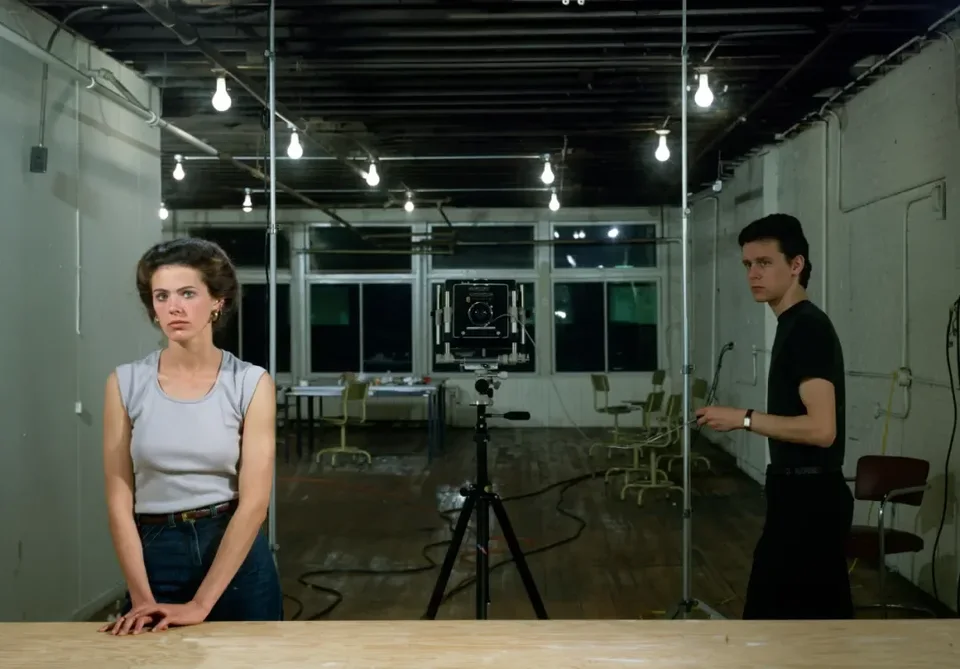
In November 2024, "Another Avant-Garde: Photography 1970–2000" opened at the West Bund Museum in Shanghai. It is a landmark exhibition, the first in China to systematically trace the development of contemporary photographic art. The curators, Florian Ebner and Matthias Pfaller, placed an early signature work by Jeff Wall, Picture for Women (Fig. 1), directly facing the entrance. Around it hung a series of early photographs from the 1930s.
At first glance, this huge transparency in a lightbox seems out of place among its neighbors. It would seem more at home in the sixth section, which draws mainly on Michael Fried's Why Photography Matters As Art As Never Before for its theoretical grounding.[1] Why, then, was it placed there? This essay will argue that it was precisely artists such as Jeff Wall who, after the 1970s, brought a particular pictorial form into contemporary photography and thereby produced a new way of making statements about the world.
This key form was reinterpreted by Michael Fried from the art historian Jean-François Chevrier's essay Les Aventures De La Forme Tableau Dans L'histoire De La Photographie. Through that reinterpretation it became fixed as the "tableau form" and a key category in the scholarly history of late-twentieth-century photographic theory. In a word, however, the consequences of introducing the tableau form into contemporary photography are not what Fried takes them to be. For Fried, its main achievement is to allow the relationship between image and viewer to be rebuilt in a way that does not succumb to theatricality. This is why he stresses how the images are hung and viewed while passing over their "mode of consumption" in a single stroke.
Quite the contrary: what the tableau form brings is a new awareness, grounded in the fragment and the apparatus, of the double constructedness of image and world. This new awareness is unmistakably founded on the "cut" itself, rather than on the objects the limit marks out.
II. From "Large-Format" to "Tableau": A Material History of Photographic Scale
As Fried summarizes it, the "tableau form" has four basic features:
- Because it is made for display on a wall, it is usually very large.
- These large wall photographs establish a distance from the viewer and thus reconfigure the relationship between work and viewer.
- It usually involves exploiting the model of painting, that is, consciously creating "photographic paintings."
- Although it does entail a fragmented unity, the themes of absorption and anti-theatricality still occupy an extremely important place.[1]143-146
In other words, for Fried the appearance of the "tableau form" in photography brings together two formal elements. The first is the history of changes in the size of the photograph itself. He places particular stress on "large format," and this is indeed a salient feature of such photographs. The second is the introduction of the role of painting, which had already secured its legitimacy as art within art history: that is, the "photographic painting" and the inheritance of the tradition of "absorption."
Beyond this, Fried quietly absorbs into his own absorption-centered formalist account what I consider Chevrier's most central idea about the "tableau": his emphasis on the unity and heterogeneity of the fragmentary. In doing so, Fried overlooks the effect Chevrier stresses, namely the estrangement produced when the image becomes an object.
Take the former first. Why do the two features of "large-format photograph" and "made to be hung on a wall" not necessarily lead to the "tableau form" Fried describes? Today we are immersed in a display environment where every image, mediated by a screen, has highly variable scale. For us, the question of size may no longer seem a sensitive topic. But we should not forget what Olivier Lugon has traced.[2] In short, before paper-based photographs appeared, every image had a fixed size. This was especially true of painting, where the dimensions of the canvas were decided almost before anything else. With the arrival of "paper-printed photography," however, the situation changed: a photograph's size was no longer determined by the dimensions envisaged at the moment of shooting.
In the mid-nineteenth century, photographs were mostly miniature images that shrank the world to something that could be held in the palm of the hand. Lugon treats this point only cursorily. I would argue that this act of "shrinking" not only helped popularize photographs but also strengthened their role as intermediaries. This is precisely what motivated enlargement.
First, the photograph's intermediary status within art history was institutionally established. In 1895, the Fogg Art Museum at Harvard University opened and displayed framed photographs of hundreds of European masterpieces. By the end of the nineteenth century, photographic reproduction had become a basic tool of art education and entered the art history curricula of major institutions. With the help of photography, a "'science' of connoisseurship" took shape.[3] As we know, Heinrich Wölfflin developed his method of formal analysis using a double projector.[4] Finally, in Le Musée Imaginaire, André Malraux pointed out that photography's logic of identity replaced the original non-identity of artworks and subsumed them into a new comparative framework: "In the museum without walls, oil paintings, frescoes, miniatures, and stained glass all seem to belong to one and the same family."[5]45
Second, small photographs lend themselves to being held in the hand, the family album being the most typical case. Their visibility often goes together with tangibility, and the two jointly form part of how photographs produce meaning. As Margaret Olin points out: "Touch brings people into contact with photographs; but as photographs pass from hand to hand, they establish and maintain relationships between people—or attempt to establish and maintain relationships between people."[6] This is especially evident in "photographic jewelry." Pocket watches holding photographs of the dead or of distant relatives made mourning possible and allowed the living to converse symbolically with the dead. This combination is what Geoffrey Batchen calls "doubled indexicality."[7]
Whether or not photographs are reliable as vehicles of memory, their relation to memory presupposes the spread of the small format. It can therefore be said that the photograph functions as an intermediary in human relationships, and that the shrinking of its size made this function materially possible. It is not much of an exaggeration, then, to say that the photograph has (once) held ontological status in how we construct the meaning of our lifeworld.
Yet if photographs were to enter the exhibition system in the mid-to-late nineteenth century, they had to overcome their transparency as intermediaries. They had to emphasize instead their own material presence and their status as artworks. There were practical considerations as well: if photographs were too small, displaying them would require multiplying their number, which made for poor viewing. Early photography relied on contact printing. Only with the appearance of "solar enlargers" in the 1850s did the wide exhibition of large photographs become possible. The problem was that this enlarging technique depended on lighting conditions, and image quality was unstable. Only in 1865, when Numa Blanc developed the "électro-mégascope," which used artificial light, did enlarged photographs truly acquire exhibition value.
Thanks to these technical conditions, large photographs could be shown in galleries and became objects with both exhibition value and collection value. As Lugon puts it:
The large dimensions of these images allowed them to form relatively independent presentations on the exhibition wall: photographs were usually hung in one or two rows, encouraging the individual viewer to engage in deep and concentrated contemplation in front of a single work. This relationship was crucial for photography's escape from the status of the 'industrial image.' The increase in size was accompanied by a reduction in the number of works displayed; it negated accumulation by quantity and suppressed the notions of mass production and mass consumption—precisely the realm from which the pictorialist photographers sought to keep their distance.[8]
Michael Fried, however, insists on reading Chevrier's emphasis on the "experience of confrontation" with large photographs as a "change in the mode of consumption," although he takes this to be Chevrier's own meaning.[1]144 For Fried, then, the tableau-mode photography that emerged after the 1970s meant that the photograph was no longer merely an image defined chiefly by reproducibility. Because of its huge size, its particular materials and techniques, and its explicit mode of display, it became an independent object that could be consumed and collected.
Set against the history above, this reasoning is, if not untenable, at least insufficient. The widespread appearance of large photographs at the end of the nineteenth century likewise brought about a change in the mode of consumption. In other words, suppose the only aim of large photographs in contemporary photography were to make themselves into "objects" and collectibles. Then this shift would already have taken place at the end of the nineteenth century. It would not have had to wait for the photographers Fried calls practitioners of the "new art photography" after the 1970s to champion it.
By the 1930s, the rise of the "photomural" pushed photography further toward installation. Unlike traditional photographic prints, these huge photographs served as visual decoration and covered walls directly. They were widely used in commercial advertising and political propaganda. A typical example is the photographic frieze, 24 meters long and 4 meters high, designed by El Lissitzky for the 1928 "Pressa" exhibition in Cologne. This trend also "tarnished" the reputation of the huge format, however. One example is the enormous photograph of a Nazi rally at the entrance to the 1933 "Die Kamera" exhibition in Berlin.
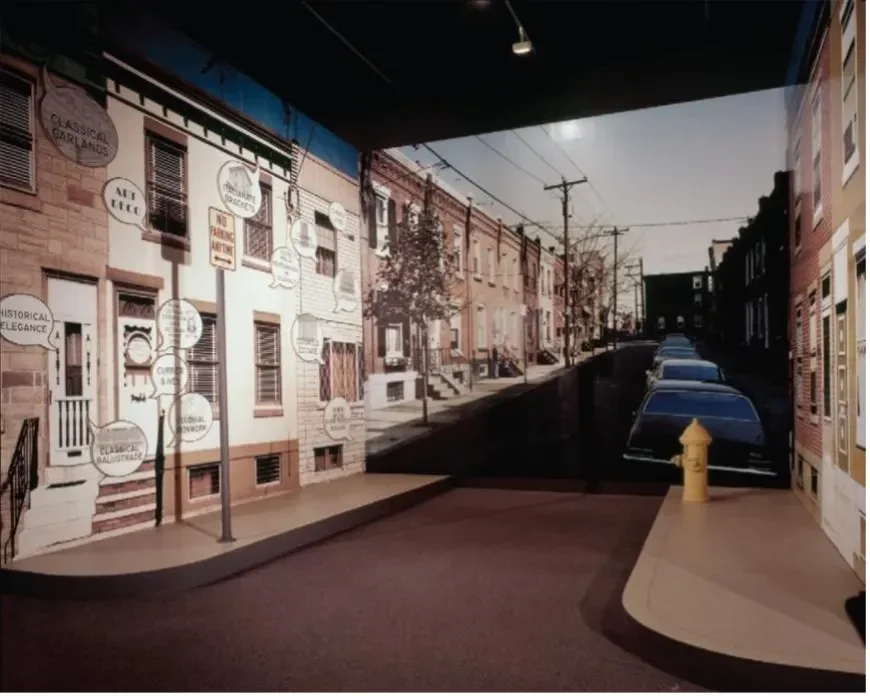
For Fried and others, the real turning point came in the 1970s, when the "tableau form"ally made its entrance. It is worth noting that commentators such as Monika Perenyei and Lugon have discussed Stephen Shore's large photographs alongside Jeff Wall's lightbox photography, as though the two belonged to a single form: "The forerunners of the photographic tableau as an art genre began to emerge at the end of the 1970s—for example, Jeff Wall's lightbox works and Stephen Shore's oversized color photographs, the latter representing a generation of photographers who broke away from the heroic tradition of American landscape photography."[9] In short, commentators often discuss Shore's large photographs together with Wall's lightboxes. They especially mention the huge "photomurals" Shore showed in the 1976 exhibition "Signs of Life," namely Signs of Life: Symbols in the American City (Fig. 2).
This classification is, if not mistaken, at least crude and one-sided. In fact, Shore's work constitutes a crucial counterexample for understanding the "tableau form." Fried tried to exclude Shore on the grounds that his work was "not made for the wall,"[1]22 but this does not settle whether the works in "Signs of Life" count as "tableaux."
The real difference between the "tableau form" and Shore's large photographs lies in their underlying aims. It must be made clear that the "tableau" is not only a matter of form; it also carries specific values. Shore's large photographs in "Signs of Life" were part of the exhibition's curatorial logic, such as the reconstruction of a "period room." Their aim was to bring into the foreground the everyday things that make up the background of our perception and to prompt viewers to re-examine them phenomenologically. As Shore himself mentioned in correspondence with me, his choice of scale was meant to provide a mode of viewing that requires the viewer to actively invest attention, rather than to produce immersion.[10] For him, photography is a way of training oneself to "live attentively," a kind of "revelation" that comes from the other.
Shore's photography therefore leads toward an awareness of the structure of intentionality. It emphasizes activating the viewer's "mental image" through foregrounded detail. It is not concerned with the "constructedness" of the relationship between photograph and referent, and even deliberately avoids it. Yet this latter concern, awareness of the "cut" and the foregrounding of the process of construction, is one of the core principles of the "tableau form". To clarify this essential difference, we must first examine the "tableau" more closely as a theoretical category.
III. Reshaping the "Tableau" Form
The "tableau" that Fried values originally meant the panel painting of the fourteenth century. After Diderot theorized it in the mid-eighteenth century, it became an important concept in drama. In brief, Fried's reading of the "tableau" starts from the priority of what he calls "dramatic" effect and ends by resting on an ontological guarantee: the relationship between picture and beholder.[11] He transplants this judgment almost unchanged onto his understanding of the revival of the tableau form in contemporary photography identified by Chevrier. To argue that his "new art photography" responds to the problem of "beholding" without yielding to theatricality, he cites Chevrier's text:
The restoration of the tableau form (forme tableau)… its primary aim is to restore the image–object distance required to constitute the experience of confrontation (l'expérience de confrontation)… The use of the tableau aims to reactivate reflection on the fragment (fragment), the open (ouvert), and contradiction (contradiction), rather than a utopia of completeness or systematic order.[12]
Fried, however, reads Chevrier's observation about the restoration of the "tableau form" as photography's introduction or borrowing of painting's legitimate identity within art history. He absorbs expressions such as "experience of confrontation" in this passage into his own framework of "absorption" versus "theatricality." At the same time, he deliberately ignores the core of Chevrier's conclusion: "reflection on the fragment, the open, and contradiction."
In my view, Fried's reading in fact departs from the theoretical tradition to which the "tableau" belongs. Roland Barthes wrote specifically on the "tableau" in 1973. Starting from the ancient Greek link between "geometry and theater," Barthes pointed out that theater is essentially a geometrical operation that presupposes the viewer's position. The implication is that if a stage is to be constituted, it must undergo certain arrangements: cutting, layout, particular angles and positions. These ensure that the audience can see only what it has been permitted in advance to see.
It is this visible cutting and cropping that constitutes a "tableau." As Barthes says: "No tableau can be seen in a musical score unless it is paired with theater."[13] In a word, the "tableau" is not a vehicle for a story. It is the geometry of viewing, the boundary of viewing. The cut that divides the field of vision is what makes a performance a performance and viewing viewing. In this sense, the tableau "is at once a 'formation or appearance,' a 'decision or division,' and a 'complete unity.'"[14]78 Only because there is cutting can there be appearance, and unity after appearance. More importantly, beyond the relationship between viewer and drama, Barthes stresses that a tableau formed by cutting necessarily involves attention to the "social gestus."
When the photography theorist Victor Burgin later returned to this concept, he stressed that the history of the "tableau" must be traced further back, before Diderot, to sixteenth-century humanist art theory, and in particular to the rise of the "history painting" tradition. Burgin extended Barthes's account of the social gestus toward its ethical and rhetorical functions. History painting makes an exemplary cut in the flow of time. The painter compresses into a single instant the meaning of an entire unfolding action, the moment of "reversal" (peripateia). The tableau that appears in the painting through this compression is the most exemplary moment of human action.
In the early eighteenth century, the mannered vogue brought by the Rococo stripped the tableau form of its ethical and didactic significance. Against this background, Diderot sought to rescue the "tableau." He opposed affectation and excessive obscurity and advocated "instantaneity, unity, and self-sufficiency," so that anyone of common sense could grasp it at a glance. This was both a return to the ethical and rhetorical functions of early history painting and a reaffirmation of the principle of ut pictura poesis.
To reduce the problem of the tableau to a problem of the relationship between work and viewer is therefore to greatly diminish its historical content and to suppress photography's own power of non-identity. The tableau's close kin is by no means "absorption," which Fried takes to exclude the actual presence of the viewer. It is rather the "apparatus" (dispositif/apparatus), grounded in "the fragment, the open, and contradiction."
IV. Tableau, Apparatus, Cut
In 2011, Mick Finch launched an academic project called the "Tableau Project," consisting of a series of seminars and themed events. Scholars including Chevrier, Fried, and Philip Armstrong took part. In an introductory essay on the project, Finch stated explicitly: "In a broader context, the tableau form is linked to the concepts of the 'dispositif' and the 'apparatus.'"[15] To emphasize the "dispositif" (in Michel Foucault's sense) and the "apparatus" (in Louis Althusser's sense) is to treat art forms as constitutive objects, as expressions of a heterogeneous structure.
Speaking of the "tableau," Laura Lisbon writes: "If we regard the 'tableau' as an 'operation,' a 'discourse,' or an 'objection,' we can also see why the 'dispositif' and the 'tableau' are related."[14]84 Lisbon goes on to understand the dispositif as a kind of "apparatus" in the sense of a technical operation, such as the "darkroom." In her view, the "tableau" on the one hand reveals its own constructedness. On the other hand, once it is completed and displayed before the viewer, it erases the traces of the apparatus that operated within it. To some extent, this reveals the invisibility of the dispositif itself.
Notably, she cites a sentence from Foucault's The Archaeology of Knowledge: "Should it not be pointed out that the 'tableau' (in every sense of the word, no doubt) is formally a series of series?"[14]85 Foucault's concern here is the visibility of knowledge. In this period, knowledge takes shape only through relations formed, at the level of series, with other series such as discourses, classifications, and rules. In other words, the "tableau" (rendered as "图表," "table," in the Chinese translation of The Archaeology of Knowledge) exists to establish, for each "series" in historical research, an inventory of elements, types of relation, or rules of description. Its ultimate purpose is to map the relations between "series."
The link between tableau and "dispositif," however, must be made explicit within the field of contemporary photography. Only then can we state precisely why the problem of the tableau must be considered with the dispositif as mediator. To borrow Foucault's view, the dispositif is:
firstly, a thoroughly heterogeneous ensemble consisting of discourses, institutions, architectural forms, regulatory decisions, laws, administrative measures, scientific statements, philosophical propositions, moral maxims, philanthropic declarations—in short, the said as much as the unsaid. Such are the elements of the apparatus. The apparatus itself is the system of relations that can be established between these elements.[16]
Combined with Foucault's definition of the "dispositif," this shows that the "tableau" is concerned with the dislocation, juxtaposition, and co-presence of different series, not with the content of any single series. Likewise, the core problem of the dispositif lies not in what elements it contains but in how the elements form a "system of relations." This "system of relations" can here be regarded as the historicized expression of the "series of series." For the early Foucault, the "tableau" can also be seen as a tool within a descriptive framework for breaking free of total history and establishing a history of series. Such a history would "determine for each series its elements, fix its boundaries, reveal its specific type of relations, formulate its laws, and, beyond this, describe the relations between different series."[17] Of course, for the early Foucault the "tableau" operated only at the level of discourse. By the period of the "dispositif," it connected the discursive and the non-discursive realms.
Why insist so earnestly on establishing, or restoring, the close link between tableau and dispositif in photography, even though in Foucault's own terms the link is not necessarily so direct? If we understand the link between "dispositif" and "tableau" in Lisbon's sense, we arrive at a problem of the technical history of photography, or of the "technical image." That problem concerns how technical elements conceal themselves once the tableau has formed, or reveal themselves and then conceal themselves again. This is not the direction I want to take. As I will explain below, how we understand this link bears on how we understand the relationship between photographic representation and the world it represents. More specifically, it bears on how we can present the many non-identical elements contained in the real world in a manner whose formal complexity is no less than that of painting.
The key lies in Gilles Deleuze's reading of Foucault's "dispositif." He writes: "A dispositif is composed of lines of visibility, of enunciation, lines of force, lines of fracture, of rupture, of breakage, all of which intertwine and entangle with one another."[18] I propose that, within the field of contemporary photography, we should understand the "lines" Deleuze points to as the "lines" that, as discussed above in connection with Diderot, cut out the "tableau." Such lines do not bring universality to photography. They bring the radical heterogeneity of the "dispositif." This heterogeneity is a force of non-identity, directly opposed to Fried's aesthetic understanding of photography based on "absorption." I need to lay out this connection more carefully.
In Photography and its Violations, John Roberts offers the most forceful analysis and rebuttal of Fried's conception. Roberts argues that Fried's theory of absorption fundamentally overlooks the "violating" power inherent in photography as a social technology. Photography incorporates nonidentitary social and political elements into itself and thereby achieves a dehierarchization of appearances.[19]35 In his view, this is the crux of staged photography: it is a productive practice that "subjects the positivist and nihilist uses of photography's violations to political scrutiny."[19]53
In other words, representative figures of "tableau-form" photography such as Jeff Wall build their own sets in the studio and shoot in a staged manner. They do this not merely to seek once more a post-Diderotian positional relationship between "work and beholder." Their aim is to use the construction of the "tableau" to interrogate the "series of series" in historical life. This interrogation does not lead to a closed or directly visible social reality. Instead, through theoretical abstraction, it foregrounds the constructedness of the "series of series" and thereby provokes the viewer to reflect on the "cut" that constitutes the tableau, and on the heterogeneity the cut implies.
Importantly, from Diderot to the present, the sense of the tableau as constructed has never disappeared. Once a tableau is to be constructed, there must be a "cut" that cuts it out. This core has persisted ever since Diderot.
V. The Problem of Indexicality: Cut and Cutting
In this sense, the "dispositif" should not be understood as an external instrument of observation, and it has no center. On a Deleuzian understanding, the dispositif is a provisional knot of multiple lines of force. Its history consists of the "event-lines" that the forces of the lines generate at each instant. In this sense, we might even say that each operation of the dispositif is a provisional determination of the cut. In the set-building practice of photography, the heterogeneous lines Deleuze speaks of appear as the "cut" that divides the visible from the invisible. This cut is the very practice of "boundary-making."
The core connection lies in "constructedness," a feature present from the theater of Diderot's time to the "tableau form" in contemporary photography. All discussion and reflection must revolve around the "cut." The "tableau" is the result of the dispositif operating and making a cut through that operation. This cutting is not simply meant to isolate the viewer from the world of the tableau. It serves the demand for concentration placed on the tableau itself as a "series of series." Even the artist's intention can be realized only in the course of this operation of the dispositif. Once a tableau is to make the "series of series" visible, it must undergo the cut of the dispositif, which makes it appear through constitutive exclusion.
In the tradition of straight photography, which is also the tradition of Stephen Shore discussed above, the photographer's chief task is to arrive "uninvited," to point out, and to reveal. In this sense, photography's inherent "indexicality" requires direct contact between object and sign. In staged tableau practice, by contrast, the photographer is the set-builder, the one who tries to make the cut. Through set-building, the photographer tries to visually internalize within the tableau the constructedness of the social relations of production in which photography itself is situated. Indexicality in this sense shifts from direct indexicality to secondary indexicality: the path from object to work is mediated by the creator's hand. In other words, the core of the revival of the "tableau" form in contemporary photography is not its "large format" but the act of set-building behind it.
Roberts points out that the high degree of malleability brought by set-building "frees photography from the positivization and reification of the categories of realism and photographic truth. For if there is no natural or unmediated relationship between the photographic referent and photographic truth, then no photograph—whether chemically generated or otherwise—can claim to be closer to the truth than any other."[19]30 In this sense, the realist force and truth-explaining capacity of the staged tableau photograph cannot be regarded as contrary to "straight photography." It is precisely the condition for a critical reconstruction of photography's capacity to make truth claims.
Staged photography thus draws the boundaries of visibility in two ways. On the one hand, it visually internalizes the layered character of reality and of the relations of production. On the other hand, through this constitutive exclusion, it foregrounds its own situatedness. Such construction is far from the opposite of direct recording, and its truth-claiming effect is no weaker. On the contrary, because it introduces situatedness and heterogeneity, this mode of production even acquires ontological significance.
Fried rightly points out that the tableau form has a heightened awareness of "to-be-seenness." Yet the photographic tableau form, born in order to be seen, does not exist to establish an atmosphere of absorption and the identity of an intellectually engaged aesthetic beholder. Its purpose is precisely to activate, through this act, the viewer's reflection on the practice of "boundary-making," that is, on "discursive practice." This practice is not an abstract conceptual activity. It is "discursive practice" in Foucault's sense, which is always material and produces knowledge, subjects, and objects in specific historical situations. This means that the practice is always generative. The process of practice and the generation of meaning continually interweave and interact under particular historical and technical conditions. Through the ongoing act of drawing boundaries, reality is constantly delimited and constantly renewed in its visibility and intelligibility. Discursive practice in this sense may be called "material-discursive practice."
Take Jeff Wall, the representative figure of "tableau photography." For him, set-building practice lies in "reintegrating the non-unity and fragmentation (or montage) of modern aesthetics within the pictorial space of the 'painting of everyday life.'"[19]72 One need only look at Picture for Women, which Fried sets aside in his argument, to see this. Wall's work is not a "series"; that is the method of Allan Sekula and others, who work mainly with slide sequences. Wall's work is instead "a succession of vivid tableaux" in Diderot's sense. Yet each photograph embodies a German Romantic idea of the fragment: fragments that are whole and unified in themselves, but not sequential.[20]
Interpreting Wall's works and identifying their art-historical sources cannot substitute for each other. As Alexandra Oliver points out, the relationship between Wall and Manet is not established through visual resemblance. It rests on the fact that Wall, by recreating scenes, "reactivates" the stubborn, non-transparent "illegibility" or "obscurity" of Manet's work.[21]109 It keeps viewers from smoothly fitting the work into any stable system of meaning when they face it. That is, "what appears balanced and unified on the surface is, thematically, a collection of isolated parts, each with its own distinct quality."[22] This illegibility is precisely the historical legacy of modernist visual language.
Wall's images look extremely clear, so clear as to put one on guard. But this clarity becomes a means of concealing their real obscurity. In other words, the clear surface and the obscure structure form a double presentation. Viewers quickly recognize Wall's "quotations" from art history and thereby overlook what really matters: the ruptures and discontinuities within the image, and spatial structures so precise as to be uncanny. These are where "illegibility" makes its appearance.
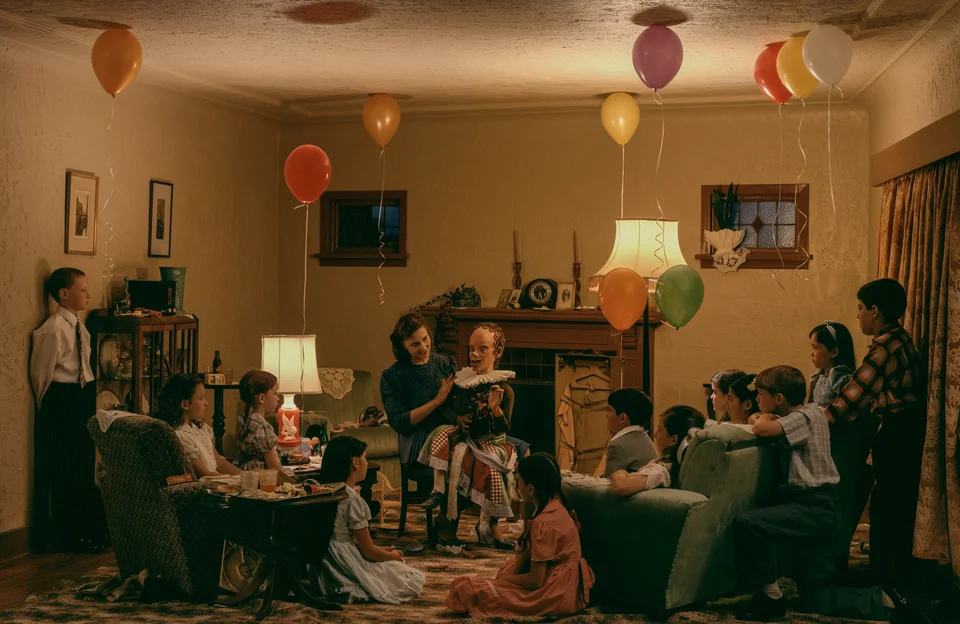
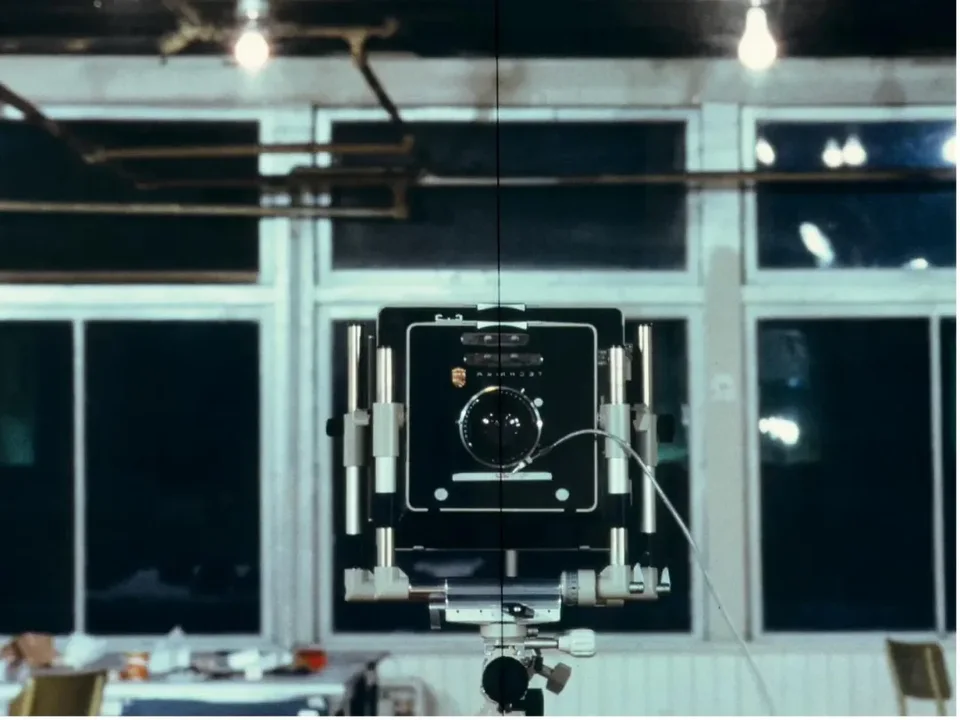
Examples include the peculiar viewing relationship in Picture for Women and the many implausible arrangements of the set in A Ventriloquist at a Birthday Party in October, 1947 (Fig. 3), both of which I analyze in detail in another essay.[23] In brief, in Picture for Women Wall breaks the illusion of transparency with a visible physical seam down the middle of the transparency (Fig. 4). Beyond this, through complex mirror relations, he turns the central point of projection, which should belong to the viewer, into a paradoxical blind spot: the position of the camera itself. The viewer is thus "looked at directly" by the camera lens while being physically unable to occupy that viewing point. This is an "impossible" spatial experience that only photography can produce.
In A Ventriloquist at a Birthday Party in October, 1947, Wall likewise plants a great many inexplicable elements at several levels. They appear in the narrative (a party that should be joyful set against the children's frightened expressions), in the space (distorted perspective), and even in the physical forms of objects and people (a confused clock, figures suspended in the air, implausible limb lengths). Many details remain incomprehensible even after we learn that the photograph's subject is "the living dead," and they only raise further questions.
Through this constructedness, on the one hand, a sense of obscurity that is always provisional and situational comes to light. On the other hand, Wall in turn sets up the scene he represents as a moment that does not actually exist in reality. That is, through a cut grounded in a specific situation, he realizes a "tableau" in Diderot's sense. And this tableau is realized as the result of the operation of the dispositif.
At the same time, we cannot ignore the sense of "illegibility" or "obscurity" internal to these images, and this holds even for the artist himself. Anyone familiar with how works such as A View from an Apartment and The Volunteer were made will know that the work's intention, "what to do" or "what to express," is not set in advance. It can only emerge gradually in the concrete practice of boundary-making. Even for the artist, the intention remains opaque as it emerges.
For example, in making The Volunteer, Jeff Wall built a space resembling a shelter and recruited a volunteer. He invited the man to clean it for him five days a week for a month. During this time, Wall kept communication with his subject to a minimum and repeatedly photographed the volunteer's cleaning. After a while, he found that the volunteer was no longer "performing" cleaning. He had begun to treat the set as a real shelter and to clean it in earnest. Only after many attempts did Wall finally select the image we now see.
In this sense, we can explain why the tableau form photographs of Wall and others cannot be fully explained as an absorptive atmosphere offered up as an object of aesthetic contemplation. Gender, labor identity, and other realities directly tied to material-discursive practices are not "represented" as "subject matter" to be used or discarded at will. (Fried understands "gender," "labor," and the like precisely as "themes" of Wall's work rather than as the conditions under which his photographic practice takes place.) On the contrary, Wall's set-building practice places itself within the production of these material-discursive practices. Awareness of the cut can then activate the viewer's reflection on the productive nature of a whole range of material-discursive forces: social, cultural, gendered, geographical, and so on.
This is the real function of the "dispositif" with respect to the "tableau." It is not there to help photography confirm its own identity, as in certain modernist readings of Wall that take him to be establishing the medium specificity of contemporary photography. Its function is, through the visualization of the tableau, to make visible the whole process by which the dispositif operates and makes the cut. Each staging in tableau photography means the appearance of a "cut" and an act of boundary-making: who is inside the picture and who is outside, what is visible and what is not. For this reason, the act of staging, by making the cut, contains a "geometry of viewing" that can be traced all the way back to Diderot's theatrical space. The cut here is the contemporary radicalization of Diderot's cut marking the audience's field of vision onto the stage.
The size of the "tableau form" here acquires a more explicit material meaning: only because it is "large" can the viewer notice the existence of its "cut" and boundaries. This constitutive cut is not arbitrary, nor is it internal to the photograph's subject matter. It is entirely the product of a historical setting. Its motives are closely tied to the artist's intention, and that intention is itself generated within the material-discursive practice of boundary-making. Large enough to occupy the wall as an object, the photograph as tableau form also acquires its material/object character through this series of material practices of production and display.
We cannot, however, treat the making of a single work as an isolated event. The dispositif itself is likewise internal to this material practice of production, and in this sense the foundational supports of the creative process must also be taken into account. The artist's careful handling of the work's material form further reinforces the presence of the cut. Examples include Thomas Demand's insistence on frameless hanging, Jeff Wall's use of custom lightboxes, and Wolfgang Tillmans's deliberate exposure of pushpins and binder clips. Each makes the photograph's material boundary and mode of display an inseparable part of the viewing experience.
In tableau photographs, the large format can be seen as a strategy that converts latent depth into lateral extension, and this extension is precisely the mechanism that makes the "cut" visible. The larger the format, the more prominent the cut. The more prominent the cut, the harder it becomes to naturalize the process by which the conditions of viewing are constructed. It reminds viewers that the cut of each photograph is neither "natural" nor "neutral." It is the result of the dispositif operating in a specific historical situation. The tableau itself, as a "series of series," likewise draws its material from a series of historical visibilities, arranges it, and takes shape through the exclusions and combinations of the "dispositif."
The indexicality of tableau photography is a staged "secondary indexicality." Precisely because of this secondary indexicality, it can bring "the constructedness of reality" directly into the photograph. It must be stressed that this "constructedness" does not rehearse the cliché that "everything is constructed." Its concern is with the constitutive exclusion produced by the process of cutting: what is included and what is excluded, and in what way one series relates to another. Only in this sense can we account for the "reflection on the fragment, the open, and contradiction" that Chevrier saw as the result of the restoration of the tableau form.
The tableau has never been a closed, autonomous narrative. It is a provisional structure that continually adjusts, or generates, its own boundaries. And it differs from Fried's plainly defensive "absorption." Fried treats "the conditions of viewing" as a given premise, as if the viewer would naturally enter a state of absorption so long as the artwork were carefully arranged. In fact, the conditions of viewing are themselves provisional and locally determined, not fixed by the artwork itself. Fried seeks a viewing that is fixed and still, and this runs directly against the realm of the dispositif, with its contradiction, struggle, and fragments, in which the tableau form resides.
VI. Conclusion: Toward a View of the "Tableau" as Cut
In sum, the problem of the "tableau" form in contemporary photography should not be framed simply as a reconfiguration of the relationship between work and viewer. That is, it should not be understood as a new answer to the problem of "beholding." From that perspective arises the view that this form is the means by which photography gains its artistic legitimacy. Such an explanation yields a closed interpretation of the "tableau," fixing it within the relationship between photograph and beholder. It ignores the question of how the indexical, causal chain between the photograph and its referent is formed. It therefore sets this "absorptive" photography up as the opposite of "interventionist" photography. But this is not the case.
A look back at the history of photographic scale and of the "tableau" shows that "large-format" photography is not rare in history, and that most of it arose precisely to resolve the question of photography's artistic legitimacy. Taking increased photographic size directly as a guarantee of artistic legitimacy has been a cliché since the nineteenth century. In this sense, the large works Stephen Shore showed in the "Signs of Life" exhibition in the 1970s, often cited as the starting point of the "tableau form," are not truly of the "tableau form". Shore's thinking about scale, and indeed about photography, is fundamentally phenomenological. It seeks awareness of the conditions of life that constitute consciousness, a path by which viewers can bring the structure of their own consciousness into identity with the things of the everyday world. The "tableau form", by contrast, seeks to provoke the viewer's reflection on fragments, inconsistency, and divergence. As a "series of series," the tableau forms a concentrated moment of obscurity. The key point is this: once the "large format" and the "tableau" converge, the problem of the "cut" hidden in Diderot's account of the "tableau" becomes unprecedentedly clear.
As we have already argued, Diderot, in discussing the "tableau" in theater, made clear that a tableau is a tableau not because it tells a story. It is a tableau because, through a geometrical operation and a situational choice, it marks out the range of what can be seen and what must be excluded. (Analyzing the qualities of this "situation" is, of course, one of the tasks of art criticism.) It is the cut that makes the tableau a tableau, and the production of the cut is a production situated within the dispositif.
Fried's problem is that he treats the "geometry of viewing" involved in the "tableau" almost exclusively as a defensive, closed entity. This makes it easy for him, in interpreting particular photographs, to explain why the world within the photograph and the world of the viewer are thoroughly cut off from each other. Meanwhile, he pays no attention to the "dispositif," in the broader sense, that makes the practice of the "tableau" possible. In my view, however, the "tableau form" does not so much resolve the problem of "beholding" anew as resolve anew, through the generation of the "cut," the problem of "constitutive exclusion." This is a problem of internal otherness: the photograph is a frame that is to some degree autonomous and closed, yet its content necessarily depends on an entirely heterogeneous external world.
This is also why Douglas Crimp, in On the Museum's Ruins, insists that Malraux's "museum without walls," and MoMA's later practice of modernizing photography, would necessarily bring about, and proclaim, the demise of the modernist institution.[5]60-61 This internal externality is not a static relationality. On the contrary, it always contains a constructive exclusion. It thus amounts to a refusal of the geometrical mode of thinking and shifts image production to the level of material-discursive practice. (Fried regards this level as "subject matter," but it is not something contained in tableau photography; it is the broader context in which tableau photography stands.)
Photography's "indexicality," the high degree of causal continuity between photograph and reality, will not give an inch. The contemporary adaptation of the tableau form in photography must therefore contend with this deep-rooted indexical character. It does so by combining the geometrical operation with indexicality through staging and by turning the photograph into an object. The result is a situational cut produced by the dispositif. The boundary generated by such a cut is unstable and historically produced, yet it does not lose its objectivity.
In a word: rather than emphasizing, as Fried does, the "photograph–viewer" side of the relationship, we need to attend more to the "photograph–referent" side. The problems of the latter are not diminished in staged tableau photography. On the contrary, they are emphasized all the more explicitly through the "cut."
The return of the tableau form in contemporary photography is therefore not simply a reconstruction of the relationship between "seeing and being seen." Beyond the direct indexicality of straight photography, it has found another way of "making statements about the world."[21]114 Such statements are necessarily "hard to understand," as those of Wall and Manet are. In this mode of statement, the genesis and constructedness of phenomena are laid bare. The shift from "content" to "cut" is therefore crucial. It makes us ask: how is a constitutive exclusion obtained through construction (staging) possible? And by what dispositif is such staging determined? Only when we genuinely begin to work at the level of the "cut" can we avoid falling into the trap of a sentimental aestheticism detached from reality.
Notes
[1] Fried M. Why Photography Matters as Art as Never Before[M]. New Haven, CT: Yale University Press, 2012.
[2] Lugon O. Before the tableau form: Large Photographic Formats in the Exhibition Signs of Life, 1976[J]. Études Photographiques, 2010(25):1-12.
[3] Moss D. Photography Changes How Art History Is Taught[C]// Marvin Heiferman. Photography Changes Everything. New York, WA, D.C.: Aperture; Smithsonian Institution, 2012:87-89.
[4] Bligh B, Lorenz K. Vorsprung Durch Technik: Multi-Display Learning Spaces and Art-Historical Method[J]. Culture, Technology and the Image, 2020:71-86.
[5] [US] Douglas Crimp. On the Museum's Ruins [M]. Translated by Yiming Tang. Nanjing: Jiangsu Phoenix Fine Arts Publishing House, 2020.
[6] Olin M R. Touching Photographs[M]. Chicago: University of Chicago Press, 2012:1.
[7] Batchen G. Forget Me Not: Photography and Remembrance[M]. New York: Princeton Architectural Press, 2004:65-94.
[8] Lugon O. Photography and Scale: Projection, Exhibition, Collection[J]. Art History, 2015, 38(2):391-392.
[9] Perenyei M. The Image in the Maelstrom of Photography[C]// Péter Baki. Hungarian Art Photography in the New Millennium: Exhibition in the Hungarian National Gallery. Budapest, Hungary: Magyar Nemzeti Galéria : Szépművészeti Múzeum Kiadó, 2013:10.
[10] Shore S. Email message to Guosen Chen[Z].2025-02-20.
[11] [US] Michael Fried. Absorption and Theatricality [M]. Translated by Xiaojian Zhang. Nanjing: Jiangsu Phoenix Fine Arts Publishing House, 2019: 83-84.
[12] Chevrier J-F. Les Aventures de La Forme Tableau Dans l’histoire de La Photographie[C]// Photo-Kunst: Arbeiten Aus 150 Jahren – Du XXème Au XIXème Siècle, Aller et Retour. Stuttgart: Staatsgalerie Stuttgart, 1989:53–54.
[13] [France] Roland Barthes. Roland Barthes on Theater [M]. Translated by Tian Luo. Beijing: SDX Joint Publishing Company, 2021: 317.
[14] Lisbon L. Notes on the Tableau[J]. Journal of Visual Art Practice, 2013, 12(1).
[15] Finch M. The ‘Tableau Project’[J]. Journal of Visual Art Practice, 2013, 12(1):3.
[16] Foucault M. The Confession of the Flesh[C]// Gordon C. Power/Knowledge: Selected Interviews and Other Writings 1972-1977. New York: Pantheon Books, 1980:194-228.
[17] [France] Michel Foucault. The Archaeology of Knowledge [M]. Translated by Shubao Dong. Beijing: SDX Joint Publishing Company, 2021: 9.
[18] [France] Gilles Deleuze. What Is a Dispositif? [EB/OL]. Translated by Lan Jiang. (2019-06-24)[2025-03-04]. https://mp.weixin.qq.com/s/w-tdZo5lMzDpBAk_A5pdWQ.
[19] Roberts J. Photography and Its Violations[M]. New York: Columbia University Press, 2014.
[20] Martin S. Wall’s Tableau Mort[J]. Oxford Art Journal, 2007, 30(1):119.
[21] Oliver A. Illuminating Obscurity: An Interpretation of the Relationship between Jeff Wall and Édouard Manet[J]. Journal of Visual Art Practice, 2013, 12(1).
[22] Joyce L, Orton F. ‘Always Elsewhere’: An Introduction to the Art of Jeff Wall (A Ventriloquist at a Birthday Party in October, 1947)[C]// Edelbert Köb. Jeff Wall: Photographs. Köln:Verlag der Buchhandlung Walther König, 2003:15.
[23] Guosen Chen. Establishing the Labor Model of Pictorial Photography: On Jeff Wall, with Remarks on the Artistic Legitimacy of Contemporary Photography [J]. Art History and Philosophy of Art, 2025 (forthcoming).