
In a world from which the gods have withdrawn, what does landscape mean? For Jean-Luc Nancy, "antiquity seems to have been almost—or fundamentally—unacquainted with the genre we call 'landscape' (whether in the sense of painting, literature, or even music)."[1] In an age saturated with divinity, the world still possessed depth; it was a world inhabited jointly by gods and humans.[2] Landscape was born when the gods were driven from the background of the world by the processes of enlightenment and secularization. Nancy makes a rather startling claim: the question of landscape is a question of the uncanny. For Freud, the "uncanny" (unheimlich) literally means "un-homely," the return of what has long been repressed. With that in mind, we can better understand why Nancy makes this pronouncement. While the gods were still present, people's attention was fixed on their encounter with the divine, on a state of overflowing plenitude in the here and now. That state ruled out the mode of seeing on which landscape painting and the very concept of landscape depend: a seeing that needs distance and treats the land as an independent and empty surface. We might also say that this mode of seeing is what allowed "landscape" to emerge as a genre in photography. After all, in a broader sense, Jacques Derrida's hauntology has the Freudian uncanny as its genealogical predecessor, and Derrida's entire theory can, uncannily, be read as a theory of photography.[3] The ghost is a revenant, and its arrival permeates every presence so that no presence remains pure. Photography is precisely the act of summoning back such an absolutely absent past.
In a world where humans and the world are primordially familiar and at one, there is no landscape. Landscape is an order of representation (and also a representation of order), and it was born from the emptiness left behind by the departed gods. The uncanniness of such a landscape means that nature has revealed its original, terrifying face: an absence of "presence" that feels strange and unsettling. Landscape is no longer the backdrop for the activities of gods or peasants. It has itself become the whole of presence, a pure, autonomous surface that for that very reason swallows everything. Formerly, peasants occupied the earth to work it, and presence belonged to them or to the gods. Now the earth occupies the figures instead. In the picture, the inhabitant is absorbed by the landscape and becomes just one more interchangeable element in it, an anonymous and passive constituent of the earth's self-display. For the earth to become landscape, then, is for the earth to lose its depth entirely and to be present as pure surface. This is what Nancy means when he writes: "The landscape contains no presence: it is itself the whole of presence."[4]
Landscape in Nancy's sense is an event rather than an object. To call landscape an "event" is to understand it as an ontological event concerning how the world appears to us. It also means approaching the question of landscape along the lines of W.J.T. Mitchell's famous proposition that we should change landscape from a noun into a verb, "not as an object to be seen or a text to be read, but as a process by which social and subjective identities are formed."[5] The condition from which this process originates is the withdrawal of the gods, that is, the withdrawal of every authoritative presence endowed with a fixed meaning. The world was once full of gods who dwelled directly in the mountains and fields, in springs, by the roadside. Divinity was this direct presence, and so the natural environment was merely the backdrop for their activities. As long as humans were still in dialogue with the gods, the land was only a container. The ancients lacked the mode of seeing that pushes the background forward and makes it into an absolute surface. Once sacred presence withdrew, the land became empty, and landscape was born.
Landscape does not imitate some given place. It is present precisely through the vastness of its emptiness, open to the unknown. Nor does it lead, as we might suppose, to some other, already existing world. Instead, landscape leads back to the viewers themselves, not to the earth that was once full of labor and divinity. Landscape therefore does not represent something no longer present; it presents this state of absence itself. In such a presentation, the image can only show the occurrence of meaning, and it no longer fixes meaning as a clear signification. It empties the world of its depth and pushes the world away, so that the absence of presence itself becomes visible; that is, absence itself becomes representable. Yet, as we may discover by the end of this essay, this property of the world's surface, its openness toward the infinite, is precisely where the ground and the power of the image lie.
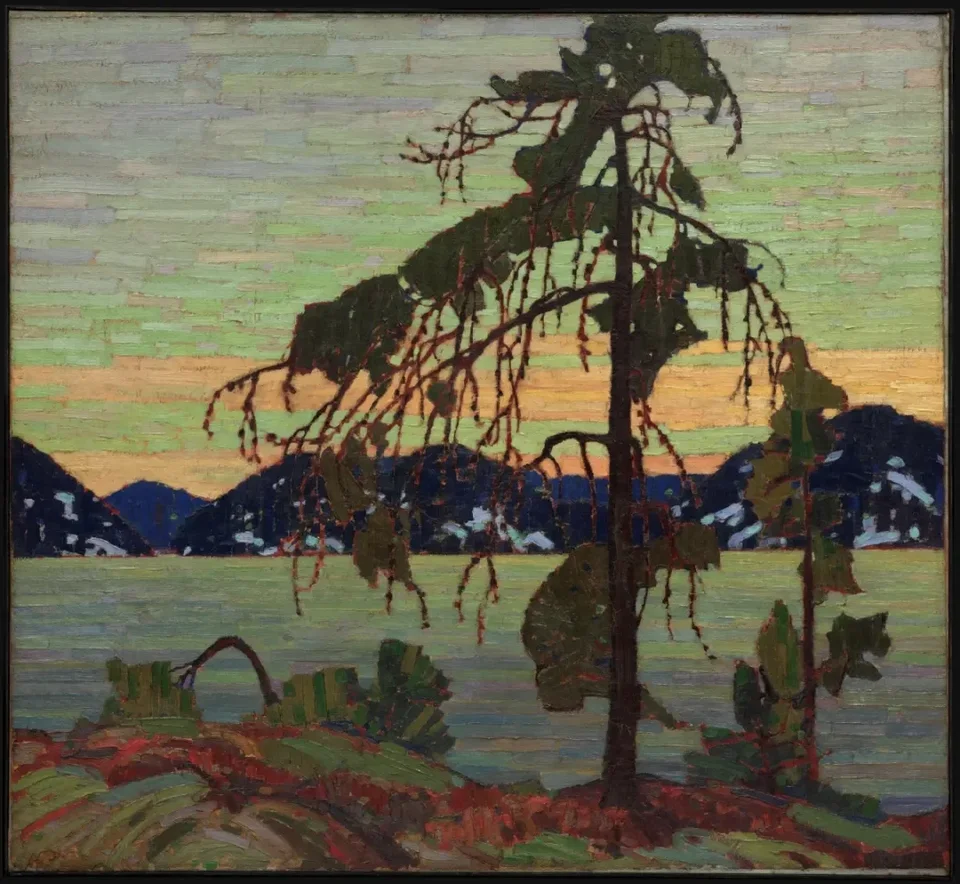
For Jonathan Bordo, the most typical expression of emptiness is the image of wilderness. The root "wild" in "wilderness" points to a state of desolation, emptiness, and aridity, and the suffix "-ness" turns it into a state or condition.[6] By wilderness images I mean the uninhabited nature we see in works such as Tom Thomson's The Jack Pine, but also the national park scenes of Ansel Adams. For Bordo, a core feature of the modern wilderness image is the erasure of figures: the land is declared a wilderness by removing people from the picture. This pictorial erasure produces a zero degree of history, a deliberate refusal to see (or a seeing without looking at) the outcomes of past and present history and of various economic conditions. This is also what Mitchell calls a kind of ignorance: "Ignorance is a state of deliberately not knowing."[7] The aesthetics of landscape rests not on "seeing" but on "blindness." We must deliberately exclude our understanding of the land's origins, its ownership, and its relations of labor before we can admire it as beautiful scenery with an easy conscience. This willful ignorance is the necessary condition for abstracting a concrete place into a visual landscape. By negating the land's original history and meaning, it leaves room for the projections of imperial fantasy.
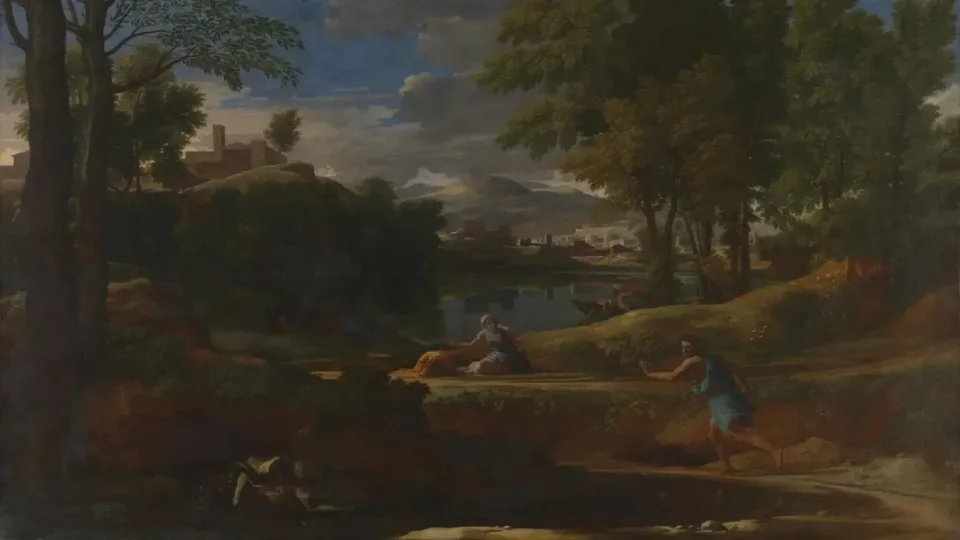
In the European tradition of landscape painting, there is usually a witness engaged in some activity within the picture: the shepherds in Nicolas Poussin's paintings, for instance, or background figures that lead the eye from the foreground. They not only till the earth beneath them but also attest that the landscape is not pure surface and emptiness, that it is a real homeland in which one can rest. In The Sight of Death, T.J. Clark's analyses of Poussin's Landscape with a Calm and Landscape with a Man Killed by a Snake are deeply moving. In the latter, the running man is poised at the threshold of speech: about to cry out, but not yet crying out. He is trying to flee the shapeless, all-devouring terror of death in the foreground (represented by the snake) and to run back to a world of discourse, a "world full of expressive signs."[8] This figure does more than move within his space. His outstretched, rigid arm becomes a kind of visual fulcrum, establishing a necessary triangular relation between the corpse in the foreground and the washerwoman in the background. Through this gesture, he tries to convert an unnameable horror into an intelligible signal, and so establishes order and balance amid the chaos of the picture.
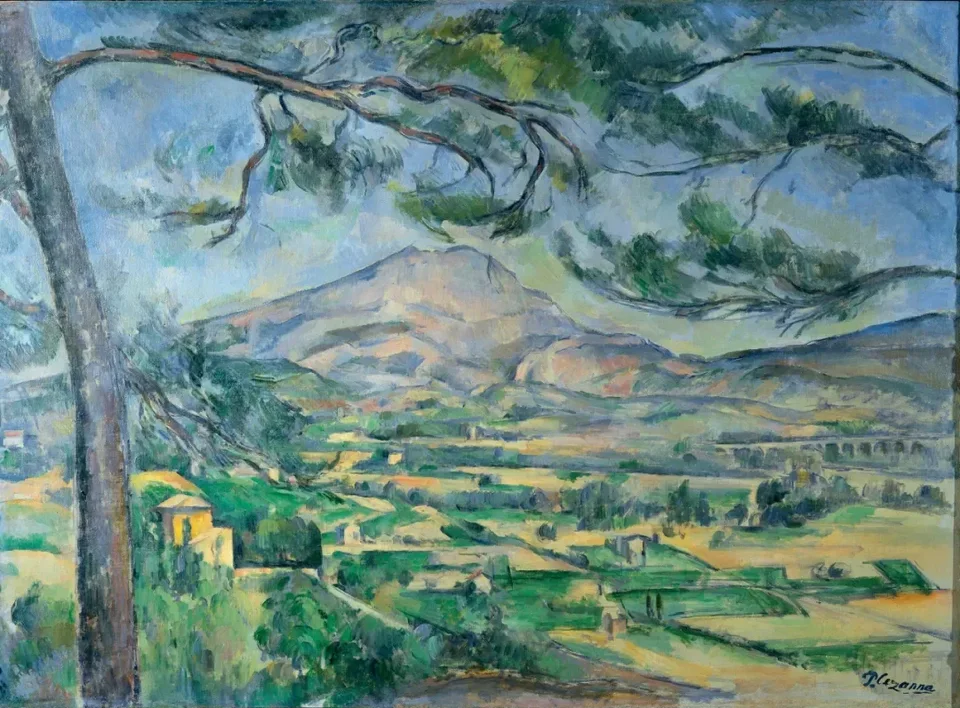
Besides the figures within the picture who attest to the reality of the landscape, however, the landscape image has another witness. This witness is what Nancy calls the true object toward which the landscape's point of view is directed: the viewer or photographer outside the frame. "Wilderness" as a concept requires human absence, yet wilderness as an image often requires the presence of a witness. The combination of the two leads to the suppression of the human figure in modern landscape imagery. When humans are removed from the wilderness, or, as Nancy would have it, become elements within it no longer bound to the earth in any unity, the purity of the land seems to be symbolically reaffirmed. These unpeopled wilderness images are paradoxical in themselves. They try to depict a world in which no humans exist, or at least one undisturbed by human activity; they try to bear witness to a world without witnesses. In such cases a substitute often appears in the picture to serve as witness. In Bordo's account, it is the "solitary trees" recurring in landscapes that occupy the position of the witness. And solitary trees of just this kind are what we find in many of Cézanne's landscapes.
Cézanne sought to express the thickness of a primordial world, and the landscape there is likewise strange and uncanny: "Cézanne's painting suspends these habits and reveals the base of inhuman nature upon which humans have installed themselves. This is why his figures are strange, as if seen by a creature of another species. Nature itself is stripped of the attributes that prepare it for animistic communion: there is no wind in the landscape, no ripple on the Lake of Annecy; the frozen objects hesitate as at the beginning of the world. It is a world without intimacy, in which one feels uncomfortable, and which forbids all human effusion."[9] In its temporal orientation, the landscape Maurice Merleau-Ponty describes here is not the same as Nancy's. Merleau-Ponty's landscape is pre-human: it refuses the projection of human feeling and is a silent, hard world that therefore appears indifferent. Nancy's points to the condition after the gods have withdrawn. Yet both present an absolute indifference and otherness. Whether "before" or "after," landscape always maintains its refusal of intimacy. What would a wilderness image that tries to restore this intimacy look like? Its paradigm is probably the landscape photography of Ansel Adams.
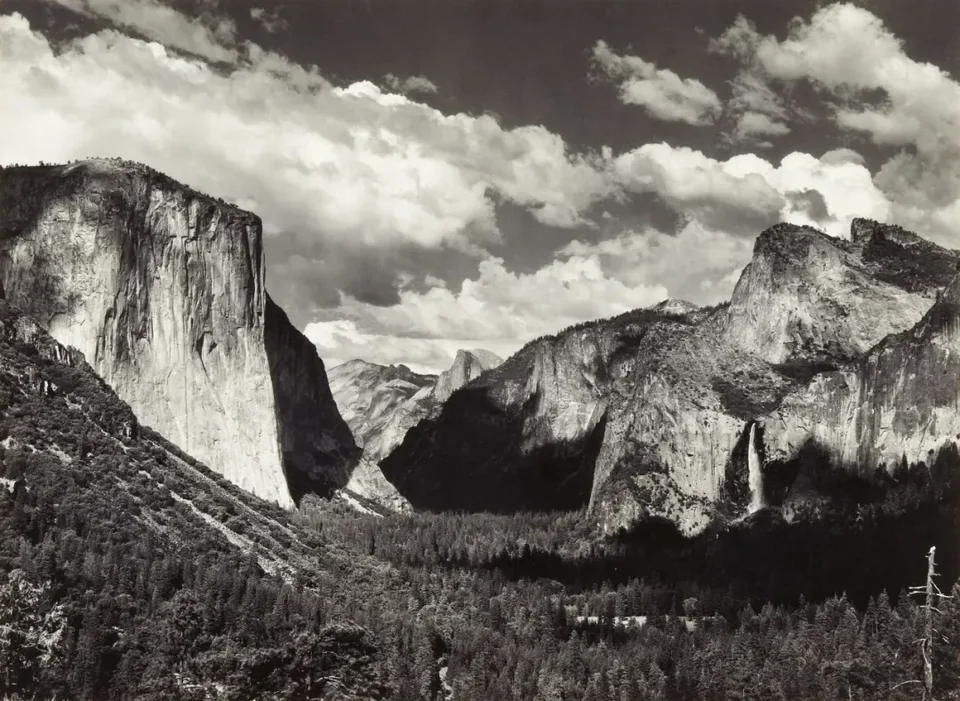
Adams consciously kept his distance from the rapid industrialization and urban expansion of his time, and so his photography played a rather particular role. His Yosemite and Yellowstone still try to present themselves as wilderness in Bordo's sense: a grand, sacred, eternal nature seemingly unrelated to human activity. Adams saw this as the expression of a pastoral ideal. He believed that "Nature" could still exist as an unpolluted whole and offer a space of spiritual rest to people rushing about in cities. In his own words: "We must battle for the integrity of experience."[10] The site where this integral experience takes place was unquestionably assigned to the landscapes in Adams's photographs. I have discussed this question in another essay.[11] In a word, Adams's pursuit contains an irreconcilable internal contradiction. He demanded that the "wilderness" be accessible to everyone, yet also that the experience remain unmediated. This contradiction arises from the zero degree of history that Bordo identifies; that is, it comes from the way the harmonious feeling of landscape conceals the historical conditions and political-economic processes that produce landscape. The wilderness Adams longed for was supposed to be an unmediated, direct relationship between humans and nature, yet it necessarily and a priori depended on the mediation of state administrative power. Once the wilderness opens to as many people as possible in order to remain accessible, it must rely on state management and the intervention of financial capital, which turn it into a tourist site. Once a tourist site has been formed, it can no longer be a wilderness free of human intervention, and what individuals experience there can no longer be the integral experience Adams longed for. Further, the very reason we can take pleasure in natural landscapes today is that the process of social abstraction under capitalism has intensified, so that the flourishing of urban culture has in turn given the wilderness its specific meaning as a place of recreation.
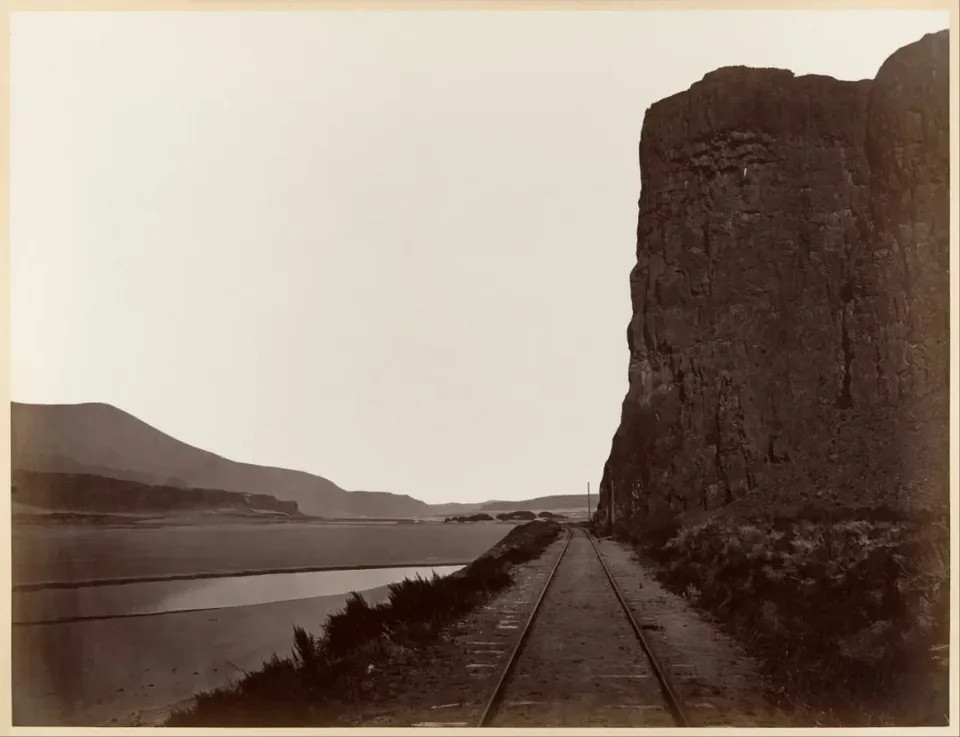
This mode of landscape photography is not rare. Its forerunner can be traced back to the practice of Carleton E. Watkins. As Joel Snyder observes,[12] Watkins's landscapes of Yosemite and the Pacific coast are supremely harmonious; through technical perfection he created a sense of eternal serenity. His landscapes thus give the impression of an Eden that would remain unchanged forever, no matter how humans acted upon or developed it. And this is precisely Watkins's cunning. When he was hired to photograph mines or railroads, he presented tracks and mines coexisting smoothly under soft light and shadow. Snyder calls this kind of landscape representation "invitational" photography: it invited investors and settlers from the East and promised that they could both come to make their fortunes and come to enjoy themselves. These viewers thus received a double promise of redemption. They could return to the primal innocence of nature, and they could profit from developing that innocence. In Snyder's terms, what Watkins did was an act of "territorialization." Through the visual rhetoric of photography, he transformed an originally wild physical space into a territory with specific socioeconomic functions; concretely, he turned natural landscape into potential real estate and industrial assets. The most radical expression of this was his depiction of mining and railroads.
Both Watkins's and Adams's landscape photography reduce process to result, making it look like pure, objective fact in the natural and geographical sense. Both present the landscape as ownerless land and erase the social conflicts and economic conditions originally attached to place and space. Watkins, however, worked during capitalism's period of expansion, while Adams, working under managerial capitalism, could no longer show nature and industry coexisting harmoniously as Watkins had. To maintain the solace required for capitalist reproduction, the state therefore had to cordon off the wilderness and establish parks. In this sense, Adams's photography is equally a product of the capitalist process of territorialization; what he shows is a territory deliberately preserved and managed by capital. This view of nature was closely bound up with the whole process of social abstraction from the very beginnings of photography.
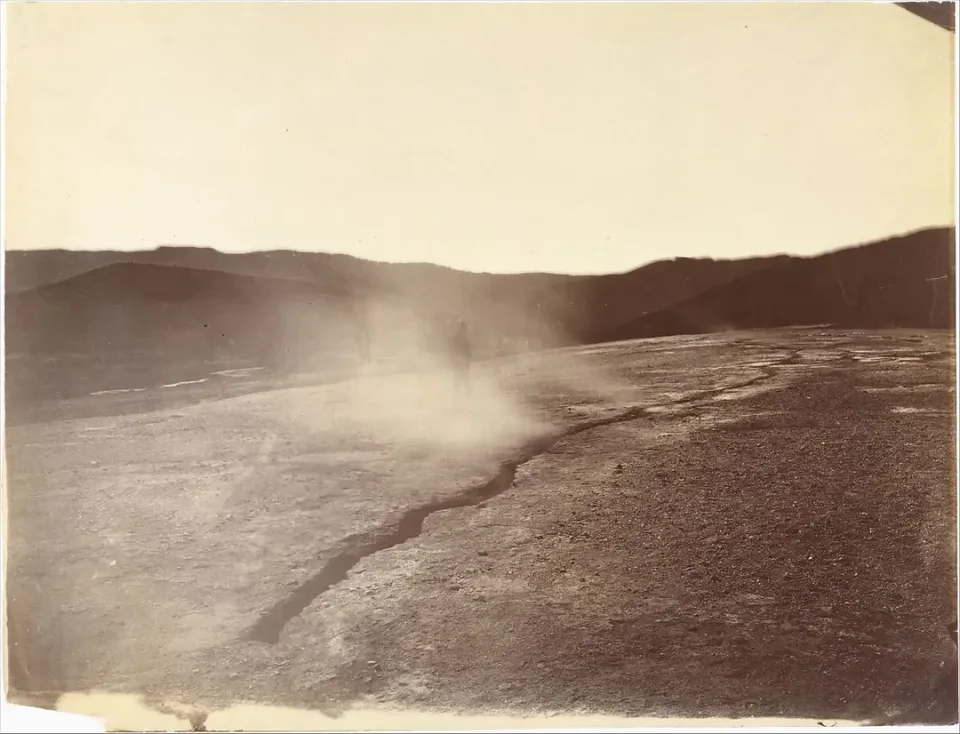
By way of contrast, Snyder presents another, anti-invitational kind of photography: the work of Timothy O'Sullivan. O'Sullivan's photographs show a desolate, terrifying, uninhabitable world. The strong shadows and unsettling ruptures in his work seem to return us once again to the theme of landscape's inhumanity. Yet O'Sullivan's photographs are equally a practice of territorialization. This is why Snyder opposes Rosalind Krauss's famous interpretation of O'Sullivan.[13] Put simply, Krauss holds that O'Sullivan's photographs, like Eugène Atget's, originally belonged to the scientific and practical domain and were improperly displaced into the domain of art by the museum institution, which obscured their original discursive space. Snyder argues, however, that Krauss's view falls into another binary trap: if a photograph is not art, it must be scientific data. The survey leaders of the time knew perfectly well that photography could not supply the quantitative data science required; that function was performed by draftsmen. O'Sullivan's photographs were meant only to give a general sense of the region's terrain. Snyder's interpretation can thus be said to restore the legitimacy of interpreting the sensory experience of viewing O'Sullivan's photographs. Even so, why should we still say that O'Sullivan's anti-invitational landscape photography belongs to the same kind as Watkins's invitational landscape photography? Quite simply: if Watkins territorialized the land as real estate, O'Sullivan territorialized it as an object of science. By producing a sense of alienation in which humans could not dwell, he excluded the public's right to approach these landscapes and established the legitimacy of a new generation of scientific bureaucrats, such as Clarence King, to manage and use them.
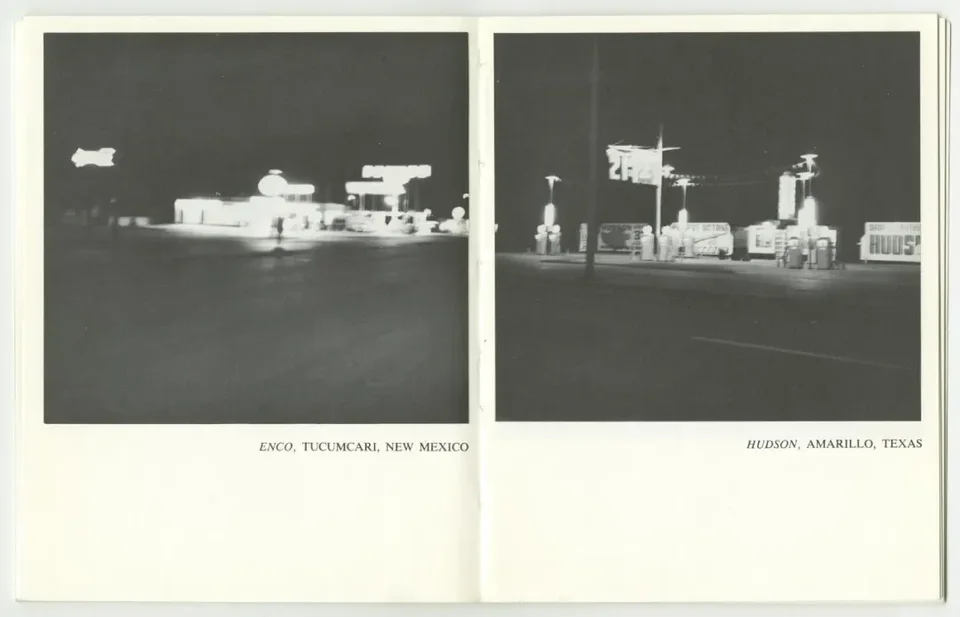
Still, O'Sullivan did show a cold, hard world that stubbornly refuses most viewers' urge to find familiarity in such landscapes. To the landscapes in O'Sullivan's photographs, we are all strangers. If we grant that wilderness and landscape no longer possess familiarity, and if we recognize that landscape can no longer serve as the heterogeneous resource on which social critique relies, then photographers must rethink their relationship to landscape. This gives rise to a new mode of critique, the method of "internalization" I discussed in my essay "From 'Repetition' to 'Typology': The Visual Internalization of Spatial Abstraction." By shifting the viewer's attention from what is represented to the means of representation itself, photographers such as Ed Ruscha, Hilla and Bernd Becher, and Andreas Gursky tried to translate the systemic forces that are not directly visible, forces operating outside the frame, directly into the visual form of the work. In other words, the photograph is no longer merely an image "about" some abstract system; it tries to become structurally isomorphic with that system and, through its own isomorphism, to make the system itself appear. In its mode of operation, this resembles what Antonin Artaud called the "double," though the two seek to make entirely different things visible. What the internalizing strategy of contemporary landscape photography tries to become isomorphic with is a highly rationalized, all-pervasive force of spatial abstraction. Behind most of the sites in Ruscha's Twentysix Gasoline Stations lies desert wilderness in the traditional sense, but he chose to aim his camera at these mutually similar modern buildings, thereby presenting visual experience itself as it has been abstracted under capitalism. To avoid repeating myself excessively, I will not go into the detailed analysis here.
In short, this is why in later landscape photography what we see is so often estrangement rather than intimacy. In The Ground of the Image, Nancy touches on the source of energy behind this transformation in the critical method of landscape: what he calls the "ground." The ground here refers to what is separated from the image. When the image forms, the ground disappears, dissolving entirely into the image. Without the ground, the image could not appear. Once the image has appeared, the ground is transformed into the force of the image and exerts pressure from within it. Or rather, this is the pressure the ground exerts on the image's surface. "Beneath this force, in this intangible non-place, it is not merely the support but the reverse side or underside of the image."[14] The ground has depth; it is the energy that drives form to emerge. Put simply, the ground is the depth of being that remains hidden yet sustains the image and gives it intensity. Without this hidden ground, the image would lose its power to move us.
Within this ground we find "the distinct": "It is the thing itself: it is what lies in the ground of things, at the heart of everything that exists, and withdraws the meaning of their being into a secret from which all sense draws its sensibility."[15] What Nancy calls a "secret" here is the opaque depth of a thing as the thing itself, the part of it that cannot be translated into concepts. The distinct in the image only shows the thing; it does not assimilate the thing through linguistic signification. The distinct is what is clear and springs forth (and is also separated) from that obscure ground; it is the pressure from the ground mentioned above. Transparent language exists to be understood, but only what is opaque can be felt. Sensibility always comes from contact, and contact is possible only because of thickness and distance.[16] An analogy may make the point clearer. Think of two magnets with like poles facing each other: the strong force comes both from their nature, which seeks to push them apart, and from our act of forcing them together. Such is the touch of the distinct. The meaning of the image is always withdrawing, even all the way back into the ground behind it, and the refusal this withdrawal produces is what presses so intensely on our senses. Purely intellectual operations require no touching. Even in Chinese, when an image moves us, we say we have been "touched" (chudong). We are touched not because we have understood in language what the image seeks to explain, but because the ground of the image is always pressing on the image's surface, and thus on us. This resistance creates the possibility of touch. One could even say that the image's separation, its refusal to be assimilated by our understanding, is what gives its touch its force. Because meaning can never exhaust itself in linguistic signs, and because meaning always maintains its gesture of withdrawal into the depths of the image, it is able to move us. The distinct is a force that appears because of the ground. It is an energy that lets things in the image withdraw from the world of usability and language, and thereby touch and strike us. As Nancy puts it: "What touches is something brought to the surface from an intimacy."[17]
The best landscape photographs never hold back from presenting this surface. They move us by pushing us away from the world they depict. Ed Ruscha's photography is therefore only surface, and Thomas Ruff goes further, subtracting everything but the surface, which in turn reveals the spectrality of landscape (for example in the jpegs and tableaux chinois series), a spectrality that haunts us long afterward. In these works we see landscapes that have broken free of the logic of territorialization, and, like reality itself, they stubbornly refuse the infiltration of any empathetic projection. Beginning with Robert Adams and others, landscape photography seems to have reached a striking consensus in presenting the inhumanity and uninhabitability of landscape. These photographers strip landscape from the functional web of human meaning, and they also refuse to let it provide the kind of solace found in Ansel Adams's work.
Ruff's jpegs series appropriates a large number of disaster photographs, including iconic images of 9/11 as well as photographs of natural landscapes with erupting volcanoes. He dismantles the structure of their surfaces and pixelates them, yet what this blurriness exposes is the infrastructural structure of the jpeg itself: the image degrades itself in the course of circulation. This blurriness is a kind of ghostliness. Such ghostliness runs throughout Ruff's practice. His Other Portraits series was made with the Minolta Montage Unit used by German police in the 1970s to identify suspects, and tableaux chinois appropriates the most representative Chinese propaganda posters of the 1950s and 1960s. By looking back into history and bringing it to the surface, Ruff traces the afterlife of the archive, and he has found a remarkably fitting mode of visual presentation, so that these historical landscapes from the archive acquire a power to move us far beyond that of the photographic medium itself. This inhumanity signifies our separation from history. These images haunt the present like ghosts and have permanently altered its character. Yet the distance between us and the ghosts remains uncrossable.
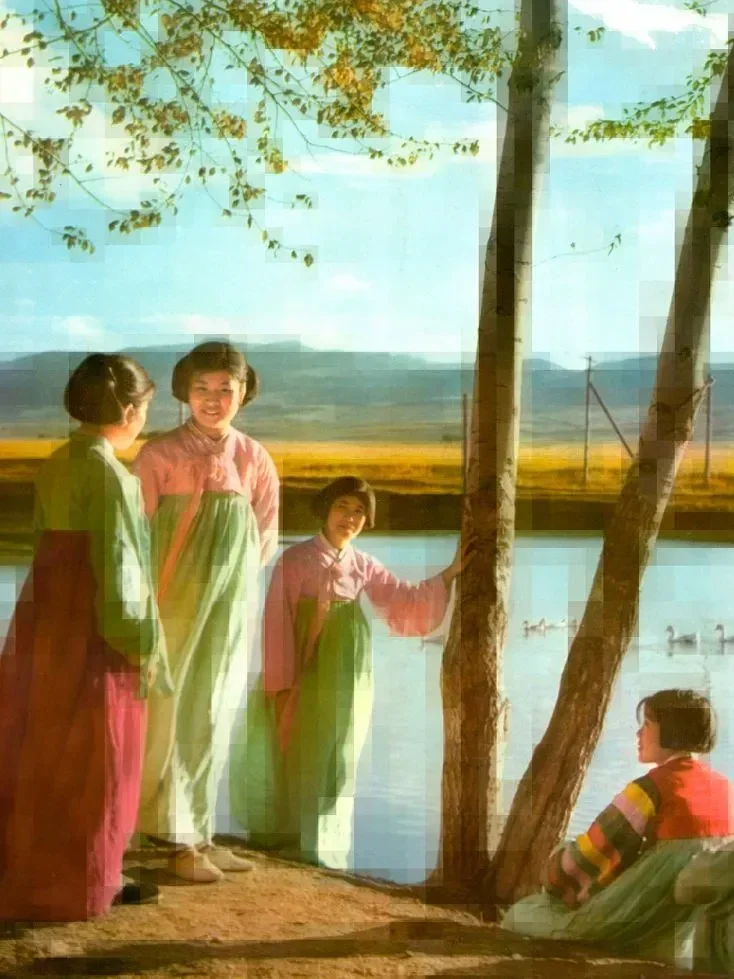
For Nancy, the "distinct" in the image fundamentally means its separation from us, and it is in the tension produced by this separation that touch can occur: "The distinctness of the distinct lies in its separation: its tension consists in a state that is posited as separate and continually maintains this separation, while at the same time being a traversal of this separation."[18] It is stripped out of the everyday, homogenized world and maintains an absolute distance and intensity. It stubbornly refuses to merge with our understanding, and it is precisely this distance that produces pressure and the intensity of touch.
With this, we can perhaps return to the question addressed at the beginning of this essay: the uncanny character of landscape. If landscape was born from the withdrawal of the gods, then landscape photography long played the role of a kind of mender within this historical process. Adopting the posture of one who invites, it once rebuilt for modern people an illusory Eden, a homeland in which one might seemingly rest again as in the age of the gods. Yet the best landscape photography has since accepted the rupture between humans and the world and the otherness of nature, and has begun its work on that basis. We can see this in the new turns landscape photography has taken since the 1950s and 1960s, and in the great majority of the works in this exhibition. The landscapes in such photography no longer invite us to dwell within them. They have begun to return to the surface and to present themselves as the most radical other. The power of such landscape photography to touch us comes from the separation between the landscape and ourselves. It is a force that can never fully make contact or dissolve into us, yet it acts concretely on our senses. Photographers no longer praise the earth, and they refuse to acknowledge a spiritual homeland. In a world where depth has been lost almost everywhere, these images can still strike us, and because of their distinctness, what we see is a renewed sensibility oriented toward the present.
Notes
[1] Jean-Luc Nancy, The Ground of the Image (New York: Fordham University Press, 2005), 57.
[2] I learned this usage of the term "depth" (jingshen) in Professor Xiaolin Qiu's class at Sichuan University. My thanks to Professor Qiu.
[3] See Malcolm Barnard, "Derrida and Photography Theory," in The Routledge Companion to Photography Theory, ed. Mark Durden and Jane Tormey (New York: Routledge, 2020), 295–308.
[4] Nancy, The Ground of the Image, 58.
[5] W.J.T. Mitchell, "Introduction," in W.J.T. Mitchell, ed., Landscape and Power, trans. Li Yang and Wan Xinqiong (Nanjing: Yilin Press, October 2014), 1.
[6] Jonathan Bordo, "Picture and Witness at the Site of the Wilderness," in Landscape and Power, 315–318.
[7] W.J.T. Mitchell, "Holy Landscape: Israel, Palestine, and the American Wilderness," in Landscape and Power, 288.
[8] T.J. Clark, The Sight of Death: An Experiment in Art Writing, trans. Lei Zhang (Jiangsu Fine Arts Publishing House, December 2011), 110.
[9] Maurice Merleau-Ponty, "Cézanne's Doubt," in Maurice Merleau-Ponty, Sense and Non-Sense, trans. Ying Zhang (Beijing: The Commercial Press, 2018), 14.
[10] Ansel Adams, "Problems of Interpretation of the Natural Scene—Sierra Club Bulletin," in Ansel Adams: Our National Parks, ed. Andrea G. Stillman and William A. Turnage (Boston: Little, Brown and Company, 1992), 115.
[11] Guosen Chen, "From 'Repetition' to 'Typology': The Visual Internalization of Spatial Abstraction," Culture and Art Research, no. 2 (2025): 16–24.
[12] Joel Snyder, "Territorial Photography," in Landscape and Power, 190–218.
[13] Rosalind Krauss, "Photography's Discursive Spaces: Landscape/View," Art Journal 42, no. 4 (1982): 311–19. This essay was later included in her major work The Originality of the Avant-Garde and Other Modernist Myths.
[14] Nancy, The Ground of the Image, 8.
[15] Nancy, The Ground of the Image, 75.
[16] To keep the argument from straying too far, I will not elaborate here on Karen Barad's theory of touching, but see: On Touching: The Void, the Inhuman, and the Ethics of the Other
[17] Nancy, The Ground of the Image, 4.
[18] Nancy, The Ground of the Image, 3.