
Opening
Ce Zang
Hello everyone, I'm Ce Zang, today's host. Welcome to the eighteenth session of Server Art's "Paths and Possibilities of Contemporary Image-Making."
We are very honored today to have invited Mr. Jeff Wall, one of the most renowned contemporary image artists in the world. He is a Canadian artist, and we are very excited that he is joining us today. Everyone knows Jeff Wall and is very familiar with his work. Whether in photography or in image-based art, any list of the most famous contemporary photographic artists will certainly have Jeff Wall near the top. Works such as Picture for Women and Dead Troops Talk immediately come to mind.
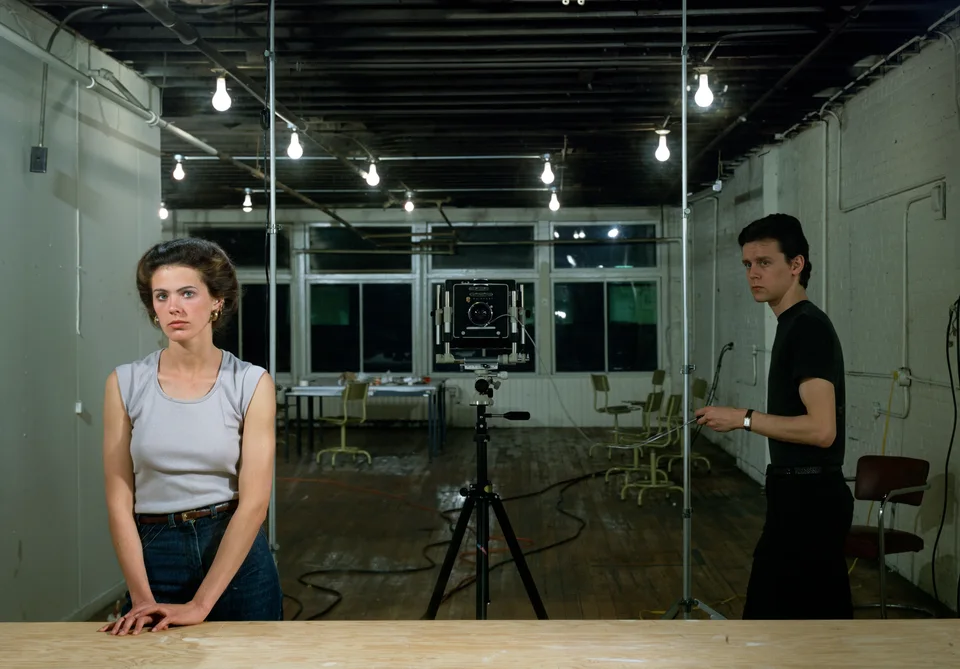
We are also very fortunate to have with us again our old friend Mr. Rong Jiang, a photography critic, photographer, and curator, as well as Mr. Guosen Chen, a PhD student in the Department of Philosophy of Art at Fudan University. They will share their thoughts and join the discussion. They can put to Jeff Wall some of the questions we care about most, and of course I will also take part in the discussion and ask questions myself.
We have also invited Ms. Vera Xia, a filmmaker from the photography department at Bard College and a student of Stephen Shore, to serve as today's interpreter. Many of us already know Ms. Jingyi well. She has interpreted our last several discussions, and she has done a wonderful job. Once again, thank you to her.
Jeff Wall is a Canadian artist and one of the most influential image-makers of the late twentieth and early twenty-first centuries. His work has been called cinematographic art. He has been called a "painter of modern life," and he identifies with that description himself. He was among the first to bring digital montage into image-making, and he has explored it extensively over many years.
Since everyone is already familiar with Mr. Jeff Wall, I won't say more by way of introduction. Now I'd like to invite Mr. Rong Jiang to ask Mr. Wall the first question, and then we'll continue the discussion from there. All right, Mr. Rong Jiang, please.
Western Pictures and Contemporary Art
Rong Jiang
Thank you, Ce Zang, and many thanks to Mr. Jeff Wall for accepting our invitation to join this conversation. Together with our audience in China and viewers around the world, we'd like to explore some questions about contemporary art, particularly how photography became contemporary art, by analyzing and discussing some of Mr. Wall's own works.
Now I'd like to ask Mr. Jeff Wall my first question. I'll use some slides as I ask, so the audience can see which work I'm referring to.
Between 1969 and 1970, you made Landscape Manual, a minimalist and conceptual work combining snapshots and text. After that, you stepped away from making art because you were dissatisfied with the literalism and non-art posture of minimalism and conceptual art. You went to London instead, where you studied philosophy, film, the history of painting, sculpture, and photography, and critical theory in depth.
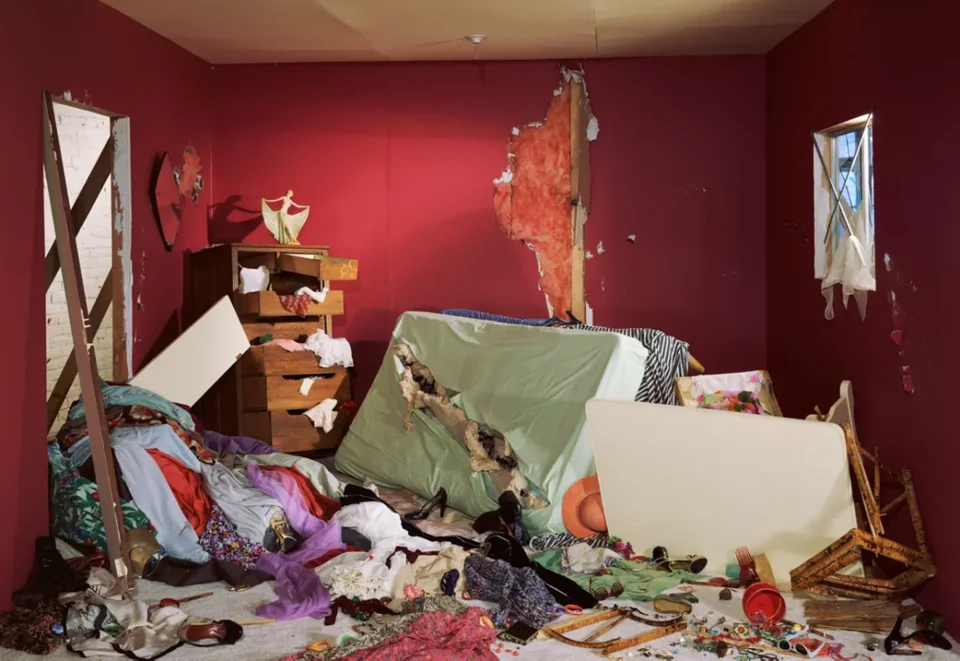
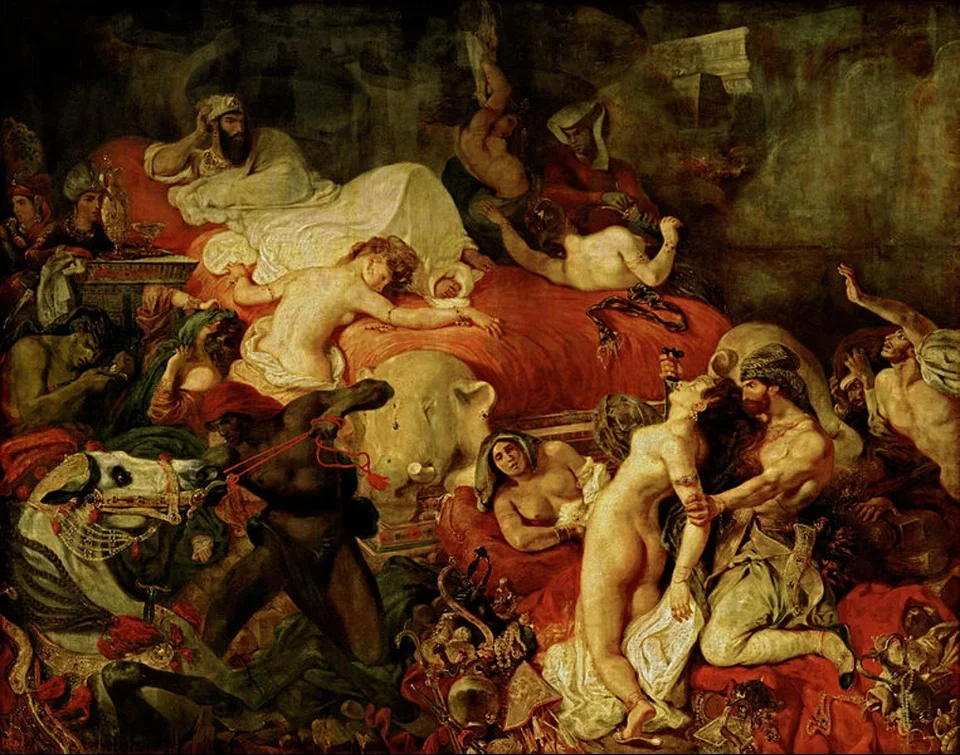
In 1978, you made The Destroyed Room, a large-scale backlit transparency depicting a woman's bedroom that has been torn apart. Let me show the work. As we know, its composition is taken from Eugène Delacroix's painting The Death of Sardanapalus. According to Naomi Merritt's book Jeff Wall and the Concept of the Picture, this groundbreaking work is a critical inquiry into the Western concept of the picture.
You have also said that you wanted to find out whether the Western picture was still alive. So my first question is this: in the 1970s, why was it so important to you to use photography as a medium for continuing the Western pictorial tradition? This may be too big a question, but I think it can give us a framework for today's discussion. When you're ready, please answer the first question. Thank you.
Jeff Wall
It is a pretty big question, I have to say, and I won't be able to answer it maybe that thoroughly, because it encompasses a lot of time for me — a lot of time over which I did things.
First of all, about the Western picture: I think we know, in general, what that means. It's a kind of picture that was generated mostly in Europe for many hundreds of years, probably almost a thousand years, which more and more became accepting of the way the world looked to the human eye, and wanted to be faithful to that and record it or replicate it, let's say. But at the same time, to make it poetic — that is, to compose it and make it exciting to look at. What was shown also suggested many more things. I guess that would be the simplest way of defining it: something that shows the world as it really is, and yet suggests more than it shows, in ways that become literary, poetic, et cetera.
But I also must say, I don't think that the so-called Western picture is entirely western, since it has so much to do with our natural vision, eyesight, and how the world looks to us. It must have a wider application and a wider effect. We see evidence of the so-called Western picture in other cultures from very early times. So we could also say that the Western picture was something that generations of western artists engaged themselves in while taking inspiration from other places as well. It wasn't an insular thing, or entirely western. And I think that's one of the reasons why other places and other cultures could respond to it very easily — or at least there could be enthusiasm for it over many centuries in other places. It's something that has to do with the fact that we see the way we see. It's a kind of fundamental expression of human experience.
For me personally, it was always a source of extreme pleasure, because I grew up seeing these kinds of pictures from a pretty early age, in books and things. They excited me as a child and I wondered about them. My own experience goes back through my whole childhood. So I'm just one of those kids who fell in love with art as a child and stayed with it. That's pretty naïve, but it doesn't need to be any more sophisticated to be real. I was a naïve person, like all children and young people, but my naïvety was real — I was connecting to something very real. And as I found a way to learn more about it, my enthusiasm, my engagement, got stronger and probably more aware of itself.
So I see the Western picture as something that's probably never going to be displaced from the world of art, even though it may not play the same role it played in the 1600s or the 1900s. It's never going to be displaced. It's something permanent that probably can't be shaken off. And I tried to shake it off — as you say, in the '60s I tried, like a lot of people in my generation, to shake it off or go beyond it or criticize it, or take some new relationship to it.
In doing that, I was sort of going with the flow of the times, because from the early '60s on there was an enormous upsurge of interest in alternatives — all kinds of alternatives: social alternatives, intellectual alternatives, and artistic alternatives. I had to be part of that, because that's what young people do, and I was one of them. So I did have a pretty serious engagement with the alternatives to the Western picture, or the whole idea of that kind of artistic tradition. I was pretty engaged with it for quite a while, and it engaged me on an intellectual level because, as I studied more, I began to understand the stakes that were being played for in the art of the '60s, and I wanted to find my own relationship to it.
As you said, the early things I did in the '60s were attempts to find those alternatives, and they weren't very successful. Other people who tried to find new forms of art-making did much better than I did. And the reason I think they did better was because they wanted to more than I did. I think back now and realize that I was inhibited from going further in that direction by my own background, and by the relationship I had with the so-called traditional picture. I gave it a try. I worked at it very hard, and I failed to find an alternative art form that would satisfy me.
When I kind of realized that — and it took me some years, as you say — I didn't have a problem with trying to find a way back to picture-making, because I had done a lot of that as a young person, mostly by drawing and painting. I didn't have a problem turning in that direction.
But at the same time — maybe I'll leave the question at this last point — I don't think that I went back to the Western picture. I don't think I went back to tradition. I don't think what I'm doing is traditional. I think that since the beginning of abstract art in the early 20th century, the whole frame of reference for art-making has been transformed. We don't make pictures now the way we would have made them in 1850. We now only make pictures in the light of what non-picture-making art has been.
I feel like I have a very long relationship with that non-picture-making art, and also with even what you would call anti-art. I've had a long relationship with all of that, and it's affected me in a lot of ways — probably ones I don't even understand yet. But I know that it's had an effect, and I think that effect is not just on me. I think that all picture-making now has been reconstructed, in some possibly difficult-to-explain way, by the presence of the anti-picture — whether it's an abstract painting or a conceptual artwork. Those things have a presence now in picture-making; I know they have a presence in mine.
So that's why I don't feel that there is a way to describe it as a return to tradition, and I don't feel traditional. And this might anticipate some future question: that had a lot to do with the fact that I realized I could do this in terms of photography and not in terms of painting. But I won't comment any further on that just at the moment.
Rong Jiang
Thank you. Before I hand things over to Guosen, I'd like to ask a follow-up question.
When I asked my first question, I didn't mean that you were returning to a traditional Western concept of painting. I was just trying to understand whether you were attempting to reconnect with what Manet did: depicting modern life, as he did in very famous paintings such as The Luncheon on the Grass and A Bar at the Folies-Bergère, whose scenes are entirely drawn from the modern life of his time.
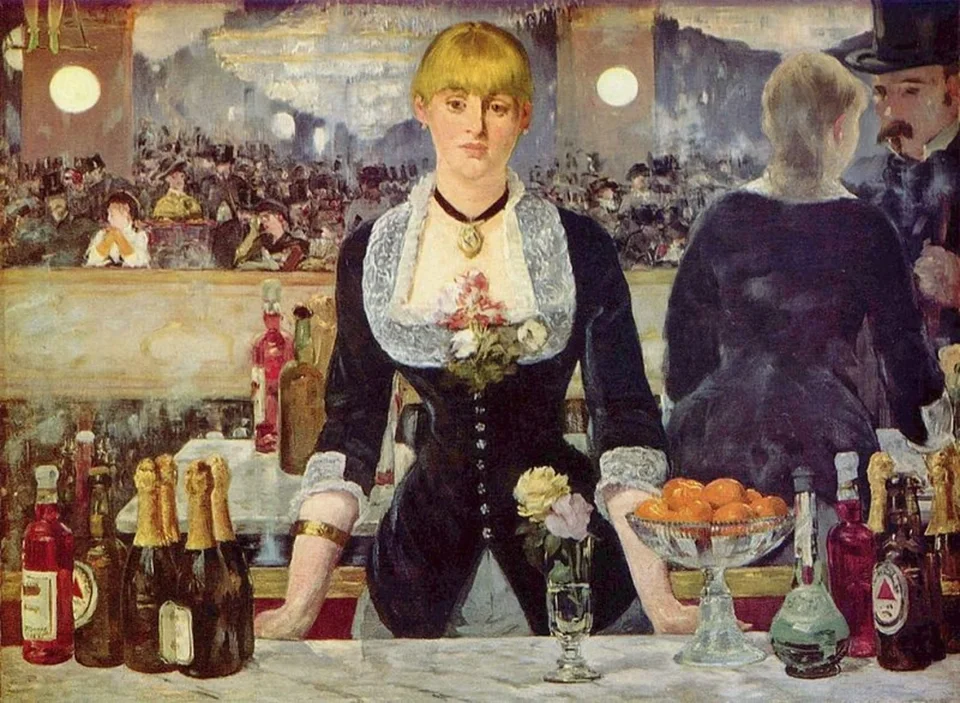
But after that came impressionism, then minimalism, and then conceptual art in the sixties, when artists began using photography. Joseph Kosuth, for example, used photography to make his work.
So basically, what I want to understand is this: when you began using the figurative picture, borrowing compositions from Delacroix or Manet, was that also a response to what minimalist and conceptual artists were doing at the time? They used photography, but not really as an end in itself, only as a means. That's my question. Also, were you trying to reconnect with the tradition Édouard Manet began when he started depicting modern life in painting? That is really my question. Could you say more about that?
Jeff Wall
I don't think I was trying to reconnect, because I was always connected to that earlier work. So when I think about the time of transition between the early '70s and then, say, the middle '70s, when I began to make these pictures — or even further back, when I was trying for the alternative, when I was trying to participate in the alternatives I just mentioned — it wasn't that I had set aside all these other things. My interest in Manet or Rembrandt, or whoever — that was still in play.
My experience of the '60s and '70s was maybe more complicated than some people's, possibly, because all the other ideas about art — I hadn't put them aside. I didn't reject them. My critiques of them never really convinced me. Those older relationships, for me, were always in action. I never really broke with those things. I suppose you could interpret that as me never really wanting to break with the past. And if that's the interpretation, I could accept that too, because there is no — to me, there is no really strong obligation to put any distance between the ambitions of someone like Manet, or any of those older painters, and my own. We share a lot of things in common, and I think artists still share a lot of things in common with them.
I don't think that one's relation to tradition can be defined using the frame of reference of the '60s and '70s avant-garde, because their view was that there was something wrong with that tradition, something wrong with that art — something that was to be dealt with. I couldn't — as much as I tried and as much as I thought it through — could not accept that. There seemed to be far too many elements that were still alive, very much alive, in that art.
So I didn't reconnect with tradition — I was always in a struggle with those traditions, and I still am, in the sense that every time one makes a new work today, one is still dealing with those fundamental problems. One of the problems for me then is the validity of the avant-garde's — or neo-avant-garde's — dissatisfaction with the art that came before. I am not convinced that their version of it is adequate. That should be obvious, but I'm engaged in it and it's part of my way of thinking. My position on it is, I think, obvious from my work: there's a lot that's still alive, and probably always will be alive, in these things, as I said.
So I was of course working against the grain of the times at some point, and I guess my work could have been seen as sort of dissident in relation to some of the main enthusiasms of the '70s. But that was cool — I was fine with that. That's my relation to the '70s.
Ce Zang
Let me say something here. While listening to Jeff Wall talk about his own explorations, I thought about many things concerning the very interesting relationship among art history, pictures, and photography. I keep coming back to this issue. It involves both our shared memory and individual memory, shared ways of looking and habits of seeing, the individual's effort to go beyond that shared gaze, and all the explorations and difficulties involved in that effort.
So can an individual's gaze and memory transcend this shared gaze and collective memory, and even the historical and temporal dimension, and if so, to what extent? I find this question very interesting. I was thinking about it as I listened, and it is truly a question worth further reflection and research. All right, now I'd like to invite Guosen to begin his questions.
Where the Work Begins
Guosen Chen
All right. Thank you, Ce Zang, and thanks to Mr. Rong Jiang for coordinating all of this. Hello, Mr. Jeff Wall. It's a tremendous honor to speak today with the artist I admire most. Thank you.
Let me introduce myself first. Strictly speaking, I'm not an artist; I'm in a philosophy department. I'd also like to say something slightly off topic first. I want to thank you in person for allowing me to use your works in my article. It really meant a great deal to me and helped me enormously.
Jeff Wall
My pleasure.
Guosen Chen
I'll share my screen now and then during our conversation so that you and the audience can see what we're discussing. But I don't need slides for now.
Besides the naïvety you just mentioned, I think one can sometimes sense it in your work too. That may relate to some things I'll mention later, such as Ventriloquist, and so on.
I think your answer to Mr. Rong Jiang's follow-up question has already touched on what I wanted to ask, but my question may be a bit more specific. You once said that your practice begins with not taking the photograph, and that missing a moment is itself a kind of relationship with photography. But some of your works clearly come from very specific visual encounters. For example, seeing a backlit advertising lightbox on a street in Spain when you were young, or seeing Las Meninas at the Prado. These have more or less become famous anecdotes in art history.
So, with respect to the work that might eventually result, how does an idea that comes from reading or memory lead to a different working process from a direct visual encounter? In other words, what is the difference in the creative process between starting from a conceptual idea, such as wanting to depict something involving the living dead, and starting from a direct visual encounter? For example, you remember Milk, right? That work actually began when you encountered a man on the street in Vancouver who was crying and clutching a milk carton, and then you found a way to realize it.
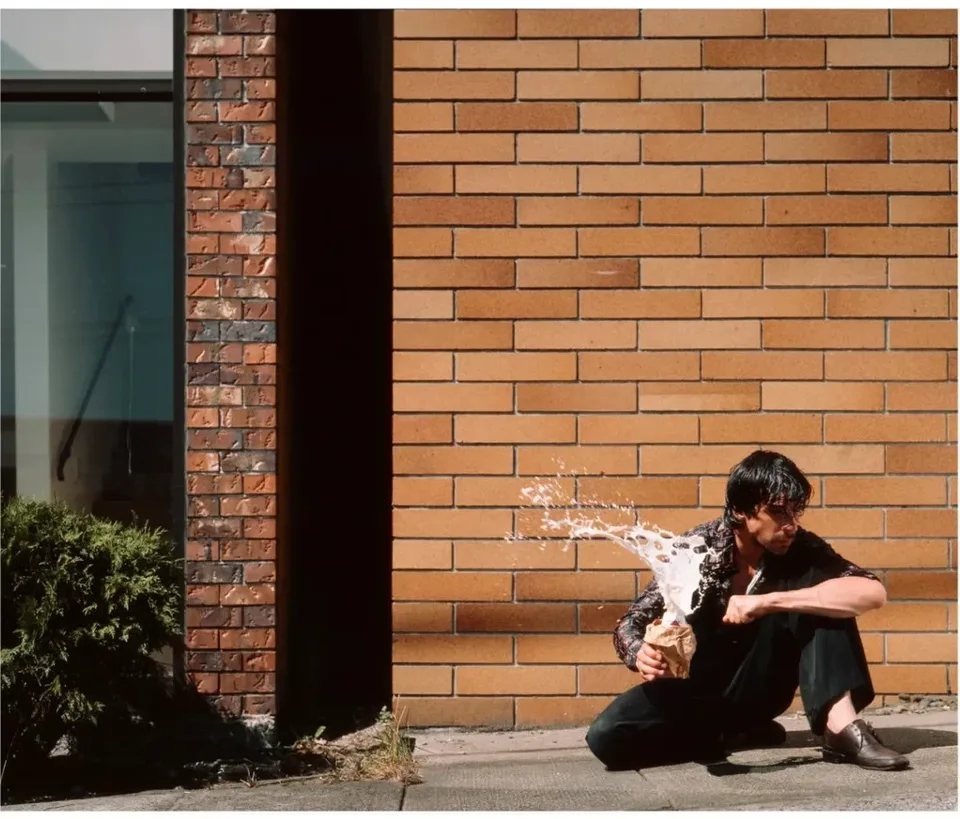
So when the starting points are so different, does the path to the work change significantly? In terms of where the work really begins, which works would you say are the most purely conceptual, and which come most directly from some immediate encounter with life? That's my question.
Jeff Wall
OK, interesting. Let me begin by saying something about not photographing. Anyone who gets interested in photography and starts looking at it from an artistic point of view begins to recognize the photographers who've done it better — the ones who impress you, just the way, say, Picasso will impress you in painting. So I did that too, pretty early. Again, I had been looking at photography pretty young in life, and by the time I was maybe 16 or 17 or 18, I learned about Walker Evans and Atget, and so on. I knew that they were different from other photographers — their pictures were what they were. We won't go into why; it's obvious.
I knew that they made their work almost always as a kind of snapshot photography, or at least as documentary photography. And I liked that — I liked the results. But I found that I was not really very interested and passionate about acting that way. I don't know why. I think it's just different personalities, and I realized I probably wasn't cut out to be a photographer in that sense.
But nevertheless, I thought that I loved photography anyway. I loved the way it looked, and was attracted to the appearance of things when you see them in photographs, just the way I'm attracted to the appearance of things that I see in paintings or in sculptures. I guess I'm just attracted to the appearance of things in art forms. The visual arts really copy the world in a way, and that copying act is also fascinating in itself — that we can create something that looks like what we see when we're not looking at a picture. I had a kind of passionate interest in photography, which I somehow wanted to realize when I began to think again, as I said earlier, about finding my own way after these anti-art things.
And the other main factor I should mention in that was looking at cinema. Because in films, we know that there's a lot of artistry that goes into the making of an image which could look like a documentary passage. And that was always very fascinating to me — how you could replicate or imitate, or whatever you want to call it, the appearance of the immediate, spontaneous capture of the world. But we know that in films, that's not what happens, or that can easily be not what happens.
I learned a lot from that, because I realized that appearance had an openness to it. It had different avenues of access to it that weren't necessarily the ones that the classic photographers took. They had their reasons — I never felt critical of their reasons and admired their work — but it wasn't for me. So this combination of understanding that there could be another avenue towards that spontaneous capture, and the aspect of composition — which was really the ultimate achievement and ultimate aim of all painting and sculpture, to compose, to bring things into a form — these things could somehow create a sort of hybrid that I could work in.
So that's when I began to think about my work as cinematography — although I didn't use the term until a little later — a kind of hybrid of cinema, of painting, and of spontaneous photography, at the same time. That became a sort of foundation for me to do my work. And it seemed very open, because there seemed to be no rules. One could start anywhere.
So if you take a picture like Milk — you mentioned it — I did see an event very much like what you see in the picture, in real life. I could never have captured it because I wasn't ready at the time, and I was sort of sad that I couldn't have captured it. But that also opened the door to the fact that it was still available to me somehow. That's what I mean when I say that not photographing is already a relationship to photography, if you want it to be. It only becomes a relationship for those who want it to be; for those who don't want it, it's not a relationship.
So that showed me that these avenues, these passages into the photographic domain and practice, were available. I just began to experiment in the '70s and '80s — I just began to try things, tried to replicate what I saw by whatever means seemed to be needed. One of the defining features of real cinematography in cinema is that the filmmakers, the cinematographers, will do whatever they need to do. There are no limitations to begin with. They will do whatever is needed. And I decided that's what I would have to do also — whatever is needed. So that's how I practice. I have no rules. I just do whatever I have to do at any given time. But I can only do that because the baseline, the field of what I call cinematography, allows for all those approaches.
To answer maybe the second part of your question, about whether there's a difference between, say, a picture made after seeing a real experience — like Milk — or another kind of picture that comes from somewhere else: I don't really make much of a distinction, because I don't think I work from concepts, and I don't think my pictures have ideas. I think they have subjects. And the subject, which I sometimes think of as just the starting point for the picture, comes from anywhere — something I see, something I read, something someone tells me, anything.
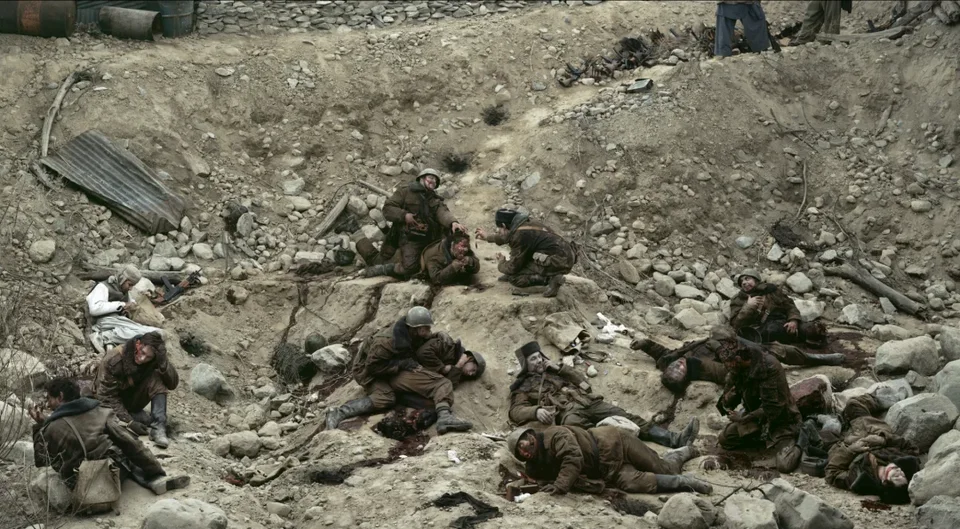
So for example, some of the pictures I've done that are more fantastic, shall we say — like Dead Troops Talk — those just came from real occurrences in my mind. I don't think we have time to go into the detail, and it's not that interesting. Let's just say the subject of these soldiers who had been killed and who somehow appear to have come back to life — which is not possible, yet we see it happening anyway — was a subject that occurred to me, I think, in a daydream state. It seemed very fascinating, and it probably has to do with things I had apprehended from literature, because that's another major part of my work. And I think many other artists' work, too — literature and art are very closely related. Pictorial art and literature have always been very closely bonded, and artists sometimes fight against that. They try to expunge the literary, and others don't — there are any number of approaches to that. I just let it happen. I've always been a reader of fiction and literature anyway — it's just something I've always enjoyed. So I've just let it happen to me when it happens.
I don't make distinctions between these subjects. I think they are all equally available to me. The only thing I do, in terms of distinguishing them — and I do this with every subject that pops into my mind — is I have to review it in some critical way, to see whether it's really worth doing. That's a hard judgment to make, and it's hard to describe. But once I decide a picture is worth making, and a subject suggests something I can accomplish, then it becomes like every other picture, and I don't distinguish them anymore.
I like the fact that I can make pictures that are very realistic — shall we call them very "documentaristic" — and pictures that are very different, and that maybe people recognize that they're done by the same person, that they have something in common, even though they're coming from very different starting points. And that maybe the commonness, the fact that they look like they belong together — I've seen them in many exhibitions and they feel like they do fit together — that suggests something about photography as well. It suggests a certain universality, I guess you could call it, or openness to all our experience, by this medium, this technology, that we are still trying to fathom. Photography is still kind of unfathomable magic — how this really happens. We know how it works scientifically, but the fact that we can copy appearances the way we can is still something we're really still dealing with. And so to me, the camera system, if you want to call it that, is applicable to anything I can engage myself with.
Guosen Chen
Before we go on, I'd like to add a few brief remarks. Your approach to making art still seems to me to have something almost phenomenological about it. You mentioned an idea I found very illuminating: for you, visual art is essentially a way of representing the world, even when the work of conceptual artists doesn't appear that way on the surface.
Some photography theorists have argued that a photograph, or something that looks like a photograph, should be understood not as an index but as an analogue. I think what you're saying is actually less similar to that position than it may seem, because the world itself is inexhaustible in its meaning; it is always interesting. Moreover, the visibility of the world is not simply equal to what we happen to see at any particular moment in reality. That is not the whole of the world. It is extremely difficult to capture, within a single moment we encounter in real life, all these relations, the whole complex web of interconnections.
I wonder whether that is part of why pictorial quality matters so much to you.
Jeff Wall
Wait a moment. Let me make one comment, because you raise something that's probably relevant that I missed out. The question of composition emerges here, you see. Because I agree with you that the visual world is inexhaustible, but it doesn't always satisfy us aesthetically in the way it looks.
So when I'm trying to do something — and let's take an example of something that's derived from a real moment that I want to reproduce as faithfully as I can — it can't be totally faithful, because I have to realize that when I have my rectangle, my basic field of vision, the real suggestivity, the anything that can become poetic or fascinating, will emerge from how that rectangle is treated visually. That means I have to compose. In order to compose, I have to invent, and I have to bring things together — shapes, colors, forms, actions, et cetera — all the basic formal things that all artists do.
And the way in which a picture — I think all pictures — have added to the simple replication of our vision is through the music, if you want to call it, the poetry of composition. So if the man with the milk was against a different wall, and you didn't see those bricks behind him, it could have been a very, very different feeling. The picture may never have had the same meaning, because it has a sort of gridwork behind this open splash of the milk. So you see the relationship between certain regularity and this unconstrained irregularity that can happen.
Now, that might even be seen as a little programmatic to do that. But I think it was a good choice, because it suggests things — it suggests more than some milk. It suggests every unpredictable phenomenon against some pattern of predictability, for example. So that becomes another subject that has nothing to do with a man on the street necessarily, or his carton of milk. It has to do with how nature reacts in certain ways, and so on. That, I think, opens the door to a literary, philosophical appreciation or enjoyment of a picture. But that comes from the whole way it's made, not the subject. It doesn't necessarily arrive from the subject; it's not contained by the subject. I think that's sort of how I respond to that part of what you had to say.
Guosen Chen
All right, thank you for these answers. They have a fascinating richness.
Ce Zang
All right. Jeff Wall just spoke about literature and daydreams, which are very important, and about their very interesting relationship with photography. This is actually something I've been thinking about for a long time. In my view, literature activates the visual memories stored in the brain through words and concepts.
Now, about daydreams. I think the biggest difference between daydreaming and documentary seeing, where we face reality in the same moment, is this: in street photography's snapshots, for example, or in the things we casually see on the street, external visual information enters our visual pathway and brain at the same moment. Daydreams are very interesting because they are deferred in time. It is not immediate, present visual information entering the brain; rather, fragments of past visual experience are recombined in the brain.
That's where the biggest difference lies between daydreams and what we see in the present, and it doesn't mean one is more real than the other. I just thought of a metaphor: fresh grapes can be pressed into juice, or later fermented into red wine. You can't say which one better represents the truth of the grape.
In our previous understanding of the photographic medium, photography has often been seen as the so-called snapshot, the present moment. But I find what Mr. Wall just said especially interesting: his work can be a kind of daydream-like vision, formed as visual fragments from literature or everyday life ferment and recombine in the brain, and then transformed and presented anew through photography. I find this process very interesting, and it is also one of his greatest creative achievements.
Strictly speaking, when people look at the world, they are not actually seeing the world itself either; it too is calculated by the brain. So, strictly speaking, even as we take in external information at every moment, we are also daydreaming all the time, including right now.
All right, that's my response for now. Mr. Rong Jiang, please ask a brief question, and then I'll begin mine.
Transparency and Composition
Rong Jiang
All right. You just used the word "compose" when describing how you make your work. Stephen Shore has also joined our forum for a discussion. As you may know, he speaks of "constructing" an image rather than "composing" one. For him, the real task is to see the relationships among the elements in the image before constructing it.
Shore also made some conceptual works in the seventies before deciding to use the camera: first a very simple camera for American Surfaces, and later a large-format camera for Uncommon Places, which I think belongs to a tradition that comes from Walker Evans. In other words, the work of both Walker Evans and Shore has a kind of transparency. As Clement Greenberg once said, photography is the most transparent artistic medium humans have invented or discovered.
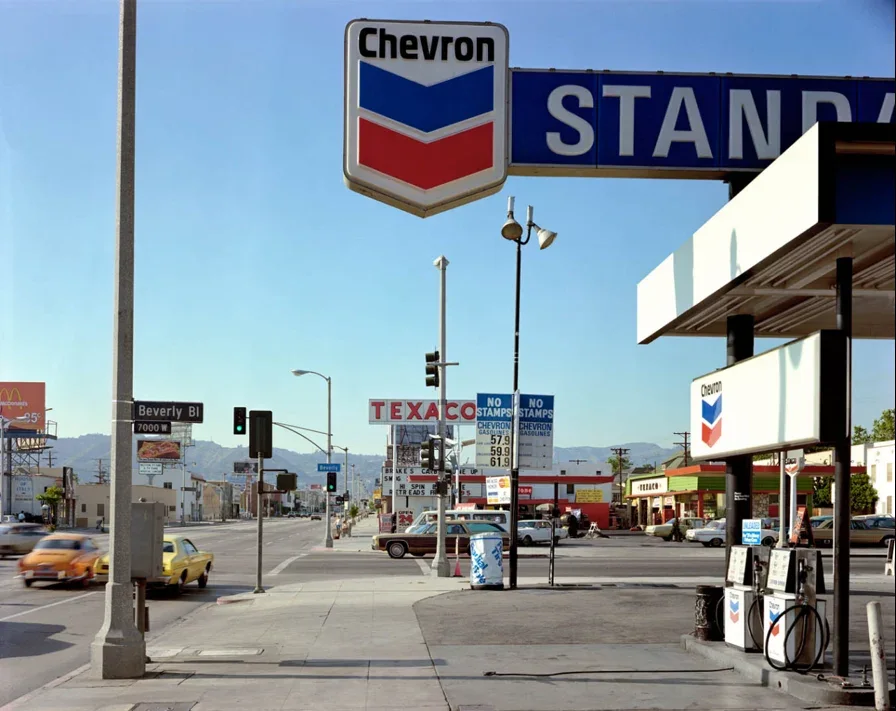
What I'd like to ask you is this. I've noticed some of your works, such as The Crooked Path and this one, Still Lake, Vancouver, Winter 2003. To me, these two images also have transparency. As I see it, the only difference between your work and Shore's is that yours seems to contain metaphor, while Shore's does not. That's my understanding, though I may be wrong. That's also why I think Shore usually doesn't enlarge his work to tableau size, two or even three meters. For him, the largest prints are usually only around one meter wide.
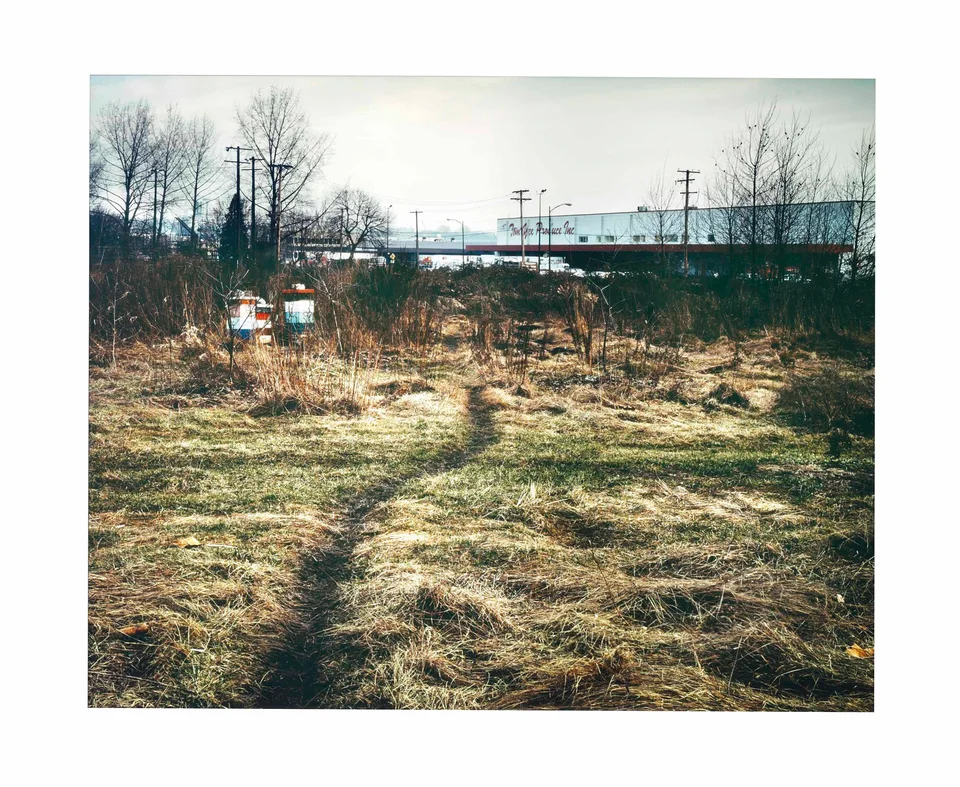
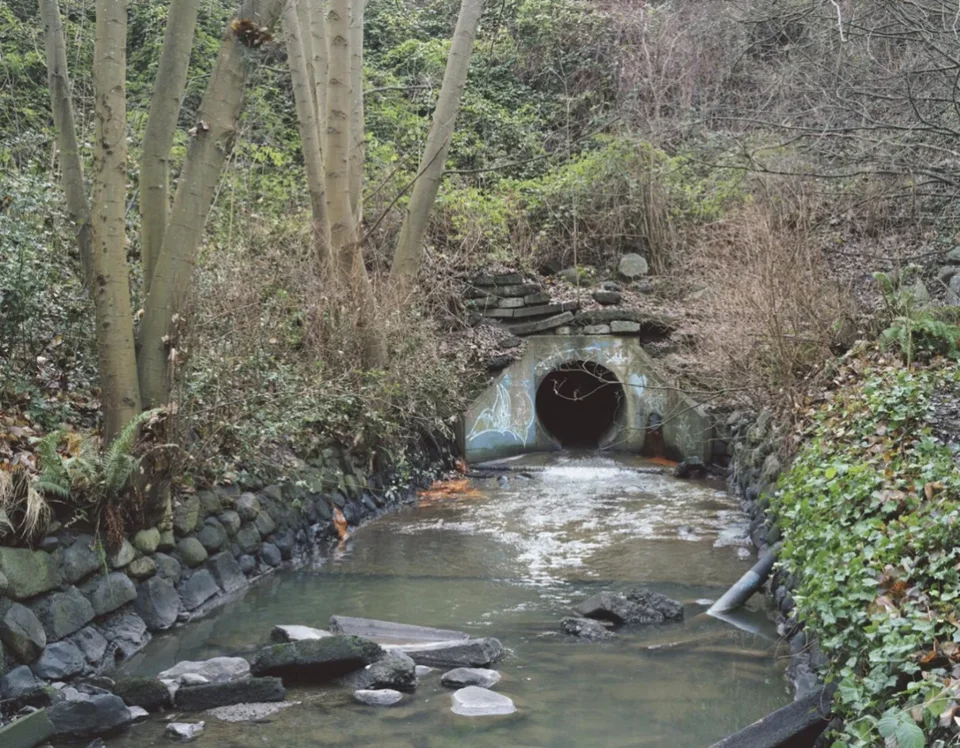
I think that once Shore's work is enlarged to a very large size, it becomes difficult for viewers to see the relationships among the elements he has constructed in the image. That's why I think his work is better printed at a smaller size, so viewers can see the details and relationships he has constructed, or rather, the details and relationships he observed and then constructed.
So what I really want to ask you is: do you think there is also transparency in your work?
Jeff Wall
Yes, because the two pictures you showed are the kind of picture I do quite regularly, or as regularly as I can. And those are utterly straight photographs. They're made exactly like anybody else takes a photograph. Those are places that interested me, just like the Standard Station in Amarillo interested Stephen — that gas station is still there, by the way, I know it.
In any case, the places that I photograph as a straight photographer are just places I find that have a certain fascination, which I don't necessarily need to define. And I do straight photography as part of my work, and I always have. I like to weave those things together, and that goes back to what we were talking about a few minutes ago — about the fact that every avenue is open. I haven't closed any doors by criticizing any other kind of photography. I have no criticism of other approaches to photography, and I certainly have no criticism of the documentary tradition. I still think that the documentary tradition or mode is the fundamental identity of photography. As I said, there are alternatives — my work is filled with documentary impulses, and therefore it's filled with transparency, what you call transparency. Most of my pictures result in a kind of immediate capture of a real place, in an existing moment in time, no matter how much literature or other energy I might be involved in to create a starting point. The result is still a photograph. I take photographs like everybody else takes them. My photographs are subject to the same criteria as any other photograph. The other aspects of them still have to finally result in a photographic capture.
There's something I have in common with every other photographer and every other mode of photography. Transparency — what we call transparency, which is a sort of way of talking about the reportorial, the direct reportorial phenomenon — is always there in my work. I work with it all the time. I never deny it.
Let me just say something about scale, because you mentioned Stephen's scale. I never set out to make big photos, and I'm not interested and never have been interested in big photographs for their own sake. I've said this many times. My pictures are made the size I think they need to be, in order that what I want to be seen is seen the way I want it to be seen.
It probably has to do with the way I see — myself, I guess, as everyone — I think everybody's work has to do with the way they see. It's a kind of expression of how I really see the world. One of the most fundamental frames of reference I use — even though, as I said, I don't follow any rules, but there are criteria — the so-called Western picture that we were talking about earlier mastered the mode of working at what we call life-size. Because when painters were painting, say, murals on big walls, many of those pictures had to appear as continuations of the space in which the spectator was standing. And so that certain magic that we get from Raphael, or whoever painted these pictures, partly stems from their ability to understand that there's something specific about that moment when the image you're looking at is in the same scale as you. And that moment is the only objective moment of scale that we have in the world. Everything else is either bigger than the world or smaller than the world. All of those scales are fine, but there's only one that is what I would call universal or objective — that is the one I've just mentioned.
Because I've always admired many of the works that were done at that scale — because they have that magic to them — I found that I had an affinity to that mode of representation. I use life-scale as a kind of rule of thumb, let's say. It's not quite a default, but it's something I think about all the time. There's something also very intimate about that scale, because you can come very close to the image and see details of the world that you're looking at that you can never really see in real life, because you can't get close to things that quickly.
So there are a lot of positive things about it. My pictures are always made at the scale I think they need to be. And that doesn't mean they have to be necessarily large. The two pictures you're showing here are places I have known and experienced in the city, that captured my attention for various reasons. We could talk about it, but there are obviously things there that intrigue me — like the crooked path intrigues me, because I like crooked paths. I like this kind of terrain vague, these spaces that haven't been settled completely, that still retain some of their non-urban feel. The countryside is still in the city. I love that sort of thing. Maybe it's a sort of nostalgia for the city I grew up in fifty or sixty years ago, which was much less built up then than it is today. And I'm sure if you're living in China, with all the construction that's gone on in the last decades, you probably know what I'm talking about — so many things have vanished.
Those things have form and shape and atmosphere and suggestion and nuance that I just like. And so I want to pay attention to it, and I want to draw attention to it, and I think they're beautiful — let's put it that way. And because they're already beautiful in themselves, the camera can just capture it. It's just up to me to have noticed them. And I use that all the time in what I do.
That's why I'm repeating what I said earlier: I don't make distinctions between, let's say, something that emerges from some literary or subliminal personal fantasy and an immediate capture. It's all immediate capture. It all leads to the same place — the operation of the lens and the shutter and the film, and so on.
And as far as there being metaphor in what I do, as opposed to what Stephen does — I'm not sure I agree with you. Because the crooked path could be a metaphor for many things, including our path in life, let's say, but I don't find that interesting, even though I know it's true. That's not what really motivated me. My motivation in that case, on the level of metaphor, would be more my affection for these ways to get through space in a settlement. Maybe it's a more anthropological treatment. But I'm not going to make a justification for my own treatment of the subject — I'm just trying to compare it a little. So I don't feel very strongly about the metaphoric aspect of my subjects. I feel strongly about the fact they're telling me something that I want to know.
Photography's Illusion and Medium
Ce Zang
All right. The last round of discussion touched on photography itself. As a medium, photography, at least in our understanding of it, is considered very transparent, the most transparent medium of all. But in fact it can also be recombined, while still presenting itself in a very transparent way, even though we know it has been recombined. This connects to what we discussed earlier: the relationship between what the eye sees and the imaginative, even daydream-like, continuous flow of consciousness that our brains generate at every moment is a very interesting subject.
Mr. Jeff Wall, what I was just discussing is really the so-called "genesis" of your work, the thoughts and ideas that come before shooting. But I've noticed a very important characteristic of your post-production after shooting: every work is considered with great care.
That leads me to a question I'm very interested in: how do you balance control over every detail of the image with letting the work fly free and retain its own freedom?
I usually don't look for answers about art and photography within art and photography themselves. I often think through neuroscience and other disciplines, including Lacanian theory, which you may know well. So I thought of a very important principle of cybernetics, proposed by W. Ross Ashby: a person's brain can only control systems simpler than itself.
For an individual artist, art is clearly a more complex system, so it's impossible for an artist to have complete control over their work. Yet I've noticed that your control over your work is very meticulous. Still, I believe there must be parts of your work that are allowed to generate themselves, parts you don't control.
So I'm very curious about this. In your image-making process, what do you leave uncontrolled, what do you control, and how do you maintain a balance between the two? That's my question.
Jeff Wall
Very difficult question to answer. Very difficult, because when I'm actually at work, I'm not always that sure what I'm in control of. We often delude ourselves that we're in control of things, and the reality is quite different. And sometimes that shows up only later, either for good or bad.
For example, I may feel like I'm controlling a process, but there are things that have escaped me, and I'm not aware of them at the time. Sometimes that can lead to very bad results, and then I have to stop and correct myself. Other times, it will lead to something much better than I would have possibly intended and could possibly have controlled. So it's not quite so simple.
For many years, people have considered me a control freak who has to control every little thing, which I think is kind of naïve on the part of people who don't really do this kind of work. Because all you have to do is watch me work for a few hours and you realize that's not quite the case.
First of all, I try to control myself — that is, I try to avoid being seduced by stupid ideas, false starting points, extraneous considerations, et cetera. That's important, because it's tempting to try and make your work for ulterior motives. It's difficult not to do that. So first of all, you need to control that — and that's not very easy in itself. Again, you never know whether you are in control, so that's a problem.
And then there are certain things that you simply must control: you will not go anywhere if you can't control them. For example, you pretty much have to control the camera, because if you don't control it, you will get no results. That's obvious. There are all those sorts of things that one controls.
When I'm working with people, I know that I can't control them. I have no control over these people. I have no authority. It's just a relationship I have with them. So that's an area where it's never definable, and so on.
So everything I do, no matter how simple or complicated, is always a sort of a game, I guess you would think of it, with what control really is. That's a much more fascinating way of looking at it than whether there is control or not. There always is, and there always isn't. And it's always fluctuating, and it's always fluctuating in ways that are difficult to anticipate. I make many so-called mistakes, but some of those mistakes, as I said, turn out to create something better than I would have done had I not made that mistake, and so on.
This goes back, in a way, to what we were talking about earlier — about the nature of what I call cinematography, which is this open field where the photographic technology, the whole apparatus, is available to be used in some way. And the way it gets used depends, for me, above all on the subject. The subject determines my path. Any picture I've ever done has been determined by that subject. That is the ultimate control, anyway, if there is one — it is the subject, because it demands things of me that I wouldn't have known about and wouldn't have sensed until that subject emerged. So I have to pay close attention to that.
How I follow that path — in some ways, the ways the path is followed are kind of unknown, because I've done many pictures and I know how to do certain things. I never seem to be doing the same thing twice. There's a certain control over the technical parts, certain control over management of whatever I'm doing, certain control with the people, depending on suggestion, and so on. It's all very vague.
So the answer to the question really is: I don't know. All I know is I have experience now of having made many mistakes, had many problems, put myself in many bad positions, got myself out of it somehow, had a lot of excitement about getting into bad positions. Sometimes it's very exciting to be really in a bad spot — it really makes you want to win that game at the last minute. That's also an experience that you have to deal with.
I think photography is also very unique in that — for example, a painter who is working on a painting with a brush and paints does have that brush in his hand, and that brush can be kind of controlled by his hand, up to a point, because we know that the end of the brush doesn't exactly do what you want. So if you want to do it exactly, you don't use a brush. But they have control over things that photography doesn't permit. So the medium itself creates this ambiguity, and I work with that ambiguity all the time.
To talk about the post-production, as you mentioned — there really only was post-production once the digital technology entered. Before digital technology, one had to capture what you're going to capture on one piece of film, and that was it. The only post-production was how well you could print it. That was pretty much all anyone could do. There was no flexibility inside of photography on that level. So there wasn't post-production to speak of — nothing important.
With digital montage, which is what I do a lot, then there are many things one can do later. I only use digital montage to assemble an image that could never be captured properly on one piece of film. That's all I ever do. I don't do anything else. So many of my pictures have been captured on a single negative, and I will always try to capture it on a single negative if I can, because it's so efficient and so satisfying. But that's not always the case, and sometimes one has to plan not to do that, because there are certain impossibilities — certain subjects just escape the possibility of being made with a single negative, and then a lot of planning has to take place.
Most of that planning is done before any digital work is done, because one has to photograph and make negatives that can be put together properly. And that's a photographic technique. I've worked a lot on that technique, so I have a good sense — if I need, say, five pieces, I know how to make them so that they're likely to go together successfully. That part of it is a kind of controlled part of the work; I can do that once I know what I'm trying to do.
For me, the post-production part is important, but it really is only the realization of something I wanted already at the negative-making stage. Nothing emerges later that would change what I've already put on film. I would never use — I guess I shouldn't say never — but I never use any kind of CGI assist or anything like that, to add elements or do that sort of thing. I don't do that. I just realize what's already on the film and assemble it in a way that I need to assemble it.
And my main rule of thumb so far has been to create the illusion of the single negative. My pictures contain an illusion — another level of illusion — which is that it's a single negative. And I think that illusion is quite important, and it hasn't really been commented on very much over the years. People who have talked about my work haven't maybe noticed that fact: my montages are based on the creation of an illusion. And that illusion, in a way, creates a relationship to this whole history of picture-making that we've been talking about — because all unified images, except for the immediate capture on a single negative in photography, all images — the unity of all images is illusory, because a long process of making brought that unity into being. All unified images that we see as whole are usually an illusion of wholeness, which is one of the things that fascinates us about them, because we know somehow — people know somehow — that it had to be brought into being, and they kind of marvel at the fact that it could be done.
That's a very old thing, and I'd like to be part of it, because I know I could never escape it — I can never escape it in any case. And this illusion is also the illusion of the level at which we feel we might comprehend our own existence, which is a sort of illusion anyway. In other words, that a picture could disclose the real nature of our existence is illusory. We aren't likely to have that knowledge. But we feel that we understand the world somehow when we see images that sparkle in some way with their unity and do all those things — we feel that we have a satisfying apprehension of who we are and where we are. But we know it's illusory, because we know it was made by another person.
So I think that the artist's relation to illusion, to that kind of illusion, is fundamental, and it comes into being in different arts in different ways. And for me, it's come into being through that process of making my pictures — even if I've captured them in one frame, like, say, the man with the milk. It's still a process of work, and it's taken time and reflection. And I think that maybe sometimes people appreciate that when they see my pictures — they feel there is more there than they are quite looking at. They feel like there's something that's escaping them that's also there. And what's escaping them maybe is their sense that I did that — that I did something to bring that into being, whether it's in post-production digitally, or whether it's in the actual work method, because my working method is often quite slow. I get there slowly. It creates that feeling.
I don't think that's too good an answer to your question, but I think that the fact is that the level of control inside of photography is just kind of indefinable. I'm still playing with it all the time.
Ce Zang
Thank you very, very much, Mr. Wall. You just used a wonderful phrase: "the illusion of the single negative." This illusion is very important in photography, because most people, going by common sense, understand it as reality. But that's impossible, because photography is a fiction; in my view, it is a fiction.
Next, I'd like to say a few words about my own view of visual art.
I know that many of Mr. Wall's imaginings, impulses, and fictions come from his stream of consciousness and daydreams: a cinematic textual construction, a kind of narrative, first takes shape in his mind. When he turns it into "the illusion of the single negative," he is in fact doing his best to erase traces of semantic information, that is, traces of narration.
My view is that when an artist makes a work, the work itself has already become a "thing." Since I know Mr. Wall is also fond of Lacanian theory, to borrow one of Lacan's terms, the work he actually produces is closer to, or leans more toward, the Real. Viewers cannot see the Real, because in the viewer's mind there is the Symbolic. Whenever viewers see something, they symbolize it. As Mr. Rong Jiang just said, when people see a path, they think of the two paths of life, that sort of thing. The human mind always has something symbolic that prevents it from seeing the thing itself, so it assigns meaning.
So I believe that in all photographic works and all visual artworks, as they pass from artist to viewer, and in the process of making them, the semantic information has already been severed; it no longer exists. Because this symbolic system exists in our minds, all the meanings we add, our imaginings, and our fictions are assigned anew when we look. This is a rather distinctive view of visual art that I hold. I wonder what Mr. Wall thinks of it.
Jeff Wall
I'm not so sure about that, because the camera apparatus, shall we say, is a scientific device, a system, a technology. I'm willing to say that what the system captures can be considered accurate to what is physically there. I'm willing to go there and say that we can accept that, just the way we accept the data emerging from other technologies.
I don't think that's very subjective, because if it is, then all science is subjective, and I'm not ready to concede that just right now. So no matter what level of awareness I'm at, or the audience is at, it's all going to be focused on a kind of capture that — despite all of what we've just finished saying about illusion — contains this unprecedented facticity, factuality. That's hard to deny. The reason it's hard to deny is because we've all looked at photos of something that we can see with our own eyes, and can compare the two. With your iPhone thing, you can do it a hundred times a day and compare what you're looking at.
So we know that this lens-system transmits to us a very close copy of what we're seeing with our eyes. We know we see with two eyes and the camera sees with one eye, but we put that aside. Regardless of the illusory universe, let's call it, that one works in with photography, we always come to this point where we have to capture. Again, we always have to come back to the fundamentals of the medium. We don't seem to be able to do anything about it, and I don't think we ever will be able to do anything about it. And that authenticity, if you want to call it that, or that accuracy, is inherent in the photograph as well.
So when I say I create an illusion of a — let's say, in terms of this discussion, there are two illusions: one, the illusion of a singular negative, if there isn't one; and two, the general illusory nature of images anyway, because all images — painted, drawn, photographed — have the illusion of space on a flat surface. We have that. Photography brings this to a very intense point of focus, of contradiction if you want to call it that. Both of these things have to occur at the same time, and we don't really know how it happens.
I will go back only to say that I really do believe that it's the composing process of the artist that allows the — let's call it the prosaic capture of fact — to somehow, at the same time, resonate with something else. That something else is what we call the artistic illusion. I guess that's one of the reasons I like photography so much, because it contains in it so much pressure — so much pressure between these two problems: one, the free play of the mind, and two, the burden of the obligatory scientific nature of the recording device.
These two things happen at the same time — something that fascinated me, and probably why, in the end, I turned to photography and didn't continue to paint, which I did earlier. Because painting seemed — but I think back on it — one of the things I might find unsatisfying is that the conflict between the actual appearance of things and our ability to use a brush or a pencil to record them just wasn't strong enough. It remained too subjective, I suppose.
Ce Zang
For the next round, I'd like to invite Mr. Guosen to ask his questions.
Comedy, Enigma, and Looking
Guosen Chen
Given the time, I think I should go straight to the question that interests me most. I need to share my screen for this question. Just a moment, let me pull it up. Can you see it?
Jeff Wall
Yes, I see it.
Guosen Chen
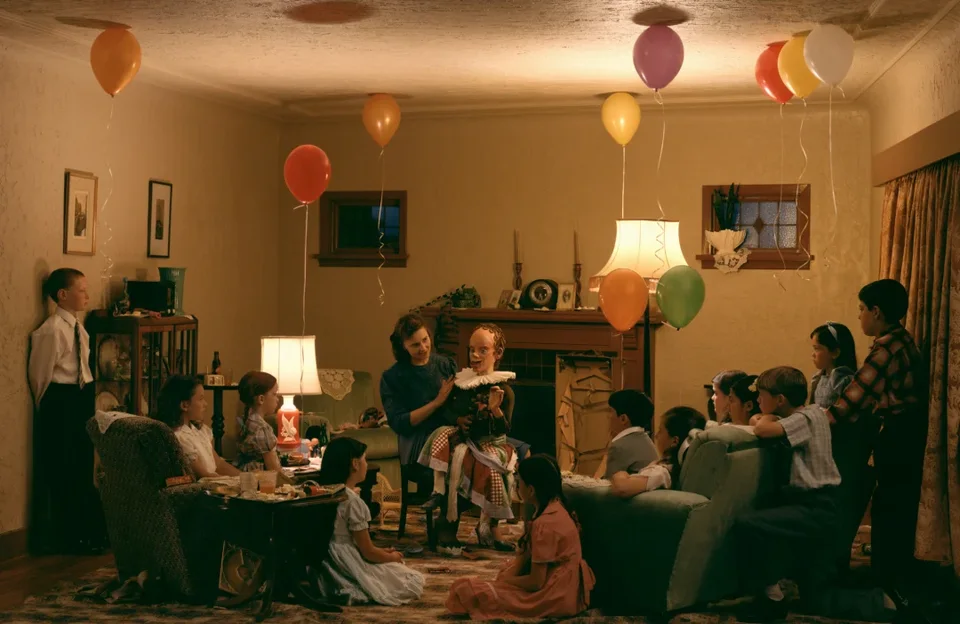
I may need a moment to explain where I'm coming from. If I had to rank my favorites among your works, I would say without hesitation that it's the enigmatic group you made in 1991 and 1992, such as The Vampires' Picnic and Dead Troops Talk, and one more, The Ventriloquist at a Birthday Party.
We've been talking about illusion. You could say that these works are, in a literal sense, illusions or visions, because what they depict could never be seen in reality, at least not in the way they actually refer to it. I've actually discussed these three works with a friend of mine, Linzi, and she told me she felt they offer only a method of decoding, while the answer is not contained in the method itself.
For example, in his book on Raymond Roussel, Death and the Labyrinth, Michel Foucault has a passage that says, roughly, that the smallest, most precious, most carefully guarded key is not inside; the apparatus exists only as a method for revealing the secret. In this sense, your work is strictly different from a riddle, because it fundamentally does not serve explanation. As a result, it haunts the viewer like a ghost.
In some of your earlier interviews, you've also mentioned that the improbable is something you often find in images, and that even works that look realistic are full of spectral characters.
But what I really want to ask about, strictly speaking, concerns neither ontology nor decoding. Starting from Dead Troops Talk and Ventriloquist, I gradually noticed a very important quality that seems to run through your work, something close to comedy. Generally speaking, you're regarded as the most theoretically self-aware photographic artist working today, someone who perhaps carries the whole modernist lineage since Manet. That might suggest a certain seriousness. Yet this comic quality is not limited to these three works. We can find it in others too. Let me give a few examples.
This one, The Vampires' Picnic. The old woman in the middle of the picture is lit by a photographic lamp. Here, she's wearing a sandal on her left foot. We can see this sandal, which makes you feel that she too has been transplanted, just like the others, from some ordinary domestic scene into this extremely uncanny forest. Then there's the naked man, the only nude figure in the entire work, at the bottom of the picture. Perhaps he refers to some socioeconomic condition; I'm not sure.
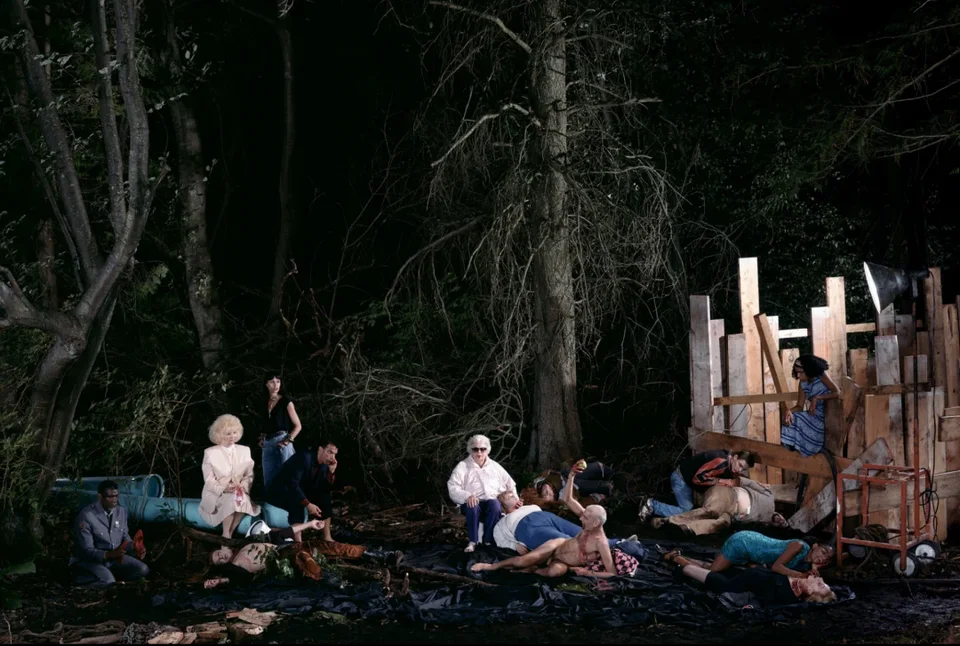
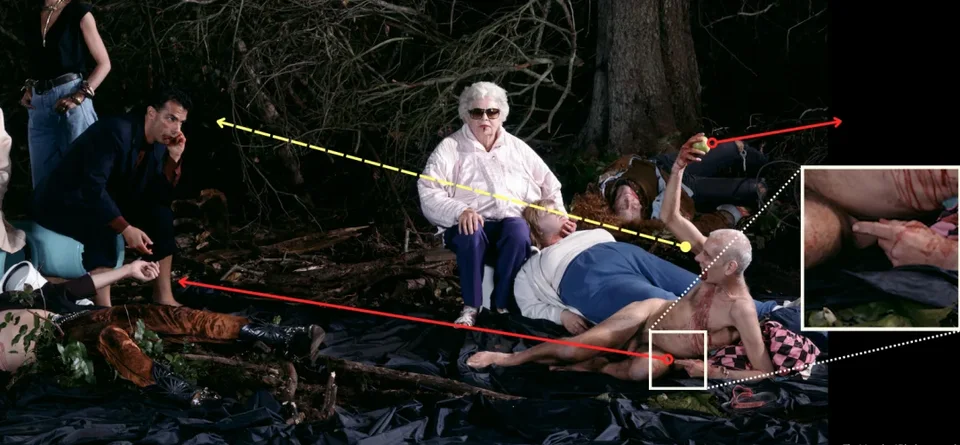
Let's look at another example. Sorry, I don't have time to explain what I found in every detail, so let's move on. In this work, I think the puppet itself has an inherent comic quality; I can feel sympathy and irony mixed together. This one reminds me of Houdon's statue of Voltaire.
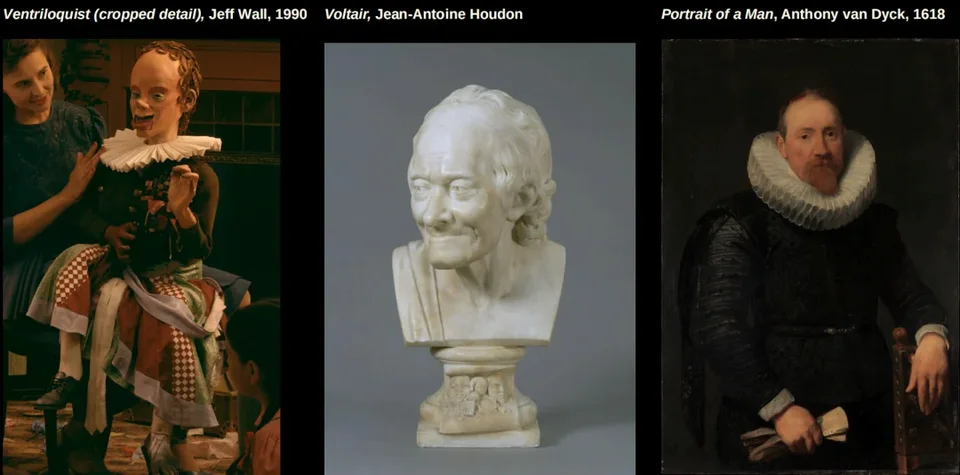
So I'd really like to know: are you aware of this comic dimension in your work? How do you understand this quality? What is the relationship between this sense of comedy and the pictorial quality or formal beauty you care about? Also, these three soldiers are laughing and joking. And in this one too, I sense something like a comic quality. That's my question.
Jeff Wall
I think it's there — not always, of course, because I don't want to — I like the idea of being able, like I said, to go freely to whichever domain I get attracted to by whatever circumstances. So I would never rule out any mood or type; that would be against the idea that there are no rules. So I've always left it quite open as to where I could begin.
A picture like The Vampires' Picnic, for example — its points of origin don't really matter. But I will say one thing: some years before, I'd written a long essay — one of the few essays I've written — about Dan Graham and about his relation to architecture. And in that, I developed this whole, slightly crazy, vampiric reading of Philip Johnson's Glass House. It made me realize that vampires had a presence in my mind somewhere. I guess that set off a delayed reaction later, because I wrote that in the early '80s and I made The Vampires' Picnic about ten years later.
For some reason, when I thought about Philip Johnson and his Glass House — it exists on a very secluded property and it has no curtains, and Johnson could live there quite privately because nobody could get onto the property — and so when I was writing about Dan Graham's architecture things, which were based in a kind of dialogue with that sort of architecture, it all kind of came back. So then later I realized: the vampires that I was talking about in that essay — where are they? They couldn't get onto Philip Johnson's property, but where are they? I suppose that's where I began to imagine: where are these vampires? That became a sort of comic premise. I realized at the beginning of the project that it's comic, because vampires — how popular they are in the mass media — anything that popular in the mass media has a certain comic aspect to it.
I knew that at the beginning, so I knew that in order to make that picture I would have to delve into those comic elements. When we say comedy, though, we don't necessarily mean something that makes you laugh out loud. It's something that amuses — it amuses you but contains other energy. It's not just telling jokes, although telling jokes is fine too. So I see the comic mode as something that's quite viable. If it should come up, I would never avoid it. And it was interesting at the time to kind of explore those things, as I hadn't really done that before much.
So I thought: I'll do The Vampires' Picnic, because when vampires go on a picnic, they don't bring sandwiches — they bring someone that they can feed off of. So all these vampires have brought their picnic with them, and that's also comic. And other aspects — like the social nature of all these people, this heterogeneous group who come from everywhere.
The subject sort of demanded an analysis of the vampiric myth. The vampiric myth is that the vampire is an aristocrat who preys on the peasantry and the lower classes in order to prolong his immortality, and so on. But as society changed, there are fewer and fewer aristocrats. If aristocrats are producing vampires, they're not producing them from other aristocrats — they're producing them from peasants and such. Eventually the demographics are going to change, and there aren't going to be very many aristocratic vampires anymore. My vampires are kind of a cross-section of the lower middle class, et cetera — all kinds of people who have become vampires over the centuries. That's comical in itself.
The subject, as I told you earlier, determines the treatment. And once I thought that I could do this subject, I knew it had to be in this comic treatment. And I've done it in other pictures, like you say — sometimes it's more of a black comedy, like with the Afghanistan war picture. It's more of a black comedy, because it's a hellish scene. And inside of that catastrophe, there are many ways that people can respond. I thought: of these soldiers, who would be aware of their own death in battle — how would they react? And some react very seriously, some react tragically, and some react foolishly. That just seemed to be part of the whole nature of the subject matter itself. It wouldn't have been a very interesting picture if they all had only a sad, somber, tragic, outraged view. Something else would have to be there — that seemed to be elemental.
I'm quite happy to engage in the comic mode whenever it seems to suit. But one other qualification: sometimes it only suits partway. Sometimes it only suits in combination with other things. It's not necessarily this or that — it can be very hybrid.
The Ventriloquist — the picture you mentioned — has in it something sort of laughable about this doll, because the creature seems absurd in a way, or perplexing, and you're not sure whether you're frightened of him or you're amused by him, or what. And I wanted that, because I felt that these children would be hearing something from him that we can't quite fathom. If it was an ordinary, standard ventriloquist puppet, you'd kind of know what he's saying. Whereas this guy, you don't know what he's saying, because you've never seen anything like that before.
I worked very carefully at making him. I invented him and made him in order that he would carry these mixed meanings — as many mixed meanings as possible. There's a certain absurdity about him and a certain horrific quality and grotesque quality. His hands aren't a pair — they don't match. His feet don't match. He's made up of pieces. That has in it a certain quality of levity, although it's mixed with many other things.
So I'm glad you see it. I think it's just as serious as any other approach. I'm trying to be open to all moods. So if something strikes me as having that kind of potential as a subject, I'll use it. I recently made a picture of a man doing a backflip in a bar. It's a recent picture and it's entirely in the comic mode — that was only a year ago or so. So it's always open to me. But then, you see, any mode is open in this pattern. I've tried to explain to you that the field is undefined, except for its technical parts.
Guosen Chen
All right. Before we continue, I'd like to respond briefly to what you just said. You connected the vampire motif to questions of society and class, and I need to share my screen again to return to that detail. I've read your essay on Dan Graham, and I once gave a presentation in which I spent about two hours going through all the details and the iconography one by one. I don't have time to go into all of it here, but the work I spent the most time on was Ventriloquist.
I want to respond to what you said about comedy, that it isn't just about telling jokes. It makes me think that in Ventriloquist, the great philosopher has been shrunk into a kind of monster, with a grotesquely enlarged head, I think because he has thought too much.
Jeff Wall
He must be very smart. This doll must be very clever.
Guosen Chen
His upper garment looks like some kind of Eisenhower-style military jacket, but on his lower half he is clearly wearing women's clothing, a kind of skirt. The gesture he makes with his right hand is, I think, a very typical rhetorical pose, something like this. And his left hand is shaped almost like an animal's claw, something nonhuman, gripping his own belly or thigh.
I think this relates to the theme of temporal dislocation, because every visible clock in the picture shows a different time, like this one, and this one. I'm not sure whether this is really a clock or something else, because it was my friend Linzi who noticed this detail and told me about it. But I think the theme of this work has to do with temporal dislocation.
But before it becomes any theme or subject, I think it is first a comic sensibility, even a kind of sharp social comedy, which we can also find in The Vampires' Picnic. It's as if, in your work, the most serious and fundamental questions are presented in a comic mode.
This makes me think of Kafka. It's said that when he read The Trial aloud to his friends, he couldn't stop laughing. In Dostoevsky, too, the most disturbing things are often the most comic, such as the moment in The Idiot when Prince Myshkin declares that beauty will save the world, and the whole thing unfolds in an excruciatingly awkward way.
More broadly, one defining feature of modern experience as Baudelaire described it is comedy. In his essay "On the Essence of Laughter," he argues that comedy is essentially a satanic quality. For Baudelaire, we laugh because we become aware of our own smallness and fragility, yet are powerless to transcend that condition.
That brings me to the man in Milk crushing the carton in his hand... All right, I'm sorry for talking so much. I remain continually fascinated by all of this. But I don't have any more specific questions about it. I just wanted to share these thoughts with you. Thank you very much.
Jeff Wall
Thank you. It's interesting. Sometimes I feel that one of the phases of my work is writing, because in some way I have to compose — I have to speak the subject in order to begin to make it. So in some ways — and I believe this is true of any picture-making artist anyway, but I know it from my own experience — there's an act of writing that takes place in the phases of making a picture.
Say, to keep to The Ventriloquist: I don't really remember why I wanted to make it, I have to say. It's too long ago now, and I can't remember. But I know that the writing work emerges at a certain point. For example, as soon as you say the term "a ventriloquist at a birthday party," you've already written something — because you've conjured up the scene. So an act of writing has already taken place at that point. Therefore, you sort of — I set myself on the path toward the photo by that act of writing.
But at the same time, I never really write any more than that. I have to stop writing at that point, because I'm not a writer and I have to work with my materials. And in this case, the materials were the birthday party — which meant there would be a children's birthday party, and it had to take place in a place, a house I suppose. Since it was in October, it would be in the autumn, so it wouldn't likely be outdoors. And there would be entertainment, and the entertainment was the ventriloquist. Sometimes you would have a juggler, a clown, this or that — especially in the old days when they didn't have other things.
Then the writing kind of migrates into something else, which is making. In this case, I had to make things in order to make the picture happen, because I did have to create the doll — he didn't exist. I looked at many ventriloquist dolls at that time, and I met a man, a friend of mine, who had a collection of them. I looked at his collection and I thought I might borrow one from him, but none of them really did what I wanted. And I realized I had to make my own — which is not that difficult.
Then, you see, the making of the doll is another phase of writing, if you want to think about it that way, because I had to write him — I had to invent him. I had to invent his face and his hands, and so on. That was very enjoyable, because I like making things. But the writing, in a way, gets sublimated, I suppose, into other practical activities, and then stops being visible as writing anymore, because it becomes lighting, costumes, clothing, people, et cetera — all the physical things.
But if the writing has quality to it — literary quality to it — then it should show at the end, you see. The composition — the terms I'm using are literature, composition, practicality — but they all are one thing that has to lead to whatever you end up seeing. And if people end up liking, enjoying the pictures, and finding something in them that's kind of not there, as you mentioned — there are things that are not visible but you sense that they're there — for example, I do really wonder what that doll is saying to those kids. But we'll never know. I also wonder whether, in fact, that doll never was there — that what they're seeing is something that they remembered later as adults, which never really happened.
Those kinds of things are literary thoughts — what are we seeing? We may be seeing something that never occurred, and so on. So I think these characteristics that I like, and I think other people like, are a kind of literary activity that is displaced into our plastic making. And I guess that's just another way of talking about pictorial composition — that it involves these different dimensions: the verbal, the identification of what one wants to do, and then the kind of game-playing and fantasy that emerges when you start doing it, because everything is, in a way, play. There's a play element in what I do. I like doing it. If I don't like doing it, I don't do it.
I remember very much liking making this picture, because I had so many things to do and had such a good time doing it. So I probably put a lot of strange, sort of intimate things of my own in there without really knowing what they were. And the doll kind of emerged in that process. So that's all I can tell you. That's enough.
Guosen Chen
Thank you for your response. I found its openness and restraint very illuminating.
Jeff Wall
I'm glad you reminded me, because I think that this question of writing has become more and more important for me to think about as time goes on.
Guosen Chen
Yes, because what I take from you is that you've created a world, and you openly acknowledge that you can never exhaust everything that world contains. To me, that is also something essentially literary. I had another question about the relationship between photography and literature, but I think I can already find my answer in what you just said. So I'll set that question aside. I think perhaps Mr. Rong Jiang should ask next. All right, Mr. Rong Jiang, please.
Ce Zang
Actually, after this round of discussion with Wall, I've also worked out my second question, so I no longer need to ask it. But later I'd still like to ask Mr. Wall whether our understanding is right, whether it's close to what he has in mind.
Picture and Image
Rong Jiang
I noticed that you used the words "picture" and "image" interchangeably. You also mentioned the abbreviation CGI, "computer-generated image." I have two questions for you. First, how do "picture" and "image" differ in definition, especially in light of Vilém Flusser's concept of the "technical image," that is, an image created by the computer as an apparatus? That's my first question, about the definitions of "picture" and "image."
There's also a related question, which I think all of us want to ask you. You once said: "By opening up the photographic moment, the computer begins to blur the boundary between the forms of painting and photography, creating a new threshold zone that interests me very much." So I'd like to know whether you think AI technology can also create such a new threshold zone. Thank you.
Jeff Wall
The first thing — about the definition of image and picture — I shouldn't have... I probably spoke improperly, because I do make a distinction. An "image" is sort of what can be produced by any apparatus — as you mentioned, Flusser's idea. That's more what we think of: an image can be formed by all sorts of means. You can see images in mirrors, you can see images generated by machines, and so on. But a "picture" is what we were talking about at the very beginning — this composed entity that we treat in a specific way.
If I made a mistake there, it was just because I wasn't thinking. But I do make a very strong distinction between the two. At the same time, paradoxically, because of the photographic process I've been talking about, this thing called the image keeps appearing in the process of making a picture. So they aren't quite as separate as all that. If I — or anyone — am making a picture, I'm also imaging. In some ways, the picture has to come into a relation with what we call the image — with the image process — in order to actually happen, especially in photography.
Again, it's not very easy to separate these phenomena from each other inside of what photography is, because it includes the technique. The technical phenomenon is so present in the whole medium that we can't avoid it. We are working with a machine that generates an image, trying to make something that's not an image, or that isn't simply an image. And that's part of the kind of dialectic of the process, which is pretty fascinating, I must say. Because, as I was talking to you earlier about my control — what I could control and couldn't control — that's a slightly comic question in itself, because it's a bit comical when you think you're controlling something and you realize that you're not. What you're controlling with is that technology, which is present all the time. The — let's call it the element we would like to exclude, which is the image — can't be excluded. A picture gets made by a treatment involving the process of imaging. So it's always blended that way.
AI — people are asking me about this these days, because it seems everybody is very interested in it. AI is whatever it is. To me, I don't like the term "intelligence" too much, because I'm not sure that really captures it. I think these are just massive networks of computers doing things. Part of what they're doing is generating images out of prompts and data, and so on. That's all good, but it's not photography.
We can talk about AI image generation, but that isn't photography, because photography happens in an encounter with an apparatus like a camera and what's outside the camera — which is still, let's call it, nature, just to be simple. That's photography: light impinging on a recording surface by means of an action. If there was no photographing — that is, if there was no light impinging on a recording surface by means of an action — then that's not a photograph.
So if people want to generate imagery that way, there may be many things that will come out of it that could be artistically interesting. I don't really have an opinion about it, because I don't really do it. But it's not photography. Photography still, if it's going to be considered photography, still has to encounter the world outside the camera and all the contingent elements that we've been talking about. And that's sort of where its peculiar qualities come from. If there isn't a capture, then there will not be the unforeseen things that we don't think we saw when we made our picture, et cetera.
At the moment, they seem to be two different domains. Artistically speaking, I think they seem to be very different domains. They'll play their part, I guess — because painting plays a part in photography, as we know. I've been saying that forever — painting, or drawing, or sculpture. So if those things play a part in photography, then I guess AI will play a part in photography too.
Your question about the blending of the media by means of the computer — that's an interesting question. I think — I probably said that when I was in a much earlier moment of getting involved with digital technology and all that. But you see, as I said, all I really do, very simply, is try to efface the joints between different photographs that I make, in order to create the illusion of this single image. That's all I really do.
But that is the sort of handwork that one does at the little tablet on the computer. Some of it is done by hand; it's not automated. Although I believe that these days some of it will get automated, because joining images together seamlessly seems to be one of the things that the new computer systems are doing really well. You can change photographs almost imperceptibly by means of new programs. That's probably very interesting, and I might even want to use that sometime, to make some things easier for myself.
On the other hand, doing things the way I do — with people — does again lead to another set of layers of unpredictability, certain qualities that may or may not be there that I can't really judge at this point.
But I would say that the technique of photography has been expanded by the advent of these computer technologies. Things we can do now are really unique, and they could not really be done earlier. But I want to step back from it. I don't know whether that's made my photographic work any better than anything done before. I don't know whether it has led to any increase in quality, or anything that significant. I don't think that's really clear. The fact that I — or anyone else — can work the way I do doesn't guarantee that anything I do would be any better than something done with the simplest means. I think there are no artistic guarantees with any of these things. They simply are possibilities that one might use if one's predisposed to do it, or has a good reason to do it. But I don't think they have any other virtues as artistic media. That really remains to be seen. But I think it's quite obvious that artistic quality doesn't depend on these sorts of things.
Rong Jiang
Thank you. I'd like Ce Zang to ask his question, and perhaps he can offer a summary. All right.
Theory and Practice
Ce Zang
All right. I've noticed that Wall remains open to every possibility. He doesn't close any door at all, and I think this very open way of thinking is excellent.
The second question I had prepared for Wall was how he balances being a scholar and being an artist. But through our discussion, I feel I now understand his way of thinking better.
As I see it, his academic background, his literature, and all his impressions from observing reality are transformed in him into something imaginative, daydream-like, a kind of cinematic vision.
I think this may be how he achieves balance, because he can awaken all kinds of visual images in his mind. So everything from art history, scholarship, literature, and what he sees in reality comes together for him into something like a gallery of images. So I think his balance may be a dynamic one achieved through the workings of this kind of thinking. I wonder whether Mr. Wall agrees with my view.
Also, on the question of AI that we just discussed, let me say briefly: I feel that AI can recognize; it can recognize images, but it cannot feel. At least so far, AI has no body, so although it can imitate the workings of the human brain, it can never become the human brain itself. It can recognize, because it generates images according to statistical principles. That kind of "technical image" (technisches Bild) comes about statistically. It is not like our human brain; in other words, a way of thinking like Wall's is something it cannot achieve. It can only recognize, not feel; it can only compute statistics, not make an embodied response to feeling. It cannot do that.
So I'd also like to hear what Mr. Wall thinks of these two views. Thank you.
Jeff Wall
OK. About — I never thought of myself as much of a scholar or a theorist or anything like that. But I've been reading about art since I was a boy, as I told you. I've been studying it just because it fascinated me from an early age. I used to go to the library on weekends on my bicycle and take out art history books and take them home and read them. And then I learned a lot about art history and things related, already very early, just because I was that sort of a kid and it just fascinated me. So I got the habit of studying — not studying other subjects much, but studying what I was interested in. I realized that I could learn a lot from books and things. Some people never really learn that, but I did, and it became always very easy for me, because I was doing what I wanted to do. When I went to school and I had to study other subjects, I didn't do so well, because I wasn't that interested in them. But with the things I was interested in, I could always learn about them, and I began to really enjoy it.
And as I did that, I realized that there were other implications that emerged from, say, just the history of art or the appreciation of an individual artist. There were all these other things that began to emerge — such as, what is aesthetics, why do they use this term, and so on. And all these ramifications led to further things to look at and pay attention to. So I've learned a lot of things over my life by that kind of study, and I'm still engaged in it. I got educated at an institution and all of that — I wasn't self-educated — but I learned a lot of things just because I wanted to.
And then I had to earn my living for a while as a teacher, like a lot of artists. So I had to learn to talk about things in front of people, and try to communicate to them — say, what was interesting about the art of the 17th century, or whatever I happened to be teaching. And so I learned to do that by doing it, and I could express myself reasonably well. I thought that I had some interesting ideas — my ideas interested me. I was interested in my ideas. I figured if I was interested in my ideas, other people might be interested in them too. So that's sort of my scholarship.
And the writing I've done as a writer — I always did because someone asked me. I never wrote anything on my own; I never wrote anything because I felt like I should write it. Everything I've ever published was written because someone asked me to do it. If they'd never asked me, I would have never done it. And when I was teaching, all the lectures I made and so on were because that was my job. I've never really seen myself as a scholar or a writer. But I have had thoughts, and I like my own thoughts about art — I think they're interesting. And so they've interested other people.
So it's sort of a byproduct of my just general affection and fascination for what I was trying to do. And also something else: my super-intense admiration for the artists I've always admired. Because there are so many great artists, writers, that I've gotten so much from in my life, that I just wanted to know more about them and appreciate them more and gain a better understanding of them — and also to see what they could teach me. I've learned, in some ways, from all the artists I've studied, without ever having talked to them or met them. I've learned a lot from them. They've been teachers to me. That's sort of my scholarship. It's not very professional — it's just a facet of what I've tried to do.
The AI thing — we talked about it briefly. It will generate images, and maybe artistically successful ones. It probably will happen, because people will use the machines that they've created to do something with. That will probably happen, and we'll probably recognize it as something valid when it occurs. I haven't seen it yet. It may be that it will just take more time. People are using AI in an ambitious way to do different things, but to use it as artists — to use it on the level of what art has been in the past, to create good images — until people want to do that, they probably won't be able to make use of AI too well, because that itself is a task: to take on the ambition, to have the capacity to do those sort of things.
So I'm not eagerly paying attention to it, because it doesn't concern me very much at my age. By now, it doesn't look like it's going to open any doors for me. So I don't have any very original thoughts about it, except we know that people will probably make use of the machinery they have to create something artistic — if they themselves are artistic.
Closing the Discussion
Ce Zang
Time is very tight now, because there were so many questions today. Mr. Guosen prepared very thoroughly for today's discussion.
Guosen Chen
So I don't have any questions at this point; I just want to share something with you. I really love your work, and this actually comes from the fact that you sent me TIFF files of the works I needed for my article, which gave me a chance to notice something.
Something you once said made a deep impression on me: the lightbox has its own "atmosphere." That word stayed with me: "atmosphere." I've seen your original works in person, and I found that to be completely true.
What I discovered is that if I want someone else to feel the pull of your pictures, I don't need to explain all the remarkable things hidden inside them. I only need to take out my iPad, make sure HDR is turned on, and bring up the image like this. The highlights in the picture light up, just like a lightbox, with an almost unimaginable brightness. Everyone who sees it says it's amazing.
The effect is most striking in The Vampires' Picnic, because in HDR mode, the first thing everyone notices is the old woman in the center, fully lit by the photographic lamp. I think that may also be an atmosphere of its own. And you had actually already achieved that HDR effect back in 1978, in Picture for Women.
What's special is that the screen usually doesn't jump into HDR mode immediately. For about half a second, it stays at a lower brightness, and then suddenly, as if someone had switched on a light, the atmosphere of the whole image becomes completely different. But before seeing your work, I had never found the HDR feature so seductive.
That's what I wanted to share; it isn't a question. Once again, thank you so much for everything you've given us today. It was truly wonderful.
Jeff Wall
Thank you again. Thank you. My pleasure. Thank you for doing it. OK, I guess — are you finished, or do you want to ask another question?
Ce Zang
Honestly, we wish this online discussion could go on forever, indefinitely, because I know Mr. Rong Jiang and Guosen prepared many more questions. But our discussion does have a time limit after all. Our art has no boundaries, and thinking about art has no boundaries; it never comes to an end. But our discussion is, after all, limited by time.
So today was very exciting and wonderful. We discussed many crucial issues, including questions of artistic ideas and close readings of images, and there were many excellent exchanges. I believe the friends watching our livestream today will also have gained a great deal.
Once again, many thanks to Mr. Jeff Wall, and thanks to Mr. Rong Jiang and Mr. Guosen for taking part. Thanks also to Jingyi for her interpretation and to Kun Yang for his technical support. That brings today's discussion to a close. Thank you, everyone, and thanks to all the friends who watched. See you next time. Our programs will keep getting better and more exciting. We look forward to the next session.