
Abstract: The Mnemosyne Atlas was Warburg's final research project, and it is also an avant-garde image experiment and a visual apparatus. By moving and assembling the materials on its panels, the "Atlas" builds a heterotopic matrix according to a nomadic cartographic principle. The movement-image points both to the ghostly survival of pathos formulas and to the cinematic structure of the "Atlas." The "Atlas" is at once a snapshot of life in motion and an interface for accessing the archive. Within it, meaning continually leaps and proliferates, taking the form of a radically anti-subjectivist vortex of knowledge, an iconomaniac psychic symptom, and Dadaist montage. As a "cultural science," the "Atlas" has never abandoned its diagnosis of, and response to, the crisis of modernity. It continues to be reconstructed and to flash back in contemporary artistic practice, in exhibition spaces, and even in intellectual history.
Keywords: The Mnemosyne Atlas; Warburg; image experiment; movement-image; photomontage
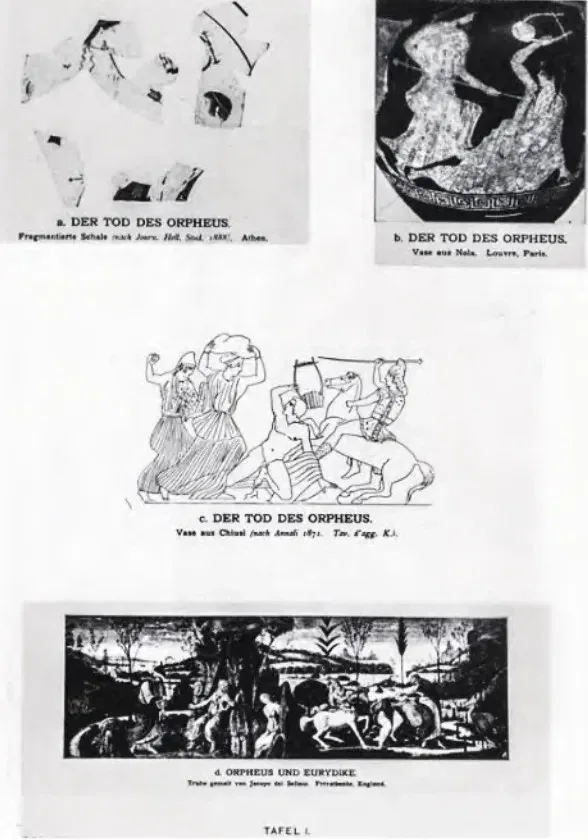
In 1905, Warburg printed an unbound reference booklet for the audience of his lecture "Dürer and Italian Antiquity" (Dürer und die Italienische Antike). It contained two pages of facsimiles of The Death of Orpheus (Der Tod des Orpheus) and one panel page that juxtaposed image material from Greek vase paintings with Jacopo del Sellaio's Orpheus and Eurydice (Orpheus und Eurydike). This last page may be regarded as the embryonic form of the panels of the Mnemosyne Atlas (Der Bilderatlas Mnemosyne) (hereafter the Atlas). In Warburg's later years, the panel became a mode of visual expression on which he relied heavily. His physician Ludwig Binswanger recorded that "...he (Warburg) was not always able to express the connections he perceived (geschauten Zusammenhang) by means of logic and language"[1]. In early May 1928, Warburg displayed in the reading room the panel series for the first volume of his original plan (comprising 40 panels and 670 items), and promptly revised it. On the eve of his trip to Italy in 1928, he produced another series of 77 panels totaling 1,292 items. Some 13 panels of this series, together with their themes, did not reappear in the "final series" Warburg assembled later that year. Until his death, Warburg kept moving and adjusting the materials of the final series (originally planned as 79 panels, of which only 63 were completed, involving 971 items). This final series forms the basis of the now-standard edition of the Atlas edited by Martin Warnke and Claudia Brink.
As Warnke puts it, "Warburg's last great research project... originally grew out of static displays of photographs and reproductions on various themes and for various occasions, a practice that ran throughout Warburg's life"[2]. The exhibition panels and the atlas made up Warburg's experimental method. The panels remained unfinished, in a constant state of shifting, dismantling, destruction, and reassembly. Warburg offered a new visual episteme that went beyond rationalism and positivism. In this sense, the "panel" is an image experiment or visual apparatus: an "image tool" rather than an "iconology." Warburg had no intention of providing a static art-historical table or an iconographic inventory. In his lecture marking the 70th anniversary of Warburg's death, Ernst Gombrich rejected Warburg's description of his own method as "non-iconological" and simply attributed the irrational montage elements in Warburg's work to his mental illness.[3] Gombrich's reading plainly overlooks the experimental nature of the Atlas's method. Georges Didi-Huberman rightly points out that "to consider Warburg's atlas solely from the 'professional' point of view of art history is to misrecognize it twice: once in the extension of its epistemological field (which reaches far beyond art), and again in the dialectic of its temporal model (which reaches far beyond standard history)"[4]. Bredekamp likewise writes that "(Warburg's) thinking reaches into those core domains in which matter and life are defined... the peculiar reach of images, extending from inorganic matter through the world of the organic all the way into the domain of culture"[5]. Warburg's method is trans-art-historical, even anti-art-historical. In diagnosing the crisis of modernity, Warburg is as important as Benjamin, Lukács, and even Adorno.[6]
The Atlas forms a decentralized matrix of signs. It disrupts the homogenized space of art history and draws knowledge into impurity and proliferation. On boards covered in black linen, heterogeneous materials are juxtaposed: photographic reproductions, book pages, newspaper clippings, postcards, advertisements, and stamps. Together they form a "heterotopia" in which different times and spaces meet. Margaret Iverson calls it outright "a kind of mosaic, a montage, even a kind of Dadaism"[7]. The Atlas flashes back and forth between the grid-like structure of rational order (traditional cartography, genealogy, and typology) and the vortex of images in motion. "Warburg conceived of the image as a cinematic structure in movement or montage"[8]. Warburg's movement-image reveals how pathos formulas circulate and discharge, invert and mutate. The Atlas is both the ghostly survival of "accessory forms in motion" and a set of snapshots of life in motion. At a certain level, the Atlas goes beyond the principle of "affinity" and appears as a radical, Dadaist montage and a symptom of iconomania. In his lecture on the serpent ritual, Warburg stated: "For us, this synchronous appearance of fantastic magic and sober purposiveness is a symptom of cleavage (Zerspaltung); for the Indian it is not schizophrenic but rather a liberating experience of the boundless communicability between man and environment (Umwelt)."[9] This may also be read as Warburg's own confession about the schizophrenic montage method of the Atlas.
I. Heterotopia: A Cartography of the Visual Apparatus
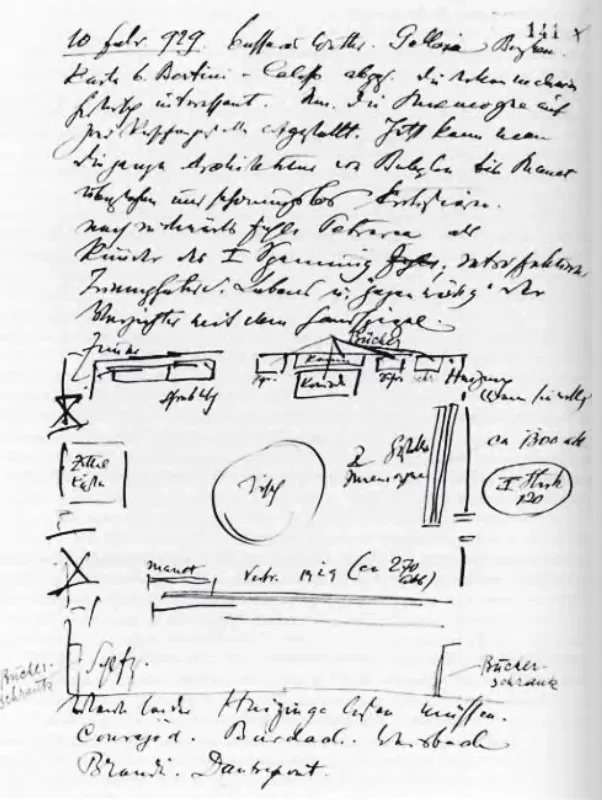
In January 1929, the panels were used and displayed publicly for the first time, in a lecture at the Bibliotheca Hertziana. In his diary for that day, Warburg wrote: "In the afternoon, set up (aufgestellt) the panels on two linen-covered frames. We can now survey (übersehen) the entire (image) architecture from Babylon to Manet"[10]. The "frame" paradigm of the panels and their assembly of materials make up Warburg's experimental method. Heterogeneous contents meet on the panel. The panel is not a conceptual chart of knowledge. It is an operative, material, engineered technical means of producing images.
The German "Tafel" (panel) and the French "tableau" both derive from the Latin "tabula," which denotes a "board" or "plank" in the physical sense. "Tabula" gradually gave rise to the cognate German word for a "chart" (Tabelle), while in French both meanings are carried by "tableau." "Tabula" originally referred to a partitioning of the space of existence and a naive classification of objects. As Michel Foucault puts it, "the other sense of (the table) is the 'chart,' which enables thought to operate upon beings and put them in order"[11]. The "table" points to something primitive and pre-thematic. To place objects on the "tabula" is to separate them from chaotic nature and place them into a cultural order. The "chart," by contrast, corresponds to the classical "episteme" (l'épistémè), in which things are distributed by genus and species onto a strict coordinate grid, then encoded, captured, and corrected to fit the idea of continuity. In early civilizations, the "table" served both as a place for eating and as a sacred site of sacrifice. It mediated the transformation between natural and cultural forces, between chaotic and organized things, between "monstra" and "astra."[12] As an open system, the table gathers heterogeneous contents and gives form to multiple relations, producing a decentralized matrix of knowledge. Warburg's "panel" should therefore be understood first in the sense of the "table" as a visual apparatus, rather than as an art-historical "chart" of knowledge or a plane of visualization. "For years, Warburg kept moving some 2,000 pictures around, fixing them onto panels to build arrangements and photographing them at the same time."[13] The photographs on the panels remained unfinished, constantly moved, dismantled, destroyed, and reassembled. In this way Warburg offered a new form of visual knowledge, one that surpassed rationalism's attempts at totalization and synthesis. "The table will be a privileged place for collecting and displaying this division... always open to modification and to the possibility of producing new configurations."[14] In this sense, the panel as table (rather than chart) becomes a true "heterotopia." It shatters familiar orders, destroys the belief in "syntax," and leads us into zones where words (images) stall, break off, and fall into disorder. As Serres says, "we ought to introduce the concept of disorder into philosophical categories"[15].
Warburg named his work "Bilderatlas," a word composed of "Bilder" (images) and "atlas." In Greek mythology, "Atlas" (Άτλας) was one of the twelve Titans and the brother of Prometheus (Προμηθεύς). In Greek, "Άτλας" is composed of the non-semantic letter "Ά" plus "τλας," meaning "to support, to bear." "Atlas, at the ends of the earth... holds up the wide heaven with his unwearying head and arms, perforce; for this lot wise Zeus assigned to him."[16] In the Atlas, the figure of Atlas first appears as the "Farnese Atlas" in the upper right corner of Panel 2. The facing panel (Panel 1) displays the liver models used in Babylonian astrology, which recalls Prometheus, who shares Atlas's fate: "on one side the viscera (the devoured liver), on the other the stars (the supported sky); through the experience of suffering his own strength, his superhuman capacity can alone bear the immense burden of the whole world."[17] As in Aeschylus's maxim "learning through suffering" (Pathei Mathos), Atlas-Prometheus is the primordial expression of the sense of suffering within the concept of "pathos." "Pathos" thus comes to signify an uncertain compulsive repetition and an unconscious, eternalized conflict. The metaphor of Atlas received a fuller symbolic and anthropological interpretation in the mythological studies of Usener[18], who taught Warburg in the winter semester of 1886–1887.
At a certain level, Atlas is a refraction of the intellectual task of the entire Atlas. Warburg studied a woodcut that Dürer made for an astrological broadsheet by Ulsenius (see Panel 58). In it, a syphilitic human figure is placed beneath the celestial sphere, showing the influence of the heavens on the "bearer" below. The celestial sphere gives Atlas the pure possibility of tragic knowledge. Atlas bearing the celestial sphere and the nymph, who is likewise a "bearer," form a montage of opposites:
She (the nymph), like the ancient goddess of victory, carries everything on her head so generously and lightly, while Atlas can only shoulder it alone... Everything that appears on the nymph's head is an offering of desire, graceful (albeit cruel); on Atlas's shoulders lie tragic fate and suffering.**[19]
"Atlas" also denotes an encyclopedic mode of integrating dispersed knowledge, namely the atlas of maps.[20] In 1595, in his famous Atlas[21], Gerardus Mercator used the word "Atlas" for the first time as the title of a collection of maps, with the figure of Atlas holding up the celestial sphere on its cover. The (map) atlas offered an entirely new way of observing knowledge and had become a popular product by Warburg's time: examples include Hermann Guthe's Bibelatlas, Wilhelm Hausenstein's Atlanten zur Kunst, and Westermann's Weltatlas. As a new episteme, the atlas breaks the framework of homogenized intelligibility and brings knowledge "into a fundamental impurity—but also an exuberance, a remarkable richness"[22]. On the very first panel of the Atlas (Panel A), Warburg placed a "map of migration routes" (Wanderstrassenkarte) tracing the north–south and east–west migrations of the images of the star gods. This map corresponds to the genealogy of the Medici/Tornabuoni families that Warburg drew on the same panel. Together they mark out the basic cartographic principle of the Atlas in the dual dimensions of time and space. Traditional cartography uses legends and grids to render places with geometric precision. The Atlas does not. Instead, it constitutes a "foliated cartography of memory and a complex geology of survival"[23], or, in Gilles Deleuze's terms, a cartography of "nomad space" rather than "striated space." The Atlas "anticipates the concept of the 'plateau' that Deleuze and Guattari make a constituent element of the 'rhizome' as generative thought"[24]. In A Thousand Plateaus (Mille Plateaux), Deleuze sets out the "cartographic" principle of the rhizome: "The rhizome is altogether different, a map (carte) and not a tracing"[25]. The "rhizome" reveals a topological space that can be cut and that generates and iterates itself. Any point in it has the openness and indeterminacy to put out roots, and it has an anti-systematic systematicity. This coincides with the cartographic principle of the Atlas: "it is connectable in all of its dimensions, detachable, reversible, susceptible to constant modification. It can be torn, reversed, adapted to any kind of montage"[26]. Like a diffuse structure, the Atlas drifts continually across multiple times and spaces, among them Padua, Toledo, Baghdad, and Florence. It settles at some point between the continuity and the rupture of images, between the Olympian and the pagan worlds, while also pervading the whole.
II. Movement-Image: Allegorized Pathos Formulas
From his doctoral dissertation, Sandro Botticelli's "Birth of Venus" and "Spring" (Sandro Bottcellis Geburt der Venus und Frühling), onward, Warburg showed an intense interest in images of life in motion. The image of life in "motion" appears in violent bodily gestures and in "accessory forms in motion" (bewegten Beiwerkes). This key concept of Warburg's first arose from his rediscovery of the wind-blown hair and garments of the nymphs in Botticelli's paintings. It is in precisely this sense that the Atlas presents, in highly dramatized form, the gestural pathos formulas found in all kinds of artistic images. Even in rigorously controlled, non-gestural, static portrait figures, "the problem of movement has not disappeared, but has been internalized"[27]. This explains why Warburg drafted the original title of the Atlas as "A series of images for investigating the function of pre-coined antique expressive values in the representation of life in motion in the art of the European Renaissance" (Bilderreihe zur Untersuchung der Funktion vorgepägter antiker Ausdruckswerte bei der Darstellung bewegten Lebens in der Kunst der europäischen Renaissance). From Panel 30 on, the Atlas focuses on the afterlife (Nachleben) of antique expressive values inscribed in late-fifteenth-century art, and this material forms the core problem area of the Atlas.[28] From Panel 41a (the pathos of suffering) onward, the theme intensifies further. As Saxl pointed out in a letter to the publisher Teubner: "The second group of panels (Panel 41a and following) comprises Renaissance paintings that re-create antique subjects. This group constitutes the main part of the atlas."[29]
The impurity of the Renaissance was Warburg's lifelong interest. He pursued it in a series of studies, including Portrait Art and the Florentine Bourgeoisie (Bildniskunst und florentinisches Bürgertum) and The Exchange of Artistic Culture between North and South in the Fifteenth Century (Austausch künstlerischer Kultur zwischen Norden und Süden im 15 Jahrhundert). In these studies Warburg understood the Renaissance as a synchronic phase between Florentine taste and northern realism, and between primitive symbolic modes of representation and the modern allegorical-semiotic paradigm. What governs Renaissance art, then, is not the ideal of harmony but the imprint of contradictory, conflicting forces that disrupt the stable structure of the work. Warburg reversed Winckelmann's aesthetic principles and the artistic hierarchy derived from them. He foregrounded instead the drama and temporality of works and their reference to movement (life). The Atlas reveals universal "snapshots" of movement and life, which leave images behind as traces. It is not a fixed image repository. Rather, it offers a kind of panoramic representation of human gestures in motion. This treatment recalls Benjamin's understanding of the dialectical image as motion photography or a flip-book animation.
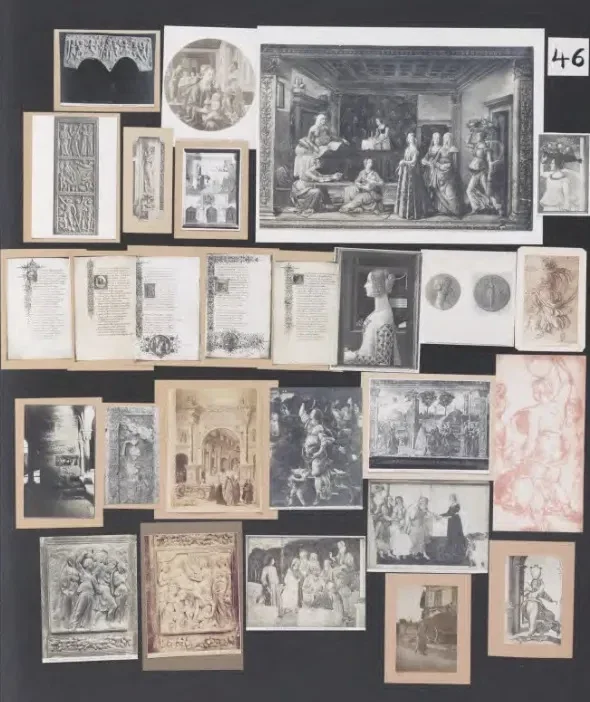
As Giorgio Agamben observes, the image of the "nymph," as a sign of profound spiritual conflict, hints at the Dionysian essence of violent external movement in art[30]. Apollo and Dionysus, the melancholy river god and the dancing nymph, make up Warburg's polar dialectic of civilization. In the famous Panel 46, Warburg presents a series of nymph figures in motion. In Ghirlandaio's Birth of John the Baptist (GeburtJohannes des Täufers), a maidservant on the right carries a fruit bowl on her head. She leans forward, her garments fluttering, full of kinetic potential, as though "entering" the picture from the right: "we can see her 'entering' the picture from the right in the... fresco"[31]. In her caption to this panel, Gertrud Bing (Getrund Bing) uses the word "Eilbringitte"[32], coined by Warburg, to describe the nymph's "entry" into the picture. Similar nymphs in motion also appear in Filippo Lippi's Madonna with Child and Agostino Veneziano's Woman Carrying a Vase on Her Head (Frau, eine Vase auf dem Kopf tragend). The moving nymph creates a strong tension with the rest of the picture. Gesture (geste) and the "accessory forms in motion" of inert, lifeless materials such as drapery folds, hair, and clothing are direct traces of intense inner emotion, and latent formulas of meaning with multiple indeterminacies. Together they reveal the circulation of ancient pathos and its ghostly survival.
The pathos formulas of gestures in motion do not unfold linearly. They are full of ruptures, leaps, and anachronic states. Image traces charged with enormous formative and kinetic energy recur from antiquity to the present, in various ways and with different meanings; Warburg found survivals of the nymph's pathos even in contemporary stamps and advertising illustrations. In Panel 47, Ghirlandaio's maidservant carrying a fruit bowl on her head becomes Judith carrying a severed head in Botticelli's Return of Judith from the Camp of Holofernes (Judiths Rückkehr aus dem Lager des Holofernes). The nymph as a pathos formula of love can thus be inverted into a "headhunter" (Köpfjägerin).[33] As Warburg says, "What we encounter in the works of early Renaissance artists are precisely the ancient pathos figures (Pathosgestalten)—maenads, the dismembered Orpheus, the dead mourned by women, women fleeing pursuers or being abducted—which are then disguised in works of art and are often presented to us in an entirely archaic manner"[34]. The banished pagan goddesses, the biblical Salome dancing gracefully, the maenads (Mänad) who tore Orpheus apart, and the nymphs in the paintings of Ghirlandaio and Botticelli all reappear. The moving figures of life carry multiple meanings: dancing, running, offering, fighting, seizing. In them, the expressive value of gestural language and its indeterminate meanings are fully revealed.
Warburg's concern with life in motion appears again in his study of the "serpent ritual"[35] of the Pueblo Indians of North America. According to Philippe-Alain Michaud, the North American journey was the ultimate response to Warburg's lifelong study of life in motion. It allowed Warburg to witness with his own eyes the mysterious energy of dynamic pathos formulas:
The appearance of the snake in the ritual Warburg described in his 1923 lecture marks the resolution, and in some sense the end point, of his long study of life in motion. As early as 1893, Warburg had noted the representation of transitory states in Florentine Renaissance art, which led him continually back to the motif of the serpent. The serpentine form appears in the nymphs with flowing hair and garments painted by Botticelli, and reappears in the figures of the intermedi (Intermedi)...**[36]
The Renaissance interest in representing momentary life in motion is concentrated in Panels 28–29. It anticipates what Wölfflin called Baroque art's pursuit of a strong sense of movement. The use of serpentine elements in the intermedi, meanwhile, points to "allegory" (Allegorie) as a methodological concept. As Benjamin says in The Origin of German Tragic Drama (Ursprung des deutschen Trauerspiels), allegory enables the melancholic to discover the sacred outside himself. The primordial pathos energy contained in the serpent found a kind of allegorized expression in the visual arts of the period: in their interest in violent gestures and extreme expressions, and in their fluttering garments.[37] The fictional battle between Apollo and the serpent in the intermedi was re-enacted for real in the ritual of the Pueblo Indians. Watching the ritual dance, Warburg believed he was seeing with his own eyes the festivities he had just been studying in the Florentine archives.[38]
In the Old Testament, the serpent is Satan in the Garden of Eden; it is also the creature that attacked Laocoön and his sons. In both roles it signifies sin and destruction. Yet the serpent also appears on the staff of Asclepius (Ἀσκληπιός) and in the figure of the ouroboros (οὐροβόρος), where it symbolizes rebirth and eternal recurrence. The image of the serpent itself thus forms an Atlas-like polar dialectic of suffering and redemption. By juxtaposing human gestures in motion with the symbolic form of the serpent, the Atlas ultimately directs the pathos energy of life in motion toward the domain of absolute spiritual interiority: "(the Atlas) re-presents the migration of images in art history in the way that the Indians represent the cycles, encounters, and mutations of the inner forces of the world"[39]. Warburg paid particular attention to the Laocoön group, a typical instance of the pathos of suffering, and emphasized its "stylized extreme states of gesture and facial expression"[40]. In the Laocoön group, the curving, coiling serpents stylize the figures' movement. The result is a dizzying montage and an extreme gestural expression of the pathos of destruction, which is the theme of Panels 40–42 of the Atlas: "Laocoön is not only a montaged figure but a figure of montage; and the serpents... also have a formal function in the arrangement: by tracing the continuity between different parts of the 'shot,' they link the group of images together"[41]. The montage of the movement-image reveals a formative energy that comes from paganism and discharges itself in the Dionysian destruction and violence of life in motion. Warburg understood the Atlas as a "ghost story for grown-ups." For him, the essential dimension of the pathos formulas of life in motion lies not in the graceful nymph. It lies precisely in their potential to be channeled toward destruction and upheaval deep within civilization. In the final panels of the Atlas, 78 and 79, Warburg already hinted at his insight into the violent antisemitism in the secular life of the 1920s. The World War was an ominous union of such pathos formulas with technology. It is no wonder, then, that in the Atlas Warburg links a newspaper clipping of a golfer's swing with the bloody "headhunter." Perhaps, as Benjamin says, "the allegorization of the body can only be carried out in all its vigor in respect of the corpse"[42].
III. Montage: Hysterical Dada and Fireflies
In a 1921 letter to the medical staff of the Bellevue clinic, Warburg wrote: "My illness consists in having lost the ability to connect things according to their simple causal relations (Kausalitätsverhältnissen)."[43] The Atlas displays Warburg's genius for juxtaposing images beyond causal connections, but the same gift also drove him into mental crisis. Binswanger evidently knew his patient well: "For (Warburg), everything—thoughts, people, things—is closer in 'space,' so that he can approach all that is within reach more fully and more easily (than in the normal case)."[44] The dialectic between orientation and magic in the primitive mind of civilization shapes the dizzying typology of Warburg's work, along with a possibility that is at once dangerous and rich. The space of the Atlas therefore continually flashes back and forth between the grid-like structure of rational order (genealogy and typology) and the vortex of images in motion. In this sense, the atlas goes beyond Goethe's principle of "elective affinities." It becomes instead a radical vortex of knowledge, a Dadaist montage, an iconomaniac psychic symptom, and a dangerous image experiment. Mitchell rightly points out that "the Atlas is not a triumph of the science of images but must be read as a symptom of iconomania, a malady now widespread in the age of Google Images"[45].
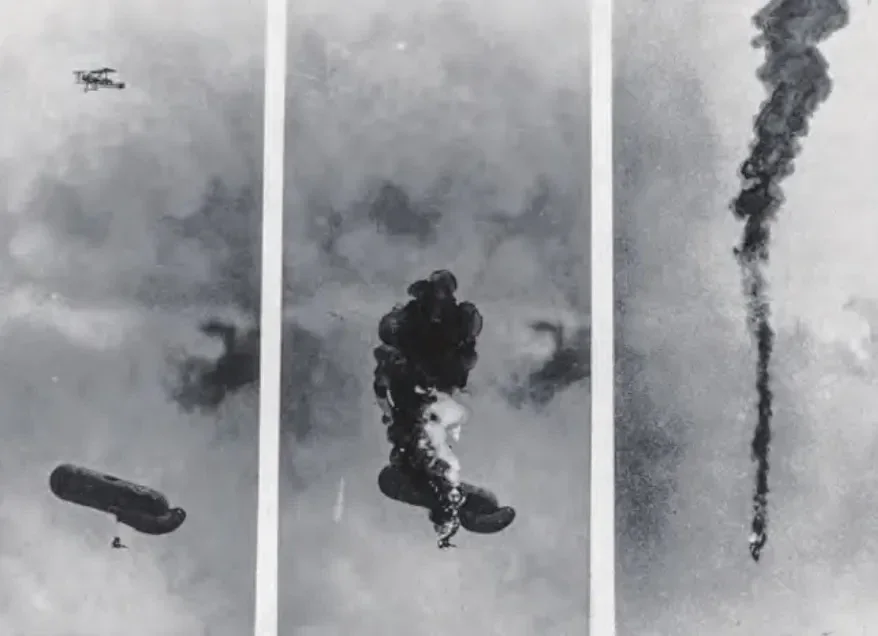
Warburg's Atlas emerged against the background of the "crisis of the European sciences." It carries the mark of an anarchist, anti-positivist, and anti-subjectivist critique of epistemology. Benjamin Buchloh even holds that the Atlas stands opposed to the model of modernity at every level.[46] The Atlas is therefore clearly avant-garde in its program: even as it sinks into the memory of the past, it breaks with traditional epistemology.[47] Warburg read the image of an airship shot down in the First World War as the falling chariot of Phaethon. This Dadaist gesture draws on the ancient pathos of destruction, newly allegorized in war. It also reflects Warburg's fear that modern technology would destroy the "distance of thought" and bring about global catastrophe. And it recalls similar montage works by John Heartfield and Raoul Hausmann. On this basis, Martin Warnke and Werner Hofmann regard Warburg's "collages" as echoes of Dadaist and Surrealist experiments.[48] "Were the panels of the atlas inspired by Lissitzky's collages, or by the altars of the Pueblo Indians? Do they replicate Alexander Rodchenko's photomontage posters, or a page from a Dadaist encyclopedia?"[49] There is no direct evidence linking the Atlas to the avant-garde art of its time. Unlike most avant-garde artists, moreover, Warburg did not fully trust the liberating function of modern mechanical reproduction and dissemination. "This analogy does not imply that Warburg's panels have any artistic value, nor does it invalidate the collages of Schwitters and Lissitzky: it serves only to redefine image montage as the construction of meaning rather than the arrangement of forms."[50] Still, the two clearly have much in common in how they diagnose and respond to the catastrophes of modernity. Both reveal, in a radical manner, the visual symptoms of civilizational hysteria:
These polarities combine in a disorderly fashion, or are interconnected irregularly, sometimes swarming like snakes... combining aggression with defense, desire with guilt, crisis with compromise, invasion with destruction.**[51]
Warburg strove throughout to establish an "iconology of the interval" (Ikonologie des Zwischenraumes) as a "cultural science." A single image fragment in the atlas (panels) has no independent existence. Only when it enters an image sequence is its meaning fully released. The interval between images is the true site where meaning emerges. In the interval between the self and the external world, between "astra" and "monstra," the interiority of mental activity installs the "space for thought" that is the precondition of civilization. "This interval simultaneously connects and separates matter and thought, image and sign, orgiastic feast and ritual of power, Dionysus and Apollo"[52]. The "interval" is a "fold" of montage: the infinite self-generation of meaning and an opening that can be folded. "The interval, the variable present, has become the qualitative leap which attains to the vast whole with the power of the moment; it is no longer an assembled totality providing the sole condition for the interdependence of independent parts—it can expand infinitely"[53]. The fold-like, productive image sequences of the Atlas serve to build a new model and visual syntax for art history, one that goes beyond the evolutionary-teleological model that has prevailed since Vasari: "in the anachronistic montage of the Atlas, a postage stamp sits next to a classical relief, on the same epistemological level as Warburg's initiatory journey to America"[54]. Juxtaposing heterogeneous images does not simply add them together. Through superimposition and intersection, it produces a qualitative leap. Placing an image of the Graf Zeppelin beside astrological manuscripts shatters the ancient cosmological space. Time itself becomes visible in montage, and images gain the fluid potential of "objective automatism": "the vortex continually formed by the 'flood of images'—everyone can experience this knowledge that comes from montage... as the 'utopian' moment of the image... it continually dismantles everything, so imagination is an unpredictable and infinite construction"[55].
Saxl believed that "in this atlas Warburg succeeded in presenting his rich scholarly work and its results in a unified way"[56]. This claim does not hold, and neither does Gombrich's similar view in Aby Warburg: An Intellectual Biography. In a 1928 letter to Jacques Mesnil, Warburg described the Atlas as an "expansive" and "endless system" (ein weitläufiges System)[57]. Warburg's work, then, is not chiefly concerned with narrative or explanatory content. It takes shape through the continual moving, dismantling, and recombining of images. It is a visualized, engineered technique of reproducibility, an image experiment, and a montage program meant to rescue him from his mental derangement. Binswanger recorded:
Elsewhere, the patient (Warburg) is likewise troubled by new spatial arrangements; he is actually disoriented (eigentlich desorientiert)... Please place emotionally resonant objects, books, or images on the table, for they help his orientation (die Orientierungerleichtert). When he reads, he looks cautiously at these objects, which bring him a certain relief. Therefore we must not make him give up his habit of carrying personal belongings with him.**[58]
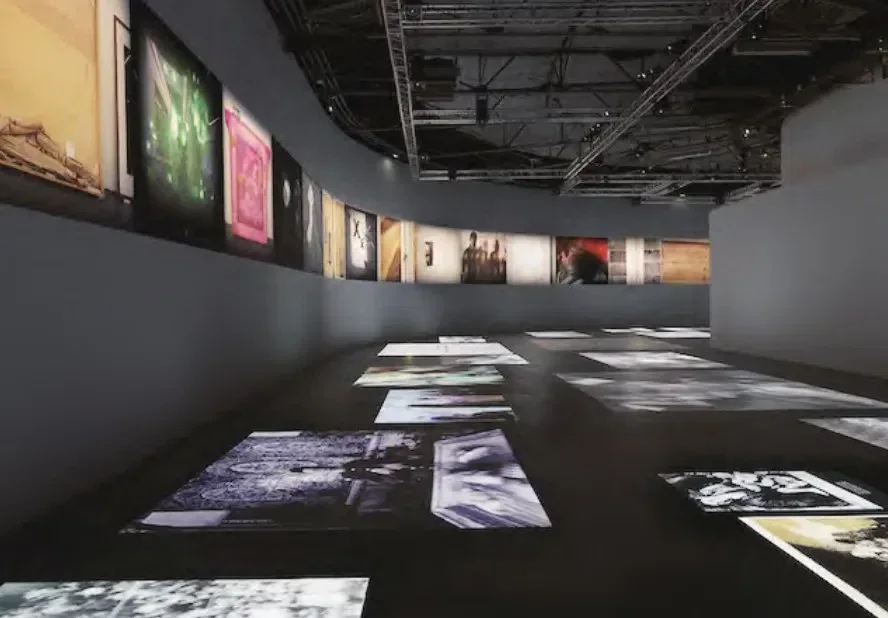
As Warburg built the visual matrix of the Atlas, the resonance among images eased his split and chaotic mental order: "with a more experimental apparatus, Warburg and his audience were surrounded by multiple images"[59]. Perhaps inspired by this, in 2014 Didi-Huberman curated an exhibition in homage to Warburg at the Palais de Tokyo in Paris: "New Ghost Stories: Take a Walk through the History of Images." In the exhibition space, projections surrounded viewers with a real vortex of images, which formed a kind of time-crystal or ghostly survival of memory and desire. The coding of memory in the Atlas is governed by the unconscious and invaded by anachronistic or eternal contents. Beyond the recognizable images, the black background of the panels is itself a mysterious element of the image. It signals missing links and blanks in memory, and it points to a potential of images beyond the visual. The pictures on the black background are like fireflies in the night sky, present in the mode of absence. As Didi-Huberman writes poetically in Survival of the Fireflies (Surviance de lucioles), "To know the fireflies, we must observe them in the present of their survival: we must see them dance alive in the heart of the night"[60].
Conclusion: Warburg's Contemporary Flashbacks
Warnke rightly notes that "the legendary atlas signifies an image laboratory or a stage of documentary work, and by no means a finished, integrated work"[61]. In the Atlas project of his final years, Warburg gathered heterogeneous contents on a vast scale and built a decentralized, dizzying image matrix. The Atlas breaks the framework of homogenized intelligibility, and through the metaphor of "Atlas" it reveals Warburg's historical geology of memory. The panels and the atlas make up Warburg's experimental method, which is profoundly avant-garde and contemporary. The Atlas responds to the crisis of narrative and the catastrophes of war in the twentieth century. It also emphasizes photography and cartographic programs as visual art forms of the age of mechanical reproduction, though this may not have been Warburg's intention. Warburg's work can therefore be connected with the photography of Étienne-Jules Marey, Karl Blossfeldt, August Sander, and Arthur Worthington. It can also be connected with the image work of William Heckscher, Bertolt Brecht, and even Siegfried Kracauer and Eisenstein. As Didi-Huberman says, "The Atlas project reveals precisely this method. It opens new possibilities in the use of photographic images"[62]. The Atlas reveals the symptoms of civilizational hysteria in the iconological sense, and at the same time it is a montage program for rescuing Warburg from his own mental chaos. Today we find similar concerns in Gerhard Richter's atlas and photo-paintings, in Harun Farocki's archival image works, in Pascal Convert's time-crystals, and in the works of Goshka Macuga and Sigmar Polke.
The Atlas continually flashes back and forth between the grid-like structure of rational order and the irrational vortex of images. Through superimposition and intersection, heterogeneous images produce qualitative leaps, and meaning proliferates exponentially. This seems to anticipate the knowledge context of today's "archive fever": "In the atlas, the archive submerges difference within a volume that cannot be exposed to vision... without the archive there could be no atlas... the atlas offers the archive's 'becoming-visual' and 'becoming-knowledge'"[63]. Images make up an archival survival of memory. To some extent, Warburg's obsession with the atlas closely resembles the Freudian compulsion to repeat that marks archive fever. The "space for thought" is entrusted to an external site, the panel, which ensures that memory can be represented and transferred. The atlas itself becomes the interface for accessing the archive. As Warburg's dangerous image experiment, it is submerged by near-magical big-data algorithms and montage, yet it flashes back into the present with every movement of the camera's eye.
Notes
[1] L.Binswanger, M. Renouard and M. Rueff trans. Histoire cliniqued'AbyWarburg(lettertoMaxWarburg,1May1925) [A]. D.Stimilli ed. La Guérison infinie: Histoire clinique d'Aby Warburg[C]. Paris: Payot & Rivages, 2007: 249-250.
[2] Aby Warburg, M.Warnke & C.Brink ed. Der Bilderatlas Mnemosyne [M]. Berlin: Akademie Verlag. 2012: VII .
[3] E. H. Gombrich, Aby Warburg: His Aims and Methods (An Anniversary Lecture) [J]. Journal of the Warburg and Courtauld Institutes, 1999, 1(62): 268-282.
[4] Georges Didi-Huberman, Shane Lillis trans. Atlas, or, The Anxious Gay Science[M]. Chicago: The University of Chicago Press, 2018: 242.
[5] (Germany) Horst Bredekamp, trans. Ning Ying and Zhong Changsheng. Theory of the Image Act [M]. Nanjing: Yilin Press, 2016: 279.
[6] See Matthew Rampley, trans. Xianzong Yang and Ke Teng. From Symbol to Allegory: Aby Warburg's Theory of Art [J]. Journal of Hubei Institute of Fine Arts, 2019(2): 4-19.
[7] (USA) Donald Preziosi, ed., trans. Yi Ying, Chunchen Wang, Yun Peng et al. The Art of Art History: A Critical Anthology [M]. Shanghai: Shanghai People's Publishing House, 2016: 214.
[8] Philippe-Alain Michaud, Sophie Hawkes trans. Aby Warburg and the Image in Motion[M]. NewYork: Zooe Books, 2004: 282.
[9] Aby Warburg, Michael P. Steinberg trans. Images from the Region of the Pueblo Indians of North America[M]. New York: Cornell University Press, 1997: 2.
[10] Georges Didi-Huberman, Shane Lillis trans. Atlas, or, The Anxious Gay Science[M]. Chicago: The University of Chicago Press, 2018: 230.
[11] (France) Michel Foucault, trans. Weimin Mo. The Order of Things [M]. Shanghai: SDX Joint Publishing, 2016: 3.
[12] See Georges Didi-Huberman, Shane Lillis trans. Atlas, or, The Anxious Gay Science[M]. Chicago: The University of Chicago Press, 2018: 43.
[13] Aby Warburg, M.Warnke & C.Brink ed. Der Bilderatlas Mnemosyne [M]. Berlin: Akademie Verlag. 2012: VIII .
[14] Georges Didi-Huberman, Atlas How to Carry the World on One's Back?[M]. Madrid: Museo Nacional Centro de Arte Reina Sofra,2011: 43.
[15] (France) Michel Serres, trans. Pu Beiming. Genesis [M]. Beijing: SDX Joint Publishing, 1996: 146.
[16] (Ancient Greece) Hesiod, trans. Zhuming Zhang and Ping Jiang. Works and Days; Theogony [M]. Beijing: The Commercial Press, 2009: 44.
[17] Georges Didi-Huberman, Shane Lillis trans. Atlas, or, The Anxious Gay Science[M]. Chicago: The University of Chicago Press, 2018:79.
[18] See H. Usener. Götternamen. Versuch einer Lehre von derreligiösen Begriffs bildung[M]. Bonn: Friedrich Cohen, 1896:39-40.
[19] Georges Didi-Huberman, Shane Lillis trans. Atlas, or, The Anxious Gay Science[M]. Chicago: The University of Chicago Press, 2018:84.
[20] Atlas's name has been used for many geographical places, such as the Atlantic Ocean, Atlantis, and the Atlas Mountains.
[21] Its full title is Atlas, or Cosmographical Meditations on the Fabric of the World and the Figure of the Fabricated (Atlas sive Cosmographicae meditationes de fabrica mundi et fabricati figura).
[22] Georges Didi-Huberman, Atlas How to Carry the World on One's Back?[M]. Madrid: Museo Nacional Centro de Arte Reina Sofra,2011: 15.
[23] Georges Didi-Huberman, Atlas How to Carry the World on One's Back?[M]. Madrid: Museo Nacional Centro de Arte Reina Sofra,2011: 172.
[24] Georges Didi-Huberman, Atlas How to Carry the World on One's Back?[M]. Madrid: Museo Nacional Centro de Arte Reina Sofra, 2011: 52.
[25] (France) Gilles Deleuze and Félix Guattari, trans. Yuhui Jiang. Capitalism and Schizophrenia: A Thousand Plateaus (Vol. 2) [M]. Shanghai: Shanghai Bookstore Publishing House, 2010: 14-15.
[26] (France) Gilles Deleuze and Félix Guattari, trans. Yuhui Jiang. Capitalism and Schizophrenia: A Thousand Plateaus (Vol. 2) [M]. Shanghai: Shanghai Bookstore Publishing House, 2010: 15.
[27] Philippe-Alain Michaud, Sophie Hawkes trans. Aby Warburg and the Image in Motion[M]. NewYork: Zooe Books, 2004: 93.
[28] On the delimitation of this group of panels, see also Christopher D. Jonson, Memory, Metaphor, and Aby Warburg's Atlas of Images[M]. New York:Cornell University Press, 2012: 11.
[29] Aby Warburg, M.Warnke & C.Brink ed. Der Bilderatlas Mnemosyne [M]. Berlin: Akademie Verlag. 2012: XVIII.
[30] See (Italy) Giorgio Agamben, trans. Liqiu Wang. Aby Warburg and the Nameless Science [M]. Shanghai: Lijiang Publishing, 2017: 17.
[31] (France) Georges Didi-Huberman, trans. Wen Zhao. With the Light Steps of a Servant Girl (Knowledge of Images, Eccentric Knowledge) [A]. Zhuan Huang ed. World 3: Open Iconology [C]. Beijing: China Nationality Photography and Art Publishing House, 2017: 285.
[32] A word coined by Warburg that blends the prefix "eil-" (meaning urgent or quick), "bringen" (to carry, to bring), and the female name "Brigitte." The full caption of this panel reads: "Nymph (Ninfa) 'bursting in' (Eilbringitte) in the Tornabuoni circle (Tornabuoni-Kreise), domestication." See Aby Warburg, M.Warnke & C.Brink ed. Der Bilderatlas Mnemosyne[M]. Berlin: Akademie Verlag, 2012: 84.
[33] The caption of Panel 47 reads "The nymph as guardian angel and as headhunter." (Ninfa als Schutzengel und als Köpfjägerin.)
[34] Aby Warburg, M.Warnke & C.Brink ed. Der Bilderatlas Mne- mosyne [M]. Berlin: Akademie Verlag. 2012: 5.
[35] Warburg recorded the snake dance ritual in detail in his notes: "...despite its resistance, its head is dipped into the sacred potion. Then it is thrown onto the sand-covered floor of the kiva... On another sand painting in the large kiva, a cloud was depicted, with four lightning bolts of different colors drawn in the form of vipers... Each snake is hurled forcefully onto it, so that the picture is erased and the viper is introduced into the sand." (Donald Preziosi, ed., trans. Yi Ying, Chunchen Wang, Yun Peng et al. The Art of Art History: A Critical Anthology [M]. Shanghai: Shanghai People's Publishing House, 2016: 187.)
[36] Philippe-Alain Michaud, Sophie Hawkes trans. Aby Warburg and the Image in Motion[M]. NewYork: Zooe Books, 2004: 222.
[37] See Philippe-Alain Michaud, Sophie Hawkes trans. Aby Warburg and the Image in Motion[M]. NewYork: Zooe Books, 2004: 213.
[38] See Philippe-Alain Michaud, Sophie Hawkes trans. Aby Warburg and the Image in Motion[M]. NewYork: Zooe Books, 2004: 149.
[39] Philippe-Alain Michaud, Sophie Hawkes trans. Aby Warburg and the Image in Motion[M]. NewYork: Zooe Books, 2004: 289.
[40] See Aby Warburg, Gesammelte Schriften (Band II ) [M]. berlin: B.G.Teubner, 1932: 443-449.
[41] Philippe-Alain Michaud, Sophie Hawkes trans. Aby Warburg and the Image in Motion[M]. NewYork: Zooe Books, 2004: 286.
[42] (Germany) Walter Benjamin, trans. Shuangzhi Li and Su Wei. The Origin of German Tragic Drama [M]. Beijing: Beijing Normal University Press, 2013: 169-170.
[43] Aby Warburg, M. Renouard and M. Rueff trans. Lettres et fragments autobiographiques(letter to Max Warburg, 1 May 1925) [A]. D. Stimilli ed. La Guérison infinie. Histoire clinique d'Aby Warburg[C]. Paris: Payot & Rivages, 2007: 187.
[44] Quoted in Georges Didi-Huberman, Harvey L. Mendelsohn trans. The Surviving Image : Phantoms of Time and Time of Phantoms : Aby Warburg's History of Art [M]. Pennsylvania: The Pennsylvania State University Press, 2017: 308.
[45] W.J.T. Mitchell, trans. by the Secretariat of the 34th World Congress of Art History, proofread by Xiang Zairong. Method, Madness and Montage [J]. Journal of China Academy of Art, 2018(2): 9-21.
[46] Benjamin H. D. Buchloh. Gerhard Richter's Atlas: The Anomic Archive[J]. October, 1999(88): 117-145.
[47] See Georges Didi-Huberman, Harvey L. Mendelsohn trans. The surviving image : phantoms of time and time of phantoms : Aby Warburg's history of art[M]. Pennsylvania: The Pennsylvania State University Press, 2017: 317.
[48] See M.Warnke, Der Leidschatz des Menscheit wird humaner Besitz[A]. Werner Hofmann, Georg Symaken, and Martin Warnke ed. Die Menschenrechte des Auges: Über Aby Warburg[C]. Frankfurt: Europäische Verlagsantalt, 1980: 158-164.
[49] Claude Imbert, Aby Warburg: Between Kant and Boas; From Aesthetics to the Anthropology of Images[J]. Qui Parle , 2006(16): 1-45.
[50] Kurt Forster, Die Hamburg Amerika Linie oder Warburg's Kunstwissenschaft zwischen den Kontinenten[A], Horst Bredekamp, Michael Diers, and Charlotte Schoell-Glass ed., Aby Warburg: Akten des Internationalen Symposiums [C]. Weinheim: Acta Humaniora, 1991: 11-37.
[51] Georges Didi-Huberman, Harvey L. Mendelsohn trans. The Surviving Image : Phantoms of Time and Time of Phantoms : Aby Warburg's History of Art[M]. Pennsylvania: The Pennsylvania State University Press, 2017: 190.
[52] Philippe-Alain Michaud, Sophie Hawkes trans. Aby Warburg and the Image in Motion[M]. NewYork: Zooe Books, 2004: 239.
[53] (France) Gilles Deleuze, trans. Qiang Xie and Yue Ma. Cinema 1: The Movement-Image [M]. Changsha: Hunan Fine Arts Publishing House, 2016: 59.
[54] Philippe-Alain Michaud, Sophie Hawkes trans. Aby Warburg and the Image in Motion[M]. NewYork: Zooe Books, 2004: 18.
[55] (France) Giovanni Careri and Georges Didi-Huberman, eds., trans. Ruonan Tian and Guozhu Yang. Art History after Walter Benjamin [M]. Chongqing: Chongqing University Press, 2022: 60-61.
[56] Aby Warburg, M.Warnke & C.Brink ed. Der Bilderatlas Mnem- osyne [M]. Berlin: Akademie Verlag. 2012: XVIII.
[57] See Georges Didi-Huberman, Shane Lillis trans. Atlas, or, the Anxious Gay Science[M]. Chicago: The University of Chicago Press, 2018: 227.
[58] L.Binswanger, M. Renouard and M. Rueff trans. Histoire clinique d'Aby Warburg (letter to Max Warburg, 1 May 1925) [A]. D.Stimilli ed., La Guérison infinie. Histoire clinique d'Aby Warburg [C]. Paris: Payot & Rivages, 2007: 176-177.
[59] Georges Didi-Huberman, Shane Lillis trans. Atlas, or, the Anxious Gay Science[M]. Chicago: The University of Chicago Press, 2018: 224.
[60] Georges Didi-Huberman, Lia Swope Mitchell trans. Survival of the Fireflies[M]. Minneapolis: University of Minnesota Press, 2008: 25.
[61] Aby Warburg, M.Warnke & C.Brink ed. Der Bilderatlas Mnemosyne [M]. Berlin: Akademie Verlag. 2012: VIII .
[62] Georges Didi-Huberman, Shane Lillis trans. Atlas, or, the Anxious Gay Science[M]. Chicago: The University of Chicago Press, 2018: 182.
[63] Georges Didi-Huberman, Shane Lillis trans. Atlas, or, the Anxious Gay Science[M]. Chicago: The University of Chicago Press, 2018: 250.